Eye See You 


You know those films that you just seem to get fixated on and love for no particular reason, like they’re not even that good, you just… really like them? That’s Eye See You for me (known as D-Tox to all you folks across the pond), a heavy handed snowbound horror vehicle for a sedated Sylvester Stallone. It’s silly to the max, thoroughly implausible and perforated with cliches, but for whatever reason I just can’t get over the damn thing. Now, I admittedly have an affinity for the Agatha Christie style murder mysteries, especially ones set in the snow (cue fond memories of Hateful 8 and The Thing), and this one piles on a blizzard of red herrings, multiple shady characters, extremely graphic violence and paranoid unease. Maybe it’s that cast, a platoon of tough guy characters actors backing Sly up in one serious roster of a supporting cast. Old Rocky plays a big city FBI agent who is trying to find a jarringly vicious serial killer that targets law enforcement and has that classic obsession with his pursuer. After his girlfriend (Dina Meyer) falls victim to this beast, Sly unravels and following a suicide attempt, is sent up north by his mentor (Charles S. Dutton) for a little R&R,

and both R’s in that stand for rehab in a special remote facility designed just for cops with issues to work out. The place is run by Krusty Kris Kristofferson, and home to so many recognizable faces one has to give the casting director a tip of the fedora. A disgraced Mountie (Robert Prosky), emotionally fragile ex SWAT commander (Sean Patrick Flanery),

former Scotland Yard (Christopher Fulford), hostile ex narc (Jeffrey Wright with some pretty Harvey Dent facial scars), an insufferable macho asshole (Robert Patrick), ex military (Tom Berenger) who serves as caretaker, sympathetic therapist (Polly Walker) and a seriously creepy Stephen Lang. That’s a whole lot of suspicious characters to pick a killer from, because (you guessed it) the meanie has followed Sly out to the mountains and is posing as a member of their group. It’s a guessing game right up until one severely bloody climax, with ex cops dropping dead all over the place along the way, and Stallone looking more hollow and dishevelled as each body turns up. He’s not in action mode here at all, hell, he’s not even in sorta kinda Cop Land action mode, he’s a broken man trying to heal who’s forced back into shit kicking, and it puts a visible strain on him that the actor handles surprisingly adeptly. The rest do their job terrifically, with Flanery standing out in the scant but affecting screen time he’s given, and Patrick blustering through every scene until you’re just praying for the killer to target him next. There’s downsides galore, mind you, this isn’t well thought out territory, it’s gory genre nirvana and not much else. There’s a level of predictability that could have been avoided by making the identity of the killer a bit less… obvious, for lack of a non spoiling term, but oh well. It’s also just overblown lurid potboiler madness, but what else do you expect from this type of thing? I get exactly what I want out of it: a nice helping of ultra-violent intrigue to tune into on a cozy night, and not much more. In fact, I think I feel a revisit happening this week.

-Nate Hill

The Men Who Stare At Goats: A Review by Nate Hill 

Stephen Lang Week: Day 2 
There’s a scene early on in The Men Who Stare at goats where hapless General Dean Hopgood (Stephen Lang) attempts a platform 9 & 3 quarters style sprint towards a solid wall, in attempt to use ‘psychic abilities’ he is being taught at a hush-hush military base. He smashes headlong into it, and in the most deadpan drawl, mutters “damn” in all seriousness. This one moment sort of sums up the absurd vibe that thrums throughout the whole film. It’s kind of like a Coen Brothers thing; you either get it or you don’t. This film isn’t quite as hilarious as it’s sister, Burn After Reading, but damn if it doesn’t try, and come out with some really weird and memorable stuff. It’s colorful hogwash that the cast sells with the enthusiasm of a drunken used car salesman, and speaking of cast, wow there are a lot of heavy hitters playing in the sandbox here. George Clooney, in yet another of his patented lovable goof roles, plays Lyn Cassidy, a former US Army nutjob who claims to have been a part of a clandestine program called the New Earth Army, employing paranormal powers in their missions. Bemused journalist Ewan McGregor is shanghai’d into following him on a mad goose chase to find out if any of his stories are true, but mostly just to babysit him, as he’s kind of a walking disaster. Ineptitude reaches a breaking point when we meet pseudo hippie Bill Django, played by Jeff Bridges who channels every other oddball role he’s done for maximum effect. Bill headed up the program until he got stymied by opposing official Larry Hooper (Kevin Spacey), a tight ass skeptic with no patience for such silliness. In fact, one must have a huge tolerance for such silliness to sit through this, and a sense of humour just south of normal to appreciate what it has to offer. I have both, and greatly enjoyed it, despite being thoroughly bewildered. Watch for Stephen Root, Glenn Moreshower, Rebecca Mader, Nick Offerman and good old Robert Patrick in a cameo as some sort of vague spy dude. A clown show to rival a high school play, no doubt, and I mean that as a compliment. 

Safe House: A Review by Nate Hill 

Safe House is cut from the same cloth as many a spy movie, but this horse doesn’t have quite as much piss and vinegar as other ones in the stable, notably the Bourne trilogy. It’s more of a slow burn, peppered with a few purposeful action sequences and quite a lot of time spent with Denzel Washington’s world weary spook Tobin Frost, a veteran operative who has gone severely rogue after escaping the grasp of a nasty CIA interrogator (Robert Patrick). He’s soon in the hands of rookie agent Matt Weston (Ryan Reynolds) who has been left to guard an agency safe house in Europe, now overrun with shadowy special ops dudes out to snuff Frost. The two of them are forced on the run together, and attempt to smoke out those behind the chaos, who turn out to be a little closer to home than they thought (don’t they always, in these types of movies?). Weston is young, naive and idealistic, Frost is bitter, jaded and ready to burn the agency down around him for what his career has made him do. They’re a formulaic pair made believable by the two actors, both putting in admirable work. Brendan Gleeson is great as Westons’s dodgy handler, Vera Farmiga shows moral conflict in those perfect blue eyes as another paper pusher in Langley, and Sam Shepherd smarms it up as the CIA top dog. It was nice to see Ruben Blades as well, who doesn’t work nearly enough, and watch for a sly cameo from Liam Cunningham as an ex MI6 agent. It’s not the greatest or the most memorable film, but it does the trick well enough, has a satisfying R rated edge to its violence and benefits from Washington being nice and rough around the edges. There’s a downbeat quality to it to, as Weston watches the futility inherent in the life of a spy unfold in Frost’s actions, which are leading nowhere but a self inflicted dead for a cause that’s bigger than both of them, but ultimately leaves them in the dust. Solid, if just above average stuff. 

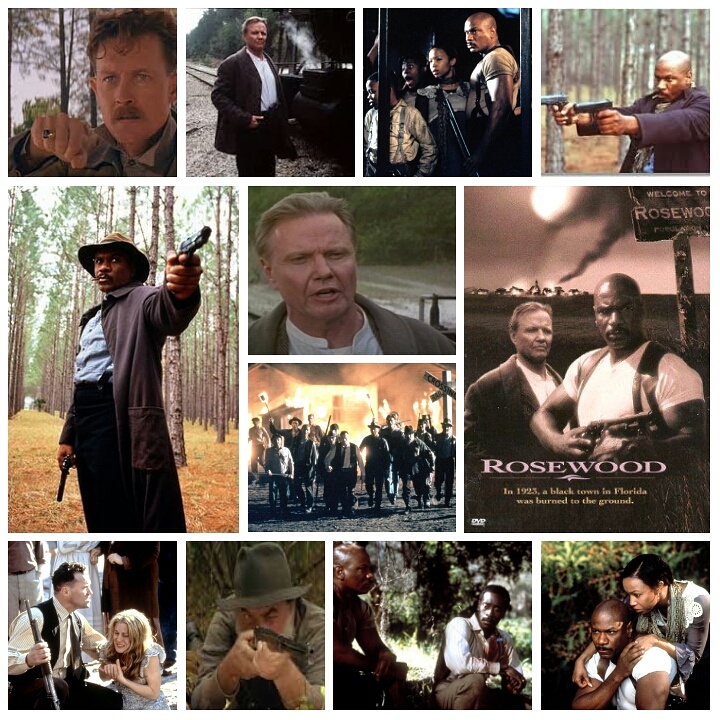
John Singleton’s Rosewood: A Review by Nate Hill 

John Singleton’s Rosewood is a partly fictionalized, greatly dramatized retelling of one of the largest lynchings and subsequent conflicts in American history. The time is 1923, the place is Rosewood, a small southern town populated largely by African communities. When borderline insane local housewife Fanny (Catherine Kellner) is caught in the midst of a violent sexual fling, a young black man accidentally stumbles upon the scene. Being the crazy bitch she is, she melodramatically pins it on him, inciting the wrath of the town. The real culprit was of course a white dude, played briefly by Robert Patrick before fleeing the county for good. Because of this selfish misdirection, every white man and his mother now wants the boy hung, and it escalates with the speed of a prairie fire until a full scale race war rages through Rosewood. A lone mercenary called Mann (Ving Rhames) happens to be around and lends his quickdraw talents to the townsfolk who are being hunted. The sheriff (Michael Rooker) is somewhat of a pushover, and unable to quell the mob anyway, especially when it’s led by a rabid Bruce McGill, who is scary and then some. The only white boy who has anything but ropes or torches to offer these poor folks is a kindly store owner played by Jon Voight, who shelters a group of them on his property, much to the mob’s anger. Voight’s character is odd; when we meet him he is in heated coitus with one of his shopkeeps, a young African girl. It’s later revealed that she’s afraid of him. Despite this dark piece of his arc, Singleton treats him as a hero, begging the question, were there scenes cut that elaborated on his relationship with her? Such imbalances in tone can be found in the story as well: much of the film is treated with a combination of severe melodrama and true crime drama, speckled here and there with jarring little bits of pulp that feel like they’re from a Django type flick. Wouldn’t have been the narrative mix I would have used, but perhaps Singleton’s hand slipped and too much of an aspect fell in which he only ever meant as a subtle garnish. Nevertheless, it’s very solidly made, wherever it sits on the genre map, with all the actors, particularly the African townsfolk, shining nicely. It’s disturbing as well, with the black body count reaching sickening heights and the racist fever at a vicious spike in temperature. It’s a scary scenario when the hunters greatly outnumber the hunted, and mass deaths are imminent, especially when such anger is involved. Sympathy is earned in spades from the viewer, as well as the urge to look away at least a few different times. I haven’t done my research on the real story so I couldn’t tell you where it falls on the authenticity charts, but I suspect a great deal of it has been exaggerated for effect and impact. In that, it succeeds, if faltering in tone a few times to puzzle the viewer, before getting back on track.