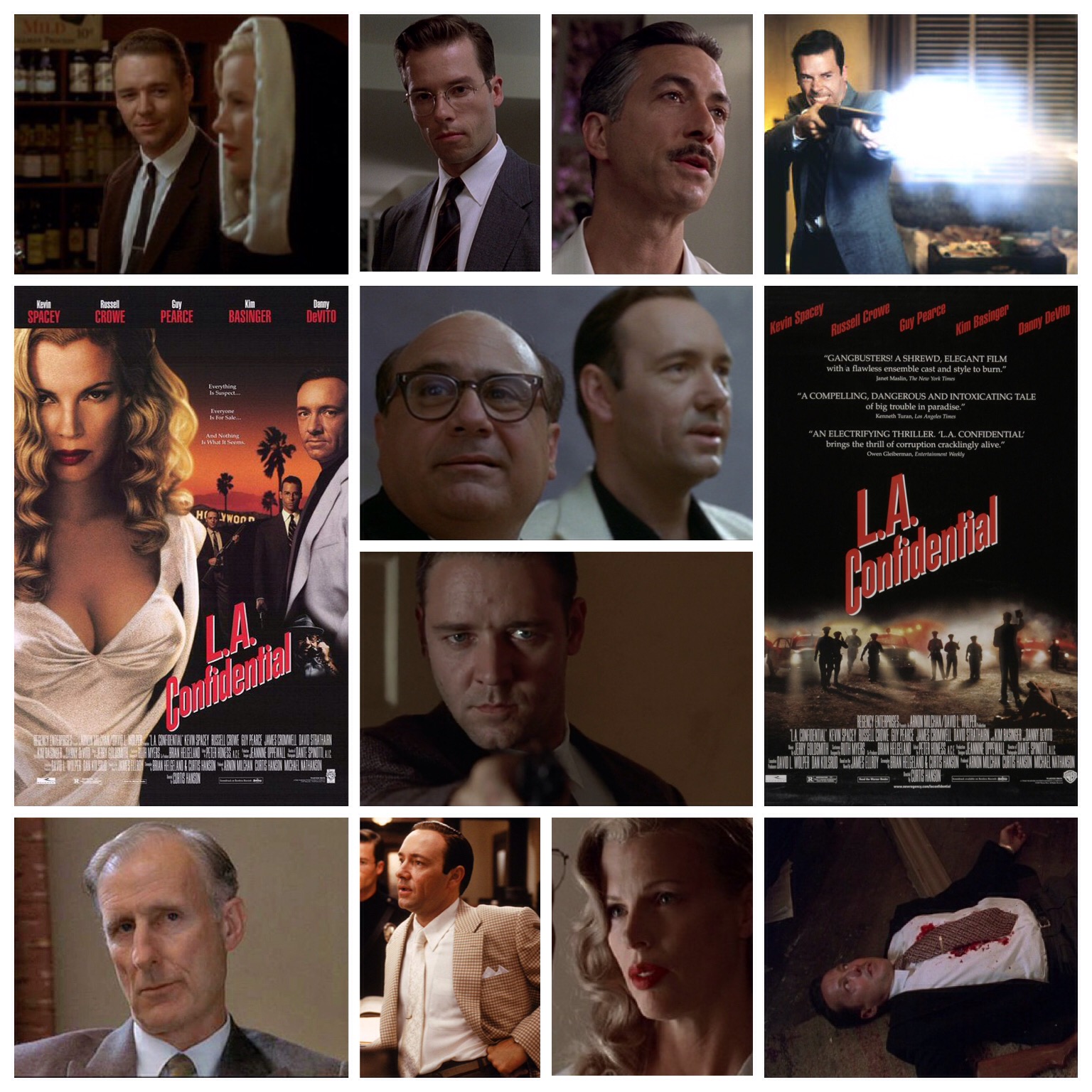
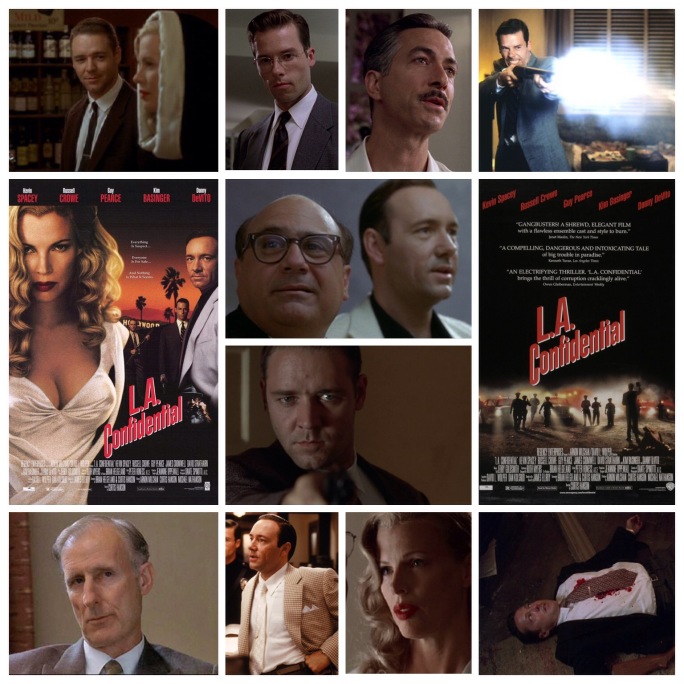
The finest Los Angeles film noir to ever come out of Hollywood, Curtis Hanson’s L.A. Confidential is a serpentine wonder, a two and a half hour parade of hard boiled detectives, sultry dames and shady dealings, all wrapped up in a multiple murder story that kicks everyone’s arc into gear, taking you places you didn’t think you’d see some of these people go. ‘Triple homicide at the nite owl’, barks the headline of a gossip rag run by a sleazy Danny Devito, and indeed the crime scene has everyone buzzing, from the shirt tuckers in the highest ranks of the LAPD, to the burly brass knuckle wearers on the brutish task force. Something is amiss with the case, and Sgt. Edmund Exley (Guy Pearce) is a dogged straight arrow with a nose for corruption. He isn’t quite the formidable force needed to barge down certain doors or break certain bones though, and that’s where Det. Bud White (Russell Crowe) comes into play. The two are initially at each other’s throats following a cleanse of many of the department’s corrupt officers, spurred by Exley himself. It soon becomes clear that they have no choice but to work together, in order to smoke out the evil source of the crime, which may be closer to home than anyone thought. Crowe and Pearce were not the stars they are now back then, but came up from the farm league in sensational style, barging onto the Hollywood scene in shotgun toting, shit kicking style. Kim Basinger won an Oscar for her poised, complex turn as a call girl who works for a pimp named Pierce Patchett (a glib David Strathairn), an eccentric who pays surgeons to deck his girls out to look like movie starlets. My favourite performance in the film comes from a diabolical James Cromwell as Captain Dudley, a dangerous rogue who you don’t want to cross for fear of his unpredictability. Kevin Spacey is all style and self loathing as Jack Vincennes, a media mogul of a cop who advises on TV shows and hogs the press limelight like a boorish politician. The supporting cast is all across the board, including work from Simon Baker, Graham Beckel, Tomas Arana, Ron Rifkin, Brenda Bakke, Jack Conley and an amusing cameo from Paul Guilfoyle as Mickey Cohen. Adapting a novel by the great undisputed king of LA noir, James Ellroy, Hanson weaves a deadly web of sensation, intrigue and steamy goings on that never follows a readily discernable pattern of narrative, and constantly has tricks up it’s sleeves. Remember Rollo Tomassi.
Tag: Russell Crowe
The Silver Stallion: A Review by Nate Hill
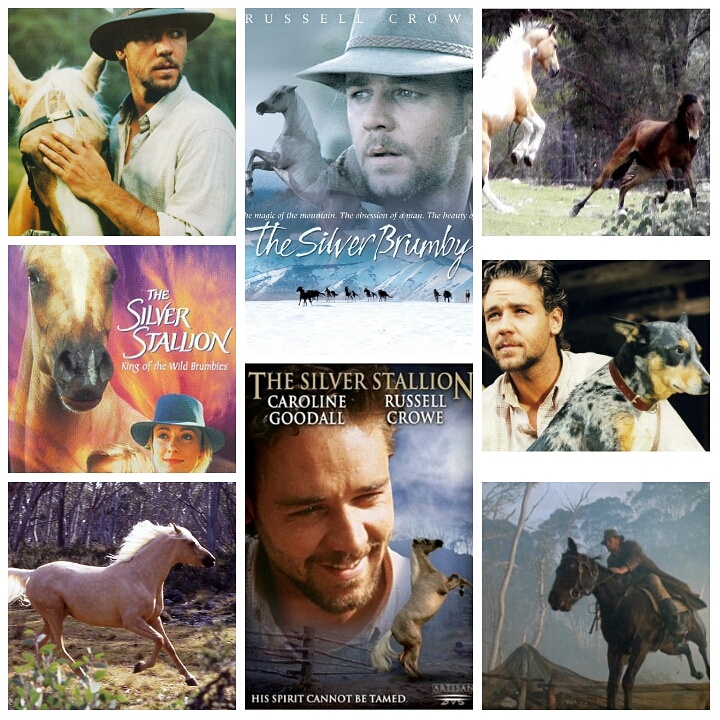
Before Russell Crowe blew up big time in North America, he did a few peculiar little flicks in his homeland of Australia. A couple rowdy gang stories popped up, and then he appeared in a little seen film called The Silver Stallion, or The Silver Brumby, which means horse in down-under-talk. Horse flicks are a dime a dozen and can go either way, usually pinning their focus on a target audience of adolescent viewers. This one is more of a visual tone poem than any sort of grand planned narrative, letting the horses do most of the emoting and character work, with the humans showing up now and again to provide their side of the story. An Australian mother (Caroline Goodall) tells her daughter (Amiel Daemien) tales of the prince of the brumbies, a member of a feral tribe of horses who has been separated from his heard and must find a way back. A relentless outback Man (Crowe) is dead set on both capturing and taming the silver Brumby, a quest which leads him to the very precipice of desperation. The horse traverses mountains, plains and many acres of beautiful northern Australian countryside to reunite with his clan. The scenes with just horses are amazing when one considers just how tough it must have been to coherently get them all together and have them interact according to the shots which the filmmakers needed to get. Quite the achievment indeed. The cinematography is pure misty magic, with both animal and nature alike providing some truly unforgettable images onscreen. Crowe is excellent, with a wild glint in his eye, quite committed to the character. There’s an overarching and altogether mythic tone to this film that always left me in awe when I saw it as a youngster. One gets the sense of true lore unfolding in front of us, the camera and script creating a piece of celluloid that’s purely entrenched in Australian storytelling, bringing it alive in the most visually impressive way possible. Very much worth your time, if you can track down a copy.
Ridley Scott’s American Gangster: A Review by Nate Hill
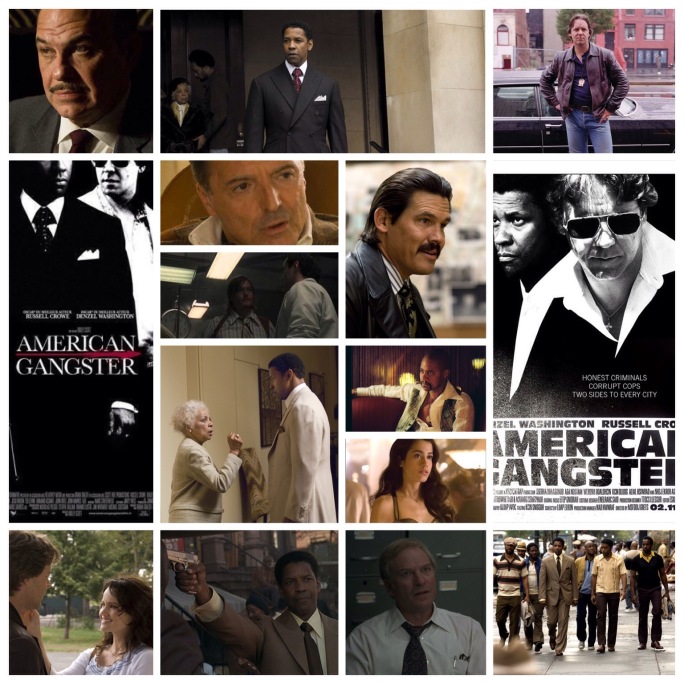
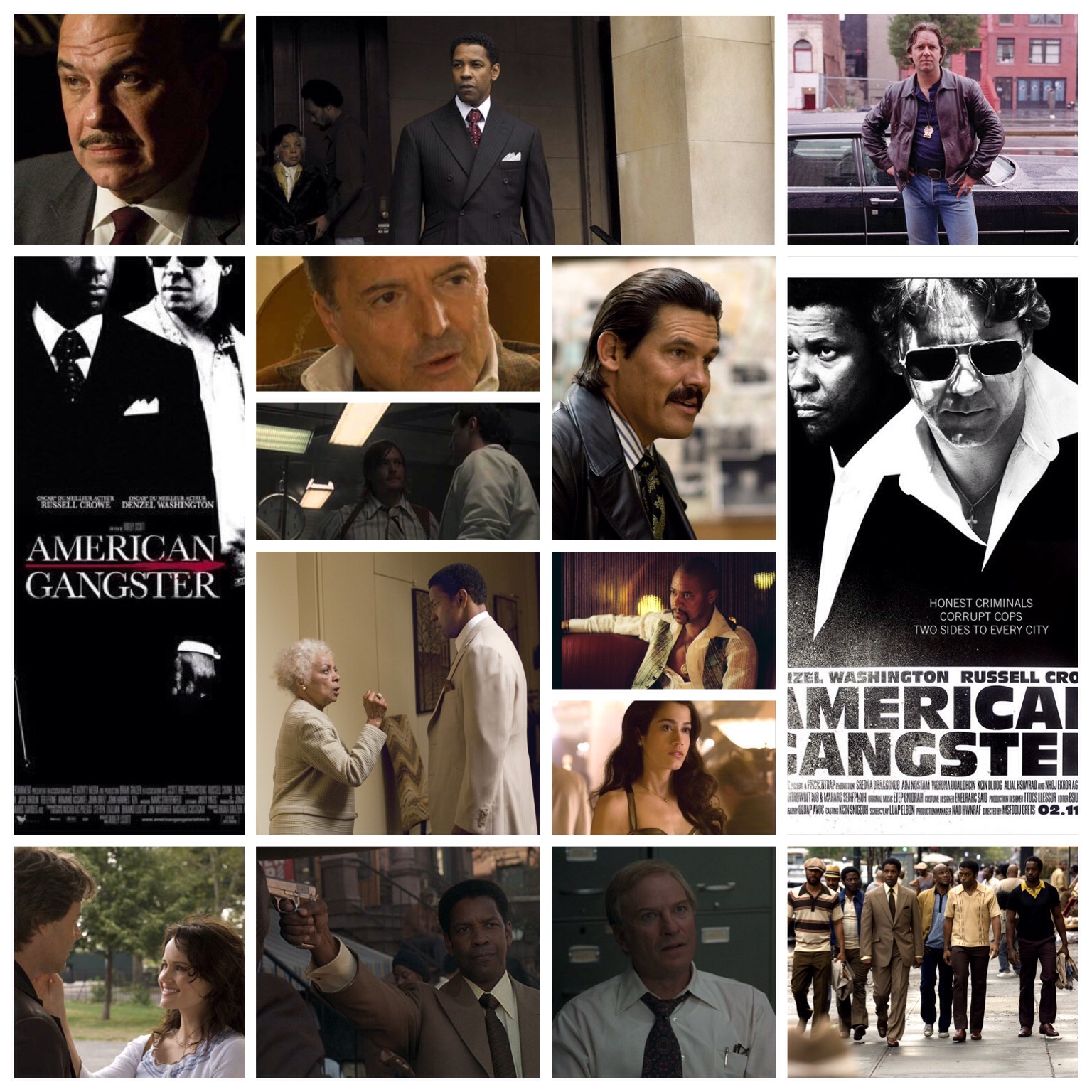
Ridley Scott’s vast, intricate crime epic American Gangster is one of the director’s finest achievement in film to this day. It’s sprawling in nature, expansive in scope but never chaotic or muddled. It always maintains a laser focus on its characters and story, thumping along at a rhythmic pace which swells and falls to the time of one of the most iconic stories in true crime. It’s Scott’s Heat, a titanic tale of cop vs. criminal in which neither are the villain or hero, but simply men adhering to rigid, ruthless principles moulded by the environments they have grown up in. Both men have an intense set of morals completely different from the other, yet equally as captivating. Russell Crowe is a troubled bruiser as Detective Richie Roberts, a cop so determined to convince himself of his own upstanding nature that he won’t take any illicit payoff in any amount or context. In contrast, every other aspect of his life is a shambling mess. Denzel Washington is quiet fury as Frank Lucas, an enterprising gangster and drug smuggler who rides the tidal wave of capitalism like there’s no tomorrow, flooding the streets of Harlem with pure heroin directly from the southeast Asian source, and rising swiftly to the peak of underworld infamy. The two are on an inevitable collision course, two juggernauts with different empires backing them who will stop at nothing. Lucas believes himself to be untouchable, shirking the flashy, preening nature of his peers and remaining out of the limelight, until cunning Roberts catches onto him. The rough and tumble world of New York in the 60’s and 70’s is lovingly brought to life by Scott, his cast and crew who go to impressive lengths in order to bring us that grit, realism and specific anthropological aura of another time, another setting. Speaking of cast, this has to be one of the most rip roaring collection of actors ever assembled, even to rival that of Heat itself. In Richie’s corner there is senior Detective Lou Toback (a sly Ted Levine, perpetuating the vague Michael Mann vibe even further), a scummy colleague (Yul Vasquez), and an off the books team of gangbusters including John Ortiz, John Hawkes and a mumbling RZA. He also clashes with his bitter ex wife (Carla Gugino) in an ugly custody battle for their young son. Over on Frank’s side of the hill are his huge extended family including Common, TI, Chiwetel Ejfor and Ruby Dee in one of the film’s finest performances as his strong willed, passionate mother, one of the only people who could talk sense into him and keep the animal inside at bay. Lymari Nadal is great as his bombshell Puerto Rican wife as well. His rivals include superfly-esque Nicky Barnes (Cuba Gooding Jr.) and a brief, hostile turn from Idris Elba. He also deals with the Italian mafia, personified by a hammy Armand Assante, an earnest Jon Polito and a slimy Ritchie Coster. One of the best performances of the film comes from Josh Brolin as positively evil corrupt narcotics detective Trupo, threatening everything that moves with his grease slick hair, porno moustache and silky, dangerous tone. As if that army of talent wasn’t enough, there’s also work from Kevin Corrigan, Joe Morton, Clarence Williams III in a powerful turn as an ageing Bumpy Johnson, and a blink and you’ll miss it cameo from Norman Reedus as well. What. A. Cast. The whole thing rests on Crowe and Washington, though, and both are like Olympian titans of crime and conflict, sweeping up everyone around them in a whirlwind of explosive violence, shifting alliances and the booming arrival of capitalism giving the American people in every walk of life a defibrillator jolt of economic change, laying the foundation for the world we live in today, one brick, one bullet, one business deal at a time. Scott achieves legendary heights with this one, a crime film for the ages that one can always revisit to see not how one hero cop took down a villainous drug lord, but how the forces which inexorably bind humans to various fates in accordance with their decisions swept up two extraordinary yet mortal men into historic infamy. In a word: Epic.
Michael Mann’s The Insider: A Review by Nate Hill
There are some films that are so perfectly made in every way possible that
I sit there thinking ‘Every persons effort and every element of creative energy that went into making this movie has been implemented flawlessly, arriving here and now to give me the viewing experience I’m getting. A perfect movie’. Michael Mann’s The Insider is such a movie. I held off on reviewing it for a couple days after seeing it, partly to let it sink in but mostly to see if I’d feel any different about it once my synapses had cooled down and the frames had dimmed from my consciousness. Perhaps the fiery reaction it drew from me in the moment was cheaply earned, or I was just in the right mood to love it at that time. Not a chance. If anything I’ve become more enraptured by it as time has passed, already aching for a second viewing. Every performance and aspect of is just so rich, deep and rewarding that for its two and a half hour runtime I found myself externally distracted not once. Occasionally Mann deviates from his comfort zone in the nocturnal crime zone. The occult themed period piece, the colonial adventure, the psychological horror, and this, the blistering drama based on a true story. One might not think the subject matter deserves a two and a half hour film, let alone would make a great one, but Mann has the cinematic Midas touch, and never half asses it. His films always contain traces of a true master at work, telling little details that engrave the film with a sense of immaculate skill and unwavering dedication to telling the story in its finest, and most honest form. The Insider tells the story of Jeffrey Wigand (Russell Crowe), a chemist who turns whistleblower on the tobacco corporation he was once employed by, finding shelter under the wing of CBS News’s 60 minutes, and particularly hard nosed reporter Lowell Bergman (Al Pacino). The network wants his take, in order to do an exposé on Big Tobacco, a plan with predictably disastrous and dangerous results, for both Wigand and CBS. The film shakes off any impending sensationalism or deliberately emotional stylistic cheats, instead keeping a microscope focus on the three lead performances and letting all the hurt, determination and emotion come forth naturally through their work, as opposed to smothering their story with an overbearing score and cheap cinematic manipulation. I’ve never been that won over by Russell Crowe until now. He always seems ‘halfway there’ in his work, like he’s missing something. This changed things for me. He’s like a raw nerve here, a family man pushed to the precipice of an impossible decision. One can almost see him wrestling with his conscience behind those haunted eyes, a storm with a lid barely kept on and anchored by Crowe in his finest hour. Pacino holds us captive with his work until we realize we’re not breathing. He’s the moral compass of the piece, and to see him explode at the injustices served up to him will give you goosebumps. The third leg of the table is Christopher Plummer as Mike Wallace, the 60 minutes anchor who also struggles morally with the situation they are in. Plummer is so good you forget you’re watching a film, giving Wallace buried gentleness and chiselled emotional intensity that you can scarce believe is even possible through the craft of acting. The supporting cast is peppered with bushels of talent. Colm Feore, Philip Baker Hall, Gina Gershon, Stephen Tobolowsky, Diane Venora, Nester Serrano, Rip Torn, Michael Gambon and an unusually sedated Debi Mazar are superb. It’s Bruce McGill, however, who almost steals the film in one blistering scene, playing a lawyer with enough righteous anger to shatter your tv screen. A career best for him. No one puts you into a story by forcing you to feel alongside the characters quite like Mann. Here he guides us through the trials that Crowe, Plummer and Pacino face with steady hand and heart until we are invested. Then he pulls the ripcord and let’s the sparks fly, making monumentally intense work of events that could seem pedestrian in lesser hands. We really feel for Crowe and clutch the seat with the same desperate intensity that he clings to his family, and sanity. We feel the same jilted fury alongside Pacino as he wades through sickening bureaucracy for a shot at retribution. We take pause with Plummer as he ponders his legacy and are incredulous with all three at the snowball effect the entire proceeding has had on them, devastating us as an audience the same as them, in turn making us feel closer to them. This is all laced with the incredibly heartfelt music from Lisa Gerrard, who sang alongside Crowe in Gladiator and was a favourite of Tony Scott as well. Mann is a ceaseless monster of storytelling, tone and pacing. The story has flair simply because he doesn’t wantonly throw it in the mix; the feeling and reaction come from story and character and not the razzle dazzle. Mann knows this, and let’s the fireworks naturally spring from the absence of deliberation, like music in the vacuum of space. This one will live on to stand the test of time far longer than the decade and a half its help for already. It’s a revelation.
MICHAEL MANN’S THE INSIDER — A REVIEW BY NICK CLEMENT
While his 1995 crime epic Heat will likely always be my “favorite” film by master filmmaker Michael Mann, his 1999 journalism thriller The Insider is likely his “best” overall theatrical effort. Simply by virtue of avoiding any sense of melodrama (no matter how rarefied as in Heat or Miami Vice) and making a film as good, or nearly as good, as Alan J. Pakula’s immortal classic All The President’s Men, The Insider stands as one of the most underrated movies ever to have been bestowed with nine Academy Award nominations (it won nothing). Mann’s usual brilliant sense of place and atmosphere is on firm display here, with Dante Spinotti’s elegantly stylish 2.35:1 cinematography maximizing space within the frame, with certain camera moves meant to dive deep into the consciousness of the characters within any given scene. The emotional and informational depth to the screenplay, co-written by Mann and the estimable Eric Roth (Forrest Gump, The Good Shepherd), is staggering to behold, as it’s the rare drama where everything is motivated by intelligent, dramatic discourse and plausible actions and situations rather than the cheap demands of plot or genre conventions. Al Pacino was terrific here, subverting expectations to a certain degree, reteaming with Mann a few years after their iconic work on Heat. But it’s the Russell Crowe show all the way, and in The Insider, this tremendous actor delivered the best performance of his impressive career, painting a portrait of a morally and spiritually conflicted man who had to face some serious personal challenges in order to get his life back on track. The dynamite supporting cast includes one of my personal favorite scene stealers Bruce McGill (show-stopping moments during the deposition sequence!), Colm Feore, Diane Venora, Christopher Plummer, Michael Gambon, Philip Baker Hall, Debi Mazar, Stephen Tobolowsky, Lindsay Crouse, Gina Gershon, Rip Torn, Michael Paul Chan, Wings Hauser, and Nester Serrano. The haunting and introspective score from Lisa Gerard and Pieter Bourke is classic Mann, perfectly complimenting Spinotti’s lucid and mobile images, which feel as if they’re always searching for thematic truth, while the various key characters consistently stare down their own existentialism in hopes of finding catharsis.
PTS Presents The Gary Young Special Episode 2: CHINATOWN, LA CONFIDENTIAL and TRUE DETECTIVE
For our second episode in the Gary Young Series, we sat down and discussed Roman Polanski’s CHINATOWN, Curtis Hanson’s LA CONFIDENTIAL and both of those films influences on the second season of TRUE DETECTIVE. We had a blast, hope you guys enjoy!