TAMARA JENKINS’ THE SAVAGES — A REVIEW BY NICK CLEMENT

1

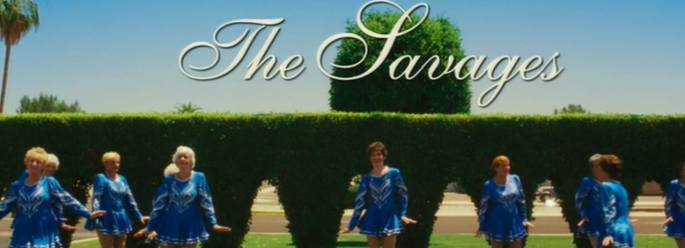
The Savages is one of those dark comedies which nails a perfect balance between sad and funny, but make no mistake, at times, this is a painful movie to view, as it examines the loss of a parent’s faculties in an upfront and explicit manner. Why has it taken writer/director Tamara Jenkins (Slums of Beverly Hills) a decade to get her next film made (she’s got Private Life set for release later this year)? As usual, Philip Seymour Hoffman was great – when was he not? But it was Laura Linney who stole the entire show. In movie after movie, performance after performance, Linney has proven to be an exceptional actress, absolutely one of my favorites. I submit to you the following titles: Dave, Searching for Bobby Fischer, Primal Fear, The Truman Show, You Can Count On Me, The Mothman Prophecies, Mystic River, Love Actually, P.S., Kinsey, The Squid and the Whale, Breach, John Adams, Hyde Park on Hudson, The Big C, and The Fifth Estate. She’s appeared in even more than that, and each time, she’s been fully committed, extremely emotional, and always engrossing to watch. In The Savages, I’m tempted to say she provided us with her best performance yet, and in my opinion, that says a ton about her work as an actress. Every time Linney appears in something, whether it’s on the small or big screen, the material is instantly elevated, and she’s got this interesting mix of sass and smarts, and sex appeal without being too “much” with any one particular thing. I’m a huge fan.
2

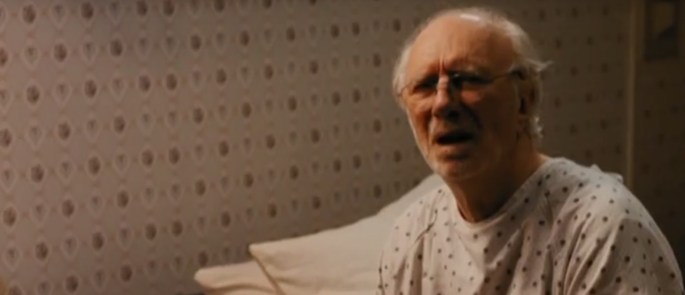
The film, which has Hoffman and Linney playing brother and sister, is an extremely sharp and poignant story about siblings who have to take care of their ailing father after the death of his girlfriend. Their dad, a tough old S.O.B. played to perfection by Philip Bosco, is suffering from delusions and early Parkinson’s disease. It’s a brilliant performance, actually; never resorting to actor-ish ticks and convulsions or histrionics, Bosco downplays the physical, in favor of the emotional, and the results are devastating, yet somehow never fully depressing. It’s all in the fine details, and this film is a subtly tricky one; you’ll have to see it to know what I mean. There’s no guns or car chases or explosions or bad guys or plot contrivances that get you to the next scene. It’s not glossy or slick, as Jenkins favors chilly winter and gloomy skies over a Michael Bay sunset finish. But this is a film that’s generously written, honestly acted, and modest yet strikingly confident with its direction. And it’s also extremely funny, which helps, because at times, it’s a spoonful of tough love medicine that many, many people will find too close for comfort. But as cinema, The Savages is a small gem, and a film clearly made because everyone involved felt an inherent need and desire to make it happen.
4

NICK’S NOTES: RIDLEY SCOTT’S BLADE RUNNER

5

Ridley Scott’s iconic sci-fi classic Blade Runner is one of those motion pictures where its legacy and lore nearly outweigh the finished product itself. Notice I said nearly. This is an all-consuming piece of cinematic art, a film that blew my mind open as a kid, and has continued to haunt and fascinate me as an adult. Seeing Blade Runner projected in 70mm as a 12 year old really did change the way I viewed movies; I knew I had never seen anything like it before and that it was special. It was also one of the first letterboxed double-VHS sets that my family rented from Blockbuster and that just meant it was “better” than any old VHS tape that was laying around. I nervously anticipate Denis Villeneuve’s follow-up, as the imagery on display in the trailer looks eye-scorching (Roger Deakins is the 2049’s cinematographer), but I’d by lying if I said that I’m very wary of long-in-the-works sequels to classic films that are separated by decades. There’s something both handmade and revolutionary about Scott’s original work, and that’s an aspect that can never be replicated. From the mind-blowing visuals that Scott and director of photography Jordan Cronenweth crafted in tandem with the trendsetting production design and art direction by Lawrence Paull and David L. Snyder respectively, to say nothing of the grand and operatic musical score by Vangelis, Blade Runner is an aesthetic masterpiece that feeds into a layered, deeply thoughtful, and engrossing narrative that gives weight to the flying cars and rain-soaked streets and neon-holograms and every other stylistic trick that Scott and his artisans had up their sleeves. It’s a phenomenal movie and an effort that easily ranks as one of Scott’s absolute best, and I’m normally not a “best” and “worst” type of person.

6

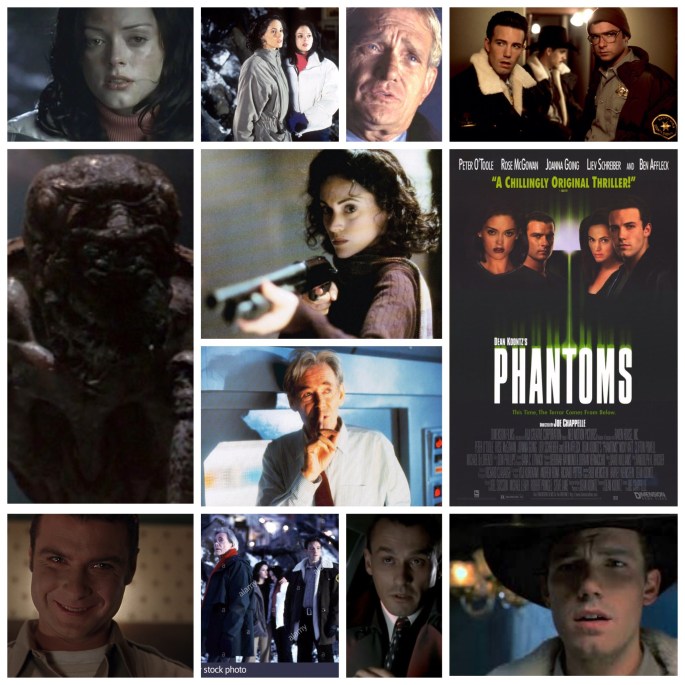
Dean Koontz’s Phantoms 


Dean Koontz’s Phantoms is one of those that I was really stoked on for years and would recommend at the drop of a hat… until I got around to reading the book. Koontz’s novel is brilliantly paced nocturnal nightmare fuel, detailed, imaginative and specific in it’s thrills and chills. This film is a brisk, truncated version of that story, not only that but it takes severe liberties and deviates quite a bit from the tale, resulting in a film that bears little resemblance to the book. It’s good on it’s own, for sure, atmospheric and freaky on terms that don’t include the big picture, but when seated alongside the novel it pales like the large number of paralyzed corpses that pop up all over an eerie abandoned village somewhere in the Midwest. Two sisters (Joanna Going and Rose McGowan) drive into town expecting to visit kindly relatives, and find only death and desertion instead. They wander about, plagued by visions and radios that play spooky old timey music of their own accord, spine tingling in this context. The only townsfolk they find are starched cadavers, killed by some unseen force that watches, waits and refuses to be defined. It’s in this first act that the film is scariest, achieving impressive levels of dread through isolation and uncertainty. As soon as Sheriff Ben Affleck and his shitkicking deputies shows up, the effect dims a bit and degenerates into schlocky survivalist gimmicks, still entertaining yet not as effective as the opening. Things get downright silly when the FBI delegates a crusty old professor of cryptozoology or some such farfetched endeavour (a peppy Peter O’ Toole) to come on over to town, analyze the mystical menace and.. well that’s about it from him. Clandestine hazmat teams are dispatched, Body Snatchers/The Thing homages ooze all over the place and the film putts along in standard horror gear, never getting near to as good as it was in the first twenty minutes or so, let alone the quality of the book. Liev Schreiber is memorable as one of Affleck’s boys who goes a little nutty, Bo Hopkins and Robert Knepper score points in cameos as cheeky G-Men, and there’s work from Clifton Powell Nicky Katt. For what it is it ain’t bad, just expect to be a little deflated if you watch this first and then go check out the book, because there’s no kind comparison to make. 

-Nate Hill

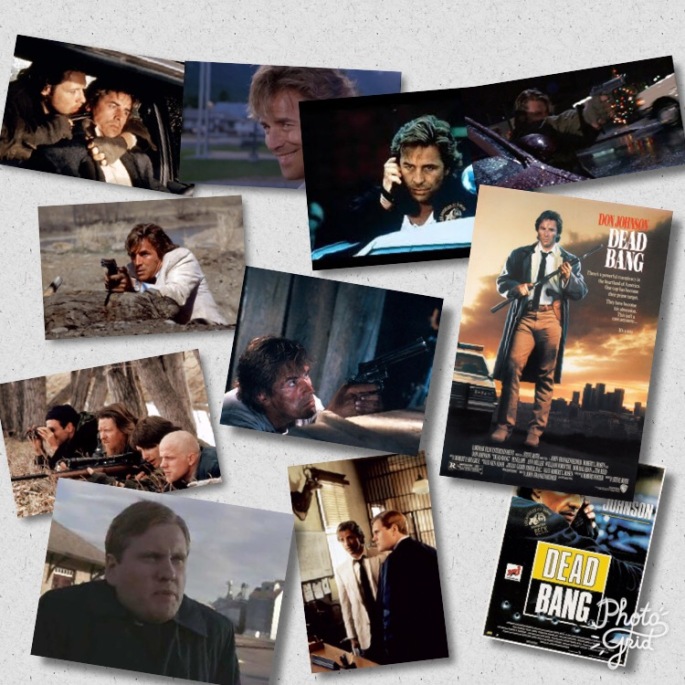
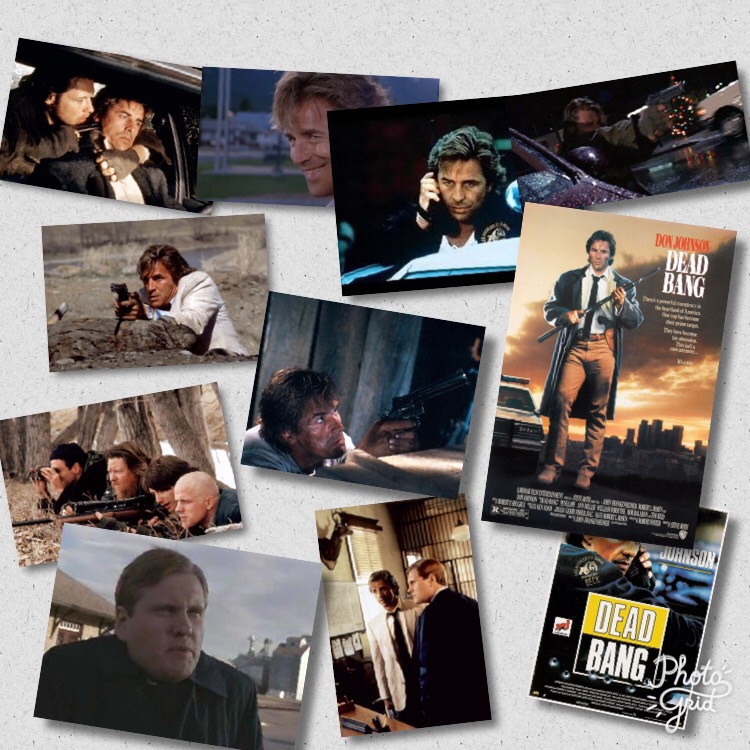
John Frankenheimer’s Dead Bang


John Frankenheimer’s Dead Bang makes no apologies for the straight up, down n’ dirty, violently obnoxious ninety minutes of rural crime mayhem it throws at you, containing no lofty subtext, tongue in cheek send ups or heady plot twists, purely and simply Don Johnson wiping out a gang of backwoods white supremacists and pissing off every superior officer along the way. A cop film to it’s roots, it’s a refreshing little diversion for Frankenheimer, who is known for taking on genre outings with ambitious undertones. Johnson is a flippant big city cop sent to the sticks to smoke out some neo-nazi assholes who are running guns, killing folks and all that fun stuff. He’s paired with a hysterically fussy FBI handler (William Forsythe, cast against type and loving it), and at odds with the psychotic ringleader of this gang (real life drill instructor Frank Military, also a solid actor), who proves to be quite a fly in the ointment. The action is rough and tumble and thoroughly R-rated, the villains are formidably nasty and Johnson’s cheeky super cop is wearily exasperated most of the time, out for the count but just gripping the edge as he hunts these yokels and deals with red tape including a department appointed shrink (Bob Balaban) who he hilariously mocks for looking like the Monopoly Guy in the film’s funniest bit, a riotous interlude. There’s scattershot work from Penelope Ann Miller, Mickey Jones, Michael Jeter, Tate Donovan and Garwin Sanford as well. Not a well known effort from firebrand Frankenheimer (I’ve heard some unbelievable stories from this set) but a really enjoyable shoot em up that deserves a far better rep. 

-Nate Hill

Aeon Flux


Before Ghost In The Shell, Dragonball (fucking shudder) and a host of other attempts at making anime content work as a live action film, there was Aeon Flux, a supremely weird dystopian Sci-Fi palooza that should have just been the first and last of it’s kind, ground zero for moving forward, lesson learned in terms of knowing that such specifically artistic material just *doesn’t* translate at all beyond the original animation versions. You’d think they would have learned with this one, but nope. Charlize Theron can practically carry any material on her own, she’s just that dynamic, and when supported by an impressive vessel of visual effects and a clinical, sleek stylistic palette she’s even better, but this beast has no heart beating at the centre of all that, and it shows. Theron is Aeon, a powerful assassin working for the Handler (Frances Mcdormand), assigned to bring down a dangerous regime in a utopian city where humanity’s last vestige of populace exists following some viral plague decades before. Of course nothing is as it seems and when she gets to the man behind the group (Marton Csokas) she discovers all kinds of secrets. There’s plenty of inventive future-world action, including a neat sequence where Aeon sends in wicked fast micro-bot marbles to blast through a door, and interesting aerobics courtesy of a character played by Sophie Okenodo, who has hands instead of feet, an anomaly the film finds little time to coherently explain. Even less explained is the sudden appearance of Pete Postlethwaite as someone who resides in a giant floating thingy far above the city, kind of like the man in the moon in the midst of chemotherapy. It all makes not a great amount of sense, through no fault of it’s own. That goes back to my thoughts at the beginning of the review though: Sometimes, a specifically drawn or written anime saga is just too much in it’s own abstract, perfectly balanced embryonic harmony, and trying to shunt it along into the very different realm of live action storytelling just isn’t possible. That’s certainly what has happened here, and with pretty much every other attempt I’ve seen to adapt the medium. 

-Nate Hill

20 years in the making: An Interview with Steve Alten by Kent Hill


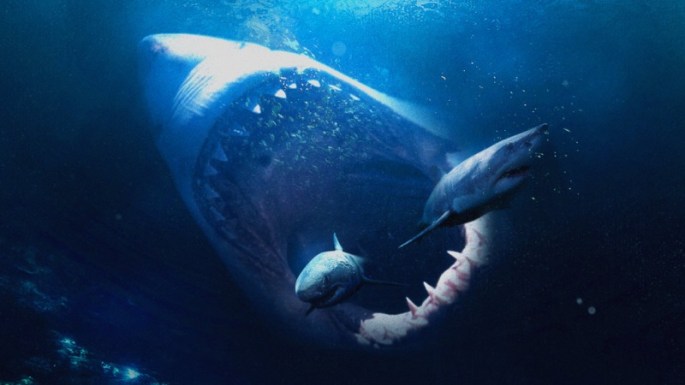
Sometimes good things take time. Still, it is rare that Hollywood, being in possession of what it believes is such a ‘hot property’, would allow said property to languish in the depths of development hell. Especially for 20 years. But that is exactly where Steve Alten’s bestseller has been in residence. That, of course, is about to change.

Yes ladies and gentlemen (and in case you haven’t been following the story) next year Alten’s leviathan shall rise and finally arrive at a cinema near you. I have long been fascinated with the journeys  movies take on the road to the big screens on which we witness them. Some of these films never arrive, some appear in a confused and unfinished form. Others are the victims of too many cooks and most are a product of the machine.

For the films that don’t make it, (see great documentaries like Lost in La Mancha and Jodorowsky’s Dune (though Gilliam seems to have at last remedied this)) their journey is often as intriguing, if not more so, than what the final product might have been. But with MEG, the powers that be have what is a potentially massive franchise on their hands. So, why the wait?

The fates are strange and fickle. Steve Alten’s bestseller was optioned before it was complete, but it has taken the better part of two decades to arrive. I found this story intriguing, mainly because this was not some sort of artsy passion project or some grand tale of ridiculous hubris. No, what could have been, and what we may yet experience, might very well be the next JAWS? And while Spielberg’s film is by its nature a far more intimate piece; the shark menaces a small community and finally three men set out to kill the beast, MEG is something we are definitely going need a bigger boat for. A really BIG boat for!

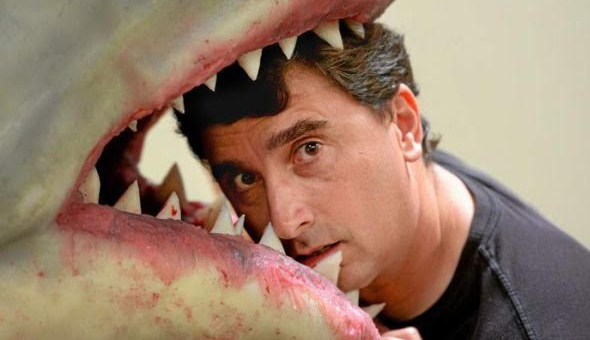
Thus Steve Alten agreed to have a chat with me about the origins of his book’s long gestation toward its screen adaptation. What he relayed I found fascinating, and still believe it could become a great extra feature or a terrific stand-alone documentary of the ride this big shark movie as taken. But, like most fans, I am just grateful that with each passing day, we finally are at last drawing closer to the MEG movie’s premiere. Of course the real relief belongs to the creator. In many ways it has been worse for him, he having served on the front lines, he having been present for each false start and each heartbreaking hurdle. I have agreed to catch up with Steve before the film’s premiere next year. As the hype builds and teasers and trailers and all the ads  bombard our senses, what brings me pause and makes me smile is the thought of Steve Alten waking the red carpet, entering the theatre, taking his seat . . . and enjoying the movie…
…as I hope you will enjoy this.

unnamed (1)


Beneath a sky so full of Sharks: An Interview with Anthony C. Ferrante by Kent Hill


It would be easy for me to simply sit here and wax lyrical about my love of SHARKNADO okay – real easy. But to do that does a disservice to one of the major components of its success, and that comes in the form of the director at the helm of the franchise; (now moving into its 5th installment) the dynamic Mr. Anthony C. Ferrante.


It was 2014. I was at work on the sequel volume to an anthology whose content was the collected author’s visions of their ultimate B movie. Anthony was prepping SHARKNADO 3 at the time for release. Still, I managed to get a hold of him to write the foreword for that book, and subsequently, the release of the book and SHARKNADO 3 fell in pretty close succession.


The desire to make movies and equally the passion for them, strikes one out of the blue. Anthony was not yet in his teens when that voice inside us all called out to him, and from that point forward, he knew making movies was exactly what he was going to do.

Now like I said earlier, to simply classify him as the SHARKNADO GUY, is to be completely unjust. Anthony is a renaissance man of the highest order. This writer, director, producer, sometimes actor, make-up effects artist, songwriter, comic book author – the list is longer than the list of cameos in the SHARKNADO franchise thus far.

But as you will hear, some of the best training Anthony received during his journey, was while writing for the likes Fangoria and Cinescape Magazine. For it was during this time that he was tasked to cover films being made in the local area. So he found himself hanging out on the sets of movies and getting to witness first-hand, all the stuff they don’t teach you in film school.


It was this and the do-with-what-you-got attitude he cultivated while making his early films in his hometown that has enabled him, or perhaps, weaponized him for the career he has enjoyed and one that continues to flourish. It is this shooting-from-hip type filmmaking that lends his work a frenetic energy. Fittingly you might say, he is the right man for the job at hand when it comes to the wild, bombastic and beloved lunacy that is the SHARKNADO franchise.

But beneath that,  I think we are witnessing a great filmmaker on the rise. A man whose talent and skill will I hope be utilized to its full potential. Anthony C. Ferrante may indeed be the antidote these tired, Hollywood tent-pole movies are sorely lacking.

But enough to this. GO, GO, GO, GO, GO, GO, GO – listen to this interview, and don’t forget to tune into the upcoming SHARKNADO!

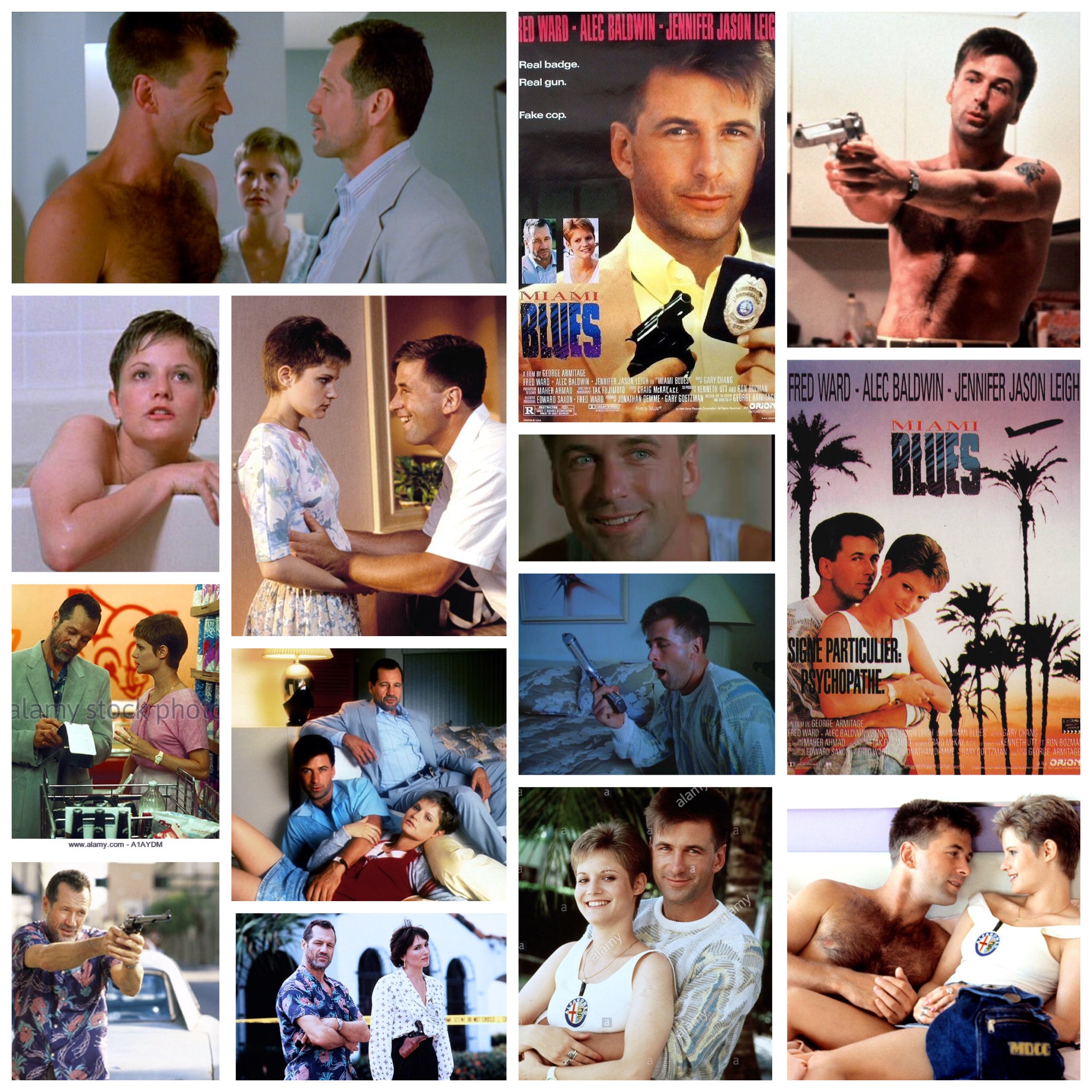
Miami Blues 


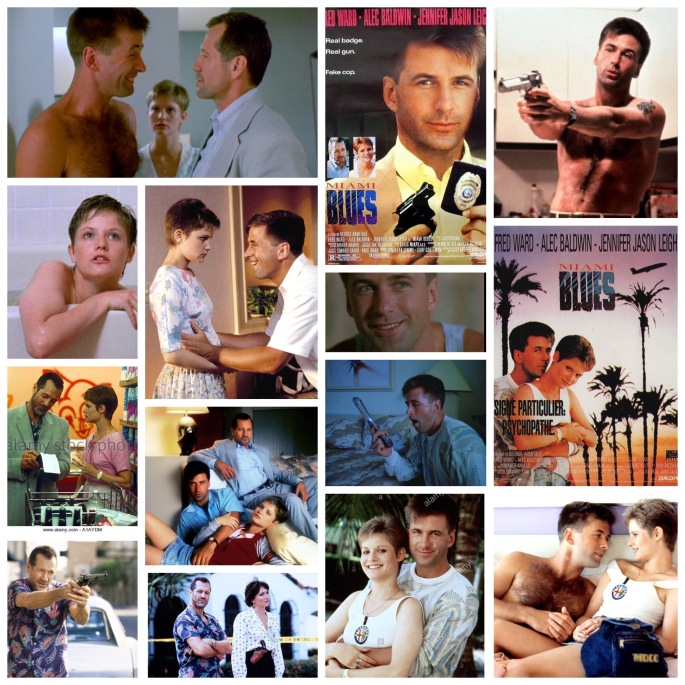
Miami Blues is a crime film full of loose ends, incompetence, wanton violence and meandering characters who seem lost within their own story, and I mean all that in the best way possible. Some pulp affairs are sharp, succinctly plotted creatures, every cog in the machine placed to serve the momentum of plot and character, while other efforts have messily dropped the cogs all over the floor for an untethered, ‘wing it’ type approach in which story and character are like aimless leaves blowing about in a restless pond. Isn’t life like that though? There’s no narrative structure to a lot of what we do, and as such there’s little to be found in the tale of highly self destructive, psychotic criminal Alec Baldwin, who has barely left the airport upon arriving in Miami before he’s already got a serious warrant out for his arrest. He’s a violent sociopath who takes what he wants when he wants and, most aggressively, how he wants. He’s also very smart, which is a dangerous mix in anyone whose moral compass has flatlined. His anarchic crime spree gains the attention of an aloof older detective (Fred Ward) whose badge he steals for some good old law enforcement impersonation, leading the poor weary cop on a darkly comical mad goose chase all over town. He also picks up an endearing dumb blonde (Jennifer Jason Leigh, excellent) who’s infatuated with him and blatantly tunes out any and all red flags, of which there are…many. That’s pretty much all there is to it, but with these three actors it’s pure gold. The knowingly audacious arch criminal, the Betty Boop wannabe wifey sidekick and the exasperated, constantly outsmarted copper, a trio of archetypes augmented slightly in favour of each performer’s stellar work. Never takes itself too seriously, knows full well how heinous the turn of events within it’s frames are, yet firmly refuses to not have fun, a cheeky, sexy, sweaty and altogether terrific little venture. 

-Nate Hill

B Movie Glory: The Alphabet Killer


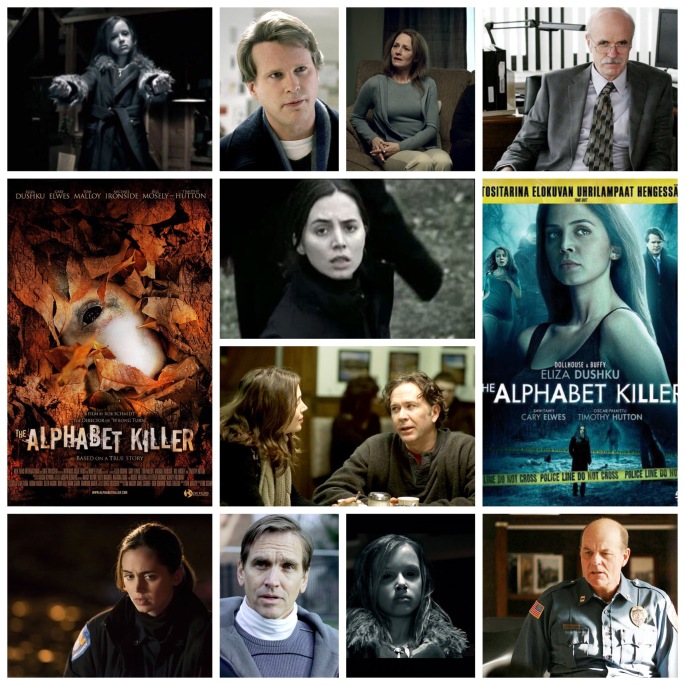
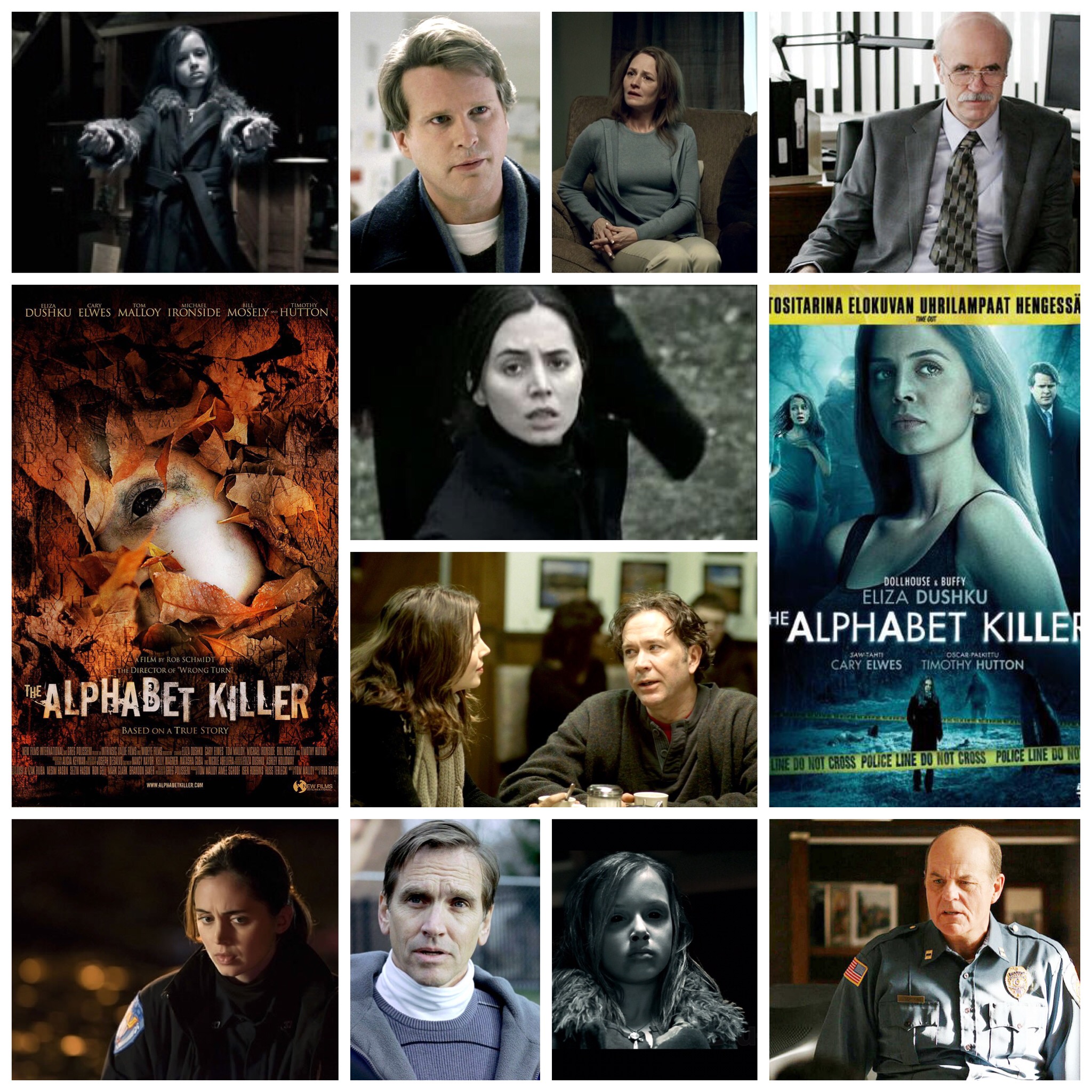
The Alphabet Killer is a silly one, a stone-serious account of some serial killer out there that tries to go the route of straightforward, down to earth fact tracking, and then deliberately messes up it’s own tone by tossing in cheap, ineffective ghostly gimmicks that seem so out of place one wonders if the editor accidentally spliced in frames from an episode of Supernatural or something. The film would have been something pretty decent without those jarring schoolyard level scare tactics tossed in, but I guess shit happens. This is very, very loosely based on an actual set of murders over in Rochester, NY, but what actual similarities to that case we see here is beyond my knowledge and, I suspect, pretty scant. What we get is Dollhouse veteran and cutie pie Eliza Dushku as a determined cop, hunting a killer of children all over upstate New York, while an impressive load of a character actors make slightly unnecessary yet well acted cameos, if only to pad the pre credit billing on the DVD cover and boost rentals. Tom Noonan, who has a running theme in his career of playing exactly the type of beast she’s tracking here, switches it up to play her stern Police Captain boss. Michael Ironside briefly plays a belligerent small town sheriff who withholds information gleefully, Bill Moseley as a reformed sex offender who’s tagged as a suspect, Timothy Hutton her wheelchair bound scholar and consultant buddy, as well as Cary Elwes and Melissa Leo. None of these actors do much but show up for a minute or two to make their presence known, and recede into the frays of supporting plot, until it’s time for one of them to resurface as the killer in the third act, the end of a whodunit guessing game we’ve seen countless times over. It wouldn’t be such a tiresome thing if they left out the spooky-dooky stuff, but there you have it. The film’s otherwise fascinating, earnest docudrama style is somewhat ruined by the occasional presence of moaning, white eyed spectres of murdered children that leer out at Eliza like minimum wage kids doing weekend shifts in the haunted house at the local county fair. Shame. 

-Nate Hill

Heineman’s ‘City of Ghosts’ is an eye-opening experience

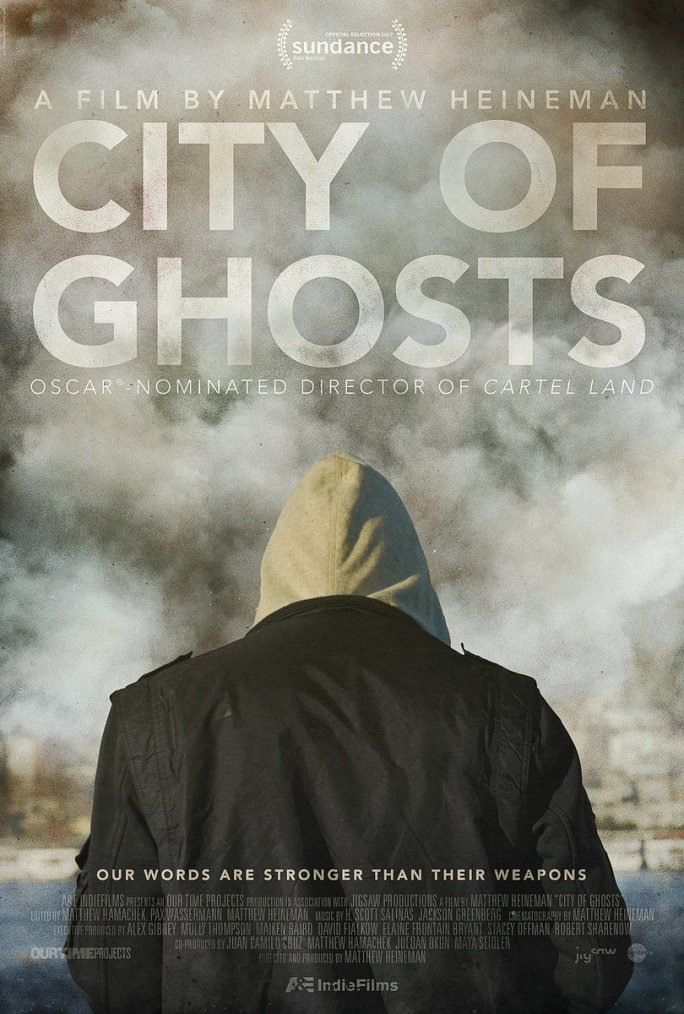
I grew up with Walter Cronkite and Dan Rather who shaped our opinions and our discussions.  We as an audience had trust in what they had to say, and more importantly in how they delivered it.  Today, the news needs to be delivered as quickly as possible, and corrections issued if a mistake is discovered.  It has become so much a part of my everyday life that I have all but abandoned traditional news outlets.  Despite this, I find myself living inside the vacuum created by social media and online news media and yet, I’m still all-too-well aware of what’s happening in the world.  However, I find that online media introduces a high-level of bias colored by a cacophony of voices rather than one person delivering the news each night.  That’s why, when I sat down to watch “City of Ghosts,” I was quite taken by surprise.  I was only peripherally aware of the Arab Spring rising of ISIL and its dangerous stranglehold on the Middle East.  I was not aware of a group of citizen journalists who have risked everything to raise awareness of the occupation of Raqqa, a city deep inside Syria on the Euphrates.  Academy Award – nominated director Matthew Heineman managed to open my eyes very quickly to the true nature of both sides of this conflict as he lays out ISIL’s ascension to power and the rapid growth of citizen journalist network Raqqa is Being Slaughtered Silently (RBSS).

After opening the film with the group receiving the International Press Freedom Award in 2015, Heineman goes on to describe ISIL’s rise to power, appeasing a war-torn populous looking for freedom.  The state-run news agency portrays life in Raqqa as peaceful, where basic services meet the needs of the people.  RBBS starts capturing footage of ISIL’s atrocities; using social media, they work tirelessly to create an online campaign attracting the attention of global media outlets and the ire of ISIL.

With unprecedented access to the core members of the group, Heineman depicts their everyday struggles to flee Syria for a safe haven in Turkey and Germany while the team remaining in Raqqa struggle to anonymously capture footage and photos of the atrocities that ISIL forces are inflicting. The team that remains in Raqqa upload the photos and videos of the atrocities to the teams in Europe.

As ISIL becomes aware of the clandestine efforts inside their borders we discover that there is truly no safe haven, for anyone.  In Raqqa, they order the citizens to destroy satellite dishes restricting internet access and cellular communications.  On the European continent, they execute members of RBBS.

In its simplest form, the picture Heineman paints is that of a propaganda war similar to one the British had with Nazi Germany during the early stages of WWII.  History is repeating itself.  Here, time is on the side of RBSS as they viral nature of social media works in their favor.  The more they post, the more it puts innocents in other countries at risk as evidenced by the attacks in France and in the United States.  And, it puts their own family members in harm’s way.

The efforts of this citizen journalist network bring to light real-world problems.  The images and the flow of the narrative convey the situation succinctly.  I could imagine audiences who watch this would be shell shocked at best.  Not for the feint at heart, Matthew Heineman touches a raw nerve here and it will stick with you long after you leave the theater.

5 out of 5 stars.

This review was written for and originally featured on phoenixfilmfestival.com.