Joseph Losey’s Figures In A Landscape

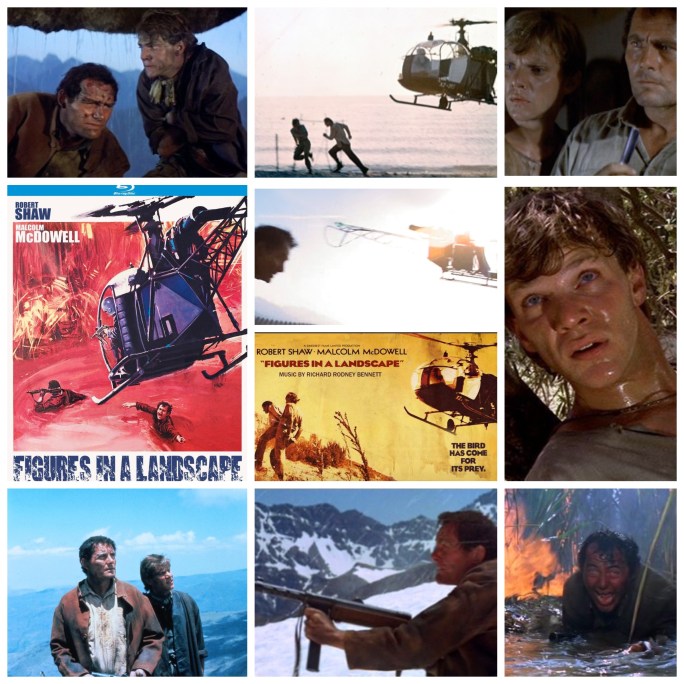
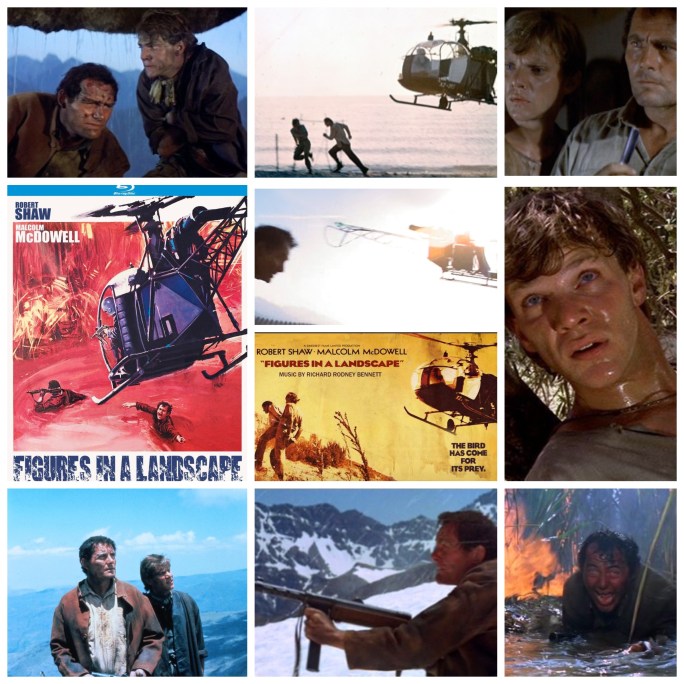
A menacing black helicopter relentlessly pursued two mysterious escapees through the harsh landscape of an unnamed foreign land. Such is the slightly surreal setup for Joseph Losey’s Figures In A Landscape, a strange, forgotten allegorical adventure film starring Robert Shaw and Malcolm McDowell. Less is more storytelling takes charge with a screenplay by Shaw himself, as very little is told to us about who these men are, what the setting and political climate is or why that big black bird won’t stop gunning for them, at one point staging a maneuver so hair raising the propellers almost take someone’s head clean off. The unspecified region here is actually Spain, and the photography is flat out gorgeous, stunning wide shots and sweeping vistas seemingly shot from the chopper itself, sprawling vineyards, dry acrid valleys and snowy mountain peaks are all captured in a film that would work as a travelogue ad for Spain if the story wasn’t so grim. Shaw is the salty, old fashioned badass who can’t keep his mouth shut and gets his hands dirty when needed, McDowell the sensitive youngster in over his head and struggling with both the chase and the elements. As the film progresses their dynamics shift though, which is fascinating to see through their two excellent performances. The climax set high atop a mountain somewhere is bloody poetic bliss and serves as both a fitting end to a well mounted thriller and an ambiguous enough wrap up for a story that’s just ‘out there’ enough to defy genre expectations. This one really has been lost to the sands of time, but luckily Kino Lorber recently remastered it for Blu Ray and it’s really something to see if you’re a fan of Shaw, McDowell, oddball films that slipped through the cracks or high adventure. Definitely recommended.

-Nate Hill

Michael Bay’s Bad Boys

Michael Bay’s Bad Boys is his Bad Boys II before college or like a drug problem, still a raging good time and a great action film but not quite the certifiably deranged mega production that he whipped out of his pants with that sequel. Nevertheless, it’s the warm up round, the pre-drink session and I love it to bits as well. I’ve read reviews comparing it to or accusing it of directly aping Beverly Hills Cop, and while it’s easy to see the thematic connection, I disagree and feel like it’s a separate aesthetic entirely. 90’s Miami, the simultaneous fast talking tornados that are Will Smith and Martin Lawrence, large scale action mayhem, constant improvised bickering, Joe Pantoliano perpetually on the verge of several strokes, it’s a vibe all its own and although this one is considerably more dialled back than II, it’s no less of a blast. Smith’s hotshot rich boy Mike LOWRY and Lawrence’s persnickety family man Marcus Burnett are live wire vice cops investigating a violent, elaborate drug smuggling ring lead by Tchecky Karyo’s Fouchet, a psychopath written as one note but the Turkish badass breathes life into him anyways. Tea Leoni is Julie, material witness to one of his murders and therefore tagging along with Marcus and Mike throughout the films chases, shootouts, verbal confrontations and what have you. Bottom line: In these roles, Smith and Lawrence are either your thing or they’re not, no middle ground. They’re loud, crass, politically incorrect goofballs who can’t sit still to save their lives and I love spending every minute with them. Also an acquired taste (and quite a cause of controversy in film discussions across the land) is Bay’s slick, noisy aesthetic, which may sometimes land with a hollow thud, but there is just no denying in one’s rational mind that the guy can’t stage absolute motherfuckers in the way of action set pieces, his films have a diamond crisp quality to the visuals, and his explosions are always shock and awe glory. The final car chase here across a giant airport tarmac is something else, feels real and dangerous, the eventual crash n’ burn a terrific payoff. The supporting ranks here are populated by the likes of Theresa Randle, Marc Macauley, Michael Imperioli, Marg Helgenberger, Kevin Corrigan, Anna Levine, Nestor Serrano, Julio Oscar Mechoso, Karen Alexander, Shaun Toub and briefly Kim Coates, hilariously credited as ‘White Carjacker.’ If you like your action movies funny, and your comedies full of action, this is the ticket. But you also have to be tuned in to Smith and Lawrence’s particular brand of lunacy, which understandably isn’t for everyone. Bring on the third film as soon as possible.

-Nate Hill

Michael Crichton’s Coma

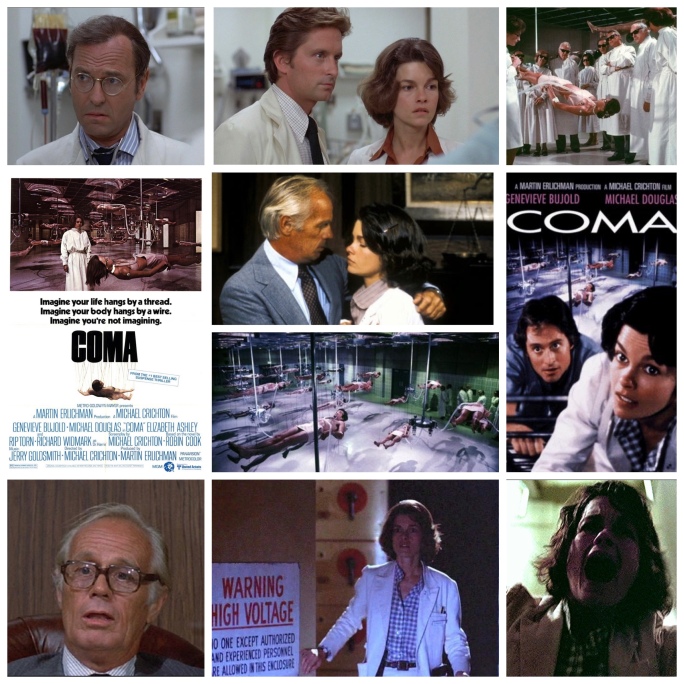
There’s nothing freakier than hospitals in Hollywood, or at least in the horror/thriller genre. Those long, deathly silent hallways that lead nowhere in particular, the cold, venereal steel tables, sheet white walls and lab coats and a general air of unrest. It doesn’t help the discomfort levels when there’s a diabolical conspiracy afoot and one can’t trust the doctors, those very harbingers of healing that are supposed to be ultimately trustworthy. Michael Crichton’s Coma takes full advantage of a nightmarish premise like this, perhaps too much in its final act, but the first two thirds are a clammy bad dream of worst case scenarios and extreme medical malpractice. Genevieve Bujold plays a junior doctor at Boston Memorial who slowly begins to notice a pattern of surgeries leading to suspicious comas, and the subsequent disappearance of the resulting vegetables. Her boyfriend and fellow doctor (Michael Douglas) brushes off her concerns as stress induced paranoia, the head of anesthesia (Rip Torn, so stoically intense he looks like one of those trolls in the hobbit that got turned to stone) casts threatening glances her way when she goes nosing around, and the hospital’s executive physician (Richard Widmark) seems amused when she brings the matter to him. These days it’s just a tad obvious that with those reactions that pretty much everyone except for her is in on the whole deal, but this was back in the late 70’s when certain narratives were still fresh. Besides, the fun isn’t in eventually getting to the bottom of things but in the chases, near misses and cat and mouse stuff along the way, and in terms of suspense this has some doozy moments. Bujold scours the bowels and ducts of the hospital and another nefarious rural institute like a spy in a complex labyrinth of boiler rooms, air intakes and empty rooms, while a heinous assassin chases her down and gets totally fucked up by this resilient gal. Douglas is billed alongside her but is only around in a glorified supporting turn, while Bujold, who is a gorgeous and incredibly dynamic leading lady, gets to do all the stunts, hurdles, combat scenes and handle the big revelations in panicked closeups. An interesting choice is to have no music at all for the first half of the film, and then when the first clue in the breadcrumb trail is discovered, the score kicks in. It’s a solid thriller that gets a bit overcooked when Widmark goes all Satan near the end and starts monologuing, but until then the pace is restrained, the mood vague and chilly. Watch for a shockingly young Ed Harris in his very first film role, and Magnum PI as an unfortunate victim of the evil plot. Good stuff.

-Nate Hill

Michael Apted’s Class Action

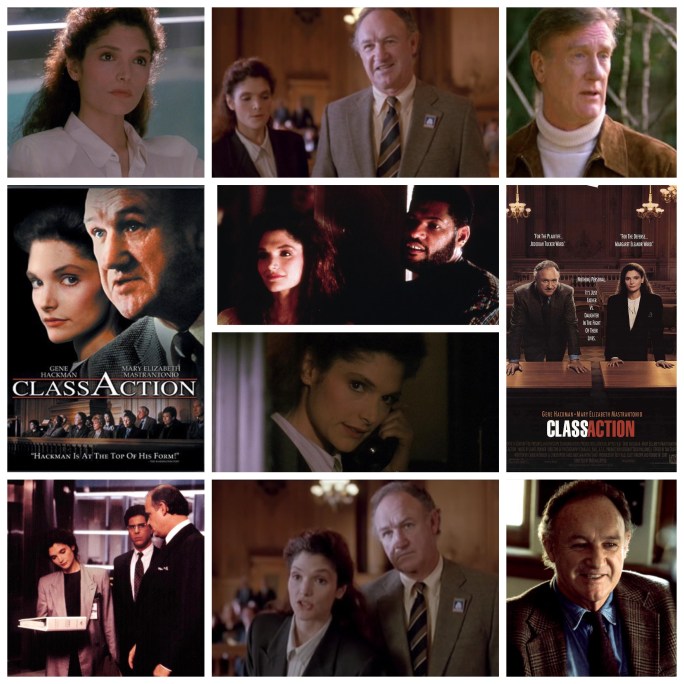
A father/daughter courtroom drama starring Gene Hackman sounds like a recipe for something glossy, showboating and melodramatic, but Michael Apted’s Class Action gives us a mature, emotionally potent and very character driven film that one wouldn’t expect from the slightly sensationalistic trailers. Hackman is a San Francisco attorney who takes on the prosecution of an auto manufacturing giant with a line of suspicious exploding cars. Opposite him as defence for the corporation? His own daughter (Mary Elizabeth Mastrantonio), with whom he has a rocky history with. He’s a philandering hard ass who was never pleased with her and she blames him for the dissent in her family from his womanizing ways years before. The case itself serves as framework for for the very real, raw interpersonal drama that unfolds between them, and their relationship feels grounded and truthful. The key scene is them together in the kitchen cooking; idle small talk leads to harshly flung accusations, emotions are laid bare and by the time the argument reaches a screaming fever pitch, both are quaking with rage, self reflection and sad regret. It’s a powerful scene of performance from both actors, and you’ll scarce breathe for the duration. Hackman is fire and brimstone as per usual, but there’s also a wounded aspect I’ve never seen in him before, something brought out by Mastrantonio who is spectacular in her calmly devastating turn. The late Donald Moffat is great as her steely firm boss, a man governed by fierce logic who has no qualms in casually covering up key evidence. Fred Dalton Thompson is nicely slimy as the reprehensible auto CEO whose soulless disregard for human life is unsettling, Jan Rubes steals his scenes as a loopy ex engineer with ties to the auto giant and Laurence Fishburne (during his ‘Larry’ days) quietly plays Hackman’s firm partner and family friend. I wouldn’t have probably ever known about this film if I hadn’t have come across it in a thrift store, and I’m glad I did. Forgotten these days it seems, it’s now one of my favourite courtroom pieces out there, for letting the characters tell this story, for making it personal and for flowing through the beats organically. The stately San Francisco architecture and melodic score by James Horner give it a personality as well, but Hackman and Mastrantonio rule the roost and probably give their career bests. Highly recommended.

-Nate Hill
The Man In The Moon

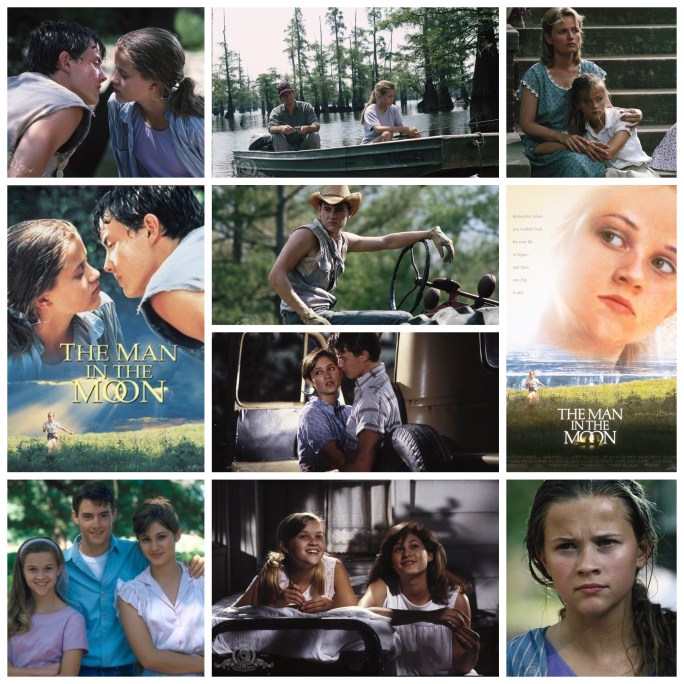
The Man In The Moon is a hauntingly opaque title for a film; it could be a literal sci fi, decidedly cartoonish or something more vague. In this case it’s a sad, enlightening and unusually mature coming of age story starring Reese Witherspoon as a girl teetering on the cusp of childlike whimsy and the tough life lessons that follow, introduced to romance, tragedy and the complexities of life as one gets older. The poster and description sounds something along the lines of My Girl, which is an astute enough film about the nasty curveballs that life throws us, but this one deliberately dodges any cliches we may see coming and mines life for the odd, unpredictable turns it takes that you don’t often find woven into narratives. Witherspoon has never been better than she was in her first few key roles as a young actress, this being a lynchpin. She plays Dani, a fourteen year old girl growing up in the south with her loving parents (Sam Waterson and Tess Harper) and beautiful older sister (Emily Warfield). She’s a forthright tomboy who loves playing in hidden glens and watering holes out in the backwater, and finds a kindred spirit in Court (Jason London), a teenage boy new to the region living with his mom and brothers. Sparks fly between the two and burgeoning emotions rose up in Dani with the fires of adolescence, until confusion and tragedy force her to reconcile them in ways that are difficult for a girl her age. The plot takes you by surprise and doesn’t him along idyllically like similar films, rather finding the bends in the road of life and emphasizing that things don’t go our way more often than they do. Witherspoon is magic in the role, balancing anger, first time heartbreak and grief incredibly carefully. She never over or underplays emotion either, and that goes for the rest of the cast too, who all coexist realistically, make the rural setting feel lived in and sculpt the relationships between one another in genuine, warm fashion. A gem that’s been sort of lost in the tides of time, but holds up wonderfully.

-Nate Hill

Stephen Gaghan’s Abandon

Sometime an artists whose primary output is writing tries their hand at directing, with mixed results. In the case of Stephen Gaghan’s Abandon, the results are flat out miserable, all across the board when you consider that he wrote the thing too. Katie Holmes headlines the murky tale of a girl whose mysterious ex boyfriend (Charlie Hunnam) resurfaces to creep her out after disappearing years before. The film is steeped in darkly shot, choking scenes of mumbling gloom that I suppose were an attempt at atmosphere but just cloud perceptions and numb over any chance of tension or thrills. Holmes has always been a huge talent and she does her best here but you can only do so much with material this bad. Benjamin Bratt plays a hunky detective who gets a bit too involved in her case than he probably should, and ends up standing around looking confused most of the time. Hunnam, whose acting style has always irked me, tries to do the deep dark brooding bad boy thing here, and comes across as listless and bored, his motivations never made clear beyond lurking with vague intent. Just as an example of how humdrum it all is: Fred Ward plays Bratt’s superior officer and when he’s introduced in a dimly lit precinct, he’s literally just sitting on the floor against his desk, looking like he gave up with the script, tossed it in the dustbin and is waiting for them to yell cut so he can call his agent and finally get the next Remo Williams film underway instead of appearing in gothic Hallmark trash like this. It’s interesting because Gaghan showed great promise after this by directing the phenomenal Syriana, then subsequently waded back into the mires of mediocrity with his next feature, Gold. He’s uneven as a director, and this is the lowest point for him. The whole thing fits the title, really; it’s like they Abandoned any hope of making this half decent and just cloaked it in as much hollow, portentous energy they could muster up and hoped no one would notice that there’s no substance to back up the style. The ending is as empty as the rest of it, there’s no resolution, twist or aha moment, it just ends in thin air. Avoid.

-Nate Hill

Kelly’s Heroes

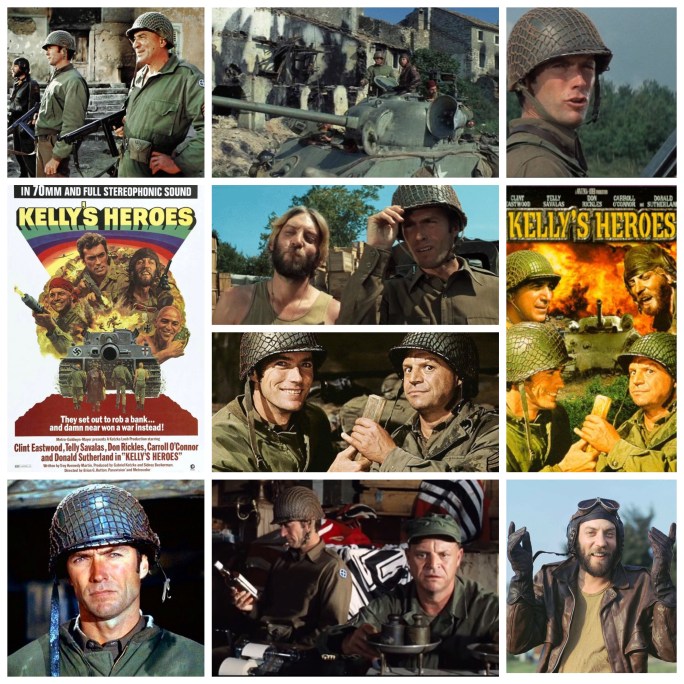
Among the multitude of heavy, doom laden war films that Hollywood has produced, its always nice to find a more lighthearted one like Kelley’s Heroes, an old Clint Eastwood vehicle that plays like Ocean’s Eleven during the fog of WWII, a peppy heist flick that has always been an old favourite of mine and features a specifically chosen, idiosyncratic cast of perennial old school tough guys. Eastwood leads a ragtag platoon of renegade allies through torn up France, and as soon as they get wind of a potential stash of ample nazi bullion somewhere in the region, their course turns in favour of the biggest payday of their lives. That’s pretty much all there is in terms of plot, but with a group this charismatic there’s never any downtime or boredom. Telly Savalas fills in the second in command tough guy role, Don Rickles inhabits his uniform like a little gold hungry gremlin as their explosives expert, but it’s Donald Sutherland who really steals the show as Oddball, a hippie who lives up to his name and serves to personify the film’s reckless, cheerful anti-establishment persona. Eastwood has fun with the material, letting a knowing grin sneak through that stoic visage, it’s an awesome rebel leader role for him and he clearly has a blast. There’s battles, chases, shootouts and it all culminates with a spectacular showdown in a small French village, in whose bank the gold is stashed. Two German tiger tanks stand guard, Kelly & Co. slowly trundle through the village and up to the doorstep, an apprehensive silence fills the air and it’s the perfect calm before the storm setup for the warfare to follow, almost like something Sergio Leone dreamed up. This plays like The Dirty Dozen on a lazy Sunday, violent but not too gritty, fast paced but never too kinetic, funny but never outright parody, it’s one of the best in Eastwood’s canon and a solid war flick. I enjoyed the recurring song ‘Burning Bridges’ by Mike Curb Congregation, a breezy tune that serves to remind us that although this is set during wartime, we’re here to relax and have fun.

-Nate Hill

Dominic Sena’s Gone In 60 Seconds

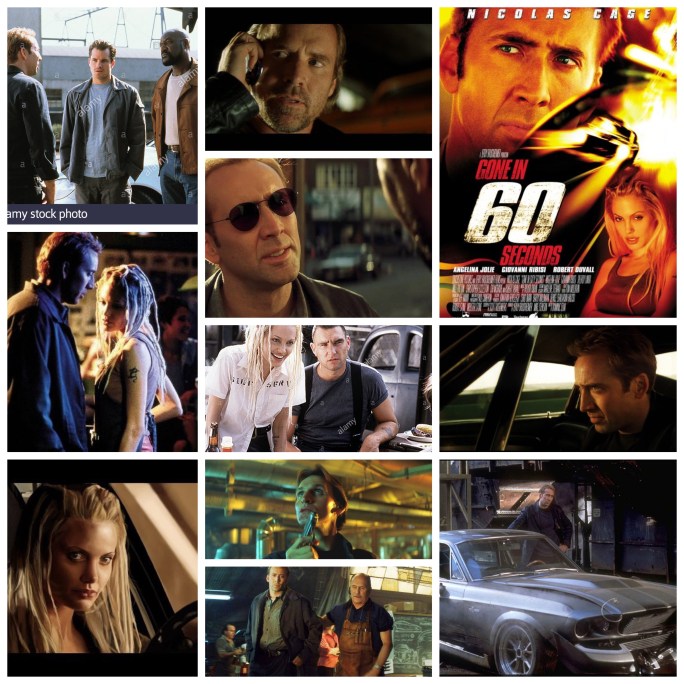
I’ve always liked Gone In 60 Seconds, even if it is one of the more lukewarm notches in Jerry Bruckheimer’s belt. Helmed by Dominic Sena who comes from a music video background, you get what you’d expect from a craftsman like that in the way of a flashy, eye catching popcorn flick that sees an easygoing Nicolas Cage as Memphis Rhaines, a car thief guru culled out of retirement when his dipshit little brother (Giovanni Ribisi) gets in deep with a dangerous UK mobster (Doctor Who). It’s the perfect setup for one long night of auto boosting as the villain gives them a laundry list of sweet cars to steal and ship out of the port by sunup or they end up as fuel for his scary flame factory/junkyard thing that these guys always seem to own and live in. The real fun is in seeing Cage put together an eclectic team of fellow thieves to work their magic, including Will Patton’s slick veteran booster, Scott Caan playing yet another insufferable horn-dog, Robert Duvall as a sagely old fence, Vinnie Jones as the strong silent muscle and Angelina Jolie as the motor mouthed tomboy who inevitably ends up in the saddle with Cage. They’re all hunted by two detectives, one an intuitive veteran (Delroy Lindo) and the other a misguided rookie (Timothy Olyphant) who always are naturally one step behind them, and so the formula goes. The cars are indeed pretty cool, especially Eleanor, Rhaines’s fabled unicorn automobile that happens to be a gorgeous matte silver Shelby GT with a seriously sexy purr. The supporting cast is solid and includes William Lee Scott, James Duval, Chi McBride, Michael Pena, John Carroll Lynch, Master P ad Twin Peak’s Grace Zabriskie as Cages’s feisty mom. This isn’t a knock your socks off flick or anything revolutionary in the genre, but it cruises along with an easy swing, carefree urban vibe and the actors, as well as Sena’s sharp and snazzy visual editing make it fun enough. Oh and it doesn’t get much cooler than those wicked opening credits set to Moby’s Flower, that’s how you lay down a mood for the film to follow.

-Nate Hill

Darren Aronofsky’s Noah

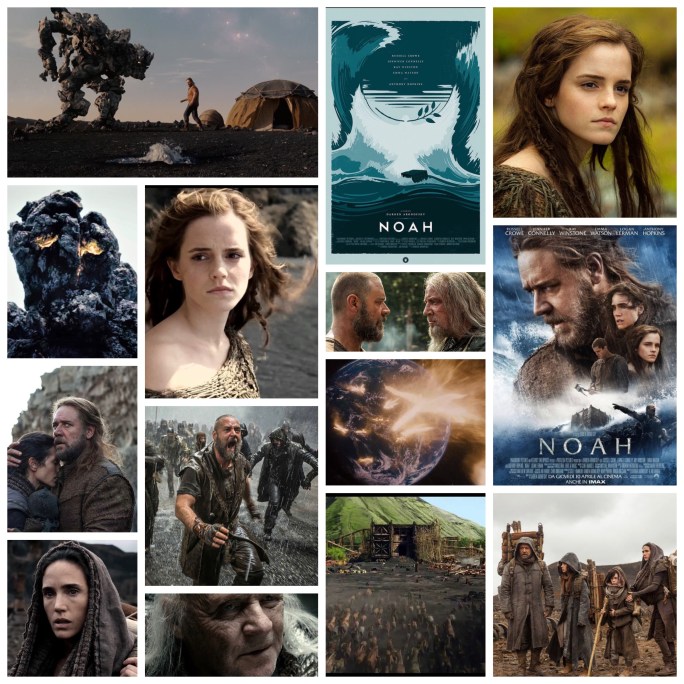
Darren Aronofsky’s Noah is an odd one, a film that I enjoyed for the fact that it somewhat cuts ties to the biblical tale it bases itself on and does it’s own thing. The style and tone are so out of place and out of time that one could almost imagine this being set sometime far, far in the future instead of the distant past. Aronofsky introduced a very earthy, tactile and nature based aesthetic with his film The Fountain (which is my favourite film ever made), and he explores it further here, with time-lapse photography of plants growing, barren landscapes that suggest either a very young planet earth or a very old one and simple, elemental costumes that could be of both ancient ilk or post apocalyptic fashion. The story is quite literally as old as time, and given new life by a fantastic cast of actors starting with Russell Crowe as Noah, a man jaded by humanity and conflicted by forces beyond his own understanding. Jennifer Connelly, Douglas Booth, Logan Lerman and others play his family, one of whom knocks up Emma Watson, causing quite the controversy when the almighty creator commands Noah to build that ark before the monsoons come. Anthony Hopkins is the prophet Methuselah, and Ray Winstone’s Tubal Cain a rough hewn archetype of all of our worst qualities as a race. Coolest of all might are Frank Langhella, Mark Margolis, Frank Oz and Nick Nolte as some ancient looking stone golems who are actually angels sent down by the creator to shepherd humans when needed. It’s funny because Nolte is so grizzled and rugged in his old age these days he probably could have just played the role in person instead of voiceover, but as it stands the special effects used to bring them to life are spectacular, a standard that holds throughout the film from landscapes, props, wildlife and general visual mood. Now, I can never get behind Christian films or take them seriously, so it’s a good thing that Aronofsky remains at arm’s length from the religious stuff and takes a more mythological approach to the story in the sense that this could be happening in any world or universe, and isn’t tied down to one theology. Not a perfect film, but the arresting visuals, fantastic cast and overarching message of love and reverence for life in all forms make it something special.

-Nate Hill

Simon West’s The General’s Daughter

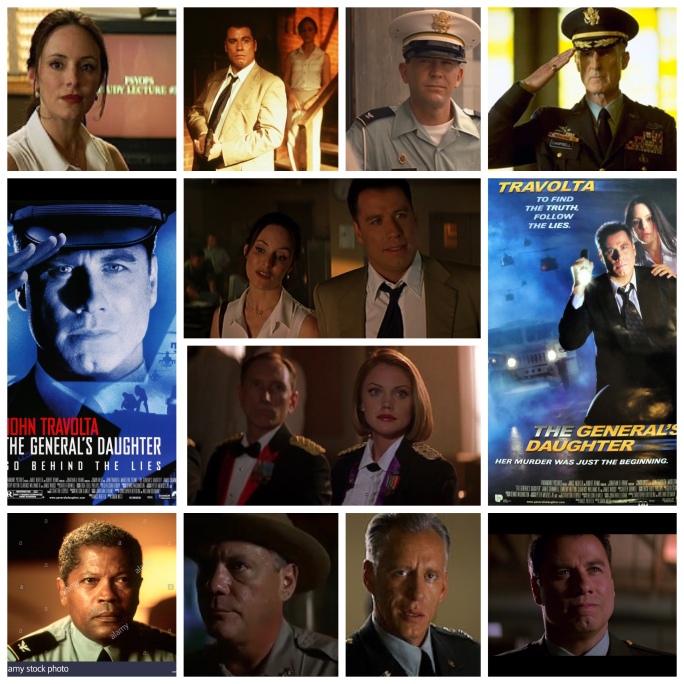
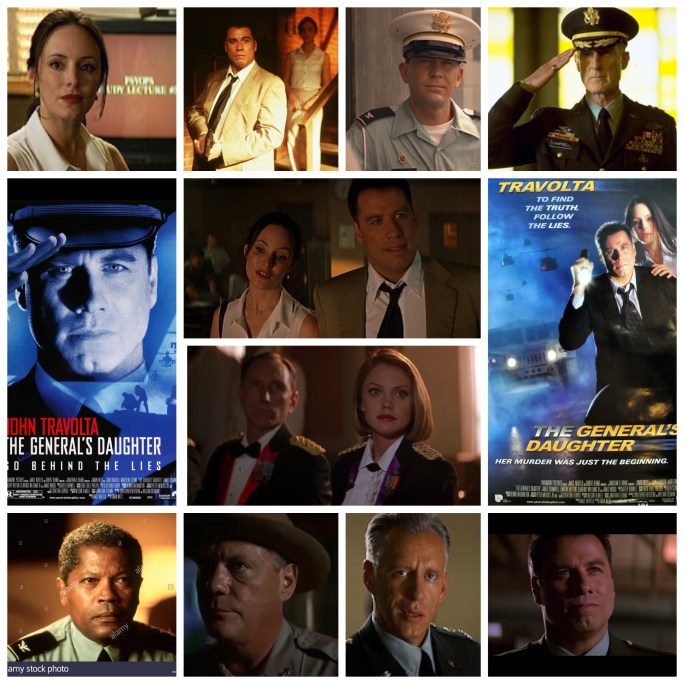
The General’s Daughter is one of those films that’s well acted and staged enough from a technical standpoint that the excessive, overcooked script, self righteous snark and needlessly perverse plot could almost be forgiven. Almost. This is a lurid, sweaty southern gothic military murder mystery, and as amazing as that sounds, it’s actually quite an unpleasant piece to sit through. Based on a book by Nelson DeMille (crown prince of airport novel thrillers), and directed by Simon West (Con Air), it’s given the subtlety of a sledgehammer and the nuance of a rogue missile. At least the acting is decent, starting with jumped up John Travolta as a private investigator called to a military base after the daughter of a powerful General (James Cromwell) is found dead on the property in… a compromising way. The suspects are lined up neatly like ducklings and include the General’s faithful aide (Clarence Williams III), an arrogant high ranking officer (James Woods, practically assaulting the dialogue), another officer on base (Timothy Hutton) who went to Westpoint with her and naturally the General himself. Travolta is joined by another investigator (Madeleine Stowe) who he has a romantic history with, because of course he does. They’re threatened by unseen assailants here and there, and stalled by a local redneck Sheriff (the late Daniel Von Bargen) who has it in for him. The investigation gets so weird, convoluted and messed up that it’s a wonder the writers could even keep track of their own work when scotch taping the third act together. When the inevitable flashbacks show up to tell us just what happened to her, we wish we didn’t know. The poor girl, played by Leslie Stefanson, is humiliated, brutalized and murdered in a way that’s miles beyond bad taste, totally unnecessary to show in graphic detail other than for the film to reiterate what a miserable display of ‘too much’ it is in every category. The scene doesn’t even stand to serve her character arc either, as we’re informed she has a history in S&M type shit. The depravity is there simply to exist on its own and turns a relatively run of the mill thriller into something deranged. It’s a spectacle, you won’t be bored, it’s well mounted and acted by a solid cast, but is it a good film? Nowhere close.

-Nate Hill