“Are you watching closely?” A review of The Prestige – by Josh Hains 

“Every great magic trick consists of three parts or acts. The first part is called “The Pledge”. The magician shows you something ordinary: a deck of cards, a bird or a man. He shows you this object. Perhaps he asks you to inspect it to see if it is indeed real, unaltered, normal. But of course… it probably isn’t. The second act is called “The Turn”. The magician takes the ordinary something and makes it do something extraordinary. Now you’re looking for the secret… but you won’t find it, because of course you’re not really looking. You don’t really want to know. You want to be fooled. But you wouldn’t clap yet. Because making something disappear isn’t enough; you have to bring it back. That’s why every magic trick has a third act, the hardest part, the part we call “The Prestige”.”

– Cutter (Sir Michael Caine); The Prestige, 2006

I’ve always been enamored by magic since I was a young boy. I don’t know how to perform any tricks and haven’t read dozens of magic books, but I’ve seen enough magic performed to validate my love for it. I’ve always enjoyed trying to decipher how a trick is pulled off. Sometimes I’m right, sometime I’m wrong. That’s the name of the game. In the case of The Prestige, Christopher Nolan’s 2006 masterpiece, I’ve spent the last couple years on and off deciphering the movie as best I can. A part of me doesn’t mind the ambiguity, and doesn’t need to solve the puzzle. The other half just had to solve it. I believe I have the movie figured out better than most, but whether or not I finished the puzzle isn’t the point of the movie. The point is entertainment, and I think The Prestige is amongst the finest entertainment you’ll find in cinema.

Apprentice magicians Robert Angier (Hugh Jackman) and Alfred Borden (Christian Bale) work under Milton The Magician (Ricky Jay), frequently acting as fake volunteers for Milton in 1890’s Victorian London. Julia (Piper Perabo), Robert’s wife and an escape artist, drowns while trying to escape from a water tank with her hands bound when Alfred ties the necessary slipknot too tightly. She’s gone before stage engineer (or “ingenieur”) John Cutter (Sir Michael Caine) can break the glass with an ax. This tragic event sets into motion a bitter and violent years long rivalry, each man trying to one-up or sabotage the other.

During this time, Borden marries Sarah (Rebecca Hall), and together they have a child, their daughter Jess, while Angier launches his own magic career with Cutter and new assistant Olivia Wenscombe (Scarlet Johansson), and Borden perfects a new trick dubbed The Transported Man. The trick bewilders Angier, but Cutter is unimpressed, suggesting Borden uses a double to complete the trick. Angier finds that solution too obvious, and becomes obsessed with finding the answer at seemingly any cost. Through a series of unfortunate events, both Borden and Angier find themselves in possession of the other’s personal journals that hold the ins and outs of how each trick is performed. Borden’s journal leads Angier to Nikola Tesla and his assistant Mr. Alley (the late David Bowie, and Andy Serkis, respectively), in the hopes they hold the key to replicating Borden’s trick.

The Prestige reminds me of a Jenga tower. Remove the wrong piece and the entire thing comes crashing down, remove the right piece and it stands tall for a while longer. At any moment the film could derail if all the plot threads weren’t tied up nearly with a bow, and yet for me it never does derail. Remove the script from your mind for a moment. Are the performances great? At least 3 are Oscar worthy. And the cinematography, score, set design, and costuming, how are they? Immaculate as one might expect from Nolan and his trusted team. And the script, what do you think of it? Delightfully complex, thought provoking, and fresh. For me, there aren’t any cracks in the glass.

About that ending. The film gives you clues as to how the lives of both men will turn out. One is willing to kill a bird and present a new one to the audience in its place, the other willing to save the bird and re-present it to the audience. Bearing that in mind, the possibility exists that one of the two men acquired a machine capable of successfully duplicating a person, much like a pile of hats and black cats (“They’re all your hat.”). The first duplicate is killed, then every night for 100 nights straight, the man performs the “Real Transported Man”, constantly duplicating himself and either he or one of his duplicates winding up in a tank of water below the stage they perform upon. Perhaps the true prestige is that the other man pulled his trick off using a twin brother, while the other sacrificed his life and the lives of duplicates for the look on people’s faces when they witness his great trick.

Perhaps the solution is simpler, and the machine never worked to begin with, and Tesla was just a distraction from the real trick, the use of a double. And perhaps when that man found out he’d been tricked, he chose to use a double from prior engagements, a drunkard stage actor, to help pull off his great illusion, and no one ever drowned until the night his rival came up on his stage. Maybe a trick lock was always used beforehand and replaced with a real one to setup the rival. Maybe the duplicates seen in a morgue or standing erecting in water tanks at films end are nothing more than wax figures. And maybe the revelation that his rival used a double all along makes his efforts seem fruitless in his final moments. Maybe the prestige of the film is that simple yet no one wants to accept it because of the simplicity, and certain science fiction infused elements like a machine capable of duplication are far too compelling and obvious a solution to be ignored.

Maybe we’re not meant to solve the mystery, just be driven mad by our own obsessions with it. Maybe we’re all Angiers.

“I didn’t leave you.” The Hains Report Presents: A review of The Sixth Sense – by Josh Hains

You need not worry, I won’t spoil the ending.

I never knew what happens at the end of The Sixth Sense until either late 2005 or sometime in early 2006. I found out the ending of The Sixth Sense when I was reading an adaptation of the film that I’d found in my high school’s library when I was in my first year. I was 14, and more than a little foolish. I read the first 3 chapters of the book (perhaps a fourth, perhaps even more but I can’t recall), and was then hit with the idea that I had guessed the ending based on what I’d read. I flipped to the end of the book and read the ending, found my guess validated, then placed it back on the shelf and never looked back. Just last year I watched the film for the first time. Oddly enough, despite knowing the ending years prior, I somehow felt a sense of shock wash over me as I watched the scene unfold in front of my eyes. Watching it for a second time over this past weekend, the ending still held the same impact. Proof you can know the ending of a movie and still be surprised by it on more than one occasion.

I observed that The Sixth Sense isn’t much of a thriller it was pitched to audiences as being (not straight horror either), but rather a ghost story where good people fall prey to those who torment them from beyond the grave. The latest victim of ghosts is the young boy Cole Sear (Haley Joel Osment), who claims one night to “see dead people”. Many believe that children are more susceptible to seeing ghostly apparitions than adults, and Cole is no exception, scribbling or screaming the ravings of ghosts he has terrifying eencounters with. I don’t know who’s more afraid, he of the ghosts, or his mother Lynn (Toni Collette) for his safety and mental well being.

Cole’s psychologist becomes Dr. Malcolm Crowe (Bruce Willis), who we first meet at the start of the film when a former patient shoots Malcolm, then himself. Malcolm seems defeated these days, tired and worn out from work and life in general. His wife Anna (Olivia Williams) doesn’t seem to notice he’s even around, barely utters a word or gives a look in his general direction. Maybe she’s having an affair. Perhaps the trauma from that night was too much to bear for her. Maybe Malcolm was never the same after.

Malcolm seems to approach Cole and his predicament with a “Sure, whatever you say kid” demeanor. It seems fair to me that Malcolm has this attitude, he probably doesn’t believe in ghosts and is just going along with whatever Cole says because he knows he needs guidance, without ever appearing condescending toward him. I doubt I’d believe the root of the issue is ghosts either, just a troubled soul in need of nurturing. Malcolm shares the same perspective, and is more than willing to help where he can. In turn, Cole helps Malcolm a little too, telling him to talk to his wife while she sleeps, because “That’s when she’ll hear you.” I don’t know who my heart bleeds for most.

Haley Joel Osment showed us 18 years ago that he was a force to be reckoned with even as a child. He wasn’t playing the typical child role where you just look cute, act silly for the camera and get your lines out with some amount of authenticity. No, here in the Sixth Sense, he actually has to act, and convincingly plays a good kid plagued by appearances of gruesomely murdered ghosts. When he’s afraid, we believe he is. When he’s sad, our hearts break. Neither he nor Willis overshadow each other, and the two have a chemistry that feels authentic and adds layers to the nature of their relationship.

Bruce Willis is a rare down to earth actor, always wearing his heart on his sleeve. He doesn’t over play his hand here, he never gets wild or over the top. Again he’s down to earth, as well as honest and subtle. In my two viewings of the film, I have almost entirely forgotten at various points that the man on screen is in fact Bruce Willis, mostly because he’s not playing the typical Bruce Willis role. Gone is any sense of his star persona or real life personality. He is just Malcolm Crowe, and I believe it. Much of the best acting of Willis’ career can be found split between The Sixth Sense and Unbreakable (his second collaboration with M. Night Shyamalan after this film), and oddly enough the best acting I’ve seen from him comes in big reveals toward the end of each film. In the case of Unbreakable, it’s when David Dunn silently reveals to his son that he’s the lone saviour of two kids whose parents were murdered by a local psychopath.

Here in The Sixth Sense, it’s the sequence in which Malcolm comes to truth with some harsh realities, none of which I will spoil here. I’m sure you’re aware of what happens by now, and if you haven’t seen the movie and don’t know the famous ending, I implore you to give it a look, you just might love it. Willis doesn’t dip into manic theatrics or parody when the truth is uncovered (though he easily could have), he remains truthful to the performance he had been giving beforehand and to the character of Malcolm, which helps to ground the movie in a believable reality.

As for that ending itself, it’s one of the few Hollywood twist endings that works, and works well enough 18 years later to be considered one of the true great twist endings in film history. Admittedly, when I read it in that book all those years ago, I was surprised by the boldness of such an ending. It’s not very often a movie ends on such a bold note, in a way that pulls the rug out from underneath you, yet invites you to come back for another visit and see things from a newfound perspective. Maybe you’ll see dead people too.

Dunkirk: Christopher Nolan’s latest is an unforgettable masterpiece – A review by Josh Hains

“We shall not flag or fail. We shall go on to the end. We shall fight in France, we shall fight on the seas and oceans, we shall fight with growing confidence and growing strength in the air, we shall defend our island, whatever the cost may be, we shall fight on the beaches, we shall fight on the landing grounds, we shall fight in the fields and in the streets, we shall fight in the hills; we shall never surrender.” – Winston Churchill

Most, of the war films I’ve seen post Saving Private Ryan have been about American soldiers and the battles they’ve fought during World War II, Vietnam, and more recent wars, save for the war sequences of Atonement. It was refreshing to see a World War II film yesterday afternoon that was shown from the perspective of British soldiers, and with the German enemy only shown for just barely a few seconds. It’s a perspective we used to encounter often decades ago that for one reason or another fell to the wayside. Hopefully this masterfully crafted piece of cinema will encourage other directors to widen their landscapes and tell more stories from the British perspective, or perhaps even the French or another allied nation.

By now you have no doubt seen many talking up a storm about this year’s undeniable “masterpiece”, and that it should be a major Oscar contender for Christopher Nolan when the season hits its stride in a few months. I dislike using the word masterpiece to encapsulate all of my positive thoughts about any given movie, and I feel it is quite often improperly attributed toward movies that aren’t actually considered masterpieces some years after they’re released. Film culture has this odd habit of using a wide assortment of colourful, hyperbolic wordage to emphasize how good a movie is during its first couple of weeks in theatres, yet the majority of movies dubbed a masterpiece during Oscar bait season seem to fade into obscurity. But the film being heralded as a masterpiece over the last week, I believe wholeheartedly, will be regarded as such decades from now and for a worthy variety of reasons, but most of all because of the way the imagery lingers within your mind like dirt under your fingernails.

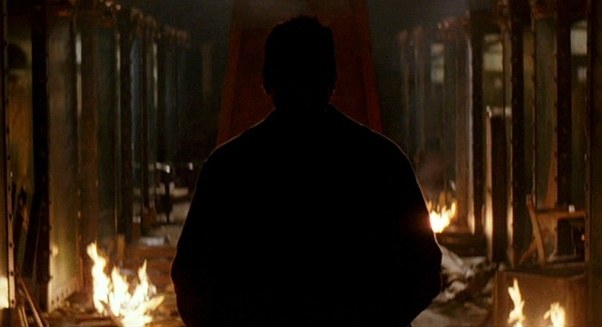
There’s an image I can’t shake no matter how hard I try, of a man looking upon a fire that’s been, for lack of a better word, burned into my mind since the moment my eyes bore witness to it. If I close my eyes, or think of it in my minds eye, I can see it as clearly as if it were happening right in front of me in this very moment. To be honest, I can see nearly the entire movie that clearly, I remember much of it so well having seen it just under a day ago, but it’s images of smaller moments that seem to have been etched into my mind with a hot knife better than others. One would think the more traditionally spectacular moments, of boats exploding and planes being shot down, would stick out in one’s mind the way they always seem to with other war movies, but surprisingly, and refreshingly, that just isn’t the case here. No, I remember the man watching the fire grow as the sun sets, a trio of young men watching a fellow soldier wade suicidally into treacherous waters, a pilot running on fumes while gliding past thousands of men on the beach as they cheer.

Dunkirk is a war film comprised of small moments such as those that, when put together in the form of a complete picture, creates the sensation of a much larger war epic without ever having to actually become one. Yes, it’s a war movie that shows us Christopher Nolan’s perspective on Dunkirk, but it’s not about the war itself, but rather these small moments within the war and the collective struggle of soldiers and common folk affected by the event, and the personal toll the war takes on every soul who had the misfortune of experiencing it.

Much has been made about a lack of a single protagonist for audiences to latch onto and invest themselves in, as if the lack of such a character is a major deprivation for audiences that’ll leave you feeling cold and emotionally detached from the movie. That’s just not true. Dunkirk is about the collective experience of the soldiers and civilians who were a part of this event, and by not choosing a single person to use as our guide through this hellish experience, Nolan allows the audience to feel like they’re right there amongst the soldiers and sailors as planes swoop overhead and bombs periodically detonate with horrific results. No one character is glorified or given the special treatment by Nolan, and thanks to his wise decision to interweave three different perspectives non-linearly together, each and every act of courage or bravery that he focuses on regardless of the immense stakes surrounding them, are treated with equal importance.

I am thankful I am not one of those people who had difficulty following the non-linear presentation of the film. While watching Dunkirk I felt that the non-linear style only amplified the suspense I was feeling, making me clench my fists tighter and my knuckles turn whiter. I enjoyed the sensation of being tossed around from one situation to the next, trying to guess what direction I’d be travelling in until the three interweaving perspectives collide toward films end, and  the pieces come together perfectly like a puzzle.

The opening scene of soldiers including young Tommy (Fionn Whitehead) running down a street trying desperately to escape enemy gunfire before finding the mole of Dunkirk harbour where Commander Bolton observes the chaotic situation while soldiers like Tommy repeatedly try to escape the clutches of the beach over the course of a week, sets the tone of the movie immediately: frantic, intense, terrifying, sudden. We spend a day upon the Sea where Mr. Dawson (Mark Rylance), his son Peter ( Tom Glynn-Carney) and their young deckhand George (Barry Keoghan) pluck soldiers like the Shivering Soldier (Cillian Murphy, and yes, that’s what he’s called in the credits) and the RAF pilot Collins (Jack Lowden) from the depths of the icy waters. Then there’s an hour in the Air where Farrier (Tom Hardy) chases down German Messerschmitt planes in his Spitfire, halting most of their attempts to bomb boats.

I’m also thankful I heard every line of dialogue crystal clear, well enough to accurately identify Michael Caine as a radio communicator for the Royale Air Force. Admittedly, I heard the explosions and gunfire so loudly I jumped a few times when the overwhelming sound caught me off guard. Many continue to emphasize the need to see this film in 70mm IMAX, but I believe that regardless of what format you choose, it’s the experience of seeing Dunkirk theatrically that is necessary, and perhaps not so much the format, though it helps if the screen you’re looking at is bigger than most. As great as our surround sound has gotten for use in our homes, nothing will ever compare to seeing this film on the biggest screen you can find. When the sound of a Messerschmitt comes roaring from behind you, then almost sounds like it’s passed overhead before screaming way out in front of you, it genuinely feels like the closest thing to actually being there that any of us will ever encounter, and it’s absolutely terrifying. When soldiers are forced into the water, typically in fleeing from a sinking vessel, you can almost feel, smell, and taste the frigid waters. And when bombs are dropped and gunfire erupts, both at near deafening decibels, you can’t help but tense up as if one of the bombs or bullets might collide with you. It’s an immersive experience you really need to experience for yourself to believe and understand the full extent of.

The actual images of the film are less terrifying than the sounds of explosions and machine gun fire, in part because Nolan leaves the film devoid of blood beyond a few cuts and scrapes, a decision that had even myself second guessing how he might make this work. Once you understand that Dunkirk is a psychological war film that asks you to ponder what you’re watching rather than simply bombard you with heaps of exposition and gory carnage aplenty, you realize there really is no need for an R rating for this picture. Dunkirk is just an hour and 46 minutes long, lean and devoid of unnecessary fats comprised of character beats, long and frequent exposition dumps, and bloody war horrors, and all the better for it. This film didn’t need to be longer or shorter than it is.

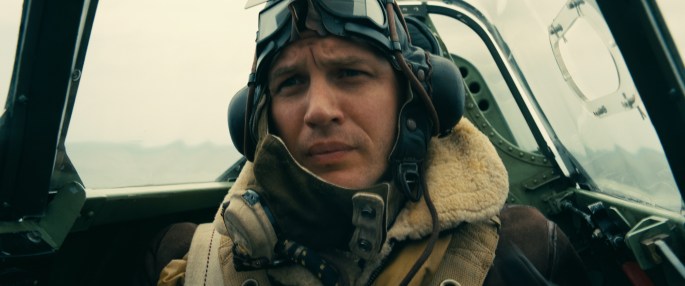
I don’t have any qualms with Dunkirk at this juncture (the qualms others have encountered I don’t have), and while I love everything I saw in the film and greatly admire the ensemble cast’s performances, from Fionn Whitehead to Kenneth Branagh, Mark Rylance, and others and the scenes they all inhabit, it was the perspective titled The Air I felt the deepest investment in. That’s not a knock against the other scenes, I just found The Air more hypnotic than anything else in the film, mostly due to the truly stunning cinematography from Hoyte van Hoytema (seriously, every frame of this film is gorgeous and should be framed and hung in a museum), and Tom Hardy’s near silent performance (he has maybe 10 lines of dialogue in total). It didn’t occur to me until today that after a certain point in the film, Tom Hardy’s Farrier never speaks again. That Hardy conveys outwardly and through his eyes (because he wears yet another mask in Dunkirk) everything Farrier is thinking in the moment is in itself is quite the accomplishment, and only goes to show just how great an actor Hardy has become. That his scenes are the most riveting and awe inducing sweetens the deal.

The first thing my mind floats to when I think about Dunkirk is still the image of a man watching the fire grow on the beach, as clear as if it happened just a moment ago. The sky turning charcoal, the flames glowing against the sands and his face, his stern expression showing accomplishment and sacrifice in the same breath, the wind snapping against his skin and tossing his hair, his story coming to an end moments before the film does. I know I’ll see Dunkirk many more times, but if I only saw it just once, I’m willing to bet I’d remember that image for the rest of my life.

“Your name’s Baby? B-A-B-Y Baby?” – A Review of Baby Driver by Josh Hains

“You’ve never seen anything like Baby Driver before”, the major critics say, and everywhere you look online the average movie goer agrees to the tune of a $30 million dollar opening weekend haul. They’re right you know, you really haven’t seen *anything* (and I do mean a-n-y-t-h-i-n-g) like Baby Driver before. Don’t believe me? Keep reading.

Sure, we’ve all seen countless of westerns and crime thrillers where the main protagonist claims they’re done with that brutal life after the fateful “one last job”, only to get sucked back into that world like Michael Corleone in the Godfather Part III. “Just when I thought I was out…they PULL me back in.” That storyline seems to have been done to near death, hell, even Logan used it earlier this year, and yet here it is once again in a totally refreshed way.

We’ve seen intricate car chases before, like Frank Bullitt roaring down the streets of San Francisco with sly hitmen on his tail, or “Popeye” Doyle weaving through chaotic traffic trying to keep up with a a sniper aboard an elevated train (The French Connection), or Ryan O’Neal’s the Driver outrunning cops in hot pursuit of the thieves in the back seat of his getaway vehicle (The Driver). Don’t worry, I may not mention about a dozen other worthy titles, but they’re here in spirit. We’ve seen plenty of amazing car chases, but have you ever seen one synchronized to a song before? I didn’t think so.

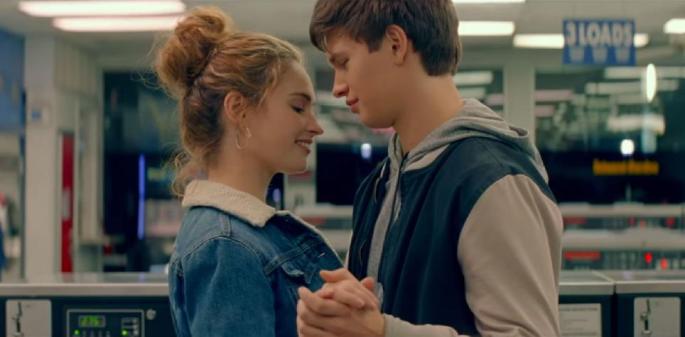
And we’ve seen many an A-list cast deliver snappy dialogue that Quentin Tarantino could bathe in, and the kinds of edgy, tongue planted firmly in cheek performances one might expect from a pulpy neo-noir fantasy conjured up by Tarantino himself. But just when we think we’ve seen it all, someone like Edgar Wright shows us we haven’t. baby_driver_ver15_xxlgBaby Driver follows the titular Baby (Ansel Elgort), a young getaway driver who works for Doc (Kevin Spacey) to pay off a debt he owes him for trying to steal his car years ago. Baby lives in a crappy apartment with his deaf-mute foster father Joseph (CJ Jones) while Doc makes a pretty penny using different crews to rob banks and post offices, including the unpredictable psycho Bats (Jamie Foxx), sexy couple Darling and Buddy (Eiza González and Jon Hamm), and Griff (Jon Bernthal), and Baby is always his lucky charm getaway driver. Baby has severe tinnitus from a childhood car accident which gave him a hum in the drum that he drowns out with an endless barrage of ear-worm inducing catchy songs, from The Commodores’ Easy, Barry White’s Never, Never Gone Give Ya’ Up, to Queen’s Brighton Rock, and yes, even a song or two with Baby in the title. I happen to have no less than six of the songs stuck in my head including Tequila by The Button Down Brass and Golden Earring’s Radar Love, thanks to a viewing of Baby Driver last night. I’m not complaining. Baby meets Deborah (Lily James), a sweet waitress working a cozy diner he frequents, and of course falls head over heels in love with the girl and vice versa. Baby wants out and fast, but alas, dirty work calls and he goes, but before he knows it things have gone south and fast, thrusting Baby into a desperate race to get outta dodge before things go from bad to way, way worse.

To say anything more about the plot would be downright stupid of me for obvious reasons, but especially because Baby Driver is definitely one of those “the less you know, the better” type movies, though not because of plot twists (though there are quite a few, and you probably won’t see all of them coming from a mile away), but because of the way Wright lets the entire movie unfold completely synchronized to that catchy, finger snapping, foot tapping soundtrack. Yes, the visuals timed with the music and how that affects you as a viewer overall is best left to the imagination, the surprise well worth the admission cost. The film opens quite magnificently with a heist that moves to the eclectic beat of The Jon Spencer Blues Explosion’s Bell Bottoms (Spencer himself has a brief cameo), with Baby singing and wildly groovin’ along in the car to the stellar tune before he pedals to the metal for the next several minutes to evade a rather large entourage of cops. It’s a fine example of the synchronicity I’m talking about, the masterfully blended fusion of stylish visuals, raw 100% practical stunts, and perfectly picked songs. It sounds good on paper, but it plays as wonderfully as any musical number in La La Land, and immediately sets the tone for the rest of the movie. A foot and car chase later in the film nearly had my jaw on the floor as I tried to wrap my mind around how Wright had so perfectly choreographed the entire thing. Of course, simply talking about this stuff doesn’t do it any justice, you truly have to see it to believe it. 

landscape-1491917013-screen-shot-2017-04-11-at-142420

By now you’ve noticed I haven’t critiqued Baby Driver in any way, and there’s a good reason for that: I can’t think of a single thing worth complaining about. I’ve run over the entire movie in my mind and there’s not one thing I saw in the movie that would register as a flaw of some magnitude. Nothing, not a single thing. A death sequence felt just a tad bit too silly, but is that a big enough complaint to warrant my bitching about it? Hell no, I forgot that ultra minor quibble while writing this review, so that can’t be that important to me. Does that mean Baby Driver is what you might call a perfect movie? Not necessarily, I know some people wish it allowed a deeper look into the psyche of the totem pole-esque Baby, some dislike the brief screen time of a beloved actor, and I’m sure others have nitpicks I don’t even want to think about…but from where I’m standing I don’t see why it couldn’t be classified “perfect”.  

Support original film making and go see Baby Driver the first chance you get, and don’t forget to buckle up, it’s one helluva wild ride from the very first second until the final frame snaps to black. baby-driver-movie-5.png

‘Logan’ Review: Hugh Jackman’s final Wolverine film is a bloody, heartfelt farewell to the last X-Man- by Josh Hains

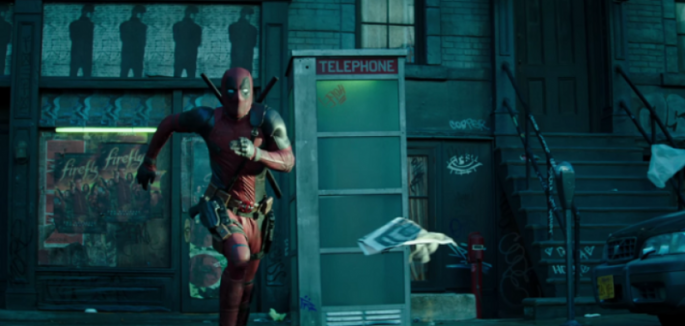
Before I break into the review portion of this piece, special mention must be made of the alleged cut scene from Deadpool 2 that serves as a preview or teaser of sorts for the upcoming sequel to the R rated smash hit. I greatly enjoyed experiencing the company of the darkly comical Merc With A Mouth once again, to the tune of John Williams’ epic Superman: The Movie score, and the song that closes out the late Tony Scott’s underrated True Romance. What a fun little riot, a pleasant albeit all too brief little tease of the pleasures to come. Cue the music!

deadpool-2-trailer-release-date-800x381

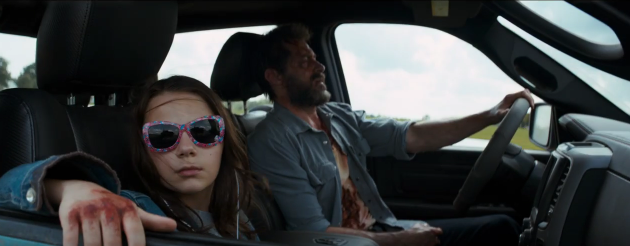
In 2029, the ageing James ‘Logan’ Howlett (Hugh Jackman) is a pale shadow of the once iconic mutant hero he used to be, Wolverine, popularized in comics that both exaggerate and sanitize the truth. Mutants are extinct save for Logan, Professor Charles Xavier (Sir Patrick Stewart), and the albino mutant Caliban (Stephen Merchant). A mutant birth hasn’t been recorded in 25 years either. Logan is an alcoholic, sporting a visible limp and a frequent cough, and a cynical, cantankerous, almost always pissed off demeanor. He’s kind of an asshole now. His body is slowly breaking down thanks to the cancerous adamantium that covers his entire bone structure and trademark claws, his wounds healing slower and leaving big ugly scars. He’s also plagued by nightmares if the brutal acts committed against and by him. At 200 years old, Logan has experienced multiple lifetimes of violence, tragedy, loss, heartbreak, and grief, the result of which coupled with his age, has broken the poor guy’s soul. He lacks the conviction and strength to get through each day, hence his worsening alcoholism and overbearing cynicism. Life has truly beat the hell out of Logan, yet he presses onward. If an adamantium bullet doesn’t kill him, time, our own worst enemy, surely will. Eventually. By this juncture in Logan’s life, violence isn’t just a way of dealing with other violent beings, it’s become a part of who he is, as if a genetic code for violence is coursing through his veins.

Logan works day and night as a limousine driver in Texas for the kind of drunken party girls who like to flash the driver, and foolhardy guys that dickishly chant jingoistic phrases. His work provides him with just enough cash to afford him the medicine he and Caliban require to help control a neurodegenerative disease that produces seizures Charles is suffering from, the result of which if left untreated renders anyone in the vicinity, save for Logan, temporarily paralyzed, or dead. They live in seclusion in a dingy private smelting plant in Mexico, until their relatively peaceful existence is shattered by the arrival of a merciless cybernetically enhanced assholes called the Reavers. They’re led by Wolverine fanboy and henchman Donald Pierce (Boyd Holbrook), and Zander Rice (Richard E. Grant), a bioengineer and Donald’s boss. They’re seeking the mute Laura aka X-23 (newcomer Dafne Keen), an 11 year old mutant who bears eerie resemblance to Logan. I think we all know why. A brutal encounter sends the trio on their way to Eden, a supposed place of salvation for young mutants in North Dakota, with the Reavers hot on their trail. Yes, this is a road movie but don’t worry, it’s a great one.

I’ve been an X-Men fan since I was a little kid, watching the ’90’s animated series on television, watching every live action movie adaptation, and collecting action figures and comic books along the way. I don’t have anything against PG-13 movies or comic book movies, with the sole exception that the rating limits on-screen violence. I’ll gladly watch jokey, fun superhero flicks any day of the week, a few of which even populate my own favourite films list. But Logan required an R rating to get across the precise tone director James Mangold and Hugh Jackman have been aiming for over the last few years. Just like many other fans, I’ve been waiting 17 years to see Wolverine finally cut loose and tear people to shreds the way I’ve always known he can, because foot-long metal claws from the strongest metal on the planet (in their reality), don’t just poke the bad guy – they dismember, disembowel, and decapitate. Rest assured, he finally does in Logan.

logan-wolverine-3-hugh-jackman

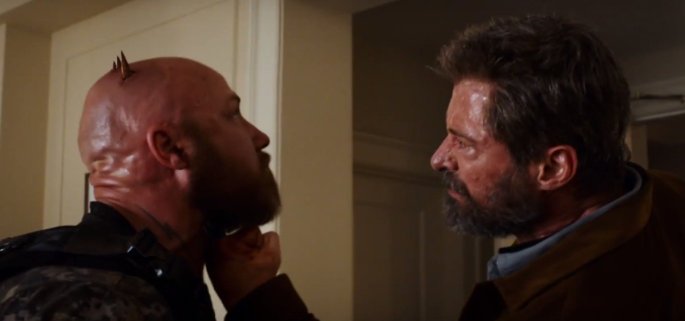
The rumours are true, Logan is packed with plenty of bloody violence, far from tame, and with enough blood soaked carnage to satisfy even the most bloodthirsty gore-hounds. Heads roll, limbs fly off, threats are ripped open wide, and buckets of blood are spilled as Logan finally delivers a whopping heap of berserker rage fuelled killings throughout its 135 minute runtime, especially in two scenes of 100% pure classic Wolverine berserker rage that will blow minds. Two fight scene in particular, one midway through the movie, and the other the bloodstained finale, offer up some of the most intense, brutal, and graphic comic book movie violence committed to film. These two scenes in  particular are stand-out action set pieces due to the physical and dramatic weight the R rating allows them to possess. When Logan becomes physically drained, weakened by multiple gunshots (*spoiler alert* or stabs wounds from an experimental clone of himself *end of spoiler*), we feel his exhaustion through his body language and facial expressions. When he or Laura are dispatching foes left and right, we feel the primal anger and blood lust. A PG-13 movie could never have that dramatic heft to it. Logan also bears a significant amount of profanity, enough to rival last year’s similarly R rated comic book movie hit Deadpool, but unlike that movie, profanity isn’t used like a comedic tool to up the wattage of vulgarity as was needed. Rather, the frequent uses of the f-bomb accentuate the anger and frustration the characters (Logan in particular), are experiencing at any given moment. Logan isn’t for the faint of heart, but there’s more to Logan than just gory violence.

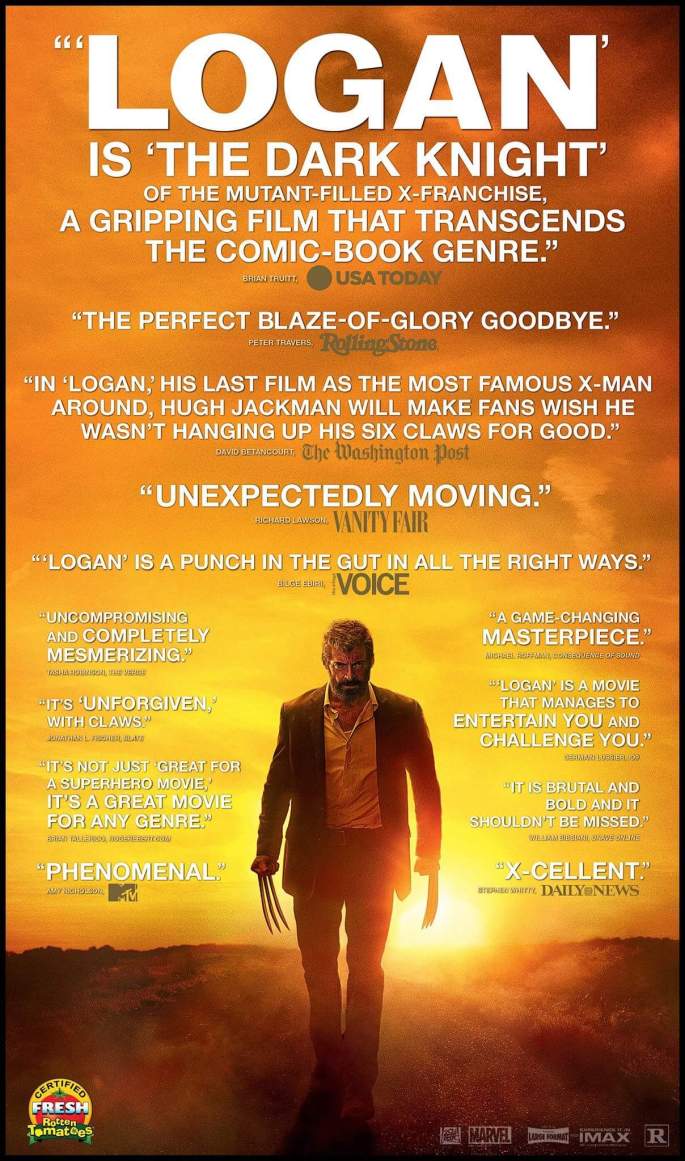
Hugh Jackman deserves an Oscar for his performance as Logan. I’m not just saying that for the sake of it. Hugh has never given a more layered, meaningful, naturalistic performance in the 17 years I’ve been watching his movies. If Logan is a truly his final outing as the iconic character, I don’t think he could have given a better performance than what you’ll see in Logan. The script by Mangold and co-writers Scott Frank and Michael Green, along with that R rating, affords Jackman the opportunity to work with dialogue and scenes that at ask for more of dramatic work than physical, allowing Hugh to go to places he wouldn’t otherwise be able to reach. It’s the work of an actor who knows this character better than anyone else outside of his creators, who isn’t simply playing a role, but living within the skin of him. He is our Logan, through and through in every way in this subtle, deeply human performance. Sir Patrick Stewart has never been better as Charles Xavier, and acting on the assumption that this is also his final turn as his iconic character, as reported in recent days, I couldn’t have asked for a more fitting end to his reign. Dafne Keen needs an X-23 movie pronto, she’s so good for such a young newcomer. Boyd Holbrook makes for a menacing villain, his smooth talking Texas accented Donald acting as quite the ice cold delight in a sea of CGI, oversized doomsday super villains, and Richard E. Grant gives multiple dimensions to his Zander, bringing a welcomed honesty, tenderness, and sheer cruelty to what could have otherwise been a thinly developed villain.

17097525_1294482667310470_5932397460279918760_o

At first glance, Logan is a comic book movie meant to bring a satisfactory yet heartbreaking end to a 17 year long career and story arc spent on the iconic hero. Peel back the layers and it’s a redemption through justice and revenge western tale, the kind kind of story carried through history books for centuries to come. Logan is right from the get-go, a classic western yarn, and the best kind too. The kind of western where a tired gunfighter has to take up their guns one last time in the name of frontier justice. The western frontier may be gone, but the idea of the stubborn hero who needs persuading still exists, right down to the classic Shane appearing on a hotel television.

That Logan uses a couple of the same tropes seen in westerns decades ago doesn’t mean the film is a slave to those tropes, as Logan firmly stands on its own two feet as a unique amalgamation of comic book fantasy, the classic western, and the modern family road trip drama. Remove the use of mutant powers and you have a modern day western about a tortured soul waiting for death to end his suffering, until his skills are called upon to assist those in need, one last time. Hollywood hasn’t run out of fresh ideas, rather they’ve just found creative ways of reinventing the wheel from time to time. Taking the fantastical world of the X-Men and grounding it in the themes of the classic American western is a brilliant manner of humanizing and personalizing Logan’s story. Logan has more in common with Clint Eastwood’s Unforgiven than any of the X-Men movies that precede it. The presence of X-Men comics in the film (real comic books with newly commissioned art by their original artist Dan Panosian), seems to suggest that the world in which the previous 9 X-Men movies occupied may also have been a sanitized embellishment of the grim world Logan inhabits. I quite enjoy the notion. 

Last year Deadpool proved an R rated comic book movie about a fourth wall breaking, profane, crudely humourous, violent mercenary out to rescue his lover and not look like an avocado had sex with an older more disgusting avocado, could out perform multiple other comic book movies released this past decade, if the correct amount of love and respect are applied to the material. This year, Logan has proven that Deadpool’s success wasn’t just beginner’s luck, but that lightning struck twice because just as much love, passion, and respect were applied in all the right places. That they had the balls to make a commercial comic book movie about a broken man learning to love one last time, proves they broke the mould when they made Logan. That we’ll likely never see another comic book movie that treads these waters again is fine by me. I wouldn’t want it any other way. This final ride was perfect.

logan-final-trailer-image-40


“I am very sure that’s the man who shot me.”: Zodiac 10 years later – by Josh Hains

The idea of offering up a defence for David Fincher’s Zodiac seems rather silly given that ten years later it’s widely regarded as perhaps Fincher’s greatest film, often revered as one of the finer films released over the past decade. We all know it’s great, though admittedly, I didn’t know that for several years.

I avoided Zodiac like it was coated in radioactive slime until 2014. I had heard a great deal of positive things about the movie, and had been greatly intrigued by the marketing behind it, but the knowledge that not only was it was a long, slow paced movie, but also a rather unsettling one too kept me away for so long. When I did finally give it a chance late September 2014, my mind immediately gravitated toward Google, scouring through page after page of information about the investigation in an attempt to better understand the finer details of the case, and come to my own conclusions about who the Zodiac killer may have been. My gut however, felt like I’d eaten a bad take out meal, disturbed, shaken, and stupidly hungry for more. I felt like how I imagined Robert Graysmith felt all those years ago, minus the fear, paranoia, and impending danger of course.

That David Fincher populated Zodiac with such a great cast is a marking of a great director who knows how to compile actors who will treat the characters as individuals and not just caricatures. I find it intriguing and perhaps even ironic, or merely coincidental, that Jake Gyllenhaal starred in last year’s underrated thriller Nocturnal Animals, given that in Zodiac he is essentially one. His Robert Graysmith is a nocturnal animal, an increasingly gaunt, wide eyed mouse sniffing around for a piece of cheese, in this case the next tangible clue or lead worth obsessively investigating. And it’s all thanks to his unshakeable love for puzzles, a factor that helps decode the first Zodiac letter. As he digs deeper into the case, we come to fear for his safety, in particular during a genuinely white knuckling scene in which the unarmed and unimposing Graysmith ventures into the basement of someone we begin to assume might put an abrupt end to Graysmith’s life.

Before the blockbuster splash that was Iron Man in 2008 thundered into the film scene, one could have argued that Robert Downey Jr.’s performance as the San Francisco Chronicle reporter Paul Avery was the best he’d ever given. An argument can be made that while he was seemingly born to play the billionaire tycoon and saviour of the planet Tony Stark, his best work still resides in the fractured Avery. The deeper the investigation gets the further Avery seems to slip from cool as a cucumber journalist to a paranoid, spineless slob.

Prior to his self induced exile on a houseboat, I got a kick out of the scene where he joins Graysmith (Jake Gyllenhaal) for drinks at a populated watering hole, chugging back those luminous bright blue Aqua Velvas while rambling about the case and their personal lives. There’s a great sense of both humour and humanity in that scene, as Avery lets his guard down and actually engages with someone beyond a superficial relationship, while Graysmith sheds his mouse-like internalized mannerisms in favour of energetic, loud behaviour, though briefly. From this point forward however, Graysmith has a spine, albeit a rather loosely fitting one, and Avery has seemingly lost his, donning “I am not Paul Avery” buttons in the hopes of fending off potential threats. He’d have made a wonderful Doc Sportello.

And of course, there’s San Francisco detective Dave Toschi played with a real sense of respectable authority by Mark Ruffalo. Toschi, an Animal Cracker snacking family man, and the inspiration behind both Steve McQueen’s preferred method of wearing his service revolver in Bullitt, and Dirty Harry’s iconic law breaking detective Harry Callahan, can’t seem to figure out how to put the pieces together in the Zodiac case, understandable in light of the overwhelming amount of contradictory information at hand. Under Fincher’s direction, Ruffalo portrays Toschi as a driven yet logically minded detective. He remains dedicated for years to catching the Zodiac, but lacks the desperation and paranoia Graysmith possesses. Instead, Toschi approaches every aspect of the case with the kind of logical thinking and reasoning every detective should be in possession of, following procedure by the book, and generally doing everything he can to crack the case until the psychological burden becomes far to heavy to bear. You can see how heavy sits in his mind by Ruffalo’s subtle body language in later parts of the movie, and you soon feel sorry for the guy.

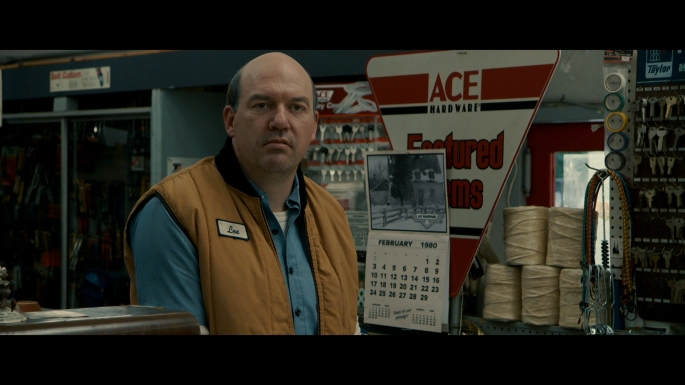
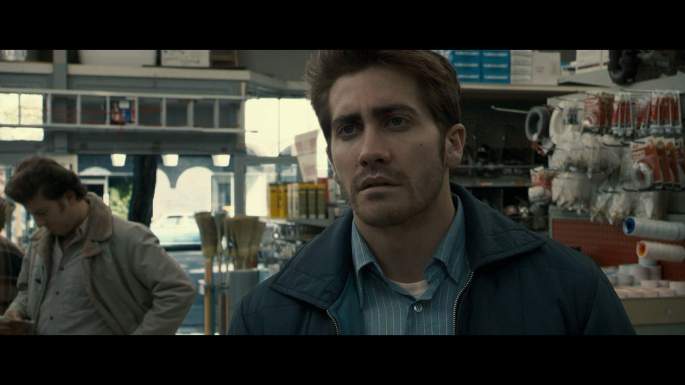
Near the end of the film, Graysmith declares “I need to stand there, I need to look him in the eye and I need to know that it’s him.”, desperate to prove that Arthur Leigh Allen (John Carroll Lynch; perfectly unnerving and subtle) is indeed the cold blooded killer. He gets his wish a short time later when he encounters Allen at an Ace Hardware store in Vallejo where Allen works as a clerk. Allen offers his assistance to Graysmith with a polite “Can I help you?”, Graysmith responds with a “No.”, the two men simply staring at one another until Graysmith leaves, Allen thrown off by Graysmith, and Graysmith appearing much more certain that Allens is the man they’re after. The movie moves forward eight years to when Mike Mageau, survivor of the Zodiac killer at the start of the film, meets with authorities to potentially identify the Zodiac killer, positively identifying Arthur Leigh Allen as the man who shot him and killed Darlene Ferrin. While many had their suspicions and some evidence pointed in his direction, Allen died in 1992 before he could be questioned. Not that he would have confessed anyway.

Admittedly, I have intentionally left out many details and characters, with no disrespect intended, and it should be said that every actor involved in this film, from the leading performances to the smallest of cameos (for exmaple, Ione Skye of Say Anything as Kathleen Johns, a woman who was threatened in her car by the Zodiac killer), give world class performances, some even the best of their careers to date. And the script by James Vanderbilt, based on books by Robert Graysmith, is an achievement of impeccable research and respect for the case. And the cinematography  by the late Harris Savides is bar none the greatest work the man had ever crafted, richly capturing everything with immaculate detail, from the lush valleys of California and its busy, inviting cities and streets, to the Aqua Vera drinks, to beams of red light emanating from police cars. He painted a gorgeous picture for us to gawk at for years to come.

Ten years later, I find it astonishing that Zodiac never truly ends like other movies do. Most movies tie up every loose thread with a ribbon to go with it, others leave room for potential sequels. You can’t end a movie when their is no resolution in reality, forcing a tacked on Hollywood ending wouldn’t sit right with anyone in possession of a brain. You can only leave the audience with the next best thing, the assurance of a living Zodiac victim that the man in the picture they’re pointing to is indeed the man who shot him. That Fincher was bold enough to choose this manner of ending his film shows us he’s a director capable of unsettling viewers long after the film ends, without needing to manipulate his audience or present alternative facts. Zodiac is a bona fide masterpiece, the crime film equivalent to All The President’s Men, and just as good too.

11415612_862880327137375_6688093266983067936_o

“You got a problem with me?” – A review of Out Of The Furnace by Josh Hains

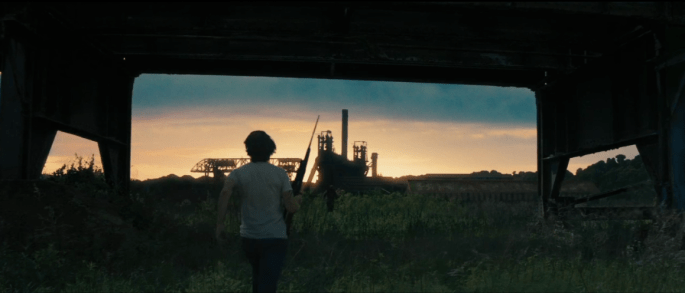
Scott Cooper’s sophomore film Out Of The Furnace follows Russell Baze (Christian Bale) through the empty, broken down streets of Braddock Pennsylvania like a lonesome ghost. He works in the local steel mill where his slowly dying father once worked, using what little money he makes to pay off his brother Rodney Jr.’s (Casey Affleck) gambling debts to sleazy local bookie John Petty (Willem Dafoe), all the while trying to maintain a relationship with his girlfriend Lena Taylor (Zoe Saldana). That all comes crashing down when Russell gets into trouble with the law and spends the next four years in prison, getting periodic visits from Rodney with updates on the state of their father’s health, Lena, and Rodney’s own exploits overseas in Iraq. Both men are broken and trying to keep it together for the sake of each other.

In due time Russell is released back into Braddock, the once thriving city on the verge of death with the mill soon to be closed. Things are different now for Russell, the times have changed, people have changed, and he has no other choice but to suck it up and trudge forward into the unforeseeable future. Rodney has picked up a deadly new habit, bare knuckle boxing, his way of violently paying off his debts to Petty before the stack gets too high. Russell tries talking him into a “normal” job to no avail; after multiple horrific tours of duty in Iraq, Rodney has been left shaken, twitchy, and is a mere shell of the man he once was. All that seems to be left is violence, anger, and undying love for Russell. Rodney begs John Petty to get him into bigger fights in backwoods New Jersey, dirtier, bloodier fights held under the watchful eye of local sociopathic hillbilly Harlan DeGroat (Woody Harrelson).

By this point in a standard issue revenge thriller, Rodney would have been long dead, but Cooper wisely makes the decision to give us time to settle into this world, and come to understand characters who feel like people, and not just cardboard cut outs. That the latter half of the movie devolves somewhat predictably into the same kind of movie it was previously avoiding replication of, is a disappointment. However, what does occur is given room to breathe. Cooper might be following the tropes of the genre, but he at least has the sense to let it unfold slowly and organically. Very little feels forced.

Things quickly turn ugly for Rodney and Petty, and when both go missing, the local law led by sheriff Wesley Barnes, exhausts all possible means in an attempt to find the pair, but can only go far because law enforcement lives in fear of DeGroat’s brutal reign of the area, and the fact that it’s outside of Braddock police’s jurisdiction doesn’t help matters either. So Russell and his uncle Red (Sam Shepard) cautiously take matters into their own hands the only way they know how.

Christian Bale delivers his most believable performance to date, fully embodying the heart and soul of Russell Baze, right down to the slightest nuances and subtleties of the man. He’s a truly masterful actor, strutting his stuff in such low-key fashion that because of the deep naturalism, rawness, and intense realism he imbues, within the first few minutes it stops feeling like a performance. It becomes, real, as Russell battles his inner demons and carries the weight of the world on his lean shoulders right up until the final frames fade to black.

Woody Harrelson knocks it out of the ball park as Jersey backwoods hillbilly sociopath Harlan DeGroat, topping his wildly over-the-top performance as Mickey in Oliver Stone’s Natural Born Killers. If you thought Mickey was a bad dude, wait until you watch DeGroat force a hot dog down the throat of a woman at a drive-in movie theatre in the films unnerving opening sequence. Harrelson has an uncanny ability of inhabiting even the most repulsive of villains with some semblance of humanity, and toward the end of the film does so with nothing more than an all-knowing expression upon his face and burning in his eyes as he delivers a couple heartfelt lines.

With this performance, Casey Affleck shed the boyish light his previous performances have always been garnished with, trading it in for a toned body and volatile outbursts of pent-up rage. He gives the more energetic performance of the two brothers, effortlessly capturing Rodney’s broken down mannerisms. Forest Whitaker, Willem Dafoe, Zoe Saldana, and Sam Shepard each provide the right amount of nuance and naturalism to their perfomances that blend evenly with their bleak surroundings and the trio of astounding lead performances.

In a scene near the midsection of the film, Russell and Lena have a conversation on a bridge about their future after Russell has been released from prison. Despite Russell’s plea to make things right between them, Lena cannot commit to him anymore because she’s carrying Barnes’ child. In a moment that ought to shatter even the hardest of hearts into a million pieces, Russell congratulates Lena, assuring her she’ll be a good mom amidst tears from both of them. This scene assuredly carries the finest moments of acting we’ve seen from Bale and Saldana to date. 

The cinematography by Masanobu Takayanagi (The Grey) is impeccable, capturing beautifully and quite often starkly, the dreary and dirty grit of Braddock, the crispness of the violence, the cold bitterness of the dialogue dripping from the tongue of the people inhabiting the film. Scott Cooper directs this film with ease, honestly and authentically capturing the bleak essence of the dying town, the harsh realities of the effects the economy is having on the people, and the brutality that is the violence that twists their worlds upside down in the blink of an eye.


“If you ride like lightning, you’re gonna crash like thunder.” – A review of The Place Beyond The Pines by Josh Hains

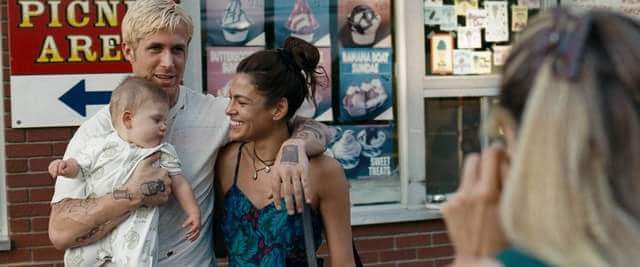
As the opening title, “A film by Derek Cianfrance”, dissipates, a breath is drawn followed by the clinking of an angel knife as Ryan Gosling’s Luke Glanton menacingly opens and closes it, his abs glowing in the dimly lit room, his body battered with tattoos as the sounds of people, rides and games emit from outside his small trailer. He’s told it’s showtime by an outside authority, jamming the knife overhand into a wall before picking up his shirt and red jacket and slipping out the door, putting them both on as he traverses the crowd until he reaches a large tent boasting The Globe Of Death. He walks with the swagger of James Dean as he enters the tent to cheers and cries of excitement from fans alike as he and two fellow riders known only as The Heart Throbs gear up on their motorcycles and glide into the deadly spherical cage. Engines roar and fans scream as Handsome Luke and The Heart Throbs dizzyingly ride their motorcycles loop de loop until the screen fades to Luke signing autographs. And to think, that was all done in one take.

The Place Beyond The Pines is a beautifully brooding, tragic, heartbreakingly powerful, and ambitious genre film about fathers and sons, legacy, and consequences. Luke Glanton (Gosling), a daredevil carnival motorcycle rider finds out former fling Romina (Eva Mendes), a local waitress and fan of Luke’s skills, recently had their son, Jason after their last fling. Much to her surprise, he quits his job in the hopes that he can concoct a relationship with the infant and her too, even though she has a new, responsible man in her life by the name of Kofi (Mahershala Ali, in an understated role).

Luke is irresponsible, impulsive, tattooed all to hell and prone to outbursts of violence. Things only get complicated once he meets Robin Van Der Zee (Ben Mendelsohn), a grubby mechanic who hires him after witnessing his outstanding skills on the motorcycle. He suggests that Luke rob banks, Robin himself having robbed banks years earlier, and Luke, in need of quick cash to support his son, opts to do just that. As time marches on the risks get higher and the cash comes thicker during riveting, manic heists and intense and stunningly realistic getaways; until Robin suddenly balks, leaving Luke to sloppily rob a bank and subsequently get chased across town on his motorcycle. The breathtaking chase leads Luke to a violent confrontation with Avery Cross (Bradley Cooper), a young police officer and son of a well respected judge.

After his confrontation with Luke, Avery begins to question his actions during the encounter as fellow officers headed by Pete Deluca (the always intimidating Ray Liotta, in full-on bad cop mode) engage in thuggish, corrupt behaviour which begins to take its toll on Avery and his family life as the father to a newborn son and husband to a fearful wife.

Skip ahead 15 years and Avery is running for public office, as his and Luke’s respective sons Jason (Dane DeHaan) and A.J. (Emory Cohen) begin a tumultuous and troubling friendship. I have to stop there, as any more details about the film will surely spoil what is undoubtedly a surprising film.

Luke’s story takes up the first 45-60 minutes, and is the best of the three stories in this triptych film; a deep, emotional roller-coaster that follows Luke as he struggles to provide for his newborn son. The heists are crisp, increasingly sloppy and volatile, brimming with an underlying intensity and fiery rawness. When he robs, he angrily squeals and shrieks his commands, grabbing the closest person to him as leverage until he has the money. When he rides, it’s as if you’re right there with him; the roar of the engine thundering through the air as he speeds down twisting roads into Robin’s cube truck.

Ryan Gosling as the violent, troubled Luke Glanton is mesmerizing, delivering his best performance since 2010’s Blue Valentine (which marked his first collaboration with this film’s director Derek Cianfrance), and surely one for the Oscar nomination list. He doesn’t say much which draws comparison to his eerie role as The Driver in 2011’s Drive, his eyes and facial expressions exuding Luke’s restrained and ominous personality in the same brooding manner as he did in Drive. He also has a vehicular skill, this time motorcycles and not cars, but that’s about where the comparisons stop. Where Driver felt like a caricature, or a fantastical vigilante ripped from a ludicrous dream, Luke feels, and very much so is, a genuine, authentic and honest portrayal of a man struggling to leave a strong imprint in his son’s life while dealing with his own inner, violent demons. He holds honest intentions, but is far too explosive and violent for the life he quietly yearns for.

Eva Mendes is at her quiet best here as Romina, giving an heartfelt and touching portrayal of a mother trying to do what’s right for her son, which may or may not always be the best of decisions. Ben Mendelsohn (of Animal Kingdom, The Dark Knight Rises and Killing Them Softly fame) yet again find a rhythm for playing the greasy, twitchy mechanic and Luke’s only friend Robin. His ability to slip into these scuzzy roles is fantastic, as he once again delivers a magnetic performance.

The second story that follows Avery post-Luke encounter runs for about the same length as the first section, as does the last section. The film seamlessly weaves between the sections, pausing only for a moment with a black screen as if to let us breathe before it catapults us into Avery’s battle for survival in the world of policing. The story presents itself much like a cop film from the ‘70’s, something the likes of William Friedkin or Francis Ford Coppola would have sunk their teeth deep into. Bradley Cooper is fantastic in this act, quickly taking the reins of the film as the torch gets passed along, proving once again that most audiences have underestimated his acting prowess in the past despite the complexity of his most recent roles. Ray Liotta as Pete Deluca, a corrupt veteran officer, is at his menacing best, and Rose Byrne (Jennifer, Avery’s wife), Harris Yulin (as Avery’s judge father Al) and Bruce Greenwood as slippery lawyer Bill Killcullen all deliver with quiet, small roles with actions that echo a lifetime.

I won’t go too deep into the final act, but I will say that Dane DeHaan is one to watch, one-upping his co-star Emory Cohen as Luke’s estranged son Jason, matching pound for pound the intensity delivered by the more seasoned actors in the film. Emory is convincing as the drug-addled interpretation of MTV styled behaviour infused into Avery’s son A.J.

The latter two stories following Avery post-confrontation, and later their respective sons, are thoroughly engaging, edgy and potent, but are intentionally not as electrifying as Luke’s daredevil lifestyle portion of the film. Luke’s story is one electric scene after another, each as haunting and memorable as the last until his story ends, when the film slows down to give us a deep insight into the lives of police officers and their family, and the ramifications of the violence and corrupt actions committed in the first story; each scene for the 140 minute running time never failing to captivate your eyes and mind. Despite how well acted the last two chapters of the film are, one can’t help but feel underwhelmed by them both after the volatile, quick paced first act.

This is a powerhouse, haunting, Shakespeare-esque cinematic experience of a lifetime. Derek Cianfrance, the director behind Blue Valentine and the largely unseen Brother Tied gives us his best film here, an honest tale of fathers and sons, violence and its impacts, actions and their consequences. He gets the absolute most of of his actors, no matter how big or small the role, with relative ease it seems. As stated in several dozen interviews, many of the scenes are genuine, featuring real actions from his actors during rehearsals, or spontaneous behaviours from them as filing was occurring, which helps push the realistic, honest and authentic nature of this film to greater heights. The violence is quick and bloody, but never stylized or gimmicky, instead remaining true to the speed and ferocity of real violence one would see in a Sunday night instalment of World’s Wildest Police Chases, which Derek himself said inspired the realism of this film. Mike Patton’s thrilling score greatly enhances each scene, never becoming overbearing or underused.

While Blue Valentine was a small scaled romantic tragedy, The Place Beyond The Pines is on a much larger playing field as it spans its 15 plus years, giving us a sweeping genre epic that stands an equal among similar father-son consequential films such as The Godfather. Derek Cianfrance once again shows us he’s a masterclass in filmmaking, delivering what will surely be the year’s best dramatic film. This is filmmaking from the pelvis by Cianfrance that grabs you by the throat and never lets go until the final, heartbreaking frames contrasted with Bon Iver’s ‘The Wolves’; this, is one hell of a film, and among the best of its year of release. As this epic tale of fathers, sons, and consequences rides off into the morning sunrise, its grip will loosen just enough to leave you breathless in its powerful wake.


“Don’t be afraid.” – A review of The Grey by Josh Hains

You’re watching the opening titles click along, Open Road, Scott Free, the works all rolling through their frames in eerie silence. You think for a fraction of a second that maybe something bad will happen, maybe one of those wolves you’ve seen advertised will erupt into the frame and tear someone’s throat out and perhaps scare the hell out of you. It would be a most opportune time for a jump scare. Instead, wolves bay at the moon, their howls long and bone chilling. I think the howling is more frightening.

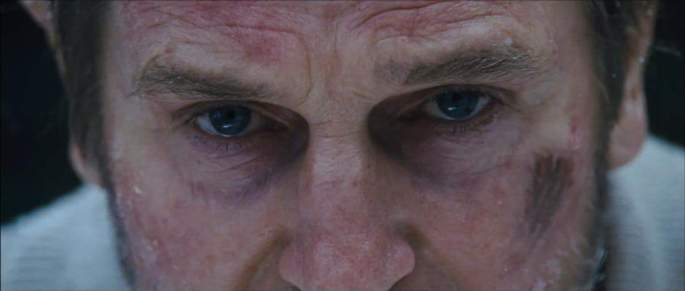
John Ottway (Liam Neeson) narrates the opening scene, conveying a “I-don’t-give-a-damn” no nonsense, cynical mindset. He drifts through the cold night like the ghost of someone who died with unsettled demons. A hopeless, broken man. So broken is he that Ottway contemplates and nearly commits suicide, his mouth firmly around the barrel of his rifle until the baying of wolves cuts his actions short. This understandably drawn out sequence is juxtaposed with marksman Ottway shooting a lone wolf that charged some oil drillers, a job he seems born to execute. Ottway respects the animal enough to stay with it until death, almost comforting the creature until its final breath.

A plane ride to Anchorage for oil rig workers on leave (Ottway amongst them) reveals seven more characters of worth, each one playing a significant role in the plot of the film. Flannery (Joe Anderson), the young reckless hick, scared out of his mind, nervous, panicky. Diaz (Frank Grillo) the cynical ex con with a penchant for the f-bomb and bar fights, and his pal Hernandez (Ben Bray). Lewenden (James Badge Dale), presumably a family man. Hendrick (Dallas Roberts), the sympathetic and rational religious mind of the group. Talget (Dermot Mulroney), the gutsy father. Burke (Nonso Anozie) the welcomed comedic relief in several key scenes. The plane they’re travelling in crashes, delivering easily one of the most terrifying on-screen plane crashes you’ll ever encounter on film; it’s the stuff of nightmares and fever dreams.

Ottway soon takes charge, seemingly the most experienced man in the group, making the decision to leave the crash site after Hernandez’s mangled body is found the morning after the sudden and brutal wolf attack that led to his death. The forest a few miles away will provide richer shelter against the harsh, unrelenting winter weather, and might work in the group’s favour against the wolves. Superficially,  The Grey is about a group of men the world seems to have discarded, “men unfit for mankind”, struggling against unfathomable odds. It’s a classic action adventure with elements of horror, but there’s more to this movie than just teeth and death.

The surviving men find opportunities for conversations that bring to light their wants and desires in life. Obviously, we learn the most information about our hero John Ottway, some though deep philosophical thoughts he seems to have been holding onto for ages, and some throughout the movie in the form of brief flashbacks with his wife. Though they are depicted as group at nearly all times, director Joe Carnahan (and co-writer Ian MacKenzie Jeffers, who also penned the short story Ghost Walker that The Grey is based on) understand perfectly how to treat each character as an individual guided by their own unique desire to survive this horrific ordeal, and live to tell about it. The performances across the board are all great, though Grillo and Neeson seem the most natural, helping maintain the grounded atmosphere the movie carries. Neeson deserved more praise upon release than he ever received for giving such a moving, raw performance.

At the end of the movie (*spoiler alert* for those who haven’t seen The Grey over the past five years) Ottway is alone, freezing, desperate, and significantly more broken than he was when we first encountered him, reflecting on those who fell before him by looking through their collected wallets (the real wallets of the cast). Soon realizing to his dismay that he has found the den belonging to the wolves that have relentlessly hunted him, he reflects upon the passing of his late wife, told through one last heartbreaking flashback, her final words giving him the strength to press forward and fight for his life. After taping a knife and broken bottles to his hands as the alpha wolf approaches him, he delivers the lines to an anonymous poem he mentioned to the group earlier that sat in his father’s office when he was a boy. The screen cuts to black, and we’re left stunned and profoundly moved.

Our only clue as to what went down between man and beast lies in promotional material, a brief glimpse of which is shown in a nightmare Ottway has and nowhere else, not even on the Blu-Ray’s deleted scenes. A post credits scene shows Ottway is alive, resting on the presumably dying alpha wolf, though it remains unclear if he is mortally wounded or just worn out, exhausted.

While the misrepresentation of the final product in the promotional materials irked many, it didn’t bother me like I thought it would because I still understand that the sequence (as awesome as it likely is) didn’t fit the tone of the rest of the movie. Liam Neeson slashing and stabbing a territorial wolf sounds like an epic fight for the ages, but that makes about as much sense as having Roy Scheider repeatedly stab the behemoth shark in Jaws to death while clinging to its dorsal fin. In a movie built on a foundation of callous logic and reasoning, that ending just wouldn’t have sat right in our stomachs, and I’m content with that.

poem1


“What happened to you?”A review of The Autopsy of Jane Doe by Josh Hains

The R rating description for the Autopsy of Jane Doe reads “bloody horror violence, unsettling grisly images, graphic nudity, and language”, a misleading description that may give future viewers the impression they’re in for a hearty gore fest. I thought I might be in for a suspenseful slasher, something akin to a cross between Don’t Breathe (another great horror entry from 2016) and The Ring, but with a greater focus on gory splatter. I wasn’t disappointed per se, but the graphic qualities of this movie don’t unfold the way you might expect them to, which admittedly caught me off guard yet pleasantly surprised me.

Without giving anything away (as this is a spoiler free review), I can tell you that this particular horror movie actually shows barely any on-screen violence. In fact, the bulk of the “bloody horror violence” actually comes in the form of the autopsy itself, which doesn’t shy away from giving viewers prolonged sequences of dissection, which plays directly into the “unsettling grisly images” of the rating description. Think of any CSI: Crime Scene Investigation autopsy scene, but make it run for an hour and twenty six minutes. The graphic nudity doesn’t come from an impromptu sex sequence, but from Jane Doe’s seemingly lifeless corpse laying nude on the cold steel table. It’s nothing exploitive or fetishized, just protocol when examining a dead person for cause of death. And as far as the language portion of the description is concerned, you might find more profanity in one scene in Planes, Trains, and Automobiles than in the entirety of this film, not that it’s a bad thing.

The movie introduces us to a gruesome multiple murder scene where a nameless nude young woman is found buried in the sands of the house’s basement floor and whisked off to the mortuary run by Tommy (Brian Cox) and Austin Tilden (Emile Hirsch), a father-son coroner duo, given until the early morning hours to find Jane Doe’s cause of death for the sheriff. Austin has plans with his girlfriend for the night, but once Jane Doe shows up, he feels compelled to stick around and assist Tommy, despite his girlfriend’s immediate unhappiness with being ditched yet again. Jane Doe’s is an extremely odd case for the duo, her entire outer body in perfect condition but her insides boasting a series of horrifying injuries including broken ankles and wrists. With how she died becoming a more frightening answer with every new internal injury discovered, the autopsy draws on, and as an unseen storm outside increases in its catastrophic potential (as heard via a radio that provides comfort music) several unexplainable supernatural occurrences begin to manifest, eventually trapping the duo in the mortuary and threatening to terrorize them all through the cliche dark and stormy night.

Early exchanges of dialogue between father and son, both personal and professional, as well as the blatant chemistry between the two actors, illustrate a believable history and relationship between the characters. You could change Hirsch’s last name to Cox and never doubt for a second that he is indeed Cox’s son, and it’s that believability that elevates the material from standard issue to fare to something special and unique. Both actors bring their A-game, and are not just convincing as family but also as coroners, the technical jargon adding another layer of authenticity and believability to the film. Your eyes and ears might be drawn to Cox more than Hirsch, as Cox has so often been a magnetic scene stealer everything from Manhunter to Braveheart to Red, but don’t underestimate Hirsch’s nuanced work here; this is his finest hour since Into The Wild.

For his first foray into American cinema, director André Øvredal (Trollhunters) does a splendid job of crafting a movie that contains characters we believe in and come to care for, all the while gradually among up the suspense as the movie unfolds. It’s always a delight when a movie sets up an intriguing premise while simultaneously providing characters worth watching, and not just the usual dumb victims.

The first hour of The Autopsy of Jane Doe is both interesting and totally suspenseful, but sadly the movie becomes a less interesting (yet still suspenseful) endeavour as more information about the titular Jane Doe is revealed. You’ll stick around to find out the fates of the characters, but after a third act exposition dumping of information about Jane Doe that lacks the subtlety of the scenes that precede it, the plot stops dead in its tracks: there is no plot left to tell. Once that information comes to light, the focus of the movie shifts to the survival of the characters against the overwhelmingly horrifying odds and lacks the surprise and intrigue of earlier scenes. I still found myself deeply involved, but not necessarily surprised or shocked by the revelations. This misstep by no means makes Jane Doe a bad movie, just underwhelming. 

Regardless of how I might feel about the third act reveals, I have to admit I still really enjoyed watching the movie right up until the final frames snapped to black. I especially enjoyed the relationship between Tommy and Austin, and even appreciated the brief but effective appearances of the girlfriend Emma (Ophelia Lovibond) who thankfully didn’t feel like a cliche and more like a real breathing human. I also appreciated the technical jargon and the extensive look at the practice of being a coroner and conducting an autopsy. It’s grisly stuff, sure to make even some of the most hardcore gore hounds’ stomachs churn, but in the context of the movie and its unique premise, makes complete sense and doesn’t feel like shoehorned gratuitous gore. The Autopsy of Jane Doe isn’t a perfect horror movie, a tall order these days, but it’s still a great and unique entry into a genre in need of a little spicing up. Somehow, despite the underwhelming feeling I got from the third act, I found the ending oddly satisfactory albeit predictable and not at all surprising. It works, like a knife through butter. If you’re in the mood for a good horror movie, open up your heart to The Autopsy of Jane Doe. You just might thank me after the sun shines in.