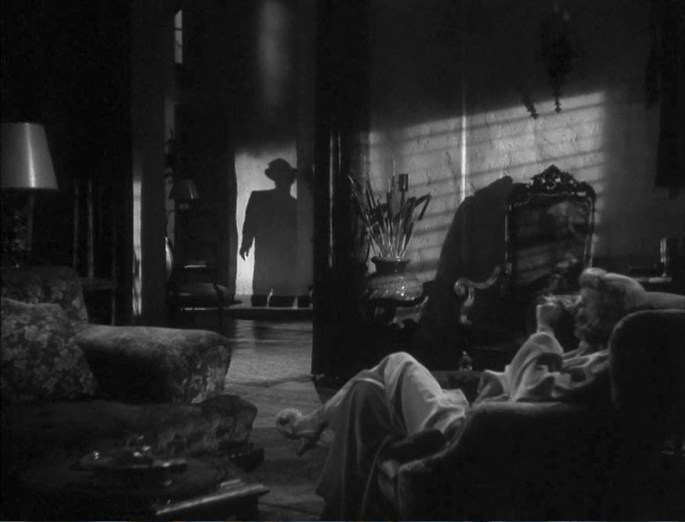
“It was a hot afternoon, and I can still remember the smell of honeysuckle all along that street. How could I have known that murder can sometimes smell like honeysuckle? Maybe you would have known Keyes the minute she mentioned accident insurance, but I didn’t. I felt like a million.” – Walter Neff
Adapted from the James M. Cain novella of the same name by Billy Wilder and acclaimed crime novelist Raymond Chandler (author of The Big Sleep), Double Indemnity (1944) is considered by many to be the quintessential film noir with its exquisite use of John F. Seitz’s atmospheric black and white cinematography – the use of shadows, silhouetted figures and darkness to convey a shadowy world of betrayal and murder (most famously, Venetian blind effects on walls or on characters’ faces so that it looks like the bars in a jail).
Walter Neff (Fred MacMurray) is a hot shot insurance salesman who falls for rich housewife, Phyllis Detrichson (Barbara Stanwyck) when she first appears to him clad only in a towel and asks, “Is there anything I can do?” which is a question loaded with suggestion. Neff is there under the pretense of renewing her husband’s automobile insurance. The dialogue between them crackles with delicious sexual tension as Phyllis draws Neff into her web, eventually convincing him to kill her husband and make it look like an accident so that she can collect the money.
Of course, it isn’t that easy and Neff’s friend and co-worker Barton Keyes (Edward G. Robinson), a persistent claims manager, investigates the case. Edward G. Robinson plays Keyes with grumpy charm, someone who isn’t happy unless he’s griping about phony claims and the foolhardiness of the company he works for. The exchanges between him and Fred MacMurray are priceless as their friendship permeates the snappy, sarcastic dialogue.
Phyllis is very unhappy and is drawn to her tryst with Neff because it is forbidden and their illegal plan excites her. Stanwyck’s character is an archetypal femme fatale: a scheming black widow that uses her sexual appeal to manipulate Neff into getting what she wants. Phyllis uses him and then gets rid of him once he outlives his usefulness. Stanwyck does a great job luring Neff with her faux vulnerability and slightly tawdry look (complete with trashy blond wig) and then coldly turns the screws on him at the crucial moment.
Up to that point, MacMurray had been known for starring in light comedies but was perfectly cast as the flawed salesman who falls for the wrong woman and finds that he’s capable of murder. It’s pretty easy to see why Neff falls for Phyllis – she’s beautiful and has access to a lot of money. The chemistry between him and Stanwyck is filled with all kinds of sexual tension – as much as they could sneak by the censors of the day and that’s part of the allure of the film: everything is suggested and nothing is explicit. For example, the husband’s murder is never shown just the sounds of him dying and shot of Phyllis’ face reacting (or rather not reacting) to what is happening that is very effective.
Looking at Double Indemnity now, it comes across as a fascinating snapshot of Los Angeles in the 1940s with its houses with classic Spanish architecture, when cars were all wonderfully big and stylish and men all wore hats. There are just enough location shots of the actual city mixed with studio interiors to convey a sense of place that doesn’t exist anymore.
 Podcasting Them Softly is honored to present a discussion with feature film editor

 Tron: Legacy replaces the “information just wants to be free” message of its predecessor with a “sins of the father” theme as Flynn attempts to stop Clu, his Frankensteinian creation, and repair the damage done between him and Sam. Tron: Legacy manages to make this world and its characters accessible to those not familiar with the first film by basically rehashing its plot, blow-by-blow, which may disappoint fans. However, it does feel like a continuation of the first film with all kinds of references to things that happened in it. There is also a rather nifty cameo by a notable character actor that hints at a possible villain for the next film, if this one makes enough money. Of course, there is the usual criticism that the dialogue is weak, the story is formulaic and there is a real lack of characterization – all issues critics had with the original film. Tron: Legacy certainly lacks in these areas also, but like the first film, the visuals are so impressive, so captivating in the way they immerse you in the computer world, that you tend to ignore the flaws, relax and enjoy the ride.





 Podcasting Them Softly