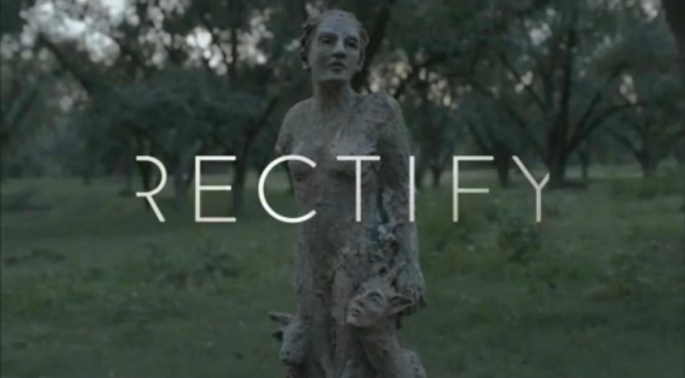
Sundance TV’s Rectify

Sundance TV’s Rectify might be a quiet, modest, unassuming small town drama but in its narrative is contained a cosmos of human experience, pain, suffering, love, joy and sadness in one Georgia county. It’s a show that was conceived by an actor called Ray McKinnon, who is very memorable in everything from Deadwood (the preacher who has seizures) to Sons Of Anarchy (the anachronistic federal agent) to the Coen’s O Brother Where Art Thou (“He’s bona-fide!!”). I had no idea that his mind contained the kind of emotional and empathetic wellspring of creative enterprise to pull off something like this though, because it’s one of the most staggeringly mature, emotionally intelligent and uncommonly compassionate stories I’ve ever experienced onscreen. It tells the story of Daniel Holden (Aden Young) a man who was once convicted of raping and murdering his girlfriend as a teen one hectic night and has been sitting on death row for something like two decades. When new evidence comes to light and he is tentatively exonerated pending a trial on the horizon, he experiences freedom for the first time in a long time, gets reacquainted with his family, faces animosity and controversy from many who are convinced he’s still guilty and must find a way to reintegrate into his community. There is also the matter of who is actually responsible for the girl’s murder so many years before but if you’re thinking this is any kind of thriller well then cool your jets because this is about as slow burn, introspective and deliberately paced as television gets. This isn’t your garden variety murder mystery, it’s a studious anthropological undertaking, a dignified observation of one man in an unthinkable position and the humans who orbit him in a nebulous nexus of relationships fraught with complexity, contradictions and the mysteries of the human soul. He’s faced with retooling relationships with his parents (J. Smith Cameron & Bruce McKinnon), the sister (Abigail Spencer) who never gave up on him, his misunderstood stepbrother (Clayne Crawford) and wife (the angelic and wonderful Adelaide Clemens) who is also something of an old flame to Daniel, a boorish US Senator (Michael O’Neill) determined to see him back behind bars, a former childhood friend (the inherently shady Sean Bridgers) who was there that fateful night and many, many more. His time out in the world is beautifully woven together with painful, illuminating flashbacks to his many years on death row where we see a kinship and brotherhood form between him and and another inmate (Johnny Ray Gill) who will become his best friend. Along with all these tangible, traceable relationships he has there are also several key allegorical figures who appear to him on his journey including a charismatic antiques dealing socialite (Leon Rippy), a compassionate prison chaplain (Matthew Posey), a flirtatious conventioneer (Frances Fisher) and a mysterious booze swilling, livestock thieving wanderer (W. Earl Brown) who imparts to him in a dreamlike journey the haunting wisdom: “It’s the beauty that hurts the most, not the ugly.” It’s quite a journey, and every step of the way the show’s creators make the right decisions for characters they love and care for deeply, even the challenging ones who are tough to relate to. This isn’t a story about whether or not Daniel is guilty or not or who actually committed the crime and if you’re expecting resolution, you’ve come to the wrong place, however if catharsis is what you seek then you’ll be rewarded greatly, just not in the ways you might think. Consider a moment where Daniel experiences a sunrise for the first time in twenty years of being locked in one room, or enjoys a bag of chips and a pop in the afternoon sun on a grass field, or simply shares a deep conversation about the rain with Clemens’s impossibly soulful Tawney. These are moments that to you and I might seem trivial because we take them for granted, but to Daniel who hasn’t been able to do these things in a cruelly prolonged amount of time they mean the world. This story takes its time getting to know its characters, allows for deep moral complexity to unfold, has some of the best writing I’ve ever heard, explores the passage of time in a way I’ve never seen attempted and is just overall legitimately one of the finest pieces of art I’ve ever seen in any medium an at times reaches levels of pure transcendence.

-Nate Hill
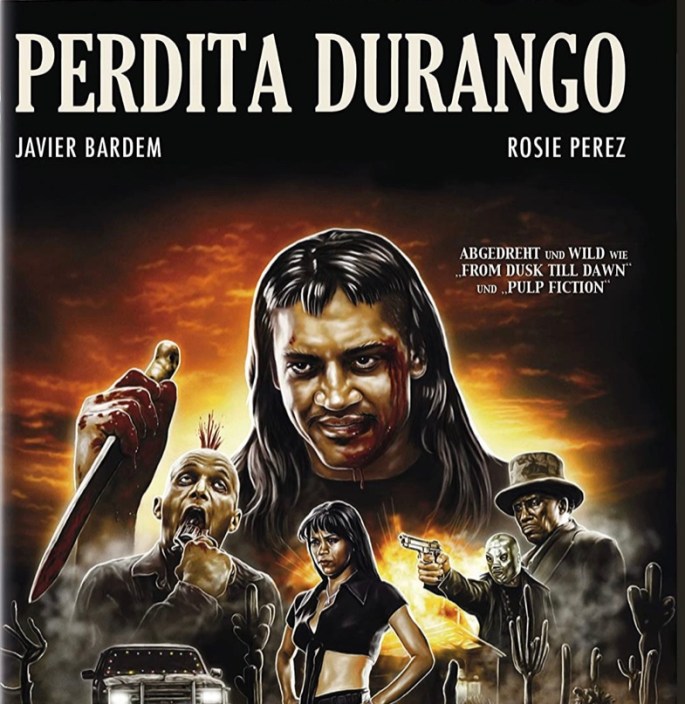
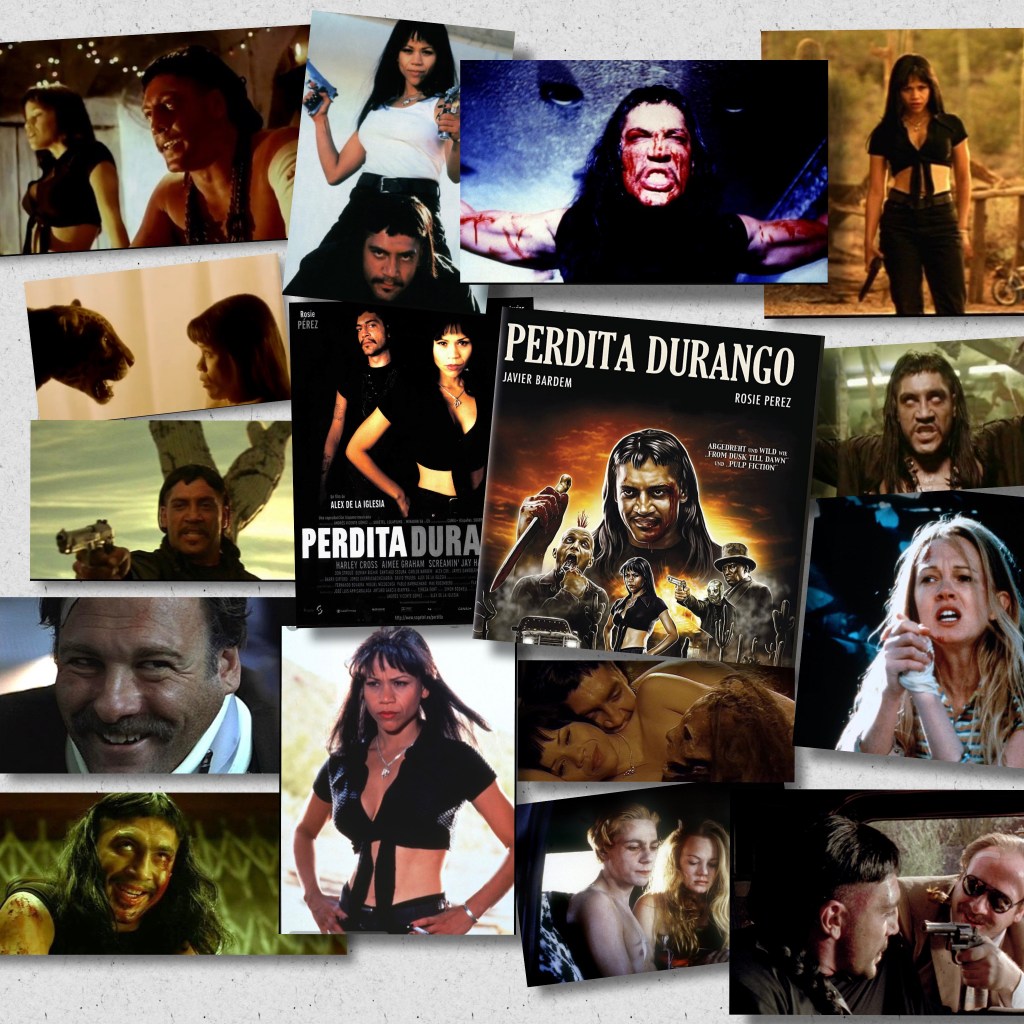
Álex de la Iglesia’s Perdita Durango

Even if I told you to picture a Mexican version of Natural Born Killers starring Rosie Perez and Javier Bardem with shades of voodoo mysticism, tons of pulpy brutal violence, transgressive taboo vibes and shades of From Dusk Till Dawn it wouldn’t prepare you for the visual audacity and narrative viscera that is Álex de la Iglesia’s Perdita Durango, a scrappy mid 90’s bit of cult nihilism based on a book by Barry Gifford. Gifford, you may recall, also wrote the book that David Lynch based Wild At Heart on so many of the same characters appear here for a kind of fascinating “Lynch/Gifford extended universe” vibe. Rosie Perez is Perdita Durango, a vivacious wayward outlaw girl who hooks up with Bardem’s Romeo, a psychopathic, voodoo practicing criminal who has been hired by evil crime kingpin Marcelo ‘Crazy Eyes’ Santos (Don Stroud) to facilitate the black market delivery of stolen human fetuses for cosmetic industry (I swear I’m not making the shit up). The two of them hook up along the way and get up to all sorts of lurid shenanigans including kidnapping a teenage couple (Harley Cross & Aimee Graham), raping them both and forcing them to tag along on their bloodthirsty swath of carnage and mayhem across Texas and the Mexico border. James Gandolfini shows up as a dogged DEA agent hellbent on stopping them and nailing Santos, and he hilariously gets hit by multiple speeding vehicles only to keep on truckin with a neck brace, then a leg brace and so on. There are also scattershot appearances from musician Screamin Jay Hawkins, filmmaker Alex Cox and a young Demien Bechir as a Vegas crime kingpin who meets a spectacularly gory end at the hands of Bardem. He is unbelievable as Romeo, I didn’t think I’d ever see a film where he has a more ridiculous haircut than his mop in No Country For Old Men but it happened, he looks like a an angry tumblr maven with his hyper cropped bangs here, and he tears into the role with a kind of unhinged ferocity and rambunctiousness I haven’t seen before in his mostly restrained career so far. Perez is like a Latin Harley Quinn as Perdita, all pissed off fury and sudden violent sexual energy in a total tour de force. This film won’t be for everyone: it’s incredibly subversive and deranged, there are explicitly shown instances of human sacrifice, rape, child abuse and domestic violence, not to mention the overall dose of supremely bloody gun violence and just a generaly lurid, deliberately unsavoury tone that stems from Gifford’s often shockingly tasteless yet somehow captivating work. But it’s a lot of fun too, there’s heaps of hilariously subtle dark comedy thrown in, a ballistic firestorm of a soundtrack, a host of deliriously over the top performances from the excellent cast and all manner of bizarre, arbitrary, surreal and eclectic sideshow-freak elements that make this an eccentric trip to hell with two demented individuals who you can’t decide whether to run from in horror or party with as they’re that much fun.

-Nate Hill

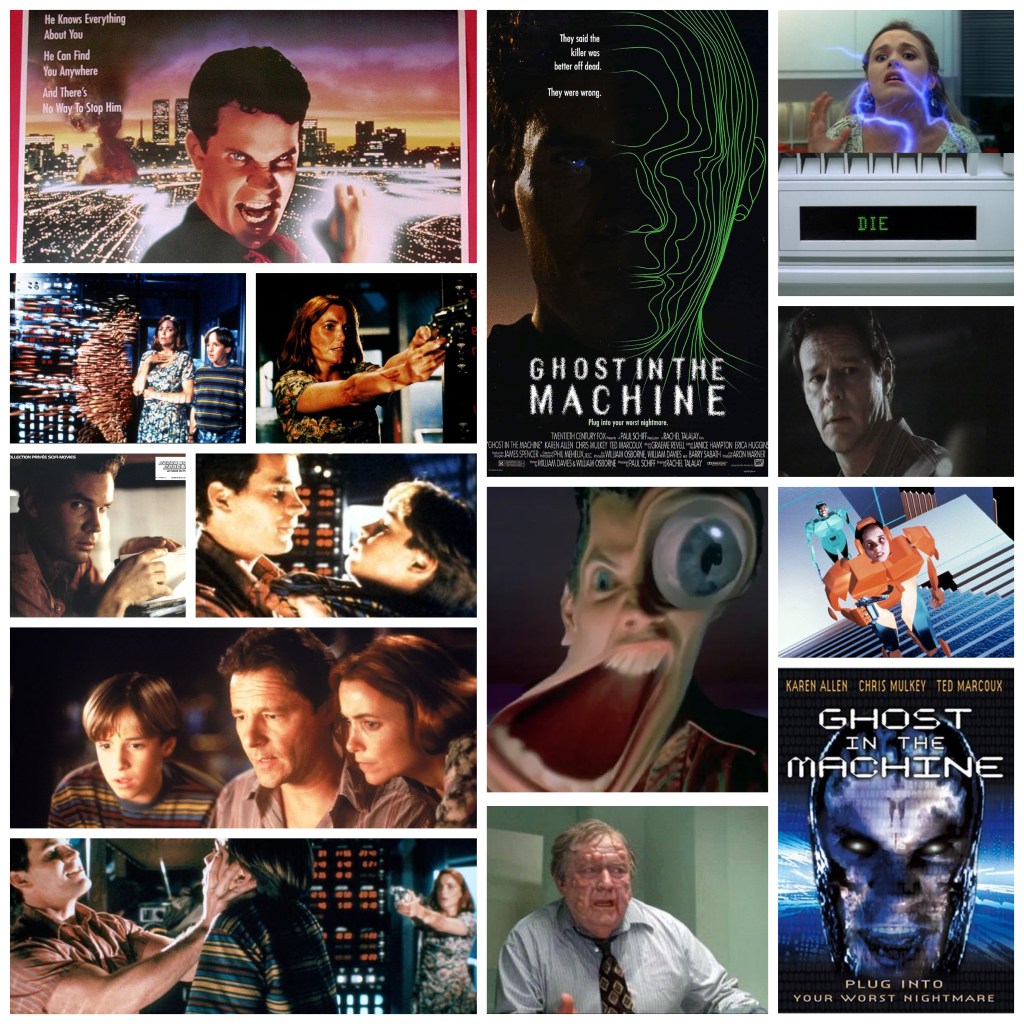
Rachel Talalay’s Ghost In The Machine

What if like, a serial killer committed suicide, but not before making sure that his soul would be uploaded into a computer server through some pseudo hacker wizardry, leaving his essence free to roam throughout entire systems of data and machine control, manipulating everyday household items into deadly weapons of murder? It sounds ridiculous and it is but it’s also a lot of fun, an old forgotten cyber horror flick called Ghost In The Machine. Now, obvious comparisons might be made to another 90’s cyberpunk SciFi/horror called Virtuosity with Denzel Washington and Russell Crowe but besides having a way lower budget, scrappy feel to it, this film is about a serial killer who was already human and then died and went into cyberspace vs the other way round. The killer here (played by Ted Marcoux) is just a nondescript, nasty piece of work dubbed the “address book killer” for his arbitrary, imagination deficient mode of picking victims. One night he deliberately totals his car off a cliff and kicks the bucket, only to resurface in cyberspace to hunt a young mother (Karen Allen) and her kid using everything from toasters, home entertainment systems, crash test dummy courses and basically anything electronic he can posses using his weird supernatural hacker magic. Their only hope is a super hacker of their own, (played by Chris Mulkey aka Hank from Twin Peaks) a good natured dude who once embezzled a million bucks from the IRS and gave it back to the people. This is fairly lowbrow, schlocker type entertainment with really, really cheesy 90’s virtual reality effects in the vein of something like The Lawnmower Man, but it has a certain viciousness and violent edge that I appreciated. Several murder scenes are pretty jaw dropping including one where the killer turns the entire interior living room of a dude’s house into an irradiated microwave zone and lets him literally fry to death, or an instance of electricity induced spontaneous combustion that is genuinely jarring in its sudden gruesomeness. Rachel Talalay the director also did the criminally underrated cult classic Tank Girl so she has a flair for the bizarre punk sensibilities that come across here. If you like retro SciFi goofiness, grisly slasher aesthetics and just a cheesy, lovably VHS feel, you’ll get a kick here.

-Nate Hill

The Poison Rose

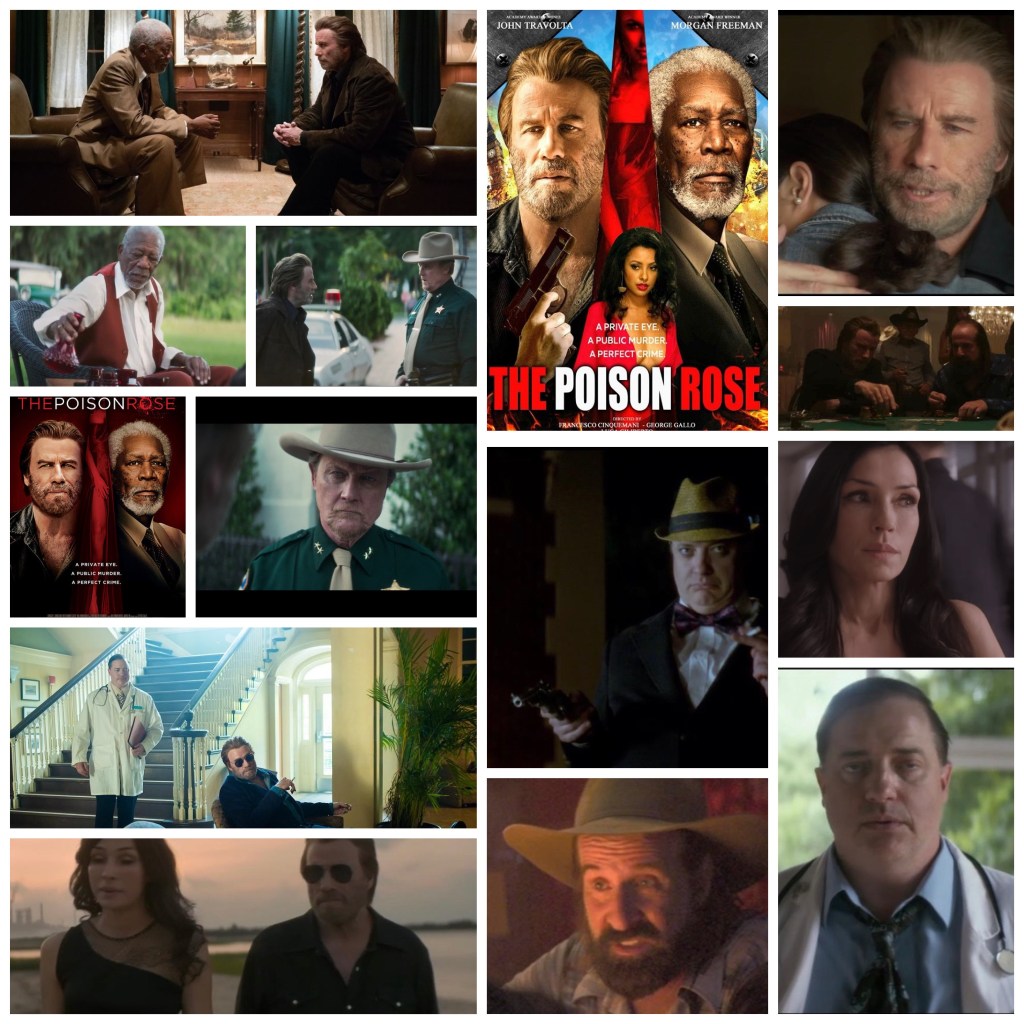
You would think that a film noir headlined by John Travolta and Morgan Freeman would be a surefire winner or at least something moderately stimulating, but The Poison Rose is just a lazy, watered down, lethargic, empty, nonsensical and just plain fucking boring film. The first five minutes show the faintest beam of promise as we see hard-luck ex football pro turned private investigator Carson Phillips (Travolta) running away from vicious loan sharks while carrying his cat in a carrier. It’s a fun bit, followed by a nice opening credits sequence where he hits the road and drives it from Cali to his hometown in Texas to take on the case of a missing woman and for a hot second the film feels like it could actually go somewhere… and then it just viciously, thoroughly and embarrassingly flatlines. Travolta narrates the proceedings as if he’s in his nightgown and favourite La-Z-Boy chair about to nod off and who can blame him with a narrative this thin and scattered. The search for this girl leads him to a few of his old high school pals including a shady businessman (Freeman, barely raising a pulse) who owns half the town, a slightly corrupt sheriff (Robert Patrick) an ageing hipster (Peter Stormare) and an old flame (Famke Janssen) now wedded to Freeman’s sinister magnate. Brendan Fraser shows up to give quite possibly the weirdest performance of his career as a psychiatric “doctor” who looks like he could use a stay in the institution himself, garbling out his lines in a syrupy lisp under a dying combover and really looking like he’d rather be anywhere else. Now, this is one serious lineup of actors, like if this thing were made in the 90’s with a better script, director and when all these wonderful actors had more energy it could have maybe been something good, but they’ve squandered a dream cast on toilet water material, dumpster diving level production value and a story that is so clearly, derivatively, unapologetically DULL that I can’t let this review go by without a serious verbal lashing. There’s just no excuse for this kind of mediocrity in any echelon of film or art, it just rests somewhere between being dimly engaging and outright terrible and they’ve just limply thrown in the towel, and added an wet blanket overtop of it. There’s a scene where Travolta says “everything in moderation, including moderation.” One thing I could use in moderation, or simply not at all, are these uninspired, flaccid dicked, direct to video embarrassments of once great stars/actors. Piss poor excuse for entertainment.

-Nate Hill

Robert Zemeckis’s The Witches

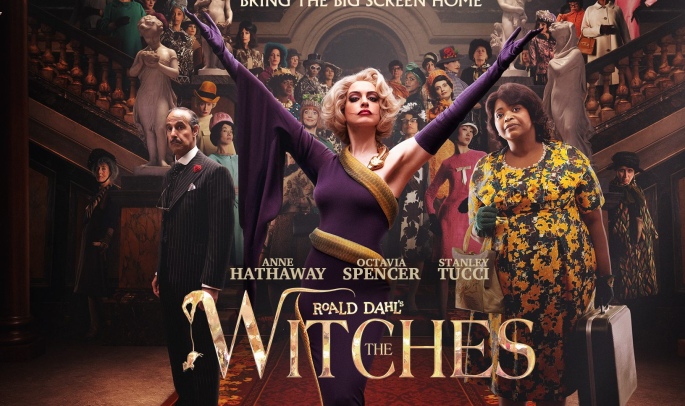
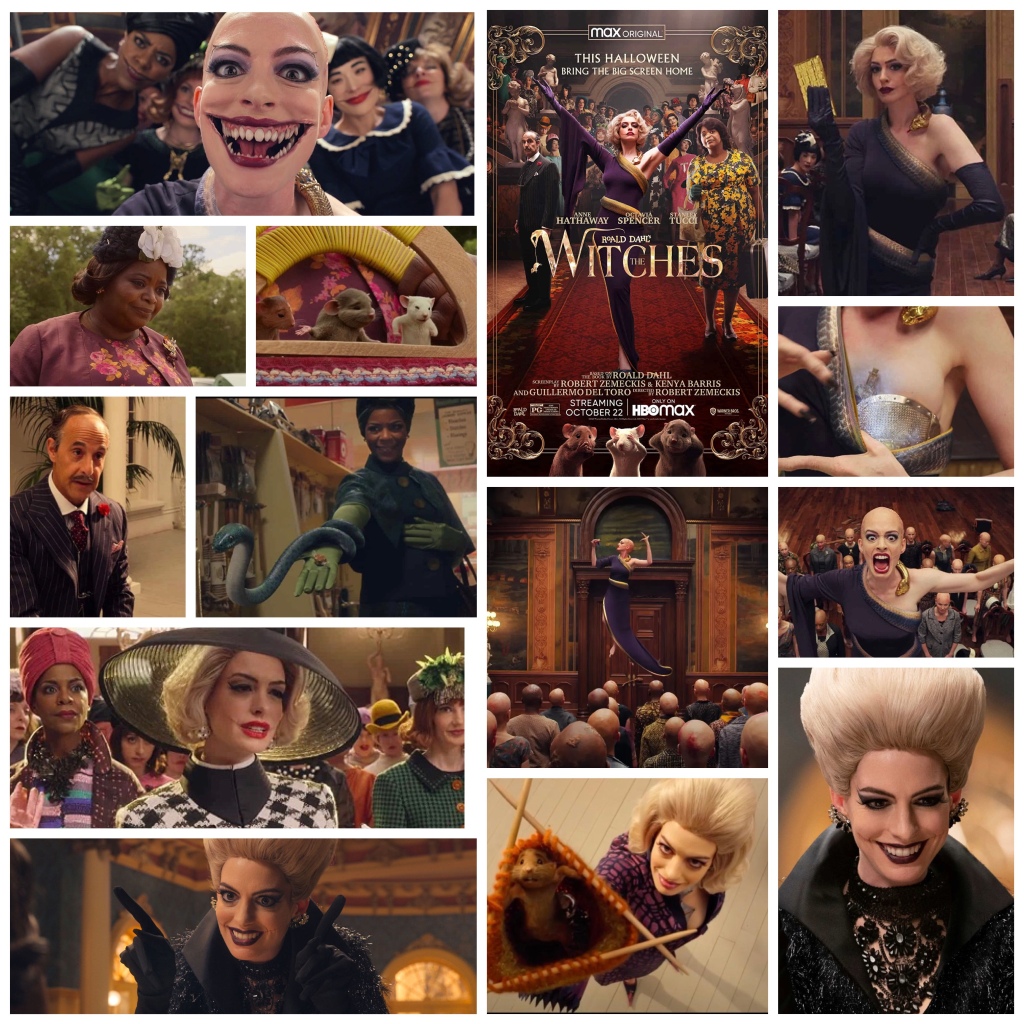
Robert Zemeckis is a perfect director to tackle one of Roald Dahl’s books; he’s got an inspired mastery over cutting edge CGI, a talent for dynamic visual storytelling and a genuine sense of the macabre, this willingness to be honest about the darker aspects of real life and include them in a story geared towards children, which is an attribute that he directly shares with Dahl himself. His crack at The Witches is an admirable, mostly successful, visually stunning and opulently stylish bit of devilish fun and although obvious comparison will be made not only to Dahl’s book (which simply cannot be topped) but also to Nicolas Roeg’s brilliant 1990 take on it. Zemeckis definitely takes the more playful route and while still injecting palpable dread and menace into the proceedings, his version isn’t quite the prosthetic soaked nightmare Roeg offered. The setting here is switched up from the UK to Deep South Alabama where a young boy and his grandmother (Octavia Spencer) encounter a coven of nasty real life witches holding a convention at a swanky bayou hotel. Anyone who has read the book knows that these witches are all about murdering children in frighteningly inventive ways and are led by the preening, aristocratic and supremely evil Grand High Witch, here played by Anne Hathaway in a performance that has to be seen to be believed. In the book the character is mean enough, in the 90’s version Anjelica Huston gave her a kind of.. ‘dark empress socialite’ vibe but Hathaway just grabs the script in her jaws like a dog and runs off with it. Sporting snowy blonde hair, a jittery Norwegian accent and mandible modifications that would make the vampires in Blade 2 shudder, she devours scenery, steals every scene and annunciates every syllable with the force of a snake sinking its fangs into someone. She truly makes this character hers, it’s the most impressive work I’ve ever seen from her as an actress and is by and far the best thing about the film. Even Stanley Tucci, who is usually the life of the party in any film, stands back in restraint as the hotel’s fussy manager and gives Anne a wide berth for her typhoon of a performance to unfold. The special effects are wondrous creations and I can’t figure out why anyone would bitch about the CGI on display here (it’s always inevitable I suppose) because it looks and feels incredibly tactile and terrifying. Zemeckis takes liberties with the witch anatomy that Dahl never dreamed of but they are righteous departures in style that make sense and add to the mythology nicely. Chris Rock narrates the film vivaciously as an older version of the young boy, and I never thought I’d say it but he has an uncannily perfect way with Dahl’s passages that had me wishing for a ‘The Witches audiobook as read by Chris Rock.’ My only one complaint is that it feels too slight in the latter half and I would have appreciated more of a runtime, but what they do give us really is a treat. Solid, comprehensive storytelling from Zemeckis, audaciously beautiful costume design, a gem of a score from Alan Silvestri and one unbelievable banshee howl encore performance from Hathaway who is truly having a blast.

-Nate Hill

Adam Wingard’s Home Sick

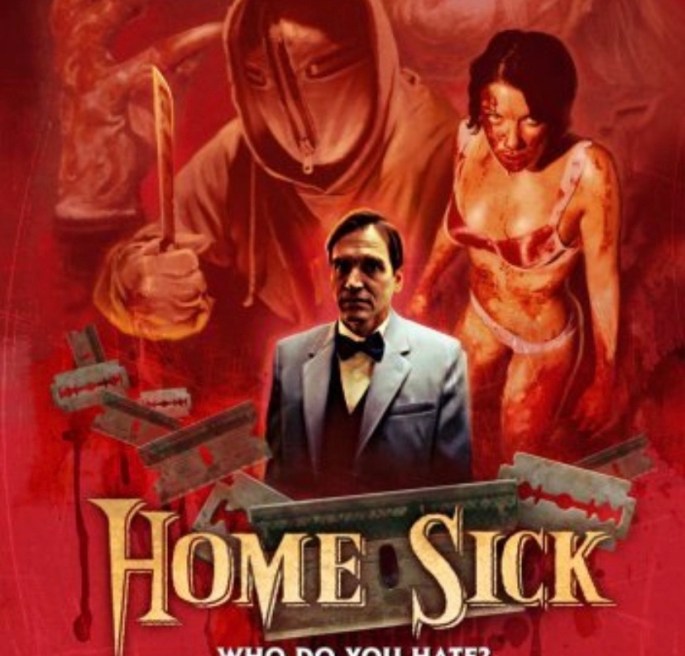
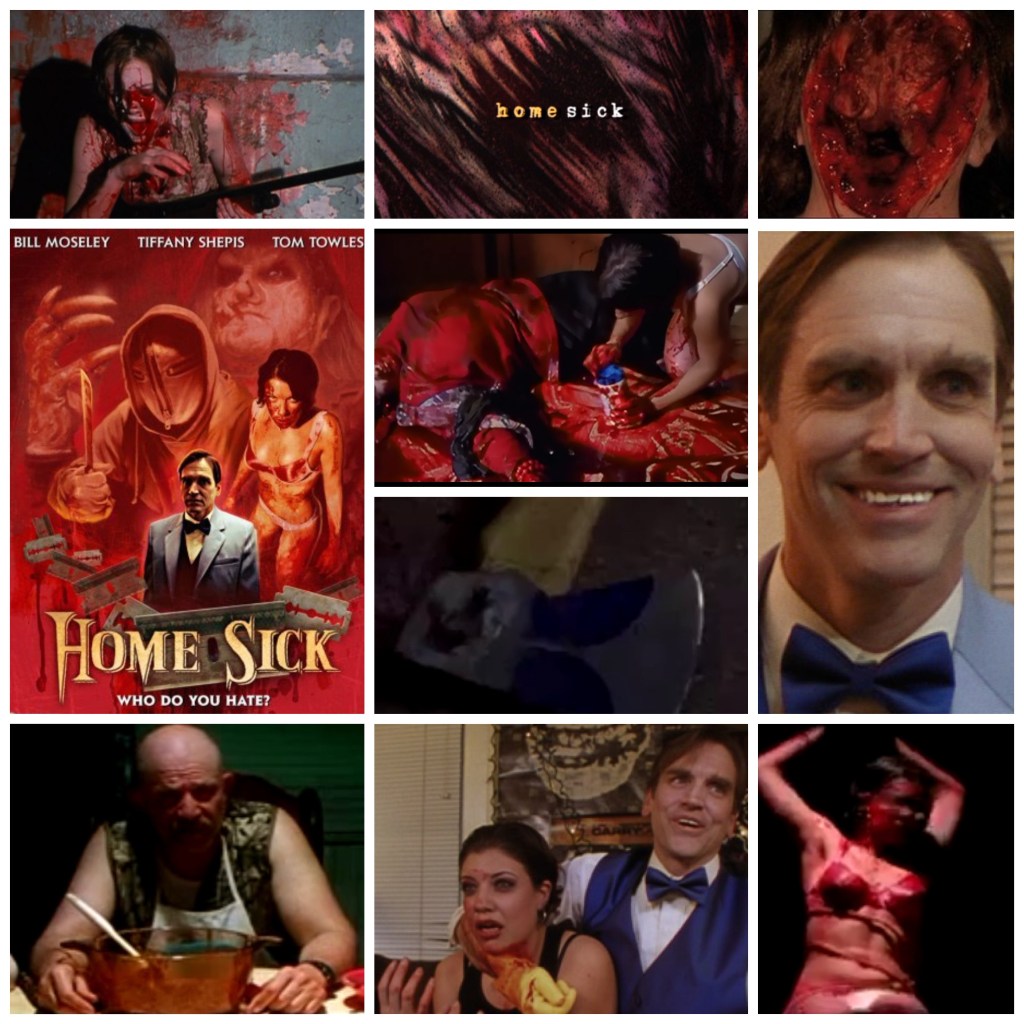
Adam Wingard has become something of a household name lately, blasting on scene with his vicious shocker You’re Next, thrilling audiences with his retro cult specimen The Guest and solidifying his presence as a filmmaker to be reckoned with by scoring the reins to Godzilla Vs. Kong, the dude is a top dog who is here to stay. Many aren’t aware of his debut film though, and fair enough because it’s about as low budget, under the radar and avant-garde as horror can be but it’s so, so worth watching to triangulate the evolution of a fascinating artist from the murkiest pits of lo-fi, Grindhouse schlock to the loftiest echelons of Hollywood high gloss. It’s called Home Sick, he made it on a shoestring budget back in the mid 2000’s and it’s an absolutely diabolical treat, but only if you can stomach some truly jarring moments of gore and have one demented sense of humour with the capacity for.. let’s just say… abstract thought. Low budget, practical effects driven schlockers like these are a dime a dozen, but this one is worth it’s weight in gold simply for going that extra mile to make it memorable and stand out from the cheaply drawn masses. It starts out slow, with an eerie opening credit musical jingle and animated sequence that could suggest all kinds of horrors to come. We meet a group of friends in the Deep South going through the motions of partying and quarreling. Tiffany Shepis does a wonderfully nutty little riff on her scream queen shtick who likes to rail cocaine at her graveyard janitor job and swing a mop around with gale force. Anywho, this weird little troupe is kicking back one night, when into the apartment walks a very ill adjusted stranger named Mr. Suitcase (the legendary Bill Moseley), and sits down on the couch like he owns the place. He’s chipper, charming and affable to a terrifying level, as he opens up his suitcase full of razor blades that he calls “gifts”. He asks them all to pick one person in their life they hate and want to wish dead, slicing a nasty gash on his forearm for each answer. The hilarious lot deadpan member of the group (Forrest Pitts, in a priceless performance of comedic eccentricities) foolishly blurts out that he wishes everyone in the room dead, and then the real fun begins. A giant masked killer begins stalking and killing pretty much every character around in ways so brutal your balls will shrink into your pancreas. Seriously, it’s like they sat down in a boardroom and systematically came up with every squirm inducing way to inflict violence on a human body, and gave their results to the storyboard artist and effects team. It all comes to a chaotic, deranged finale when they take refuge with Uncle Johnnie (the late great Tom Towles, always brilliant) a gun toting chili enthusiast. That’s where the film comes off the rails, but it’s seemingly deliberate and actually quite hilarious, as everyone pretty much goes certifiably bananas and loses the plot all at once like feral kindergarten class in overdrive. There’s some thought and care put into the writing, and as such the characters, however odd or over the top, seem like real people, albeit some strange and undesirable folks. The film oozes unsettling atmosphere right from the get-go, fervent in its aggressively weird sense of style and never taking the conventional route that most horrors end up with. Like I said, if your sense of humour has an affinity for the bizarre, demented and off the wall (think David Lynch meets Tim & Eric meets The Evil Dead meets John Waters), you’re gonna love this little gem. On top of being a laugh riot, it’s just freaky enough to earn it’s horror classification, something which many films in the genre just can’t claim. As to why it’s called HomeSick, though? Couldn’t tell you, and there’s no reference to it the entire time. Perhaps it’s called that for the folks that will be thoroughly repelled and repulsed, those who watch it expecting a run of the mill, cookie cutter slasher and feel uncomfortable with the oddness, getting “home sick” for their safer horror fare. As for me, I’m right at home up the weird end of the alley, and love this type of thing and it’s one hell of a fascinating debut for any director to start out with.

-Nate Hill

THE P.T. ANDERSON FILES: BOOGIE NIGHTS (1997)

It’s a strange thing to consider but for all of the power that sex wields to start wars, topple the powerful, and put people into financial or personal ruin, the porn industry is small time. That’s not to say that the porn business doesn’t make boatloads of cash. In fact, it’s quite the opposite. I mean, if one really wants to believe that the only things subsidizing the porn industry are the spending habits of amoral perverts, that person may want to try and show their math on that assertion if only to sooner realize that there just aren’t that many degenerates wandering the earth. In other words, a whole lot of people you encounter at work, in the streets, and (gasp) at church have at least dipped a toe or, more likely, engaged in a full baptism into one of the four corners in the pool of the sex industry. But yet, for all of the dough the films generate, there are precious few hardcore actors or directors that have been able to transcend the hermetic shell of the adult film world either in name or deed. For every John Holmes, Ron Jeremy, or Sasha Grey, there are a thousand others whose stopover into the world of porn occurs because it’s a place that, if they can’t build a legacy, they can definitely make a buck.

It is because of this that, despite actually working at a General Cinemas theater at the time, I’m unsure as to what went through the public’s mind when they saw the expertly cut and energetic trailers for Paul Thomas Anderson’s Boogie Nights prior to its release in the summer of 1997. Here was a film that was going to be playing in the multiplexes and malls across America that would, in seemingly frank terms, follow the story of an ersatz John Holmes as he navigated the literal ups and downs in the pornographic film industry in the 1970’s and 80’s. Would America be able to reckon with its very real attachment to pornography to feel comfortable enough to go and see it and give it the respect it deserved or would the film flop given the culture’s mind-bogglingly puritanical attitude towards THIS KIND OF SEX™️? If there is anything to challenge the accepted notion that sex sells, it’s to invite people to sit through two-and-a-half hours of it.

But Boogie Nights was a hit and, surprisingly, a quite sizable one. Anchored in the front by a dynamite and keenly sensitive central performance from a then-risky Mark Wahlberg and, in the back, by a jaw-dropping return to form by Burt Reynolds with incredible, fearless performances by Julianne Moore, Heather Graham, John C. Reilly, Don Cheadle, William H. Macy, and Philip Seymour Hoffman (among others) between them, Boogie Nights was received as a rollicking, exhilarating American epic that was an intoxicating mix of Scorsese-like rhythms and editing being navigated by Demme/Ashby-like heart across an Altman-like canvas; the most joyous piece of pop filmmaking since Quentin Tarantino’s Pulp Fiction three years earlier.

Boogie Nights appeared at just the right time in America to make the splash that it did. The years of peace and economic expansion under the Clinton administration turned the 90’s into a freewheeling party which saw the birth of the internet and, also, a certain lax in our social mores as latchkey kids from the 70’s who grew up sneaking peeks at their parents’ poorly hidden porn stashes rolled into their twenties with a more permissive, NBD attitude towards Boogie Nights’s subject matter. All of the moments within the film that focused on the hilariously crude approach to adult filmmaking (and its spot-on recreations of the final product) were met with the appropriately knowing chuckles of an audience that couldn’t do anything but acknowledge that they understood exactly what they were looking at and, in the words of Elliott Gould in The Long Goodbye, it was (at long last) ok with them. And it was the good fortune of everyone cast in the film that the worm of American culture had somewhat turned as Boogie Nights is a virtual “who’s who” of talent that was just beginning to crest a professional summit out of indie-world and the film’s success would propel almost every single one of them to mainstream fame.

One of the things that has continued to work in Boogie Nights’s favor almost a quarter century later is its anticipation of the succeeding generation’s devotion to 100% acceptance and the encouragement of full positivity among its peers. To this end, Anderson doesn’t excuse his characters’ flaws but is ultimately sympathetic to all of them (save and except Diggler’s mother, Joanna Gleason in a ferociously monstrous performance). The characters are small time but, almost presciently, exist in a world of total support and encouragement; one in which, from the point of view of those on the ground in the actual time and place, seemed like more of a legitimate enterprise than, say, selling blowjobs on Hollywood Boulevard for a hot meal and/or somewhere to sleep. So maybe it’s technically incorrect (and borderline irresponsible) for Julianne Moore’s mother-surrogate, Amber Waves, to fawn over Wahlberg’s decidedly not-very-talented (but massively endowed) Dirk Diggler as “so fucking talented,” but is it really worse than how his actual mother treats him in the neatly trimmed “normal” world of Torrance? Sure, Jessie St. Vincent’s (Melora Walters) paintings are uniquely awful but, really, are they any more subpar than some of the tacky prints that adorned the walls of suburbia at the same time? Are those adult award shows any more moronic and stupidly self-congratulatory than the Oscars? Certainly, the ephemeral static attached to the porn industry doesn’t make it look like the most positive environment to some people who live nine-to-five existences but, as the film makes crystal clear, the need-driven support structure within it is mighty alluring for the socially outcast, the marginalized, and the abused.

And Boogie Nights was never going to be a movie that reveled in its orgiastic pleasures for its own sake. Much like Goodfellas, there is a real “set ‘em up and knock ‘em down” formula to the film’s structure. The film’s first half looks like a total blast of wanton abandon; an effervescent celebration of the largesse of the sexual revolution replete with a pulsating soundtrack and the promise of a perpetual California sunset. As an audience member, you WANT to be there, even if you’re just hanging out in a lounge chair poolside while drinking a margarita while everything else swirls around you. But, sweet Christ, brutal is the comedown that occurs in the second half of the film when the organic pleasures of the 70’s are replaced with the synthetic coke high of the 80’s. A nonstop stack of nightmares including a murder-suicide, crippling addiction, accompanying sexual dysfunction, mounting legal challenges, the cold yet practical move from film to video, and violent moments of terrifying, rock-bottom sobriety show that Boogie Nights is just as eager to argue the downslope as convincingly as it does the ascension, though without any kind of sanctimony in regards to its characters’ plights.

But as much as Robert Altman utilized the titular city to examine America as a whole in 1975’s Nashville, Anderson is using the porn industry in the bracketed time frame to explore the fluid boundaries of family much like he did in Hard Eight the year before and he would in Magnolia two years later. And, to be sure, the world of Boogie Nights remains his best Petri dish in which to study this dynamic as the film’s libertine atmosphere mixes with its members’ outcast and discarded statuses which create disarmingly moving and powerful moments throughout the film, most especially those involving any combination of Wahlberg, Reynolds, and/or Moore.

And so it is that Boogie Nights endures not just because it’s a naughtily hilarious and dramatically satisfying film, well-remembered by Gen-Xers who pine for the sun-kissed days of the mid-90’s. It endures due to the fact that it was written and directed by a guy not yet twenty eight who could resist the easy temptation of sniggering at its subject matter in favor of focusing on the longer view that included poignancy, care, and familial love shared among its characters, ensuring that it would continue to pay dividends to its audience well into the future.

Hélène Cattet & Bruno Forzani’s Let The Corpses Tan

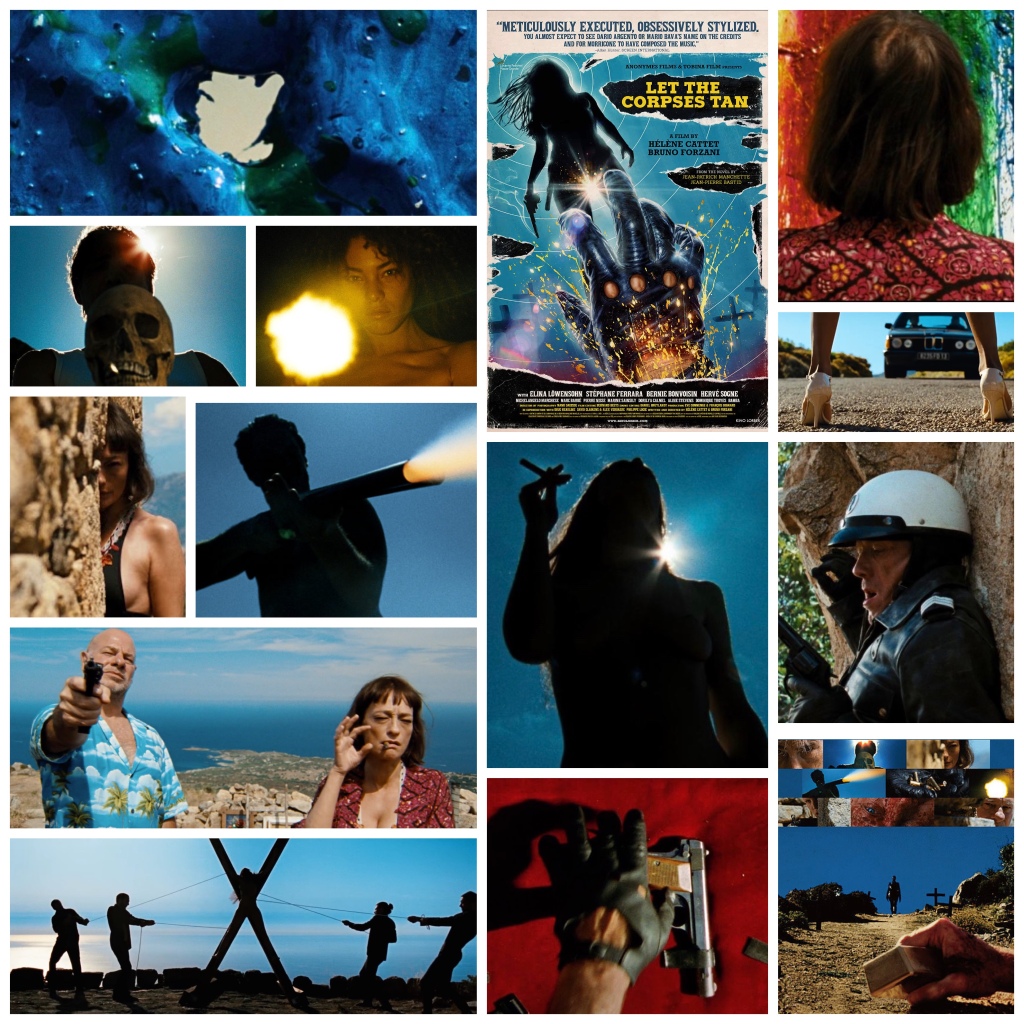
Whenever contemporary filmmakers attempt a homage to cinematic styles, tones and artistic mechanics of bygone eras in cinema it’s very easy to tell whether they know their shit and have captured their intended aesthetic or missed the mark. Every culture and era of the medium has their own unique and distinct flavour woven into every aspect of the artistic process, and any pastiche is just going to be a delicate undertaking. In the case of Hélène Cattet and Bruno Forzani’s Let The Corpses Tan they have done an impeccable job of emulating this kind of… 60’s/70’s Italian pulp/murder/spaghetti/cop/splatter/action vibe that’s so specific to that time and region I can’t even properly describe how… unmistakable the palette is. It’s like Italian genre cinema went to sleep one night and this film is a window into into its REM cycle. On a remote, sun drenched island in the Mediterranean (shot in beautiful Corsica), a gang of murderous thieves spearheaded by a vicious femme fatale (Romanian cult icon Elina Löwensohn) hide out in the crumbling ruins of a Hellenic ghost town, harbouring a stolen trove of gold bullion. As they languidly await some vague deadline, others approach including a gaggle of unfortunate civilians and two intrepid motorbike cops, whose arrival heralds the furious, bloody, beautiful extended gun battle that becomes the film’s centrepiece. That’s all for plot really, but trust me it’s all you need, this film is all style, aesthetics and nightmarish visual poetry and contains some of the most outright striking imagery, editing and production I’ve ever seen in cinema. The weapons are all gorgeously retro and have this… ‘Spaghetti SteamPunk’ mechanical anatomy, the violence has a Giallo singed, pop art bloodiness to it, and the editing is some of the most painstakingly detailed work I’ve ever seen. Closeups on craggy faces, hyper-quick zooms, pans, jump cuts and jarring chops that are so off the wall, intense and unconventional they nearly give the viewer a heart murmur in the best way possible. Amidst the gunplay that although supremely stylish is very down to earth there is also this wonderful flourish of shocking surrealism woven into the story, as we see a mysterious, Venus-esque maiden appearing occasionally surrounded by tantalizing, erotically charged symbolism, gunshots explode into otherworldly blasts of coloured paint and all manner of dreamlike cutaways, hyper-stylized mysticism and enough bright colours and sunshine to get a rave going. Absolutely astonishing film, highly recommended.

-Nate Hill

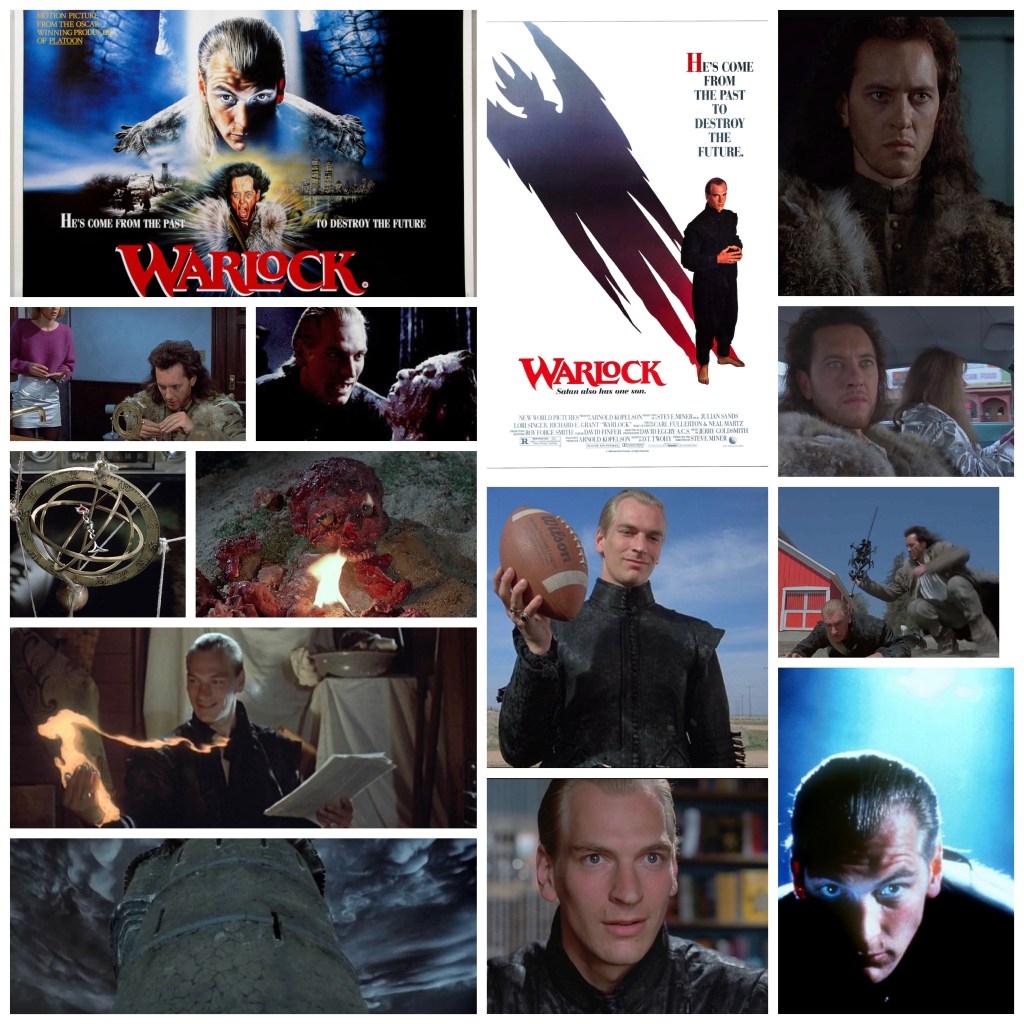
Steve Miner’s Warlock

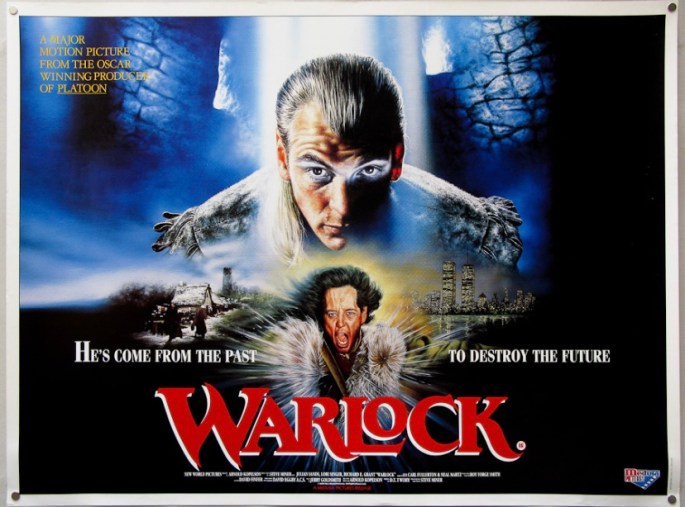
Steve Miner’s Warlock is billed as a horror film but it looks, feels and works better as a sort of time travel adventure deal. There are elements of horror, and the sequel (which I’ll review next) definitely dabbles in horror more hardcore but this is a rollicking, spirited jaunt from 1600’s New England through space and time to 1990’s L.A. as a hyperactive witch hunter (Richard E. Grant) pursued a dangerous supernatural sorcerer (Julian Sands) before he can collect enough dark magic to unleash the apocalypse or… something. It doesn’t matter what your specifics are when your effects, journey and overall atmosphere are this much fun. Sands is mercurial, devilish and relentless as the Warlock and he carefully walks a tightrope between being an unstoppable, faceless force of evil like some horror boogeymen and having his own unique charisma and panache, like others. Grant is ridiculously fun as the initially boorish, then gradually likeable and by the third act downright adorable witch hunter, sporting a coat right out of The Revenant and a mullet that Chuck Norris would be jealous of. Also he’s called “Giles Redferne,” which might be the coolest name ever in cinema, and he sure lives up to it. He meets a bubbly 90’s valley girl who has no interest joining forces with him until the Warlock puts a nasty aging spell on her and then, well, you can imagine. The effects are naturally of the 90’s variety but they have their own kitschy charm, especially during a hilariously shocking sequence where Sands literally kills a child and uses its blood for a flying potion so he can become a cruise missile and engage Redferne in a raucous highway car/flying Warlock chase. This is a fun one with elements of horror, dark comedy and swashbuckling tinged adventure all at play.

-Nate Hill

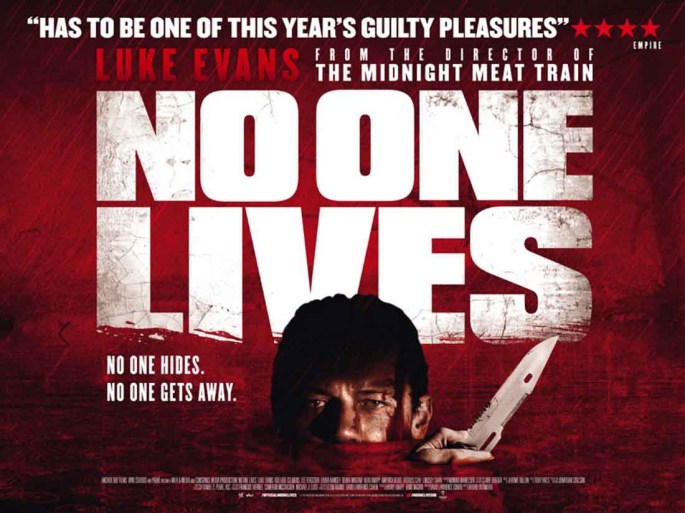
No One Lives

I don’t think I’ve ever seen quite as… efficient a serial killer as Luke Evans in No One Lives, an absolutely mental, ruthlessly gory, completely unhinged shocker with enough torque in its hood to short circuit your TV. It’s one of those stories where a group of very bad people accidentally enter the orbit of someone much, much worse and live to deeply regret being so careless. In this case the bad people are a roving gang of backwater criminals led by Lee Tergesen, but they’re not a biker gang or anything specific they’re just like… a gang, like the Warriors or something which I found hilarious for some reason. Anyway they unwittingly piss off Luke Evans’s seemingly benign ‘Driver’, who turns out to be an impossibly cunning, deviously psychotic and *very* experienced mass murderer and he has now decided that they are all gonna die. Every. Last. One. It’s not so much a game of survival as it is a total massacre of fish in barrel and we see him dispatch them all in some truly unsettling and bloody ways that involve everything from an industrial wood shredder (it’s not a wood ‘chipper’, the only applicable description of this fucking giant thing is ‘shredder’) to a lethal harpoon gun pulley system to a grisly variation on the ‘Leo hiding in a horse carcass’ moment from The Revenant. Amidst the mayhem and splatter the film even finds time for some genuinely twisted victim/aggressor psychology involving a former captive of his played by the lovely and always slightly unnerving Adelaide Clemens, who comes across like a shellshocked Michelle Williams. The two have a perverse, Stockholm Syndrome laced former dynamic that is eerie and very well acted by both. Evans usually shows up in polished, rollicking Hollywood high budget fantasy and whatnot but it’s very refreshing to see him roll up his sleeves and dive headlong into something knowingly lurid and deliriously pulpy, he has a ton of fun as basically the Jason Bourne of serial killers and I could totally see the character returning for a sequel or two. It’s decidedly lo-fi, B horror stuff and very in your face gruesome but Japanese director Ryûhei Kitamura keeps the momentum surging at a breathless pace, the gore and action nearly nonstop and the schlocky, Midnite tone evenly dispersed throughout for a wicked wild ride.

-Nate Hill