Henry Selick’s Monkeybone

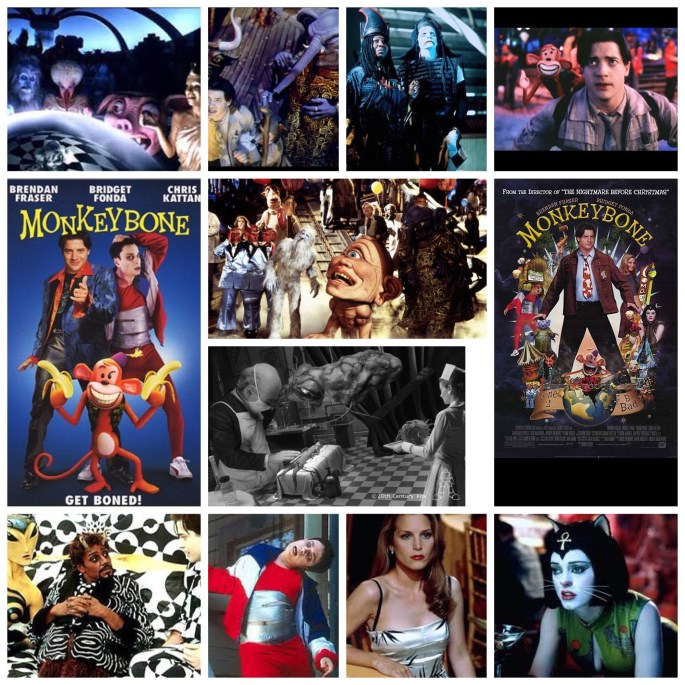
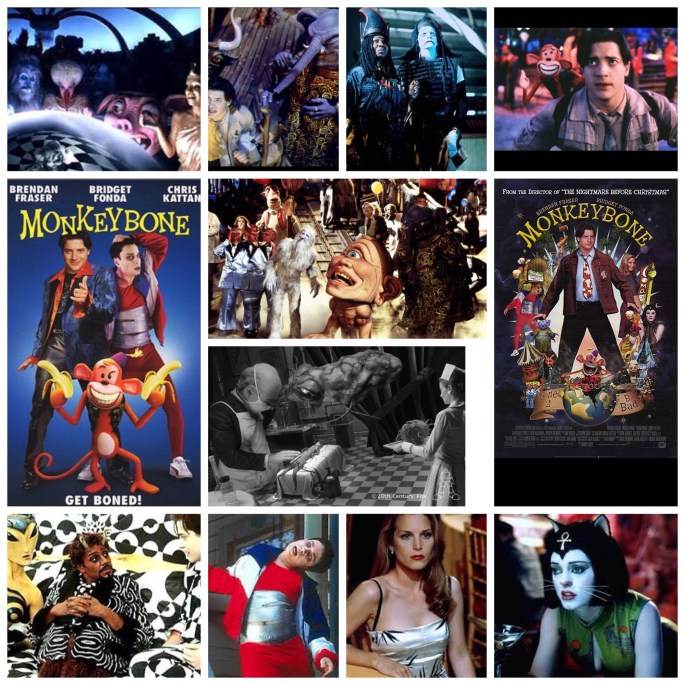
Henry Selick’s wacktastic, surreal Monkeybone is off its head, and while it never quite coalesces into something wholly memorable, the images and impressions on parade are not something easily shaken. To start with, the visual production design is so detailed and thoroughly deranged it deserves it’s own art gallery after the fact. Selick, the other half of the creative team behind Nightmare Before Christmas, create’s here what is maybe one of the most unsettling, eye popping mood boards in any film of the century. It’s just just in keeping us awake with the storytelling that he falters somewhat, not enough to sink the ship, but enough that not a lot of people remember or revere this film these days, which is a shame because it’s quite an achievement in areas. Brendan Fraser, who seems to actively seek out oddball scripts, plays cartoonist Stu Smiley, who goes into a coma, gets sent to a place called Downtown where the veggies go until they either croak or wake up, and is put in jeopardy once someone has the idea to pull the plug on him. His loving girlfriend (Bridget Fonda, who I wish was still in the acting game) waits for him, while his newest creation, a little plush horn-ball named Monkeybone, gets a little too sentient and tries to steal his body, which has a certain organ he wasn’t endowed with on the drawing board. The story is too weird and raunchy for kids, and falls into the Roger Rabbit/Cool World arena of adult oriented fare that still has a childlike sensibility. Downtown is essentially a haunted DisneyLand astral plane, a reject realm where ghosts, ghouls and monsters with disturbing anatomy roam free and feed on nightmares, siphoned from the psyched of those upstairs stuck in comas. Weird enough for you? You don’t know the half of it. The nightmare scenes are shot in stark black and white and have a genuinely subconscious, tuned in vibe to them that actually feels like one does in dreams, not an easy aura to pin down onscreen. Fraser does a wicked job, especially when the monkey hijacks his body upstairs and starts prancing around like a mental patient, it’s an inspired bit of physical comedy from the man who brought us George Of The Jungle. Monkeybone is apparently played by none other than John Turturro, but his voice is so tripped out on helium effects it’s fairly unrecognizable. The film gets downright hilarious when Stu follows the scamp back up in the avatar of a corpse with a broken neck (bravo to Chris Kattan), a dementedly genius sequence. There’s cameos and vaudeville supporting turns galore, including Rose McGowan as a sexy cat/human hybrid, Bob Odenkirk, Thomas Haden Church, Giancarlo Esposito, Lisa Zane, and Whoopi Goldberg as Death, a sly meta rework on her Ghost character. The film is at it’s best when it focuses on Downtown, which really is a vibrant atmosphere to hang around in, always an odd mutant creature to look at or a morbid one liner for chuckles. The stuff back on earth can be fun too but really doesn’t pick up until Kattan comes roaring in and steals the climax with his bobble-head gymnastic fanfare. If only this had been a little more in terms of story and character, it could have matched it’s truly impressive visual scope. As it is, it’s worth it just to see how weird and surreal mainstream movies can get when they want to.

-Nate Hill

STAR WARS: THE LAST JEDI

Star Wars The Last Jediby Jason Callen

Rian Johnson has accomplished something remarkable. He has taken a sprawling space opera that encompasses 8 feature length films, hundreds of hours of animation, and dozens of books, comics and video games and created a story about intimacy and connection. Given the nature of the force as the “thing that binds us and holds the universe together,” you’d think something along these lines would have been attempted before, and certainly there have been moments throughout the series that highlight the connections the force can create, but it always felt more in service of plot then any kind of exploration of the force’s potential. Through the simple, time honored technique of cross cutting between two characters Johnson creates that connection between Rey (Daisy Ridley) and Kylo (Adam Driver). It is the first time we’ve seen two characters communicate with each other via the force. I know, it seems ridiculous right, like this has happened repeatedly, but no, all other moments of force communication (I’m making these terms up as I go) have always been between “ghosts” and the living or been just a word or a feeling between living characters, never a conversation. (And yes, I realize that technically the connection is manufactured by a third party but I don’t think it changes the impact at all). Big deal you say. What’s the difference you say? I know, I felt the same way at first but as Johnson persisted in its use it became clear he wanted to give the force a more important role. So we get this expanded connection and we get Leia’s amazing force moment, which was so necessary and about damn time, but beyond that we get connections between non force wielding characters. Not telekinetic connections but human ones. I’m speaking obviously of Finn and Rose who end up separated from the main action but vital to it nonetheless. With no one else to trust, they must rely on each other. This would seem a fairly straight-forward side mission, something abundant in the Star Wars universe, but when Johnson goes back to Rey and Kylo, the parallels between the two budding relationships become clear.  Neither Finn nor Rose is force aware in any sense we are familiar with but their connection is clear and clearly meant to enrich the potential of the force. The “force binds and connect everything,” it is not simply a tool for the Jedi and Sith but something that anyone one has the potential to tap into. As it should be.  And while Finn and Rose didn’t exhibit any force powers, I would not be surprised to see them emerge in later episodes.

Luke’s belief that it is “time for the Jedi to end” takes on a different meaning if we accept this. We don’t have to assume a Jedi genocide or more (always more!) self-imposed Jedi exile. Instead the end of the Jedi might simply mean the end of Jedi elitism. People no longer need the Jedi to inform them on the ways of the force or to restrict them in the ways in which the might use it with religious tenets. Put simply, the force is for everyone. You don’t bring balance to the universe by hoarding the force among a select few. You bring balance to the universe by imbuing all with the force.  Children abandoned to slavery, former Storm Troopers who grow a conscious, lowly maintenance workers who have only ever dreamed of battle, broom boy…any one could now end up the greatest wielder of the force the galaxy has ever seen. Couple this new potential with Luke’s evolution to a celestial being and it’s safe to say Rian Johnson has blown up the Star Wars mythos, and while many have and will disagree, I’ve found those moments that have garnered the most ire (I won’t list them, you know them) to be the moments that set this film apart from the rest and give the audience something richer than we’ve come to expect. The future of the franchise has never been so wide open or exciting.

Will any of this potential be realized in upcoming films? Sadly I hold out little hope for the next episode since it will be returning to the pedestrian, TV aesthetic inclined, J.J. Abrams who is half the director and a third the writer that Johnson is. But fear not, Disney has already green-lit Johnson a new, non-episode trilogy so there is reason to rejoice and believe he’ll get a chance to move his vision forward, and if we’re really lucky (and if Disney has any brains at all) perhaps he’ll be involved at least in the writing of the next episode. Whatever happens, they better be bold, because the bar has been raised. This is the best live action STAR WARS.

Behind Enemy Lines

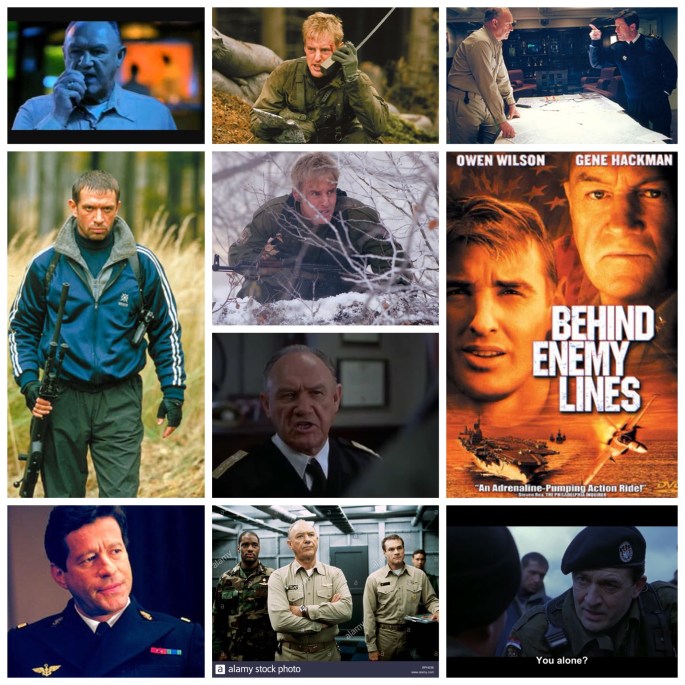
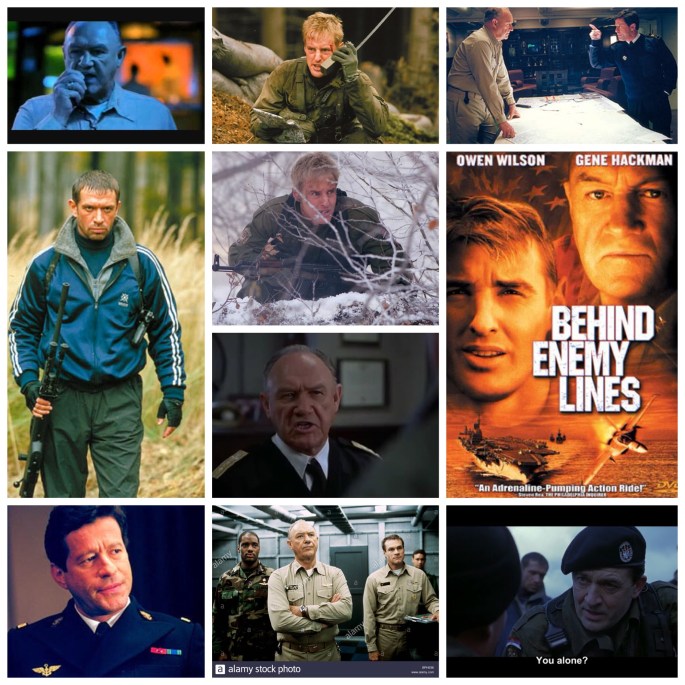
I’ve always enjoyed Behind Enemy Lines, a hyperactive, simple minded, highly kinetic Owen Wilson/Gene Hackman war survival flick. It’s lowbrow, full of plot holes and questionable in terms of representing both the military and the Serbian/Bosnian war, but it’s also explosive, jacked up fun that packs a visual and auditory wallop. Wilson is an Air Force pilot who goes awol after a crash, and runs afoul of some Serbian radicals running a sickening genocide operation somewhere out there, while Hackman is the fiery Admiral tasked with coaching him back to an elusive drop point, and helping him avoid obstacles along the way. In pursuit is a nasty rogue general (Olek Krupa), who wants to snuff him out as he’s witnessed the man’s squadron murder his copilot (Gabriel Macht), and also just because he’s the classic stock villain and has nothing better to do. His top assassin (Vladimir Mashkov, almost identical to Niko Bellik of Grand Theft Auto 4) is an Eastern European Bear Grylls with homemade grenades and the pain tolerance of a tank, also chasing poor Wilson. It’s fairly implausible, but oh so cinematic and one I often put on just to work out the sound system of my tv. Crazy souped up editing, jagged freeze frame effects and whatnot ensue, it’s cool and kind of like Tony Scott Lite in a way. Hackman could yell out any dialogue and be convincing, owning yet another role, especially in a scene where he has a wicked shouting match with an A-hole of a UN General (Joaquim De Almeida firing on all cylinders and then some). David Keith has a great bit as another Admiral assisting in Wilson’s plight too. It’s suspenseful, doesn’t take itself too seriously and shouldn’t be subject to too much scrutiny, lest you rob yourself of a pleasurable genre viewing experience. Plus the sequence where Wilson hides in a freaky, mud filled mass grave has stuck with me for years. Good stuff, man.

-Nate Hill

Fluke

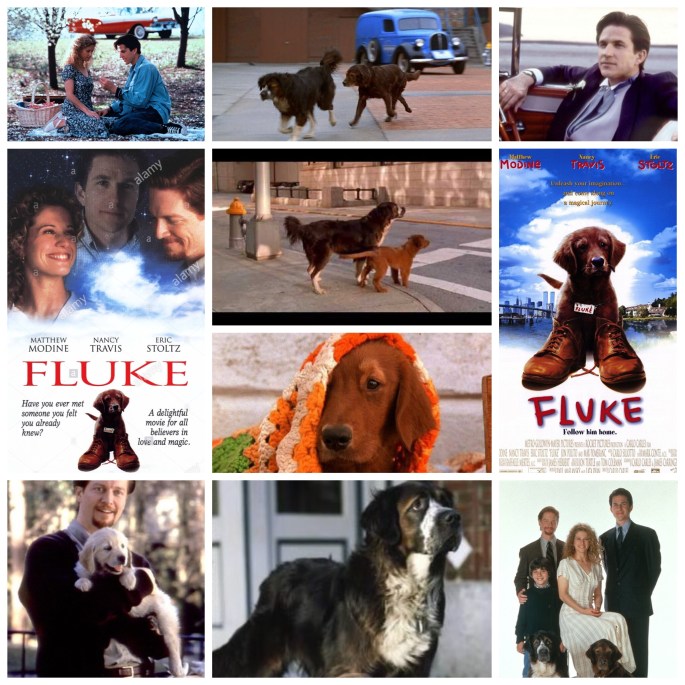
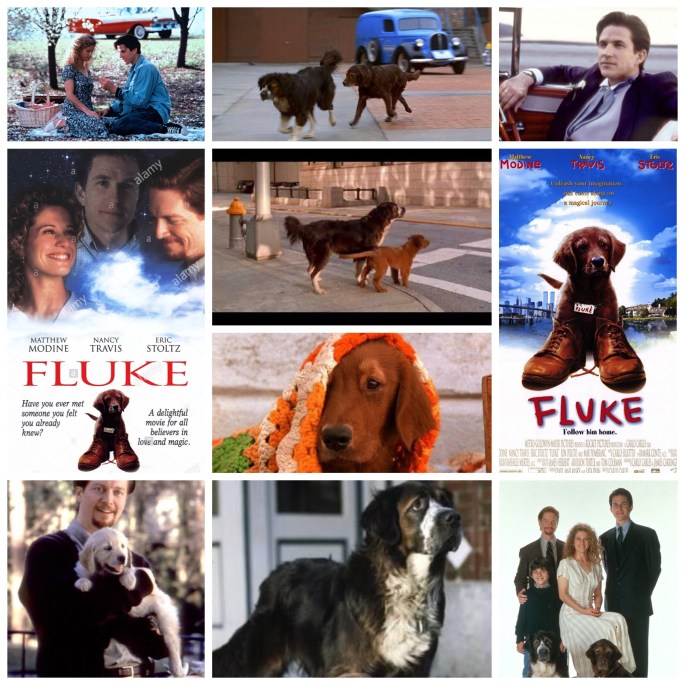
On paper, or at least on poster, Fluke looks like a benign kid’s flick in the tradition of Beethoven or Babe, as a big fluffy Red Labrador gazes down adorably from the blockbuster shelf. Well, I rented this way back when I must have been like ten, and I can tell you it ain’t no children’s movie. There’s a sadness and deep thoughtfulness to the story that will sail over youngster’s heads, leaving them with just the scenes of talking dogs to keep them occupied. Based on a poignant novel by James Herbert, this is one of the oddest and most depressing family films out there, but it’s also unique and brave enough to go where it does, reaching beyond the sappy to try and become something more complex. Matthew Modine plays a successful businessman who is killed in a foolish car accident one night, leaving behind his wife (Nancy Travis) and son (Max Pomeranc). The film gets spiritual as we seen him reincarnated as that very same mutt from the DVD cover, a curious creature called Fluke. Born into frustrating circumstances, he finds himself pulled into one situation after the other, including bonding with an old woman who passes away, living in a junkyard for some time and making friends with a troupe of homeless urban canines, including tough St. Bernard Rumbo (Samuel L. Jackson), mongrel Sylvester (Ron Perlman) and wiseguy pup Boss (the late Jon Polito). Eventually though, he remembers he was once a man, and sets off to find the family he left behind, feeling alienated in his animal form. It’s a terribly sad film, one that’ll gouge your heart right out, if you can take that sort of thing. It’s also daring and complicated when it wants to be. Fluke feels all the more isolated when he does find his family, as his wife has become close with his old business buddy (Eric Stoltz), and he has nothing but his bark to communicate, a crushing interaction to see. This is one of a kind, and in no way should be in the kid’s section of any video store or iTunes manifest, it’s just too out there and thematically challenging, but that’s in a way where it’s strength as a story lies. Should be viewed as an existential, spiritually inclined drama about what it means to really live, in whatever form you’ve been given, and how someone can ruminate on the choices they’ve made through new eyes.

-Nate Hill

B Movie Glory: Necessary Evil

There’s always those B Movies that seemed to be sewn together out of bits of other scripts and produced solely so SyFy or Space has something, anything to fill up their 3am Saturday time slot. It’s like production team grabbed discarded narratives from all kinds of genre flicks, shoved them in a magic bullet, but purée and served up whatever the result is to the distributor. Now, this can often be a terrible idea resulting in boring mish-mash horror flicks that make little sense, or they can oddly kind of work in their own absurd way. Necessary Evil… kind of works, kind of doesn’t, there’s definitely something splattered on the canvas with it’s narrative, what it is though, I’m not even sure the filmmakers had an idea. It’s part Lovecraftian horror, part psychological something, part social satire and all schlock, but these themes bleed into each other until even the most attentive viewer will have not much of a clue what they’re watching. Best I can describe it: a super sinister doctor named Fibrian (Lance Henriksen) runs a shadowy psychiatric ward. There’s all kinds of rumours about illegal testing, dodgy pharmaceuticals, mass mind control and occult ties, none of which is ever made clear or disproved. However, when you have Lance playing your asylum director, you can almost be sure the place is up to something it shouldn’t be, he just has that cavalier maliciousness that he always switches on for these types of parts. A police detective and a reporter are onto him, and do theor best to infiltrate the facility, but his powers have already spread to the city outside, causing people to act strange and… well, a bunch of other weird shit. Danny Trejo has an amusingly hostile extended cameo as some vague operative working for Fibrian, and yada yada. It earns points for sheer WTF-ness though, it’s like every day on set they picked one crew member to add the craziest thing they could think of to the script and just ran with that (which would be a cool free association method of improvisational filmmaking, now that I think about it. They outdo themselves in a hilarious, out of left field cliffhanger ending that gets pretty cosmic and out there, adding a straight up supernatural element that cements the demented vibe they’ve strived for with the whole thing. A true oddball.

-Nate Hill

Walter Hill’s The Long Riders

◦ I’m pretty sure that Walter Hill’s The Long Riders does something that no film had done before or after, least to that extent: pull off the biggest sibling stunt casting session in history. Based on the rowdy, violent exploits of the James Younger gang in the old west, Hill casts real life brothers as the troupe, a choice which could have been south of silly in any old director’s hands, but works like gold here. James and Stacy Keach play Frank and Jesse James, David Robert and Keith Carradine are the Younger clan, while Randy and a very mean, very young Dennis Quaid fill the boots of the Millers. It’s fairly brilliant, well organized and pays off nicely, especially if you’re a fan of any of these guys, which I am and then some. Now, the film. Most westerns about these hotshot outlaws take a quippy, cavalier standpoint and go for sterling silver charm. Not Hill, a notorious trend shirker and trailblazer whose tactics in casting, music, editing and tone have never followed the Hollywood grain. The film is downbeat, somber and mostly a series of vignettes that topple against each other like dominoes. The gang shuffles from robbery to holdup almost reluctantly, like it’s written in the stars and they have no choice but to commit crimes. They clash royally with the ruthless Pinkerton agency, who cause more than a few casualties on their side. The shootouts here are no sanitized 50’s Lone Ranger fluff, they’re brutal, bloody and amped up to extreme violence, which is always to be expected from Hill. The life of an outlaw is not glamorized here either, a choice rarely, if ever made in the western department. These are hard men resigned to their rough lives, not fast talking hot-doggin prince charmings like insufferable Young Guns type crap. There’s scattershot subplot about the brother’s lives, but mostly the focus is rooted in their exploits and run ins with the law. David Carradine’s Cole Younger has a cool knife fight sequence up against half breed injun Sam Starr (Hill favourite James Remar) over the favour of pretty hooker Pamela Reed. The actors are all gritty and grizzled, from James Keach’s long-faced, Moody Jesse James to Dennis Quaid’s volatile psychopath Ed Miller. Hill’s go to music guru Ry Cooder provides another achingly gorgeous score with echoes of his composition on Southern Comfort a few years later, a melancholic tune stripped bare of any action sequence swells or orchestral hoo-hah. Pretty damn underrated as far as big screen westerns go, with a tone and look that seems somehow far more genuine than many others in the genre.

-Nate Hill

Netflix’s The End Of The Fucking World

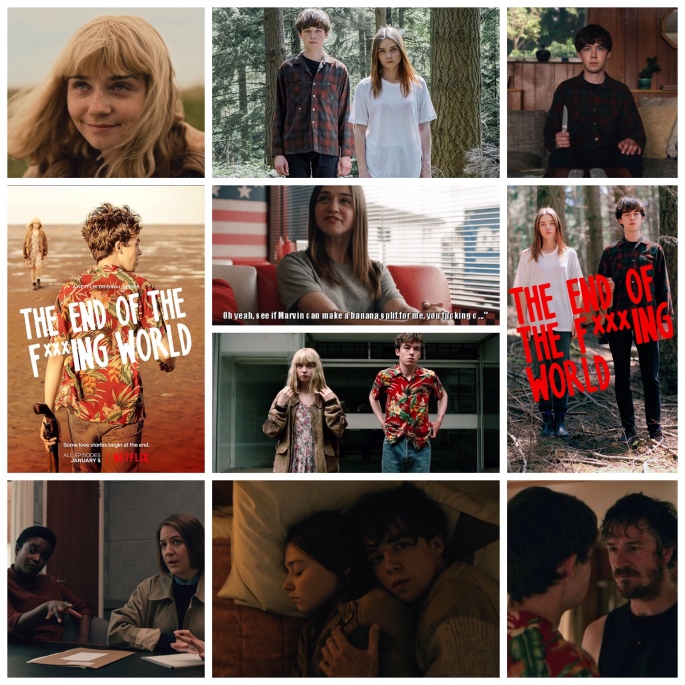
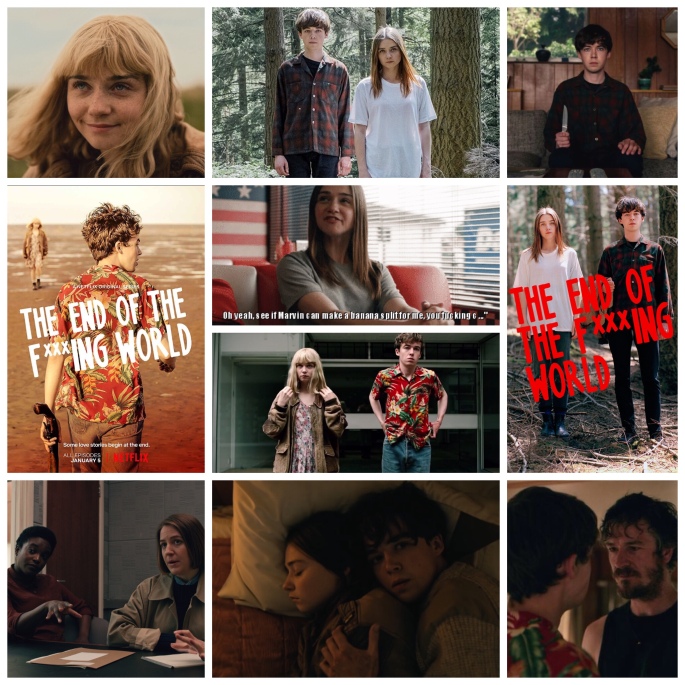
Netflix’s new original show The End Of The Fucking World is impossible to really describe until you go binge it for yourself, which isn’t a tough task, considering it’s only eighth episodes, each twenty minutes or so in length. It’s a dark comedy, a road movie, a love story, a pseudo coming of age tale and everything in between, seen through a sardonic yet heartfelt lens, wicked sharp acting that’ll have you laughing in stitches when it’s not hitting you in the feels, and the beautifully blunt script to back it up. James (Alex Lawther) is a stoic seventeen year old who is fairly certain that he’s a psychopath. He’s killed all manner of household pets and local wildlife, but plans to graduate to something bigger very soon. Alyssa (Jessica Barden) is a mouthy little thing, also seventeen, with a monumental attitude problem and enough social dysfunction to fill an auditorium.They’re an odd pair, and hit the road together after James literally decks his father in he face and steals his car. This isn’t your average love story, road flick or black comedy though, which is a good thing. Mad at their families and willing to get prickly with anyone who crosses their path, these two are an odd suited pair and an electrifying couple of protagonists to spend four hours with. I could outline more of the plot but then I’d be shedding unneeded light on a beautifully unpredictable, often scary, achingly sweet and altogether unique turn of events that land with an arc that has to be seen to be believed. Out across rural England their joyride leads them, and into shenanigans ranging from puzzling to endearing to downright disturbing (there’s both a serial killer and a molester involved, but not in ways you might expect). Lawthon and Barden are two uncanny finds, bringing teenage awkwardness, earned warmth and hilarious delivery to every facet of their work. If this is a tick on the barometer for the steady uphill direction that Netflix is heading in with their originals, keep at it. Oh and please please please give us another season of this, because I’m already in withdrawal.

-Nate Hill

Beyond the Black Rainbow

Beyond the Black Rainbow

2012.  Directed by Panos Cosmatos.

download (3)

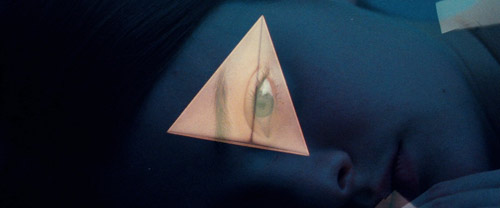
Beyond the Black Rainbow is a film out of time, a bad acid nightmare that would have been right at home on the VHS shelves of the 1980’s.  An exercise in personal catharsis for the director after losing his parents, Rainbow is an amalgam of surreal cinematic influences, that uses confounding and genuinely gorgeous alien aesthetics to present an unsettling exploration of what lies beyond the limits of the human mind.

Elena is a teenager who is a captive in a scientific prison underneath the Arboria Institute, a new age research company whose aim is to achieve transcendence through extensive indulgence in psychotropic narcotics.  Her captor is Dr. Barry Nyles, Dr. Arboria’s heir apparent, whose mind and body were cosmically altered after a ghastly inter-dimensional encounter in 1966 that left Elena’s mother dead and Dr. Arboria in a fugue state.  Nyles has become infatuated with Elena’s psychic abilities, believing they hold the key to the mysteries of the subconscious.  As Nyles gradually slips into pure madness, Elena harnesses her preternatural abilities and attempts a desperate escape into an alternate reality in which the Cold War’s threat of nuclear extinction is but one of many horrors waiting in the darkness.

download.jpg

Beyond the Black Rainbow is jigsaw origami.  The surface level is relayed through sharp angles and psychedelic colors that present Elena’s ordeal as a reverse Alice in Wonderland.  Beneath the LSD convolution lies a subversive criticism of the baby boomer generation, presenting the casualness of the demographic as the Black Rainbow, a metaphysical point of no return that mankind had no place crossing in the first place.  The theme of personal improvement and evolution pervades throughout the glacial narrative, with Cosmatos presenting strange technology, malignant psychic capabilities, and the bio-mechanical horrors of the Arboria Institute as the yield from foolhardy experimentation fueled by manic obsession.

Norm Li’s cinematography is jaw dropping, using a deluge of colors and framing techniques to give the Arboria Institute an otherworldly atmosphere that is simply unforgettable, evoking the compositions of Kubrick and Argento with skin crawling results.  In particular, the 1966 flashback scene, shot in unfocused black and white is both terrifying and awe inspiring.   Yes, the concession that many aspects of Beyond the Black Rainbow were taken from other films is undeniable.  However, the way that Cosmatos assembles each nostalgic block into a psionic Jenga is pure, malicious brilliance.  Within a few, precious minutes, you know you’re witnessing something truly different, the type of experimental voodoo that enraptures as much as it divides, and Rainbow is a prime example of one of these poisoned offerings.

download (1).jpg

Eva Allan conveys Elena’s torment as a form of telepathic bipolar, portraying a young woman whose entire life has been experienced through captivity.  With only a lonely, unreliable television to keep her company, Elena fixates on the world outside and wishes only to be reunited with her father.  Her chemistry with Michael Rogers’s Nyles is surprisingly potent, especially during the first therapy scene.  Rogers’s gives a delirious turn with his villain, presenting Barry Nyles as the false prophet, a murderous prodigal son who maintains his human status through creepy cosmetics and a barely passable sense of endearment that sits atop a furnace of aberrant rage, epitomizing the film’s central theme that not only should man not seek to exceed it’s karmic limitations, but that success in such endeavors would only lead to a new dimension of unspeakable dilemmas.

Cosmatos’s script is filled with important details that will almost certainly be overlooked during an initial viewing.  Astral communication happens through unplugged telephones, while an ominous Ronald Reagan monologue enshrouds Elena’s predicament.  A disturbing diary contains the profane incantations of a madman and strange automatons, Sentionauts haunt the corridors of the institute, each of them baring a horrifying similarity to Elena’s child like visage.  Almost every aspect of the film has an implied double meaning, electing to use limited dialogue and overwhelming visuals to construct a haunted house story told from the inside out.

download (2)

Jeremy Schmidt AKA Sinoia Caves’s soundtrack is a synthesized love note to Tangerine Dream, one of the many influences on the film.  Every song is perfectly applied to a specific segment, enriching the atmospheric occultation with an array of 80’s cult melodies.  La Vonne Girard’s set designs, clearly influenced by Suspiria, present the interior of the institute as a post modern dungeon, filled with precarious open chambers that offer few places for Elena to hide.  Kathi Moore’s costume design is devilishly simplistic, using a simple white dress for Elena and presenting Nyles as a shag carpet hold out from the institute’s free love origins.  The Sentionauts, however, appear as crimson golems who remain suspended in their leather suits until activated, merging the deceptive mundane with the unnatural truths that lurk throughout.

Available now for digital rental, Beyond the Black Rainbow is one of the most unique films of the 21st century.    From a distance, this movie is an extreme example of stylistic overkill for what appears to be a straightforward premise.  However, if you’re patient with the slow burn allegory, Beyond the Black Rainbow has a plethora of dark wonders to explore, hidden among an eclectic blend of hallucinatory motifs and surreal horror.  If you’re interested in a remarkably different, constantly elusive film, this is a one of kind viewing experience.

Highly.  Highly Recommended.

download.png

Cult Rewind: Leviathan 1989

Image result for leviathan 1989 poster

Frank and Kyle join teams to talk about one of their favorite, and underappreciated films from the 80s, George P. Cosmatos’ LEVIATHAN starring Peter Weller, Richard Crenna, Ernie Hudson, Daniel Stern, and Meg Foster. While this film does borrow heavily from THE THING and ALIEN, it’s much more than just a rip-off hybrid that stands on its own with strong performances, excellent production design, and value, and remarkable creature effects and a brooding score.

Pick up the Shout Factory blu ray here.

B Movie Glory: The Vault

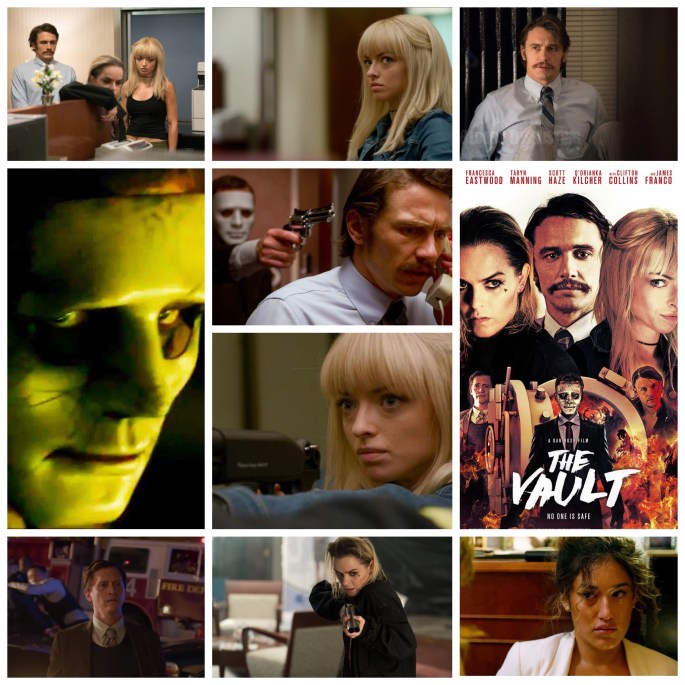
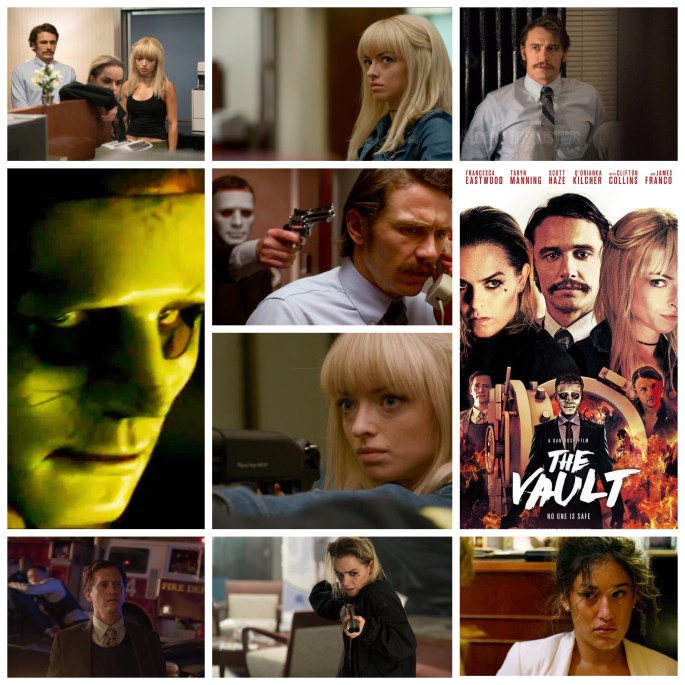
I miss films like The Vault, and it’s refreshing to see there’s still artists out there who care enough to make them. You see, in today’s hyper meta, incredibly self aware age of remakes, redos, reimagining and reboots, everything has to be bigger, better, have cutthroat innovation and just be… more. Neglect often rises in terms of making good old, straight up, no bullshit genre flicks, the kind we fell in love with in the first place, the kind which without, we’d have none of the throwbacks of our era. I suppose you could in fact call this one a throwback because these days the lines of definition are impossibly blurred, but there’s just something so earnest, endearing and straightforward to it’s formula that reads as effortless and totally in it’s groove. Picture this: bank robbers unwittingly siege a branch that turns out to be haunted. It’s obviously more complicated, but come on man.. a haunted bank! The concept alone gets one giddy. During a hectic warehouse fire that conveniently gridlocks a whole city block, a roughneck crew of outlaws take hostages, led by sisters Francesca Eastwood and Taryn Manning, who have bad blood for each other right out of the gate. Outside, a wearily sarcastic Detective (Clifton Collins Jr) tries to keep the peace, clueless of the crime in progress a few doors down. Inside the bank, all hell breaks loose, literally and figuratively, as the perps slowly discover that beneath the building’s modern veneer, deep in the old abandoned vault, something evil has awoken. It’s a neat premise, and both the crime and horror aspects are handled well enough to keep one glued to the screen. Manning is an actress I haven’t seen in a while, but I’ve always enjoyed her scrappy tomboy style, and she’s a hyperactive gong show here. Eastwood has quietly been putting out great work for some time now (check out her brief but affecting cameo in Twin Peaks), she does the tough but sexy turn really nicely. Q’orianka Kilcher has been all across the board since she came onto the scene playing Pocahontas in The New World, showing up in the least expected places, like a cool bank teller role here. James Franco has a solid supporting turn as the bank’s strange assistant manager as well. Much of the film is a hyper kinetic, pulsating thrill ride with stranglehold pacing, eventual pauses coming for the schlocky elements to breathe and the scare tactics to effectively come forth, a great mixture. This one is simplicity itself in terms of genre, with no cheeky pretence or smirking, meta undercurrent, just a good old school horror hybrid, and a damn enjoyable one too.

-Nate Hill