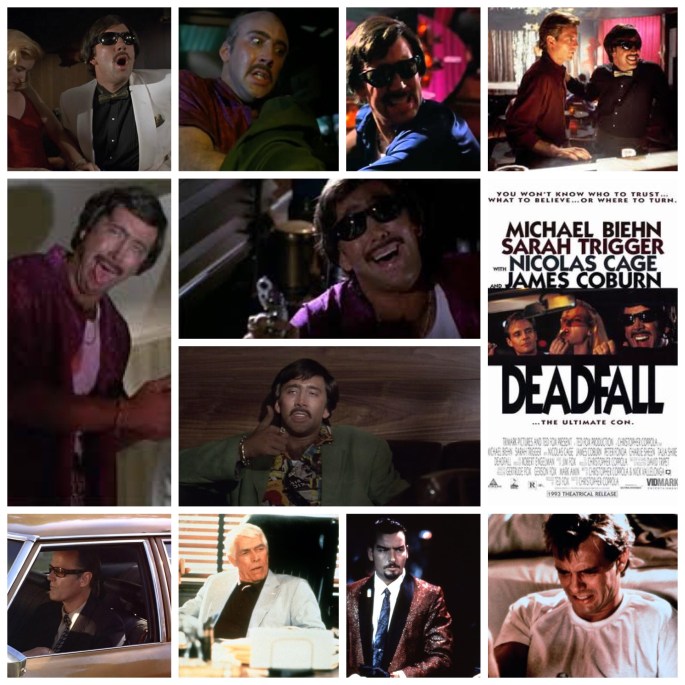
Christopher Coppola’s Deadfall


I hear a lot of talk about how weird Nicolas Cage can get in films, and I’m always seeing top ten craziest Cage compilations on YouTube and such, but people often seem to neglect the veritable cherry on top, the big cheese of nutso Cagery, a terrible conmen flick from back when called Deadfall. This is a film directed by a member of the Coppola family, and anyone who’s done their base research knows that Cage is a member of the brood, which is the only reason he ever broke into the industry in the first place. Now as to why and how he was allowed to give the unapologetically certifiable ‘performance’ we see here, well that remains a mystery. Needless to say, this is Cage unchained, off the leash and out of the Cage, an unnecessarily clownish banshee cry of a turn that derails the entire film, eclipses every other actor and puts a big dark stain on everyone’s career. The protagonist here is Michael Biehn as a shit-outta-luck hustler who accidentally kills his own father (James Coburn, who also does double duties to play the man’s brother), and ends up in the criminal doghouse, reprimanded by his boss (Peter Fonda) and left to flounder in small time stings. Enter Eddie (The Cage) another small-potatoes loser who clashes with anyone and everyone around him, a true lunatic of a character whose left empty of any sort of engaging qualities or charisma thanks to Nic’s utterly bombastic histrionics and lunatic ravings. If I sound like I’m overselling just how fucked up his performance is or making mountains out of molehills, please feel free to jaunt on over to YouTube, type in ‘Nic Cage Deadfall’ and see for yourself. If bad performances were represented as train wrecks, this would be the infamous explosion escape scene from The Fugitive, and even that doesn’t do it justice. This is a giant schoolyard tantrum, an inexcusable, near fourth wall busting bag of uncomfortable verbal utterances and bodily contortions that make you want to call an exorcist for the poor spastic, I really don’t know how the film ever got released with such fuckery on display. Anywho, all that just drowns out literally *everything* else about the film, and when one of your actors acts out so much that they smother work from heavy hitters like Biehn and Coburn, you know your filmmaking process is handicapped beyond repair. As such, brief appearances from Michael Constantine, Talia Shire and Charlie Sheen are subsequently lost to the abyss of Cage’s deafening orbit. A mediocre film without him as it is, but add what he does to the mix and you have a true stinker, the cinematic equivalent of a spittoon filled feces. Don’t bother. 

-Nate Hill

CATHY’S CURSE (1977) – A REVIEW BY RYAN MARSHALL

During the first five minutes of Eddy Matalon’s CATHY’S CURSE, a father hits the road with his young daughter in an effort to escape the presumebly destructive mania of his wife. Prior to the fatal car crash which takes both of their lives, he consoles the panicked child in her bedroom and then suddenly takes a few unseen steps back, at which point he blurts out “Your mother is a bitch!”

Though this is hardly the first offbeat note in a film that’s essentially made up of them, it can be easily pinpointed as the moment when the majority of viewers will tune either in or out of its oddly alluring frequencies. As singularly strange as what basically amounts to a French-Canadian riff on CARRIE and/or THE EXORIST sounds, nothing on paper could possibly exceed the film’s baffling execution; as it is, it’s like a never-ending sequence of happy accidents.

cathyscurse3[1]

The girl from the beginning turns out to be the late aunt of the titular Cathy, who’s now about as old as her ill-fated relative when she went up in flames. Along with her overbearing father and “neurotic” mother, Cathy returns to the house from before only to happen upon the same supernatural forces which plagued the previous generation as they set their sights on her soul.

Much of the routine that follows seems familiar, what with the creepy dolls that can possess unassuming children or, even more disconcerting, the nosy spiritual medium neighbors. Then there’s the house these people occupy, with its bedrooms bathed in blood red and vomit-yellow kitchen interiors. The atmosphere, often flooded in uncomfortably over-exposed light, feels simultaneously obscure and attainable; it invites us in if only to inspire notions of escape.

large_cathys_curse_07_blu-ray_[1].jpg

Those who put sensory satisfaction over conventional narrative logic will surely have a field day with this one, seeing as it’s an absolute structural nightmare that nevertheless gets by on its own unique vibrations. Scenes cut in and out of one-another abruptly, the set-up is so vague that it requires intertitles in order to get the viewer on the same general wavelength, and not a single human being present acts like one. It’s best to let things happen on their own terms; and oh, how they do.

An elderly handyman who gets a little too close to Cathy for comfort is set upon by snakes from inside a kitchen drawer and the bottom of a bottle, bath water turns to blood (and lots of leeches) in the blink of an eye, the finale delivers the scorching, appropriately nonsensical goods. And yet, even with such consistent eccentricities on display, it’s the dissociated direction that makes this that special kind of weird. Beverly Murray, playing Cathy’s mother, is an exceptional case, shrieking her way through this mess as if she’s trying to dig her way out of it; and who would blame her, seeing as her character is subject to so much excessive cruelty?

large_cathys_curse_17_blu-ray_[1].jpg

The men at the heart of this ghastly tale aren’t much better; there’s a rather concerning undercurrent of casual misogyny that runs throughout, and it hardly ends at the aforementioned opener. If the film had a little more sense, it might have served as a scathing commentary on the broken concept of Family, but no dice. Instead what we get are fragments of ideas, snapshots of excursions that never were, co-existing in a world where everyone and everything is associated with unnaturally powerful properties, and in a sense this is far more compelling.

large_cathys_curse_14_blu-ray_[1].jpg

One is left wondering if Matalon had spent much time around people, or if the finished product reflects a troubled production rather than lack of artistry. Either way, the film isn’t merely behind on the times – it’s not of this world. Like a half-remembered dream; lost in its own haze and ultimately incoherent, but also inexplicably addictive. Even if this isn’t one of the most unintentionally psychedelic films ever exposed to the unworthy general public, there’s still truth to be found in those glowing green eyes, those over-lit doors, and mother’s cold, soulless gaze. In a most peculiar sense, this is a lot like coming home.

NICK CASTLE’S THE LAST STARFIGHTER — A REVIEW BY NICK CLEMENT

31984’s The Last Starfighter, energetically directed by Nick Castle from a script written by Jonathan Betuel (MY SCIENCE PROJECT POWER!!!), was one of my favorite films as a little kid, and much to my surprise, it still holds up as an example of a solid, low-budget Star Wars/Star Trek rip off that knew how to have just the right amount of fun even if it was never designed to be staggeringly original from a story perspective. I don’t care how “cheesy” and “dated” and “old” some people might find this film – I love it, and I’d take it over any number of $200 million CGI bullshit extravaganzas that have been clogging up multiplexes. I can’t wait to show my own son this movie when the time is correct; I suspect he’ll enjoy it with the same sense of wide-eyed-glee that I did when I was a kiddie. Alex Rogan (Lance Guest, engaging with that great smile) is your average trailer park teenager who just so happens to be a whiz at the one arcade game that is hooked up near his home. After breaking all of the records in the game, he’s dramatically recruited by an inter-galactic squadron of aliens (think Green Lantern) in an effort to get him to fight in their epic space battles.
2

Along with Tron, The Last Starfighter was one of the first movies to use major sequences with CGI, and while the film certainly shows its age, it’s incredible to think that a movie of this nature was made for “only” $15 million back in the day. There are some exciting space dog fights, terrific practical make-up and special effects, and a wonderful sense of humor during the passages on Earth that while corny at times, feel like the perfect combo of sci-fi action and teen comedy. A mild theatrical success in theaters during the summer of ‘84, this cult classic would go on to have a major shelf life thanks to the VHS explosion of the mid-80’s, and the low-tech charm and gee-whiz spirit of the entire endeavor still feels entirely of its time, the sort of movie that could never get made in today’s slicked-up cinematic climate. The cool supporting cast featured Robert Preston(!) in his final film role doing a riff on his con-man character from Music Man, Dan O’Herlihy, Catherine Mary Stewart (an early crush…), Norman Snow and Kay E. Kuter. Fun tidbit: Castle was the original Mike Myers in John Carpenter’s classic Halloween.

1

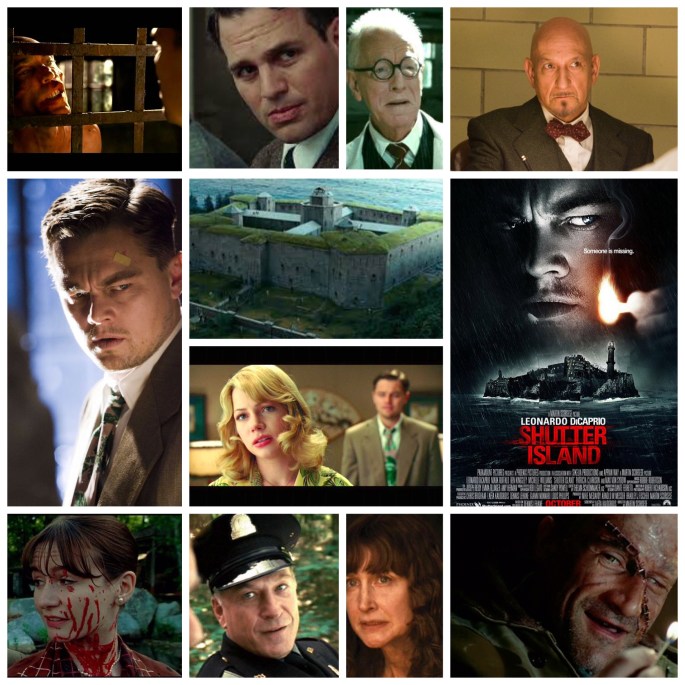
Martin Scorsese’s Shutter Island 


Shutter Island is my favourite film by Martin Scorsese. Now, keep in mind that I still have yet to see heralded classics like Goodfellas and Raging Bull, but that being said I still feel like this clammy psychological opus would remain at the top of the charts. I’m a genre guy at heart, and as such gravitate towards that when watching any director’s work, I just feel more at home wading into fictitious, stylized thrillers than I do with earnest biopics or urban crime dramas, which aren’t always my thing to begin with. Shutter is a brilliant piece, a deliberately dense and serpentine mystery that unfolds step by delicious step, a gift to anyone who loves a good twist and plenty of clues to keep them engaged along the way. Not to mention it’s wonderfully acted, cleverly written and primed with emotional trauma to keep us invested in the puzzle beyond base curiosity. Leonardo DiCaprio is best when portraying intense, tormented people, and his US Marshal Teddy Daniels here is no exception, a haunted man who feels like a caged animal as he investigates the disappearance of a mental patient from a secluded island sanitarium, a place that just doesn’t seem right, with a mood in the air so oppressive you can almost feel the fog, both mental and meteorological, weighing you down. The patient, Rachel Solando (Emily Mortimer will send shivers up and down your spine) seems to have vaporized into thin air, and Teddy’s investigation leads to closed doors, uncooperative staff and a heightened level of dread that lurks beneath every hushed exchange of dialogue and fleeting glimpse at things he, and we, aren’t even sure he really saw. The head doctor (Ben Kingsley, excellent) is clearly hiding something, as is the austere asylum director (Max Von Sydow). The freaky Warden (terrific cameo from Ted Levine, who gets to deliver the film’s best written and most perplexing dialogue) babbles to Teddy in biblical platitudes, and the patients have run amok following a storm that compromised security. Needless to say the plot is deviantly constructed to constantly mess with the audience until the third act revelations, which come as less of a melodramatic thunderclap and more like a quiet, burning sorrow of realization, a tonal choice from Scorsese that hits you way harder. Scorsese has assembled a cast for the ages here, and besides who I’ve mentioned so far we also have Michelle Williams in disconcerting flashbacks as Teddy’s wife, so perfectly played I wish she got a nomination, creepy Elias Koteas as another phantasm from his past, John Carrol Lynch, Mark Ruffalo, Jackie Earle Haley, Robin Bartlett and Patricia Clarkson. The score is a doom soaked death rattle courtesy of Robbie Robertson, not without it’s emotional interludes but thoroughly grievous. There’s also a beautifully slowed down version of ‘Cry’ by Johnnie Ray that accompanies the horrifying dream sequences within the film, adding to the already thick atmosphere nicely. This is a film built to last, both for dutiful rewatches from adoring veterans and discovery by lucky newcomers who get to experience it’s affecting story for the first time. All these boxer biopics, big city mafia ballads and heady stuff seems to have rolled off of me as far as Scorsese goes, I enjoy them, don’t get me wrong, but they’re a one-off as far as how many times I’ll watch them. Give me a well spun, emotionally rich psychological murder mystery with no shortage of style, character and tantalizing thriller elements, however, and I’ll pop that sucker back into the DVD player time and time again. Scorsese’s best effort by far. 

-Nate Hill

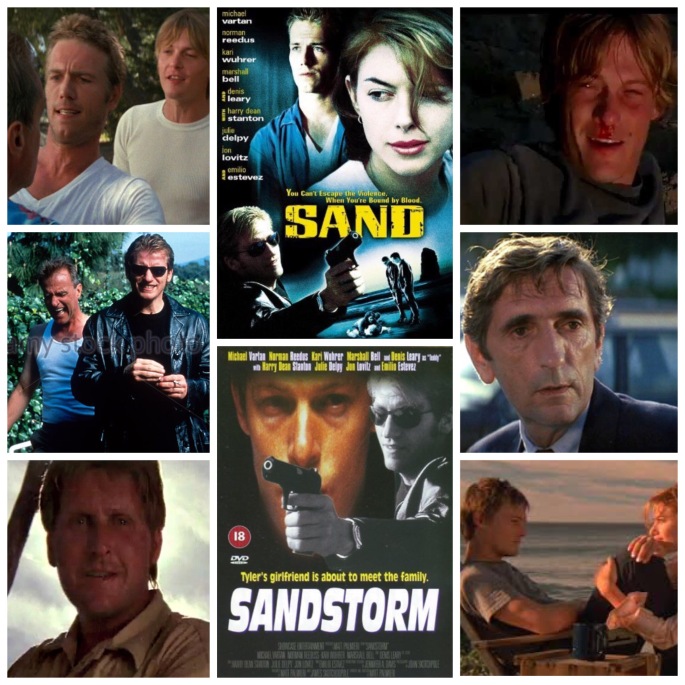
B Movie Glory: Sand


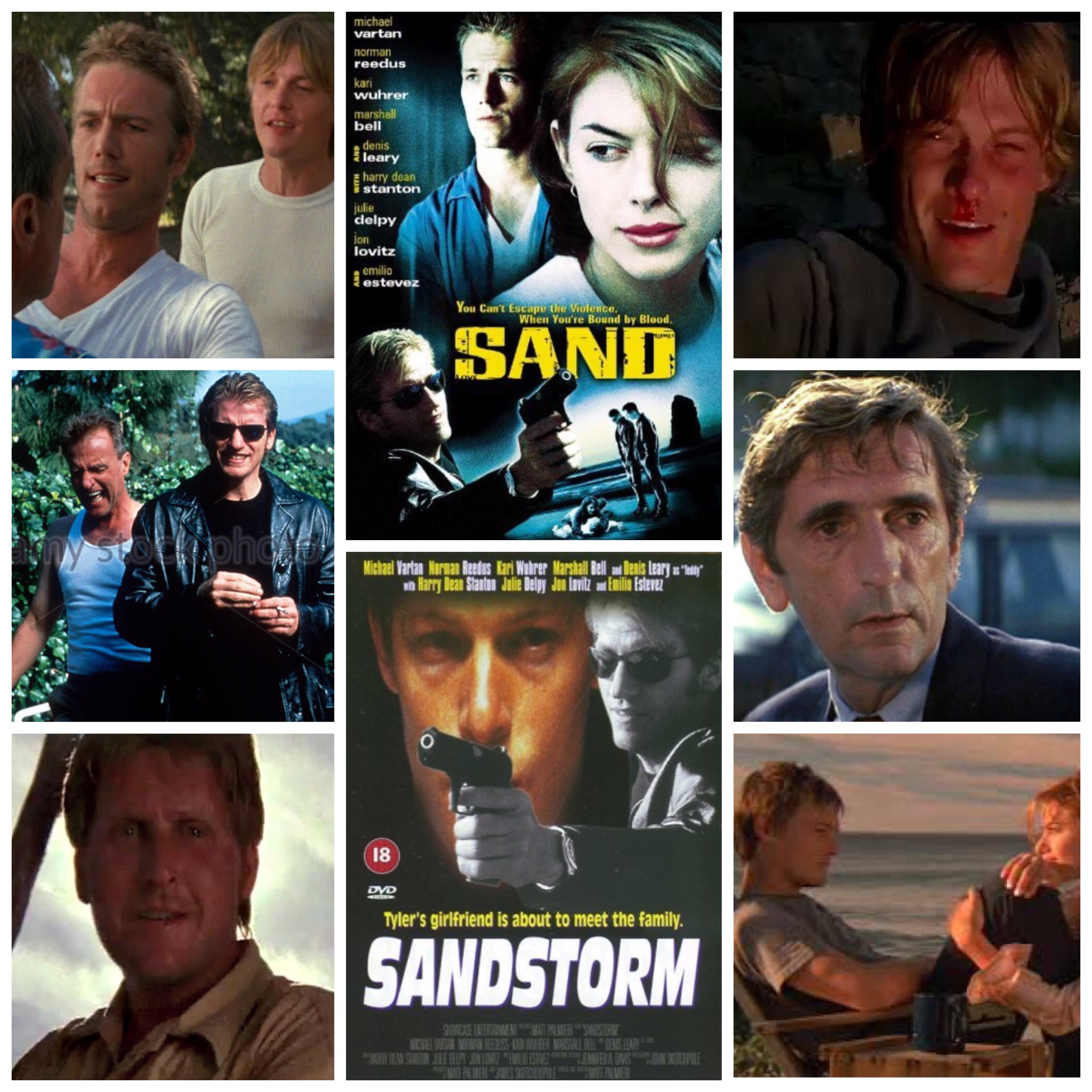
Sand is about as tasteful and memorable as it’s title, a bland, pointless and inconsequential piece of low grade fluff that starts nowhere and ends up just about the same. Funnily enough, it attracted the attention of some fairly notable actors who show up to loiter around in a boring family melodrama that barely registers past a flatline, and wander off again without bothering to bring their character arcs to a satisfactory close. Michael Vartan is some California stud who returns home to the surfing town he grew up in only to run afoul of his nasty criminal father (Harry Dean Stanton), and two deadbeat half brothers (John Hawkes and some other dude). They’ve shown up to lay low from the cops, but instead have eyes for Vartan’s cutie pie girlfriend (Kari Wuhrur) which is where the vague trouble starts. I do mean vague, as no one really makes an effort to convince us that these characters care, let alone know about what’s going on, and any sense of real danger is stifled by lethargy. Denis Leary usually crackles with witty intensity, but not even he seems to want to play, a sorry excuse for a villain who mopes around looking like he forgot his lines and just wants to go home. Norman Reedus is wasted on a quick bit as Wuhrur’s surfer brother, and there’s equally forgettable cameos from Jon Lovitz, Emilio Estevez and Julie Delpy too, but it all goes nowhere. There isn’t even any kind of adherence to genre, no Mexican standoff, no ramp up to revenge, it just kind of drops off and leaves an absence of anything interesting in the air. Some cool Cali scenery that could be Big Sur if I remember correctly, but even then you’re better off ditching this one and going to the beach for real. 

-Nate Hill

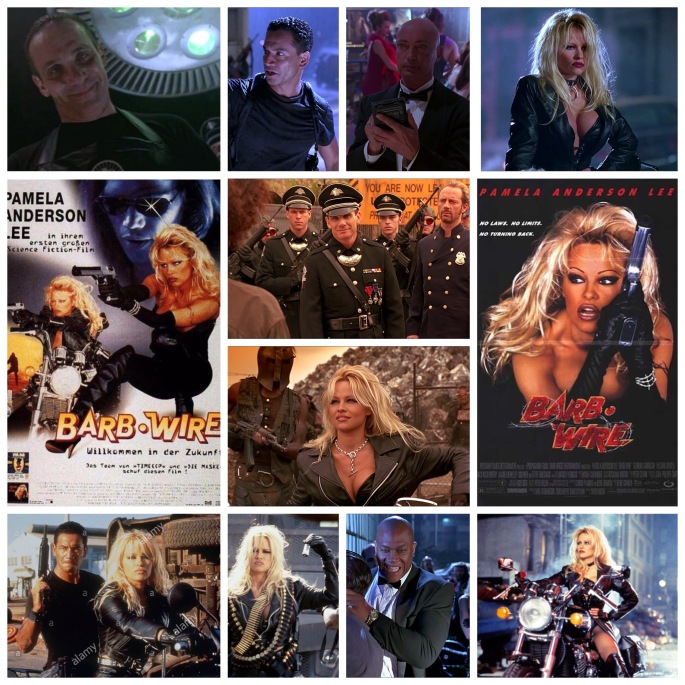
Barb Wire


Bear with me here for a sec while I say this, but Barb Wire is actually a genuinely great flick. Based on a kinky Tank Girl-esque comic book and boasting a busty starring turn from Baywatch babe Pamela Anderson, it’s got a lot more going for it than the porn vibes the poster probably gives off at first glance. Picture this: Pam is Barb, night club owning bounty hunter in a Neo-fascist futuristic American industrial town called Steel Harbour, ducking gestapo style soldiers and playing the double agent against a government gone rogue. She’s propelled back into action when her former boyfriend Axel (Temuerra ‘Jango Fett’ Morrison) blows back into town with fellow freedom fighter Cora D (Victoria Rowell). Barb is now faced with protecting her club, extricating all of her friends to a safe haven in Canada (come on up) and battling the forces of supremely evil Colonel Pryzer (Steve Railsback, chewing the scenery and then some). It’s a total blast of perverse steampunk mayhem, Pam solidly playing a badass heroine who’s fun to hang around with. Udo Kier shows up as her friend and club manager Curly, eccentric as ever, and watch for Clint Howard, Nils Allen Stewart, Jack Noseworthy, Xander Berkeley and Tiny Lister as well. Not half as much of a novelty or gimmicky film as some would have you believe, this one actually takes itself seriously for the most part and proves to be a solid genre effort. Good times. 

-Nate Hill

David Lynch’s BLUE VELVET

Image result for blue velvet poster

BLUE VELVET may just be one of the most depraved and transgressive love stories ever put on film. It’s a complex narrative that ushers the audience past their comfort zone into a dark and dangerous world of obsession and perversion. Not only do we enter this world through our innocent protagonist, Jeffery Beaumont, but we see and experience what he is exposed to. As his innocence erodes, as does ours.

Like anything David Lynch, the film is richly layered. The color scheme can be overanalyzed, as can the vague shadow world crime story, and especially the shifting timeline. When we’re in Jeffery’s world, we are in this overly nostalgic “good old days” of Americana and once we enter into Frank Boothe’s life in the fast lane all of a sudden we are thrown into this overly stinging and lightspeed paced contemporary (the 1980s) world of drugs, violence, and sexual perversion.

Image result for blue velvet dennis hopper

Lynch constructs a deeply layered world by his own aesthetic and his brilliant casting strokes. Kyle MacLachlan and Laura Dern’s star-making performances zigzag back and forth between the two worlds that Lynch creates, showcasing their brilliant range as actors as they carefully hold the audience’s hands during the build up of the story only to rip away once they enter the world of Frank Boothe.

Dennis Hopper is incredible in this film. His embodiment of Frank Boothe is not only one of the finest performances on film ever, but it is such a bold and daring performance. Frank Boothe is nearly irredeemable. He’s disgusting, he’s dangerous, he’s insane – yet he has a very empathetical trait. Everything he is doing, he’s doing because he is so very much in love with Dorothy Vallens played by Isabella Rossellini who matches and outdoes Hopper when it comes to giving a deeply brave performance.

Image result for blue velvet dean stockwell

With Lynch’s casting of Priscilla Pointer, Frances Bay, and George Dickerson he builds his pure vision of the idea of America, only to tear it down with the Hopper and more specifically former Golden Age of Hollywood child star Dean Stockwell in one of the most unique and scene-stealing performances ever. Stockwell’s overly caked on makeup, 70’s powder suit, and lip syncing Roy Orbison’s IN DREAMS using a work light as a microphone is one of the most memorably haunting scenes in Lynch’s canon, and that’s saying a lot.

Once the rip cord is pulled in the film, it is an incredibly exhilarating ride. How this film got made, or better yet distributed to the degree it did upon its initial release is gobsmacking. It’s a piece of cinema that will never be outdone. It propelled Lynch into a stratosphere of auteurs that not many can even approach.

CHRISTOPHER NOLAN’S INTERSTELLAR — A REVIEW BY NICK CLEMENT

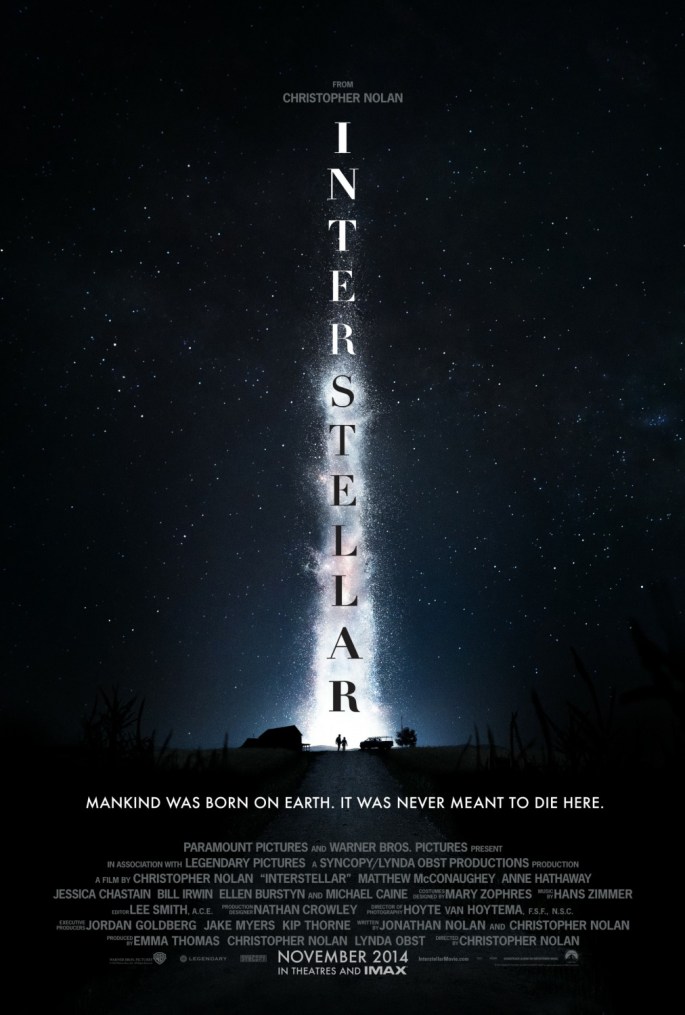
interstellar_xlg

Interstellar, Christopher Nolan’s visually astonishing and mind-bending science-fiction epic, is an overwhelming experience. At least it was for me when I saw it on an IMAX screen, and it continues to be every single time I pop in the Blu-ray or watch it on HBO.  It’s a $165 million anti-blockbuster that was based on an original idea, one that never felt like a pre-determined or manufactured “product” that was eager to sell toys and video games and lunchboxes and sequels and TV-spin-offs. There’s no “made by committee” feeling here, and I applaud the fact that it offers the audience very little in the way of traditionally overt “fun,” instead placing an enormous emphasis on ideas, grim reality, hard-science, and hypothetical thought, while still telling an intimate and emotionally gripping story that’s relatable, honest, and impactful. Nolan, often labeled cold and humorless by his critics, has made his wittiest, most heartfelt movie yet with Interstellar, and it’s in his expert and patient blending of the earth-bound dramatics and the cosmic life or death stakes that an enormously involving story is crafted.

4

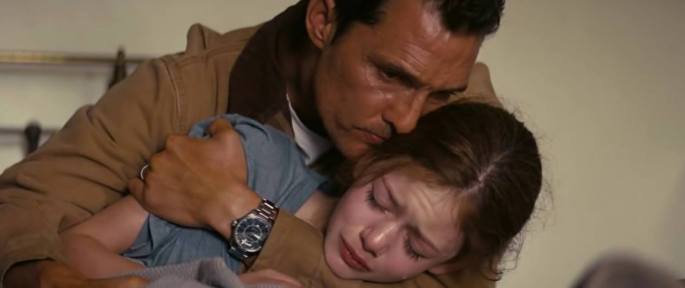
Anchored by an immensely appealing and dead-serious movie-star performance from Matthew McConaughey, (the sort of role Tom Cruise would’ve been asked to do 10-15 years ago), playing a test-pilot who agrees to navigate an experimental space shuttle into a black hole, leaving behind his children, unsure of whether or not he’ll ever return, all in an effort to find a new and habitable planet for the citizens of Earth, as our resources are fast depleting. Interstellar takes its time but never feels its length (it’s close to three hours), allowing the first, emotionally fragile act on earth to breathe and take shape before we blast off and out of our solar system. The child actress Mackenzie Foy was sensational as McConaughey’s despairing daughter, and the waves of emotion that hit her face are amazing to observe. After a brilliant jump-cut from the back of a speeding pick-up truck to the fiery rocket engines of a shuttle, we’re in the vast reaches of space, heading for Saturn and beyond, with wormholes and black holes and new dimensions and galaxies to explore.

1

The years pass on earth rapidly with time progressing ever more slowly for the astronauts, and as we watch McConaughey at the film’s half-way point watch and listen to video messages from his children that have been recorded throughout the years, the vastness of this story begins to dawn on you, and it’ll be impossible not to be moved by McConaughey’s sad and honest reactions to what he’s witnessing. To be honest, the less that’s spoiled about this trickily involving narrative the better, because as with all of Nolan films, there’s layer upon layer that will be open for dissection, interpretation and surprise. There are shades of 2001, The Right Stuff, Contact, and Primer felt throughout, but Interstellar is definitely its own thing, operating on a massive canvass and utilizing top-flight craft contributions from everyone in the ace crew. The jaw-dropping cinematography is by Hoyte Van Hoytema (Her, Tinker Tailor Solider Spy, Let the Right One In) and each shot is worthy of the pause button, with the IMAX format allowing for some incredible vistas. The flawless and seamless digital effects are used to propel the story, not as a lazy crutch, but the most impressive aspect to Interstellar may just be how much was done practically and in-camera.

2

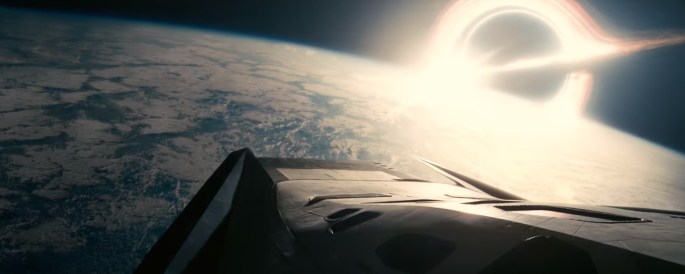
Again, no spoilers, but this is an intensely beautiful movie at times, with images that will simultaneously thrill and haunt the viewer, and I’d suspect filmmakers like Jonathan Glazer and Terrence Malick went bananas for this otherworldly trip. But most importantly, as a filmmaker, Nolan seems incapable of not engaging his audience on a cerebral level every time he gets behind the camera. The last 30 minutes are as trippy as it’s going to get for big-budget cinema, with the narrative constantly coming around on itself again and again. The wormhole and black-hole segments are special effects cinema at its most bravura, literally taking you to places that you will never, ever see with your own eyes. Hans Zimmer’s magisterial score was one for the ages, possibly the greatest of his already legendary career. Multiple viewings of Interstellar have only reinforced how I felt after my first screening – this is Nolan’s grandest effort to date, and if The Prestige still remains my absolute favorite film made by this classy and sophisticated filmmaker, I’m simply in awe of all of the various moving parts that consist to Interstellar. And it goes without saying that I’m beyond ready to see his WWII film, Dunkirk, which hits theaters in two weeks.

3.jpg

B Movie Glory: Killer Buzz aka Flying Virus


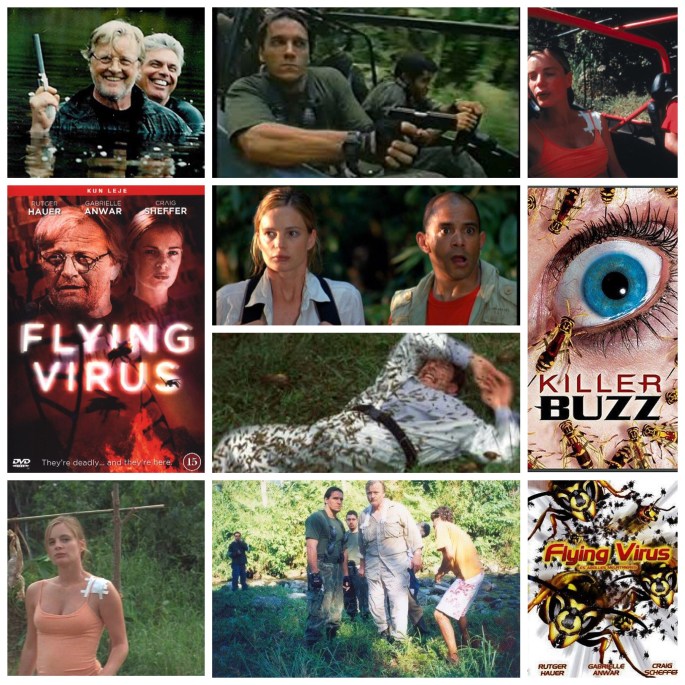
Killer Buzz, aka ‘Flying Virus’, is every bit the ludicrous SyFy turd you’d expect, and follows on the heels of several other B movies starring real life couple Gabrielle Anwar and Craig Sheffer, who inexplicably insist on starring together in bilge water like this (check out the third sequel to Turbulence and you’ll see what I mean). All you need to know about this one, besides the fact that it sucks, is that it’s about genetically altered killer wasps brought to life by windows 98 screensaver effects, and a sorry bunch of actors running away from them, one of which unfortunately happens to be Rutger Hauer. Anwar plays some journalist who uncovers a plot hatched by the government to kill humanity using giant monster wasps (how’s that for a plot), and makes a vague effort to stop it. Hauer is a hard nosed mercenary in charge of distributing these mutant stingers, and the shittiest, bottom feeding schlock ensues for a mercifully short eighty minute runtime. The special effects for the wasps really are a pitiful effort, even by these second tier standards, they look like pixelated crazy-frogs made of yellow paper mâché. The only memorable part is when someone warns Hauer about how dangerous they are and he growls in deadpan, “actually, bees are allergic to me”, brandishing a sidearm that wouldn’t do any good against them anyways. I kind of wanna go get a shirt printed at Bang-On of him saying that and giggle like a hipster when no one on the planet but me gets the reference. In all honesty, Killer Buzz is a giant buzz kill and should be avoided like a swarm of…. wasps. 

-Nate Hill

Clint Eastwood’s Mystic River


Clint Eastwood’s Mystic River is one of the most gut wrenching, haunting, stressful experiences one can have watching a film, and I’m only talking about the first ten minutes so far. On a quiet 70’s era Boston afternoon, three young boys play street hockey near their homes. After writing their names in freshly lain concrete sidewalk, a sinister ‘police detective’ (John Dolan, who I can never ever see as anyone but this character, he’s that affecting) hassles them and tries to lure the youngsters away. Two of them are wise to his game and escape. The third does not. This crime spurs a ripple effect into the future for these boys, as we see them grow up into very different and equally troubled men. Jimmy (Sean Penn has never been better) is a small time hustler with anger issues, Sean (Kevin Bacon) a cop with his own demons and Dave (Tim Robbins), the boy who was successfully kidnapped and held all those years ago, is a fractured shell of a human whose damaged soul lashes against the whites of his eyes and prevents him from functioning normally. Malcontent comes full circle to find them once again when Jimmy’s young daughter (lovely Emmy Rossum) is found murdered, setting in motion one of the great tragedies you’ll find in cinema this century or last. Eastwood lets his actors quietly emote until the floodgates open and we see raw despair roil forth from three men who are broken in different ways, and how it affects everyone in their lives. Penn is tuned into something higher here, and I’ll not soon forget him arriving at the scene of his daughter’s murder. Robbins let’s the horror of buried trauma deep through the family man facade until we see the deformed psyche left beneath, while Bacon reigns it in for a performance no less memorable than the others. Marcia Gay Harden and Laura Linney are excellent as Dave and Jimmy’s wives, while Laurence Fishburne provides the faintest ray of humour as Sean’s partner. This is as much a murder mystery as it is an intense interpersonal drama, but the whole story is ruled by emotion; that burning need for revenge from several angles, the hollow pit of loss left behind when someone dies, the psychological scar tissue that trails in the wake of abuse, everything slowly coming to light as the grim, doom laden narrative unfurls. Tom Stern’s camera probes inlets along the harbour, sprawling neighbourhoods and hidden barrooms, Brian Helgeland expertly adapts the novel from Dennis Lehane and Eastwood himself composes a beautiful lament of a score, while the actors turn in galvanizing work. One of the finest films of the last few decades and not one you’re ever likely to forget, once seen. 

-Nate Hill