DIFF 2017: Review of FRANTZ

Paula Beer, Pierre Nuney, Marie Gruber, Ernst Stötzner, Johann von Bülow. Directed by François Ozon. Rated PG-13. 113 minutes. 2017.

There must be a reason for the man’s intrusion upon the family’s shared grief. Their only son was one of the many who died in the war that ravaged an entire world, and the conflict that drove a rift between the French and German governments has, of course, developed between the people of those countries, too. When the fallen soldier’s father realizes that their visitor is French, he, a proud German, expels the man from his presence with eyes popping and voice strained. It isn’t a rational fear of ideological divide in this case; it’s an irrational fear of the “other.” The Frenchman doesn’t belong in the German doctor’s office – or, no doubt, in Germany at large.

The mystery surrounding the reason for the Frenchman’s visit to the grave of the fallen, German soldier is solved by the halfway point of François Ozon’s Frantz, but wisely, the co-writer/director understands that the solution to its puzzle is of secondary importance to what it means for its characters. For some time, this approach works toward a vital, urgent, and moving first half in which the unspoken secrets (replacing the truth with carefully observed lies) between two fragile people place an emotional barrier between them (There is also the clever photographic trick devised by the director and cinematographer Philippe Rombi to switch between black-and-white and color depending upon the mood of the scene). It’s understandable, though, that Anna (Paula Beer), who was to be the wife of Frantz (Anton von Lucke) until his death at the frontlines, would be distrusting of Adrien (Pierre Nuney), who represents for her much of what led to her fiancé’s demise.

It is even more understandable that Adrien would receive some resistance from Frantz’s parents, the doctor and his wife (played by Ernst Stötzner and Marie Gruber), and so it charges forward until the scene at almost precisely the halfway point in which Adrien confronts Anna with the truth. The arrival of this scene, played perfectly by Beer and Nuney, would in any other movie be the climactic one of confrontation, leading perhaps to a single contrived scene of reconciliation and the end credits. Ozon is a bit smarter than that, understanding that the unspoken secrets must be confronted in a more resolute way. This is where the screenplay by Ozon and Philippe Piazzo (adapting both Maurice Rostand’s stage play and the screenplay for Ernst Lubitsch’s Broken Lullaby) unfortunately stumbles.

It isn’t the fact that Ozon pushes forward after the central mystery of the film’s plot is confronted. The general fact of this confrontation is tricky and well-handled. What transpires after this, though, steers the film away from its honest view of its characters and toward exactly the kind of contrived melodrama that Ozon so carefully avoids until this point. The best way to put it, without revealing anything about the truth, is that it replaces the mystery that opens the film with another, far less involving, far more trivial one that seems to be a long-winded ploy to reunite Anna and Adrien. It feels dishonest, and Frantz suffers thus from two distended halves that betray each other.
DIFF 2017: Review of A QUIET PASSION

Cynthia Nixon, Jennifer Ehle, Duncan Duff, Keith Carradine, Jodhi May. Directed by Terence Davies. Rated PG-13. 125 minutes. 2017.

Terence Davies’ A Quiet Passion approaches the life of poet Emily Dickinson with an astonishing sense of understanding its subject. Dickinson was, famously, guarded about her personal life, so that sense of understanding is a coup for the writer/director. The character speaks in her real-life counterpart’s typically witty and philosophical barbs. Dickinson was one of the more outspoken feminist voices of her time, righteously obsessed with ideas of agency and independence in a time when the patriarchal society frowned upon such activities. For a while, Davies’ film rejects the usual biographical elements that accompany a period piece about an historical figure, and even when the film must confront the events that led both to Dickinson’s late-life reclusion from outward society and ultimate death in 1886, the film never settles.

Even at a younger age, Emily (Emma Bell) was rebellious against a strict, religious upbringing. Deistic of a higher power, whom, she believed, would be less than uninterested in her petty existence if it even existed, she rejected the societal powers that might direct her to be in answer to men. As an older woman (played by Cynthia Nixon), she lives much by the same code as before, in distrust of the idea of marriage, lest it place her in the servitude of a man. She feels her intellect is enough to steer her right and conducts herself in exactly the manner that she feels befits that intellect while in the presence of men.

The biographical elements that do exist here contribute to the little plot that, thankfully, exists. Her father Edward (Keith Carradine) is disapproving of roughly her every move, unless he feels it will bring honor to their family, such as her wish from a young age to write for the Springfield Republican. Her mother Emily Norcross (Joanna Bacon) slowly deteriorates from an unspoken illness and attendant despair that consistently leaves the rest of the family reeling. Her brother Austin (Duncan Duff) joins the family’s law practice, marries the charming Susan Gilbert (Jodhi May), and later, carries on an affair with the alluring Mabel Loomis Todd (Noémie Schellerts) that will have lasting impact on Emily. Her sister Vinnie (Jennifer Ehle) remains loyal to Emily’s interests, even as the latter has trouble remaining grateful for the support.

We get the sense of an entire person through these events, which are guided by Davies’ perfectly attuned ear for the dialogue of the time, rich with meaning that, it seems, has been lost with the evolution of modern language. This aspect will alienate some viewers, but it’s crucial for our sense of insight into this woman. It also helps that Nixon, whose performance is phenomenal, knows seemingly instinctively how to deliver this dialogue in a matter that seems as natural as it can be. That goes for all the actors, and Davies’ understated camera utilize medium shots and close-ups to superb effect. A Quiet Passion is an observant character study of a woman, an author, and a poet who was, well, quite the character.

DIFF 2017: Review of HEARTSTONE

Baldur Einarsson, Blær Hinriksson, Diljá Valsdóttir, Katla Njálsdóttir, Jónína Þórdís Karlsdóttir. Directed by Guðmundur Arnar Guðmundsson. No MPAA Rating. 129 minutes. 2017.

Coming-of-age films are easy to mishandle because much of the dramatic forward motion is mirrored in the characters, who are often teenagers prone to melodramatic overreactions that come as unwanted guests in the throes of puberty. Heartstone is a film that gets the coming of age right through a remarkable sense of forthright honesty and raw emotion. The emotion is genuine here, too, chronicling a single summer in the lives of four young teenagers simply trying to grapple with the insecurities, the loneliness, and the explosive troubles of pubescence. It’s hardly a subtle movie, but the crescendos of the narrative build organically from what, early on in director Guðmundur Arnar Guðmundsson’s screenplay, is intentionally aimless.

That aimlessness is incredibly appealing in this instance, too, because these kids are appealing, even amid their myriad flaws and outbursts of hormonal indignation. Two of them are defined by their suffering loneliness in broken homes. Þór (Baldur Einarsson) is one of three children whose single mother Hulda (Nína Dögg Filippusdóttir) is something of the town pariah upon the decision to become romantically involved with a foreigner of a different nationality. Þór’s sisters, Rakel (Jónína Þórdís Karlsdóttir) and Hafdís (Rán Ragnarsdóttir) are opposites of each other – the former is an attention-seeker who has little patience for quirk and the latter likes to paint and produce poetry – and of Þór, whose budding sexual feelings and practices are complicated by his sharing a room with Rakel.

His best friend is Kristján (Blær Hinriksson), whose own home life is perhaps even more dour than Þór’s. His father Sigurður (Sveinn Ólafur Gunnarsson) has won himself a spot of infamy in this small, Icelandic town by picking a fight from which he still sports a blackened eye. He’s an often angry, occasionally violent man who is entirely ignorant of his wife’s concerns and of his son’s increasing, desperate depression. Kristján, after all, is gay, but he is in denial about his sexuality, as well as his feelings toward it. When Hafdís paints a portrait of Þór and Kristján dressed up as two women, those feelings come tumbling out for Kristján. And when the pair of boys meets Beta (Diljá Valsdóttir) and Hanna (Katla Njálsdóttir), a pair of would-be romances strikes up that is based around the exploration of their physical attraction and emotional maturity.

This plot, of course, leads to a series of melodramatic developments in these boys’ lives that would feel contrived if not for Guðmundsson’s insistence upon keeping an honest view of his characters and not simplifying them at the expense of their situations. The performances have a significant role in this, with each child actor having a lot asked of them and bearing the weight extraordinarily well under the pressure of heavy subject matter. Some of the third act does bend to contrivance with how it solves one of these subplots, but Heartstone remains an honest account of grappling with the hardest part of growing up. For that, it’s a special film.

John Woo’s BULLET IN THE HEAD

Author’s Note:  This is a guest post by Damian K. Lahey, an award-winning filmmaker, and screenwriter who we had as a guest on our podcast last year.

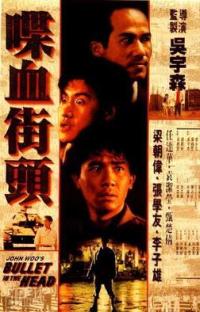
BulletInTheHeadPosterThis is a hysterically violent and poetic film about loyalty and the bonds of friendship. John Woo went for the brass ring with this one. Many believe he came up short but I believe this is his greatest achievement.
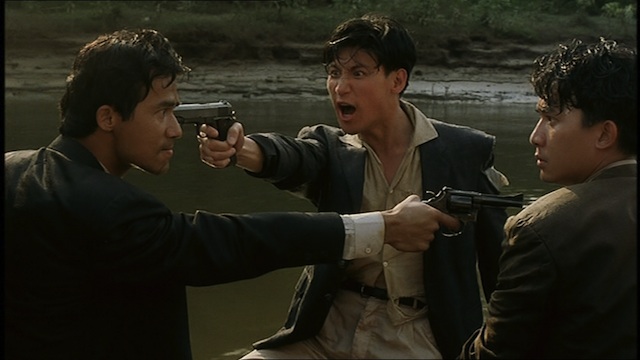
The chaos of war, the insanity, the opportunism and the complete betrayal of one’s moral instincts is splashed up on the screen in a bare naked emotionalism that is at times refreshing and startling. The stakes are high enough and the circumstances desperate enough that the fever pitch the actors maintain is tolerable if not entirely believable. Those familiar with his work know Woo is not afraid to get hammy with his melodrama. Here I found the dramatics at their most earned and poignant.

It could be argued that at times the maniacal violence underscores the level of artistic achievement Woo is going for here.

This film also makes the strong case that looking for a quick buck in war-torn countries is a bad idea.

Aside from being the director closest to mimicking Sam Peckinpah’s signature style (though he doesn’t collapse time the way Peckinpah did in his actions sequences) Woo can also be credited with giving Chinese action pictures an emotional gravitas they had not had before with his 1986 film, ‘A Better Tomorrow’ which was very influential both in Asian cinema and abroad. He would go on to whip out other action classics like ‘Hard Boiled’, ‘The Killer’ and ‘Face Off’. At the time, Woo felt ‘Bullet In The Head’ was the natural progression of his work. He spent a lot of his own money on this, too. Not until 2008 with ‘Red Cliff’ would he attempt something as epic if not as bold.

Originally some of the material for this film was going to be the basis for ‘A Better Tomorrow III’. But Woo and his partner Tsui Hark had a major falling out and Woo took his material and sculpted it into ‘Bullet In The Head’ while Hark rushed ahead with ‘A Better Tomorrow III’ to beat it at the Hong Kong box office.

Woo’s western influences for ‘Bullet In The Head’ were obviously Coppola’s ‘Apocalypse Now’ and Cimino’s ‘Deer Hunter’. I wouldn’t rank it as highly as those two films but Woo’s ambitions for this film are truly maddening. He puts his heart on the line like few do and the result is epic, daring and soaked in blood.

BulletInTheHead

PREVENGE (2016) – A REVIEW BY RYAN MARSHALL

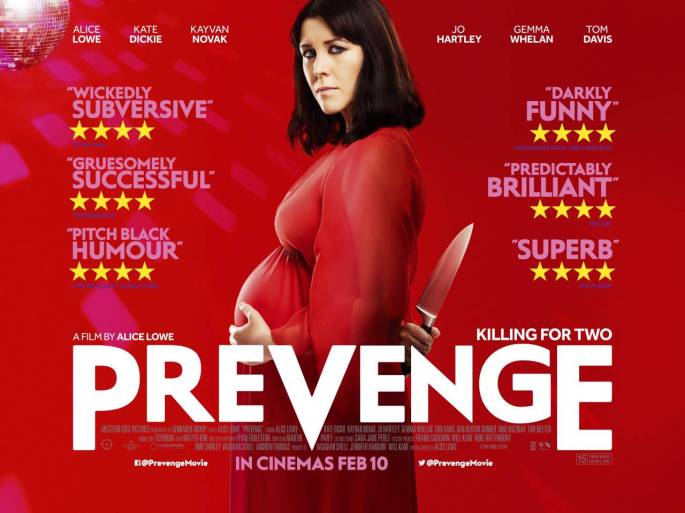
The ever-reliable Alice Lowe has carved quite a meaty role for herself in PREVENGE, a perversely amusing and multi-faceted exercise in genre defiance which also happens to mark the renowned British comic’s directorial debut. While past work on the ingeniously strange GARTH MARENGHI’S DARKPLACE and even more recently a collaboration with Ben Wheatley (with whom she wrote SIGHTSEERS) have undoubtedly rubbed off on her over time, this is Lowe’s own wonderful slice of weirdness to claim. If it doesn’t hit every one of its targets with ease, it at the very least wastes no time finding new ones.

Lowe plays Ruth, a widow who’s a good seven months into her pregnancy as of her opening confrontation with the sleazy proprietor of an exotic pet shop, with remarkable conviction. You see, she’s not carrying around just any old fetus; this is a fetus that speaks to Ruth, telepathically, in the voice of a little girl and compels her to do its evil bidding.

alice-lowe-prevenge[1].jpg

As any good mother would, Ruth is willing to mercilessly slaughter any man or woman who crosses her path in the hopes of satisfying the most carnal desires of her beloved monster. If at first there appears to be little method to the madness, it’s surely a result of Lowe’s insistence on favoring viscerally compelling storytelling over a series of utterly banal exposition dumps. Ruth keeps a notebook on her person at all times, in which the specificities of the kill list are better defined, and the influence of the absent father and husband surely shouldn’t be ruled out entirely. Most of the victims are – in fact – men, though it’s soon made quite clear that gender is hardly a factor into the unborn child’s insatiable bloodlust.

It’s both a blessing and a curse that Ruth’s motivation isn’t explored in more explicit detail; a blessing, because this way the film is able to effectively maintain a consistently exhilarating pace, and a curse because it can tend to leave a bit of an empty pit in its wake. Nevertheless, the film’s emotional pallet is a most impressive one. It would be far too easy to pass this deeply disturbed odyssey off as shallow misanthropy, or merely a wryly amusing riff on Alain Robak’s great BABY BLOOD, just as it would be misguided to claim that Lowe’s point-of-view remains elsewhere where the human experience is concerned.

prevenge-2016-alice-lowe[1]

This sort of angry, slippery satire – in which Lowe goes after the likes of corporate drones, fitness junkies, millennial hipsters, and thinly veiled misogyny – is thankfully accompanied by a great deal of empathy, as the film is really a confrontation of grief as well as the dangers of solitude.  That she was actually pregnant at the time of principal photography is just the icing on the cake where such a uniquely engaging talent is concerned, and Lowe is able to balance her apparent adoration for cynical splatter with deeper undertones of sadness. It’s rather beautiful, how Ruth is capable of existing in her own world up to a certain point, and the film does well to explore how truly crushing it can be when these isolated walls are suddenly broken down.

It certainly helps a lot that Lowe has such a talented team behind her at all times, ranging from the likes of Ryan Eddleston – whose cinematography is equally understated and effectively surreal whenever either, or both, is apt – and the efficient editing of Matteo Bini to the always welcome acting chops of Kate Dickie and fellow British comic Tom Davis (who makes for a delectably sleazy downtown disc jockey), among others.

Of course, one imagines that Lowe could do so much more with a more generous budget as well as more time allotted, but if this is the quality of entertainment that she is capable of producing in just eleven days, then it’s quite apparent that she has a bright future at the helm ahead. Articulately merging influence with graceful naturalism, PREVENGE is a deranged delight. It certainly hits the spot, if only to stomp it to pieces soon after.

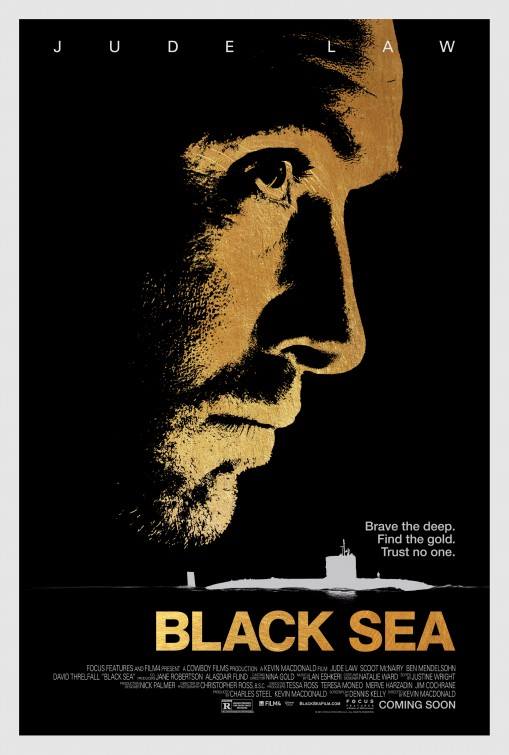
KEVIN MACDONALD’S BLACK SEA — A REVIEW BY NICK CLEMENT

1

Kevin Macdonald has had an extremely interesting directorial career. Cutting his teeth on documentaries (One Day in September, Touching the Void, Life in a Day, Marley), he’s transitioned to feature films, and over the last 10 years he’s made a career out of making solid, unpretentious dramas (The Last King of Scotland, The Eagle, State of Play, How I Live Now) that don’t find a big enough audience in theaters. They’re smart, they look good, the material is adult-minded, the budgets are medium sized, and his narratives don’t feature superheroes, giant special effects, or easily marketable elements. His most recent film, Black Sea, fits right into this mold. Every time I notice that this one is airing on one of the movie channels, I have to join it in progress; movies like this are my bread and butter.

2

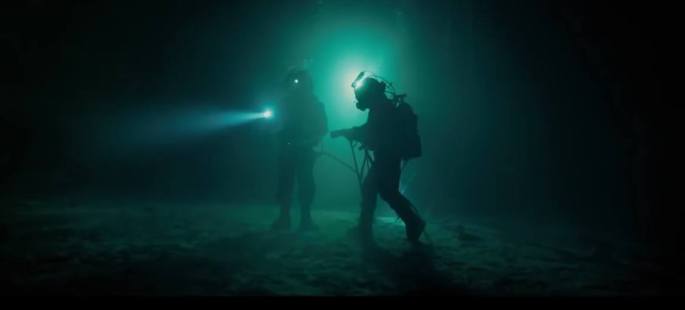
Dennis Kelly’s sturdy screenplay cleverly combines two popular genres – the submarine movie and the heist picture – and tells a swift, suspenseful, just-believable-enough story that hooks you from the first scene and keeps you in its firm grasp for two entertaining hours. Jude Law leads a gang of submariners, divers, and technicians in an effort to salvage buried Nazi gold that’s been sitting on the ocean bed inside of a WWII-era German U-boat. They gain access to an extremely weathered submarine that they carefully navigate to the U-boat, grab the gold, and that’s when greed kicks in, people start getting killed, issues flare up with the battered sub, and it becomes a guessing game of who will make it back up to the surface for a breath of fresh air.

4

This is a movie of sweaty, greasy, unshaven faces, with lots of smoke and steam filling the frame, peppered with great underwater photography and some excellent, claustrophobia inducing shots inside the hull of the sub. Macdonald’s direction is muscular but never overpowering and he’s just as concerned with motivation as he is with violent spectacle. While nothing revolutionary, Black Sea is content to tell a simple, engrossing tale of deceit and exciting action, with a seething resentment for the upper-class buried within the hardscrabble mindsets of its grizzled characters. Manly and macho and brimming with testosterone, this fits snugly alongside undemanding but capable genre entries like Jonathan Mostow’s U-571 and Kathryn Bigelow’s underrated K-19: The Widowmaker.

3

Hector & The Search For Happiness


I’ve read a lot of reviews for Hector & The Search For Happiness, and there’s a common, and fairly petty gripe that seems to be a theme throughout them, pissing me off no end. In the film, Simon Pegg plays a wealthy psychiatrist with a solid career and a beautiful wife (Rosamund Pike). Deep down though, he feels empty, unfulfilled and as if something is missing, and embarks on a spontaneous, unplanned global voyage to essentially search for the meaning of happiness, or at his own on the smaller scale. Now, a few critics have this whiny sentiment that because he’s well off, stable and lucky in life (I won’t even use the dreaded ‘P’ word), that it’s somehow offensive to see him search for more, or find himself unhappy. He ventures forth to places like Tokyo, L.A. and Africa in his travels and it seems to be some consensus that because he runs into people from third world areas who haven’t been dealt as lucky a hand as he has, materially speaking at least, that he has no right to complain or contest his position or mindset in life. Absolute butthurt. Everyone on this planet, be they billionaires, orphans, middle class mothers, movie stars or refugees, everyone is going through their own private set of problems and inner turmoil, and no one has the right to so blindly insist that some people’s problems, mental and/or material, matter more than others just because they have more money or resources than. The richest, most capable individuals could be going through hell on the inside, and they deserve to be acknowledged and sympathized with just as much as anyone else. Grow up. Now that my rant is over, on to the film, which is somewhat of an oddball and not easy to define, genre-wise. The posters and trailers make it out to be one of those quirky ‘find yourself’ comedy dramas where some plucky misfit goes on a journey, meets various archetypal characters and discovers a bunch about themselves, until the inevitable revelation that caps their story. Well, it is that, and it kind of isn’t as well. It’s certainly structured like that from beginning to end, but at times it gets quite dark, more than merely momentarily, and has far more of a brain in it’s head, both in terms of script and technical execution, than you would see coming. Pegg feels adrift in his profession, smothered by his doting but high maintenance wife and needs that leap into the unknown, which he takes. His first encounter is with a cynical hotshot businessman (Stellen Skarsgard), a man who lives in planes, airports, hotels and nightclubs, filling his time with life’s pleasures and the power of commerce, yet fully aware of what else he’s missing out on, perhaps the reason he is drawn to Pegg’s character. Over to Africa next, where he spends time with relief workers, to see if fulfillment can indeed be found in selflessly aiding others, but things turn intense when he’s captured by scary rebels and somewhat befriends a volatile arms dealer (nice to see Jean Reno, who’s been laying low these days) with a sad secret of his own. His trip takes him to the states, where he reconnects with an old flame (Toni Colette), no doubt allured by the sweet promise of nostalgia, a powerful force that doesn’t always yield happiness when adhered to. A loopy self help guru (Christopher Plummer), Skype sessions with Pike back in England and other encounters beset him, and in the end we wonder what the point of it all was, but this is his journey, not ours. I like that it doesn’t necessarily follow a blueprint that we’re used to, moves forward in fits and starts, meanders a bit, even veering into thriller territory briefly, his path truly an unforeseeable one that could lead anywhere based on chance, timing and the decisions he makes. That’s the mark of a good script, one that surprises and confounds in the best possible of ways, and shirks all labels applied to the final product, arriving on our screens as something just weird enough to be memorable and just this side of accessible in order to not be too much of an off-putting black sheep. Interesting stuff. 

-Nate Hill

Terrence Malick’s SONG TO SONG

It is getting more and more difficult to quantify Terrence Malick as a filmmaker, particularly with his abstract and introverted narratives with his last three features.  TO THE WONDER, KNIGHT OF CUPS, and now SONG TO SONG are a trilogy of films that are visual interpretations of fragmented memories that Malick holds within his psyche.  The picture (filmed back to back with his previous film KNIGHT OF CUPS) centers on three major characters woven within the music scene in Austin, Texas.  Rooney Mara is the wannabe musician, working her way up through the ranks of Michael Fassbender’s production company, and Ryan Gosling is a musician who falls deeply in love with Mara.  A tragic and tangled love story ensues, and we watch as these three people zigzag throughout each other’s lives.

Michael Fassbender Song to Song

The film is very much a natural progression of Malick’s previous two films.  It is as if you’re trekking through a reflection of someone’s memories.  We see prominent moments, with a slurry of small, yet important details that bridge together a kaleidoscope of a narrative.  Where KNIGHT OF CUPS was playfully sensual and very erotic, SONG TO SONG is brutally perverse at times, seeing and experiencing a very dark portrayal of sexuality.

The actors assembled are remarkable.  There are a few carryovers from KNIGHT OF CUPS, Cate Blanchett and Natalie Portman in particular, but the bulk of the cast is a new Malick ensemble.  Michael Fassbender is nasty as ever as the record producer who is without emotion.  He constantly pushes himself in transgressive ways.  He forces threesomes upon his acquired lovers, he experiments with drugs, and he undercuts anyone whose support he has gained.

Natalie Portman Song to Song

Ryan Gosling is very different than we’ve seen him in a film before.  He’s very sweet, he’s very romantic.  While he maintains his stoic cinematic image, he sheds the mystery and hamminess that we’ve become too used to.  His interactions with Rooney Mara are wonderfully beautiful.  He gives a very touching and soft performance, a clear contrast to the menace and dirtiness of Michael Fassbender.  Natalie Portman gives yet another completely vulnerable turn as a young woman distracted by Fassbender’s charm and monetary value, ultimately suffering from it.  Val Kilmer and Holly Hunter briefly show up.  Kilmer is a singer, who greatly plays off his Jim Morrison persona, and Holly Hunter is the mother of Natalie Portman’s tragic darling.

What separates this from the previous two people twirling features, is that for the first time Malick has used popular music, while still using classical numbers.  Del Shannon’s RUNAWAY was prominently featured in the trailer and in an important scene in the film.  Along with his use of popular music, the film also features cameos from the Red Hot Chili Peppers, Johnny Rotten,  a significant scene between Michael Fassbender and Iggy Pop, and a narrative affecting performance from Patti Smith who acts as a mentor to Rooney Mara.

Ryan Gosling Song to Song

The collaboration between Malick and cinematographer Emmanuel Lubezki is a pairing that is cinematic nirvana.  It’s a match that tends to not be talked about nearly as much as it should be.  The picture looks and feels organic, it doesn’t look like a movie, nor does it feel emulated; it is real life.

If you haven’t been with Malick on his last two pictures, it would be difficult to recommend this film to you.  Yet the film is powerfully filled with beautiful and transgressive emotions.  The film is an experience, it’s as unorthodox as one might think.  The film is challenging, it is an experience that is worthy of anyone’s attention.  If that album cover of Pink Floyd’s WISH YOU WERE HERE were a film, it would be SONG TO SONG.


SCOTT STEWART’S DARK SKIES — A REVIEW BY NICK CLEMENT

2

I’m a sucker for a good extraterrestrial narrative, and the supremely wicked Dark Skies, which was released to ho-hum reviews and weak box-office back in 2013, is one of the more enjoyable genre offerings in recent memory. This is an intimately scaled sci-fi horror thriller with engaging performances from Keri Russell and Josh Hamilton as suburban parents who are being visited, along with their children, by something spooky in the night. J.K. Simmons is very effective as the alien hunter who helps them solve the mysteries that are plaguing their house. Written and directed by Scott Stewart and produced by the now-on-fire Blumhouse Productions, the film has an absolutely chilling and upsetting final scene, which really drives a stake through the heart of any parent who might be watching. The crafty cinematography is by David Boyd, while Joseph Bishara provided the ominous musical score and was in perfect tandem with Peter Gvodas’ sharp editing. Dark Skies isn’t groundbreaking, but sometimes a nasty and efficient little chiller is all that’s required.

3

Bone Tomahawk

Bone Tomahawk

2015. Directed by S. Craig Zahler

screens_feature6

The romanticizing of the Western has become a low hanging fruit that films have been attempting to deconstruct for years.  While a handful manage to succeed, the majority of these films fail to present any semblance of resonant ideas, let alone understand the concepts they seek to undo.  S. Craig Zahler’s harrowing debut feature, Bone Tomahawk begins in an attempt to distance itself from this camp, using a profane marriage of glacial pacing and unrelenting acts of violence to produce a singular, unforgettable film.  However, it is this dark design; a seething meditation on masculinity and the Western’s self-aggrandizing of its heroes that completes the cycle, firmly cementing Bone Tomahawk as an near perfect masterpiece of the genre.

Four men set out to rescue a group of townsfolk who have been kidnapped by a cannibalistic tribe on the frontier.  The posse features an atypical grouping of gunslingers, one of the many details of Zahler’s potent script that hints at the depth beneath the dusty surface.  Each man is representative of the male ego at different stages in life.  Patrick Wilson portrays an injured man whose wife has been taken.  Young, in love, and fiercely devoted to his wife, Wilson, who is the weakest of the pack if only for screen time, communicates the vibrancy of youth through his labored delivery while courageously displaying the self-doubt that can plague a relationship at its inception.  Icon Kurt Russell plays the town Sheriff, a violent, but noble man with an ailing wife.  Russell brings his expected level of grit to the role, but it is his candid bravado that elevates his performance to the upper tier of his fabled career.  Sheriff Hunt is a man who lives by order and the gun; a willing participant in killing when needed, who has managed to come through a life of gunplay with a grim understanding of the darkness, but also an appreciation for love and the simplicity of life.

008 Geno Segers as Boar Tusks

Russell is contrasted by Matthew Fox who gives the performance of his career as the town’s mysterious gunslinger, Brooder.  Where Russell’s sheriff was able to extricate himself from the darkness, Fox’s gentleman killer has embraced it, wrapping himself in the coldness of death.  Some of the best scenes of the film are when the façade of bravery slips; revealing the broken souls behind the mask of machismo and Fox’s understanding of this is a thing of tragic beauty.  Prolific character actor Richard Jenkins rounds out the heroes with Chicory, the town’s venerable deputy.  Jenkins steals virtually every scene and his exchanges with Russell are a ray of light in the endless darkness of the story.  There’s a scene in the bloody final act in which the heroes are in grave peril and Chicory begins to ruminate on the reality of a flea circus.  He is joined by the sheriff and both Russell and Jenkins’ intimate understanding of death becomes reflexive of the journey, even more so than the act itself, a feat made possible by Jenkins’ towering performance.  He takes what is obviously the comic relief and turns it into a grounded, vulnerable exposition that becomes the surrogate for the audience’s preconceived notions of right and wrong.

Bone Tomahawk’s central theme explores various notions of time.  Zahler takes the Western framework, especially The Searchers and separates the story from the hook by grinding the narrative to a turtle’s pace, forcing the characters to become flesh and blood before summarily ripping them to shreds.  Where the main characters represent the masculine life cycle, the simple, yet unforgettably brutal story is not only a plausible tale from the past; it is painful reminder that monsters are very real.  The pursuit itself is dictated by time, with Wilson’s injured combatant serving as a constant reminder of not only the very real danger but that fate ignores such temporal constraints, dictating death and clemency in an instant.  Violence is the medium through which these bleak truths are explored, both in its commission and in its aftermath. The movie is at its best when the guns are holstered, both in the philosophical maze of the second act and the terrifying climax.  Men facing creatures outside their understanding is nothing new, however it is Zahler’s understanding of the central conceits of the genre that make this undertaking an uncomfortable itch that the viewer is powerless to not scratch.

bonetomahawk

Benji Bakshi’s digital cinematography presents an interesting conundrum.  The crisp digital shots bring a sense of cleanliness to a dirty world, framing the exterior locales with sweeping wide shots that keep the harriers in focus, offset by blistering oranges and burned browns that hint at the danger that surrounds them.  The interior shots, particularly in the beginning have a wooden quality that leaves the eye eager to return outdoors, however, this only lasts for a few previous moments of set up.  Chantal Filson’s rigorous costume design is the final piece, using period vintage in creative combinations to solidify the symbolic representations of the gunmen and contrasting them with the sparse, totemic appearances of the cannibals.

Available now on Amazon Prime, Bone Tomahawk received Independent Spirit Award nominations for Zahler’s screenplay and Jenkins’ performance.  This is a vicious film that will frustrate some viewers with its fatigued pacing and downright nasty portrayals of violence.  If you can get past these two issues, there is a wealth of splendor underneath the gory veneer.  If you’re of strong stomach and are interested in a unique Western film that will follow you into your dreams, Bone Tomahawk is the experience you’re looking for.

Highly.  Highly Recommend.

bone-tomahawk-title-card