Slow West clocks in briskly under 90 minutes, which is usually unheard of for a western. You can stamp out any thoughts of it being rushed or too slight of a flick though, because it’s exactly what it needs to be every step of the way. It’s a beautifully scored, tightly plotted and boldly characterized (the key ingredient in the genre, if you ask me) mix that saunters along like a mule of the plains, before kicking up the dust for a bloody, atmospheric finale that leaves you stunned and breathing hard. Westerns are often ambitious, lofty affairs and can get quite moody and too densely packed for their own good. Not this baby. It breezes by like a summer wind, with just enough violence, character development and aching catharsis to billow out its chipper narrative during the brief stay we are treated to. Kodi Smit McPhee plays a young Scottish lad who is a tad out of his depths in the American west, searching for a girl (Caren Pistorius) who had to flee the country with her father (The Hound himself, Rory McCann). McPhee is naive to the dangers of this new territory, and nearly finds himself at the receiving end of a bullet before being saved by a roaming outlaw (Michael Fassbender) who takes him under his wing with much gruff and huff along the way. Reluctance is doled out along with sympathy on Fassbender’s part as he shields the boy from a dangerous bounty hunter and former employer of his, played by a wonderfully greasy Ben Mendelsohn, perpetually shrouded in acrid cigar smoke and snuggled up in one epic and fabulous fur pelt. These three wayward misfits gravitate towards the obligatory final shoot out, which takes place in the girl’s hideaway house on the picturesque pretty plains. Impressive is an understatement for this sequence: yellow grass sways, a hailstorm of bullets punctuate the horizon and the mournful tones of Jed Kurzel’s lonely score, grim fates are earned in a gorgeous set piece that resembles something like Wes Anderson making an Oater. Everything before and winds up to this sequence, and the payoff is superb. If I’ve made it sound dark or off putting, think again. It’s all crafted with the utmost light and poetic buoyancy, a lilting sadness to the violence that hits home but never batters you. The performances echo this as well, Fassbender a world weary, affable and altogether dangerous man, Mendelsohn slithering about with a dry silver tongue and an itchy trigger finger, and a fish out of water McPhee stuck in between. The visual palette is quite something to see, accented by the music perfectly. I’m beyond anxious to see what first time director John Maclean comes up with for us for his next ride, for he’s knocked it out of the ranch with this one. Ho for the West.
Category: Film Review
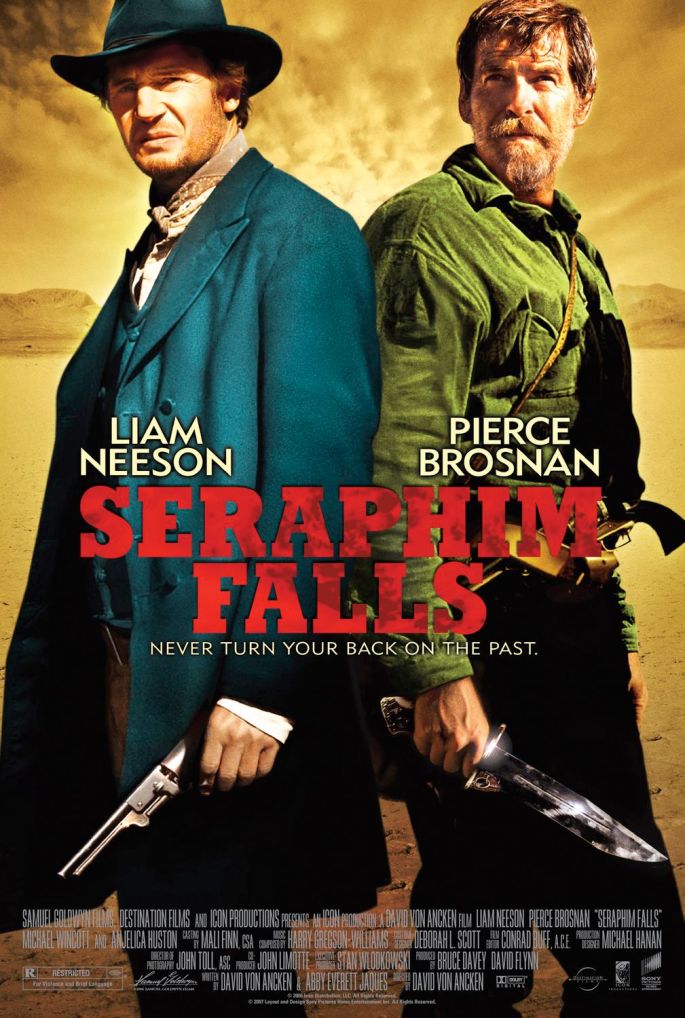
DAVID VON ANCKEN’S SERAPHIM FALLS — A REVIEW BY NICK CLEMENT

Tipping its hat to Clint Eastwood’s The Outlaw Josey Wales while recalling certain masculine aspects of Sydney Pollack’s epic adventure Jeremiah Johnson and portions of Man in the Wilderness from director Richard Sarafian, the 2006 films Seraphim Falls was ruggedly and forcefully directed by David Von Ancken, a TV veteran who made an auspicious feature debut with this rough and violent revisionist Western that benefited from contemporary production values while exploring time-honored themes of revenge, personal survival, and feverish bloodlust. While watching it, you can see how it might have set some sort of template for last year’s Oscar winning masterpiece The Revenant from challenging filmmaker Alejandro González Iñárritu. Von Ancken co-wrote the terse and effective screenplay with Abby Everett Jaques, with the action centering on two men pitted against each other in a bounty hunt to the death. The time is the late 1860’s, and a Union solider (Pierce Brosnan) has become the prey for a Confederate colonel (Liam Neeson), while the excellent supporting cast including Michael Wincott, Tom Noonan, Kevin J. O’Connor, Ed Lauter, Xander Berkely, Wes Studi, Angie Harmon, and Anjelica Houston filled the edges of the intense and sometimes physically overwhelming narrative. John Toll’s superb cinematography shot for the epic at all times, while still getting down-and-dirty personal when called for, while the tight and economical editing by Conrad Buff kept the film moving at a brisk yet coherent clip. The pulse quickening musical score by Harry Gregson-Williams accentuated every scene without ever becoming overbearing, while both Neeson and Brosnan were perfectly suited as mortal adversaries, with a narrative outcome that’s both surprising and satisfying in equal measure. After premiering at the 2006 Toronto International Film Festival, Seraphim Falls received a very limited theatrical release (I saw it at the Arclight in Los Angeles in a mostly empty theater), this is one of those rarely discussed films that certainly deserves to find a new set of fans, as it will certainly delight those who love a gritty, action-packed period piece with piss ‘n vinegar to spare. Seraphim Falls is available on DVD and on a UK-release Blu-ray that does happen to be a region free disc.

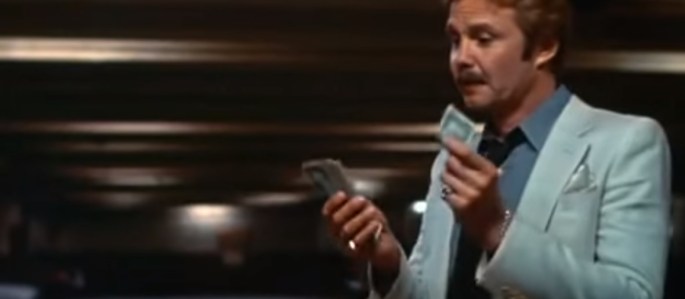
HAL ASHBY’S LOOKIN’ TO GET OUT — A REVIEW BY NICK CLEMENT

Released in a compromised form in 1982, Lookin’ to Get Out found Hal Ashby back in full on comedy mode, taking on a jaunty, semi-improvised project written by Al Schwartz and Jon Voight, who also starred as a degenerate gambler who heads out to Vegas with his partner (an extra affable Burt Young), in an effort to hit it big and avoid punishment from the hoods to whom they owe gambling debts. The film was loosely scripted and feels that way in many spots, and features a seven year old Angelina Jolie in her big screen debut as Voight’s daughter. The lovely Ann-Margaret made a colorful supporting turn, while the film has a tone that is mostly comedic but dramatic in a few key spots to keep it grounded. This was one of the last big movies of Ashby’s career, which was compromised by drug and alcohol abuse and repeated fights with producers and executives, resulting in a huge disagreement with the studio and loss of final cut over the picture. As legend has it, some years ago, Voight was at a speaking engagement at USC, and discovered that a version of the film being shown to students was somehow Ashby’s original cut, which had been considered gone, lost, or buried. Voight brought it to the attention of Warner Brothers, who then released Ashby’s director’s cut on DVD in 2009. While certainly not a bad film, it’s entertaining and frequently smart and funny, but it doesn’t have that special spark that made his films from the 70’s so unique. But for fans of this filmmaker, it’s most definitely worth seeking out.

Virtuosity: A Review by Nate Hill
Nothing says the 90’s like Virtuosity, a big hunk of circuit board sleaze and cheese that is so of it’s time that it’s hard to watch it these days without believing it to be some kind of spoof. Re-reading that sentence it sounds like I was making some kind of underhanded compliment, which I suppose is a better outcome for a film to arrive at than some. It could have gotten stale or dated in a bad way. Well it’s definitely not stale (it is dated though), in fact it’s one of the liveliest flicks from back then, thanks mostly to a ballistic characterization from Russell Crowe. Crowe is Sid.6, a virtual reality program molded from the personalities of several different serial killers and designed to basically wreak havoc. This is exactly what happens when he escapes, or rather is let out by one of the maniacs at the research centre (Stephen Spinella). Sid is now flesh, blood and roughly 200 pounds of extremely skilled, remorseless killing material, running wild in the unsuspecting streets. The head of the Institute (William Forsythe) has the brilliant idea to recruit ex-cop whack job Parker Barnes (Denzel Washington) to hunt Sid down and destroy him. Barnes has a bleak history with artificial intelligence, one that has left him with a cybernetic replacement arm and a huge chip on his shoulder. This is one mean, mean spirited film, as we are subjected to a manic Crowe as tortures, murders and maims innocent civilians with a grinning cavalier cadence the Joker would applaud. He’s off his nut here, something which clumsy bruiser Crowe rarely gets to do, so it’s a rare and extreme outing for him. Washington is perpetually angry, ill adjusted and violent here, and the lengths he goes to destroy Sid are almost as bad as his quarry’s homicidal antics. The cast is stacked with genre favourites, so watch for Costas Mandylor, Kevin J. O’Connor, Louise Fletcher, Kelly Lynch, Traci Lords and a weaselly William Fichtner. The special effects… well what can I say, this was the 90’s and they look like a computer game that’s been drenched in battery acid, then souped up with caffeine. There’s brief homages to video games in fact, and the opener where Crowe is still inside the program is fairly creative. I don’t know if the creators of the film were trying to say something about the dangers of virtual reality, but whatever it was, it’s sort of lost in a hurricane of unpleasent shenanigans that are admittedly entertaining. One thing that’s evident is that anyone who makes a computer program with the persona of one, let alone a handful of murderers is just begging for an incident. I suppose that’s the point here though, the catalyst for the whole deal. Crowe and Washington are great though, both down and dirtier than their characters in the next royal rumble they’d share, Ridley Scott’s American Gangster. Fun stuff, if you have a strong gag reflex and don’t take yourself too seriously.
PTS Presents Producer’s Notes with EVZEN KOLAR

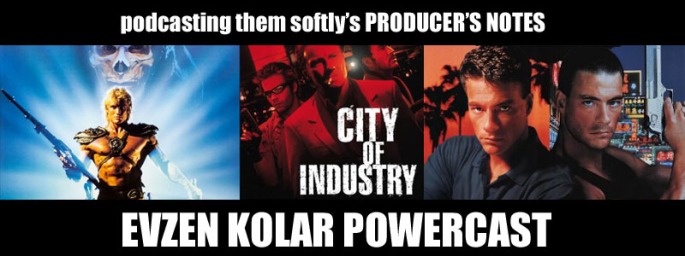
Podcasting Them Softly is incredibly proud to be joined with veteran producer Evzen Kolar whose credits include STREET SMART, the epic Cannon Film’s MASTERS OF THE UNIVRSE, DOUBLE IMPACT, SURF NINJAS, and a film that was made to be a featured film on Pocasting Them Softly, the 1997 hardnosed neo noir CITY OF INDUSTRY. Evzen also produced the soundtrack that is a must own for any cinephile soundtrack junkie! Before becoming a producer, Evzen worked as an assistant director, a unit manager on NEVER SAY NEVER AGAIN, and he has also done some stunt work. Unknown to us prior, Evzen is married to Robert Shaw’s daughter, and we spend a fair amount of time talking about Robert Shaw!
Donnie Darko: A Review by Nate Hill
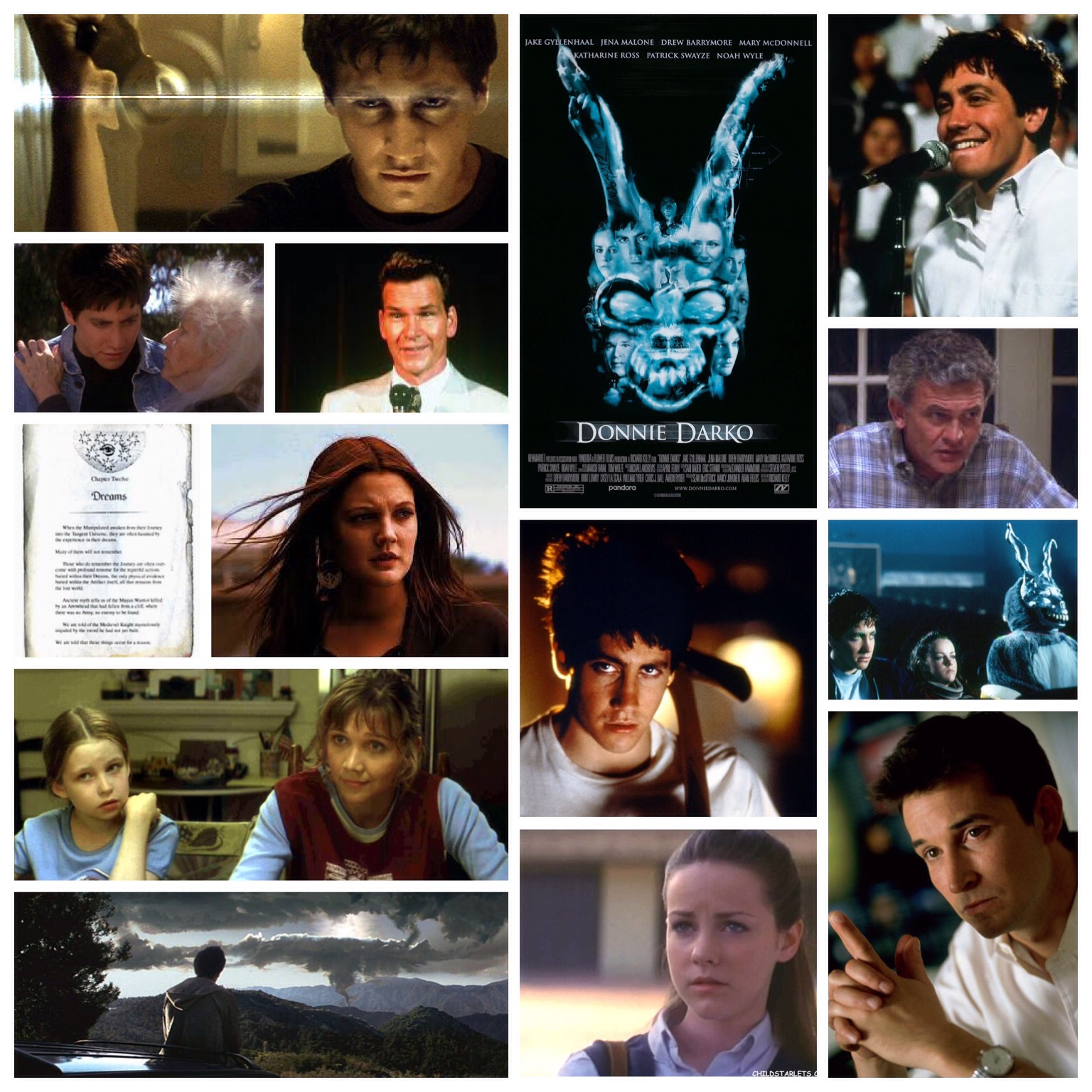
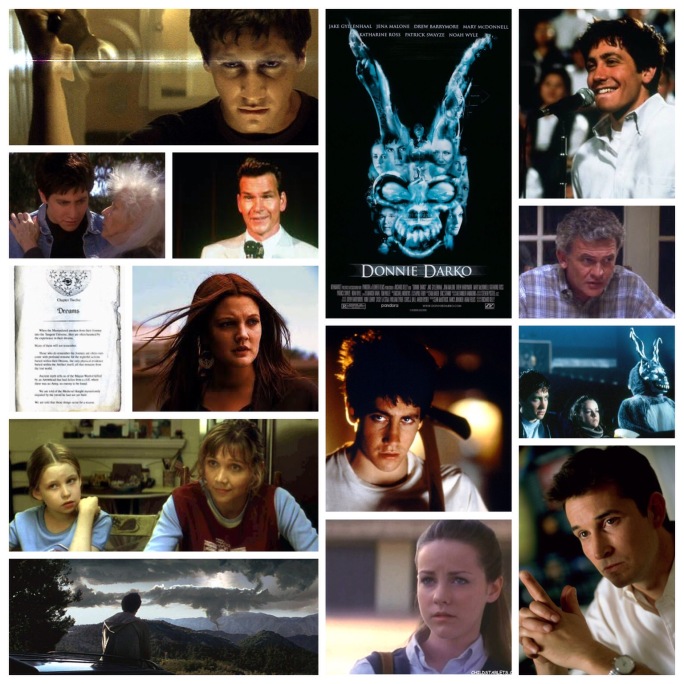
The director’s cut of Richard Kelly’s Donnie Darko is one of the most profound experiences I’ve ever had watching a film. It transports you to its many layered dimension with unforced ease and tells it’s story in chapters that feel both fluid and episodic in the same stroke. It has such unattainable truths to say with its story, events that feel simultaneously impossible to grasp yet seem to make sense intangibly, like the logic one finds within a dream. These qualities are probably what lead to such polarized, controversial reactions from the masses, and eventual yearning to dissect the hidden meaning which at the time of its release, didn’t yet have the blessing of the extended cut and it’s many changes. A whole lot of people hate this movie, and just as many are in love with it as I am. I think the hate is just frustration that has boiled over and caused those without the capacity for abstract thought to jump ship on the beautiful nightmare this one soaks you in. Movies that explore the mind, the unexplainable, and the unknowable are my bread and butter, with this one taking one of the premier spots in my heart. Kelly has spun dark magic here, which he has never been able to fully recreate elsewhere (The Box is haunting, if ultimately a dud, but his cacophonic mess Southland Tales really failed to resonate with me in the slightest). Jake Gyllenhaal shines in one of his earliest roles as Donnie, a severely disturbed young man suffering through adolescence in the 1980’s, which is bad enough on its own. He’s also got some dark metaphysical forces on his back. Or does he? Donnie has visions of an eerie humanoid rabbit named Frank (James Duval) who gives him self destructive commands and makes prophetic statements about the end of the world. His home life should be idyllic, if it weren’t for the black sheep he represents in their midst, displaying behaviour outside their comprehension. Holmes Osborne subtly walks away with every scene he’s in as his father, a blueprint of everyone’s dream dad right down to a sense of humour that shows he hasn’t himself lost his innocence. Mary McDonnell alternates between stern and sympathetic as his mother, and he has two sisters: smart ass Maggie Gyllenhaal (art imitating life!) and precocious young Daveigh Chase (also Lilo and Samara from The Ring, funnily enough). The film also shows us what a showstopper high school must have been in the 80’s, with a script so funny it stings, and attention paid to each character until we realize that none are under written, and each on feels like a fully rounded human being, despite showing signs of cliche. Drew Barrymore stirs things up as an unconventional English teacher, Beth Grant is the classic old school prude who is touting the teachings of a slick local motivational speaker (Patrick Swayze). The plot is a vague string of pearls held together by tone and atmosphere, as well as Donnie’s fractured psyche. Is he insane? Are there actually otherworldly forces at work? Probably both. It’s partly left up to the viewer to discern, but does have a concrete ending which suggests… well, a lot of things, most of which are too complex to go into here. Any understanding of the physics on display here starts with a willingness to surrender your emotions and subconscious to the auditory, visual blanket of disorientation that’s thrown over you. Just like for Donnie, sometimes our answers lies just outside what is taught and perceived, in a realm that has jumped the track and exists independently of reality and in a period of time wrapped in itself, like a snake eating it’s own tail. Sound like epic implications? They are, but for the fact that they’re rooted in several characters who live in a small and isolated community, contrasting macro with micro in ways that would give David Lynch goosebumps. None of this malarkey would feel complete without a little romanticism, especially when the protagonist is in high school. Jena Malone is his star crossed lover in an arc that finds them spending little time together, yet forming a bond that that feels transcendant. Soundtrack too must be noted, from an effective opener set to INXS’s Never Tear Us Apart to the single most affecting use of Gary Jules’s Mad World I’ve ever heard. It’s important that you see the director’s cut though, wherein you can find the most complete and well paced version of the story. There’s nothing quite like Donnie Darko, to the point where even I feel like my lengthy review is stuff and nonsense, and you just have to watch the thing and see to truly experience it.
Donnie Darko: A Review by Nate Hill
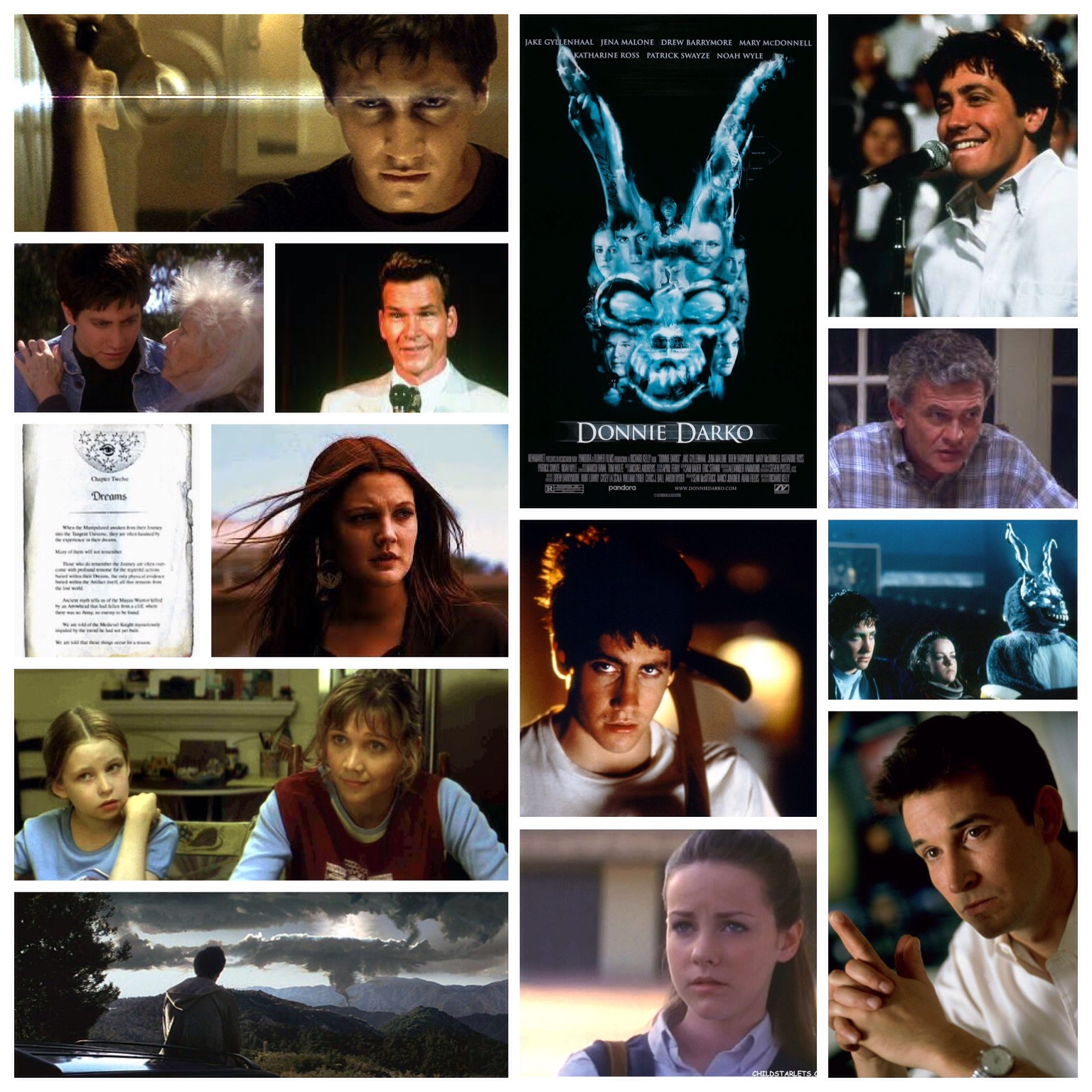
The director’s cut of Richard Kelly’s Donnie Darko is one of the most profound experiences I’ve ever had watching a film. It transports you to its many layered dimension with unforced ease and tells it’s story in chapters that feel both fluid and episodic in the same stroke. It has such unattainable truths to say with its story, events that feel simultaneously impossible to grasp yet seem to make sense intangibly, like the logic one finds within a dream. These qualities are probably what lead to such polarized, controversial reactions from the masses, and eventual yearning to dissect the hidden meaning which at the time of its release, didn’t yet have the blessing of the extended cut and it’s many changes. A whole lot of people hate this movie, and just as many are in love with it as I am. I think the hate is just frustration that has boiled over and caused those without the capacity for abstract thought to jump ship on the beautiful nightmare this one soaks you in. Movies that explore the mind, the unexplainable, and the unknowable are my bread and butter, with this one taking one of the premier spots in my heart. Kelly has spun dark magic here, which he has never been able to fully recreate elsewhere (The Box is haunting, if ultimately a dud, but his cacophonic mess Southland Tales really failed to resonate with me in the slightest). Jake Gyllenhaal shines in one of his earliest roles as Donnie, a severely disturbed young man suffering through adolescence in the 1980’s, which is bad enough on its own. He’s also got some dark metaphysical forces on his back. Or does he? Donnie has visions of an eerie humanoid rabbit named Frank (James Duval) who gives him self destructive commands and makes prophetic statements about the end of the world. His home life should be idyllic, if it weren’t for the black sheep he represents in their midst, displaying behaviour outside their comprehension. Holmes Osborne subtly walks away with every scene he’s in as his father, a blueprint of everyone’s dream dad right down to a sense of humour that shows he hasn’t himself lost his innocence. Mary McDonnell alternates between stern and sympathetic as his mother, and he has two sisters: smart ass Maggie Gyllenhaal (art imitating life!) and precocious young Daveigh Chase (also Lilo and Samara from The Ring, funnily enough). The film also shows us what a showstopper high school must have been in the 80’s, with a script so funny it stings, and attention paid to each character until we realize that none are under written, and each on feels like a fully rounded human being, despite showing signs of cliche. Drew Barrymore stirs things up as an unconventional English teacher, Beth Grant is the classic old school prude who is touting the teachings of a slick local motivational speaker (Patrick Swayze). The plot is a vague string of pearls held together by tone and atmosphere, as well as Donnie’s fractured psyche. Is he insane? Are there actually otherworldly forces at work? Probably both. It’s partly left up to the viewer to discern, but does have a concrete ending which suggests… well, a lot of things, most of which are too complex to go into here. Any understanding of the physics on display here starts with a willingness to surrender your emotions and subconscious to the auditory, visual blanket of disorientation that’s thrown over you. Just like for Donnie, sometimes our answers lies just outside what is taught and perceived, in a realm that has jumped the track and exists independently of reality and in a period of time wrapped in itself, like a snake eating it’s own tail. Sound like epic implications? They are, but for the fact that they’re rooted in several characters who live in a small and isolated community, contrasting macro with micro in ways that would give David Lynch goosebumps. None of this malarkey would feel complete without a little romanticism, especially when the protagonist is in high school. Jena Malone is his star crossed lover in an arc that finds them spending little time together, yet forming a bond that that feels transcendant. Soundtrack too must be noted, from an effective opener set to INXS’s Never Tear Us Apart to the single most affecting use of Gary Jules’s Mad World I’ve ever heard. It’s important that you see the director’s cut though, wherein you can find the most complete and well paced version of the story. There’s nothing quite like Donnie Darko, to the point where even I feel like my lengthy review is stuff and nonsense, and you just have to watch the thing and see to truly experience it.
NEIL LABUTE’S IN THE COMPANY OF MEN — A REVIEW BY NICK CLEMENT

This film is utterly poisonous. It’s totally cruel and it’s in love with the fact that it’s cruel. It’s happy to be mean, and it doesn’t care if you don’t like it. Neil LaBute’s first film, In the Company of Men, is still more than likely his best. This is a movie where two seemingly nice guys simultaneously romance a naive, deaf woman, with the express written plan to drop her like a sack of potatoes, thus destroying her as a person. Rarely do you get a glimpse of cinematic treachery on a level that this film provides. Some of this film is dangerously funny; portions of it will make you sick. It made a star out of Aaron Eckhart and it led to a fabulous chacter actor career for Matt Malloy. Stacy Edwards breaks your heart – it’s such a gutsy performance. LaBute’s extremely pessimistic worldview was on full display here, and without spoiling everything, you should know that this is a worldview where bad people often times come out on top. LaBute’s plain but subtle visual style gave off an icy, emotionally remote vibe that extends to the themes on display. I can remember being absolutely in awe of this movie as a high school senior; it’s the first film I reviewed for my school newspaper and it’s the movie that really spurred on my interest in discussing film in the written form.
ADVENTURELAND – A REVIEW BY J.D. LAFRANCE

Summer jobs are usually the bane of a young person’s existence. They are what you slog through so that you can afford to go to school. They are the drudgery you endure while daydreaming of going to the beach, hanging out with your friends or going to see your favorite band – in other words, pretty much anything else but work. Summer jobs are a necessary evil and no one understands that better than filmmaker Greg Mottola who has masterfully encapsulated these feelings in Adventureland (2009), his follow-up to the popular hit Superbad (2007).
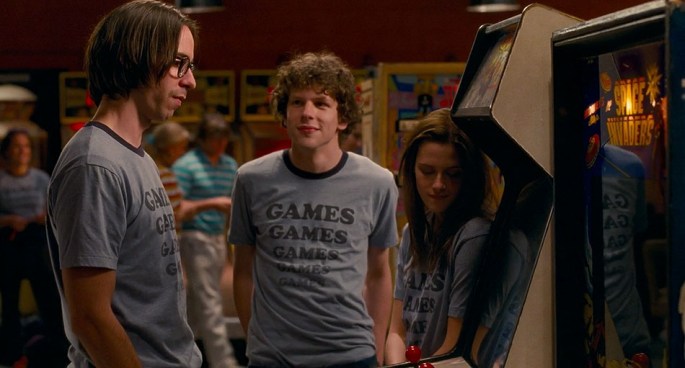
The film opens to the strains of “Bastards of Young” by The Replacements and right away you know you’re in good hands. The year is 1987 and James Brennan (Jesse Eisenberg) has just graduated from college. He is planning to go to Europe for the summer with his buddies; however, his folks can no longer afford to help him pay for it or for grad school at Columbia University in the fall where he hopes to study journalism. James makes some calls, does some legwork and realizes that, with his academic background and a resume with a severe lack of work experience, he’s not qualified for manual labor.
Faced with no other options, James decides to apply at Adventureland, a local amusement park. Much to his surprise, he’s hired right on the spot and put in charge of various games booths. He’s shown how everything works by Joel (Martin Starr), a terminally bored co-worker who’s clearly done this song and dance routine way too many times, telling James at one point, “So, your life must be utter shit or you wouldn’t be here.” While working at the theme park James meets Em (Kristen Stewart), an attractive co-worker with excellent taste in music, and whom he develops a crush on. He also befriends Connell (Ryan Reynolds), the park’s maintenance man, and who is in a local band in his spare time, claiming to have once jammed with Lou Reed. James spends the summer hanging out with Em and his fellow co-workers and learns that if he wants to be a good writer he needs to have some life experiences under his belt.
Adventureland accurately portrays the thankless slog of a minimum wage job (“We are doing the work of pathetic lazy morons,” Joel deadpans) with repetitive tasks, annoying customers, and crap pay. The only thing that makes it remotely bearable is the people James works with – after all, misery loves company. Mottola includes all sorts of nice touches, like the cheesy Foreigner cover band that plays at the local bar, or the mixed tape of music that James makes for Em, which gives the film a more personal feel. This is helped considerably by a great soundtrack that features the likes of Big Star, Crowded House, Husker Du, and The Jesus and Mary Chain – bands responsible for some of the best alternative music of the 1980s. Like the way music was used in Richard Linklater’s Dazed and Confused (1993), the music in Adventureland transports you back to another time and immerses you in it.
Jesse Eisenberg and Kristen Stewart have excellent chemistry together and do a good job of playing two young people that want different things out of a relationship. She has her own issues and they keep James always slightly at arm’s length. One hopes that despite the success of the Twilight films, Stewart will continue to make small, more personal films like Adventureland. Eisenberg nails the awkwardness of someone who’s had very few life experiences, especially in the romance and relationship department.
Mottola does a good job of portraying the brief flings that happen over the course of a summer. They are intense while they last even though they rarely do. He also accurately depicts how messy they can be, especially when you’re at that awkward age – your twenties – and are still trying to figure things out. Adventureland has an authenticity in how it feels to be in your twenties and to fall in love for the first time, stumbling through things, learning as you go. Whereas Mottola was basically a hired gun on Superbad, Adventureland comes from a very personal place and has much more heart while still being very funny and entertaining.
HAL ASHBY’S THE LAST DETAIL — A REVIEW BY NICK CLEMENT

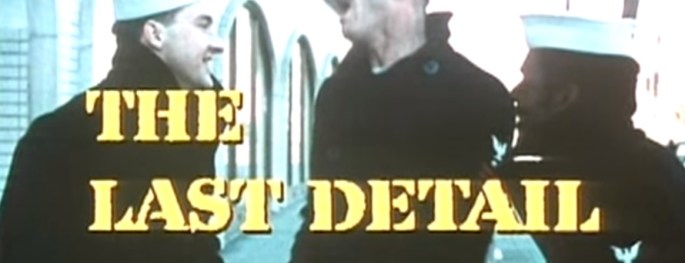
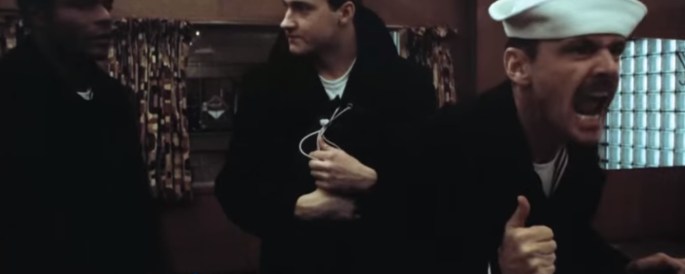
Released in 1973 and featuring an absolutely fantastic screenplay by Robert Towne, The Last Detail found Ashby doing some of his best mixing of comedy and drama, with results that are piercing and at times brutal. Starring Jack Nicholson and Otis Young as two sailors who are tasked with escorting one of their own (Randy Quaid, fantastic) to a military prison in New England, The Last Detail is one of those amazingly observed character studies that’s wholly interested in human behavior and how the bonds of friendship are tested in ways that the characters could never expect. The three men have all sorts of adventures along the way to their destination, and the final act involves some decisions that are as smart as they are sad, because you fully believe in the story and the people who populate it. Towne adapted the screenplay from the 1970 novel written by Darryl Ponicsan, which would became famous for a copious amount of “F-bombs,” and which would solidify Towne’s status as one of the premiere screenwriters of his generation. Shot in muted tones with a naturalistic sensibility by the great cinematographer Michael Chapman, the film has a terrific sense of time and place, with Ashby’s understanding of tone and pacing in full effect. Nominated for three Academy Awards (Nicholson, Quaid, and Towne), the film would become a critical and commercial success, and would also find Nicholson winning Best Actor at The Cannes Film Festival. Now available on Blu-ray from Twilight Time.