TARSEM’S THE FALL — A REVIEW BY NICK CLEMENT

1

THE FALL is not going to be everyone’s cup of tea. But for me, this is the brew I need. I drank the whole pot and loved every single sip, as this is truly a one of a kind  effort. Directed by Tarsem (THE CELL) from a script he co-wrote with Dan Gilroy (NIGHTCRAWLER) and Nico Soultanakis, THE FALL is one of the most personal and private films that I’ve ever encountered, a constant feast for the eyes, ears, and brain. Terrence Malick and Werner Herzog would blush if they saw it. It’s also an uncompromising, wholly masterful vision that was easily my favorite film in 2008, and over the years, I’ve repeatedly returned to it in an effort to unlock all of its secrets and filmic virtues. There is imagery in THE FALL that I will never forget, and for me, that’s what I look for in movies – a visual style that’s going to take me somewhere new and fantastic in a way that I’ve not experienced. This is a haunting movie, a work that mixes surrealist fantasy with a simple yet dark story, and THE FALL has captivated me in a way that few other releases have over the last decade. From the utterly engrossing opening in luscious, smoky, black and white, all the way to the emotionally draining and satisfying ending, THE FALL sweeps you out of your seat with lush, exotic, and unforgettable visions while spinning a touching yet complicated narrative that adds up to something completely spectacular and original.
3

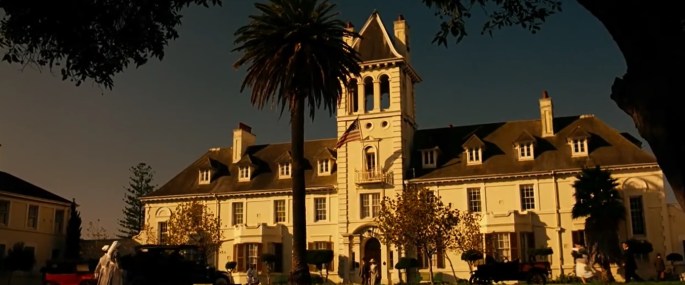
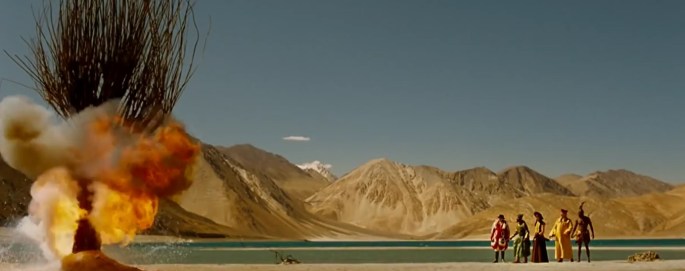
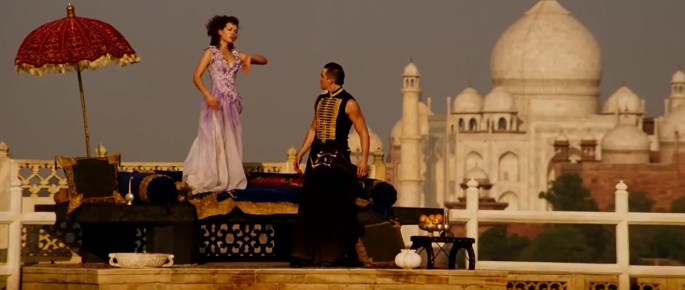
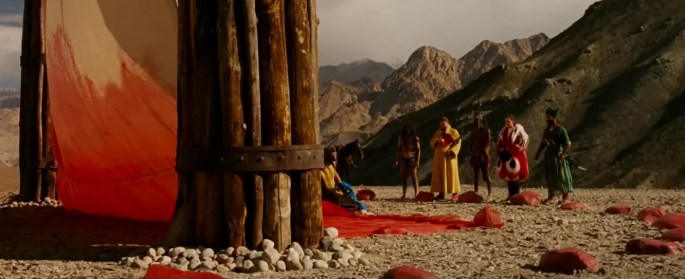
Shot over the course of four years in over 20 countries and fully financed by Tarsem out of his own pocket, THE FALL is the story of two lost souls who connect while convalescing in a Los Angeles hospital, sometime in the early 1920’s. Roy Walker (a tortured and excellent Lee Pace) is a Hollywood stuntman who has become paralyzed from the waist down after falling off his horse during the filming of a Western. Confined to his bed in the hospital, he is a man suffering not only from his terrible injury, but from a broken heart; it seems that his actress-girlfriend has run off with the film’s leading man. Along comes the impossibly precocious Alexandria (Catinca Untaru), a Romanian immigrant no older than 10 years old, who is nursing a broken arm at the hospital. Their paths cross and an instant bond is created. Roy begins to tell Alexandria a fantastical story about five adventurers (an Indian, an Italian explosives expert, a masked bandit, an African slave, and Charles Darwin) who are all caught in a battle with the evil Governor Odious. Alexandria patiently listens to Roy tell his story, and the audience gets to see how she envisions what she’s being told. Because of her wild imagination, the language barrier between her and Roy, and her childlike view of the world, Roy’s story shape-shifts in Alexandria’s head to the point of cerebral exhaustion. In a nod to THE WIZARD OF OZ, Alexandria imagines the five adventurers as versions of the people who surround her in the hospital (a doctor, a nurse, Roy himself, etc.). What she doesn’t realize is that Roy is really conning her; he starts stopping the story at integral moments (much to her cute annoyance) so that she can fetch him morphine pills from the hospital’s dispensary, in an attempt to slowly commit suicide. That’s as much of a plot synopsis that I will offer.
7

What I will report is that THE FALL is one of the most gorgeously mounted productions I can think of. Tarsem, a world-renowned commercials and music-video director who somehow has yet to truly explode on a massive stage, was operating on another level while making this film, working on an all-together different playing field with this film. His utter dominance of the visual language is so distinct and so intricately detailed that I’ve found it difficult to think of anyone else who comes close to this level of artistry. There are shades of BARAKA and PAN’S LABRYINTH and the aforementioned WIZARD OF OZ that can be felt throughout THE FALL, but in the end, Tarsem has created something completely original. This is a boldly imaginative movie that smartly pays homage to other works that have come before it, and yet sets out to chart its own specific course in the annals of cinematic fantasy. And still, for some reason, with as much talent as Tarsem clearly has, other than THE CELL, which benefitted from a terrific screenplay from Mark Protosevich, he’s yet to fully find his footing as an established filmmaker. Immortals was a great looking CGI/green screen movie that felt like 300’s cousin, and while I haven’t seen Mirror, Mirror, it felt like a decidedly minor effort based on the trailers. Self/Less came and went.

2

And to think, a project such as this one, could have easily been a complete failure. Without a strong story or well developed characters, the film would have become two hours of startlingly beautiful imagery in search of a meaningful narrative or dramatic purpose. The friendship that develops between Roy and Alexandria makes the fantasy sequences all the more involving because the closer they get in spirit, the more intense the fantastical elements become. Pace brings you into Roy’s situation and you feel his pain at times. His performance is always interesting and quite layered once you factor in the various levels that the story is pivoting on. Untaru is a revelation in her big screen debut, and even if she never makes another feature film again (she’s appeared in a few short films), she’ll always have this special piece of filmic history. Her line readings, at times alternating between supremely confident and slightly awkward, produce a nervous quality to the film that melds perfectly with the avant-garde nature of the visual scheme. Alexandria, whether due to her naiveté or youth, doesn’t understand everything that’s going on around her, which allows Tarsem and his writers the freedom to run wild with her interpretation of the story. Certain moments, including a swimming elephant, a chanting and dancing tribe of natives, a city painted in blue, a man resting on a bed of arrows like a bed of nails, and a creature separating itself from a flaming tree, were beyond words in their level of visual sophistication. Working with the brilliant cinematographer Colin Watkinson, THE FALL has one of the most unique and robust visual palettes that I’ve ever come across. The breathtaking opening sequence, showcasing Roy’s tragic accident in creamy black-and-white and super-slow-motion sets the tone right away; THE FALL is akin to a living, breathing painting.
5

THE FALL will be a polarizing film for most audiences, and to be honest, as with any great piece of moving image art, more than one viewing is likely required, because on first exposure, it’s incredibly easy to get lost in the visuals as the film is constantly overwhelming. It’s experimental, it’s artsy, it’s innocently pretentious in a great way, and above all, it’s totally exhilarating. To watch a filmmaker shoot for the moon the way Tarsem did here seems almost lunatic in the level of overall ambition. This is not the sort of film that could ever get made through the traditional studio system and it’s not the sort of film that, sadly, will win over sold-out crowds and every critic who checks it out (it’s a 50/50 split at Rottentomatoes, with some truly moronic comments made by some sneering “critics”). However, I truly feel that this is a work of art, and a beyond personal accomplishment that’s worth seeking out if you care at all about the power of filmmaking and storytelling. It’s a visual tour de force that has few equals and one of the rare instances where a filmmaker literally put their own money where their mouth was, conjuring up results that are nothing short of cinematically intoxicating.
9

The Caveman’s Valentine: A Review By Nate Hill


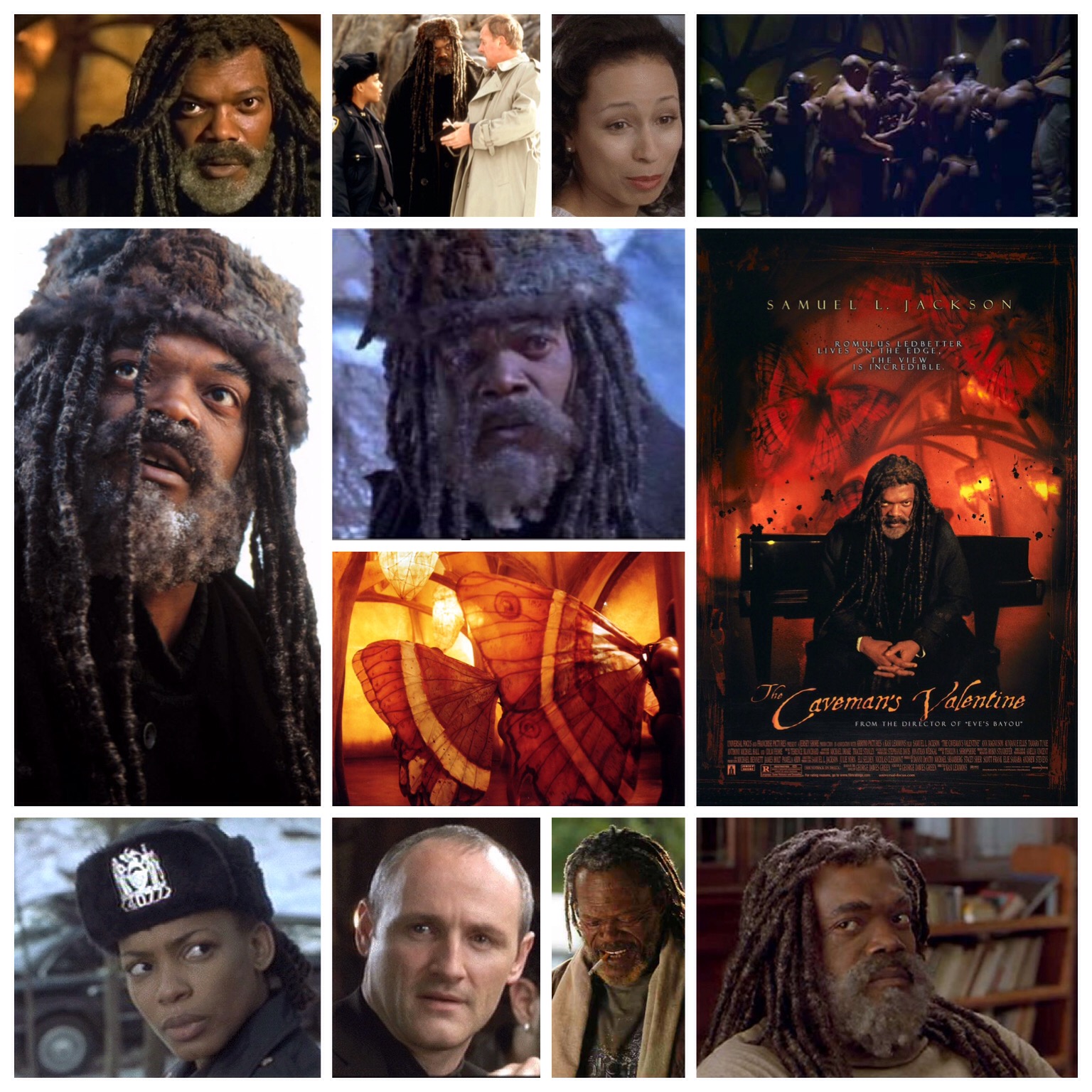
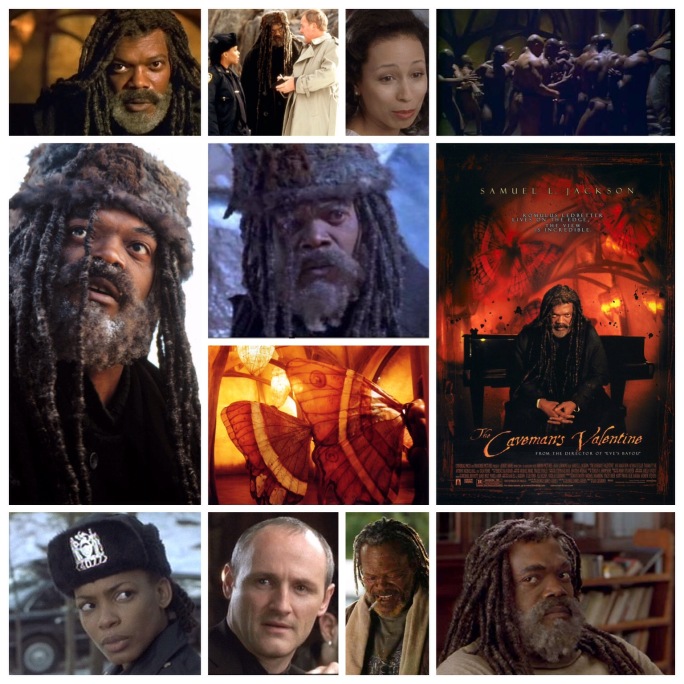
 The Caveman’s Valentine has always fascinated me. As someone who has a mental illness, I’ve always tried my best to seek out films that portray such conditions in a respectable, inquisitive and enlightening tone. While this one cushions it’s earnestness with a slightly lurid and generic murder mystery, much of its desire to explore its character’s inner mindset shine through superbly and with much more authenticity than other films that try the same. Unless you suffer through, or have some intimate experience with someone like this protagonist, it’s tough to artistically represent their state. This one manages very well, and Samuel L. Jackson gives one of the most memorable, affecting and curiously overlooked performances of his career so far. Jackson is an actor who almost always gets cast in assured, authoritative roles. Here he portrays exactly the opposite of that as Romulus, a severely schizophrenic man who lives in a cave in Central Park, New York City. Romulus was once a brilliant pianist and a student at Juilliard, before his illness cut his career and personal life painfully short. He spends his days in confusion, raving in delusion about an all powerful man named Stuyvesant who secretly manipulates everyone in the city. When a young man is found murdered near his cave door, he feels an internal compulsion to find out what happened to him. As you might imagine, a man with his affliction might not make the most reliable detective, but Romulus tries his best and in between bouts of paranoia he makes his way towards weirdo avant grade photographer David Leppenraub (always excellent Colm Feore) who may have had something to do with the homicide. He also has a daughter (Aunjanue Ellis) who is a policewoman and somewhat resents him through her ignorance, and a wife (Tamara Tunie) who no doubt left, but still speaks to him in segments of his visions. Because his perceptions can’t be trusted, even by himself, it makes it a touch and go plot-line that’s heavily accented by frequent visual detours into his own consciousness, where humanoid Moth Sarefs hauntingly play unearthly instruments. Director Kasi Lemmons is not only a woman, but an actress herself, both traits which I believe lead to a certain intuitive advantage in filmmaking. I absolutely love how she moulds the narrative to patiently linger with Romulus’s perception of events and never make them sensationalistic or rushed. Even though Romulus walks through a dangerous, real world story of murder and corruption, the film always sticks with his childlike, abstract and very intangible internal view of the world, a choice which most films either don’t possess the courage or aren’t allowed to do. Jackson is subtle, complex dynamite in what is for me the best work of his career, playing completely against type and most definitely the opposite of his usual instincts to give us something truly special, to any viewer who wishes to exhibit the same patience and understanding that the filmmakers have strived for in making this unique piece. 

Summer Love, aka Dead Man’s Bounty: A Review by Nate Hill

image

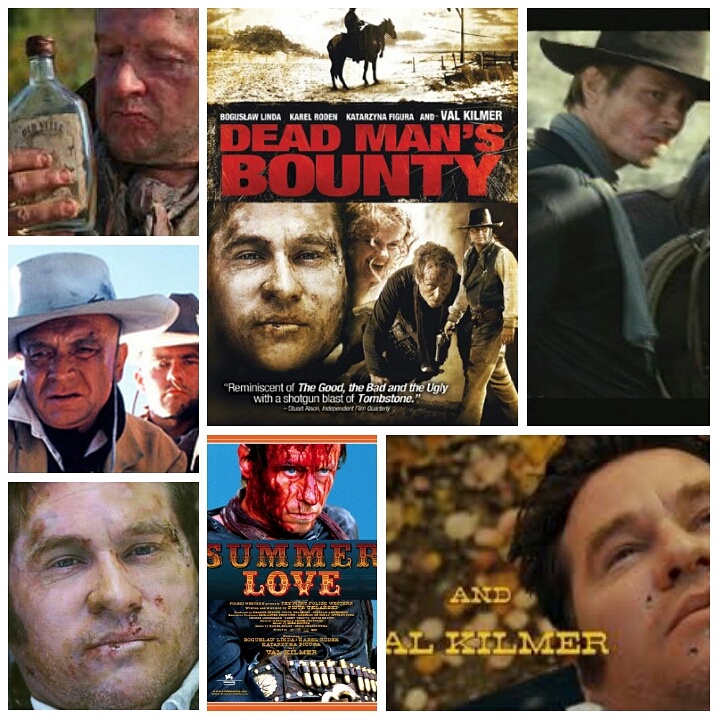
Ever wish there was a movie where Val Kilmer plays a dead corpse? Like…the whole movie? Well you’re in luck, because in Summer Love he does just that. It’s funny because there aren’t even any flashbacks, any death scene or any instances where he’s alive. He’s just a dead body for the whole. friggin. movie. Now you might think what an lazy, pay cheque collecting half ass move, but let me assure you that shit isn’t easy. I’ve played a corpse in films for maybe minutes at a time after I’ve bee killed, and that was bad enough. Thinking about having to lie still and do that for an entire film gives me hives. So kudos to Val who sticks through it like a champ, spending every frame all rigor mortis-ed up and dead as disco. The film was released in North America unde the dvd title ‘Dead Man’s Bounty’ a decidedly more genre title than Summer Love, which is all part of an effort to label it as a violent action western. It’s It’s a western, alright and it’s plenty violent. But action? No sir. It’s slower than the service I get at McDonald’s and very, very European. Most of the actors besides Kilmer are Polish, kind of like Eastwood waltzing around with a bunch of Italians in a spaghetti western. I guess the term for this one would be perogy western. The lead actor is actually Czech, the ever awesome Karel Roden, playing a perpetually wounded and apparantly mute gunslinger who arrives in a dinghole of a town with Kilmer’s body, looking to collect his bounty. The town is a sour, miserable, derelict place, populated by bad tempered, booze gulping men, and one much abused whore (Katarzyna Figura). The sheriff (Boguslaw Linda) is a stumbling, incapable drunkard whose first thought is to rob anyone who passes through his town. Roden silently navigates this cesspool outpost, keeping Kilmer near and his guns at the ready. Not much actually happens in the film, mostly everyone just sits around drinking and mumbling incoherently to themselves in tones that no doubt sound poetic to their heavily inebriated minds. The whore gets slapped around a whole lot which will no doubt put some viewers off, if they aren’t already asleep. The ‘Summer Love’ title comes from the chorus of a song which is played in an opening sequence that proves to be one of the few sparks of life in this fairly dead affair. Kilmer’s trademark peppiness is nowhere to be found because… well… he’s a dead guy, and the rest of the cast are basically drunk western zombies who have all lost their scripts. Morbidly fascinating, never enjoyable, startlingly bad.

Tony Scott’s Beat The Devil: A Review by Nate Hill


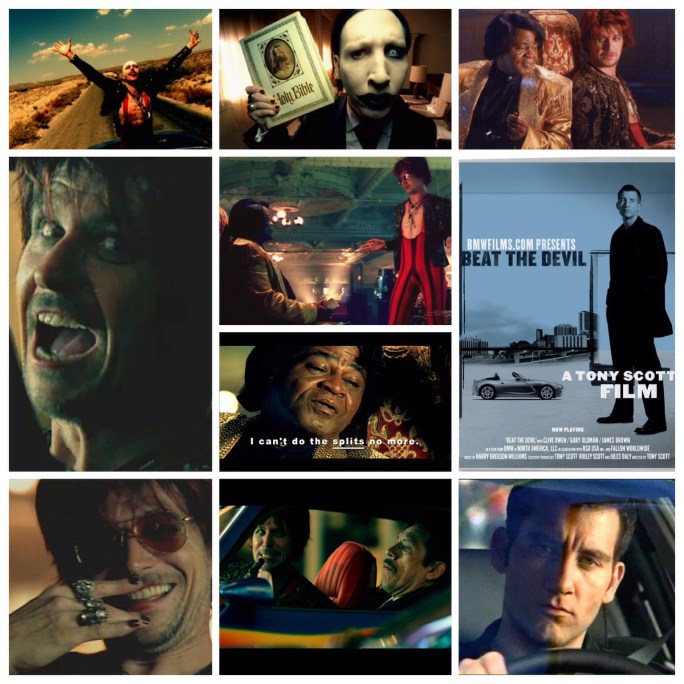
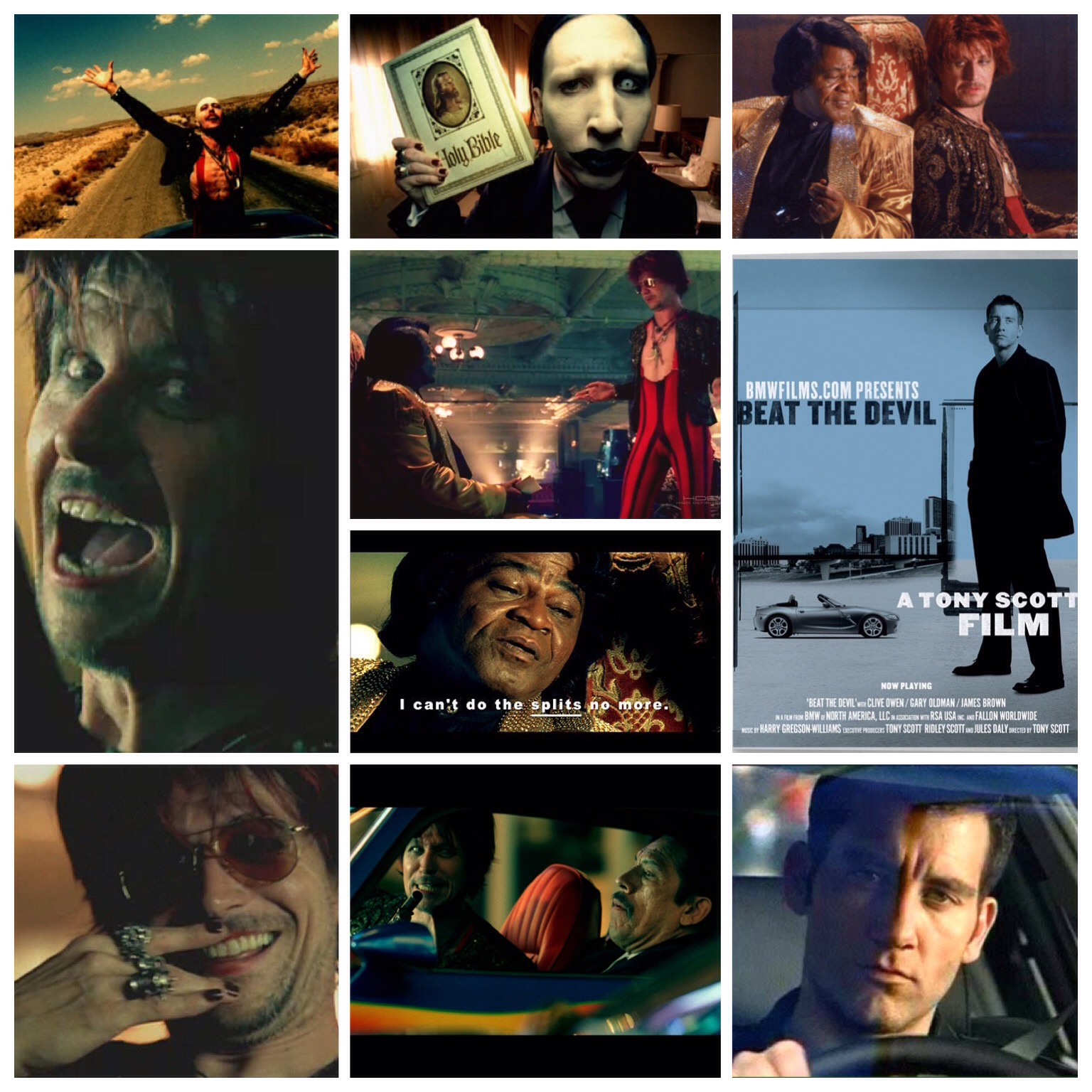
Tony Scott’s Beat The Devil is one part of a multi episode series of promotional short films called The Hire, themed around, and sponsored by BMW. An unbelievable amount of acting heft and prolific directors were brought in to make these, including Scott, Joe Carnahan, Alejandro Gonzales Inarritu, Guy Ritchie, Ang Lee and more. They’re all wonderful and different in their own way, but Scott’s is my favourite of the bunch hands down. From the eclectic cast, all having a blast, to the sheer kinetic momentum and adrenaline soaked velocity of the stylistic direction, it’s pure moviemaking. Tony Scott’s very distinct and polarizing visual aesthetic rears its beautiful head here for a literal crash course which would go on to emerge from the chrysalis and fully spread its wings in the director’s two best films, Man On Fire and Domino. This one is a delicious little treat and obvious precursor to those. The story is fable in nature, starring James Brown as himself (!), pining about his old age. He hires the 007 sequel Driver (Clive Owen, stars in every one of these films, drives a BMW all the time and ties them all together), who takes him to Las Vegas to see The Devil (Gary Oldman, who else), who he sold his soul to decades earlier for fame and fortune. Brown wants to renegotiate the terms of contract, or simply put. Wants to live as a youth longer. Oldman is a sight to see, adorned in crimson lipstick and all manner of kitschy wardrobe numbers, a flamboyant debutant who acts like a Dr. Seuss character in drag. He makes a deranged proposal: the two of them will race the Vegas strip at dawn, Owen against Devil’s driver Bob (a deadpan perfect Danny Trejo). If Brown wins, he gets an extension on life and youth. The race is pure Tony Scott, a commotion fuelled superstorm of breakneck editing, colours flying off the saturation charts proudly and auditory assault as only the guy can craft. It’s the most fun out of the Hire series, careening along on its own delirious and joyful reckless abandon. Watch for a priceless cameo from Marilyn Manson as well.

THE TRANSFORMERS: THE MOVIE – A REVIEW BY J.D. LAFRANCE

Tftm1986e

Before Michael Bay decided to piss all over our nostalgic memories of The Transformers cartoon with his live-action monstrosities, there was a feature-length animated film that for all of its clunky animation and cheesy, dated soundtrack is better than the entirety of Bay’s series of movies. For those of us who grew up watching the cartoon every day after school in the early 1980s, the movie came as quite a shock. Most of us, at that early, impressionable age, were unprepared for the much darker tone and the increased level of violence, including some of the show’s most popular and beloved characters getting quickly killed off in the first few opening scenes. The Transformers: The Movie (1986) was a commercial and critical failure but went on to develop a strong cult following among fans.

It is 20 years into the future (making it, at the time, 2005!) and the war between the Autobots (a race of good transformable robots) and the Decepticons (their evil counterparts) continues to rage. The Decepticons have taken control of the transformers’ home world of Cybertron. The Autobots are planning to retake the planet but need to get more energy from Earth in order to do so. Unfortunately, the Decepticons learn of these plans and their leader Megatron (voiced by Frank Welker) intercepts the ship headed for Earth with the intention of launching a sneak attack on the Autobot’s base. Unbeknownst to the Autobots and the Decepticons, a planet-sized transformer named Unicron (Orson Welles) is devouring entire planets to feed its insatiable desire for energy. Only the Matrix of Leadership, housed in Optimus Prime (Peter Cullen), leader of the Autobots, can stop him.

The dark tone of the movie is set right from the prologue, which features Unicron mercilessly destroying an entire planet of transformers. No one is spared. We even see one escape pod almost make it before getting sucked into Unicron’s massive, gaping maw. For kids used to the relatively tame television series this sequence came as quite a surprise. This was nothing compared to what came next as soon afterwards the Decepticons ambush a ship carrying several Autobots that are quickly and casually killed off! It was one thing to see anonymous characters with nothing invested in them be destroyed but it was something else entirely to see characters we had grown to like on the series dispatched so suddenly and coldly. These deaths do raise the stakes considerably as if the filmmakers were making a statement that all bets are off with this movie – any character, no matter how beloved, is fair game.

Clearly the powers that be (i.e. the toy company) meant to clear the decks for a new generation a.k.a. a new line of toys for kids to buy but I think they underestimated just how profound an effect all these deaths would have on their audience. This culminated with the death of Optimus Prime – the most popular transformer. Not since Darth Vader cut down Obi-Wan Kenobi in Star Wars (1977) had the death of a heroic character been so traumatic for its fanbase. At least Prime got to go out in style with an epic one-on-one slugfest with his nemesis Megatron. For kids at the time, it was an emotional moment because we cared about Prime. His death scene, in particular, had gravitas and meant something to the fans of the show. This is something that the Bay movies never were able to replicate with their multi-million dollar budgets.

Another memorable aspect of the movie is the scope and scale. Where the T.V. show’s action was largely confined to Earth, the movie opens things up by introducing other worlds and races (even if they are all transformers). And so we are presented with the Planet of Junk, one of the more fascinating additions to The Transformers universe. It is inhabited by the Junkions and their leader Wreck-Gar who speaks in T.V. clichés mainly derived from advertisements. In an inspired bit of casting, he is voiced by Monty Python alumni Eric Idle. Their world is a metallic compost heap masquerading as a planet and rather fittingly their theme song is performed by none other than Weird Al Yankovic. This race of robots provides a much-needed moment of levity in what up to that point had been a very dark film.

The battles are also bigger and more intense as Unicron transforms into an enormous robot that attacks Cybertron but this almost pales in comparison to the intensity of the epic battle between Optimus Prime and Megatron that left many fans shocked by its outcome. No one was prepared for what went down and the film never quite recovers from this moment. Speaking of gravitas, who better to play a transformer the size of a planet than Orson Welles, the brilliant filmmaker who made Citizen Kane (1941)? His digitally augmented voice has the dramatic weight befitting the scale and power of Unicron. The filmmakers needed a formidable actor to play a formidable character and they found their ideal candidate in Welles. This gig would be his last and he died five days after completing his work from a heart attack.

One of the things that dates The Transformers movie the most is its soundtrack of awesomely bad generic ‘80s hair metal, complete with the show’s cool theme song redone by Lion. Most memorably is Stan Bush’s “The Touch,” which went on to be hilariously immortalized in Paul Thomas Anderson’s Boogie Nights (1997). The one song that acts as a crazy counterpoint to this bloated arena rock is Weird Al Yankovic’s theme for the Junkions, “Dare to Be Stupid.” His goofy, non-sensical lyrics (anticipating Beck by a few years and actually goofing on Devo) are perfect for this absurdist, almost Dada-esque race of transformers.

After the first two seasons of the television show, toy company Hasbro wanted to eliminate many of the characters and introduce a new line. Season three would feature several new characters and the feature film would make that transition. Toy lines are discontinued for new ones and so the dilemma facing the screenwriters of the movie was how to make this transition seamlessly. According to story consultant Flint Dille, “So, we had this one scene where the Autobots basically had to run through a gauntlet of Decepticons. Which basically wiped out the entire ’84 product line in one massive charge of the light brigade. So whoever wasn’t discontinued, stumbled to the end.” The scene didn’t quite play out that way but over the first third of the film, several of seasons one and two characters were killed off. Not surprisingly, it was Hasbro that dictated the story of the film, “using characters that could best be merchandised for the movie. Only with that consideration could I have the freedom to change the storyline,” said director Nelson Shin in an interview.

The Transformers: The Movie
’s pacing is fast and furious with never a dull moment – perfect for kids with short attention spans and actually works in its favor as any narrative fat is trimmed, packing a lot of action into its running time (again something the live-action films failed to realize with their bloated lengths). While I don’t know if the movie exactly lives up to its poster’s tag line, “Beyond good. Beyond evil. Beyond your wildest imagination.” It was a pretty mind-blowing experience for this impressionable youth back in the day. So, I come at this movie now with nostalgic baggage in tow, unable to really look at it objectively. I can only imagine what kids of today think of it now. Sadly, they probably don’t even know/care of its existence having been bombarded by the Michael Bay movies, which is too bad because they lack the imagination, the ambition (which are largely earthbound while the animated film takes place mostly in outer space) and the substance that makes The Transformers: The Movie by far superior. Plus, I’d take the likes of Stan Bush and Lion over the bland nu metal stylings of Linkin Park any day.

MELANIE LAURENT’S BREATHE — A REVIEW BY NICK CLEMENT

3

I don’t want to oversell Melanie Laurent’s brilliant psychological thriller Breathe (Respire). It’s 85 minutes of cinematic perfection. There isn’t one bad scene or false moment. It’s a slow-burn first two acts which give way to some shattering developments by the finale. I wasn’t prepared for this film, how emotionally hard-hitting it would be, or for how stylish on a cinematic level it would get. This is a gorgeous film that was shot with a painter’s eye; cinematographer Arnaud Potier is now firmly on my radar. Released in France in 2014 and based on the novel by Anne-Sophie Brasme, Laurent and Julien Lambroschini handled the scripting adaptation, and while I can’t claim to be familiar with the source material, what they’ve put on screen is piercing, troubling, sexy, and fascinating on numerous levels. Starring Joséphine Japy and Lou de Laâge as two high school seniors who unexpectedly fall into each other’s orbits, the film operates as a smart and savvy mix of Blue is the Warmest Color and Fatal Attraction, and because of how delicate the entire piece is, I’m reluctant to reveal much more about the plot. What I will allow is that Laurent’s film is thematically rich, poking at the social norms and constructs of the modern high school setting, the many layers of friendship, obsession, and emerging sexuality, while toying with preconceived genre expectations in all the best ways. The two lead performances are tremendous, totally different from one another, and dependent on each other’s abilities in ways that two-handers like this really need to pounce on. Supporting performances are all top notch, there’s a Malick-esque vibe to some of Potier’s striking visuals along with some expertly judged stedicam work and slow-motion techniques, and the final scene is one that you’ll never, ever forget. Had I seen this film during the year of its initial release, it probably makes my top 15. Breathe is available as a DVD rental via Netflix and as a streaming option on Amazon.

2

Wrong Turn At Tahoe: A Review By Nate Hill

  
I’ve been ragging a lot on Cuba Gooding Jr. The past few reviews, so I’ll go easy and speak about a good one instead. Wrong Turn At Tahoe has a script that should have been given the royal treatment; it’s wise, brutal, thought provoking and very violent, with many sets of morals clashing against each other in true crime genre style. It didn’t get a huge budget or a lot of marketing, but what it did get was a renakably good cast of actors who really give the written word it’s justice, telling a age old story dangerous people who inhabit the crime ridden frays of both society and cinema. Cuba plays Joshua, a low level mafia enforcer who works for Vincent (Miguel Ferrer), a ruthless mid level mobster who runs his operations with an OCD iron fist. He also rescued Joshua from a crack house when he was a young’in, forging a father son bond that runs deeper than terms of employment. When a weaselly informant tells them that local drug runner Frankie Tahoe (Noel Gugliemi, reliably scary) has it in for them, Vincent brashly retaliates first by viciously killing him. That’s where the shit starts to get deep. Frankie was an employee of Nino (Harvey Keitel) that most powerful crime boss on the west coast and not a man to cross. Nino Wants hefty payment for the loss of Frankie, who was a good operative. Vincent, being the proud and belligerent son of a bitch that he is, bluntly refuses. So begins a bloody, near Shakespearean gang war in which both sides rack up heavy losses and the phrase ‘crime doesn’t pay’ collects it’s due. All parties were inevitably headed to a bitter end whether or not the Tahoe incident occurred, and I think the writer simply used that inciting incident as an example of many ways in which a life like that will always end up at a dead end. The writing is superb, especially for Gooding, Keitel and Ferrer, a vicious triangle indeed, all at the top of their game and then some. Johnny Messner is great as Gooding’s cohort who can’t keep his mouth shit, and watch for Mike Starr, Leonor Varela, Paul Sampson and Louis Mandylor too. Dark deeds, unexpected betrayal, self destructive ego, combustible machismo and ironic twists of fate are explored here in a script the remains as one of my favourite of that year. Really excellent stuff. 

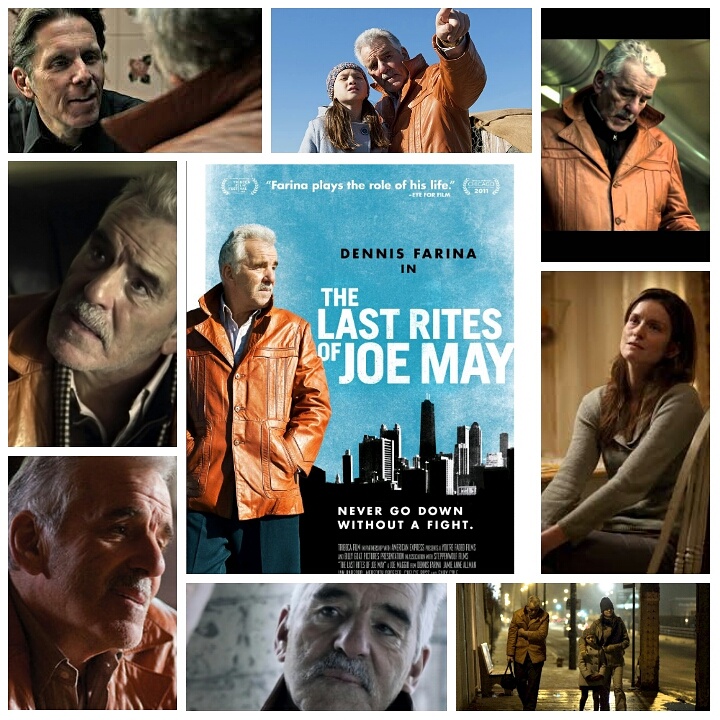
The Last Rites Of Joe May: A Review by Nate Hill

image

The Last Rites of Joe May is Dennis Farina’s bittersweet swan song, his final exodus from a long, epic and beloved career, showcasing the actor in the role he was always meant to play, and a lead role no less. He did a few other films after this one and a priceless cameo on Family Guy, but this is the spiritual final entry, and when you look at the story of the film, it’s both eerie and fateful that the man would go on to pass away just a few years later. He plays Joe May here, a Chicago wiseguy and short money hustler who has been in the hospital with pneumonia for almost a year. Upon returning to his borough, he finds his apartment rented out to a woman (Jamie Anne Allman) and her daughter (Meredith Droeger), all his belongings sold, and his presence pretty much forgotten, with some even under the belief that he has died. The woman takes pity on him and let’s him stay in his apartment with them if he helps her out, and he goes back to the same hustling, or at least tries too. All his ventures have gone dry, his former boss (a splendid Gary Cole) giving the cold shoulder. Joe starts to realize that one must face the eventual consequences of a life lived in selfishness and foolhardy actions, as he finds himself alone in the world and shunned even by his own son. He gets a shot at redemption upon having the little girl in his life, and being there to help out her mother who has one lowlife monster of a boyfriend that just happens to be a cop. Farina is sensational in every scene, and it’s a shame the guy didn’t ever get more lead roles. He makes Joe a grim yet sympathetic being who serves as a sorrowful reminder of how we all will arrive at the end of our road someday, and how important it is to line said road with good deeds, kindness, respect and worthwhile ventures, even if they only show up in the last few miles of it. This is a Tribeca festival film so it’s tough to find, but anyone with a love for Farina or simple, well told and emotional stories should definitely check it out. The beautiful piano score adds to the loneliness of Joe and his state of mind, as does Farina’s performance which a a gift to filmgoers and contains see of the hardest work and piercing truth I’ve ever seen from the guy. RIP.

MICHAEL BAY’S 13 HOURS — A REVIEW BY NICK CLEMENT

3

Michael Bay is back. Potentially forever lost to giant toy movies (which certainly have all had their moments of gee-whiz visual insanity), he’s stepped up and made an uncompromising modern combat film with 13 Hours. Smartly avoiding any overt political specifying or sketchy speculation, Chuck Hogan’s battle-ready screenplay, based on Mitchell Zuckoff’s book, is all forward momentum, focusing on the harrowing and desperate efforts of six American private military contractors who leapt into action when a United States diplomatic compound in Benghazi was attacked by terrorist insurgents on September 11, 2012. Captured with Bay’s always spectacular sense of bravado, heroics and adventure, this is a grab you by the throat action picture, violent and sad and upsetting, never diluted by extraneous side plots or unnecessary digressions, all made more robust by the surprisingly thoughtful contextualization of the enemy and the local people of the area. The extra-macho cast includes the movie stealing James Badge Dale who completely dominates with a tough as nails performance, a surprisingly effective John Krasinski, the terrific Pablo Schreiber, Max Martini, Toby Stephens, David Denman, Dominic Fumusa, Freddie Stroma, and Alexia Barlier. The opening act and closing moments might’ve been a bit tighter, and some of the spoken dialogue is a tad corny in spots, but these are very minor quibbles, as this was a movie designed for maximum sensory force and extreme visceral impact, made by a filmmaker who seemed liberated to be working in a more decidedly adult arena.

2

Dion Beebe’s powerhouse cinematography is nearly hallucinatory at times, conjuring up images that are absolutely tremendous, while emphasizing spatial geography in nearly every instance, putting you smack-dab in the middle of one ferocious fire-fight after another with striking clarity. You’ve seen plenty of war films but not one done by Bay in this particular fashion, and it’s clear that he took notes from Black Hawk Down and Lone Survivor and other recent genre entries that have demonstrated a single-minded obsession of detailing bloody, terrifying sequences of wartime violence. The lucid and precise editing by master cutter Pietro Scalia (Black Hawk Down) only further ratcheted up the suspense, dread, and excitement. Lorne Balfe’s on-edge musical score highlights triumph where needed but mostly uses somber, almost mournful ambient sounds to give the film an added sonic pulse. One set-piece in particular, featuring a group of mercenaries taking refuge in a heavily armored Mercedes SUV that comes under fire from every direction, ranks as some of the best on-screen firepower that Bay has ever delivered, to say nothing of the overwhelming final blasts of rooftop fighting, with one particular on-screen injury ranking as one of the gnarliest I’ve seen. And that’s saying something. I’ve always been a fan of Bay’s distinct brand of visual mania, and this is the hardcore action picture I’ve been waiting to see from him for a very, very long time.

6

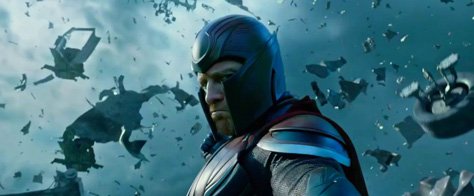
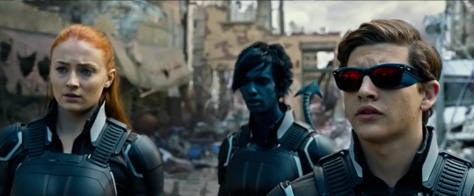
X-MEN: APOCALYPSE – A Review by Frank Mengarelli

X-MEN APOCALYPSE completely forgoes and abandons the immense promise we were given with DAYS OF FUTURE PAST. The entire film is a bloated and dull calamity. It is misguided at every turn. The direction, poor writing, and uninspired performances lead us to yet another third X-Men film that unintentionally tries it’s hardest at undoing the smart entertainment from its former two films.

XA2.jpg

The setup, is yet another rehash of the idealist Professor X uniting with his former best friend and now arch nemesis, Magneto, to save humanity from yet another unstoppable force.  There is little to like about this film. Evan Peters as Quicksilver is the best part, but even his slow-motion scenes become a mundane walk-through. Hugh Jackman shows up in a forced and out of place cameo that leaves you wishing he wasn’t even in the film.

XA3.jpg

Unlike the previous two X-Men prequel films where each story capitalized on it’s time period, APOCALYPSE does absolutely nothing to remind us that this film takes place in the 80’s aside from Jean Grey having shoulder pads and a trio of them seeing RETURN OF THE JEDI.  There is not any character progression for an of the existing characters, or any of the new ones.  They just exist.XA

FIRST CLASS wasn’t a great film, but it built a solid foundation for the epic and remarkable DAYS OF FUTURE PAST that brilliantly and organically rebooted the entire X-Men franchise. This new film completely squanders the fresh start we were promised. I loved DAYS OF FUTURE PAST, but pertaining to X-MEN APOCALYPSE, there ain’t nothing good about this shit at all.