SHANE BLACK’S THE NICE GUYS — A REVIEW BY NICK CLEMENT

1

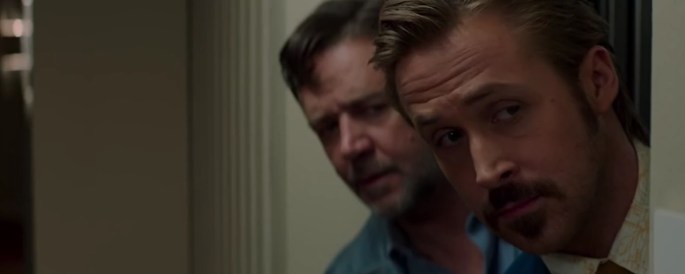
Shane Black’s The Nice Guys is an extremely entertaining throwback to the 80’s buddy-cop film, but switch out cops for bumbling private detectives, and add a dash of 70’s-flavored aroma to the cinematic atmosphere. Starring the improbably perfect pairing of Ryan Gosling and Russell Crowe as mismatched partners who start the film as enemies but learn to love each other by the end, the film has a rough-house vibe with Black’s usual smart-assed sense of humor on full display. Add in a dash of Freebie and the Bean inspired vehicular mayhem (LOVE the opening bit with the car vs. house!), a seedy porno element, copious use of casual vulgarity, a funkadelic soundtrack, some lively and bloody (but never gratuitous) shoot-outs, and a sprinkling of nudity – it’s all so Shane Black and I love it. He’s got a way of adding unique character bits to the smallest of supporting players, and his two big leads get some serious zingers while displaying layered character backgrounds that help to add to the tonal richness of the piece. Gosling in particular seems to be having a ball with the comedic elements, even riffing on classic Abbot and Costello material. I love how the film mixes tones all throughout, and while the stakes are high, you know that it’ll all end comfortably. Crowe looks like he gained 50 pounds of fat and his laconic delivery is well suited to his character’s brutish tendencies. The two actors have genuine chemistry with one another and it’s a pleasure to watch them interact.

2

I am not going to attempt to summarize or potentially spoil the shaggy-dog plot, but it sort of reminded me of elements of The Big Lebowski, where the almost tangential A-story continues to escalate in craziness, while all of these interesting characters walk in and out of the twisting narrative. There’s a careening sense to the physical action which was also really enjoyable, especially during the big, raucous set piece at the film’s mid-section, a debauched porn-party at a glitzy mansion in the hills that turns into a shooting gallery. The film looks fabulous thanks to master cinematographer Philippe Rousselout (Big Fish, The People vs. Larry Flynt) calling the shots behind the camera, and the pace is zippy due to the crisp editing by Joel Negron. The widescreen images have been purposefully altered to suggest the haze and grime of late 70’s Los Angeles, all smoggy and brown and gold and amber. Too many comedies aren’t creatively thought out on a photographic level, and because Black cares about this side of filmmaking, his witty script compliments his great sense as a visual storyteller. A great ensemble cast is along for the ride, including Kim Basinger (still smoking hot), Keith David, Matt Bomer, the alluring Margaret Qualley, and the excellent Angourie Rice as Gosling’s mischievous daughter, which is one of Black’s classic movie staples. My only question: Why didn’t he set this film during the Christmas holiday?

3


THE NICE GUYS: A Review by Joel Copling

Rating in Stars: *** (out of ****)
Cast: Russell Crowe, Ryan Gosling, Angourie Rice, Matt Bomer, Margaret Qualley
Director: Shane Black
MPAA Rating: R (for violence, sexuality, nudity, language and brief drug use)
Running Time: 1:56
Release Date: 05/20/16

One man is a bouncer of sorts, hired by contract to threaten or coerce physically those who terrorize his clients. The other turned private investigator following a tragedy that left him a single father to his daughter. The Nice Guys, as written by Anthony Bagarozzi and director Shane Black, is the buddy comedy of contradictions in which these two men are the co-leading protagonists. That isn’t a complaint. If the second man’s character history is largely left a blank space to be filled by the viewer, the first man’s must be played as a joke. If a running gag is that the case they have been hired to investigate results in an increasing body count, at least one of the deaths that occur needs to shake up the tone a bit. If the daughter is introduced to be a less bungling detective than her father and his new partner of a sort, the film needs to introduce her to real danger to justify the choice.

The actors filling these two major roles are crucial to the roles’ success. Russell Crowe is Jackson Healy, the hired hit-man, in the literal sense of the term, whose marriage ended as a result of some surprising infidelity on his wife’s part (That’s the joke part of his character’s set-up, and it’s a good joke). Since then, he’s dedicated his life to making the lives of half the people he meets better by making the other half pay for their trouble. Healy wears brass knuckles as a form of wedding ring and lives above a bar. Crowe’s performance is the clever “straight man” to his co-star, relatively speaking, weaving a story involving a diner that is one of the few high points in his life, but he has solid comic timing, too (a surprise for an actor who usually chooses those roles that stretch how far he can grimace).

Ryan Gosling is Holland March, the former cop who is now a detective on his own payroll asked to investigate the silliest things. One woman asks him to find her husband, and one glance to his left tells March that the man has not only died but been cremated. It’s a sometimes thankless job, and March occasionally calms down by drinking whatever he can whenever it is possible. Gosling is fantastic here as a whirlwind of unpredictable features and a source of great physical comedy (such as when he tries to act tough while in a precarious position during a bodily function). His daughter Holly (Angourie Rice, very good in her first and certainly not last performance of any real significance) is a Nancy Drew type, having inherited her father’s gift for observational technique.

The plot runs in circles, presenting a series of red herrings and a MacGuffin to give us a case of the usual odd mystery. A popular actress of adult-film legend has died in an over-the-top and messy car crash, and another, the daughter (Margaret Whalley) of the head of the Department of Justice (Kim Basinger), has gone missing. The pieces of the mystery are odd, but the particulars of them are only vague for the intention of hiding a fairly obvious motivation involving politics and corruption (A particularly lazy scene involving a character acting ostentatiously suspicious further undermines any attempt at suspense). Nevertheless, we get an assembly line of memorable tertiary characters, such as an assassin (played by Matt Bomer) with a curious nickname and cold, blue eyes or a couple of henchmen (played by Keith David and Beau Knapp) who have the misfortune of getting on Healy’s wrong side.

It’s all very funny, with few elements interrupting Healy and March’s repertoire. The dialogue is as punchy as Healy’s choice of profession, with more lines to quote than can be counted on two hands (Highlights include a scene involving a protest group who didn’t fully think through their use of an apparatus, March’s literal stumble into two major developments in the case while so drunken his speech is slurred, and a hallucination during a potential race to the finish line). Few real surprises for that case are in store, and the end of the movie brings not much more than a shrug where that is involved, but other surprises, such as Holly’s able response to danger or Healy’s unexpectedly complex methods of intimidation, allow The Nice Guys to elevate itself above its familiar trappings. It may not be new, but it acts like it is and has the go-getter attitude to prove it.

PTS Presents WRITER’S WORKSHOP with NATHAN ZELLNER

ZELLNER POWERCAST.jpg

ZellnerPodcasting Them Softly is excited to present a chat with the multitalented filmmaker and actor Nathan Zellner. Nathan co-wrote and produced the film Kumiko The Treasure Hunter with his brother, David, who handled the direction, which was one of our favorite films from 2015. It’s truly the sort of under the radar gem that Podcasting Them Softly was founded upon, and it confidently announced to the both of us a very distinct cinematic voice. Nathan has done TV work, a plethora of short films, a variety of features, and has preformed numerous times in front of the camera as well as taking on occasional cinematography and editing duties, with excursions into directing and visual effects. The quirky short Sasquatch Birth Journal #2 is a hysterical piece of surrealism that everyone should check out, you can view it at YouTube, and he made a hilarious supporting turn in the quirky comedy Goliath, which was written and directed by his brother, and happens to contain one of the best performances by a cat ever committed to film. We hope you enjoy this exciting conversation with one of the more unique cinematic voices we’ve heard from yet!

REALITY BITES – A REVIEW BY J.D. LAFRANCE

tumblr_nafg91N3AK1qdnfkpo1_1280

The early to mid-1990s was a period of time when popular culture was dominated by Generation X, from films like Richard Linklater’s Slacker (1990) to Douglas Copeland’s book, Generation X to the massive popularity of Seattle music spearheaded by Nirvana. During this decade three films were made that provided a fascinating spectrum of how this generation was depicted. On one end, there was Linklater’s low-budget independent film. On the opposite end there was the glossy, studio picture Reality Bites (1993). Somewhere in between was Singles (1992), which shared the big studio backing of Reality Bites but with the authenticity of Slacker.

I can remember when I first saw Reality Bites, I hated it. I had recently seen and was blown away by Slacker, which felt so authentic. In comparison, Reality Bites tried in vain to capture the essence of Gen-X, but came across more like an episode of Friends. Slacker presented everyday settings with realistic, albeit eccentric people, warts and all, while Reality Bites introduced perfect looking people with perfect problems. Now that some time has passed and the whole Gen-X thing has died down, I see Reality Bites in a different light now. When I think of the film, I think of the videos for “Stay” by Lisa Loeb and “Spin the Bottle” by Juliana Hatfield – the two big singles to come off the soundtrack album. Back in the day, it seemed like those two songs were everywhere. The film is still lightweight material but it has a more nostalgic vibe now as a dated piece of mainstream ‘90s culture. It’s a pretty decent snapshot of that time and reminds me a lot of what I liked about the decade.

Reality Bites
also features one of my favorite performances of Winona Ryder’s entire career. She had just come off making several period piece films and was clearly looking to do something contemporary, something that spoke to her generation. She used her star power to pluck an unknown screenwriter out of obscurity and, with the help of Ethan Hawke, got the film made where it would normally have languished in development hell for years. However, Reality Bites was seen as and marketed as a Gen-X film and its supposed target audience wasn’t interested in seeing their lives and interests writ large in a mainstream commercial film. It underperformed at the box office but has since gone on to develop a sizable following. I don’t want to say cult following because it isn’t that kind of film but it does have its fans.

Reality Bites
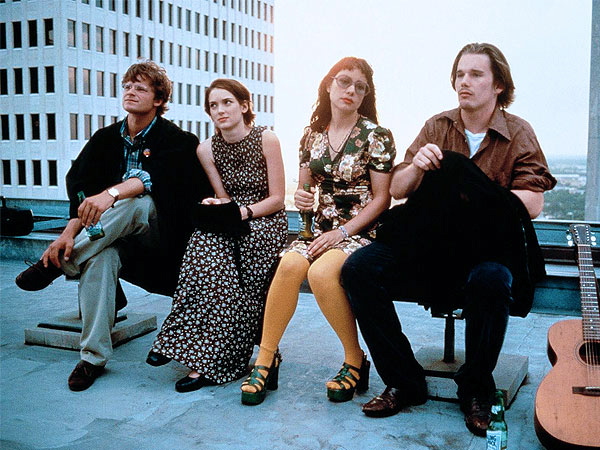
is about four college graduates dealing with life after school as they try to figure out what they want to do with the rest of their lives. Vickie (Janeane Garofalo) works as store manager at a local Gap. Sammy (Steve Zahn) is trying to figure out a way to tell his conservative mother that he’s gay. Troy (Ethan Hawke) is a struggling musician. Lelaina (Ryder) aspires to be a filmmaker and chronicles the ups and downs of her three friends for a documentary about her generation.

Lelaina, like her friends, is a child of divorce and her parents (Swoosie Kurtz and Joe Don Baker) want her to get a regular 9-to-5 job so that she can become a productive member of society. To pay the bills, she works as an assistant/gofer for a morning television talk show called Good Morning Grant! where she caters to the whims of its obnoxious host (played with two-faced gusto by John Mahoney). She’s roommates with Vickie and their friendship is summed up rather nicely in a scene where we see them singing along to Squeeze’s “Tempted” in Lelaina’s car. Who hasn’t done that with their friend(s) at some point in their lives? I don’t mean necessarily to that song but to music in general.

One day, she literally runs into Michael Grates (Ben Stiller), an executive at MTV wannabe, In Your Face TV, when they get into a minor car accident. She finds herself attracted to his inability to articulate a sentence much less a thought and he’s drawn to her nervous, awkward energy. It’s baffling what they see in each other but they’re both young and attractive and start dating. However, when Troy is fired from his day job, Vickie invites him to stay at their place (“Welcome to the maxi-pad.”) until he can find work, much to Lelaina’s chagrin (“That’s the American Dream of the ‘90s. That could take years!”). Me think she doth protest too much (“He will turn this place into a den of slack!”). See, Lelaina has a thing for Troy and he for her but they’re too busy getting on each other’s nerves in a meet-cute kinda way to do anything about it.

Lelaina’s first date with Michael has to be one of the most inarticulate ones ever put on film as they stammer their way through dinner. They each come up with some real gems to woo each other, like he tells her about how Frampton Comes Alive! changed his life while she explains why the Big Gulp is the most profound invention in her lifetime (?!). Maybe these two are really made for each other. As superficial as Lelaina comes across a lot of the time, Winona Ryder, with her adorable presence, keeps me interested and engaged. Away from Michael’s I.Q.-sucking black hole presence, Lelaina seems smarter.

When he’s not spending time pretending he can’t stand Lelaina, Troy writes awful, subpar Beck lyrics and quotes from Cool Hand Luke (1967). While he waits for her to realize that he loves her, he has sex with a succession of not-too bright groupies (one of them is a blink and you’ll miss her, Renee Zwelleger). Vickie also has a revolving door of sexual partners – so much so, that she gets an AIDS test and anxiously awaits the results – her character’s big dilemma that is resolved fairly quickly and a little too neatly.

Ben Stiller, in what was not only his first major acting gig, but also his directorial debut, does a good job of portraying a guy who means well but is so clueless when it comes to things that really matter. He isn’t afraid to come off as an idiot while also hinting that underneath it all Michael does appear to have the best intentions, he just goes about articulating them in all the wrong ways. Troy, on the other hand, is mean-spirited and channels his jealously in vindictive ways, like when he pretends to tell Lelaina that he loves her. The hurt that registers on her face, especially in her eyes, says it all, reminding one of how good a silent actress Ryder could have been if she had acted in another bygone era.

Ryder shows a capacity for comedy in a montage where Lelaina applies for a series of film and T.V.-related jobs featuring brief but amusing cameos by Andy Dick, Keith David, Anne Meara, and David Spade. Watching Ryder try to define irony under pressure always gives me a chuckle as does her interaction with Spade’s condescending burger jockey (“Ms. Pierce, there’s a reason I’ve been here six months.”). She was one of my earliest cinematic crushes and I know I shouldn’t like this film but dammit, she’s in vintage adorable Manic Pixie Dream Girl mode – smart and gorgeous with a vulnerable quality that I find irresistible. Sorry Natalie Portman, Zooey Deschanel and you other Pixie Dream Girls, Ryder is the original – accept no substitutes!

Coming from the world of stand-up comedy, Janeane Garofalo gets some of the film’s funniest lines (“I think I was conceived on an acid trip.”) and delivers them effortlessly like she was born to play Vickie. She also interacts well with Ryder and an even more interesting film would’ve been one where Vickie’s friendship with Lelaina was the focus. Obviously, others thought she had something special and for a brief while, Garofalo flirted with a mainstream film career with The Truth About Cats and Dogs (1996) and The MatchMaker (1997). Out of the four friends the one that suffers most in terms of screen time is Sammy. It often feels like his storyline was reduced so that more time could be devoted to the Michael-Lelaina-Troy love triangle. It’s a shame because Steve Zahn is such a gifted comedic actor with excellent timing and he’s given little to do in Reality Bites.

If I sound a little too harsh on Reality Bites, I don’t mean to be. The film does nail what it’s like to sit around with your friends, get high and comment ironically on old 1970s sitcoms. There is a fun bit where our four friends go out to get junk food and dance spontaneously to “My Sharona” by the Knack. It’s nice to see the normally reserved Ryder cut loose and act goofy. The film’s best scenes are the ones where all four friends are interacting with each other, bantering back and forth in a way that feels authentic and has a relaxed air that only comes from people who have known each other for some time.

In 1991, the producer of The Big Chill (1983), Michael Shamberg wanted to make a like-minded film for people in their twenties. He read Helen Childress’ Blue Bayou, a writing sample from the 23-year-old University of Southern California film school graduate. He liked it and wanted her sample to be the basis for his project. She met with him and told him about her life and friends and their struggle to find work during the recession that had hit the United States at the time. She had used her friends, their personalities and some of their experiences as the basis for her script. Shamberg, along with co-producer Stacy Sher, saw the pilot for The Ben Stiller Show and approached him to direct not act. At the time, Sher and Childress were developing the screenplay and had Lelaina and Troy figured out but couldn’t quite come up a credible character to complete the love triangle.

In February 1992, Shamberg sent Ben Stiller a copy of Childress’ script while he was editing the pilot for a show on Fox. He soon signed on to direct and worked with Childress for nine to ten months, developing her script. He suggested that he could play the third person in the love triangle. Over time, the Michael Grates character changed from a 35-year-old advertising man attempting to market Japanese candy bars in America to a twentysomething executive at a music video T.V. station. Childress and Stiller also changed the structure of the film, with the focus changing to the relationship between Lelaina and Troy while the stories about Vickie and Sammy, which were originally more fleshed out, were scaled back.

Childress and Stiller had a script that could be filmed by December 1992 and began shopping it around to various Hollywood studios all of whom turned it down because it tried to capture the Generation X market much like Singles had attempted to and failed. They finally got TriStar interested and began developing it there. The studio soon put it in turnaround. Childress, Sher and Stiller managed to convince the Film Commission of Texas to fund a location scouting trip to Houston despite no studio backing, no budget and no cast. As they arrived in the city, they got a call and learned that Winona Ryder had read Childress’ script. She wanted to do it and Universal Pictures agreed to finance the film. Coincidentally, Childress had Ryder in mind when she wrote the character of Lelaina.

The previous three films Ryder had made were period pieces and she needed a break. She wanted to do “something about people my age and in my generation growing up in today’s society.” She read Childress’ script while making The House of Spirits (1993) and it made her laugh: “It was very familiar to me – the way they talk, the attitude they have towards each other, the places they go. These were things I could relate to.” It was exactly the change of pace she wanted. At the time, Ethan Hawke’s career was in a rut after the buzz from Dead Poets Society (1989) had subsided. Up to that point, he had been known mostly for playing clean-cut characters and so the role of Troy would be something of a departure for him. Ryder was a fan of Hawke’s work and stipulated in her contract that he would co-star opposite her.

Stiller met Steve Zahn through Hawke as they were doing a play together at the time and was impressed by how funny he was. Zahn borrowed some money from his agent and went to Los Angeles to test for the film. He responded strongly to portraying a gay character coming out of the closet. Janeane Garofalo knew Stiller through their work together on his show and the producers felt that her style of comedy was perfect for the role of Vickie. According Garofalo, it came down to her, Parker Posey, Anne Heche and Gwyneth Paltrow. The studio loved and wanted Paltrow but Ryder liked Garofalo and had developed an instant connection with her.

tumblr_nn20i1aWFx1rkd2bio2_1280Ultimately, Reality Bites plays it too safe and veers dangerously close to being a feature-length sitcom by wrapping things up too conveniently. The characters often come across as superficial which tends to undercut the sincerity of the film’s message. Singles and the hilarious short-lived MTV sitcom, Austin Stories, were much more successful in documenting the trials and tribulations of Gen-X. And yet I’m oddly fascinated with Reality Bites, mostly because of Garofalo and Ryder. They play characters that deserve to be in a better film. I always thought that at the end of the film, Lelaina should’ve dumped both guys and stayed single. I mean, look at her options: Michael is a clueless T.V. executive that listens to generic gangsta rap and Troy is a pretentious wannabe musician that screws around with her emotions. Hell, she should’ve hooked up with Vickie, who is funny in wonderfully sarcastic way and digs ‘70s popular culture in a sincerely ironic way. Despite all of its flaws, I still enjoy watching Reality Bites when I just want to turn off my brain and let a film wash over me – junk food for the mind. Films like that have their place, too.
Robert Redford’s The Company You Keep: A Review by Nate Hill

image

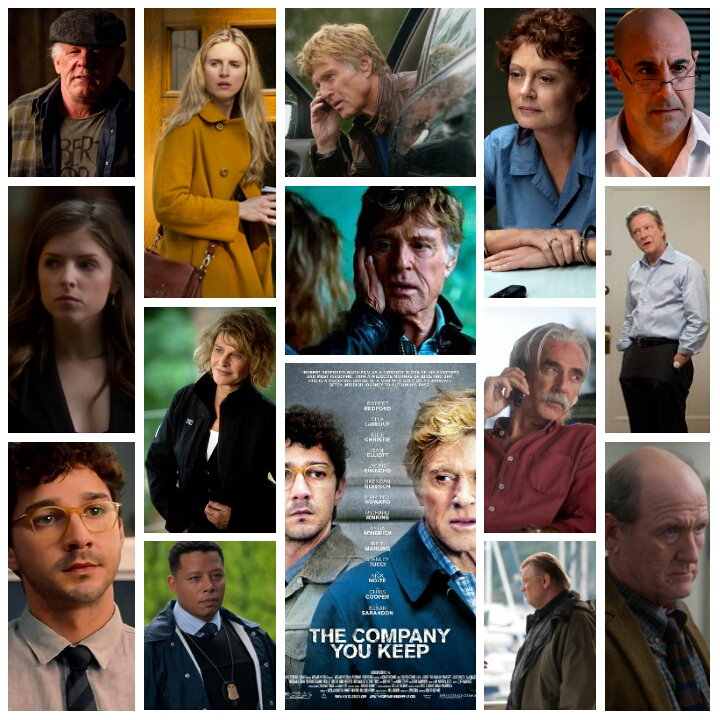
Robert Redford’s The Company You Keep is a powerful, smart, grounded drama revolving around the seriousness of one’s actions, the consequences they may make even decades down the road, and the lengths that some people will go to put things right. Redford has shown only improvement throughout his career, and has been really awesome as of late (All Is Lost was a favourite for me) and he directs here with as much confidence and empathy as he puts into his performance. He plays Nick Sloan, a former underground activist who was involved in a tragic accident as a result of his protesting, and branded a domestic terrorist. He went into hiding for nearly 30 years, until an intrepid journalist (Shia Lebeouf) uncovers traces of his tracks, and he’s forced to go on the run, leaving his young daughter with his brother (Chris Cooper). Lebeouf suspects his agenda is to do more than just hide, and indefinitely stay on the run. A federal agent (Terrence Howard) makes it his tunnel vision mission to find him. Sloan’s agenda only gradually becomes clear to us, as he navigates a tricky, treacherous web of former acquaintances, trying to locate his former lover and fellow activist (Julie Christie, phenomenal in a comeback of sorts). Old wounds are slashed open, the law closes in, and Nick wrestles with the notion that despite the good he tried to do in his idealistic youth, he is indirectly responsible for bloodshed. It’s enthralling to watch Redford play this man in his twilight years trying to put things right, waist deep in decades of acting experience, supported by an amazing script and a supporting cast that you couldn’t dream up . There’s memorable appearances from Stanley Tucci, Richard Jenkins, Brit Marling, Stephen Root, Susan Sarandon, Anna Kendrick, Brendan Gleeson, Sam Elliott, Susan Hogan and Nick Nolte, all in top form. For a thriller that takes itself seriously, takes its time building character and suspense, and sets itself in a realistic, believable tale that completely engrosses you, look no furthe

BEN STEINBAUER’S WINNEBAGO MAN — A REVIEW BY NICK CLEMENT

1

To say that Jack Rebney is a pissed-off guy would be an understatement. For background, go and YouTube the phrase: The Angriest Man in the World. What you’ll encounter are a slew of viral videos all centering upon Rebney, back in the late 80’s, working as a pitch-man for the Winnebago company. During a particularly arduous, steamy-hot, mid-August shoot, Rebney kept screwing up (and cursing up a fuckin’ storm), and all of the outtakes were edited into a reel by one of the editors working on the shoot. The rest is history. What you get is pure and raw and utterly hysterical; a guy coming undone on camera, flipping out repeatedly on both his crew and himself, and even laughing about some of it. The documentary Winnebago Man is part genuflection, part investigation, and all absolutely fascinating and grin inducing. After becoming fixated on the viral videos, newbie filmmaker Ben Steinbauer boldly tracked down Rebney in northern California, in an effort to get a glimpse into the man’s life and apparent madness, and with the obvious hopes of getting Rebney to talk about the infamous Winnebago shoot.

Winnebago Man is many things at once — funny, dark, sad, eye-opening, and by the end, oddly moving. Rebney, unlike, say, Timothy Treadwell (another eccentric doc subject — see Grizzly Man), doesn’t come across as a total loon, but rather, a man fed up with a country that he feels unfamiliar with. All one has to do is view the completed sales tape that he produced for Winnebago and it’ll become clear that this was a guy who cared about his job and what he was doing. He could never have figured that some cussing and yelling done on a closed set would ever be remembered the way it has been. I won’t spoil any of the priceless surprises and genuine twists that you’ll learn from watching this exceedingly entertaining movie. It’s the kind of doc that a lot of people are going to discover and instantly love.

2

CRIME STORY – A REVIEW BY J.D. LAFRANCE

z9270693Q,Crime-Story

Fresh from the success of Miami Vice in the mid-1980’s, Michael Mann parlayed his powerful clout within the industry to produce a new television show entitled, Crime Story. It was a pet project that he developed with good friend Chuck Adamson and Gustave Reininger. Like Vice, Crime Story was a cop show but set in the early 1960s and with a grittier, darker edge as opposed to the stylish, brightly-lit pastel look of its predecessor. To this end, Mann not only cast Hollywood outsider Dennis Farina (whose unconventional looks must’ve terrified NBC executives), but had exploitation filmmaker Abel Ferrara direct the pilot episode. The result is a lean, mean drama that features politically incorrect police officers battling it out with nasty criminals.

The pilot episode for Crime Story begins with a daring restaurant robbery gone badly. Del Shannon sings “Runaway” (re-recorded especially for the show) as the hold-up turns into a hostage situation. Three police detectives led by Mike Torello (Farina) race to the scene (blink and you’ll miss a young Michael Rooker as a beat cop). No words are spoken between the men as they calmly check their guns and get ready. As the criminals are about to take off with their hostages, Torello leans in menacingly and says to one goon, “You hurt anybody else, when this is all over I’m gonna find what you love the most and I’m gonna kill it. Your mother, your father, your dog. Don’t matter what it is – it’s dead.” Welcome to the world of Crime Story.

It turns out that the criminals are working for local wise guy Ray Luca (Anthony Denison), a vicious thug with a short fuse and an awesome pompadour that defies gravity. This guy isn’t afraid to smash bottles and furniture over hapless underlings to get his point across. Luca plans to steal some valuable European royalty jewels from the Lakeshore Museum but Torello intends to link the restaurant robbery to the thug and stop the heist from going down.

Mann has said that he was influenced by working on the Police Story T.V. series (1973-1977), which was run by playwright Liam O’Brien and included famous crime writer, Joseph Wambaugh (who wrote The Onion Field) as a contributor. Each episode was based on a real event, working with the policeman whose story it was based on. Mann “learned a lot about writing and about working with real guys.” Crime Story was based on the experiences of Chuck Adamson, a former Chicago police detective of 17 years. He claimed that the stories featured on the show were composites rather than actual events that happened, “but they’ll be accurate.” According to Mann, the genesis of the project was to follow a group of police officers in a major crimes unit in 1963 and how they change over 20 hours of television. He asked Reininger and Adamson to write the series pilot and a “Bible.”

Reininger was a former Wall Street international investment banker who had come to Mann’s attention based on a screenplay he had written about arson investigators, and a French film that he had written and produced. Reininger researched Crime Story by winning the confidence of Detective William Hanhardt who put him in touch with undercover officers in Chicago. They sent him on meetings with organized crime figures. Reininger risked wearing a body microphone and recorder. After visiting the crime scene of a gruesome gangland slaying of bookmaker Al Brown, Reininger backed off his Mob interviews.

Mann said that the first season of the show would go from Chicago in 1963 to Las Vegas in 1980 where the characters would have “very different occupations, in a different city and in a different time.” He said, “It’s a serial in the sense that we have continuing stories, and in that sense the show is one big novel.” Mann and Reininger’s inspiration for the 1963-1980 arc came from their mutual admiration of the epic 15+ hour film, Berlin Alexanderplatz (1980) by German director Rainer Werner Fassbinder. Mann said, “The pace of our story is like the speed of light compared to that, but that’s the idea – if you put it all together at the end you’ve got one hell of a 22-hour movie.”

NBC President Brandon Tartikoff gave an order for a two-hour movie, which had a theatrical release in a handful of U.S. theaters to invited guests only. Tartikoff also ordered 22 episodes which allowed Reininger and Adamson to tell a story with developing character arcs, and continuing stories (instead of episodic, self standing shows). Mann predicted a five-year network run for the show. However, due to budgetary constraints (the need for four sets of vintage cars proved to be too expensive). Tartikoff eventually allowed their series to move to Las Vegas for the last quarter of the 22 episodes. By the second season, an average episode cost between $1.3 and 1.4 million because it was shot on location, set during the 1960s and featured a large cast.

However, they realized that it was too expensive to go through several different period changes in one season. Universal Pictures decided not to make Crime Story because they deemed it too expensive and a small studio called New World Pictures Ltd. stepped up to finance it. It allowed them to work in the big leagues with a major T.V. network like NBC and a chance to sell the show overseas while Universal would retain the domestic syndication rights. The production schedule was a grueling two episodes every three weeks shooting 12 hours a day or more every day of the week.

One of the most distinctive aspects of Crime Story is the look, the attention to period detail. Hilda Stark worked as an art director on the pilot and was asked back by Mann after seven episodes to be the production designer. To achieve the show’s period look, she and her team would go to second-hand and antique stores, run ads in the in newspapers seeking articles from the period, and sometimes build furniture if they could not find it. According to Stark, the overall design or look of the show featured “a lot of exaggerated lines. We go for high style – sleek lines and high style…We go for the exaggerated shapes that recall the era.” Stark and her team also came up with a color scheme for the show that featured “saturated color, and certain combinations – black, fuchsias – reminiscent of the ‘50s.” She finds inspiration from a library of old books and magazines, in particular Life. For the vintage cars in the show, they would buy or rent from private owners.

It’s a testimony to Mann’s reputation at the time that Crime Story was even greenlighted. NBC would have never gone for the casting of Dennis Farina, with his pockmarked face and lack of acting experience, had Mann been a neophyte producer with no proven track record. The choice of cult film director Abel Ferrara must have also freaked out network execs. His previous films included The Driller Killer (1979), where a deranged psycho gruesomely kills people with a power tool, and Ms. 45 (1981), where a rape survivor viciously kills the men who attacked her with a .45 pistol.

And yet, the final product proves that Mann’s instincts were right on the money. Farina delivers the hard-boiled dialogue with the perfect amount of intensity (Torello orders a loose cannon cop, “Why don’t you get unconscious for awhile.”). You can see it in his eyes and the way he barks out orders that this a no-nonsense guy who isn’t going to let anything get in the way of his job. In many respects, he is the prototype for Al Pacino’s equally driven cop in Mann’s Heat (1995). Farina’s Torello is the prototypical Mann protagonist: professional and a perfectionist, all at the expense of everything else.

Ferrara directs with the same proficient skill of crime auteur, Don Siegel. Like Siegel’s two best crime films, Charley Varrick (1973) and The Killers (1964), Crime Story depicts a harsh world where life is cheap and characters will do anything – even if it means bending or breaking the law – to achieve their goals. Crime Story would provide the blueprint for Ferrara’s later forays into urban crime films like The King of New York (1990) and Bad Lieutenant (1992).

tumblr_m5dqibKT7Z1r14f8v

One of the most striking aspects about Crime Story is that it feels like it was ripped right from the pages of a James Ellroy novel. It is even more surprising that this show was done before Ellroy had written his famous L.A. Quartet of books that featured L.A. Confidential, which Crime Story most closely resembles. The author claims that he hadn’t seen the show until after he wrote these novels but he does admit to being a fan since then. In an interview with Paul Duncan, Ellroy said, “I think Dennis Farina as Lieutenant Mike Torello is a force of nature. When the hatred between him and Anthony Denison fuels the plot, it’s great, it’s epic. but after a while it just goes to hell.”

J.C. CHANDOR’S ALL IS LOST — A REVIEW BY NICK CLEMENT

1

All is Lost is as simple and straightforward as storytelling will likely get, but at the same time, it strenuously avoids or upends cliché at almost every turn and is totally devoid of obvious, for-the-cheap-seats-sentimentality. It’s a nearly wordless motion picture, relying on clear-cut visual storytelling to communicate its ideas and feelings, and I am never less than fully moved to tears by its devastating, thought provoking conclusion. Seriously – I was an emotional, physical, and spiritual DISASTER when the lights came up after my first viewing in the theater, literally bawling like a confused, scared baby. This film AFFECTED me, and after countless viewings, I’m still choked up when that final sequence begins to unfold. Writer/director J.C. Chandor and screen legend Robert Redford, in an utterly historic performance, take the viewer on a harrowing and breathtaking journey with an ending that shakes to the core – this is vital cinema for anyone who considers themselves a fan of the medium. Recalling the sadness and melancholy of Hemingway’s The Old Man and the Sea but also infused with a sense of pride and grace under pressure, All is Lost will likely test the limits of most moviegoers, as it offers little in the way of backstory or easily identifiable character traits, and values patience and quiet like few recent films.

2

The primal muscularity and overwhelming visceral tension that Chandor and cinematographer Frank G. DeMarco achieved harkens back to 80’s-era Friedkin and Mann as well as the works of Philip Kaufman, Joe Carnahan, and Robert Zemeckis, recalling films such as Sorcerer, Thief, The White Dawn, The Grey, and Castaway, while still achieving its own sense of place and importance. Shooting on the open water in full 2.35:1 widescreen, while also utilizing hand-held cameras which were fitted with wide-angle lenses, the filmmakers presented themselves with a huge task, and the film possess a near-constant state of nervousness and visual excitement. Whatever CGI or green screen work that was used was brilliantly integrated and kept to a minimum, which maximizes the overall verisimilitude of the film. Alex Ebert’s moody and inventive score surrounds the film but never overpowers it, allowing Redford’s remarkable face to do the heavy emotional lifting rather than a cloying soundtrack; it’s the smartest use of music in a film that I can remember. All is Lost is a tour de force for all involved, a work that’s interested in pushing boundaries and expectations, and is clearly the closest we will get to pure, existential filmmaking in the current Hollywood landscape. This was my #1 film from 2013, and while that year was tremendous overall, this is the one that I feel truly changed the game (The Counselor is a VERY close #2). Magnificent, minimalist, profound, and ultimately masterful, Chandor has fast become one of the premiere young talents working today.

3

WERNER HERZOG’S MY SON, MY SON, WHAT HAVE YE DONE? — A REVIEW BY NICK CLEMENT

13

There’s never been a “cop film” quite like Werner Herzog’s engrossing and bizarre My Son, My Son, What Have Ye Done? I use the phrase “cop film” loosely because, as usual, Herzog subverted all of our preconceived genre expectations, and in doing so created a surreal, fascinating look at a man descending deeper and deeper into madness, through the rough prism of the procedural film. Michael Shannon is incredible (when is he not?), as he’s able to convey “fucking crazy” better than any other actor out there. From his darting, menacing eyes to the way his jaw clenches when he’s thinking really hard, Shannon has the market cornered on “obsessive/crazy.” The plot is inspired by real-life events: A mentally disturbed man murders his mother with a samurai sword in suburban San Diego. Willem Dafoe and Michael Pena are the cops who are called to the murder scene as Shannon has taken hostages and has barricaded himself in a house across from his mother’s. The film flashes back to show Shannon’s fractured psyche and all of the events that contributed to him reaching his breaking point, not the least of which was his freak-show of a mother.

My Son, My Son, What Have Ye Done? was produced by David Lynch, and yes, it does have a Lynchian imprint at times. But this is Herzog’s movie all the way. From the Peruvian jungle bits (was that stuff based on fact?) to the African bushmen to the stuff with the ostriches to the way Shannon resembles Klaus Kinski, this is yet another instance of Herzog unleashing another damaged yet incredibly interesting soul on the big screen and letting the audience take a trip to a truly weird place. So much seemingly random stuff happens in My Son, My Son, What Have Ye Done? that at times you’re left thinking — what the hell does this have to do with the main story? But then Herzog’s genius kicks in and brings everything together to form a strange but complete whole; this is a film of acute angles, prickly sides, and odd moments. The musical score, while at times slightly off-putting, adds to the mysterious and unpredictable tone, and much like Herzog’s other, better cop film, Bad Lieutenant: Port of Call New Orleans, My Son, My Son, What Have Ye Done? takes the viewer on a wild ride through the mind of a troubled, deranged main character that is always interesting and unique to observe. This an avant-garde film that many people are likely to become frustrated with, and as such, I’d recommend it only to fans of Herzog and to adventurous cinephiles.

Easy A: A Review by Nate Hill

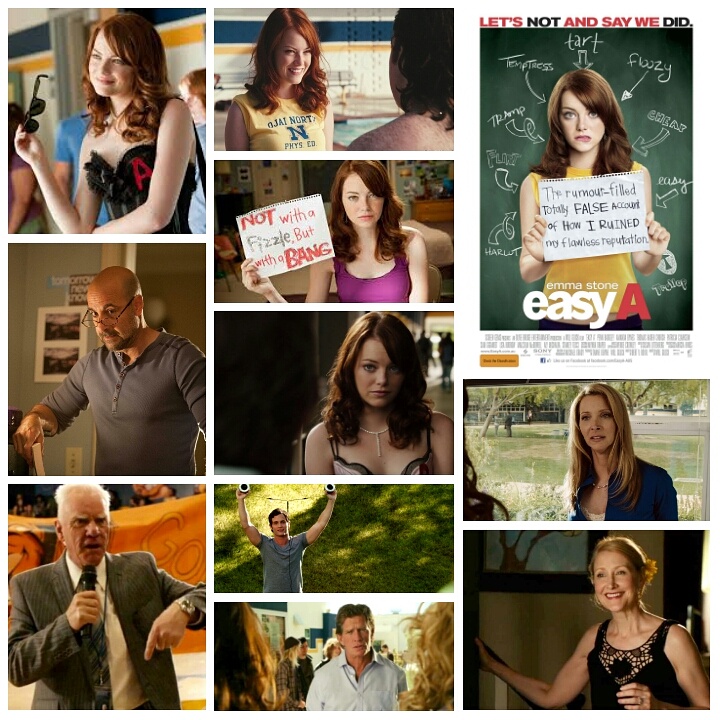
image

The best way to describe Easy A is calling it a wiseass high school retelling of The Scarlet Letter. That can also be a temperature gauge for someone to tell ahead of time if it’ll be there thing, or not. I enjoyed it a lot, thanks to a funny as hell Emma Stone who doesn’t leave out the vulnerability peeking through her guise as strong young woman. It’s a little more relaxed in the content department than some of the bawdier stuff that she got her start in, but still contains sufficient amounts of raunch to please the comedy hounds. Stone also has a veritable army of seasoned pros backing her up, an element which helps her, however she’s quite capable of carrying a film and does so as well. She plays Olive, a spitfire high school girl who finds herself in a funny yet unfortunate situation after her dunce of a friend starts a wildfire sexual rumor about her. Soon the whole school is talking about it, and she takes action in a bizarre move to fight fire with fire…of a certain kind. She boldly takes up the mantle of the school harlot, forever changing things in her quiet serengetti of suburban youth. It all spins wildly out of control, a common characteristic of adolescence, with poor Olive stuck right in the middle of the debacle, which sucks for her but is too funny not to enjoy. Stanley Tucci (“The Bucket List”) and Patricia Clarkson are darlings as her parents, Thomas Haden Church scores points as a deliberately hip and sympathetic literature teacher, and Lisa Kudrow that old flamingo, has fun as a dour guidance counselor. There’s also work from Amanda Bynes as an unhinged religious nut, the perpetually wooden Cam Gigandet, Penn Badgley and a brief cameo from Malcolm  McDowell as the world’s most cynical high school principal. As a riff on The Scarlett letter it keeps theme alive, and as a teen comedy with a gaggle of adults trying to keep up with the youngsters, it’s a charmer. Stone holds the proceedings together very well.