The 6th Day: A Review by Nate Hill

image

The 6th Day is a brash, in your face sci fi actioner with some deft scientific notions that it plays around with in near satirical fashion. It chooses to shoot most of its scenes in my hometown of Vancouver, including a set piece atop the spiral shaped Vancouver Public Library tat sends sparks raining down into the streets and choppers spinning wildly to their demise. I love when films shoot here, because it gives my city an exciting chance to be a part of escapism, and it’s amusing to watch them digitally maim all sorts of landmarks and then chuckle as I see them intact on my way to work the next day. Schwarzenegger, in one of his last great flicks before his deliberate hiatus (we shall not speak of the abomination that is Collateral Damage), plays Adam Gibson, a helicopter tour guide who has a strange blackout in mid flight while transporting the CEO of a swanky scientific corporation (slick Tony Goldwyn). He arrives back home to find a clone of himself living with his family, and things only get weirder from there. He has stumbled into the inner workings of extremely illegal experiments involving human replication, and Goldwyn & Co. are none too pleased about it. Goldwyn has secretly made human cloning an everyday thing for the company, hidden from the aging eyes of the moral upright doctor who founded the company (Robert Duvall). This is all enforced by a ruthless corporate thug for hire (Michael Rooker) and his foxy assistant (Sarah Wynter). Schwarzenegger is faced with the daunting task of taking down this un-sanctioned empire, reclaiming his family and blowing up some stuff along the way. It’s a terrific flick, and Arnie gets to say the best line he’s ever spoken, directed at Goldwyn, which I won’t spoil here but it’s pure gold. Goldwyn is hateable and malicious, the horrific third act prosthetics fitting him like a slimy glove. Duvall strikes a noble chord and almost seems to have wandered in from a more serious film. Rooker is intense, evil and scene stealing as always. Watch for Wendy Crewson, Michael Rapaport and Terry Crews as well. In a movie so committed to the trademark Ahnuld fireworks, it’s cool to get a whiff of actual thought provoking, Asimov-esque intrigue with the cloning, a concept which is fully utilized and really a lot of fun here.

BRIGHT LIGHTS, BIG CITY – A REVIEW BY J.D. LAFRANCE

bright-lights-big-city-1

In the late 1980s, Michael J. Fox attempted to break out of the typecasted roles he found himself stuck in – light, breezy comedies like Teen Wolf (1985) and The Secret of My Success (1987). He also didn’t want to be known just for his role as the ultra-conservative Alex P. Keaton on the hit television sitcom Family Ties. To this end, he tried his hand at three dramatic departures: the gritty, blue collar Paul Schrader film Light of Day (1987), playing a musician in a bar band; a naive American foot soldier faced with a tough moral dilemma in Brian De Palma’s Casualties of War (1989); and a cocaine-addicted fact checker whose life is falling apart in Bright Lights, Big City (1988). You can argue the merits of each film but clearly the mainstream movie-going public was not interested in seeing Fox’s serious side and all three films failed to set the box office on fire. The critics were just as unforgiving and the films received mixed reactions at best, or outright savaging at worst.

Out of these three films, I find Bright Lights, Big City to be the most interesting one, especially in terms of Fox’s acting. The film is an adaptation of Jay McInerney’s best-selling novel of the same name and the production was plagued by all kinds of problems, which makes the fact that the finished product is as coherent as it is that much more impressive. For all of its flaws, the constant is Fox’s excellent performance as a struggling New York writer trying to figure out why his wife Amanda (Phoebe Cates) left him and why his life is a mess.

“You are not the kind of guy who would be at a place like this at this time of the morning, but here you are…”

And with these words both the book and the film begin with Jamie Conway (Fox) drunk and coked to the gills on what he calls “Bolivian Marching Powder.” With McInerney adapting his own book, he is able to preserve its distinctive second person narrative, which only reinforces Jamie’s self-absorbed state of mind. For example, there are several shots of Jamie looking at himself in various mirrors as he recognizes less and less of the person staring back at him. He works as a fact checker for Gotham magazine, a fictionalized version of The New Yorker. What he really wants is to be working in the fiction department. It’s interesting to see all the grunt work Jamie has to do at his job in the days before the proliferation of computers and the omnipresence of the Internet. At home, he works on his novel on a clunky old typewriter. It is these things that date Bright Lights, Big City in a wonderful way, especially for those of us who can remember these things.

The film’s most glaring flaws include an ill-conceived dream sequence involving “the coma baby,” the story of an unborn child trapped in a woman in a coma as documented on a daily basis by The New York Post. In the dream, Jamie sees the baby through the mother’s transparent belly. Not only does the baby look obviously fake, Fox does its voice as well. I guess the selfish child is supposed to be him or something like that. This sequence always takes me out of the film temporarily. Then, there’s the scene where Jamie and his best friend Tad Allagash (Kiefer Sutherland) break into the Gotham offices to plant a live ferret in his ex-boss’ office. Naturally, all hell breaks loose and the film’s tone veers dangerously close to slapstick as the understandably freaked out animal bites Jamie’s hand and almost tears off Allagash’s balls. They are caught in the act by Alex (Jason Robards), the veteran staff member who spends most of his time drunk, rambling on about working with the likes of William Faulkner and Dorothy Parker. Alex is almost taken out by a suit of armor in a kind of goofy moment. This scene isn’t quite as bad as the coma baby dream sequence but both could easily be removed from the film and no one would miss them. Interestingly, both of these scenes are in the novel but some stuff just doesn’t translate as well on the big screen as it does on the page where your imagination can create its own images.

Michael J. Fox does a really good job showing the gradual spiraling of his character, like when Jamie shows up to a fashion show featuring his wife (Phoebe Cates) as one of the runway models. He arrives a sweaty, disheveled mess, bribes the bartender (a then-unknown David Hyde Pierce) to pour him a couple of drinks even though the bar is closed, and then tops it all off by trying to get his wife’s attention by attempting to climb up onto the catwalk only to get ejected for his troubles. During this scene, Fox has a glazed look in his eyes of someone clearly not fully in control of their faculties. If that wasn’t bad enough, when spotted on the street by his brother (Charlie Schlatter), Jamie runs away, sprinting through the streets like a madman until he loses his sibling on the subway. The end of this perfect day comes when Jamie has dinner with a kind, former co-worker (Swoosie Kurtz) and proceeds to get drunk and make a clumsy advance towards her that is intentionally awkward and uncomfortable to watch. What a shock these three sequences must’ve been for fans of Fox’s squeaky clean roles on T.V. and in film.

Fox is excellent playing someone in denial that their life is falling apart. He just keeps piling on more alcohol and drugs in an attempt to deaden the pain or to forget about the reality of his situation. As the film progresses, you keep wondering when is Jamie going to hit rock bottom? It’s hard to say if he ever does but there is a scene late in the film where he finally acknowledges the reality of his situation. Whether he will finally be able to straighten out his life is left rather open-ended but there is a suggestion that he has come out on the other side of a pretty dark place and lived to tell the tale, just like the coma baby.

I’ve always admired Kiefer Sutherland’s courage to play unlikable characters that are interesting to watch. With his leading man good looks it would’ve been so easy for him to play one-dimensional romantic leads or flawless heroes but he has stubbornly refused to do so time and time again. Just think of some of his signature roles. In Stand By Me (1986), he played a vicious bully that terrorizes the film’s three teenage protagonists; in The Lost Boys (1987), he played the leader of a pack of vampires that delight in feeding off the riff raff at a California beach community; and in Flatliners (1990), he played a gloryhound medical student willing to kill and then resuscitate his classmates in order to prove life after death. In two of these three films he plays out and out villains and in the other one he plays a deeply flawed protagonist and yet we kinda like all of these characters because of Sutherland’s natural charisma. As an actor, he’s just so damn interesting to watch.

In Bright Lights, Big City, he plays Fox’s best friend Tad Allagash, the kind of Yuppie slimeball character that James Spader perfected during the ‘80s (I guess he was busy doing another film when this one was cast). On the surface, Allagash seems like a good friend to Jamie. After work, Allagash takes Jamie out clubbing and introduces him to several beautiful women in an attempt to help his friend forget about his disintegrating marriage and thankless day job. However, they really have a toxic relationship. He only pretends to listen to Jamie’s problems and always seems to be hitting him up for drugs. With the exception of a clandestine visit to Jamie’s workplace after hours, Allagash only seems interested in taking Jamie to nightclubs and parties. Sutherland uses his natural charisma to show why someone like Jamie would hang out with a guy like Allagash. He’s the kind of guy that is hard to say no to, especially when he’s offering you drugs, alcohol and women.

In 1984, Jay McInerney’s semi-autobiographical novel Bright Lights, Big City became a hot commodity. Brat packer Emilio Estevez wanted to option it and adapt it into a film. He met with the author who was working on his own screenplay version. However, it was Robert Lawrence, vice president at Columbia Pictures, who ponied up the money for the option and championed the novel despite resistance from older executives who saw it as “subversive and unconventional.” Lawrence saw it as his generation’s The Graduate (1967) with “a little bit of Lost Weekend in there.” Columbia agreed to make it with Jerry Weintraub producing and Joel Schumacher, hot off St. Elmo’s Fire (1985), directing. Soon after McInerney started writing the screenplay, Schumacher started rewriting it. Considered for the role of Allagash were the likes of Judd Nelson, Estevez and Rob Lowe. Tom Cruise was all set to play Jamie Conway and even took a tour of the New York City night life with McInerney and Schumacher.

A year later, when Weintraub became the chief executive at United Artists, he took the project with him. Now Bright Lights, Big City needed a new producer and so Sydney Pollack and his partner Mark Rosenberg agreed to come on board. They hired Julie Hickson to write the script. Schumacher lost interest and Cruise got tired of waiting. They left and Weintraub also exited, leaving the studio. The project was tied up in a complicated settlement until late 1986 when the studio decided to start from scratch with the notion of casting a relative unknown like Charlie Sheen (pre-Platoon) as Jamie. Tom Cole, who adapted a Joyce Carol Oates story into the screenplay for Smooth Talk (1985), was hired to adapt McInerney’s novel. His wife Joyce Chopra had directed that film and her high-powered agent not only got her involved in Bright Lights but also sent the novel to another of his clients, Michael J. Fox.

Initially, Pollack and Rosenberg weren’t too crazy about the idea of Fox starring in Bright Lights but then they got worried that mainstream audiences wouldn’t relate to a selfish Yuppie like Jamie. Pollack reasoned, “There is something in the persona of Michael that makes you care what happens to him, no matter how bad the character is.” However, with the casting of Fox, Bright Lights changed from a modestly budgeted film to a major commercial feature shot on location in New York City with a top box-office movie star. Fox used his clout to request Kiefer Sutherland play the part of Tad Allagash.

The producers surrounded Chopra with a crew that had worked with Pollack and were loyal to him. To make matters even more interesting, she brought James Glennon, her cinematographer on Smooth Talk, on board, thereby drawing sides with her, Glennon and Cole against the rest of the Pollack-loyal crew. To complicate matters, a Directors Guild of America strike was predicted to start early in July 1987 (that ended up never happening). Fox had to resume work in Los Angeles on Family Ties by mid-July giving Chopra ten weeks to finish her film.

Principal photography barely started and already studio executives were not happy with Chopra’s working methods. Some felt that she relied too much on Cole and Glennon and took too much time setting up shots. The director claimed that she “kept insisting that we take time each day to give the actors a chance to find their way,” and worked “collaboratively” with Glennon. Clearly, this slow, methodical approach was not going to work for the time crunch that the production was working under and something had to give. Executives did not like the footage Chopra was getting and a week into principal photography the chairman of United Artists and the president of production flew in from L.A. to New York. They had rushed the film into production without reading Cole’s script which diverged significantly from the novel. McInerney felt that Cole “was writing out all the drugs.” In his defense, Cole claimed that Pollack instructed him to do that because the producer was worried about tarnishing Fox’s squeaky clean public image.

Officially, Chopra was fired over creative differences with the studio. Fox cheekily referred to the month that Chopra was in charge as “a rehearsal period, though it wasn’t meant to be.” On the short list of replacements were Ulu Grosbard, Bruce Beresford and James Bridges. On a Friday, Bridges received a phone call from his agent telling him that Bright Lights, Big City was in trouble. He read the novel that night, flew to New York on Sunday and saw the footage Chopra shot. He agreed to take over only if he could start from scratch. Bridges was known for box office hits like The China Syndrome (1979) and Urban Cowboy (1980) but was coming into Bright Lights with back-to-back flops of Mike’s Murder (1984) and Perfect (1985).

On Monday, Bridges contacted legendary cinematographer Gordon Willis who agreed to sign on to the production. In a week, Bridges wrote a new draft of the script that had Jamie’s mother’s death as the emotional core of the film. He brought McInerney back into the fold and fired six actors, replacing them with Jason Robards, John Houseman, Swoosie Kurtz, Frances Sternhagen, Tracy Pollan, and Charlie Schlatter. They all read the novel because the script wasn’t ready. Bridges wisely kept Kiefer Sutherland and Dianne Wiest as Allagash and Jamie’s mother respectively. Before each day of shooting, Bridges worked on rewrites of his script and on weekends worked on it with McInerney. Bridges brought a much needed stability to the production and the film was shot in six weeks.

vlcsnap-2014-02-08-15h56m40s45Shooting on location in New York City gives Bright Lights, Big City a real authenticity and serves as a snapshot of a city that looks and feels quite different now. In the ‘80s, it was quite a hedonistic time with materialistic Yuppies snorting cocaine in nightclub bathrooms while holding down jobs in the publishing industry or on Wall Street. I always felt that Bright Lights was the east coast answer to Less Than Zero (1987), also a flawed adaptation of a best-selling novel about affluent twentysomethings mired in drug addiction. Bright Lights is more successful because it doesn’t soften the edges of its protagonist as much as in Less Than Zero, which feels more compromised and less faithful to its source material. It’s really a shame that audiences and critics didn’t respond more favorably to Bright Lights. I would’ve liked to have seen Fox take more chances like he did with this film. Instead, he retreated back to safe comedies like Doc Hollywood (1991). It’s a rather unfortunate case of what could have been.

DAVID KOEPP’S THE TRIGGER EFFECT — A REVIEW BY NICK CLEMENT

1

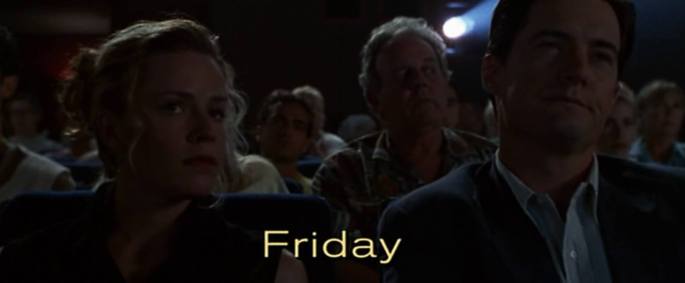
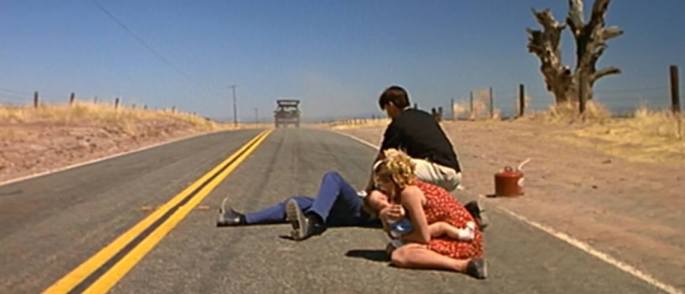
My father and I were the two people to pay and see David Koepp’s gripping directorial debut The Trigger Effect back in the late summer of 1996. Koepp, one of the most successful “blockbuster” screenwriters in the business (Spider-Man, Jurassic Park, Carlito’s Way, Snake Eyes, Mission: Impossible, Panic Room, War of the Worlds), also happens to write and direct underrated, mid-budgeted thrillers (Stir of Echoes, Secret Window, and Premium Rush are other fun, disposable genre entries that are light on pretension and high on style), and this film is definitely his best. Starting with a deliriously awesome tracking shot that would make Brian De Palma blush, the compelling scenario centers on a mysterious (and never explained because it’s not important) electricity black-out that hits Los Angeles, and how the various characters strewn about the narrative deal with the mounting problems and consequences from their increasingly desperate actions. The always excellent Kyle MacLachlan stars alongside an in-her-prime sexy Elizabeth Shue as husband and wife, with the shifty and engaging Dermot Mulroney as their intriguing friend, with Koepp’s twisty, Hitchcockian script taking them outside the presumably safe confines of their comfortable home and out onto the perilous road, looking for reinforcements, medicine, and safe passage. Michael Rooker turns up in an absolutely electric mid-plot set-piece, and gives the film his usual brand of intense menace and macho bravado, and Richard T. Jones has some incredibly effective scenes during the last act.

3

Working with the exceptional cinematographer Newton Thomas Sigel (Three Kings, Confessions of a Dangerous Mind), Koepp gets a great mix of gritty and slick, with some terrific long takes (again – the opening tracking shot inside of the mall and movie theater is tremendous) and astute use of composition within the frame at all times. Jill Savitt’s editing is the epitome of crisp and clean, and James Newton Howard’s creepy score jangles the nerves in all the right places. Seriously – this movie is grotesquely unsung and totally forgotten about – and it’s the sort of unpretentious thriller that Old Hitch would have ADORED. And besides, it goes without saying, Koepp wrote Bad Influence for Curtis Hanson – he gets an automatic lifetime pass! The film is available on widescreen/anamorphic DVD (no Blu-ray yet…!) and on Amazon HD Streaming. This is one to track down if it escaped you 20 years ago(!)

2


A Chat with Michael Biehn: An interview by Nate Hill


  I am unbelievably ecstatic to bring you my first interview in quite some time, this time with legendary badass Michael Biehn. Michael has played the fearless Kyle Reese in The Terminator, the cavalier mercenary Dwayne Hicks in Aliens, and appeared in countless other fantastic films including The Abyss, The Art Of War, The Seventh Sign, Stiletto, Michael Bay’s The Rock, Grindhouse, Tombstone, Mojave Moon, and many more. He is as iconic as he is magnetic on screen, a powerhouse of a performer with a legacy that I was honoured to quiz him on. Please enjoy our brief chat!
Nate: At what point did you know you wanted to become an actor? 
Michael: Since I was very little I was acting in school plays and community theater from productions like Pinocchio, rags to riches, Alice in wonderland and I just never stopped.

Nate: You have forged an impressive lineup of tough guys and take no prisoner badasses with your roles. Did you see yourself becoming that kind of Charles Bronson/Lee Marvin style, old school guy, or did the direction your career took surprise you? 
Michael: I really never had a plan for the direction my career would take, you really can’t control the roles you get when you start out. I was fortunate enough to keep getting cast in these roles. They just ended up being a consistent thing for me.

Nate: I’m trying to keep these questions about things you don’t normally get asked about, but I gotta bring up Terminator- how was that experience for you. You created a believable, vulnerable, visceral action hero that holds up today and is a classic dude in the genre. What was your mindset going into that role?
Michael: I read a book for my preparation. It was on the soldiers that had to fight for survival in the sewers against the Germans. And it took a very long time for the Germans to find all the soldiers and destroy them. This book gave me a mental investment that this role was about survival. It was the best investment I made for myself to portray that character.

Nate: The Seventh Sign- Always been one of my favourites, especially the devastating final scene in the hospital.. How was creating that character for you, your process, acting with Demi and especially Jurgen Prochnow? (He’s a favourite of mine as well). 
Michael: Demi, and Jurgen are great actors. They really have a good professionalism around them. We were really able to act with each other, present and in such truth. You can’t just go into this kind of movie reading the script and winging it. You really have to lay a foundation. And research your part to develop what you need. That’s what we all did.

Nate: Stiletto- a highlight for me in your roles, and a nice reunion for a lot of early 90’s action guys (Berenger, Forsythe, Russo, Sizemore etc, a dream cast). How did you get approached for that, and did you enjoy playing that lively psycho Lee? 
Michael: We had a lot of fun on set. There were a lot of serious scenes to deal with so its hard to break character and interact in-between. But it was still enjoyable.

Nate: You and Jennifer have quite a legacy these days with BlancBiehn Productions. How are you enjoying the work with that and the incredibly original lineup of films that you’ve been doing?
Michael: It’s a Blessing. Not only to have the ability to produce films we like but to do it together. It has made us stronger and the films are coming out great!

Nate: If you had to pick a few roles that you’ve played that you enjoyed the most for whatever reason, what would they be? 
Michael: I really enjoy all the roles ive played, and I really like working with Cameron. Anything I film with him has been amazing.

Nate: Another very memorable role for me was on Law & Order CI, in a heartbreaking role that went to some sad places and for me is a standout in your career. How was that experience for you. 
Michael: It was a difficult scene particularly because I am not a method actor and the emotions that I was working from were pulled from current situations and events In my own life. It’s always hard to open yourself up to such vulnerability but if you don’t you will not create and develop an honest scene and then it just looks staged. As difficult as it was I enjoy those character roles very much.
Nate: Thank you so much for your time Michael, it’s phenomenal to be able to chat with you. Best of luck in the future with all endeavours, including your fantastic work with the production company!

A Chat with Jennifer Blanc Biehn: An Interview by Nate Hill

  
Incredibly excited to bring you a chat with actress and producer Jennifer Blanc Biehn. Jennifer has appeared in many films included The Crow, The Divide, Everly, Wrong Cops, Bad Ass, The Brady Bunch Movie, and more. She has also done work in television shows like Saved By The Bell, It’s Always Sunny In Philedelphia, Dark Angel, CSI, Veronica Mars, Southland and more. She also has a wicked production company with her husband Michael Biehn in which she has spent the last few years making some super awesome genre films. Enjoy!
Nate: How did you get into acting? I read on imdb that you were on Broadway at age thirteen which is so awesome!! Any stories from way back then?

Jen: The first serious paying job I got was Brighton Beach Memoirs on Broadway for a year. I did the national tour first. It was great for me because my mom was struggling really, really hard to support us as we were on our own. I was finally able to help her a little with my earnings. What we worked so hard for was starting to pay off.
Nate: Dark Angel: you’re a huge part of that series, how was your experience playing Kendra and working with all the other actors?

Jen: Everyone on the show is really hip and cool and fun. It was an amazing experience.
Nate: The Crow: according to imdb you did some voice work for it (one of my favourite movies), who did you end up playing? Cool experience? 

Jen: Working on The Crow was a great experience and has lead to more voice work.
Nate: You made a nice appearance in Its Always Sunny In Philedelphia. How was it working with that gang in such a crazy environment? 

Jen: Fun, and exciting. They are hilarious. The Cast and Crew are great to work with.
Nate: It was so cool to see you kicking ass in Everly. How was that for you, and I gotta ask did you do your own stunts for it?

Jen: I did my own stunts. That character was very empowering. The moments were intense.
Nate: Some of your favorite roles you’ve played in your career so far?

Jen: I think that you have covered most of them. We have some films produced at Blanc-Biehn Productions that I have enjoyed playing. Wrong Cops was so much fun to be a part of. I keep getting new favorites as my career continues and my acting grows with it.
Nate: It’s quite the adventure you and Michael are on with BlancBiehn Productions. How are enjoying it so far? 

Jen: It’s been amazing. The production family we have built and the films we have been creating are exactly what we wanted. And we can see a strong future for this company and all who are involved.
Nate: Any upcoming projects you are doing that you’re excited for and would like to talk about? 

Jen: We have a lot of films beginning to release, Night visitor 1 & 2, Hidden in the woods, were wrapping up some others in post like she rises, fetish factory, and the Lincoln to name a few and will be filming 3 more by the end of this year. Just keep checking our website for more information: 

http://blancbiehnproductions.com/
Nate: Thank you so much for your time Jen, and all the luck in the world in upcoming projects! Cheers!!:)

MIDNIGHT RUN – A REVIEW BY J.D. LAFRANCE

midnightrun-3

One of the most popular trends in the 1980s cinema was the buddy-action film. The best ones to come out of this period were 48 HRS. (1982), Beverly Hills Cop (1984), Lethal Weapon (1987), and Midnight Run (1988), which spawned numerous imitators and sequels. Along with Lethal Weapon, Midnight Run is arguably the genre’s last gasp before slipping into formulaic predictability and self-parody (see Rush Hour, Blue Streak, et al). What makes Midnight Run so good, even after all these years, is the unbeatable combination of an excellent cast, a witty script and solid direction.

Jack Walsh (Robert De Niro) is a bounty hunter hired by his bail bondsman Eddie Moscone (Joe Pantoliano) to find and transport to Los Angeles, one Jonathan Mardukas (Charles Grodin) — a.k.a. “The Duke,” an accountant who stole $15 million from Las Vegas gangster Jimmy Serrano (Dennis Farina). What is initially a simple “midnight run” from New York City to Los Angeles, turns into the road trip from hell as Walsh and Mardukas are pursued across the country via plane, train, and automobile by dim-witted gangsters, frustrated FBI agents led by Alonzo Mosely (Yaphet Kotto), and a rival bounty hunter named Marvin Dorfler (John Ashton).

While this film may be a comedy, Brest lets us know right from the get-go that it’s going to have a slightly unpredictable edge to it as Walsh is almost killed by a deadbeat he’s supposed to bring in. If that wasn’t bad enough, his guy is almost snatched away from him by Dorfler. I like that Brest takes the time to show Walsh doing his job and that he’s good at it. The bounty hunter is able to track down and find Mardukas where the Feds and the Mob were unable.

Brest wastes no time introducing the film’s various antagonists starting with Mosely who approaches Walsh on the street. The bounty hunter quickly finds himself surrounded by four FBI agents. Walsh knows what they want and gives them nothing but smartass replies to their questions. Yaphet Kotto doesn’t play Mosely as an inept bumbler but instead brings an impressive intensity to the role that makes his character something of an intimidating figure which, of course, makes his kind of incompetent lackeys that much funnier the more frustrated he gets when they are repeatedly unable to catch Walsh and Markdukas. For example, there’s the withering glare Mosely gives one of his flunkies when he states the painfully obvious – that Walsh has his identification.

Midnight Run
adheres to the basic formula of the buddy-action film with two diametrically opposed characters teaming up to fight the bad guys. Inevitably, humorous situations arise from constant bickering while the duo shoots, punches, and fights their way out of action-packed set pieces. Ultimately, what makes Midnight Run work so well is how it messes around with the formula. Instead of having one funny guy and one straight man, you have two straight men with De Niro and Grodin. And yet it works, due in large part to the skill of the two leads who complement each other perfectly — De Niro plays Walsh as a gruff, foul-mouthed guy constantly annoyed by Grodin’s clean-cut accountant, armed with a seemingly endless supply of personal questions to ask his traveling companion. Their scenes together seem very spontaneous and real as they annoy the hell out of each other.

Fresh from his scene-stealing appearance in The Untouchables (1987), Robert De Niro was eager to try something different. He wanted to do a comedy and to this end, pursued the lead role in Penny Marshall’s film, Big (1988). Marshall was interested but the studio was not and thankfully the role went to Tom Hanks. Martin Brest, who directed Beverly Hills Cop, had found another script by George Gallo in the same vein — one that blended elements of comedy and action. He sent it to De Niro and was very up front with the actor: Midnight Run was a commercial film, not an in-depth character study. Regardless, De Niro researched his role by working with real-life bounty hunters and police officers.

Paramount was originally interested in backing Midnight Run but they wanted a big name star opposite De Niro in order to improve the film’s chances at the box office. Their production executives suggested that the Mardukas character be changed to a woman and wanted Cher for the role in the hopes that she would provide some “sexual overtones.” Brest wisely rejected the idea and so Paramount suggested teaming De Niro up with Robin Williams. Williams was a big star in his own right and eager to get the role. He even offered to do an audition for Brest — a rarity for the comedian whose name alone could green light projects. However, Brest was impressed by Charles Grodin’s audition with De Niro. The director felt that there was a real chemistry between the two actors. As a result, Paramount backed out and the studio’s president Ned Tanen claimed that the budget became too high and decided that “it wasn’t worth it.” Universal Pictures became interested in the project. It is to Brest’s credit that he supported Grodin down the line and refused to change his decision despite studio pressure.

Brest brought Grodin aboard with the understanding that the actor would have the opportunity to improvise. Grodin was very much open to De Niro’s improvisational technique. He remembered that De Niro “was all about ‘work,’ plain and simple, and being with him felt like breathing pure oxygen.” Some of their best scenes feel like the screenplay was just thrown out and that they simply riffed off one another. For example, the night boxcar scene where Walsh and Mardukas bond, after illegally stowing away on a train, was improvised entirely.

Much of Midnight Run’s humor comes from these moments as they constantly antagonize each other. This relationship is believable because the film takes the time to develop it with many scenes where the two men just talk, and this allows us to get to know them. Most buddy films spend only the bare minimum amount of time on character development and instead cram as many action set pieces and explosions in as possible. As a result, we do not become attached to the characters. Midnight Run does not fall into this trap.

For all of its commercial elements, George Gallo’s script has very strong, three-dimensional characters that transcend their stereotypes. It was the script that first drew Grodin to the project. He said in an interview that “the script had dimension beyond what I’m used to seeing. The dimension of character. It looked like a good action-adventure genre picture with strong character evolution.” De Niro, being the consummate actor that he is, still manages to inject little touches and details, like a habit of constantly checking his faulty watch, or the nice bit of comedy when he checks out Mosely’s identification that he pickpocketed during their first meeting. De Niro walks away from the camera only to quickly turn around and flash the stolen ID in an amusing parody of an FBI agent. It is these little bits of business that provide insights into his character. Brest commented in an interview that, “sometimes I’d let the camera run after finishing a scene to see if he did any bits, and invariably he did.”

From the two leads to the rest of the supporting cast, each character is given a moment or two to say or do something that makes them distinctive and funny. For example, there is John Ashton as Dorfler, a rival bounty hunter who falls for the same stupid trick every time. Dorfler is not just some generic bounty hunter. Ashton transforms him into a self-absorbed idiot who is completely oblivious to the big picture. Even though Dorfler is always on the receiving end of many jokes, he gets his chances to prevail. However, you know that, ultimately, he is destined to fail. Dorfler has a distinctive personality instead of being merely a cardboard cutout.

Joe Pantoliano is so good as the increasingly exasperated bail bondsman. His opening exchange with De Niro early on in the film is so well played. In a matter of moments De Niro and Pantoliano suggest a long history between their two characters in the way they act towards each other. Eddie is a consummate bullshit artist but Walsh sees right through that. I like the nice little detail that Brest throws into this scene where Eddie pays Walsh by taking out a wad of cash stashed in his pink and white socks. It is details like this that say so much about a character. Eddie cares only about money and his reputation. These characters could have been presented as clichéd stereotypes but Brest wisely casts veteran character actors like Ashton and Pantoliano in these roles.

Many of the supporting characters appear constantly throughout the film in a series of recurring gags, like Mosely running into people who’ve encountered Walsh posing as him, or Mardukas’ never-ending questions about Walsh’s personal life (“Why were you so unpopular with the Chicago Police Department?”), or Dorfler getting fooled by the same trick time and time again. Then there’s Joey (Robert Miranda) and Tony (Richard Foronjy), two dumb Vegas wiseguys that work for Serrano. Tony’s the slightly smarter one but not by much. The give and take between these two minor characters is really funny and the script gives them a moment of actual competency which makes them more than just one-dimensional thugs. It helps that the two actors playing them do such a good job bringing these characters to life.

Much like Yaphet Kotto does with Agent Mosely, Dennis Farina plays his character as if he were in a drama and not a comedy. Unlike his goofier mobsters in Get Shorty (1995) and Snatch (2000), the actor transforms Jimmy Serrano into an imposing figure best illustrated in the scene where he confronts Mardukas and tells him that he’s going to die. For a brief moment, Midnight Run stops being a comedy and there’s a real sense of danger thanks to Farina’s chilling presence in this scene. He’s also quite funny in the scenes where he threatens his underlings with all sorts over-the-top violent acts if they don’t do his bidding.

Nowadays, it’s hard to remember when De Niro doing a comedy was something of an anomaly. Sure, he had done The King of Comedy (1983) but by and large he was known at the time as a dramatic actor. So, teaming him up with veteran comedic actor Charles Grodin in an action comedy must’ve seemed like a risky prospect to the studio. But this would be tempered with director Brest behind the camera. This was years before Gigli (2003) when he was still enjoying the good will from the smash hit Beverly Hills Cop. If anybody could make De Niro funny while still retaining his trademark intensity, it was Brest.

Now, there is a whole generation of filmgoers that only knows De Niro from comedies like Meet the Parents (2000) and Analyze That (2002). Charles Grodin has, for the most part, shunned the limelight. He had a short-lived talk show but has, unfortunately, not done anything on par with his work in Midnight Run. In fact, he hasn’t acted much since 1994 and said in a recent interview that he has quit acting altogether. By the late 1980s, early 1990s, the buddy-action film had become a tired and hackneyed cliché. Screenwriter Shane Black offered a brief breath of fresh air with Lethal Weapon (1987) and The Last Boy Scout (1991) but generic time-wasters, like De Niro’s own Showtime (2002), Serving Sara (2002), which blatantly rips off Midnight Run, or the more recent The Bounty Hunter (2010), are still cranked out with predictable regularity by the studios. Back in 1988, Brest delivered the goods in a big way, serving up an R-rated film that mixed exciting car chases and shoot-outs with hilarious recurring gags and assortment of colorful characters.

DAMIEN CHAZELLE’S WHIPLASH — A REVIEW BY NICK CLEMENT

1

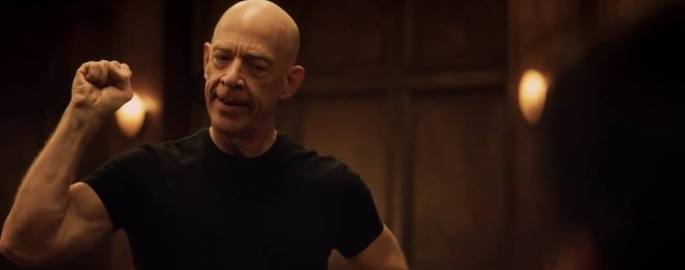
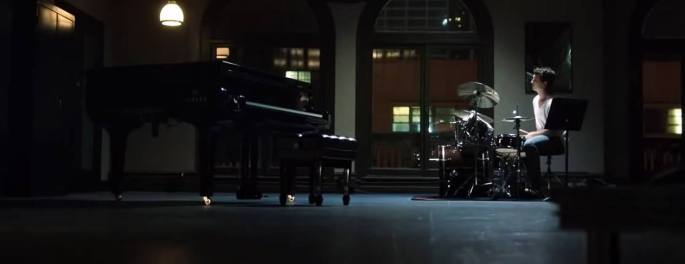
Pauline Kael once said something along the lines of: “Great movies are rarely perfect movies.” If she were around today, she’d hopefully think that Whiplash is both great and perfect, because after only a few viewings, I’m pretty much convinced that it’s a nearly flawless piece of cinema, something that couldn’t possibly be improved upon, made with exacting care and precision. Yes, it lives inside of its movie-movie world, but that’s one of the things that I look for in captivating cinema; I want to be grabbed by something with almost unnatural force. Writer/director Damien Chazelle made one of the most promising debut features in recent memory, demonstrating commanding technique and a raw understanding of how to ruthlessly move your narrative forward without shortchanging character and emotion and depth. Led by two of the best performances from 2014 by Miles Teller and J.K. Simmons, Whiplash tells the laser-focused story of a determined college drumming prodigy (Teller) and his psychotically passionate band instructor played with extreme ferocity by J.K. Simmons (channeling R. Lee Ermey in Full Metal Jacket), who will stop at nothing in order to bring greatness out of his students. I will spoil no more about the twists and turns that the high-voltage story takes but I will allow this: There’s not a false moment to be had at any point during the two crisp hours that the story unfolds.


3

To say that Chazelle has been influenced by Full Metal Jacket would be an understatement; Whiplash feels like a war movie, from Simmons’ intensely verbal and vulgar taunts, to the fetishizing of the instruments on display, while the obsessive details of rehearsals and recitals feel wholly authentic. This is clearly a world that Chazelle feels in his bones and he’s made a picture that grabs you from frame one and never lets you go. Sharone Meir’s dynamic and agile cinematography gets intimate and personal with the all of the musical action, bringing the viewer one step closer to the loud and rhythmic world on display. It goes well beyond being just another Mean Teacher Movie because of the way that Chazelle explores the psyches of his stop-at-nothing-to-achieve-greatness characters. Whiplash is about striving for greatness, never losing sight of the task at hand, and how certain people have an almost obsessive desire to always be perfect, no matter what’s being asked of them. And just wait for the absolutely dazzling and utterly impeccable final shot – it’s the best single shot in any film from its calendar year, and that includes Birdman! Not just because of how it looks visually, but for what it suggests thematically and emotionally. It’s a wowser of a cinematic moment.

2

Top Ten David Lynch Characters: A list by Nate Hill

The cinematic universe in which legendary director David Lynch has chosen to tell his stories is a yellow brick road which leads the way to a rabbit hole, wherein can be found dreams, nightmares, horror, love, spirits, small towns, psychological torment, offbeat humour, danger and endless gallons of hot black coffee. Within this mesmerizing realm lives a whole armada of strange and wonderful human beings, often with antennas extended out into both the metaphysical, the supernatural and the just plain undefinable. This makes them some of the most richly fascinating, deeply felt individuals to ever dance across our screens. If you have clicked on this post, you will see below a list of my personal top ten characters to have ever wandered out of the one of a kind mind of Mr. Lynch and been brought to life by the intuition, grace and startling gut instinct of many fine actors. Enjoy!
 
10. Marietta Fortune, played by Diane Ladd in Wild At Heart


Diane Ladd plays the ultimate mommy from hell in Lynch’s wacky, colourful romance road trip flick and livens the proceedings up no end with her mental instability, overprotective mania and frequent banshee screams that echo the terrifying melodrama of an exaggerated and psychotic Joan Crawford. Ladd rightly earned an Oscar nomination for her feral work, and one only needs to witness the unnerving sight of her sprawled across the bathroom floor with a liver full of martinis and a face smeared with crimson lipstick to appreciate the work funnelled into both the performance and direction to give us this horrific harpy.  

9. The Man From Another Place, played by Michael J. Anderson in Twin Peaks 
  

No other character solidifies Lynch’s pipeline to the collective subconscious like the red suited, inter-dimensional man of limited stature, a haunting presence who dances, speaks backwards and is always one step ahead of every fellow character and watching audience member who lays eyes on him. He serves as an image of what lays beyond, and no doubt an experimental choice for Lynch, one that would go on to become a token image of the television series, and his career as well. 

8. Bobby Peru, played by Willem Dafoe in Wild At Heart
  

The uniting forces of Willem Dafoe’s brand of creepiness morphed together with Lynch’s intuition for everything weird resulted in Bobby Peru, a disgusting psychotic whacko who only shows up in the last quarter of the film, yet dominates every frothy frame. Peru is a scary son of a bitch, and Dafoe lends every Joker grin, sallow grimace and harsh syllable he can muster in a very discomforting scene in which he abuses Laura Dern’s character to squirm inducing effect. This heinous outburst only makes the explosive end he meets all the more satisfying. A true Lynch monster, a Dafoe creation to remember and spin yarns about in years to come beside the cinematic campfire. 

7. Nikki Grace/Susan Blue, played by Laura Dern in Inland Empire
  

Dern turns the performance of her career in what is perhaps Lynch’s most peculiar film to date, a purposefully meta, altogether perplexing soul bender of a tale that revolves around two incredibly strong female characters, both played by her. There’s a galvanizing monologue buried within the heart of this dense saga that’s at once both a savage outcry and a self reflective summary to the character, Dern nailing every sharp turn of both that passage, and her work in the film as a whole. Lynch sat on Hollywood Boulevard with a cow and a sign advocating an Oscar nomination for her powerful work here, and upon viewing it it’s easy to see why. ‘A woman in trouble’ cries the DVD cover. Dern cries out into the dark and lets us know this character is exactly in that place, but her and Lynch lay out the breadcrumb trail in an ambiguous fashion that never really lets us in on the how and the why of said trouble. Such an achievement is pure collaboration, and worth every penny spent on the cow rental. 

6. Margaret Lanterman, aka The Log Lady, played by Catherine E. Coulson in Twin Peaks
  

The Log Lady is the symbolic lynchpin of Twin Peaks, a woman who lost her husband in a fire long ago, and quite literally carries a log around in memorial, speaking to it as if it were a person. Such a concept could be seen as silly, but in Lynch’s hands it simply is compelling. Coulson too treats it with reverence, giving her the undefined gravity that is a key ingredient in the Twin Peaks mystery and will be remembered by fans, loved by veterans and discovered by newcomers for eons.

5. Frank Booth, played by Dennis Hopper in Blue Velvet
  

The third scariest person on this list comes in the form of Booth, an oxygen loving, volatile kinkster played with primordial menace by a wild eyed Dennis Hopper. Booth took audiences by storm when Blue Velvet was released, showcasing a villain’s ability to completely shatter the idealistic and womblike notions of small town, old world bliss that came before him. He barges into the film and immediately flips the table as far as tone goes, catching everyone off guard with his criminal and very twisted antics. A true Pabst Blue villain and force of perverted nature that we won’t soon forget. 

4. BOB, played by Frank Silva in Twin Peaks
  

No demon has shivered the timbers of viewers quite like Killer Bob. He was a fluke, a lightning bolt of creative energy that Lynch channeled into what would become the scariest and strangest villain in his stable. A nightmarish and all too real apparition who feeds on rape, murder, fear, abuse and all the tools which reside within the darkest corners of humanity’s toolkit. Silva is a salivating horror, feeling his way through a performance that is rooted directly within the forces of undiscovered nature and firmly committed to scaring the pants off of us. 

 3. Mystery Man, played by Robert Blake in Lost Highway
  

Blake unsettles big time as a pasty faced, hollow laughed denizen who torments the protagonist at the most unexpected of moments and can’t help but utter a grinding giggle every time he can harvest an iota of confusion from his quarry. Whether the accusations against Blake in real life are true or not, the guy just has a corrosive vibe to his work and it kills me that he never got a chance to live out more years in cinema. This was one of his last two roles, and he’s the acrid soul of the piece, a snarling symbol of mental instability and otherworldly nastiness within the main character’s psyche.

2. Special Agent Dale Cooper, played by Kyle Maclachlan in Twin Peaks
  

Ahh, Dale Cooper. No one puts a big old smile on my face like him. In a career that has a whole bunch of lunatics and weirdos running amok, Lynch has given us the ultimate good guy, a comforting, likeable lawman with a keen sense of character and a deep love for both coffee and copious amounts of cherry pie. Maclachlan soars into pop culture legend with his winning smile, delightful idiosyncrasies and unyielding dedication to the law. 

1. Laura Palmer, played by Sheryl Lee in Twin Peaks
  

The battered angel, the homecoming queen, the beauty wrapped in plastic. No one represents both the decaying, corrupted human spirit and the same purity that wages war upon the sickness as well as Laura. When Twin Peaks was cancelled and Lynch launched plans for a big screen follow up, he stuck with the one element that made the show so special: Laura. Through hell, high water and every horror in between he stuck with Laura, turning the film into a final loving ode to her that would be seen by many as too much, and a stark deviation from the show. He was simply following through with the uneasy themes which mean so much to him, represented by the ultimate girl in trouble, whereby spiritual forces or simply the malfunction within humanity. Lee has never been better, serving as the rose within the centre of the dark bouquet of characters which Lynch  draws forth from his dreams. 

Top Ten Harvey Keitel

Harvey Keitel is one of cinema’s most valued actors.  His brand: tough alpha male, career criminal, and the all-around bad motherfucker.  His filmography is unique; he has been a mainstay in the works of Martin Scorsese, Quentin Tarantino, James Toback, Abel Ferrara, and most recently Wes Anderson.  While his hallmark is the tough guy, he’s been able to transform that archetype into colorful dimensional characters that only he could have portrayed on film.  Whether he’s in a crime film, a big budget opus, or an incredibly small independent film, Keitel is always on the mark and he is always fascinating to watch.

ALICE DOESN’T LIVE HERE ANYMORE 1974 Dir. Martin Scorsese

HK ADLHA

In his third collaboration with his friend Martin Scorsese, Keitel gives a dual layer performance.  He starts out being the affable and charming suitor of Ellen Burstyn’s Alice – until he isn’t.  He’s the all too real sociopath that is able to cover his anger and inner frustration with his charm.  Keitel is frightening in this film, the way he’s able to camouflage the character’s actual motivations and drive is unique to the range he has as an actor.

BAD LIEUTENANT 1992 Dir. Abel Ferrara

HK BAD LT

There has never been a performance like Keitel’s turn in BAD LIEUTENANT.  It is as pulverizing as it is soul bearing.  He removes the audience from their comfort zone, and takes them into the heart of darkness, watching a man spiral out of control.  He’s a killer, a gambler, a junkie, a cop – yet he accidentally finds a reason to live through redemption.  While the Bad Lieutenant is incredibly vile, the subtle vulnerability that Keitel graces makes this performance all that more tragic.  Aside from being one of Keitel’s finest performances, this remains one of the best performances in cinema history.

DANGEROUS GAME 1993 Dir. Abel Ferrara

HK DG


Off the heels of BAD LIEUTENANT, the seminal trio of Abel Ferrara, Harvey Keitel, and cinematographer Ken Kelsch embarked on one of the most daring and transgressive pseudo autobiographical films, DANGEROUS GAME.  Like Fosse’s ALL THAT JAZZ or Felini’s 8 ½ Abel Ferrara uses his actor as a vessel to tell his own story on film.  Keitel completely shakes his gangster vibe but leaves his darkness and intensity completely intact to play filmmaker Eddie Israel in a movie within a movie.

FINDING GRACELAND 1998 Dir. David Winkler

HK FG

In the vastly underseen FINDING GRACELAND, Keitel plays a quietly broken drifter who claims to be Elvis Presley.  While on the road to Graceland, he gives his most quietly heartfelt performance with an incredible amount of soul and reach.  We’ve seen characters like this before in cinema, but seeing Keitel playing a man claiming to be Elvis, along with singing SUSPICIOUS MINDS, is a one of a kind performance.  Yes.  Harvey Keitel sings Elvis.  That’s worth watching it on its own.

FINGERS 1978 Dir. James Toback

HK FINGERS

Somewhere there needs to be a theatre showing a double bill of FIVE EASY PIECES and FINGERS.  This is a key performance from Keitel, where he plays the gangster and the intellectual.  He’s a brutal enforcer for his father, yet doubles as a piano prodigy.  Both sides of himself have one thing in common: sexual addiction.  FINGERS is Toback’s finest hour as a filmmaker, and is yet another performance of Keitel’s that is chalked up in the underseen category.

THE LAST TEMPTATION OF CHRIST 1988 Dir. Martin Scorsese

HK TLTOC

Martin Scorsese’s most seminal film, THE LAST TEMPTATION OF CHRIST is controversial and monumental for a variety of reasons.  One of the most enamoring aspects is Keitel’s reinvention of Judas.  He’s an insurgent warrior, he’s the loyal follower, and then he becomes the voice of reason while Jesus is being guided through his final temptation.  Keitel’s turn earned him a Razzie nomination, and that is completely off base.  Keitel is brutish and forceful; purposely directed to speak with an overt Brooklyn accent with a new take on the Biblical character.

MEAN STREETS 1973 Dir. Martin Scorsese

HK MEAN STREETS

MEAN STREETS is often mentioned as the film that birthed the brilliant collaboration of Scorsese and De Niro, but the film is much more than that.  Keitel takes the lead, as the morally conflicted Charlie who is set to take over for his gangster Uncle, yet having to constantly juggle his wild card best friend Johnny Boy (brilliantly played by De Niro).  De Niro has the flashy role, but Keitel is the foundation of the film.  He’s Scorsese’s alter ego; he is struggling with his faith, his family, and his identity.  Keitel gives an incredibly soft and vulnerable performance as a man who is stuck in his own quagmire, having no way out.

RESERVOIR DOGS 1992 Dir. Quentin Tarantino

HK RD

This is the performance where everything Keitel has done before comes to a perfect culmination.  There isn’t an actor who has delivered Tarantino’s dialogue with as much weight as Keitel.  Keitel walks Tarantino’s walk, and in particular talks his talk.  There is a Shakespearean quality to Keitel’s performance in this film.  From the start of the film, we know he’s heading for impending doom, and he does it all with gravitas and honor.

TAXI DRIVER 1976 Dir. Martin Scorsese

HK Taxi Driver

Originally, Scorsese wanted Keitel to play the campaign staffer Tom (the role Albert Brooks knocks out of the park), but instead Keitel wanted to play the pimp who had only a few lines of dialogue in the original screenplay.  Keitel transforms into a smooth and funny character, yet in his private encounter with Iris (Jodie Foster) we see what a master of manipulation and control he is in a creepy and quiet way.

SMOKE 1995 Dir. Wayne Wang

HK SMOKE

SMOKE is another one of those quietly underseen gems of independent cinema.  In a very low key way, we see Keitel in a new light. He’s himself, in a certain regard, a brash New Yorker who smokes, runs a tobacco shop, yet he has an undying pension for art.  In this film’s case, he’s a photographer, who has taken the same photograph in the same intersection every day for the past twenty years.  This is a very touching film, and Keitel gives one of his sweetest performances.

YOUTH 2015 Dir. Paolo Sorrentino

HK YOUTH

In a character that is fusion of Charles Bukowski and John Cassavetes, Keitel plays writer/director Mick Boyle who is on his annual holiday in the Swiss Alps with his best friend, Michael Caine.  This was a role that Keitel was born to play.  He’s the artist that is overflowing with creativity and inner torment.  He’s being torn apart by his own emotions and ego, and he gives is a bittersweet showboat of a performance of what it is truly like to be an artist.

Honorable mentions: BAD TIMING, BLUE COLLAR, BUGSY, CITY OF INDUSTRY, COP LAND, FROM DUSK TILL DAWN, THE PIANO 

Brown’s Requiem: A Review by Nate Hill

image

Brown’s Requiem is a neat little slice of Los Angeles film noir in the tradition of L.A. Confidential and Mulholland Falls. It’s based on a book of the same name that’s written by James Ellroy, who actually wrote L.A. Confidential as well, so the crime vibe here is thick, rich and geniune. Michael Rooker is flat out fantastic as Fritz Brown, a world weary, hard bitten private investigator who is hired by a rotund caddie named Fat Dog (Will Sasso) to find his kid sister (Selma Blair) a wayward girl who has apparantly run off with a her sugar daddy, and may be in danger. Brown noses around and before he knows it he’s neck deep in police corruption, violence and murder. It’s convoluted, but film noir always is, and when the plot is left to bake in the California sun, it’s going to be nicely sinewy and labyrinthine to please all the filmgoers put there who fancy themselves gumshoes and like to decipher the happenings along with the protagonist. The trail leads Brown to sinister police captain Cathcart (the late Brion James), brutal thug Richard Ralston (Jack Conley) and many other bottom dwelling nasties. This is a rare lead role for Rooker and he’s riveting, fitting this genre protagonist like a glove. His innate menace and gruff whisper of a voice are put to good use as the hangdog tough guy takes care of business in style. Watch out for Kevin Corrigan, Tobin Bell, Christopher Meloni and a brief but darkly funny cameo from Brad Dourif. Where L.A. Confidential hid it’s grit beneath a sheen of glamour, Brown’s Requiem wears it proudly on its seedy sleeve, a scrappy little cousin to Confidential, and a sturdy little noir mystery boosted by Rooker’s work.