LEGEND – A REVIEW BY J.D. LAFRANCE

legend_8_tim-curry_darkness3

“The time is ripe for a John Ford of science fiction films to emerge. And I’m determined to be that director.” Ridley Scott told this to author Harlan Ellison when he asked him to write the screenplay for Dune (1984). Although, Scott’s version never happened, for years it looked like he was going to fulfill that bold statement with the incredible one-two punch of Alien (1979) and Blade Runner (1982). The 1980s was a fertile period for fantasy films with the likes of memorable efforts such as Dragonslayer (1981), Conan the Barbarian (1982), and Ladyhawke (1985) and not so memorable ones likes The Beastmaster (1982) and Krull (1983). The best of the bunch was Ridley Scott’s Legend (1985). With this film, he wanted to do for the fantasy genre what he did for science fiction with Blade Runner – create a visually stunning film rich in detail. He cast two young, and up-and-coming stars, Tom Cruise and Mia Sara, recruited acclaimed author William Hjortsberg to write the screenplay, have make-up genius Rob Bottin bring the various fantastical creatures to life, and get legendary composer Jerry Goldsmith to compose the score.

Sounds like the ingredients for a masterpiece, right? Partway through principal photography, the elaborate forest set created on a soundstage burned down. The studio, eager to appeal to Cruise’s youthful fanbase, replaced Goldsmith’s score with one by Tangerine Dream because they had scored Risky Business (1983), the breakout film for the young actor. To add insult to injury, the studio and Scott cut over 20 minutes of footage for North American audiences. After all the dust had settled, Legend was a commercial and critical failure, relegated to cult film obscurity. It’s too bad because even the mangled U.S. version has a lot going for it, namely Bottin’s groundbreaking prosthetic make-up and Tim Curry’s mesmerizing performance as the Lord of Darkness. In 2002, Ridley Scott revisited Legend for a souped-up Ultimate Edition DVD that allowed the director to assemble a version of the film approximating his original intentions.

The opening credits play over shots of a dense forest at night. In typical Scott fashion, we are fully immersed in the sights and sounds of this place. We see a goblin by the name of Blix (Alice Playten) walking through the forest until he comes across a foreboding marsh dominated by an imposing structure that resembles a massive tree. It is known as the Great Tree – “when evil anarchy ruled the land, the wicked came here to sacrifice,” a character says at one point.

The first words that are spoken in the film are, “I am the Lord of Darkness. I require the solace of the shadows and the dark of the night,” They come out of Tim Curry’s booming, theatrical voice, one that is absolutely dripping with menace. Not surprisingly, his enemy is the light of day, but he seeks to find a way to make it night forever. Since he is confined to the shadows, Darkness (Tim Curry) entrusts his “most loathsome of goblins,” Blix, whose heart is “black as midnight, black as pitch, blacker than the foulest witch,” to find and kill the two remaining unicorns – the most pure symbols of goodness and light. Darkness instructs Blix to bring him their horns – the source of their power.

Reclusive creatures, the unicorns can only be lured out into the open by innocence. Cut to Princess Lili (Mia Sara), a beautiful young woman traveling carefree through tall grass, singing happily to herself. Mia Sara, with her expressive big eyes and fresh-faced look (this was her feature film debut), certainly epitomizes the essence of innocence. When she’s not slumming with the common folk, Lili flirts with Jack O’ the Green (Tom Cruise), a young man who lives in the forest among the animals. While the film’s stylized dialogue doesn’t always sound convincing coming out of Tom Cruise’s mouth, he makes up for it with a very physical performance, moving gracefully at times like a classically trained dancer.

Jack shows Lili the wonders of the forest, including the rare unicorns. Their first appearance, captured in slow motion and soft focus, is a sight to behold. Unfortunately, Blix and two other goblins have been following Lili. When she dares to break the unwritten rule of the forest and actually touch one of the unicorns, the goblins strike, taking down one of the magical animals and removing its horn. Lili’s single act of selfishness plunges the world into darkness, blanketing the once lush forest in snow and transforming a nearby pond into ice. I wonder if Peter Jackson is a fan of Legend as the scene where Jack dives into a pond to retrieve Lili’s ring, with its use of a distorted lens, eerily anticipates a similar shot early on in The Fellowship of the Ring (2001) when the Ring’s backstory is recounted.

Lili runs off in shame and guilt, leading the goblins to the second unicorn that they capture. She finds her way to the Great Tree and is courted by Darkness, only to be bewitched and transformed into his dark bride. Crestfallen over Lili’s betrayal, Jack takes refuge in the forest and is discovered by Gump (David Bennett) the elf and two dwarves, Screwball (Billy Barty) and Brown Tom (Cork Hubbert) – providing much of the film’s comic relief. They are in turn helped out by a fairy named Oona (Annabelle Lanyon) who is smitten with Jack. Together, they go to the Great Tree to retrieve the unicorn’s horn and free its mate.

The corruption of Lili sequence is arguably the highlight of Legend as it takes on a captivating, dream-like atmosphere. Dazzled by sparkling trinkets and jewelry, she spots a figure dancing in swirling black garments. Lili is compelled to dance with this mysterious, featureless figure and pretty soon they merge into one and she adopts a stunning Gothic look, complete with black lipstick to contrast her pale alabaster skin. Lili has been bewitched by a powerful spell and it is at this point that Darkness chooses to reveal himself, emerging from a mirror.

Scott prolonged the reveal of Darkness’ entire appearance for as long as possible. All we get early on is a tantalizing glimpse of a hand or an arm. But here is the money shot and what an impressive creature he is: massive with two large horns and cloven feet. He is Rob Bottin’s crowning achievement, a creation so stunningly fully-realized that it still surpasses anything done in subsequent fantasy films, The Lord of the Rings trilogy included. Of course, it doesn’t hurt that Tim Curry’s personality is still able to permeate the tons of prosthetic makeup that he’s buried under. With that great voice and the deliberate cadence he adopts, Curry gives his dialogue an almost Shakespearean flair with the lyrical quality in which he speaks.

When filming The Duellists (1977) in France, director Ridley Scott came up with the idea for Legend after another planned project, Tristan and Isolde, fell through. He thought of a story about a young hermit that is transformed into a hero when he battles the Lord of Darkness in order to rescue a beautiful princess and release the world from a wintery curse. However, Scott felt that it was going to be an art film with limited mainstream appeal and went on to do Alien and then extensive pre-production work on a version of Dune that never happened. Frustrated, Scott came back to the idea of filming a fairy tale or mythological story. For inspiration, he read all the classic fairy tales, including ones by the Brothers Grimm. However, he wanted Legend to have an original screenplay because he felt that “it was far easier to design a story to fit the medium of cinema than bend the medium for an established story.”

By chance, Scott discovered books written by American author William Hjortsberg and found that he had already written several scripts for some unmade lower-budgeted films. Scott asked Hjortsberg if he was interested in writing a fairy tale. As luck would have it, he was already writing some and agreed. The two men ended up bonding over Jean Cocteau’s Beauty and the Beast (1946). In January 1981, just before Scott was to begin principal photography on Blade Runner, he and Hjortsberg spent five weeks working out a rough storyline for what was then called Legend of Darkness. Originally, Scott “only had the vague notion of something in pursuit of the swiftest steed alive which, of course, was the unicorn.” He wanted unicorns as well as magic armor and a sword. Hjortsberg suggested plunging the world into wintery darkness. Scott also wanted to show the outside world as little as possible and they settled on the clockmaker’s cottage. The quest was longer and eventually substantially reduced. Scott wanted to avoid too many subplots that departed from the main story and went for a “more contemporary movement, rather than get bogged down in too classical a format.”

The look Scott envisioned for Legend was influenced by the style of classic Disney animation which, incidentally, was the studio Scott originally offered the project to but they were intimidated by the film’s dark tone despite his reassurances that he would not go too far in that direction. Regardless, the director visually referenced Disney films like Snow White and the Seven Dwarfs (1937), Fantasia (1940) and Pinocchio (1940). Early on, Scott worked with Arthur Lea as a visual consultant, drawing some characters and sketching environments. However, Scott replaced Lea with Assheton Gorton, a production designer the director had wanted to work with on both Alien and Blade Runner. Scott hired Gorton because he knew “all the pitfalls of shooting exteriors on a soundstage. We both knew that whatever we did would never look absolutely real, but would very quickly gain its own reality and dispense with any feeling of theatricality.”

As with all of Scott’s films, Legend is a marvel of production design as evident from the interior of the Great Tree. For example, there’s the hellish kitchen where Jack and his companions find themselves imprisoned only to watch helpless as some other poor creature is tortured among infernal fires. There are the intricate carvings and finely crafted sculptures located in Darkness’ throne room, or the immense columns that lie just outside of this room and Scott gives you an idea of their scale as they dwarf Lili when she runs among them. You could pause the film at almost any moment and marvel at the detail contained in a single frame.

And yet for all of its visual grandeur, the film feels surprisingly intimate. It certainly is not set on the scale of say The Lord of the Rings and this actually works in its favor. Legend has a very specific focus with one overriding quest for our heroes to accomplish. There is a textured, hand-made quality to Scott’s film that seems to be missing from most post-Lord of the Rings films (with the possible exception of The Brothers Grimm as director Terry Gilliam was also working with a modest budget).

Scott also consulted with effects expert Richard Edlund because the director did not want to limit major character roles to the number of smaller people that could act. At one point, Scott considered Mickey Rooney to play one of the major characters but he didn’t look small enough next to Tom Cruise. Another idea they considered was to use forced perspective and cheating eye-lines (later used on in The Lord of the Rings films). Edlund came up with the idea of shooting on 70 mm film stock, taking the negative and reducing the actors to any size they wanted but this was deemed too expensive. Producer Arnon Milchan was worried that the budget for Legend would escalate like it did on Blade Runner and would be an expensive box office failure also. Scott had to find an ensemble of small actors.

After completing The Howling (1981), Scott contacted Rob Bottin about working on Blade Runner but he was already committed to doing John Carpenter’s The Thing (1982). Scott told Bottin about Legend and towards the end of his work on The Thing, the makeup wizard received a script for it. He saw this as an excellent opportunity to create characters in starring roles. After finishing The Thing, Bottin sat down with Scott and they reduced the amount of creatures to a workable number (the script suggested thousands). It would be a daunting task involving complicated prosthetic makeup that would be worn for up to 60 days with some full body prosthetics as well. According to Bottin at the time, Legend had the largest makeup crew ever dedicated to one project. He divided his facility into different shops in order to cover the immense workload. As actors were cast, Bottin and his crew began making life casts and designing characters on drafting paper laid over sketches of the actors’ faces.

The creature makeup in Legend features Rob Bottin at the height of his powers. Consider Meg Mucklebones (Robert Picardo), a nasty-looking witch with green skin, large ears and a crooked nose – exaggerated ugliness at its most inventive. In the film, she has long, spindly arms that end at curved fingernails. The amount of detail just in her face alone is incredible. With the exception of Cruise and Mia Sara, all the principal actors spent an average of three-and-a-half hours (with Tim Curry taking five-and-a-half hours) every morning having extensive makeup applied. Each person needed three makeup artists working on them.

Curry took considerably longer because his entire body was encased in makeup. At the end of the day he had to spend an hour in a bath in order to liquefy the soluble spirit gum keeping it on him. At one point, Curry got too impatient and claustrophobic and pulled it off too quickly, tearing off his own skin in the process. Scott had to shoot around him for a week. From that point on, he had to have an oxygen tank because the makeup was so claustrophobic. Out of all the characters the most challenging one in terms of makeup was Darkness. Bottin and Scott had agreed on a Satanic look for the character. Curry had to wear a large, bull-like structure atop his head with three-foot fiberglass horns supported by a harness underneath the makeup. The horns placed a strain on the back of the actor’s neck because they extended forward and not straight up. Fortunately, Bottin and his crew came up with horns that were lightweight enough to reduce the strain.

Set at a budget of $24.5 million (that by many reports escalated to $30 million), the film’s sets were constructed on six huge soundstages at Pinewood Studios in England, including the world’s largest film stage where a vast forest resided. It took 50 men 14 weeks to build. Principal photography on Legend began on March 26, 1984. The larger the production became, the less money Scott had to work with. Then, 16 weeks into production, and with 10 days left on the large soundstage at Pinewood, the entire set burned down during a lunch break. Flames from the fire leapt more than 100 feet into the air and clouds of smoke could be seen for five miles away. Scott quickly made changes to the schedule and only lost three days as the crew continued to film on another set on a different stage. Meanwhile, the art department rebuilt the section of forest set that was needed to complete filming.

Scott’s first cut of Legend ran 125 minutes long. He felt that there were minor plot points that could be trimmed and cut the film down to 113 minutes, testing this version for an audience in Orange County. However, it was felt by studio executives that the audience had to work too much to be entertained and another 20 minutes was cut. The 95-minute version of Legend premiered in France in September 1985 and the United Kingdom in December through its world distributor 20th Century Fox. Universal Pictures originally planned to release the film in North America on November 6, 1985 but pushed back the date after audience previews did not go well. They re-cut it and replaced Jerry Goldsmith’s score with one by Tangerine Dream. Goldsmith said, “That this dreamy, bucolic setting is suddenly to be scored by a techno-pop group seems sort of strange to me.” It must’ve been a bitter pill for the veteran composer to swallow. Normally, he would spend 6-10 weeks on a film score but for Legend he spent six months writing songs and dance sequences ahead of time “so they could shoot them. Of course all that is out now.” At the time, Scott said, “European audiences are more sophisticated. They accept preambles and subtleties whereas the U.S. goes for a much broader stroke.” As a result, he made the film simpler.

With Legend, you can see Ridley Scott aiming for the prestige and grandeur that Peter Jackson achieved with his The Lord of the Rings films. Scott’s film had the ambition and the sterling production values but failed to capture the popular imagination because of the lack of faith and belief that the studio had in it. Did Scott not do his homework and remember how Universal screwed over David Lynch on Dune (1984) and Terry Gilliam on Brazil (1985)? This was not a studio friendly towards fantasy and science fiction films. One wonders how Legend would have done back in the day (or now for that matter) if this director’s cut had been available and the studio put everything they had behind it like New Line Cinema did with The Lord of the Rings films. We’ll never know and as it stands, Legend is a fascinating cinematic what-could-have-been and a cautionary tale of an ambitious filmmaker succumbing to a myriad of problems and pressures that marred his original vision. Alas, Scott never did realize his dream of becoming the John Ford of science fiction and fantasy films. The commercial and critical failure of Legend, coupled with its production and post-production problems, scared him off from revisiting these genres until recently with Prometheus (2012).

JOHN WOO’S FACE/OFF — A REVIEW BY NICK CLEMENT

face off mixer

Face/Off unquestionably represents the one time that Hollywood really got out of the way of action maestro John Woo and allowed him to go for broke with a big-budget and play on an R-rated playground of his patented poetic ultra-violence. I saw this film twice during opening weekend back in the summer of 1997 (19 years ago!), and over the years, I’ve watched it so often that most of it has been committed to memory. The film contains two of the juiciest movie-star performances of all time between John Travolta and Nicolas Cage, both hamming it up exceedingly well, delivering sympathetic and villainous turns, sometimes in the same scene, while getting a chance to flex their action star muscles, which had been respectively set in motion with 1995’s Broken Arrow (also directed by Woo) and 1996’s The Rock, from then-rising star and future genre overlord Michael Bay. The exceedingly high-concept story from Mike Werb and Michael Colleary must’ve resulted in a big script sale, as this was the sort of non-franchise action movie that used to get made before everything started to take on a homogenized, PG-13 flavor. Travolta is Sean Archer, an FBI Agent hell-bent on capturing or killing the terrorist Castor Troy (Cage, who was given one of the best movie character names I can think of), who inadvertently killed his son.

The film’s gorgeous and dreamlike opening sequence, all crafted without one line of dialogue, perfectly sets up the story, which breathlessly leads into the film’s first action set-piece, and then from there, the movie is like a rip-cord of over the top ideas and sequences, all done with zero CGI, featuring larger than life stunt men and women who were doing things that could have easily gotten them killed, all for our general amusement. A great supporting cast was on hand, with Joan Allen, Gina Gershon, Nick Cassavetes, Alessandro Nivola, Colm Feore, Harve Presnell (this guy’s post-Fargo credits are sort of obscene), John Carroll Lynch, C.C.H. Pounder, and a then-teenaged Dominique Swain all delivering solid work that tied the two, mega-wattage star turns from Cage and Travolta together. Woo went wild with his trademark double-fisted shoot-outs and bloody, operatic fight sequences studded with classical music, fluttering pigeons, and overall eclectic soundtrack choices (“Somewhere Over the Rainbow” gets a very subversive workout), with results that often times resemble an elaborate dance. John Powell and Hans Zimmer teamed up for the pulse pounding musical score, while ace cinematographer Oliver Wood pulled out all the stops behind the camera, resulting in one of the best looking action movies ever crafted. I was totally obsessed with this movie back in the day, and upon revisiting, it’s not hard to see why. It’s absolutely awesome.


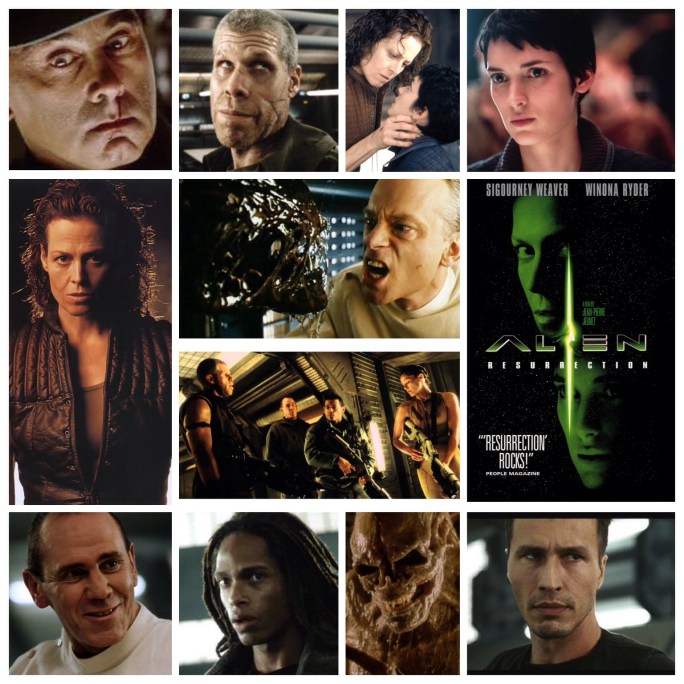
Alien Resurrection: A Review by Nate Hill

  
To this day it still amazes me how under appreciated and misunderstood Alien Resurrection is. The four films in the series are a quartet of vastly different stories, due to the fact that the torch was passed to four very diverse directors over the course of the legacy. Ridley Scott crafted a tense, claustrophobic catalyst. James Cameron made a rootin, tootin Wild Bunch set in a galaxy far far away where no one can hear you scream. David Fincher gave us an odd, inaccessibly disturbing thriller where the real monsters lurked inside the humans, literally. French Maestro Jean-Pierre Jeunet, best known for his own charmingly surreal quartet of distinctly European wonders Amelie, A Very Long Engagement, City Of Lost Children and Delicatessen, made the final film in the franchise. I once saw a post on IMDB which prompted users to describe each of the Alien films in one word. The one response that stuck with me was: Alien-suspense, Aliens-action, Alien3-unpleasant and Alien Resurrection-weird. Is this accurate? Depends on your opinion of the series. Resurrection is my second favourite, after Aliens. To some it was weird, to many a failure, but to me it’s a bona fide, rip roaring odyssey of gorgeous, gory design and offbeat ideas fleshed out by an absolutely legendary cast, headed up by Sigourney Weaver as Ripley. Two hundred years after she died, she is cloned using parts of the Xenomorph’s DNA, and kept sequestered on a titanic pseudo military ship run by whackos who have never heard of a certain expression involving curiosity and a cat. She awakens, the alien genes giving her a decidedly heightened awareness which Weaver plays with giddy, sinister glee. This ain’t the stalwart Ripley we are used to. Her eyes dance with an unearthly fire that pronounces ‘here be dragons’, in the spaces beyond science that humans foolishly venture into. The station is run by creepy, power hungry Dr. Mason Wren (underrated J.E. Freeman is almost ickier than the monsters themselves), and his sidekick Gediman, played by Brad Dourif in his final form, resembling a demented Pokemon who also raises more goosebumps than the aliens. The good doctor has commissioned a ragtag troupe of space pirates to bring him kidnapped humans in cryogenic sleep to be forcefully impregnated with alien fetuses. Lovely, right? This is where it gets interesting. Joss Whedon penned the script, and the crew of intergalactic badasses in this film are in fact the prototype for his endlessly successful TV series Firefly. Now, he claims that everything about the tone, delivery and execution of this film is wrong, and that the end result butchered his work. Here’s my take: I’ve seen Firefly. It’s good. But the team of space pirates in this movie are eternally more fascinating and worth spending time with. I feel that he really abandoned part of a great premise here, opting for a chipper, watered down version of a vision which presented itself to him and begged for further exploration. Firefly is fun, and it’s characters are a veritable Partridge Family of interplanetary characters to chill with, but it lacks the steel edged nastiness and grit that he began with here. Michael Wincott is a blast as the captain, Frank Elgyn, in a role that’s cut entirely too short but is aces while it lasts. Ron Perlman is a primate on earth and proves the same in space as Johner, the lovable lug of the crew. Gary Dourdan, the only black dude I know with blue eyes is Christie, with more than a few high powered tricks up his sleeves. Jeunet disciple Dominique Pinon plays wheelchair bound Riess, a tougher cookie than one might imagine. Lastly, Winona Ryder is Call, a doll with a pixie cut who takes an immediate shine to Ripley, leading them both to dark and dangerous places. Dan Hedaya makes lively work of Perez, the military honcho in charge, with Raymond Cruz, Kim Flowers and a shrieking Leland Orser rounding out the dream cast. As one might expect, all hell breaks loose in outer space as the creatures breed and hunt anything in their proximity. This provides loose cannon Jeunet with reason to fire off many a special effect that will give your gag reflex a workout and your pulse a solid pounding. There’s seriously gnarly stuff here, especially near the end with a certain fucking monster of an alien hybrid that acts as pure nightmare fuel while also being a bucket of fun at the same time. One of Whedon’s complaints was that his lighthearted script was given the heavy treatment, which obviously clashed with the vision he had. Fair enough. It was his baby after all. But for me though, it works bettering he ever planned. The characters maintain a sense of gallows humour laced with very real danger, garnished with cheeky levity in the face of unimaginable horror. That’s a good recipe to follow in any book I can think of. This one is ripe for redemption, certainly in the eyes of many who panned it upon release, and always ready for a revisit from myself.  

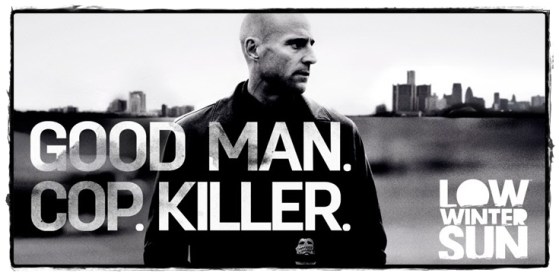
LOW WINTER SUN – A Review by Frank Mengarelli

poster-low-winter-sun-goog-man-cop-killer

LOW WINTER SUN came and went quickly but it packed a heavy gut punch. It was AMC’s remake of the BBC show of the same name that starred Mark Strong as Detective Frank Agnew. Strong reprises his role for the AMC remake. The show was a conventional, dark cop drama that lasted one season. Strong’s performance as the stoic detective put this show over the top, and Strong was able to show his range as an actor. He wasn’t just another archetypal cop, he was deeply layered. As the show ran its course, we would get glimpses into what made him the man he was.

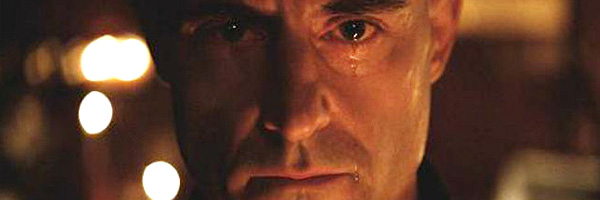
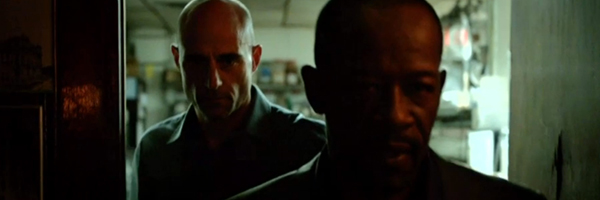
The storyline was just as layered as Strong’s character. The show starts with his partner (played perfectly by Lennie James), killing a fellow detective, and staging it as a suicide. Agnew was coerced into this by his partner who had told Agnew that the detective they killed, had killed Agnew’s Russian escort of a girlfriend. The first shot we see of the show is a tight closeup on Strong’s face, he is looking into the camera with a tear streaming down his cheek. We can hear his thought: I am not a bad man.

Strong LWS 1

The show progresses with multiple story arcs of police corruption, a young gangster on the rise, and Agnew’s “missing” girlfriend who was presumed dead. The show never overreaches, and all the story arcs are taut and perfectly executed. The build up pays off remarkably in the two part series finale. Strong, who played it calm and cool in the show, spirals out of control so fast, you can’t believe everything you are seeing in the final two episodes.

The first part of the series finale has a remarkable segment. Distraught, Agnew travels to see his ex wife, who we had previously knew nothing about. She’s remarried and has a kid. The latter is as a surprise to Agnew as it is to the audience. This is Agnew’s last stop. He’s lost control of the beast of a situation he helped create. He recounts to his ex wife their previous relationship. He remembering of their marriage is sweet and loving, something he holds very dear. His ex wife corrects him. She tells it like it was, not how Agnew re-remembered it. And there we have it, it’s all out on the screen, it’s the price that Agnew paid for his stoicism.

LWS3

LOW WINTER SUN ends on a perfect note. While I would have loved to have seen a second season to see where the characters progress onward, the arc is neatly buttoned up, and Agnew’s season long journey has come to a close. This show is a slow burn. It’s brooding and dangerous, and Mark Strong gives the finest performance of his career in an amazing tour de force.

LOW WINTER SUN is available to stream on Netflix.

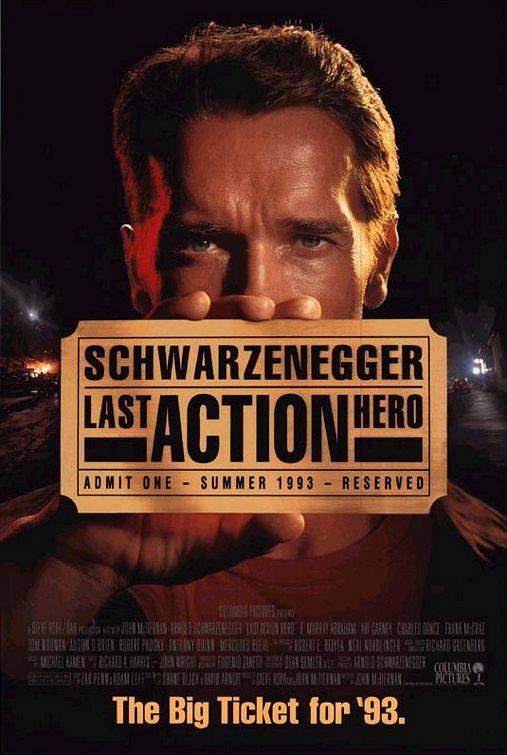
JOHN MCTIERNAN’S LAST ACTION HERO — A REVIEW BY NICK CLEMENT

1

I’ve seen this film 150 times. I can’t help but watch it whenever I find it playing on one of the HD movie channels. It’s never not hysterical and amazingly entertaining. Shane Black and David Arnott’s endlessly witty screenplay, which was based on an original script/story by Zack Penn and Adam Leff, was WAY ahead of its time. Back in 1993 people weren’t interested in satirizing the action movie genre; if this film got released today (and not up against Jurassic Park!) it does a lot better than it did. Critics waited with sharpened knives for this one, and never even tried to give it a chance. Fine, the kid is annoying, but I think that was part of the plan – the character is one of many constructs that the filmmakers sought to deconstruct. Arnold is VERY good here – sly, self-effacing, totally in on the joke. John McTiernan’s muscular sense of action (lensed by the great Dean Semler) is on display the entire time, with some really awesomely over the top stunts and sequences. There are so many wonderful throwaway lines and moments in this film, and the endless cameos and absurd supporting cast really sealed the deal. The ending is so meta it almost hurts, Tom Noonan POWER galore, and Arnold WIPING HIMSELF CLEAN WITH GENERIC PAPER TOWELS after falling into the La Brea Tar Pits. The absconding of Leo The Fart’s body is a great (and very funny) action set-piece, and Charles Dance and Anthony Quinn were both terrific. Silly, smart, and totally fun.

2

Q & A – A REVIEW BY J.D. LAFRANCE

MSDQANA EC007
Q & A, Nick Nolte (front, left), Timothy Hutton (front right), 1990. ©TriStar Pictures

Among the many genres prolific filmmaker Sidney Lumet has dabbled in, the one in which he excels and demonstrates the most affinity for is the crime thriller. In particular, he is fascinated with police corruption and how the law and order system works (or, in some cases, doesn’t work) in New York City. In the 1970s, he told the story of an undercover cop who deals with corruption among his fellow officers with Serpico (1973). In the 1980s, he depicted the plight of a police detective that informs on his cohorts after being busted himself in the magnum opus Prince of the City (1981). In the 1990s, Lumet tackled police corruption yet again but this time via the angle of racism with Q & A (1990). Based on the novel of the same name by New York judge Edwin Torres, Lumet’s adaptation received mixed reviews from critics and was largely ignored by audiences of the day. It has become something of a forgotten, underappreciated film in Lumet’s filmography and one that deserves to be rediscovered.

During the opening credits we see the rain-slicked streets of New York City through the back seat of a cop car. This sequence sets a nice, gritty tone and takes us on a mini-tour of the city where most of the film’s action takes place. However, Ruben Blades’ jarring song that plays on the soundtrack almost ruins it. I’m not quite sure what Lumet was thinking but it simply does not work here.

Lieutenant Mike Brennan (Nick Nolte) is a dirty cop as evident from his introduction where he ambushes an unarmed Latino drug dealer, blows the guy’s brains out and then bullies two nearby witnesses into saying that the man had a gun in his hand. Assistant District Attorney Al Reilly (Timothy Hutton) is assigned to the case. His boss tells him that the incident is a cut and dry one. He is told that Brennan is a good cop – a little rough in his methods but all of his cases have been tried successfully with no appeals. Reilly is instructed to collect the facts with the help of a stenographer and present them to a grand jury. His boss instructs him that “the Q & A defines what really happened. If it’s not the Q & A, it didn’t happen.”

Reilly is eager to please and is impressed with Brennan’s imposing presence and reputation. The young A.D.A. questions Roberto “Bobby Tex” Texador (Armand Assante), a drug dealer and racketeer, who, along with his wife Nancy (Jenny Lumet), witnessed the aftermath of the murder. He refutes the theory that the gun was found on the murder victim. Reilly begins to suspect that something might not be right with the case. He is also faced with a personal conflict as he used to be involved with Nancy and still has feelings for her. Reilly soon realizes that’s he’s taken on more than he can possibly handle. Sidney Lumet pits Brennan, Bobby Tex and Reilly against one another, each with their own agenda and the film gradually heads towards an inevitable confrontation between the three men.

Nick Nolte is a lot of fun to watch as a larger than life cop. He sports slicked back hair and a thick mustache that threatens to overtake his mouth. There’s a memorable scene early on where his character recounts a story to some other cops about how a mobster gave him a hard time when he tried to fingerprint him that is hilarious and disgusting. The scene has an authenticity of a veteran that delights in telling old war stories to inflate his own ego. Nolte’s Brennan is a chatty guy that loves to tell stories of past glories as he tries to buddy-up with Reilly until the A.D.A. lets him know that he’ll go after the veteran cop if he finds out he’s dirty. Nolte’s whole demeanor changes in a heartbeat and it is quite exciting to see him go from jovial to threatening in the span of a few seconds. Brennan is as corrupt as they get and enjoys the influence he exerts and the power he wields. He uses fear and intimidation to get what he wants. Nolte put on 40 pounds for the role because he felt that the character required it: “just the sheer mass of brutality. I felt that would be the right kind of thing. He had to be on the edge of his own dissipation.”

Armand Assante is a force of nature as Bobby Tex, portraying the crook with an aggressive swagger and an intensity that is impressively conveyed in his eyes. During Reilly’s initial questioning, Bobby oozes casual confidence and Assante does a great job of conveying it. He also imparts a keen intelligence. Bobby isn’t just some two-bit street punk. He doesn’t even blow his cool when Luis Guzman’s cop gets all in his face. Bobby matches his intensity and it is great to see two skilled character actors go at it. Assante ups his intensity when he warns Reilly to stay away from his wife. He gives the A.D.A. a seriously threatening look that would have most people shaking in their shoes. It’s Bobby’s first appearance in the film and Assante makes quite an impression.

Up against two lead actors playing colorful characters, Timothy Hutton wisely underplays Al Reilly. His character may be young and new to the job but he knows the law as demonstrated when questioning a mobster by the name of Pesch (Dominic Chianese) and his lawyer (Fyvush Finkel) in rather confident fashion. At first, it appears that the slick mob lawyer is going intimidate Reilly but the young man expertly turns the tables with his intelligence. Hutton is good as the straight arrow A.D.A. that decides to take on a highly respected cop and in the process uncovers an intricate web of corruption. The actor avoids stereotyping by showing layers to his character through the revelation of his feelings for Nancy which affects his approach to the case. Reilly starts off as an idealistic person but over the course of the film, as he’s exposed to corruption, he gains experience and becomes savvier when it comes to how things work. Early on in Q & A, there is a revealing conversation he has with Leo Bloomenfeld (Lee Richardson), a veteran attorney that has clearly been working in the system for far too many years. He’s jaded and tells the eager Reilly how things really are, giving him a taste of the corruption he will witness first hand later on. To prepare for the role, Hutton went on squad-car runs with police officers in Manhattan in order to get an idea of the challenges they face on the streets. He said of the experience, “in many cases the hands of the officer on the street are tied.”

Lumet shows how close these cops are by the short-hand between them and the familiarity they have with each other. In the scene where Reilly questions Brennan about the homicide in a room full of cops, the director really captures the camaraderie among these men. The dialogue sounds authentic and is delivered by the actors in a way that is so natural you believe that they are these characters. Consummate character actor Luis Guzman has a memorable role as a homicide detective that first suspects the Brennan case is rotten. He has a memorable moment where he jokingly defends Brennan’s casual racism: “He ain’t no racist. He hates everybody. He’s an equal opportunity hater.” Even though this is said in jest, in actuality it’s not far off the mark.

However, in his review for The New York Times, Vincent Canby wrote, “great little scenes overshadow bigger, more important ones. Characters come and go at speed. Watching the movie is an entertaining ride, but when it’s over it’s difficult to remember where, exactly, one has been.” USA Today gave the film two-and-a-half stars out of four and wrote, “Overkill ultimately wears Q & A down, despite two bravura performances and some Hutton understatement that’s adequate to the task. So, too, does unrelenting sordidness, a deadly love angle and a score (Ruben Blades) almost as awful as Cy Coleman’s sabotage of Lumet’s Family Business.”

One of the major themes Q & A wrestles with is racism. There is the casual kind between black, white and Latino cops and there’s the more damaging kind that resulted in the end of Reilly and Nancy’s relationship years ago. Racism informs a lot of the characters’ decisions and often motivates their actions. The film addresses racism in an honest way that you rarely see outside of a Spike Lee film. As he did with Prince of the City and later with Night Falls on Manhattan (1997), Lumet sheds light on how cops and crooks can be intricately linked and just how deep corruption runs in a sprawling metropolis like New York City. These films show how law and order works in fascinating detail and that feels authentic, much like the television show Law & Order does year in and year out.

TOMAS ALFREDSON’S TINKER TAILOR SOLDIER SPY — A REVIEW BY NICK CLEMENT

tinker


Elegant. Cool to the touch. Brilliantly layered and carefully doled out. Possessing a quietly stylish veneer that stresses every single shade of brown imaginable. Tinker Tailor Soldier Spy is one of the more literate modern spy films, directed with classy panache and extreme intelligence by Tomas Alfredson (Let the Right One In), and adapted from John le Carre’s celebrated novel by Peter Straughan (The Men Who Stare at Goats). Released in December of 2011, the film wasn’t given the splashiest push by its distributor, and already feels underrated to a certain degree, despite excellent critical support. Set in 1970’s England, the dense narrative pivots on the actions of MI6 chief, Control (a magnificent John Hurt), who sends one of his best agents (Mark Strong, always persuasive and commanding) to rendezvous with a general from the Hungarian army who might possibly have information leading to the uncovering of a duplicitous Russian agent who has infiltrated the ranks of the British spy organization. Of course, the mission becomes compromised, leading to double and triple crossing, allegiance testing, and a general sense that anyone could be anything at any point.

An ex-British spook named George Smiley (a perfectly weathered Gary Oldman) is called in to weed out the potential mole, in an effort to stop leaked information finding its way into Soviet hands. Filled to the brim with fantastic supporting performances from a stellar ensemble cast including Tom Hardy, Colin Firth, Stephen Graham, Benedict Cumberbatch, Toby Jones, Ciarán Hinds, David Dencik, Kathy Burke, and the always potentially sinister Simon McBurney, Tinker Tailor Soldier Spy hums along without any sense of forced narrative conceits or extraneous plot developments, keeping everything tight and smart. Cinematographer Hoyte van Hoytema (Interstellar, Her) and composer Alberto Iglesias were in perfect aesthetic synch, with fleet editing provided by Dino Jonsäter. There isn’t one false step that this film takes, with everything leading up to a quietly powerful finale. Also, that scene at the airport on the tarmac with the plane landing in the distance and slowly taxiing its way up to the actors – ABSOLUTELY AMAZING.


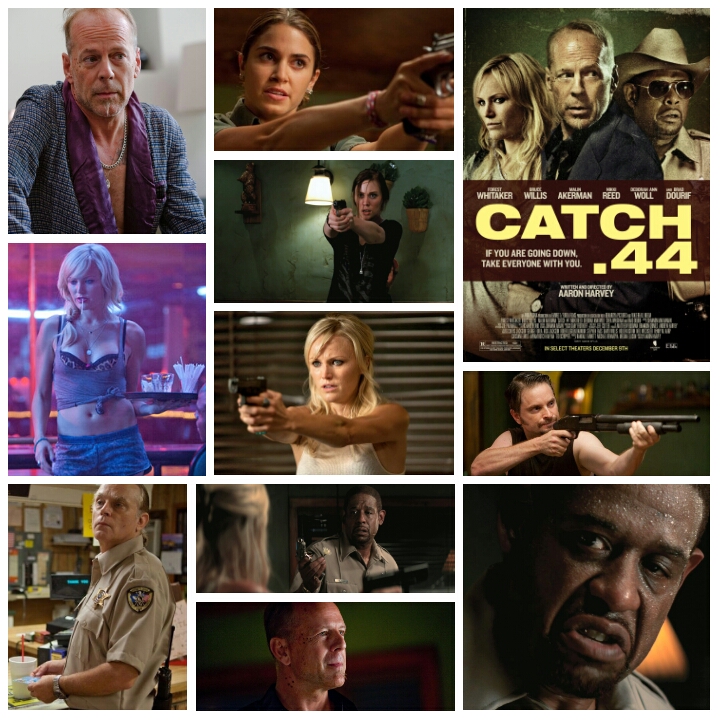
B Movie Glory with Nate: Catch 44

image

Catch 44 lives in that lurid interzone of direct to video crime thrillers that have the budget for the bare boned minumum: guns, a few big name actors stopping by for a paycheck, and a hard boiled, often ludicrous tale of criminals, cops and sexy chicks knocking each other off for some unnatainable trinket of wealth. Here we meet three lively femmmes fatale: Malin Ackerman, Nikki Reed and Daredevil’s Deborah Ann Woll, the angel’s to Bruce Willis’s Charlie, in this case a sleazy criminal kingpin named Mel. He tasks them with intercepting a mysterious package that passes through a lonesome truckstop diner. All hell breaks loose when the shotgun toting owner (Shea Wigham) takes them off guard,  and blood is shed. From there it all spirals into a mess of chases, strange pseudo artsy setups and the entire cast hamming it up royally as they essentially go nowhere fast. There’s Forest Whitaker who seems to have wandered in from the loony bin, playing a psychotic Sheriff who switches up his accent from scene to scene until we realize we are sitting there watching an Oscar winner warble out a choppy Tony Soprano impression and have to chuckle at the absurdity of it all. Willis has fun doing his nonchalant smirk to kingdom come and sporting a soul patch that steals his scenes before he gets a chance. There’s also an underused Brad Dourif as a confused highway patrolman who wanders in and out of the story. A lot of pulpy outings like this get accused of aping Quentin Tarantino’s style, and while that is often a lazy, bullshit critic’s cliche, here the claim is understandable and not necessarily a bad thing. The soundtrack is appropriately offbeat, the trio of girls have a Death Proof type cameraderie and Willis ambles through his scenes with a verbosity reminiscent of Pulp Fiction. The story is a little haywire and one wonders what the ultimate outcome even means, but it sure has a ball getting there in violent, kooky fashion.

IRON MAN 2: A Retrospective by Joel Copling

Rating in Stars: * (out of ****)
Cast: Robert Downey Jr., Gwyneth Paltrow, Don Cheadle, Scarlett Johansson, Samuel L. Jackson
Director: Jon Favreau
MPAA Rating: PG-13 (for sequences of intense sci-fi action and violence, and some language)
Running Time: 2:04
Release Date: 05/07/10

Iron Man may have contained roughly an equal share of strengths (its central casting coup and the performance that resulted from it, a tone that largely matched the protagonist’s personality in both its good and bad forms) and weaknesses (a structure that was restrictive to a formula shared by many origin stories, a villain who was bland outside of his incidental connection to the hero), but its first sequel exacerbates only the weaknesses and finds a few to call its own, as well. Iron Man 2 is a work of distinct smugness in a way that cannot be attributed to the titular superhero, who here more resembles an anti-superhero (super-antihero?) before becoming a tool of Justin Theroux’ witless screenplay and Jon Favreau’s anonymous direction.

Tony Stark, once again played by Robert Downey Jr. but in a performance that here seems bored with the material already, is dying. The miniaturized arc reactor, powered by palladium that keeps the shrapnel from an attack in the first film from entering his heart and killing him, is killing him. He’s looking for a replacement of the element and having no luck. As his faithful computer-program sidekick J.A.R.V.I.S. (voice of Paul Bettany) keeps telling him, he’s running out of options (His ultimate solution to the problem is muddled beyond belief). He opts not to tell Pepper Potts (Gwyneth Paltrow), his longtime personal assistant, whom he makes C.E.O. of Stark Industries out of fear of leaving the company in the wrong hands.

He’s been thinking about his dad (John Slattery via archival footage of the filming of promos for Stark Industries) a lot during this period of grief. Well, it would be a period of grief, if it wasn’t for the fact that Downey’s performance is almost exclusively a series of sequences in which he looks plaintive after checking the level of toxicity in his blood. Meanwhile, the Iron Man suit has been deemed a weapon by a sleazy Senator (Garry Shandling in a fun cameo that bookends the film), who wants the United States government to reclaim it, and Justin Hammer (Sam Rockwell), a Stark clone of sorts from whom Tony steals publicity with ease.

Everywhere one looks, smugness exists, whether it is Tony’s belief that inspiring the longest period of peace the United States has known (six months and climbing) is all about him or that Hammer’s ultimate endgame is to destroy Tony’s and Iron Man’s legacy by creating a new kind of military. It becomes dull quickly, especially as it all seems to come to a head when Tony, drunk and careless and wearing the suit, battles James Rhodes (Don Cheadle, replacing Terrence Howard for some reason) over ego and destroys most of his house. When Ivan Vanko (Mickey Rourke), a new villain, arises, a different and boring kind of ego also raises its head: Vanko is the son of the co-founder of Stark Industries and resents Tony’s legacy as a man whose actions have caused the deaths of so many.

The pieces of a good movie are here, but most of them are still in the box. Vanko’s entire motivation is just a bland reversal of the previous villain’s motivation, and it’s ultimately glossed over in the action sequences, which approach small-scale warfare with only one instance of ingenuity (the initial moments of Vanko disrupting a race in which Tony has randomly decided to take part) and a whole lot of nondescript visual noise elsewhere (the climax, which pits Tony and Rhodes against Vanko and his drones). The best part of Iron Man 2 is the provision of what amounts to a trailer for what is to come in the Marvel cinematic universe: Samuel L. Jackson (who with ten collected minutes of screen time devoted to exposition still gives the best performance onscreen), Scarlett Johansson, and Clark Gregg as agents of a government organization working in secret. The rest of this affair is dopey and self-obsessed.

WATCHMEN – A REVIEW BY J.D. LAFRANCE

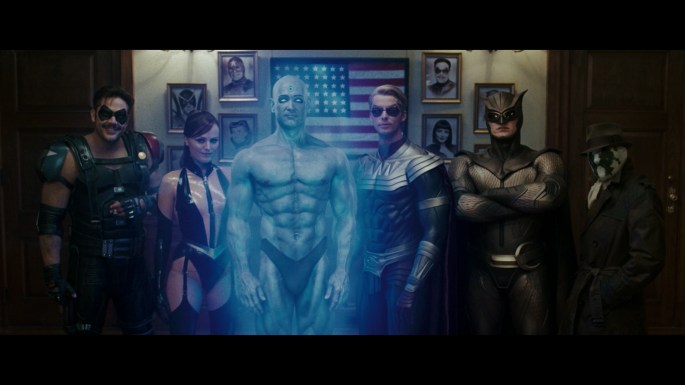
Watchmen-watchmen-13107406-1920-1080

To say the Watchmen film (2009) had a long and checkered production history is a massive understatement. Originally a 12-issue mini-series written by Alan Moore and drawn by Dave Gibbons that was released in 1986, it was a revisionist superhero story about a mysterious assassin killing off costumed superheroes but this is merely a springboard for a brilliant dissection of the genre and comics in general by manipulating symbols and icons. It also addressed the fear of nuclear annihilation that was so prevalent in the 1980’s. The series was a critical and commercial success despite Moore and Gibbons’ intentions for it to act as an epitaph to the superhero genre and ended up revitalizing superhero comics and spawned numerous rip-offs. It wouldn’t take long for Hollywood to come calling.

In 1989, just after he finished making The Adventures of Baron Munchausen, Terry Gilliam was approached to direct a film version of Watchmen by producer Joel Silver. Sam Hamm (Batman) wrote the screenplay, which by all accounts was awful. So, Gilliam discarded this draft and wrote his own with Charles McKeown (his screenwriting partner on Munchausen). Gilliam felt that the mini-series was unfilmable as a traditional two-hour film. The biggest problem lay in the financing. According to Gilliam, Silver said that he had secured a $40 million budget but in actuality he only had about $24-25 million. In 1996, after the success of 12 Monkeys, Gilliam was asked again and turned it down.

Nothing happened with the project for many years until it was announced that screenwriter David Hayter (X-Men) had signed a seven figure deal to adapt Watchmen for the big screen and possibly even direct it for Universal. Larry Gordon, who had long held the rights to Watchmen was going to produce the film. Originally, Hayter pitched Watchmen as a mini-series for HBO but the cost would have been an estimated $100 million. His way to condense the mini-series into a two-hour film was to break down the story points into their main components.

Filming was to being in Prague sometime in 2004; however, the option was picked up in April 2004 with Darren Aronofsky (Black Swan) being named as the director for Revolution Studios. By July, the project had moved over to Paramount when the deal fell through with Revolution. However, by early November 2004, Aronofsky was off the project due to scheduling conflicts with pre-production on The Fountain (2006). Paramount’s insistence on getting Watchmen out in theaters by summer of 2006 forced them to find another director fast. In late November of 2004, they picked Paul Greengrass (The Bourne Supremacy) to direct using Hayter’s script. It did not take long for problems to arise when in April 2005 Paramount was looking to cut the film’s budget by 20% while Greengrass was immersed in pre-production at Pinewood Studios in London, England. One of the reasons cited was the exchange rate of the U.S. dollar to the British pound. However, the studio put the project in the dreaded turnaround (i.e. development hell) in June of the same year because of change of studio heads and the new one felt that the budget for such a risky project was too high.

Finally, in 2005, the film’s producers took the project to Warner Bros. and approached Zack Snyder to direct as they were impressed with his work on 300 (2007), a stylish adaptation of Frank Miller’s graphic novel of the same name. Screenwriter Alex Tse was hired and he took elements from Hayter’s drafts while maintaining the Cold War setting of the comic book. The resulting film polarized critics and was a modest commercial success. Taking his cue from Robert Rodriguez’s adaptation of Sin City (2005), Snyder set out to make a visually faithful adaptation, often recreating certain panels exactly as they were presented in the comic book but ran into trouble when he deviated with his own preoccupations and stylistic flourishes. The end result is a film that is at times brilliantly faithful and also deeply flawed – a mixed bag but also an admirable attempt at an impossible task. The Ultimate Edition version, which fused the director’s cut with the animated short film, Tales of the Black Freighter (a comic book that runs throughout Watchmen, often commenting on the action), is the most complete version of Snyder’s take on the material.

Set during the mid-‘80s amid the nuclear arms race between Russia and the United States, Watchmen begins with two police detectives investigating the mysterious murder of Edward Blake (Jeffrey Dean Morgan) whose alter ego is the costumed superhero known as the Comedian, an amoral mixture of Nick Fury and G. Gordon Liddy. Another costumed vigilante by the name of Rorschach (Jackie Earle Haley) – imagine Travis Bickle mixed with Sam Spade – decides to conduct his own investigation and realizes that the Comedian’s death is only a small fragment of a much larger puzzle. He proceeds to notify the surviving members of the superhero team he belonged to: Dan Dreiberg (Patrick Wlison) a.k.a. Nite Owl, a Batman-esque crusader now retired; Laurie Jupiter (Malin Akerman) a.k.a. Silk Spectre, a beautiful woman pushed into the business by her famous mother, Sally (Carla Gugino), the original Silk Spectre; Adrian Veidt (Matthew Goode) a.k.a. Ozymandias, a billionaire businessman and considered by many to be the smartest man on the planet; and Dr. Manhattan (Billy Crudup), an omnipotent being capable of manipulating matter on a cellular level. As Rorschach’s investigation progresses it appears that someone is trying to eliminate all of his former team members but to what end?

The first indication that director Zach Snyder imposes his trademark style occurs in the prologue when the Comedian is killed by a mysterious assailant. Not only does he drag out the fight, but he also unnecessarily employs his slow motion/speed up technique. However, Snyder makes up for it with a superbly executed opening credits sequence that introduces this world and its alternate history timeline (i.e. the Comedian assassinates President Kennedy on the grassy knoll) while also including all kinds of visual Easter eggs for fans of the comic book (like showing how minor character Dollar Bill died). As a result, there is something for newbies and fans alike.

For everything Snyder gets right – the look and feel of the film, which features some truly astounding production design that completely immerses you in this world – he maddeningly gets other things wrong when he adds bits to scenes that have no purpose except to add a little more action for our ADD culture, like in the scene where Rorschach is discovered by two police officers as he’s searching the Comedian’s apartment. The masked vigilante subdues one of them and disappears before the other can collar him. Why? To show what a badass he is? This is unnecessary as actor Jackie Earle Haley’s excellent performance does that for him.

Another nice addition is the integration of an animated rendition of The Tales of the Black Freighter, a comic book within the graphic novel about the sole survivor (voiced by Gerard Butler) of a shipwreck who desperately tries to make it back home to his family before the pirate ship of book’s title does. Snyder nails the nightmarish Tales from the Crypt vibe of the comic while also restoring the newsstand scenes between the vendor and the kid reading the book, which fleshes out this alternate world.

Snyder makes some blunders with a few of the musical cues, like using “Ride of the Valkyries” in the sequence where Dr. Manhattan slaughters Viet Cong soldiers during the Vietnam War. The director is obviously paying homage to the famous use of the song in Apocalypse Now (1979) but it is unnecessary and too on the nose. However, the most glaring miscue is using “Hallelujah” by Leonard Cohen instead of “You’re My Thrill” as it was in the graphic novel. Do we really need this song played yet again in a film? This song and all versions of it need to be retired from cinema indefinitely.

For the most part the casting is spot on. Patrick Wilson put on weight to portray the slightly out of shape Dan Dreiberg and with his retro haircut and defeated posture certainly looks the part. Wilson gives Dreiberg a slightly sad, pathetic vibe, which suits the character. Billy Crudup nails the eerie detachment of Dr. Manhattan, a god-like being bored with humanity. The actor adopts a neutral tone akin to that of HAL 9000 in 2001: A Space Odyssey (1968). Perhaps the best realized and most faithfully recreated portion of the graphic novel is Dr. Manhattan’s tragic backstory, which also attempts to present his worldview: he perceives the past, present and future simultaneously. Crudup does a nice job of showing the transition of Manhattan from a mild-mannered scientist to omnipotent super being with some eerily uncanny recreations of panels from the graphic novel. We see how Manhattan’s ability to manipulate matter on a cellular level radically changes the course of world history (for example, the U.S. wins the Vietnam War with his help). According to Moore, his aim with Manhattan was to show that he “does not perceive time the same way we do. We have a character who’s post-Einsteinian, who seems to accept that all time is happening at once. Past, present and future. And to him, the past is still there, and the future is there, right now.”

Thankfully, the flashbacks depicting the Comedian’s backstory don’t shy away from his amoral behavior: trying to rape the original Silk Spectre and killing a Vietnamese woman pregnant with his child. Jeffrey Dean Morgan does a fantastic job conveying his character’s skewed worldview: how everything is part of a big, dark joke that only the Comedian gets. In his own way, he realizes that what costumed superheroes do – fighting crime – is ultimately meaningless in the face of nuclear annihilation. The darker and more chaotic things get the more he likes it. Morgan is also able to dig deeper during his tearful late night visitation with an old foe, giving us tantalizing hints at a much, darker and larger scheme at work – the knowledge of which got him killed in the first place.

Easily the strongest performance comes courtesy of Jackie Earle Haley as the sociopathic Rorschach. The most important thing he does is get the voice right. Everyone has their own idea of what he should sound like and Haley got it. Not only does he look great in the costume but also out of it during the portion of the film where he’s unmasked and in prison. The actor is even more chilling as he recounts to a psychiatrist how he became Rorschach and the incident that transformed him permanently into his costumed alter ego. This section of Watchmen offers a glimpse into his disturbing worldview in what is easily the darkest, most bleak part of the film, much like the graphic novel. But again, Snyder imposes his style unnecessarily, adding his own gory flourishes to Rorschach’s showdown with a kidnapper. It is excessive and clumsily executed like something out of a cheap B-horror film whereas the graphic novel was much more horrifying because it left the criminal’s fate to your imagination. Snyder is too busy making Rorschach look cool and failing to realize that in the graphic novel Moore and Gibbons were deconstructing the romantic costumed superhero myth and exploring what motivates someone to dress up and fight crime and how this might warp them. Rorschach wasn’t meant to be a cool character but a depressing, frightening one. His backstory was where, according to Moore, “we actually go for the heart of darkness, we go to the very center of this black, depressing sort of pre-nuclear worldview.”

The most significant miscasting of the film is actress Malin Akerman as Laurie Jupiter. While the attractive actress looks the part, she lacks the acting chops required for the role. Known mostly for romantic comedies, Akerman looks lost in the role, which is unfortunate as it’s the most pivotal part and arguably the most complicated character in the book. Laurie’s relationship with Dan is the emotional center of the story and this is diluted in the film by the casting of Akerman. Carla Gugino, who ironically plays her mother in the film, would’ve actually been better in the role – or, maybe Jennifer Garner who demonstrated a capacity for action and drama in the J.J. Abrams television show Alias.

Another glaring miscast role is that of Matthew Goode as Adrian Veidt. The actor doesn’t look like the character or really act like him either. He’s a little too smug and too over-confident in his portrayal whereas in the graphic novel Veidt was subtly condescending to those around him, coming across as almost distracted, the reasons for which become apparent later on. Snyder has said that he didn’t want to cast recognizable movie stars in the major roles but for Veidt, a celebrity in his own right and by his own making, this would’ve been a wise move. I always thought that Jude Law would’ve been a good choice as he looks the part and showed the capacity to play unlikable characters in films like The Talented Mr. Ripley (1999). Plus, while doing press for Sky Captain and the World of Tomorrow (2004), Law admitted to being a huge fan of the graphic novel and probably would’ve been willing to take a pay cut.

Watchmen perfectly summarizes Snyder’s limitations as a filmmaker. He slavishly recreates panels and sequences from the graphic novel without demonstrating any understanding of what they mean. For example, the climactic scene where Laurie convinces Dr. Manhattan to come back to Earth, that there is more to the universe than random molecules colliding with one another is handled all wrong. In the graphic novel, we find out that Sally loved the Comedian, even after he tried to rape her. The fact that she could feel for a person who committed such a horrible act goes against all logic and that Laurie was the product of their act of love is what convinces the Manhattan to renew his interest in humanity. The film waters this down completely and Sally says that she made a mistake being with the Comedian that one time but that she loves Laurie anyway. Whereas, the graphic novel is a thought-provoking look at human nature and our fascination with costumed superheroes, the film dilutes and tries to make it palatable for a mainstream audience while still trying to appeal to fans of the source material. This schizophrenic attitude is arguably one of the biggest flaws of the film.

Watchmen is a flawed mess of a film – one that gets many things right but also gets a lot of things wrong – but a fascinating one nonetheless. If I’m being overly critical on Snyder it’s only because I love the source material so much that seeing it brought to life in a film was at once exhilarating and depressing. One has to give Snyder credit for making it at all, for using his clout to make sure it was R rated and keeping it set during the ‘80s – two things he went to the mat for with the studio. He made the best possible film one could with the limitations of a feature film format. Ideally, the graphic novel could only truly be done justice in a mini-series format aired on a cable channel like HBO, which would free the filmmakers of the constraints of network television. Watchmen asks many questions but perhaps as Dave Gibbons points out, it really asks the big question: “Who makes the world? Who is responsible for the way the world is? And a lot of it is planned, but a lot of it is just sheer chance. There are patterns, the pattern that we perceive, but there are patterns going on underneath it. And that’s what we tried to show. With these sub, almost subliminal patterns that go through things, echoes, repeating shapes, motifs turning up in unexpected places.” Is the world made of patterns or is it sheer coincidence? The graphic novel expertly examines these questions and offers an entertaining story as well. The film? Not so much.