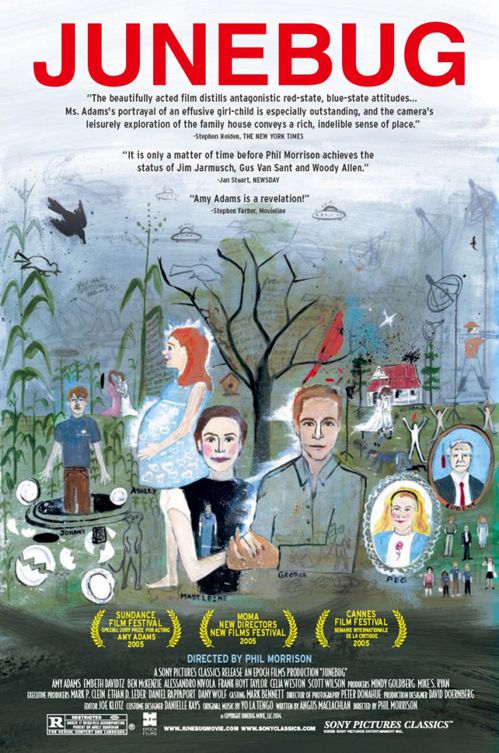
PHIL MORRISON’S JUNEBUG — A REVIEW BY NICK CLEMENT

junebug.jpg

If you haven’t seen Phil Morrison’s terrific independent film Junebug, seek it out on disc or via streaming options immediately. It’s a little gem, and provided a big launching pad for Amy Adams, who delivered a remarkable performance which netted a first Oscar nomination for this most wonderful talent. Working from a beautifully observed and emotionally sensitive script by Angus McLachlan, Morrison weaved a sad and funny southern-fried tale of dark familial dysfunction that will make you cringe one moment and laugh out loud the next. Never condescending or at any point making fun of the characters, Morrison’s subtle direction worked perfectly with McLachlan’s lived-in portrait of distinct American values and a particular lifestyle. The story revolves around George, played by Alesandro Nivola, who takes a trip down to North Carolina with his wife Madeleine, played by Embeth Davidtz. She’s an art dealer specializing in offbeat pieces who is drawn to the incredibly weird paintings of a racist and possibly crazy artist, who also happens to live near her husband’s family. Having only been married for six months and having never met his parents, Madeleine is taken back by the culture shock of staying with his family and his brooding, sullen brother Johnny, played by Benjamin McKenzie. The ensemble cast is perfection all down the line. Adams is astonishing as Johnny’s immature pregnant wife; it’s a performance that is so believable you’ll be convinced it’s not really acting. But to see how Adams has blossomed as a performer, from Enchanted to The Fighter and everything else in between, it’s further proof of how much range she possesses and how skilled she is as an actress. George’s mother, who almost instantly disapproves of Madeleine, is played by the great Celia Weston, who steals every scene she appears in. And the great character actor Scott Wilson is George’s quiet, wood-working father, the sort of many who values the amount of words that leave his lips, preferring to take a step back and experience life as a whole rather than a series of broken up pieces. I don’t want to reveal any plot points or spoil anything in this little film. It’s moving, hilarious, and poignant without being overly sentimental, extremely well-paced and directed, and truly deserves a higher profile.


B Movie Glory with Nate: Cyborg 2: Glass Shadow

image

The fact that Cyborg 2: Glass Shadow has almost nothing to do with the first Cyborg is probably a good thing. I’ve seen both, and the first one is an ugly, grimy early starring vehicle for Jean Claude Van Damme that plays like an episode of American Gladiators on PCP. This sequel, however, is a scrappy little sci fi delight. It takes plays in a futuristic B-Movie realm where maniacal corporations wage war on each other for the control of lucrative artificial intelligence, cyborgs who can be programmed to be slaves, soldiers or whatever you want. Angelina Jolie is Casella ‘Cash’ Reese, a gorgeous warrior Cyborg held under the watchful eye of the Pinwheel corporation, ruled by a hammy Allen Garfield. Her trainer, a mercenary named Colton Hicks (Elias Koteas) starts to fall in love with her. In this particular B movie universe, it’s implied that there are fragments of what may resemble a soul that begin to grow inside the cyborgs, and gradually Cash falls for him as well. They plan their escape, and embark into a delightfully cheap looking metropolis of the future, seeking an oasis far away that’s basically a non extradition zone for robots. Pinwheel sends some dangerous bounty hunters after them. There’s fighting. And running. And shooting. And Cyborg sex including a 17 year old Angelina going fully topless, which makes me wonder how the filmmakers ducked the authorities on that one. Not that I’m complaining. Aside from baring her chesticles, she makes a pretty solid action heroine at that age, and even before making a name for herself she carries the film pretty well. Koteas is pretty much capable of anything as far as acting goes, breezing through this one in his sleep whilst still keeping one eye open to give Hicks a vulnerability and desperation that the film hardly deserves. Character actor Billy Drago gives a scene stealing performance of sheer unbridled lunacy as Danny Bench, a terrifyingly unhinged contract killer who pursues the pair and has an absolute smackdown of a fight sequence with Koteas. That old salty dog Jack Palance even shows up for an amusing, warmhearted supporting role as a mysterious hacker who helps the duo out and in turn gets his own retribution. Get one thing straight right now: this a B movie. If you go into one of these with your critic’s brain shoveling coal into the fires of cynicism, you’re gonna have a bad time. These films are overtly cheap, chock full of deliberate plot holes and speckled with acting that could wilt flowers. But I love them anyway. I grew up watching an endless stream of direct to video horror, sci fi and thriller flicks that maybe ten people on planet earth besides me have seen. I love them, they are amazing and they exist in a realm far, far outside film ‘criticism’. It’s best to gear your brain into fun mode before hitting play, then just relax and enjoy. If you’re the type of person that can do that, you’ll love this kind of stuff. If not, steer well clear. Cyborg 2 is the perfect example of a B movie done right, and I’ll be the first to admit that there’s plenty that are made with the kind of lifeless ineptitude that doesn’t even deserve a place in the genre. This one’s cheaply made, doesn’t have much of a budget to its name, yet admirably creates it’s own little world with what it has, spinning a story of action, romance, robots and Angelina Jolie. Honestly, who can say no to those things? You, that’s who.

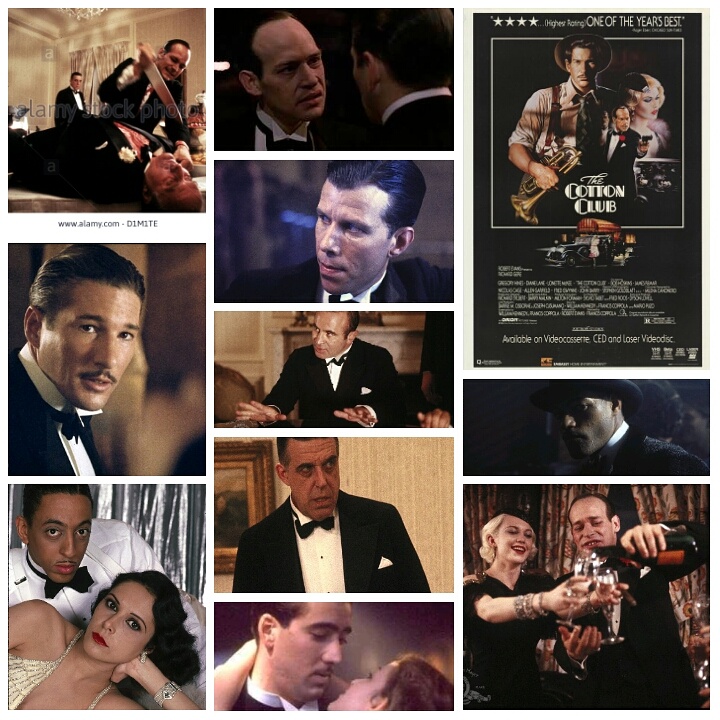
The Cotton Club: A Review by Nate Hill

image

Francis Ford Coppola’s The Cotton Club is every bit as dazzling, chaotic and decadent as one might imagine the roaring twenties would have been. it’s set in and revolves around the titular jazz club, conducting a boisterous, kaleidoscope study of the various dames, dapper gents, hoodlums, harlots and musicians who called it home. Among them are would be gangster Dixie Dwyer (a slick Richard Gere), Sandman Williams (Gregory Hines), a young Bumpy Johnson (Laurence Fishburne) and renowned psychopathic mobster Dutch Schultz (a ferocious James Remar). Coppola wisely ducks a routine plot line in favor of a helter skelter, raucous cascade of delirious partying, violence and steamy romance, a stylistic choice almost reminiscent of Robert Altman. Characters come and go, fight and feud, drink and dance and generally keep up the kind of manic  energy and pizazz that only the 20’s could sustain. The cast is positively stacked, so watch for appearances from Nicolas Case, Bob Hoskins, Diane Lane, John P. Ryan, James Russo, Fred Gwynne, Allen Garfield, Ed O Ross, Diane Venora, Woody Strode, Giancarlo Esposito, Bill Cobbs, Sofia Coppola and singer Tom Waits as Irving Stark, the club’s owner. It’s a messily woven tapestry of crime and excess held together by brief encounters, hot blooded conflict and that ever present jazz music which fuels the characters along with the perpetual haze of booze and cigarette smoke. Good times.

A PERFECT WORLD – A FILM REVIEW BY J.D. LAFRANCE

apw059In 1993, Clint Eastwood was enjoying a resurgence in popularity. His revisionist western Unforgiven (1992) won three Academy Awards and he received critical and commercial acclaim for his performance in the action-thriller, In the Line of Fire (1993). When he was approached with the screenplay for A Perfect World (1993), he was still making Line of Fire and doing promotion for the Academy Award nominations for Unforgiven. As a result, Eastwood anticipated only directing A Perfect World. However, when Kevin Costner came on board, he felt that Eastwood would be perfect for a smaller role in the film. Eastwood agreed because it wouldn’t require him to spend a lot of time in front of the camera.

A Perfect World is essentially a road movie set in Texas, 1963, three weeks before the John F. Kennedy assassination (an event that subtly hangs over the film with ominous foreshadowing) that recalls a simpler, even more innocent time. Thematically there is much more going on as the film wrestles with father/son relationships, child abuse and religion. The film begins with two convicts making a daring escape from prison only to take refuge in the neighboring suburbs. Terry Pugh (Keith Szarabajka) is the more amoral one as he wants to kill the driver of the vehicle they commandeer to leave the prison. He then later tries to rape a woman whose house he breaks into. The other convict, Butch Hayes (Kevin Costner), steps in before things go too far with Pugh and the woman. Butch even convinces her little boy, Phillip (T.J. Lowther), to give him the handgun that was dropped during the ensuing scuffle.

This is a crucial moment because it establishes early on the instant bond between Butch and Phillip. Despite the circumstances, there is something about Butch that Phillip intrinsically trusts. What this is will become more apparent later on in the film. When a neighbor intervenes unexpectedly, Butch and Pugh kidnap Phillip and take off in a stolen car. Texas Ranger Red Garnett (Clint Eastwood) is called in to track down and bring in the fugitives. However, the Governor (Dennis Letts) assigns him a criminologist by the name of Sally Gerber (Laura Dern). He immediately resents her intellectual approach to the situation as opposed to her being a woman, which would have been the norm at the time. He tells her, “This is not a penal escape situation, this happens to be a manhunt. And no talking around in circles is gonna fix all that.” Eastwood immediately establishes an antagonistic relationship between Red and Sally, which parallels the antagonistic relationship between Butch and Pugh. In no time at all, both conflicts will be resolved – one amicably, the other violently.

Like many of Eastwood’s characters, Red works on instinct and common sense. He resents authority figures and bureaucracy. He likes to be left alone and do things his own way. He sees Sally as an annoyance and a possible obstacle in his path. However, she clears the air pretty quickly, letting him know that she’s no pushover when she tells him, “But the one thing I won’t do is be your straight man so you can play hero to a bunch of morons who think you’re some kind of hillbilly Sherlock Holmes.” These lines deflate Eastwood’s traditional stoic lawman façade and Red even offers a compromise of sorts. He encourages Sally to speak up and even though he might not agree with her theories, he’s willing to listen. A Perfect World proceeds to cut back and forth between Butch and Phillip’s developing friendship and the partnership between Red and Sally with the two storylines dovetailing finally at the film’s conclusion.

One of the hallmarks of Eastwood’s directorial efforts is an emphasis on character and the relationships that are created between them. This film is no different with John Lee Hancock’s superbly written screenplay. He would go on to adapt Midnight in the Garden of Good and Evil for the film of the same name that Eastwood also directed in 1997. Sadly, they haven’t teamed up since but these two efforts are proof that they were a good match for each other. Hancock’s screenplay is filled with clever dialogue, like when Butch tells Phillip his theory about how a car is a time machine. Everything behind them is the past, everything in front is the future and inside the car is the present. “We’re time traveling through Texas,” Butch proudly proclaims. And in a way that’s what the film is doing – taking us back to a time that doesn’t exist anymore, to a time before President Kennedy was killed and when people were more hopeful and optimistic. His assassination (and that of other key figures of the 1960s) changed all that and we watch these events transpiring with the knowledge of how radically history will change in a few short months.

Hancock’s screenplay should also be noted for how well it develops the relationship between Butch and Phillip. Early on, Butch puts his trust in the boy by leaving him and Pugh in the car with the gun while he goes into a store for supplies. Pugh is able to get the drop on Phillip and take the gun away from him only to find out that there are no bullets in it. Butch assumed that this would happen and did not want to see Phillip get hurt. He may be a convict but he is not as heartless as Pugh. In turn, Phillip trusts Butch and stays with him even when he has the option, on a couple of occasions, to escape. Butch makes Phillip feel important and needed. Once they are on the road, having ditched Pugh, Butch refers to the boy as the navigator of the car. Later on, he asks Phillip to scout a car that he is interested in stealing. Butch doesn’t make Phillip feel like a passive observer but encourages him to become involved in their adventures.

Another significant factor in their friendship is Phillip’s lack of a father figure – something that Butch can also relate to and this provides common ground between them. Butch also speaks honestly to the boy. In one scene, when Phillip says that his mother told him his father would return, Butch replies that she lied and that he is never coming back. He doesn’t come out and say it but we sense that Butch knows this from his own personal experience. He also broadens the boy’s horizons by allowing him to experience things that his Jehovah’s Witness practicing mother would never condone, like drinking soda or wearing a Halloween costume and going trick or treating.

The relationship between these two characters works so well not just because of the excellent script but also because of the strong performances from Costner and T.J. Lowther. On the surface, Butch seems like one of Costner’s cocky, cool characters that he is often known for (i.e. Fandango, Silverado or Bull Durham), yet underneath lurks a dark, dangerous streak that surfaces when he sees a child being abused (the sure sign that Butch was probably abused when he was a child as well). Eastwood never lets us forget that Butch is a criminal. Costner is able to balance this element of danger with his trademark charm, like when he helps Pugh differentiate between a fact and a threat in a scene that is slightly threatening because violence is involved but is also funny as well because of the absurd tone. If Costner had any doubts about his character going into this film, Eastwood assured him that movie stars like Humphrey Bogart and James Cagney weren’t afraid to play convicts and “have a bad side,” the director said, “and I had Kevin play a much harder edge than he has played.”

Lowther matches Costner’s performance with his superb take on a shy, young boy who develops a strong bond with his captor. He has such an expressive face, which he uses to great effect during emotional scenes, like the internal conflict that becomes apparent when Phillip is given the chance to escape or stay with Butch. He has been cut off from everything and everyone he knows. He has little choice but to stay with the convict. Lowther doesn’t have too much dialogue but he is able to convey so much with a look and with his expressive eyes. He is more than capable of holding his own with Costner and their scenes together are well-played as we see their friendship develop over time. Eastwood was never interested in playing the sympathy angle with this friendship. He said, “You can’t have him treat the kid as if he’s paternal. I didn’t want it to come off like he’s cuddling the kid.” Above all, the director did not want the boy to “become precious. I wanted an un-Disneyesque kid.”

The script also provides motivation for Red’s personal interest in this case. We learn that the lawman put Butch in juvenile hall when he was young in an attempt to save him from his abusive father but it turned him into a career criminal. Red even paid off a judge so that Butch would stay in longer and so he feels guilty and responsible for what happened to him. Even though he never comes out and says it, one feels that Red wants to be the person to find Butch and try set things right. This backstory also explains the convict’s hatred for any kind of child abuse (Pugh hitting Phillip or a mother physically scolding her two children) and this manifests itself in a particularly strong way towards the end of the film when he and Phillip take refuge in a poor family’s house in what is surely the darkest scene in the film. After witnessing the father repeatedly abusing his little boy, Butch hits and threatens the father, his own rage threatening to boil over. A scene that started off warm and inviting turns into one that is uncomfortable and filled with tension as Phillip sees just how dangerous Butch can be. He ties up the entire family and we see how this affects Phillip as he observes the fear in the eyes of the mother and her child as Butch threatens the father repeatedly.

Phillip stops Butch before anything fatal happens to the family but the question lingers, was he going to kill them or just tie them up so that they couldn’t get away? Regardless, Phillip shoots Butch and runs away, setting the stage for the film’s climactic showdown between Red and Butch. Even here, Eastwood defies our expectations by drawing out the stand-off. The relationship between Butch and the boy continue to play out as he apologizes for shooting him. They have one last emotional conversation and because we have gotten to know these characters, we care about what happens to them. Their final moments are very touching, even moving. Costner and Eastwood finally have a scene together and this is what we’ve been waiting for the entire film. Not much is said between them and this is because we already know their motivations, Eastwood has been building to this moment. Visually, A Perfect World begins and ends the same with a slow motion shot of Butch lying in a field with money floating around him in the wind but by the film’s conclusion we know how and why he got there.

These sequences feel like something out of a dream and coupled with the leisurely pace probably didn’t endear it to mainstream audiences who were expecting another crowd-pleasing popcorn movie like In the Line of Fire. A Perfect World is closer to Unforgiven thematically as both films explore how the sins of the past affect the present with Eastwood playing tortured characters that try to fix old mistakes that had life-altering consequences but end up resolving things violently. In the case of Unforgiven, Eastwood’s character takes an active part in this resolution but with A Perfect World events spiral out of his control. This film is one of his most underrated efforts to date with its almost lyrical approach making it ripe for rediscovery by another generation of filmgoers receptive to an Eastwood film with complex relationships and a tragic conclusion reminiscent of more recent efforts like Mystic River (2003) and Million Dollar Baby (2004).

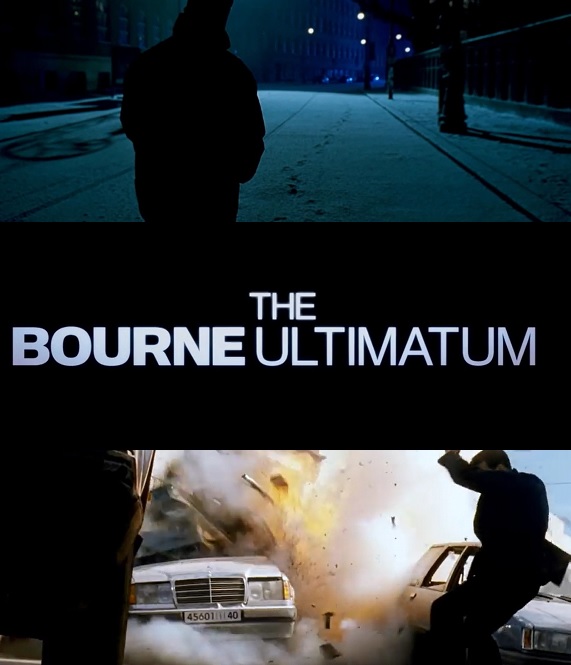
PAUL GREENGRASS’ THE BOURNE ULTIMATUM — A REVIEW BY NICK CLEMENT

ult

Paul Greengrass is one of my absolute favorite action movie directors, and The Bourne Ultimatum is easily my top choice in the series. Greengrass got his start in British documentary television and exploded on the feature scene with the inexorably intense Bloody Sunday, which is about as compelling as fact based cinema can get. He then moved to the second film in the Bourne franchise, The Bourne Supremacy, which was an excellent follow up to Doug Liman’s terrific first installment. Then, Greengrass directed one of the most unforgettable pieces of filmmaking I have ever seen, the 9/11 drama United 93. That film, though extremely tough to watch, is an extraordinary piece of storytelling, totally riveting and down-right scary at times. It’s some of the best pure direction that I’ve seen in a film, so it was no surprise to see that he would get Oscar nominated for his powerful achievement. Building on his famous brand of shaky-cam style that he used in his fist few movies, the work he did on United 93 is monumental, and he brought the same level of verisimilitude to The Bourne Ultimatium, which was critically acclaimed and did massive box office. Matt Damon kicked a ton of ass in the lead role yet again, and the many story threads developed in the first two pictures were all tied together in an extremely satisfying way.

But what blew me away the most about The Bourne Ultimatum was how Greengrass ratcheted up the intensity from the very first scene. It’s like being on a rocket ship for two hours; the film never stops to catch its breath, it’s refreshingly spare with dialogue (what little is said is all that needs to be said), each action set-piece existed in service of the story, not in place of it, and the hand-held cinematography by Oliver Wood was downright sensational even if a few shots sort of defy normal cameraman logic. And the incredible car chase through NYC was absolutely stellar, up there with some of the better screen pursuits of all time, and really demonstrating how hard it must be to coordinate a massive action sequence during the day in the Big Apple. Greengrass always brings his audience into the action whenever possible, using fast cuts and hectic camera movements not as a distraction, but rather as a way to make the viewer feel as if you’re in the middle of the action. I understand that many people don’t like this filmmaking aesthetic. And that’s fine. There are tons of classically shot action films I could point you in the direction of. But in terms of modern stylistic brilliance within the overcrowded action genre, Greengrass is at the top of the list, and I’m not surprised that so many other filmmakers have adopted his inherently visceral style.


Hearts In Atlantis: A Review by Nate Hill

  
The one great benefit that any film based on a Stephen King story has is just that: it’s based on a Stephen King story. The guy is just such a prodigy of fiction that even if the film version of one of his books doesn’t deliver, one can still see the brilliant blueprint lurking beneath the frames. When the filmmakers are successful, however, we get a visually stimulating project founded on the tale he has weaved to support all the other elements. Hearts In Atlantis is based on an anthology volume of his, and in fact the story the film follows isn’t even called that, it’s actually ‘Low Men In Yellow Coats’. I can see why the director went with Hearts In Atlantis though, as it’s much more akin to the ethereal, sentimental tone he was going for, and less of an ominous hook. The story itself follows a mysterious man named Ted Brautigan (Anthony Hopkins), a recent tenant in the home of young Bobby Garfield (Anton Yelchin) and his wayward mother (a miscast Hope Davis). The setting is Midwestern America, in the dead heat of a 1950’s summer. Bobby spends his days cavorting in the local woodlands with his fastest of friends, Carole (Mika Boorem) and Sully (Will Rothhaar). He takes a shine to Ted though, who pays him a dollar a week to read to him, and warns him of shadowy ‘low men’, threatening figures who doggedly pursue him for nasty reasons. Ted becomes a father figure for young Bobby, whose mother has questionable ideas about not only raising a son, but taking care of her own affairs. Now the film may seem a bit thinly plotted to some, and there’s a reason for that. This story is actually a tiny fragment in a much larger tale, King’s magnum opus The Dark Tower. Ted and Bobby have important parts to play in that saga, in which the events of this film are but a sentence long. Some viewers may feel slighted by a lack of context, but the filmmakers here still find a way to make this its own story, crafting a touching coming of age story melded with whispers of otherworldly intrigue. The fusion of beguiling nostalgia and the vague menace that advances on Bobby and Ted makes for a unique tone, something just south of a thriller which can’t quite be pinned down by genre labels. Hopkins can be both terrifying and tender depending on the role. Here he is kindness incarnate as a man whose worldly intuition goes beyond telekinesis into the kind of qualities reserved for the best and brightest. Yelchin and Boorem, who would star alongside each other again a few years later in the lacklustre Along Came A Spider, are the superb heart of the film. Yelchin has shown a constant progression of strongly realized, believable work and the quality of his craft can be traced back to this stunning genesis role. Boorem is highly underused these days, and one need only watch her light up the screen with emotional sincerity in this to see why she should be working far more. There’s neat supporting work from Tom Bower, Celia Weston, Alan Tudyuk and David Morse as an older version of Bobby who yearns for days gone by. I found myself deeply enjoying this one whilst constantly drawing back to the knowledge and context I have for it via The Dark Tower, but the film on it’s own is enough to provide a rewarding experience for anyone who isn’t familiar with the multiverse. Amid King’s favourite topics and settings are Midwest adolescence, idiosyncratic nooks of Americana and the ever present supernatural aspect, dynamics which Hearts In Atlantis gives us aplenty, along with an open invitation to explore the universe farther, should one want to venture along the path to the Tower. I’d recommend it. 

DAVID CRONENBERG’S A HISTORY OF VIOLENCE — A REVIEW BY NICK CLEMENT

history_of_violence_xlg

I love the psychological underpinnings of David Cronenberg’s A History of Violence. Josh Olson’s casually deceptive screenplay in tandem with Cronenberg’s typical obsessions with duality, sex, and graphic violence made for a truly memorable crime thriller, a film with a smart subversive streak running under the surface. There are so many stand-out scenes in this film, especially during the final act, when William Hurt comes in and blows the doors down with a show-stopping portrayal of pure evil. I love the moment when Maria Bello lies to the cop in the living room, and then she and Viggo Mortensen, who gave a brilliant performance, proceed to smack each other around, which leads to one of the roughest, most vigorous big-screen sex-scenes, the two of them banging each other on the hard, old, wooden steps of their house, with Bello taking out her frustrations on Mortensen, as he begins to slowly unravel, becoming the man he’s tried so hard to leave behind. And then right after this intense moment of physical sexuality, you have this fantastic shot of Bello sitting up in her bed, with the moonlight creeping into the room, and you can see the indentations on her back from those wooden steps, which have clearly left an indelible mark on her in more ways than one. Mortensen is his usual tremendous self, never giving up any of the inherent mysteries that his character is holding deep inside, allowing the revelations to be slowly parsed out via facial expressions, body language, and the manner of his speech. Ed Harris was the definition of nasty, with a calmness to match his explosive rage and violent tendencies. Hurt’s absolutely magical and darkly hilarious performance during the film’s obscenely awesome climax seals the deal on this thematically probing piece of work. I love how Cronenberg and Olson were able to take various elements from crime and noir and spin them into a unique brew that hits various tones and notes all throughout the twisty and twisted narrative. Peter Suschitzky’s matter-of-fact yet stylized cinematography rarely calls overt attention, but is still extremely clever in its use of angles, composition, and color palette. This is just a terrific movie all around and one to catch up with if you’re not familiar.


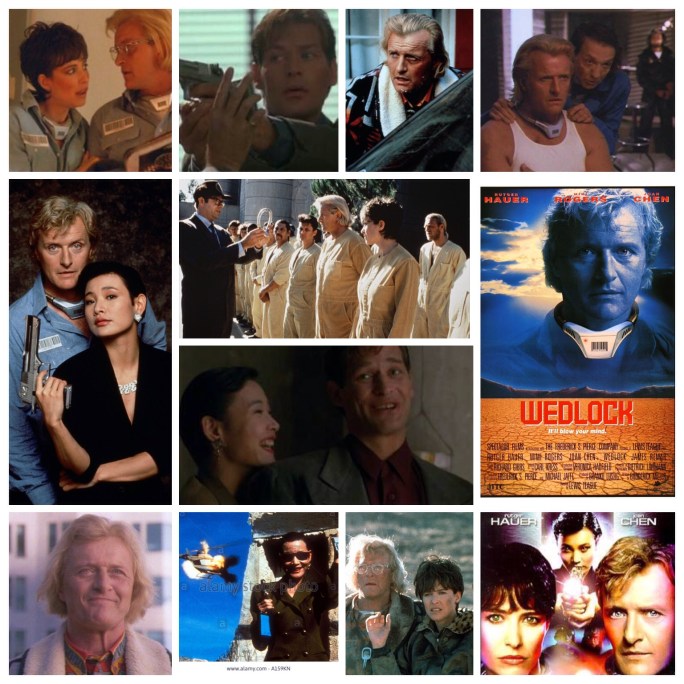
B Movie Glory with Nate: Wedlock


Wedlock is one of those shamelessly trashy B-movie romps that the 80’s proudly churned out in droves for our viewing pleasure. Some are shitty and enjoyable, some are just shitty, and some are solid gems, provided you’ve been schooled a bit in this particular, acquired taste of an arena. I spent a lot of my teenage years being a scholar in this sort of lovable junk, so I have plenty of ancient data in my mental hard drive to dust off for the old blog-ski. Rutger made quite a few ventures into this field (come to think of it most of my favourite actors have. Wonder what that says about my taste lol). He’s got genre written all over his acting style, and loves to play broad characters in stylized fare. Here he plays Frank Warren, an amiable jewel thief who is betrayed in an opening sequence heist by his dodgy partner Sam (James Remar), and rowdy girlfriend Noelle (Josie Packard- I mean Joan Chen). He’s sent to an amusingly ‘futuristic’ penitentiary where they implement prisoners with a unique system: each prisoner is fitted with a collar, each collar has a twin collar, and if the two get several miles apart, both detonate rigged explosives and messily decapitate the pair of unlucky inmates. They are not aware who has their twin collar, making escape a risky notion indeed. It’s exactly the type of high concept buffoonery that trademarks these type of outings, and it’s played for both suspense and laughs very nicely. Frank escapes, dragging along the woman who wears the twin collar (Mimi Rogers), pursued hotly by Sam and Noelle who want to find the diamonds that he hid shortly before his arrest. It’s a prison flick, it’s a chase flick, with its own kooky, offbeat sense of style. Hauer is usually so intense he looks like he’s gonna implode in on himself, but here he gives a very laid back, slight and funny performance, which gives the film it’s refreshingly upbeat feel. Remar and Chen are bouncing balls of energy as the dastardly couple out to ice Frank, riffing off each other and cheerfully chewing scenery. Watch out for an early career appearance from Danny Trejo, as well as work from Glenn Plummer and Stepehn Tobolowsky as a hard ass warden who gets the best line of the film: “You non-conformists are all the same”. That alone encapsulates the irreverent, tongue in cheek tone that’s a nice switch from the usually dank, oppressive atmosphere that second tier action flicks often get saddled with. Oh, and I want the number of Hauer’s wardrobe outfitter; those fluffy, technicolor wool sweaters are a sideshow unto themselves. 

BIG TROUBLE IN LITTLE CHINA – A REVIEW BY J.D. LAFRANCE

big trubs born ready

“What I’d like to do today is get your version of what happened,” says a mild-mannered, middle-aged attorney. “Oh? You mean the truth,” replies a rather small, aging Chinese man who identifies himself as bus driver, Egg Shen (Victor Wong). The attorney remains skeptical as his potential client calmly describes his belief in Chinese black magic, and other supernatural phenomenon. As if to prove his point, the man holds up his hands so that they are parallel to one another. Suddenly, small bolts of blue electricity begin to flow from each palm, much to the attorney’s amazement and Shen’s bemusement. “That was nothing,” Shen states. “But that’s how it always begins. Very small.” And with this intriguing, tell-me-a-scary-story teaser, John Carpenter’s film, Big Trouble in Little China (1986), takes us on a ride into the heart of ancient Chinese lore and mythology.

Carpenter, always the maverick director with a knack for exploring offbeat subject matter (see They Live and In the Mouth of Madness), created a film that simultaneously parodies and pays homage to the kung-fu film. This often-maligned genre is given a new level of respectability that is rarely seen in Hollywood. Gone are the ethnic slurs, the insulting stereotypes and that annoying quasi-Chinese music that always seems to accompany representations of Asians in past mainstream features. Big Trouble takes great care in presenting funny and intelligent characters without caring whether they are Chinese or not. What is of paramount importance to Carpenter is telling a good story. He has created an entertaining piece of fantasy that manipulates the conventions of the action film with often-comical results.

From the engaging prologue, Big Trouble takes us back to the beginning of our story with the first appearance of truck driver Jack Burton (Kurt Russell), a good-natured, fast-talking legend in his own mind. When he and his buddy, Wang Chi (Dennis Dun), go to the airport to pick up the latter’s future bride arriving from China, a mix-up occurs. Wang’s bride-to-be is kidnapped by The Lords of Death, a local gang of Chinese punks, and the duo quickly find themselves immersed in the middle of an ancient battle of good vs. evil with immortality hanging in the balance. This struggle takes place deep in the heart of the Little China neighborhood of San Francisco with Burton and Wang Chi taking on David Lo Pan (James Hong), “The Godfather of Little China.” Even Egg Shen appears to help our heroes and provide them with the means to stop the evil that threatens not only Little China, but of course, the whole world.

Big Trouble in Little China was originally written as a period Western set in the 1880s with Jack Burton as a cowboy who rides into town. Producer Paul Monash bought Gary Goldman and David Weinstein’s screenplay but after a reading he found that it was virtually unfilmable due to the bizarre mix of Chinese mythology and the Wild West setting. He had the two first-time screenwriters do a rewrite, but Monash still didn’t like it. “The problems came largely from the fact it was set in turn-of-the-century San Francisco, which affected everything — style, dialogue, action.” The producer decided against having Goldman and Weinstein do additional rewrites because they didn’t want to upgrade the story to a contemporary setting and felt that they had done their best.

Keith Barish and Monash brought in W.D. Richter, a veteran script doctor (and director of cult film, The Adventures of Buckaroo Banzai) to extensively rewrite the script. Almost everything in the original screenplay was discarded except for Lo Pan’s story. “I realized what it needed wasn’t a rewrite but a complete overhaul. It was a dreadful screenplay. This happens often when scripts are bought and there’s no intention that the original writers will stay on.” Richter’s template for his draft was Rosemary’s Baby (1968). “I believed if, like in Rosemary’s Baby, you presented the foreground story in a familiar context — rather than San Francisco at the turn-of-the-century, which distances the audience immediately — and just have one simple remove, the world underground, you have a much better chance of making direct contact with the audience.” Richter was having a hard time getting his own scripts made into movies so he tried sneaking in his own eccentric ideas into other people’s projects. “It’s often easier to take an idea that they bring to you and try to pass it through your sensibility. If you’re honest up front, you get license to work with material you wouldn’t get them to look at if it was your own story.”

John Carpenter had wanted to do a film like Big Trouble in Little China for some time. Even though it contains elements of an action / adventure / comedy / mystery / ghost story / monster movie, it is, in the filmmaker’s eyes, a kung-fu film. “I have dug the genre ever since I first saw Five Fingers of Death in 1973. I always wanted to make my own kung-fu film, and Big Trouble finally gave me the excuse to do just that.” Barish and Monash offered Carpenter the movie in July of 1985. He had read the Goldman/Weinstein script and deemed it “outrageously unreadable though it had many interesting elements.” After reading Richter’s script he decided to direct. Carpenter loved the off-the-wall style of Richter’s writing and coupled with his love of kung-fu films, it is easy to see why he jumped at the opportunity to make Big Trouble.

The two filmmakers had crossed paths before when Carpenter rewrote Richter’s screenplay, The Ninja, a big-budget martial arts epic, for 20th Century Fox. In fact, Richter and Carpenter had both attended University of Southern California Film School from 1968 to 1971. “Rick and I went through all three production classes together. We each had our own crews, so we never actually collaborated on a film.” Carpenter made his own additions to Richter’s screenplay, which included strengthening Gracie Law’s role and linking her to Chinatown, removing a few action sequences (due to budgetary restrictions), and eliminating material deemed offensive to Chinese Americans. Carpenter was disappointed that Richter didn’t receive a proper screenwriting credit on the movie for all of his hard work. A ruling by the Writer’s Guild of America gave Goldman and Weinstein sole credit.

Problems began to arise when Carpenter learned that the next Eddie Murphy vehicle, The Golden Child (1986), featured a similar theme and was going to be released near the same time as Big Trouble. Ironically, Carpenter was asked by Paramount to direct The Golden Child. “They aren’t really similar. Originally, Golden Child was a serious Chinese, mystical, very sweet, very nice film. But now they don’t know whether to make it funny or serious.” However, as both films went into production, Carpenter’s views of the rival production became increasingly bitter. “Golden Child is basically the same movie as Big Trouble. How many adventure pictures dealing with Chinese mysticism have been released by the major studios in the past 20 years? For two of them to come along at the exact same time is more than mere coincidence.” To avoid being wiped out by the bigger star’s film, Carpenter began shooting Big Trouble in October 1985 so that 20th Century Fox could open the film in July 1986 — a full five months before Golden Child’s release. This forced the filmmaker to shoot the film in 15 weeks with a $25 million budget.

To achieve the efficiency that he would need for such a shoot, Carpenter surrounded himself with a seasoned crew from his previous films. He reunited with three long-time collaborators, line producer Larry J. Franco (Starman), production designer John Lloyd (The Thing), and cinematographer Dean Cundey. The cameraman had worked with Carpenter on his most memorable features: Halloween (1978), Escape from New York (1981), and The Thing (1982). The director wanted as many familiar faces on board because “the size and complexity are so vast, that without it being in dependable, professional hands, it could have gone crazy…So I went back to the guys who had been with me in the trenches before on difficult projects.”

Carpenter and Cundey had parted company before Starman due to “attitude problems.” Cundey says it was due to scheduling conflicts, but Carpenter has said that they had problems while working on The Thing. However, when Big Trouble came along, Carpenter met Cundey in Santa Barbara one weekend. “His attitude about survival in the [movie] business coincided with my own. We had a really good time, so we decided to work together again.”

Big Trouble also saw Carpenter re-team with his old friend, actor Kurt Russell who has appeared in several of the director’s films, most notably Escape From New York and The Thing. At first, Carpenter didn’t see Russell as Jack Burton. He wanted to cast a big star like Clint Eastwood or Jack Nicholson to compete with Golden Child‘s casting of Eddie Murphy. However, both Eastwood and Nicholson were busy and Fox suggested Russell because they felt that he was an up-and-coming star. The actor remembered reading the script and thinking that it “was fun, but I was soft on the character. I wasn’t clear how to play it. There were a number of different ways to approach Jack, but I didn’t know if there was a way that would be interesting enough for this movie.” After Carpenter and Russell began to go over the script, the character started to take shape. The role was a nice change for Russell as Carpenter remembers, “Kurt was enthusiastic about doing an action part again, after playing so many roles opposite ladies recently. So off we went.”

After watching Big Trouble it’s impossible to see anybody else as Jack Burton. Russell perfectly nails the macho swagger of his character: he’s a blowhard who’s all talk, totally inept when it comes to any kind of action and yet is still a likable guy. It is the right mix of bravado and buffoonery, a parody of the John Wayne action hero much in the same way Russell made Escape From New York’s Snake Plissken a twisted homage to Clint Eastwood. Russell said, at the time, that he “never played a hero who has so many faults. Jack is and isn’t the hero. He falls on his ass as much as he comes through. This guy is a real blowhard. He’s a lot of hot air, very self-assured, a screw-up. He thinks he knows how to handle situations and then gets into situations he can’t handle but some how blunders his way through anyhow.” Russell showcases untapped comedic potential that ranges from physical pratfalls to excellent comic timing in the delivery of his dialogue. One only has to look at his scene with Wang and the elderly Lo Pan to see Russell’s wonderful comic timing. No one before or since Big Trouble has been able to tap into Russell’s comedic potential as well as Carpenter does in this movie.

By many of the actors’ accounts, Carpenter is a director open to suggestions and input from everyone involved. Dennis Dun’s character starts off as the sidekick of Big Trouble and ends up accomplishing most of the film’s heroic tasks while the initial hero, Jack Burton, becomes the comic relief. Prior to Big Trouble, Dun’s only other film role was a small part in Michael Cimino’s Year of the Dragon (1985) but he was a veteran of more than twenty plays. Carpenter liked the actor in Cimino’s film and met with him twice before casting him in Big Trouble. Even though shooting began only a few days after Dun was cast, the action sequences weren’t hard for the actor who had “dabbled” in martial arts training as a kid and done Chinese opera as an adult.

Dun enjoyed the freedom he had on the set. “John gave me a great deal of leeway to develop my character and pretty much let me do what I wanted. He just encouraged me to be as strong as I could. He gave me a lot of freedom.” This freedom results in a very strong performance from Dun who holds his own against a veteran actor like Russell. Dun remembers that he and Russell shared the same approach to acting. “We never really talked about the scenes. We would come in that day to shoot a scene, and we would just do it. A large part of it was working off each other, just looking in each other’s eyes and taking each other’s energy and running with it.” The chemistry between the two characters is one of the many endearing qualities of Big Trouble as evident from numerous scenes, most notably the one where Wang Chi bets Jack that he can split a beer bottle in half and the scene where the two men attempt to break into Lo Pan’s building to rescue Wang’s fiancée.

The studio pressured Carpenter to cast a rock star in the role of Gracie Law, Jack Burton’s love interest and constant source of aggravation. For Carpenter there was no question, he wanted Kim Cattrall. The studio wasn’t crazy about the idea because at the time Cattrall was primarily known for raunchy comedies like Porky’s (1981) and Police Academy (1984). “I told them we needed an actress, and I enjoyed the way Kim wanted to play the character. She blended in well with the film’s style.” Cattrall plays Gracie as a pushy, talkative lawyer who acts as the perfect foil for deflating Burton’s macho ego at every opportunity.

Big Trouble’s script cleverly avoids the trap of reducing her role to a screaming prop by having Gracie take an aggressive part in the action. “Actually,” Cattrall said in an interview, “I’m a very serious character in this movie. I’m not screaming for help the whole time. I think humor comes out of the situations and my relationship with Jack Burton. I’m the brains and he’s the brawn.” There’s a great give and take between her and Russell. Their characters make for an entertaining screwball comedy couple: he’s always on the make while she constantly fends off his obvious advances. This was Carpenter’s intention. He saw the characters in Big Trouble like the ones “in Bringing Up Baby or His Girl Friday. These are very 1930s, Howard Hawks people.” Listen to how Jack and Gracie talk to each other — it’s a very rapid-fire delivery of dialogue that is reminiscent of Hawks’ comedies.

Production designer John Lloyd designed the elaborate underground sets and re-created Chinatown with three-story buildings, roads, streetlights, sewers and so on. This was necessary for the staging of complicated special effects and kung-fu fight sequences that would have been very hard to do on location. For the film’s many fight scenes Carpenter “worked with my martial arts choreographer, James Lew, who literally planned out every move in advance. I used every cheap gag – trampolines, wires, reverse movements and upside down sets. It was much like photographing a dance.”

Another refreshing aspect of Big Trouble is the way it is immersed in authentic Chinese myths and legends. Carpenter explains: “for example, our major villain, Lo Pan, is a famous legend in Chinese history. He was a ‘shadow emperor,’ appointed by the first sovereign emperor, Chan Che Wong. Lo Pan was put on the throne as an impersonator, because Chan Che Wong was frightened of being assassinated. Then, Lo Pan tried to usurp the throne, and Chan Che Wong cursed him to exist without flesh for 2,000 years, until he can marry a green-eyed girl.” Big Trouble could have easily made light of Chinese culture, but instead mixes respect with a good dose of fun.

Big Trouble also places Asian actors in several prominent roles, including Victor Wong and Dennis Dun who is the real hero of the story, as opposed to Kurt Russell’s character who is a constant source of comedy. “I’ve never seen this type of role for an Asian in an American film,” Dun commented in an interview, “I’m Chinese in the movie, but the way it’s written, I could be anybody.” Big Trouble crushes the rather derogatory Charlie Chan stereotype by presenting interesting characters that just happen to be Chinese. Carpenter also wanted to avoid the usual cliché soundtrack. “The other scores for American movies about Chinese characters are basically rinky tink, chop suey music. I didn’t want that for Big Trouble. I wanted a synthesizer score with some rock ‘n’ roll.”

As if sensing the rough commercial road that the film would face, Russell felt that it would be a hard one to market. “This is a difficult picture to sell because it’s hard to explain. It’s a mixture of the real history of Chinatown in San Francisco blended with Chinese legend and lore. It’s bizarre stuff. There are only a handful of non-Asian actors in the cast.” Unfortunately, mainstream critics and audiences did not care about this radical reworking of the kung-fu film. Opening in 1,053 theaters on July 4, 1986, Big Trouble in Little China grossed $2.7 million in its opening weekend and went on to gross $11.1 million in North America, well below its estimated budget of $25 million.

Big Trouble came out before the rise in popularity of Hong Kong action stars like Jackie Chan, Jet Li and Chow Yun-Fat, and filmmakers like John Woo and Wong Kar-Wai. Mainstream audiences weren’t ready for this kind of movie. Despite being promoted rather heavily by 20th Century Fox, Big Trouble disappeared quickly from theaters. Bitter from having yet another movie of his snubbed by critics and ignored by audiences, Carpenter swore off the big studios. He learned the hard way that working with them meant compromising his art in order to advance his career. Carpenter laid it all out in an interview a year later: “everybody in the business faces one truth all the time — if your movie doesn’t perform immediately, the exhibitors want to get rid of it. The exhibitors only want product in their theaters which makes money. Quality has nothing to do with it.” Years later, he said, “The experience [of Big Trouble] was the reason I stopped making movies for the Hollywood studios. I won’t work for them again. I think Big Trouble is a wonderful film, and I’m very proud of it. But the reception it received, and the reasons for that reception, were too much for me to deal with. I’m too old for that sort of bullshit.”

Big Trouble in Little China has stood the test of time. It was rediscovered on home video where it has become a celebrated cult film with a dedicated audience. It has since become one of the most beloved films in John Carpenter’s career and with good reason. It is a fun, clever movie that still holds up today and remains one of the finest examples of cinema as pure entertainment.
MCGEHEE & SIEGEL’S WHAT MAISIE KNEW — A REVIEW BY NICK CLEMENT

maisie

What Maisie Knew is one of the most perceptive, honest, and devastating films that I’ve ever seen to involve a young child as its lead protagonist. Onata Aprile’s performance is utterly, unexpectedly extraordinary, projecting a sense of maturity well beyond her years (she was six years old at the time of filming), and is nothing less than wholly compelling as a young girl caught in the middle of a bitter and selfish custody battle between her two absolutely thoughtless parents (Julianne Moore and Steve Coogan, both chillingly excellent). Expertly directed by the extremely talented combo of Scott McGehee and David Siegel and sensitively yet caustically adapted by Carroll Cartwright and Nancy Doyne from the classic Henry James novel, this film had an absurdly low profile release despite enormously positive critical reaction, but because it’s actually about something important and believable and absolutely true to life, most people couldn’t be bothered to check it out.

I can think of so few movies where the performance of a child in a leading role was this exquisite (the brilliant Italian film I’m Not Scared also features some remarkable performances by youngsters), and it’s because of Aprile’s phenomenally observant quality as an actress that the viewer is thrust into her awkward and sad headspace, resulting in a film that pulls zero punches and affords no easy answers or tidy conclusions. Alexander Skarsgård and Joanna Vanderham both offer fantastic supporting turns, amplifying the high-stakes game of emotional fireworks that the narrative becomes, while creating layered characters which helps to solidify the interpersonal dynamics of the story, which is entirely focused on words and feelings and moments of intense anger and strife. This is a tremendously underrated film, that rare picture made for adults but expressly told through a child’s POV, and easily in the top five productions ever to be funded by modern schlock distributors Millennium Entertainment, now going by the name of Alchemy. But regardless of where the money came from to produce What Maisie Knew, this is the sort of effort that deserves more cinematic visibility, and will prove to be unforgettable to those who get a chance to see it.