JOHN CROWLEY’S BROOKLYN — A REVIEW BY NICK CLEMENT

2

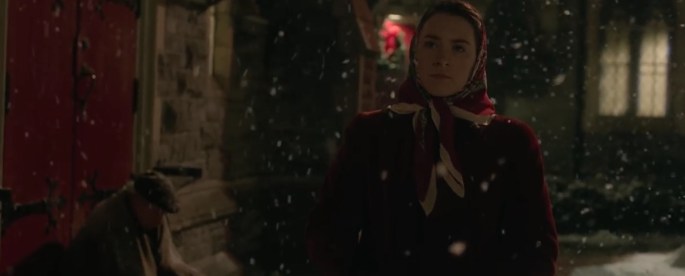
Brooklyn is a delightful film that had me crying pretty much all throughout. It’s heartfelt, it’s poignant, it’s sentimental (in the best possible way), and it features a performance of exquisite care and radiance by Saoirse Ronan, who in film after film has impressed, but here, genuinely dazzles. And completely steals your heart. And did I mention make you cry? From the very first scene, I was wrapped up in this honest, believable, thoroughly universal tale of home, family, love, and unknown opportunities. Yes, the filmmakers have told a romanticized version of the Irish/Italian immigrant experience in NYC circa 1950, but there’s a certain clarity to the message, and a touching sense of nobility to the narrative that reinforces the themes at every turn. Directed with grace and class by John Crowley (Boy A and Intermission, two very gritty and underrated films) and sensitively written by Nick Hornby (About a Boy, High Fidelity) who adapted Colm Tóibín’s novel, Brooklyn centers on Eilis (Ronan), who leaves her mother and sister back in Cavan for a new start in New York. She has a leg up, as a kindly priest (the magnificent scene stealer Jim Broadbent) has helped to arrange a room at a boarding house and a department store job, but her life changes when she meets the potential love of her life, a young Italian named Tony, whose parents had come to the states in search of a better life for their family. There’s an excellent scene at the dinner table where you get to meet Tony’s family, and rather than becoming a cheap stereotype, the moment feels beautifully played by all parties. Brooklyn is a movie about the importance and longing for family, how it defines many of us, and how it can shape us in ways we can’t predict. The movie was captured in creamy, sometimes gauzy tones by cinematographer Yves Bélanger (Dallas Buyers Club, Wild, Laurence Anyways), while the elegant score by Michael Brook (The Perks of Being a Wallflower, The Fighter) never ladles the schmaltz on too thick.

Throw in some drama back at home or Eilis, a budding romance, and the blossoming of her own sense of purpose and individualism, and you’re left with a warm and engaging film that hits all the proper notes you’d expect. Crowley knows exactly how long to hold on Ronan’s face in key moments, wisely holding on his actress’s expressive and pretty face, but also finding the uniqueness in her as a person that helps to separate her from her contemporaries. After some startlingly excellent work in diverse films like Atonement, Hanna, The Lovely Bones, How I Live Now, and The Way Back, this is a further reminder of her skills as a young actress, and offers a fantastic pairing of actress with material. Emory Cohen shines as Tony, the young Italian plumber from a big family who falls in love with Eilis, giving off irrepressible humor and spirit as a man who feels as if life is an endless stream of possibility, especially when he’s living it with the woman that he loves. After being featured in Derek Cianfrance’s The Place Beyond the Pines, his performance here is even more relaxed and sturdy, and you really root for the character. Domnhall Gleeson adds another feather in his cap from 2015 after his superb work in Ex-Machina and The Revenant with a stop for some ruffled-nose-fun in The Force Awakens, getting another juicy supporting role, and never allowing his character to become the cliché that it so could have been. And that’s the thing about the story to Brooklyn – it never gets too complicated or unnecessarily stuffed – this is Eilis’ story and the Ronan show all the way, with the filmmakers wisely zeroing in on the character and letting it take center stage. Ronan totally deserved her recent Best Actress nomination, as it’s a performance that signals a major step up for her as an artist. And it’s a large step up for Crowley, who on a $10 million budget made a film that feels at least twice as expensive, with a smart sense of pacing and tone; I’m anxious to see what’s next for him as a director.

6

AGI’S BIUTIFUL — A REVIEW BY NLC


1.jpg

Biutiful is pure cinema, extremely artsy and personal (so by that definition people liked to call it pretentious…), and a further reminder of how filmmaker Alejandro Gonzalez Inarritu is interested in pushing the form and crafting films of intense emotional and visceral impact. This 2010 Spanish language film was met with passionate embrace from a handful of critics, and star Javier Bardem would win Best Actor at the Cannes Film Festival, as well as garnering an Oscar nomination for Best Actor (which was the first time the Academy recognized an entirely Spanish language performance in this category). The film would also receive a nomination for Best Foreign Language Film, and would serve as Inarritu’s follow up to Babel. Bardem plays a terminally ill career criminal named Uxbal, who cons his way through Barcelona’s seedy, underground sweatshop world, a place filled with darkness hanging around every corner, with back alley deceit a major highlight. But Uxbal has a conscience, and understands the plight of the impoverished workers that make up this hellish environment.

He’s also a devoted family man, in love with his wife to an alarming degree, and as the film traces his final days of life on Earth, we watch as a man tries to put all of the messy strands of his life together, all the while knowing he’ll most likely be incomplete in all his goals. There’s a ghostly spiritual angle to this film as well, which were the portions that rubbed some people the wrong way, but Inarritu has always been intoxicated by a sense of the ethereal in all of his films, it’s just here he took it literally, with results that were, for me, rather intoxicating. Rodrigo Prieto’s gritty yet extraordinarily beautiful cinematography makes tremendous art out of a ton of despair and suffering, offering the viewer boldly designed visual compositions which are as searing as Bardem’s tour de force performance. Gustavo Santaolalla’s mournful score sets the appropriate mood, and it’s interesting to note that the film was co-written by two of the men who Inarritu would script Birdman with (Armando Bo, Jr. and Nicolas Giacobone); in retrospect the two films feels VERY connected on both an aesthetic and thematic level. The great Stephen Mirrione handled the fluid and graceful editing, cutting a picture that doubles back on itself, and uses expressive visual language to communicate mood and feeling. Seek this out if you’ve not seen it.

PTS Presents NICK AND FRANK’S BEST OF 2015

bestof2015

We returned to form with our first new recording together since the newest addition to Nick’s family, and the STAR WARS overload that Frank has been overwhelmed by.  We go over our top ten films of the year, top five directors, actors, actresses, supporting actors, supporting actresses, screenplays, cinematographers, score, ensemble and television shows.  We were both very excited to do this, and we hope you enjoy!

DAVID GORDON GREEN’S JOE — A REVIEW BY NICK CLEMENT

1

David Gordon Green is one of my favorite filmmakers. Impossible to pin down, he’s dipped his hands into a multitude of genres, going big with some, small with most, and always delivering something unique. He’s been extremely prolific, releasing almost a movie per year, and in some instances, more than one film in a 12 month period; he’s busy and I like it that way, because there’s always something different, edgy, and different about his films. He’s an idiosyncratic filmmaker clearly inspired by 70’s filmmaking, and the more I see of Hal Ashby’s work, there’s almost a modern Ashby sensibility to some of DGG’s output, as he’s always been interested in character and mood and atmosphere and people just as much as he’s been in plot. In his dark, slow burn drama Joe, Nicolas Cage went down and dirty and extra deep and DGG went small town and very mean with the nasty little film. This is a really tough but oddly rewarding movie, filled with low lives and drunkards and raw emotional and physical violence, telling a bruising story about a young boy dealing with a dangerous father, and how the kid crosses paths with a mysterious drifter (Cage) who may or may not be able to change his life for the better. Thanks to Tim Orr’s gritty cinematography, Joe has a very authentic atmosphere, and it’ll make you feel like a shower is necessary afterwards. Tye Sheridan impresses yet again; this kid has a serious streak going. Gary Poulter gives one of the scariest, most unpredictable performances of an alcoholic in a long time. But it’s the Cage show all the way in Joe, and this movie is a further reminder that he can still bring it when he’s interested in working with quality filmmakers on hefty material. He’s invested in the character, and so becomes the audience, and by the finale, the film hits moments of reflection and catharsis that are both unexpected and well earned.

A chat with John Dahl – An interview by Nate Hill

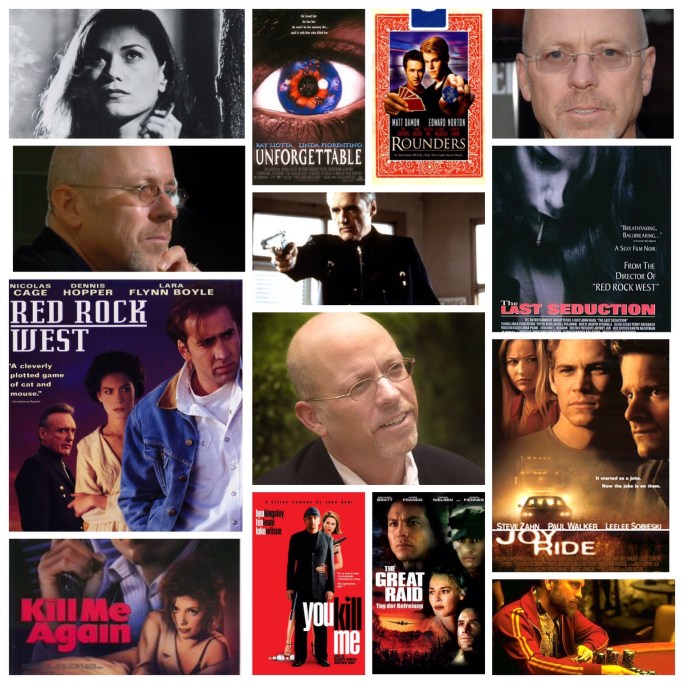
I’m incredibly excited to bring you my latest interview, with veteran director John Dahl. John has a staggering resume, having helmed episodes of television shows including Hannibal, Breaking Bad, Ray Donovan, Justified, Kingdom, House Of Cards, Jessica Jones, The Affair, Californication, Outlander, The Bridge, The Strain, Dexter, Arrow, Homeland, Shameless, Caprica, True Blood, Battlestar Galactica and more. He has also directed some amazing films, including Joy Ride, Rounders, The Last Seduction, Kill Me Again and Red Rock West. It was an honour to speak with him and I hope you enjoy reading it!

Nate: Growing up, what was it about film that attracted you, and how did you discover that you wanted to pursue it? Were there any filmmakers you admired or have inspired your work?
John: I always love going to see movies but then I remember seeing a “behind the scenes” preview of Jeremiah Johnson. They were pushing the camera on dolly track, it was the first time I’d seen anything like that. It started me think about how films were made. Then there was A Clockwork Orange. I was an art student and I loved the production design of the film and the use of Beethoven. Again it occurred to the that someone had to make everything that was in front of the camera. This film has really stuck with me as one of my favorites. As for influences; Kubrick, Coppola, Hitchcock, Spielberg, David Lynch & the Coen Brothers.

Nate: You have spent one portion of you career making feature films, and a more recent section has been centered on episodic TV. How do you find that the two differ? In film school we were told that they get directors for shows who are kind of like ‘guns for hire’, who will be efficient and carry the overall tone of the show without changing it too much. Did you find with any of the shows that you worked on (Ray Donovan, Hannibal, Justified etc) that you were rigidly set within the parameters of the show, or were you able to give them your own style, even a little, at all?
John: In any endeavor I’ve know there was always a practical side to me. From playing in bands, making artwork and certainly in writing and directing. While studying cinema in college I was curious as to how directors got their starts. This is when I came upon Roger Corman and his low budget approach. I noticed that both Jonathon Demme and Martin Scorsese got started with him. At this writing Corman has 409 producing credits and 56 directing credits. Are they all great? No, however If every movie I watched was as good as The Godfather or Rocky I probably never would have left Montana. Corman was a window into how films could be made and how one could grow through time and experience. Supposedly he shot Little Shop Of Horrors in 48 hours. My first professional directing experiences were doing music videos in the 80’s. This was a great playground to learn about lens, lighting, editing and how to work with a budget and a professional crew. I directed about 30 music videos when I got the opportunity to direct my first film. I’ve never worked on a project where money and time were not a factor, in the 8 movies that I’ve done and almost 90 episodes of television. The process is pretty much the same as I can tell – yes when you direct a film you are more in control of the process until you show it to the studio and start testing it. Then you have to respond to the audiences, producers and studio desires to hopefully recoup their investment. When you make television the studio and producers are involved every step of the way. It’s a group effort rather than an individual one. I can’t help but bring my sensibilities to the work I do – so far it hasn’t been a problem because when I’m doing someones tv show I’m trying to figure out how I can make it as great as possible with the time, money and talent available. I see filmmaking as the art of what is possible.

Nate: Rounders: for some reason, feels like the most personal film of you career. Silly for me to say, I know, since I’ve never met you, but it’s such a focused, distilled style and seems like all efforts involved were purely concentrated upon making this something really cool. How was you experience on this film?
John: Rounders what a terrific experience for me. I never really saw myself as much of a writer. I wrote so that I could create opportunities to direct. After four movies I was finally handed a movie and it was Rounders – pretty much the way you see it on screen. I saw it as a sports movie, the sport was gambling, not baseball or golf but a game of chance in which if you study, work hard you would succeed. Miramax supported the project, they liked the script, the cast – everything went fairly smooth. Interesting that you would say it my most personal film. I would probably say Red Rock West would be my most personal film – but to each their own.

Nate: Joy Ride: a colossally fun film. How was your experience making this one? I’m very curious about Ted Levine. On the dvd there test clips for Rusty Nail auditions with both Levine, Eric Roberts and a guy called Stephen Shellan. Were you in control of who nailed the role? Did you get to work a lot with Ted in the recording process?
John: Ted did a great job on the film although he was not my first choice. I pitched the ending of the film to the studio, building on the idea that the movie had to have a suspenseful ending – not more surprise which JJ Abrams was big on. I set up the idea that if Rusty Nail had Venna and the cops were coming to the rescue, if Venna was in jeopardy by say a “shotgun to the head” it would be more exciting – kind of the way Silence Of The Lambs ended. That may have been the take away for JJ – Buffalo Bill thus Ted Levine.

Nate: Red Rock West: Classic desert noir. How was the experience? One thing with your films that always is consistent and incredibly memorable performances from your actors. Particularly Dennis Hopper (Lyle From Dallas haha) and JT Walsh, who was a family friend of my parents. What was it like working with them? This is a Segway into my next question:
John: They say 90% of directing is casting the right actor. I agree. I’ve been blessed to work with remarkable actors. My approach is simple, I try to get great actors, set up the scene and get out of their way.

Nate: Working with actors: how do you approach the working relationship between actor and director? How has that process evolved for you over time and what have you learned from it?
John: I try to say as little as possible. I trust that they’ve done their homework and want to be great in any role they play. I’m there to guide them. Help them do their best work. As long as they end up going where I’m trying to take them — I give them full license to find the role.

Nate: The Last Seduction: I’m very curious about what it was like working with Linda Fiorentino, who is a favorite of mine.
John: Linda was fantastic. It was clear from the moment she entered the room that she was perfect to play that part. She pretty much cast herself, all we had to do is get out of her way and let her be Bridget Gregory.

Nate: You have written both Red Rock West and Kill Me Again. How do you find working with a director with your own material as opposed to other projects where you are dealing with a script crafted by someone else?
John: I like working with a writer – gives me someone to bounce ideas off of – it allows you to challenge the material – make sure you have the best version possible when you start shooting and even while you are shooting. I’ve often thought that the people with the most skin in the game are the director, writer and actors – those 3 jobs live or die each time they make something.

Nate: Are you hooked on tv now, or will we see some more films from you at some point in the future?
John: I like television. I’ve been able to work on great shows with fantastic writing. I don’t see a big difference between the two – if the material is good, I’ll do it. Do I still want to do features? Yes, I just need a great script. 
Nate: Thank you so much for your time John, it’s been a pleasure speaking with you, and keep up the great work!

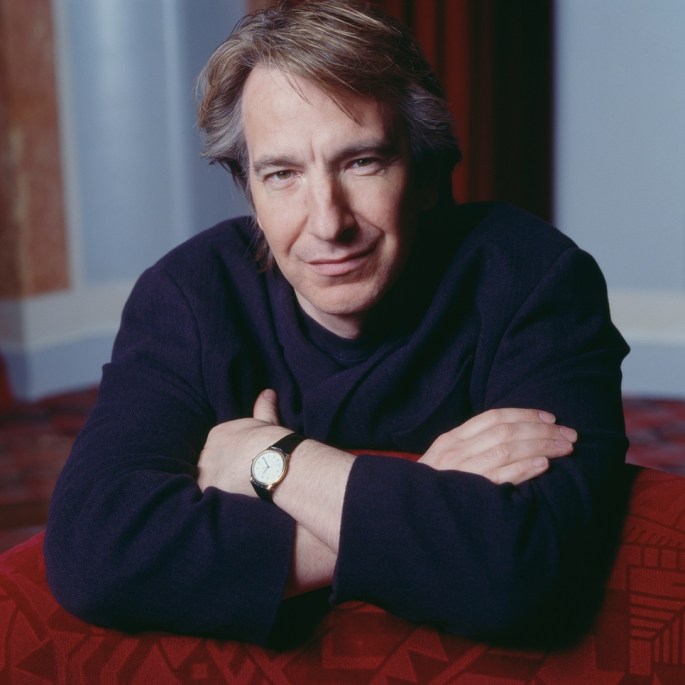
A Tribute to Alan Rickman, and David Bowie by Josh Hains

I have to say some words about the passing of beloved actor Alan Rickman, who passed away at the young age of 69 from a battle with cancer, the same way as musical icon David Bowie. I cannot begin to fathom the pain and grief their respective families are surely experiencing, and I can only wish them the deepest of sympathies from my heart to theirs at this most difficult time in their lives.

It is difficult to realize that two individuals who I cherished so much for so long, are no longer with us anymore, and the thought that I will never be able to hear their voices ring in my ears, or see them perform as splendidly as they both did for so long, is one that has left a void in my heart that cannot be filled. I grew up with Bowie’s unique sounds drifting from the speakers and dancing into my ears, every tune as weird, wonderful, and fascinating as the last. I was a little four year old boy cheering for Kevin Costner’s Robin Hood to defeat the villainous Sheriff of Nottingham, who Alan Rickman brought to life with such ferocity and grace, in Robin Hood: Prince Of Thieves. Throughout my life I continued to listen to Bowie’s tunes and watch him strut his stuff in films such as The Man Who Fell To Earth, and watch Rickman’s enthusiastic performances come to life onscreen, in everything from the badass Die Hard to the magnificent Harry Potter series, blindly assuming these two would be around for much, much longer.

12509804_962225607202846_687231817322484173_n

Something deep within me believes that these two brilliant men wouldn’t want me to feel sadness, pain, and grief, but would rather wish that myself and legions of fans around the world, instead take the time to remember the time we did have with them. To that notion, I say we shall. In the hours and days and years to come, lifelong fans of these tremendous artists will continue to gleefully listen to the soulful otherworldly music of David Bowie, and relentlessly watch the vast filmographies of both Bowie and Alan Rickman. Whether you know Bowie for Rebel Rebel, or Starman, or Ziggy Stardust, or some other tune or one of his varied film roles, or Rickman for The January Man, Die Hard, or that most beloved Professor Severus Snape, or for some other role, whether you have engaged in their work for twenty years or just a few months, take the time to remember what you love most about their respective careers, and them as individuals. Remember if Snape broke your heart. Remember if Hans Gruber gave you chills and made you laugh at his witty one liners and sarcastic demeanor. Remember if Rebel Rebel made you crank up the volume in your car and speed down the highway in pure bliss. Remember if Space Oddity, or Starman, or Heroes touched the deepest part of your soul. Remember if Bowie, with his flaming red hair and trendsetting outfits and makeup made you embrace your inner self and feel proud to be the unique individual you surely are. Remember the laughs. Remember the tears. Remember the smiles, the joy, the fun. Remember their work and how they made you feel. Remember your heroes, and never forget them.

“I do take my work seriously and the way to do that is not to take yourself too seriously .” – Alan Rickman

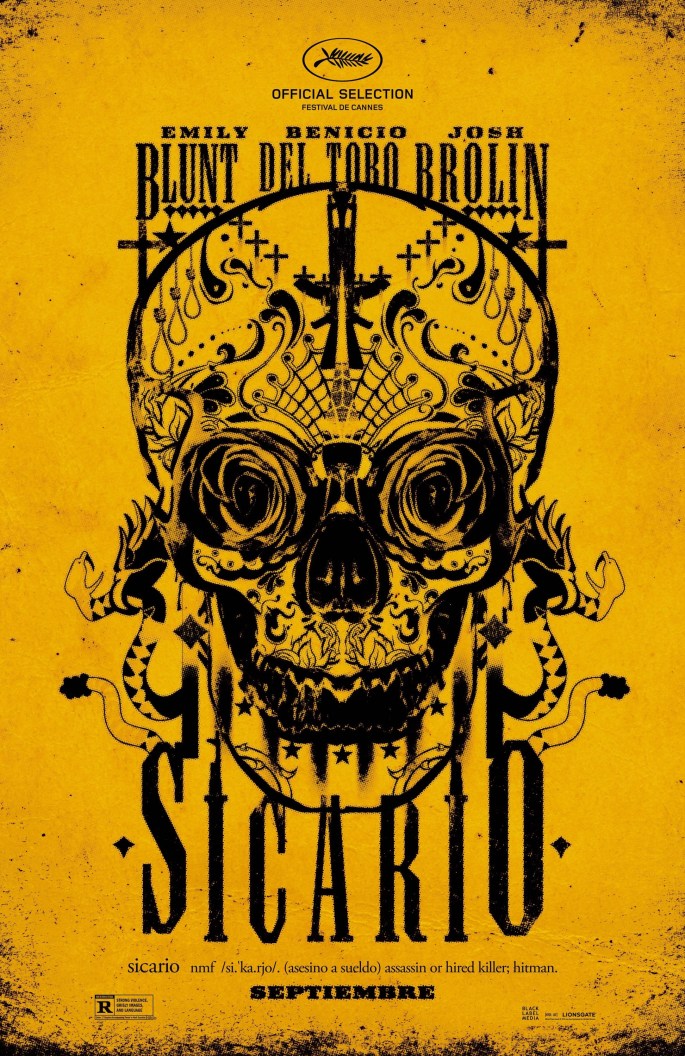
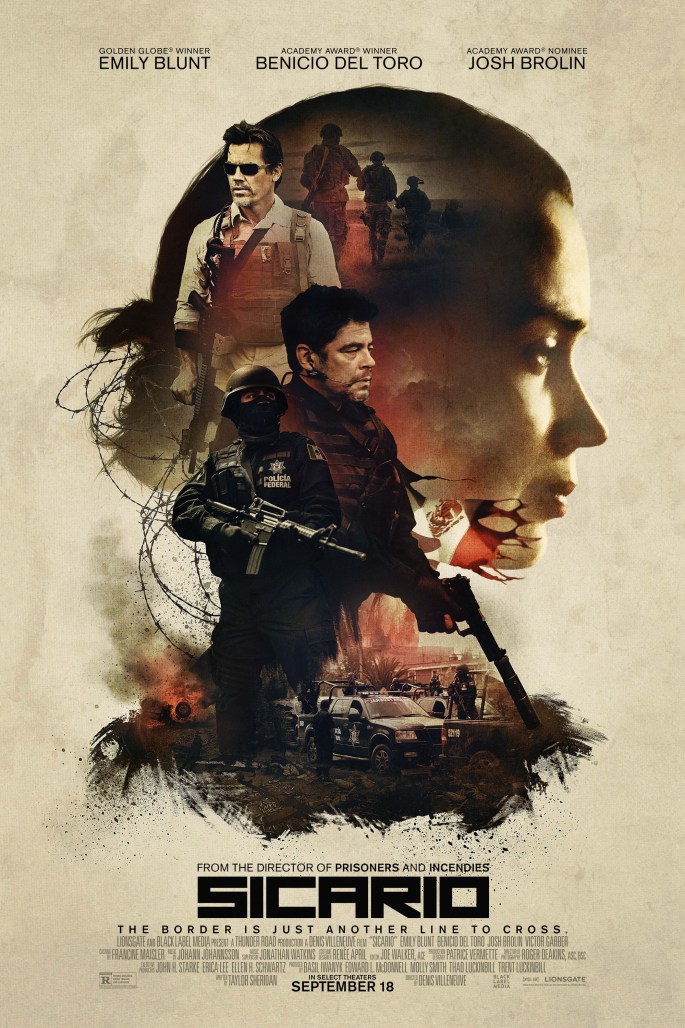
Sicario – A Review by Josh Hains

sicario_ver8_xxlg

“You are not a wolf, and this is the land of wolves.”

Sicario has been stuck in my mind since the opening sequence unfolded before my very eyes in theatres, in a manner so few films in my life ever have. Very few have ever been successful in leaving such a lasting stain on my mind. This film is like days-old dirt stuck under my fingernails, salt water swishing in my ears, the undying Sun burning in my eyes. It does not want to leave at all, it just wants to stay buried in these deep places I cannot reach. It is so dark, disquieting, and depressive in nature, and such a brutally violent, honest, and eerily realistic piece of cinema that quite honestly, made me want to shower after seeing it. I have not seen anything like it since The Counselor crept into theatres a couple years ago; Apocalypse Now springs to mind as another example. Sicario is ultimately a low-key, intimately orchestrated thriller that almost left me underwhelmed simply because it is not the big and bombastic flick one could assume it may be by the films trailers.

The score, repetitively pulsing throughout the film in the greatest way possible, chimes through the air with the ferocity of an explosion, then proceeds to crawl into your ear and make its way deep beneath the surface of your skin. As that music creeps toward your nerves, the suspense of any number of impeccable sequences, such as the infamous highway interaction, slowly turns your knuckles pearl white, puts the hairs on the back of your neck in standing position, and the gorgeous, stark cinematography lowers your jaw to the floor. A gunshot will crack against the wind, taking you by surprise as magnificently as the films twists, so deafeningly loud you almost experience a ringing sensation in the canals of your ear. The performances catch you off guard with their inherent subtleties and nuances, while the completely unexpected humour of a couple brief moments fills your lungs with welcomed laughter. The sheer brutality of the violence widens your eyes with fear, the popping of gunfire so realistic you just might think you are being shot at; murders so gruesome if you are of the weak stomached, your insides may churn at the sight of beheaded bodies, and heads exploding in bursts of crimson life force. But it is the journey by the characters into a near unparalleled descent into darkness from which there is no return, that will put a poisonous void inside the deepest caverns of your heart, and send cold shivers running down the length of your spinal column, disrupting the tranquility of your very soul. Sicario is a film that you’ll be unable to shake in any reasonable period of time.

The performances across the board are all great, from the itchy trigger fingered lowlife criminals to Emily Blunt’s naive agent Kate Macer, to Josh Brolin’s stern cowboy-ish possibly C.I.A. spook, though Benicio Del Toro’s quietly contemplative, brooding god of merciless death Alejandro is most likely to leave the strongest impression; he’s quite the wicked force of nature.

Any other year, Roger Deakins would deserve, and bear the potential of scoring an Oscar nod at the very least for his spellbinding cinematography that captures the smallest of dust particles to the true essence of night in such staggering detail one may shed tears in awe of the beauty, or simply find themselves speechless. While it likely is not as staggering as the work Emmanuel Lubezki has done with The Revenant (I have not had the pleasure of seeing that film just yet), Sicario still bolsters brilliantly concocted visuals from a true master of the craft.

In a crime film that follows the exploits of various law enforcement operatives systematically slaughtering cartel members left and right in an attempt to sever the head of the snake[so to speak] orchestrating cartel inflicted killings across America and Mexico, Sicario by films end feels like a hot-blooded rogue documentary with the ferocity of a screaming gunshot captured on camera by one of the agents, and not the silly exploitation movie it could have been in misguided hands. If one views it as such, you can clearly witness how blunt, honest, authentic, naturalistic, brutal, and precise this stellar film is. It surely is a stressful and powerfully overwhelming endurance test. It is assuredly an openly nihilistic (in the best way possible), unflinching examination of the thin grey line that separates wolves from sheep, and hunters from the hunted, with one hell of a bloodthirsty, tortured man in Alejandro dragging us blindly into a realm where darkness reaches out to darkness with battered hands and consumes its soul. And ours.

*This is a revised edition of a review I wrote on October 11th, 2015.


SEAN PENN’S THE INDIAN RUNNER — A REVIEW BY NICK CLEMENT

1

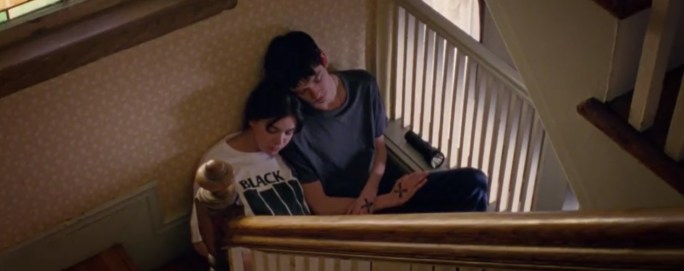
This is a very hard hitting film, and served as Sean Penn’s remarkable directorial debut. I’ve found merit in all of Penn’s efforts as a filmmaker (Into the Wild is likely my favorite of his works), but this has got to be one of the most intense and anguished films from a first time filmmaker, at least that I’ve seen. Curiously based on the song “Highway Patrolman” by Bruce Springsteen, the film is set in Nebraska and revolves around two very unique brothers, one a small-town deputy while the other has resorted to a life of crime. The lawman is played by the wonderful character actor David Morse, giving one of the very best performances of his supremely underrated career, while the criminal is essayed by an early-in-the-game Viggo Mortensen, who gives an incredible and deeply layered performance as a Vietnam veteran who can’t seem to pull his life together no matter how hard he tries. Released in 1991 to excellent critical support but nonexistent box office, the film has attained a cult following, and is one of those small, meditative pieces concerned more with mood and character than about plot and overt payoff.

Anthony B. Richmond’s cinematography stings with burnished elegance, and Jay Cassidy’s editing keeps the pace moving along despite the film possessing a certain slow burn quality. The melancholy musical score by Jack Nitzsche and David Lindley only helps to add to the somber atmosphere, with Penn never resting on his music to do any of the emotional heavy lifting; his actors were more than up to the task while Penn’s screenplay stings in all the proper places. This is a very heavy, dramatic film, with an ending that leans on impassioned family dynamics rather than right and wrong. A fantastic supporting cast comprised of Dennis Hopper, Benicio Del Toro, Valeria Golino, Patricia Arquette, Charles Bronson (quietly powerful), and Sandy Dennis in her final film role all have memorable bits in this tough and sad film, while Arquette’s character goes through one of the most believable child-births that I’ve ever seen captured on film. The Indian Runner is only available, at the moment, on DVD, but this title screams Criterion Collection or Twilight Time.

BERMAN & PULCINI’S 10,000 SAINTS — A REVIEW BY NICK CLEMENT

3

10,000 Saints is a solid indie drama, taking familiar, coming of age material and spicing up the proceedings with some excellent performances from a deep cast, most notably Ethan Hawke and Hailee Steinfeld. Set in the 1980’s in upstate Vermont and NYC, the film follows the journey of Jude Keffy-Horn (an effective Asa Butterfield), an introverted high schooler and aspiring musician, prone to smoking weed and huffing anything he can get his hands on. After a rather unfortunate mishap with his best friend, he decides to change up his lifestyle, and he moves in with his pot-growing hippie father (Hawke, in a sensitive, generous, extrememly funny performance) in the big apple. This film was directed by Shari Springer Berman and Robert Pulcini, the director’s of American Splendor, and if each of their projects hasn’t gotten close to the brilliance of their first, they’ve become reliable storytellers who are interested in that middle of the road story or project. Based on Eleanor Henderson’s novel, the film benefits from an excellent sense of time and place, with 1980’s NYC convincingly recreated on a presumably small budget, with the New England location shooting adding a touch of lived-in believability. Emile Hirsch, Julianne Nicholson, Emily Mortimer, Nadia Alexander, and Avan Jogia all contribute spirited supporting performances, while the camerawork from Ben Kutchins is unfussy yet moodily stylish in a low-key manner. Personal fun fact: one of the producers of this film, Robert Simmons, is an old high school friend – congrats!


PTA’S MAGNOLIA — A REVIEW BY NLC

magnolia

Paul Thomas Anderson’s unique and sprawling sense of narrative was perfectly matched by cinematographer Robert Elswit’s total mastery of the widescreen aspect ratio in Magnolia, a film that feels studiously cinematic, existing in its own hermetically sealed universe, a world that looks and sounds pretty much like our own, but contains a surreal, heightened atmosphere that was made possible expressly because of how well PTA and Elswit understand light, framing, and overall composition. The Stedicam work in this film is extraordinary, with one shot in particular ranking as one of the greatest of all time – the scene where child prodigy Stanley Spector (Jeremy Blackman) is being escorted by his domineering father (Michael Bowen) and stressed-out show coordinator through the bowels of the TV studio. In this long, unbroken piece of virtuoso filmmaking, the audience learns not only about two very important characters, but comes into contact with a variety of peripheral individuals, while providing a fascinating look at the behind-the-scenes machinations of a game show. The shot also starts outside, in the rain, and then moves inside, further upping the technical demands of the crew, which resulted in something truly unifying from a filmmaking perspective; it’s one of the ultimate “show-off” shots that adds something to the narrative instead of just being style for style’s sake. All throughout Magnolia the audience is treated to PTA and Elswit’s massive sense of style (the bit with the camera staying locked in place in the kitchen with Melora Walters and John C. Reilly entering and exiting frame is a delight), which never overpowers the story, probably because the narrative is as juicy and oversized as the visual aesthetic.

And this isn’t an action film or a period piece or some sort of hyped-up thriller, but because PTA is pure-cinema-all-the-time, Magnolia feels big, it feels weighty, and the visual design of the film intermingles with the density of the script and forms one epic yet intimate whole that feels cohesive. The camera seemed at-one with all of the actors and it’s because Anderson and Elswit are so in touch with one another as collaborators that this film feels uniquely organic in a way that few other films ever achieve. The use of music jacked-up many scenes – not to mention the sing-along towards the mid-way point – to the point of dizzying heights; this film has a busy soundtrack, taking in tons of sonic information, in an effort to create an audible tapestry in a decidedly Altman-esque fashion. One after another, a roll call of brilliant actors take center stage and run away with the movie; Tom Cruise, Jason Robards, Philip Seymour Hoffman, Julianne Moore, William H. Macy, John C. Reilly, Melora Walters, Philip Baker Hall, and Jeremy Blackman offer up performances that stare directly into their tortured souls as screen artists. This is a movie about damaged people behaving in questionable ways, so as a result, there’s an anything-goes quality to the narrative. It may not live in the “real-world,” but in terms of an untouched cinematic vision, something like Magnolia lives with the greats of Los Angeles storytelling. Even if the results are exactly your cup of tea, the boldness of the filmmaking simply cannot be denied.