SCANNERS – A REVIEW BY J.D. LAFRANCE

scanners-01

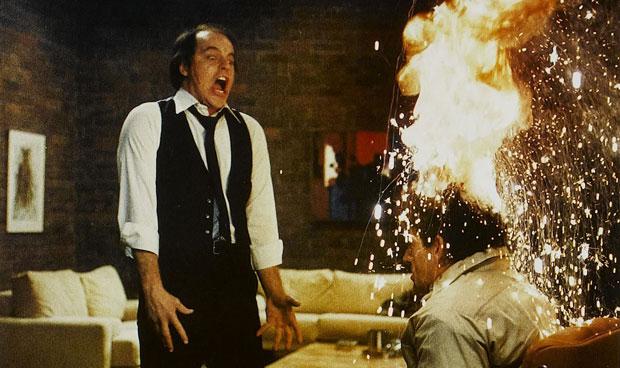
For a good part of his career, David Cronenberg has been fascinated by secret societies, be it the New Age-y psychotherapist and his patients in The Brood (1979) or the people addicted to an immersive video game in eXistenZ (1999). With Scanners (1981), he explored a small, but growing number of people endowed with mental abilities that allowed them to read other people’s thoughts or literally blow their minds. This is evident in the film’s most iconic scene where a character blows up another’s head. This premise eerily mirrors Brian De Palma’s The Fury (1978), but where it was more of a conventional thriller, Scanners incorporated more cerebral ideas as some of Cronenberg’s characters see themselves as the next rung in the evolutionary ladder.

Cameron Vale (Stephen Lack) leads a vagabond lifestyle and is kidnapped and brought to Dr. Paul Ruth (Patrick McGoohan) who works for a mysterious corporation called ConSec. He tells Vale that he is a “scanner”, someone with telepathic abilities and proceeds to teach him how to use his powers. Ruth soon finds himself at odds with Braedon Keller (Lawrence Dane), head of security at ConSec and who is secretly in cahoots with Darryl Revok (Michael Ironside), the leader of an underground group of scanners. Ruth sends Vale to infiltrate Revok’s group and the film builds to an inevitable confrontation between the two powerful scanners.

Stephen Lack, who came from a performance artist background, delivers a wonderfully idiosyncratic performance as Vale, a man who is initially uncomfortable in his own skin, but gradually becomes more confident as he learns how to control his abilities. In one of his career-defining roles, Michael Ironside is excellent as the malevolent Revok who sees himself as a Che Guevara-type figure. Lack and Ironside’s contrasting acting styles compliment their adversarial characters nicely.

Scanners was part of a fantastic run of early films that Cronenberg wrote and directed himself as he explored the dark intersection where the science fiction and horror genres converged. The success of this film spawned two lackluster sequels that Cronenberg wisely had no involvement in. Unlike The Fury, Scanners goes into much more detail about how these mental abilities work and how they can be harnessed as evident in a scene where Ruth teaches Vale how to accelerate a man’s heartbeat, almost killing him. Cronenberg goes further than simply pitting good scanners vs. bad, but also touching upon the notion that they may be the next step in human evolution.

MATTEO GARRONE’S GOMORRAH — A REVIEW BY NICK CLEMENT

1
Matteo Garrone’s Gomorrah is tough and totally brilliant. It’s a nasty, unflinching piece of filmmaking, and because it stays so focused and refuses to ever get sentimental there’s a hardened quality to the storytelling that’s unique for the genre. Now, is it an “entertaining” mafia saga along the lines of Goodfellas or Casino or The Godfather? Not remotely. As impeccably made as it is, Gomorrah is a punishing and depressing look at real-deal organized crime in Naples, Italy. Based on a bestselling and highly controversial true-crime novel which ended up requiring the author (and members of the eventual film production) to go into witness protection, Gomorra is essentially the Italian version of City of God, in that it takes you on a hellish journey to a very violent corner of the earth and rubs your face in vicious behaviors and unremorseful killing. And that, really, is the essence of Gomorrah: The act of killing and how it affects so many different people. Death, as it is in all gangster tales, hangs over this film like the Grim Reaper itself, and as the narrative progresses, you slowly realize that there’s no hope for anyone in the story.
2
You half expect any of the characters to get bumped off at any moment while the riveting action unfolds; the phrase “always looking over your shoulder” is a sad reality for everyone in Gomorrah. The film effortlessly weaves five separate storylines together. Two young punks who love reciting dialogue from Brian De Palma’s bloody classic Scarface are anxious to become real-life hoodlums, and are blissfully unaware of the real dangers that they face. An illegal garment maker who has perfected his trade through various crime circles starts trading his knowledge to the Chinese in exchange for cash; you can imagine how pissed the Italians will be with this. Two youngsters are drafted into a life crime after doing petty jobs for the higher-ups, and here, you get a look at the organization’s money-man, who becomes increasingly conflicted with his job as the film progresses. And finally, there is the toxic-waste disposal element to the narrative, which is equally as troubling as any of the other segments.
gomorrah_xlg
The hand-held, down and dirty aesthetic is reminiscent to that of The Battle of Algiers, as director Garrone immerses you in the scummy, crime-filled environment and forces you to see everything at ground level and face value. There is immediacy and sad impact to the violence in Gomorrah, which features a bracing level of coldness on display from the various killers, which is rather startling. It’s all part of the business – killing just comes with the territory. And even though almost all of the characters are unlikable, you watch with a growing sense of dread as it becomes all but certain that everyone will end up meeting their maker before the end credits start to roll. This isn’t an easy or commercial gangster movie like the films I referenced earlier. Instead, it’s a brutal look at a real-world scenario that’s going on right now, one that’s been going on for years, right under our noses. Gomorrah takes you to hell and back, and there is an uncompromising sense of inevitability and visceral impact in the film that forces the viewer to take notice.
3

WARREN BEATTY’S REDS — A REVIEW BY NICK CLEMENT

1

Warren Beatty’s towering historical drama Reds is one of the grandest achievements in cinema, a film that matches its epic scope with poignant intimacy on a character level, resulting in a work that has genuine grandeur and a sense of sweep that immediately engrosses the viewer. The often-imitated faux interview structure is marvelous to look back upon in retrospect, as it’s informed so many other filmmakers on so many diverse projects, and the way that Beatty was able to shape this sprawling yet always coherent narrative into something fully cohesive is a testament to both his innate understanding of filmmaking, and to the astounding work done by the film’s editors, Dede Allen and Craig McKay. The dense and info-packed screenplay by Beatty and co-writer Trevor Griffiths was based on the John Reed novel Ten Days that Shook the World, focusing on Reed’s life as a journalist during the Russian Revolution, and with Beatty assuming the lead role. Co-starring Jack Nicholson and Diane Keaton, both absolutely superb, the film had a deep supporting cast, including Paul Sorvino, Jezy Kosinski, Gene Hackman, Nicolas Coster, M. Emmet Walsh, Maureen Stapleton, Ramon Bieri, Edward Herrmann, and many others.

2

There’s a tremendous sense of romance running all throughout this big and volatile motion picture, with history and Hollywood colliding in the best sense, while the filmmakers stressed intelligence in all departments, resulting in a film made by adults and for adults. Master lenser Vittorio Storaro’s burnished and elegant cinematography worked in perfect tandem with the nearly overwhelming and astonishingly detailed production design by the legendary Richard Sylbert, while the evocative costumes from Shirley Russell reveled in period authenticity. After a year long shoot, in which Beatty and Keaton’s personal relationship apparently greatly suffered, the post-production process reportedly lasted close to two years, as this behemoth of a movie required various teams of editors to sift through nearly two and half million feet of film and the constant supervision of Beatty to bring it all home. Released in December of 1981 and garnering glowing reviews from critics, the film preformed solidly at the box office, grossing $40 million domestic; the over three hour run time definitely limited the number of screenings and likely dissuaded some people from seeing the film on the big screen. Beatty won the Oscar for Best Direction, Storaro for Best Cinematography, and Stapleton for Best Supporting Actress, with nine other nominations.

3

RIPD: A Review by Nate Hill 

I wanted to give RIPD chance, I really did. But it’s such a shameless ripoff of Men In Black that most of it just constituted one big eye roll from me. It’s not an outright knockoff, but it just uses the unmistakable blueprint of MIB and runs with it as if it were it’s own organic idea. The veteran wiseass, the young hotshot, the clandestine otherworldly law enforcement syndicate, googly, goopy special effects, it’s all there and just feels stale these days, but for a few saving graces. Jeff Bridges is an undeniable charmer as Roy, an undead wild west super cop who is tasked with retrieving runaway souls hiding out down on earth, and capturing them for return to the great beyond, here pictured as the penultimate vision of nightmarish beaurocracy that seems oddly derived from Beetlejuice (huh). When Boston cop Ryan Reynolds is betrayed and murdered by his corrupt scumbag of a partner (a skeezy Kevin Bacon) he’s recruited by Proctor (Mary Louise Parker, all business and loving it) to join Roy in bringing “deados” back upstairs. The two don’t get along, as newly paired cops in movies always behave, and the banter only really works from Bridges’s side. He’s a hoot as crotchety old Roy, while Reynolds plays it a bit too serious, especially in scenes with the wife he left behind (Stephanie Szostak). The film earns it’s one inspired subplot when we see the human avatars the pair use to move about the earthly plane: Bridges is a knockout blonde chick (Marissa Miller), and Reynolds an elderly Chinese man played by the seemingly immortal James Hong. If they spent more time on terrifically funny ideas with potential like that and less on special effects that look like something out of the Garbage Pail Kids, they might have been on to something worthwhile. But alas, most of the film is spent on a whirlwind of silly slapstick and big gross weird things that are in no way engaging. There’s a few slap dash deado hunts, including a brief turn from Robert Knepper as one that is lured out of hiding with Chinese food (what in the..), and a big sky vortex yawner of a finale where evil Bacon tries to wreak havoc on earth. Most of the time it’s just a snooze though, save for the few times the clouds part and we get something fresh, usually from either Bridges or those to damned hilarious avatars. Shame.

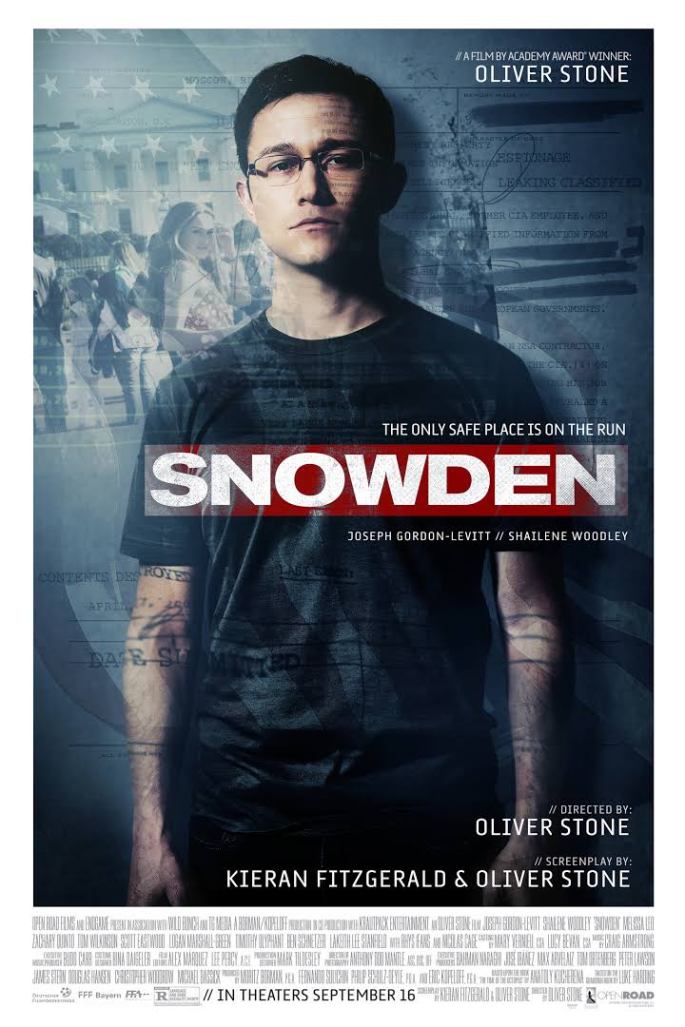
OLIVER STONE’S SNOWDEN — A REVIEW BY NICK CLEMENT

1

Regardless of what your stance is on mass data collection supervised by Uncle Sam, Oliver Stone’s engrossing political thriller Snowden raises some extremely provocative and timely questions about our right to privacy, the ever evolving war on terror, and how trustworthy our government has been and can be in the future in regards to these types of surveillance programs. Joseph Gordon-Levitt is very strong as Edward Snowden and there isn’t a performance in the entire cast that’s not well rounded and effective; Rhys Ifans has a casually chilly demeanor which he exhibits to maximum effect as Snowden’s boss, Nicolas Cage is perfectly cast as the old spy who has been sent to the basement, and Shailene Woodley is both natural and extremely easy on the eyes as Snowden’s long suffering and always-in-the-dark girlfriend. The film uses the Citizenfour interview by doc filmmaker Laura Poitras (motherly Melissa Leo) and Guardian newspaper writer Glenn Greenwald (easily angered Zachary Quinto) as its entry point, folding back in time to Snowden’s discharge from military service, his journey through various governmental branches, and eventual hiring as a data analyst. Working for various subcontractors, he got a bird’s eye view of what our post-9/11 espionage world is like, and even had the chance to build some of those systems. It’s totally wild to see how far the government has progressed with the digital monitoring of its citizens and everyone else across the rest of the world. Starting out as an uptight conservative and ending up a liberal defector, Snowden saw things he wished he hadn’t, and for various reasons, felt that he had to tell the world what was going on, thus resulting in his permanent exile in Russia. The busy narrative uses Snowden’s complicated relationship with his girlfriend as an emotional through line, presenting a compelling portrait of a man caught between what he thinks he needs to do and how others are expecting him to act.

2

The thing that I noticed the most while watching Snowden was how eerily prescient the 1998 film, Enemy of the State, from producer Jerry Bruckheimer and director Tony Scott, has become. Researched and written in the mid to late 90’s and three years before the Twin Towers would fall, that film imagined a scenario where the U.S. government is ready to employ a far-reaching and questionable policy called the Telecommunications Security and Privacy Act, which is essentially what the Patriot Act would become a few years down the road. The technology shown in Enemy of the State is EXACTLY THE SAME SORT OF STUFF being used in real life today, as depicted in films like Snowden, which actually break down the official programs being used by big brother. Even some of the stuff glimpsed at during Scott’s sci-fi genre-bender Deja Vu feel like they have been sampled from reality. By the end of watching Snowden, and due in no small part to the dynamic if measured camerawork by digital ace Anthony Dod Mantle (Slumdog Millionaire, 127 Hours, Rush), you’ll have a great sense of what is capable due to the work being done in various underground compounds and secret spy bases all over the world. One of the best sequences in the film is a visual approximation of what it’s like to put a trace on a phone call to one person, and how that one person can spiral into millions of people by the end of the digital process. With whiz-bang ease, so much information can be culled at a moment’s notice, that it’s hard not to be equal parts impressed and alarmed by what’s able to be achieved.

1

Stone’s film, which he co-wrote with Kieran Fitzgerald, is engaging at all times, frequently incensed by the story being told, and yet, it never went for the jugular in the way that the best, most long-lasting films from this proudly defiant and trouble-making auteur have done in the past. Which is fine. Stone has become a different filmmaker over the last 10 years, which apparently, many people cannot accept. Stone hasn’t “lost it,” but rather, after his sensational and aesthetically groundbreaking run of films during the 1980’s and especially the 1990’s, he’s become more sedate, especially after the grand ambitions of his tour de force historical epic Alexander back in 2004, which for my money, is still one of the best achievements in the sword and sandal genre that’s ever been mounted. World Trade Center, which I feel is his John Ford movie, is wildly underrated, celebrating a country that he so often took to task on a variety of issues; in this film he paid tribute to the notion of sudden heroism, resulting in an emotionally resonant motion picture that scaredy-cat viewers dismissed as “too soon” when it was first released. And while I thought W. could have been better and different and more scalpel-sharp, over repeated viewings, I’ve come to find it a delicious black comedy of political buffoonery. Wall Street 2 was a bit of a let-down but still entertaining, but I absolutely loved his sexy and stony marijuana actioner Savages; he made his Tony Scott adventure with that one, even hiring Scott’s longtime cinematographer Daniel Mindel to call the shots, resulting in one of the slickest looking films of his career. And with Snowden, Stone is clearly conveying a ton of anger towards both the Bush and Obama administrations, while reminding audiences that he’s incapable of making an uninteresting movie. I’d actually wager a guess and say that this is one of the most anti-government movies that has been released in years, going beyond the term liberal and entering into its own new realm. It’s no surprise that indie distributor Open Road were the ones to take this on and that there are about 20 people listed as producers from various overseas entities in various capacities; no major studio would have the balls to put their logo on this one.

3

Indie Gems with Nate: Wildlike

It’s random netflix time again, where I decided to take a look at Wildlike, a film I’ve never heard of before, and one that I will not be getting out of my head anytime soon. I have a certain affinity for films set in the wilds of the pacific northwest, films that use nature and scenery to accent themes relating to humans (eg. The Grey, Into The Wild). I also saw Bruce Greenwood on the poster, and that guy just seems to have a head on his shoulders when it comes to choosing scripts, so off on this journey I went. Newcomer Ella Purnell is astounding as 14 year old Mackenzie, sent off to live with her uncle (Brian Geraghty) after her mother has a breakdown following a family tragedy. The poor girl goes from the frying pan into the fire though, when it’s revealed that her is sexually abusing her, and may have in the past. The abuse shown in this film is not loud or violent, nor is it melodramatic or designed for shock value. It’s quiet, frank and subtle, the damage of it measured in a glance, a tear streaming down a cheek or a barely percievable shift of weight from Mackenzie when he looks at her. Geraghty is a handsome dude, nowhere near the bespectacled, paunchy clichéof abuser so often seen. He plays it straight, a pleasant and agreeable fellow who can’t even comprehend the kind of damage he’s doing. The scenes of abuse themselves are quick and fleeting, made all the more uncomfortable by how intimate they seem. This is the closest to what I’d imagine realism with this sort of thing looks like, and i had trouble not turning away. When she can’t bear it any longer, Kenzie makes a run for it into the nearby town, hiding out and eventually befriending lone hiker Greenwood, who is healing from wounds of his own. Kenzie is confused and broken from what has happened, and the filmmakers know that when this befalls someone whose brain and soul are not developed enough to understand it, they act in strange ways. Purnell is heartbreaking and should have been in contending for some sort of award. Going from almost no film work to lighting up the film with this brave, staggering turn was something I was honored to see unfold on my humble iPad screen. Much of the story unfolds in the breathtaking Alaskan wilderness, the camera capturing misty mountains, verdant landscapes and little coves that ferries weave in and out of. You just have to contrast this type of subject matter with beauty of some kind, and Kenzie’s journey takes her from darkness into the possibility of light, surrounded by the natural world and the companionship of her new friend and protector. Most of the time it’s just the two of them out in the desolation, aside from when they meet a kindly group of campers, including Ann Dowd, an incredible actress who seems to be riding some sort of comeback these days. Films about this sort of thing range all across the board, from hamfisted pulp revenge, to tender and inquisitive documentation. This one respectfully shows you the kind of irresponsible, selfish and sick behaviour humans are capable of, particularly towards the ones they are supposed to love and protect. It also looks at kindness and compassion that can come from a complete stranger and shelter those who have been broken. There’s both light and dark in this world of ours, and Kenzie meets them both face to face. Purnell owns the film, and I think we will see great things from her. Couldn’t recommend this film, and her performance, enough. 

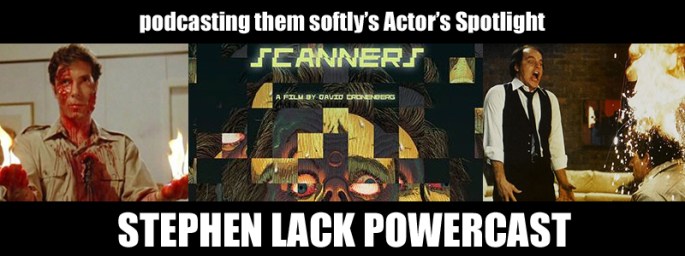
PTS Presents ACTOR’S SPOTLIGHT with STEPHEN LACK

lack-powercast

1002747_10151651644449691_942999894_nWe are very excited to announce and introduce artist and actor STEPHEN LACK to join our actor’s spotlight series.  All of our listeners will instantly recognize Stephen as Cameron Vale in David Cronenberg’s 1981 classic SCANNERS.  He then re-teamed with Cronenberg in the role as Andres Wollek in DEAD RINGERS.  He was also featured in Larry Cohen’s PERFECT STRANGERS, Michael Grant’s HEAD ON, and Allan Moyle’s RUBBER GUN which Stephen also co-wrote.  Please check out Stephen’s website STEPHENLACKART.COM to get a glimpse at his fantastic no-expressionist art work.  For our listeners in New York, Stephen’s work is on display at the Castor Gallery on the lower east side throughout September.  We hope you enjoy this as much as we did!

SPIKE JONZE’S WHERE THE WILD THINGS ARE — A REVIEW BY NICK CLEMENT

1

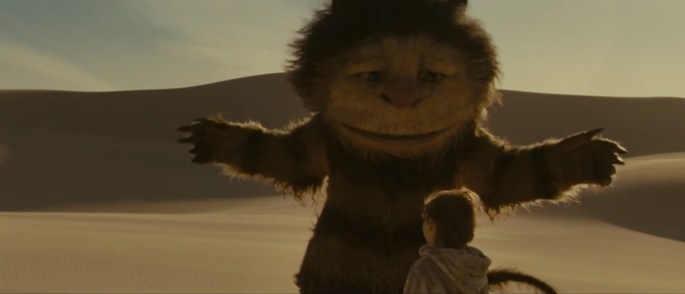
With Where the Wild Things Are, idiosyncratic genius Spike Jonze tapped his inner Kubrick and his inner Malick, and made a $100 million art film, a project not necessarily for children, but centering on a child, told in a mature, intelligent, creative, and singular way. I was expecting something grand when I first encountered this film on the big screen roughly six years ago, and I definitely got that. It’s just that I wasn’t sure what the end result was going to be, what with all of the fighting between Jonze and Warner Brothers during production, and the troubled shoot and endless post-production process. The film is definitely “the book,” so anyone who was afraid that Jonze and crew wouldn’t remain faithful to Maurice Sendak’s original source material can stay calm. But for me, it’s much more than the book; it’s a painful movie about the effects of divorce and how it shapes children, and in the case of the film’s hero, Max, how it informs an awkward boy as he starts to understand his uncertain familial future. This is as bold of a “kids” movie as I’ve ever seen, but again, I hesitate to really call it a “kids” movie. For a film that went through years of production and creative turmoil, you’d never know it. Where the Wild Things Are is, above all, a visual marvel; the creatures themselves are some of the most beguiling cinematic creations that have ever been imagined. The idea to go man-in-suit with the Wild Things was a great idea. This low-tech, old-school approach has been perfectly mixed with state of the art visual effects for the eyes and mouths, and the results are nothing less than stunning.

2

Lance Acord’s gorgeous, hand-held, and totally engrossing cinematography was some of that year’s best shooting, and the driving, upbeat yet melancholy score brought everything together. And one must credit director David Fincher, for showing Jonze the technology he was using at the time on Benjamin Button, as that gave Jonze the confidence to use a blending of CGI and men-in-suit performances. And I haven’t even touched upon the performance of Max Records as Max; in short, it was an auspicious debut. The entire movie hangs on his performance, and he really was captivating. But it was the interactions between the Wild Things that will keep me coming back to this film in years to come. Where the Wild Things Are was one of the best films from 2009, but it’s not going to be loved by all; it’s too specific and too artistic to garner universal love. I think little kids, by and large, will be scared by it, and will probably be turned off by the lack of major action set-pieces and cheap and easy cutesy-humor bits. This isn’t a whiz-bang CGI creation with bright colors and easy to digest themes. It’s a potentially damaging film that is more likely to be appreciated by adults, and by people who loved the book as a child. And maybe most impressively, few other films have conjured up fever-dream images quite like the way Wild Things does. Despite receiving warm critical embrace, the film failed to achieve blockbuster status. But that doesn’t mean that the movie is uniquely special in ways that money can’t describe.

22

THE BLAIR WITCH PROJECT: A Retrospective by Joel Copling

Rating in Stars: **** (out of ****)
Cast: Heather Donahue, Joshua Leonard, Michael C. Williams
Directors: Daniel Myrick, Eduardo Sánchez
MPAA Rating: R (for language)
Running Time: 1:21
Release Date: 07/14/99 (limited)

It is the unknown we fear when we look upon death and darkness, nothing more.
— Albus Dumbledore in 
Harry Potter and the Half-Blood Prince

We fear the silent darkness because it seems such an unnatural thing; we fear the noises that penetrate it, not because of the potential source of those noises, but because the unnaturalness is now layered on top of itself. A bear in the dark woods is far less frightening than the suggestion of the bear in the dark woods. Alfred Hitchcock once posited that suspense was a bomb placed underneath a table, refusing to explode far past the point at which it would, for the purpose of drama, comfortably explode. The bomb itself is secondary: What frightens is the mere suggestion, and if you doubt this, think about the adage regarding yelling, “Fire,” in a crowded place.

The Blair Witch Project applies that thesis to yet another source, layering the unnaturalness threefold: We are also frightened (sometimes in a playful way, it is true) by ghost stories. Writers/directors Daniel Myrick and Eduardo Sánchez concoct quite the corker. Stories are told of an ancient town in Maryland known as Blair that was discovered abandoned and renamed Burkittsville and of a woman who lived there before being condemned for witchcraft. Since her own vanishing, disappearances and gruesome murders have followed. The early parts of the film detail the legend through faux interviews with the townsfolk of Burkittsville in precisely the anecdotal fashion shared by all ghost stories.

Myrick and Sánchez’ method introduces a fourth bit of layering to the unnaturalness by choosing to frame the story from the point-of-view of a documentary crew investigating the local legend. Heather (Heather Donohue) is the host and leader of a school project. Josh (Joshua Leonard) is the cameraman. Mike (Michael C. Williams) is the sound guy. They are the only primary characters we see as they interview the townsfolk, including a particular woman who saw the Blair Witch up close and somehow survived to tell about it, and then head into the Black Hills woods toward the campsite where, in the 19th century, five men were ritualistically murdered.

In the years since the film’s release, the number of so-called “found footage” films has increased, so that the method now effectively leads a sub-genre within horror. Here, in one of the first examples of the method, is a film that would not work without it. The intimacy of Neal Fredericks’s camera works to dig into the psychology of three young adults who entered into a situation far beyond their ability to control it, and by doing so, he makes the audience a participant in the terror. A member of the group goes missing, his screaming for help useless when the others cannot locate him. At some point, they find they’ve gone in a circle. The most frightening aspect of the film is its rising psychological terror, causing anxiety, panic attacks, and even something near a mental breakdown.

Eventually a more traditional kind of horror must be introduced, as two among the trio enter an ancient house with ties to this legend. What does transpire will not be revealed here for those who haven’t seen the film, but the filmmakers leave much — nearly everything — to the imagination. The audience does not need to know what happened, because, again, the suggestion is far more horrifying than being shown what happened. The performances, especially Donohue’s, are exceptional at conveying a sense of deteriorating sanity. They help to make The Blair Witch Project a positively, desperately, relentlessly horrifying experience, and that’s before the haunted-house tour.

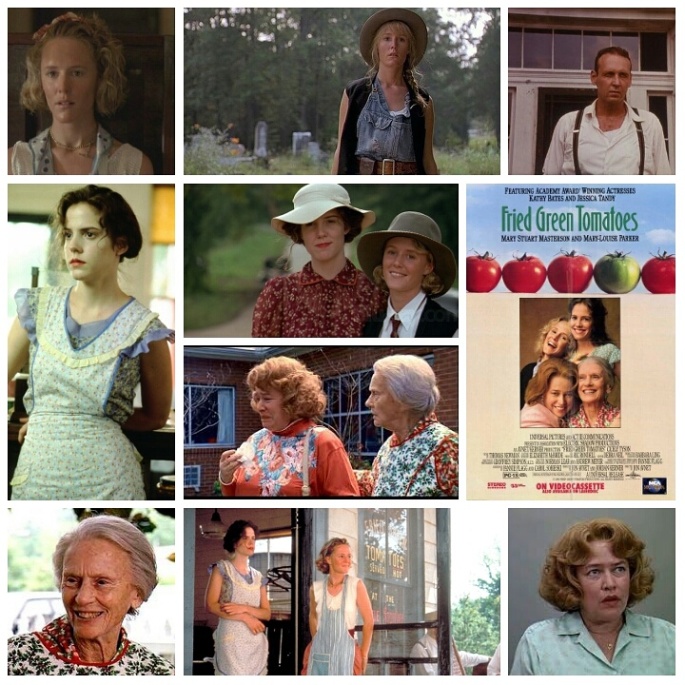
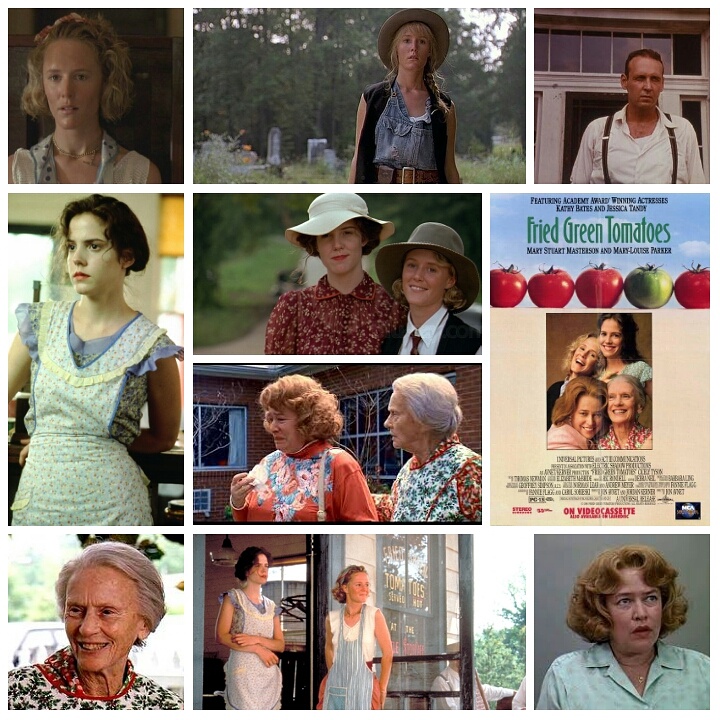
Fried Green Tomatoes: A Review by Nate Hill 

Fried Green Tomatoes is one of those films that presents two narratives, simultaneously woven together and unbound by the laws of past and present. A character from the present tells tales of the past, and the film jumps ever back and forth between the two, until a connection emerges. You’ve seen it in stuff like The Notebook, where it works beautifully, and both stories support each other. That’s the issue with this film: One of the narratives is lovely and works quite well. The other? Mmm…not so much. Kathy Bates plays a hospice worker in a retirement home who is charmed by stories of life, freedom, injustice and romance from long ago, all told with wit and passion by an excellent Jessica Tandy. She tells of life growing up during the early 1900’s in the American southwest, of free spirited tomboy Idgie (a fierce and emotional Mary Stuart Masterson), the girl she loves (Mary Louise Parker, radiant) and the whirlwind of trouble and conflict going on around them. Idgie lost her brother and best friend (a short lived and very young looking Chris O ‘Donnell) to a horrible accident, and sort of has a lost pup complex, holding on to Parker for dear life and trying her best to extricate her from an abusive relationship with her monster of a husband  (Nick Searcy is evil incarnate). It’s whimsical, touching and flavored with just the right touches of sadness and danger. Now, the story with Bates in the present just feels aloof and silly. The scenes with her and Tandy fare better than glimpses of her home life and attempts to empower and change her for the better. Don’t get me wrong, I love that idea, the notion of inspiration  transcending time and the ability to help others simply with the spoken word and the wisdom of the past, but it just didn’t work in this case. As for the scenes in the past, I fell hard for them. Masterson is a terrific actress who usually gets saddled with light, fluffy roles, but here gets a chance to let some raw emotion out. Parker is more reigned in but every bit as soulful, as the girl in a situation no one should have to endure, her soul practically screaming out through those beautiful brown eyes. I suppose you could say that it’s half of a great film, that couldn’t quite pull off it’s own narrative flow.