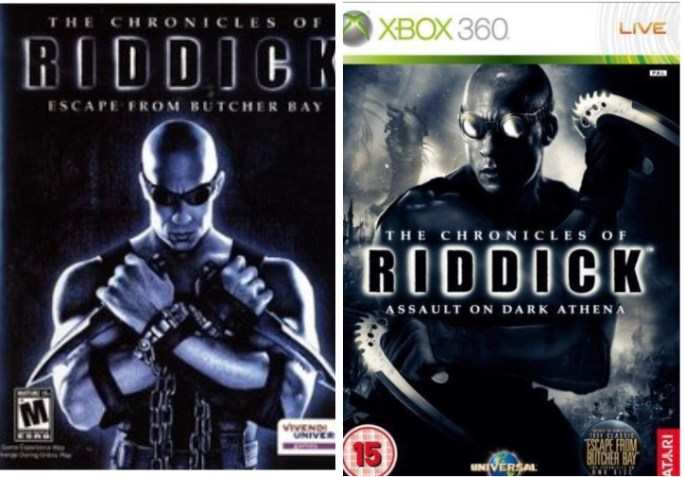
The Chronicles Of Riddick: Escape From Butcher Bay & Assault On Dark Athena

I’m a huge fan of the Riddick films, I love the mythology, world building, alien anatomy and general vibe, and while the film trilogy is amazing there are also all kinds of other bits of lore to be found in other arenas including comics, animated shorts and two spectacular video games that I got a chance to view entire walk-throughs on YouTube the other night. Now, these aren’t just cheap promotional ‘tie-in’ games that are rushed into production to be released alongside the film for no other purpose than cash, they are deep, important chunks of Riddick’s story with integral character beats, wonderful stories and jaw dropping set pieces all their own. They’re also great because Vin Diesel did the voice and motion capture work for Riddick, which has to be the lynchpin role of his career and he’s supported by a galaxy of star talent and cult actors in voice roles.

The first game is called Escape From Butcher Bay and it sees Riddick and his perennial bounty Hunter nemesis/best pal Johns (Cole Hauser) arrive at the titular penitentiary, a grim institution lorded over by preening Germanic warden Hoxie (Dwight Schultz) and brutally kept in check by his corrupt head guard Abbott (rapper Xzibit). It’s here that Riddick must fight his way through hordes of feral inmates and descend deep into the bowels of the prison to find a way out and discover pieces of his mysterious identity. He participates in a gruesome fight club run by Centurion (Michael Rooker), fights alongside exiled gang kingpin Jagger Valence (Ron Perlman) and runs afoul of many other creeps voiced by awesome folks like Tony Plana, the late William Morgan Sheppard, Stephen McHattie and Joaquim De Almeida. Deep in the heart of the facility he encounters half undead deformities and meets a shadowy subterranean prophet called Pope Joe (Willis Burkes) who operates on him and first gives him his ‘sight in the darkness’ eyes. Along with these eyes come haunting visions where Furyan spirit Shirah (Kristen Lehman) speaks out to him from his ancestral past and guides his eventual path towards destiny that we see unfold in the films.

The second game is called Assault On Dark Athena and while not as mythologically rich as Butcher Bay it has the advantage of being made a few years later and so the graphics, cutscenes, fighting styles and visual aesthetics are far more polished and impressive. It picks up right where the other left off, as Riddick and Johns approach a mammoth slave ship ruled by aggressive tyrant Revas (Michelle Forbes), where he must fight and outwit his way to find intel and weaponry deep within the giant floating prison. He’s aided by former military man turned inmate Dacher (Lance Henriksen, superb) and he forges a deep bond with a little orphaned girl roaming the craft, a relationship that reminded me very much of Ripley and Newt from Aliens and provides Riddick’s arc with pathos and poignancy. I can’t speak for the actual gameplay, controls or anything on the ‘hands on’ aspects of these games as I essentially watched them as you would a movie, but in that sense they are absolutely terrific stories and more than essential to the Riddick canon and lore. Spectacularly violent, gory and hard-R like these stories were always meant to be, a beautiful fusion of poetic deep space atmosphere and kinda steampunk/mecha/convicts in space aesthetics and a wonderful pair of expansion stories on Riddick’s exciting, moving, imaginative, immersive and artistically spellbinding voyage through galaxies to find his identity, history and change the course of the universe’s future. Highly recommended, whether you want to get an old console and play them as games or hop on over to YouTube and view them as films.

-Nate Hill

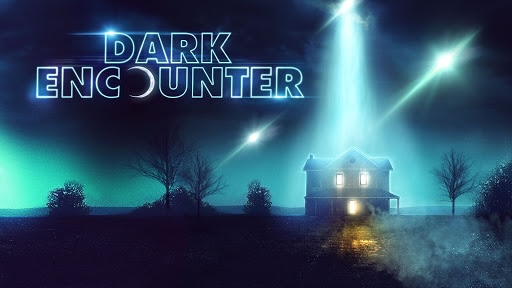
Carl Strathie’s Dark Encounter

You can do pretty amazing things with lower budgets if your heart, storytelling technique and ambitions are in the right place and Carl Strathie’s Dark Encounter is a glowing example of that. This is a wonderful, emotionally devastating amalgamation of classic alien abduction/UFO stylistics and deeply heartfelt interpersonal family drama that wears its influences (everything from Nolan’s Interstellar to Spielberg’s Close Encounters) lovingly on its sleeve. It tells the story of a large family sometime in the 60’s or so who get home one night to find their young daughter missing. Flash forward one year later, they are still grieving her loss and trying to deal with the lack of closure, and as they all gather at her parent’s place to try and heal, strange things begin to happen. Lights in the sky and in the forests around their property, massive flocks of birds vacating the area en-massé, and mysterious spacecrafts hovering over their abode. Was their daughter abducted by aliens, who have now returned to torment the rest of her kin? I won’t say another word about the story beyond that except to say that at this point things get *really* interesting and completely unexpected. This is a beautifully made film full of unbelievably innovative special effects when you consider the budget, everything from iridescent strobe lights emanating from the floorboards to haunting points of light dancing on the edge of the forest’s horizon to a jaw dropping immersive sequence where our POV zooms out for a breathtaking visual voyage into the far reaches of the cosmos, a journey both inwards and outwards that reminded me, in spirit, of both Kubrick’s 2001 and Malick’s The Tree Of Life. I have to warn any viewer that this is a gut punch of a story that deals in subjects matter both tragic, disturbing and is tough to watch, but the process, execution and artistic forces at work are remarkable. The film’s score might be the best I’ve heard in a long time, an expansive auditory soundscape that encapsulates everything from the eerie to the experimental to the emotionally orchestral that digs your heartstrings right out of your chest. The cast are all perfect, with Laura Fraser and Mel Raido giving soulful work as the girl’s tormented parents, and an appearance by the always awesome Vincent Reagan, this role being perhaps the first time I’ve ever seen him in cinema without a sword in his hand. This is a fantastic film for anyone who appreciates spooky, atmospheric UFO themed storytelling, very well acted family drama and an unexpected, highly affecting narrative that I promise you will not guess ahead of time. Great film.

-Nate Hill

THE MICHAEL MANN FILES: THIEF (1981)

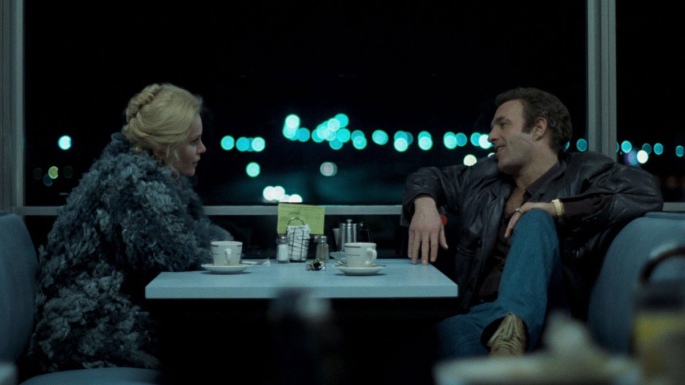
“I have run out of time,” Frank softly says to Jessie, almost begging her to listen to him. He wants her to know that his time on this earth has been abnormally disrupted due to incarceration and that his life as a professional criminal has rendered a regular, natural existence impossible. In Jessie, the lady who works the register at one of his favorite breakfast haunts, Frank correctly senses another outcast; a wounded and marginalized soul who is letting the better part of her years slip away from her. He desperately wants her to be a part of his life and does everything in his power to convince her to agree to do so. Tearfully, she eventually does.

Leading up to that conversation in a late night diner, it’s crystal clear that Frank has had quite a day. After pulling off a meticulously executed, all-night diamond heist, he has to deal with some criminals that have stolen the money he was supposed to have received for the aforementioned robbery, he’s learned that his father-figure and mentor, Okla, is rapidly dying from heart disease, and, to top it all off, he’s over two hours late for a dinner date with Jessie due to his having to go through some clandestine, bullshit meet with members of a crime syndicate just so he can recoup his dough from the robbery the previous evening. This is his life, but it’s sure not the life he wants.

One of the most disarming things about Thief, Michael Mann’s theatrical film debut from 1981, is how much it focuses on Frank’s desire to chuck his life as a criminal and to settle into suburban anonymity. As portrayed by James Caan, Frank is decidedly not addicted to the juice of living like a criminal nor does he need the action to direct his life. Unlike Harry Dean Stanton’s Jerry in Ulu Grosbard’s Straight Time, co-scripted (uncredited) by Mann, or later Mann characters such as Heat’s Neil McCauley, a “regular type life” with “barbecue and ballgames” sounds just fine and dandy to Frank. In fact, Frank is so desperate for convention that he carries around a sad, wallet-sized collage of his dream life replete with pictures of children, a luxury car, Okla, and an inexact depiction of someone who will fill the role of wife and life partner. It’s no more exciting than what regular people take for granted but it means the absolute world to Frank.

In order make his modest dream life happen quickly, Frank makes a devil’s bargain with crime boss Leo (Robert Prosky), agreeing to a limited number of complex, pre-set, and high-yield robberies with the handshake agreement that he will be able to refuse any further work after each completed job. Naturally this will fall apart in spectacular fashion as crooked cops and even more dishonorable criminals complicate and jeopardize Frank’s vision for his future.

For a movie that made such limited noise at the box office, Thief’s influence on the crime thriller, in both look and content, is all but incalculable. As to the former, one would think that Michael Mann singlehandedly invented the visually intoxicating mix of wet streets and neon signs in the same way someone bumbled into mixing peanut butter and chocolate and made the Reece’s organization a bottomless fortune. As to the latter, the attention to detail that soon became the norm is directly influenced by Thief’s impeccably shot and edited sequences that highlight the fascinating, granular elements that make up the lives and work of professional criminals. Certainly films such as Jules Dassin’s Rififi and any number of Jean-Pierre Melville titles predated Thief’s love for the Swiss watch-precision in criminal activity. But Mann’s significant choice of laying the hypnotic and percolating minimalism of Tangerine Dream’s prog rock score over his near-wordless action montages pretty much created the blueprint for the look of almost ALL visual media that followed. When critics spoke about the slick, heavily-stylized “MTV look” that crept into theatrical films and commercials in the early 80’s (including Mann’s next theatrical endeavor, The Keep), they were talking about a style the ground zero of which was found in Thief. William Friedkin may have pioneered the idea in 1977 with Sorcerer (also boasting a score by Tangerine Dream) but Mann perfected it in 1981.

The lyricism found in Mann’s dialogue is also in full flower in Thief which melds quite beautifully with the stark, unmistakable realism of the life of the convict both in and out of prison, as chronicled by Frank in his diner monologue to Jessie which eerily recalls the day-to-day life of Murphy in Michael Mann’s previous film, The Jericho Mile. When Frank tells Jessie about an assault on his life and the aftermath that followed while he was serving time, he sounds as if he’s reciting a poem he was asked to write to describe the hell that exists within the prison walls. This is likewise the case when a bereft Frank verbally melts down and makes a full spectacle of himself in an adoption agency after he and Jessie are turned down as prospective parents due to Frank’s status as an ex-con. Never before has the utter hopelessness and anguished inhumanity that is the part and parcel of the life of a criminal been delivered with such control and beauty as it is in Thief.

Unlike Michael Mann projects that would come later, Thief, isn’t as interested in exploring the slippery nature between cop and criminal as it aims to be more classic in its mold while being more progressive in its approach. Thief, for lack of a better term, is a neo-noir where the chiaroscuro is given heavy assistance by magnesium but it is not an existential mediation on the tenuous line between good and evil. That said, in doing some rather interesting things in its casting, it does serve as a bit of thematic foreshadowing as real-life thief John Santucci, who served as a technical adviser and whose actual industrial burglar tools are used in the film, portrays the sleazy Sgt. Urizzi and real-life cop Dennis Farina, close to hanging up his badge for a respectable career in show business, shows up as Carl, Ataglia’s lethal bodyguard. The crossed lines of cop and criminal are all in the casting here but they will soon be at the heart of the rest of Mann’s oeuvre.

Aside from its technical and structural brilliance, Thief will always register as a bonafide masterpiece due to the impossibly high level of passion in the performances. It has been said countless times over but it will never not bear repeating that Thief is James Caan’s greatest hour. Equal parts tough, thoughtful, tragic, and triumphant, Caan slow-walks himself through the role of a lifetime, enunciating every syllable and wearing every nuanced emotion on his face while also turning in a remarkably physical performance (cat burglary looks like a lot of work, folks). As a woman whose past connection to the criminal element has limited her own options in life, Tuesday Weld’s Jessie radiates a wholly believable warmth and an inner-toughness which has been constructed to shield her from certain disappointment and render her invulnerable to easy influence. Jim Belushi is terrific in a rare dramatic role as Barry, Frank’s wiretapping and surveillance whiz, and Willie Nelson transcends mere stunt casting as the zen and terminal Okla, Frank’s jailhouse mentor. Among all of the supporting cast, though, Robert Prosky is the one who deserves special mention. A latecomer to acting (he was 41 when he was cast in his first part in a television movie in 1971), Thief was Prosky’s first big role and he owns every second of it. One second professional to the core and the other the most poisonous villain this side of Ben Kingsley’s Don Logan, Prosky brings a perfect balance to the role that forces him to oscillate between grand benevolence and guttural betrayal. Prosky’s delivery of an absolutely odious monologue in the last third of the movie deserves some kind of special award for being as captivating, thrilling, and rewatchable as it is horrifying, execrable, and repellant.

When speaking about the contemporary crime thriller, Michael Mann’s name brings as much heft to the genre as Hitchcock’s name did with the suspense film and Thief worked overtime to make that happen. And due to Michael Mann’s unshakable fidelity to the detail of the work of his characters and his impeccably operatic examination of their melancholic lives, he would soon find his options opening up exponentially when he redirected his focus from the lonesome, existential life of the career criminal and towards the cops that made their living chasing them. But with Thief, Mann found that perfect vehicle that allowed him to fuse his visual and thematic sensibilities into one flawless package while setting a stylistic pole position for the rest of Hollywood.

(C) Copyright 2021, Patrick Crain
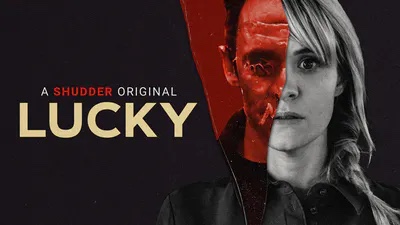
Brea Grant’s Lucky

I struggled with Lucky, a new horror film billed as innovative and groundbreaking and yes it’s well made, yes it’s themes are incredibly important but you have to fashion a story that makes sense and draws you in around said themes or all you’re left with is abstraction without any proper narrative tissue to cling to. This is written by and stars Brea Grant, an actress whose work I loved in Rob Zombie’s Halloween II and some of the later seasons of NBC’s Heroes, where she played the Quicksilver proxy. Here she plays a suburban woman who is attacked one night in her own home by a masked man. She wounds the guy and he runs off, but the next night he shows up again. And the next night again. And again, and so on. When she tells her husband he more or less shrugs it off with a non-reaction. Her friends and the police seems to have the same lukewarm indifference so she’s stuck in this surreal twilight zone where she’s the only person who finds it concerning that the same intruder comes back night after night to torment her, no one in her life properly believes, listens or takes her seriously and she feels alienated and outmatched by both her attacker as well as the people and support systems in her life that are supposed to care. See where this is going? It’s a fabulous concept for a film and the fear, panic and paranoia is well executed on top of a terrific performance from Grant… however… the script does absolutely *nothing* to explain this concept from a story/script point of view beyond “she’s attacked every night by the same dude, no one really believes her and she’s basically on her own in fighting back.” Then, it starts happening on a mass scale all throughout the city like some kind of violent epidemic and everyone who is not the attacker or the victim seems to just carry on like nothing much of anything’s happening. The film makes absolutely zero effort to explain this beyond simply showing it happening, and as a result it completely tanks itself, and doesn’t work whatsoever as anything close to a coherent narrative. Now, this is a tricky one to review because of the subject matter itself so let me spell it out clearly: there is no doubt in my mind whatsoever that these themes are incredibly important, that violence/assault towards women is a very serious matter that needs to be addressed both in art or society, and so too the endemic indifference and non-believing nature of others in their lives who either turn a blind eye or don’t care. It’s so important. However: these filmmakers made their story *purely* from an abstract, allegorical point of view and didn’t mesh in a storytelling device or proper narrative to support it, and that to me felt lazy, incomplete and incoherent, and I disliked the film. Anyone out there hollering “you just didn’t get it because you’re a man and this film wasn’t made *for* you” into the echo chamber can stop right there. I succinctly and pristinely understood these themes, and understand how important they are, but that doesn’t change the fact that the film itself, as a piece of art, was not a successful endeavour and my saying so in a review doesn’t immediately imply that I’m discrediting anyone’s experiences or these social issues overall. I shouldn’t have to explain this so in depth but some people out there really seem to struggle with it, so there it is. Well made film from a technical standpoint, an absolute knockout of an original score by Jeremy Zuckerman, fantastic performance by Brea Grant and very important themes… but ultimately it falls flat on its face.

-Nate Hill

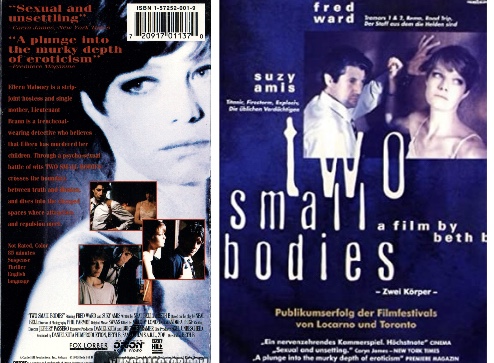
The VHS Files: Two Small Bodies

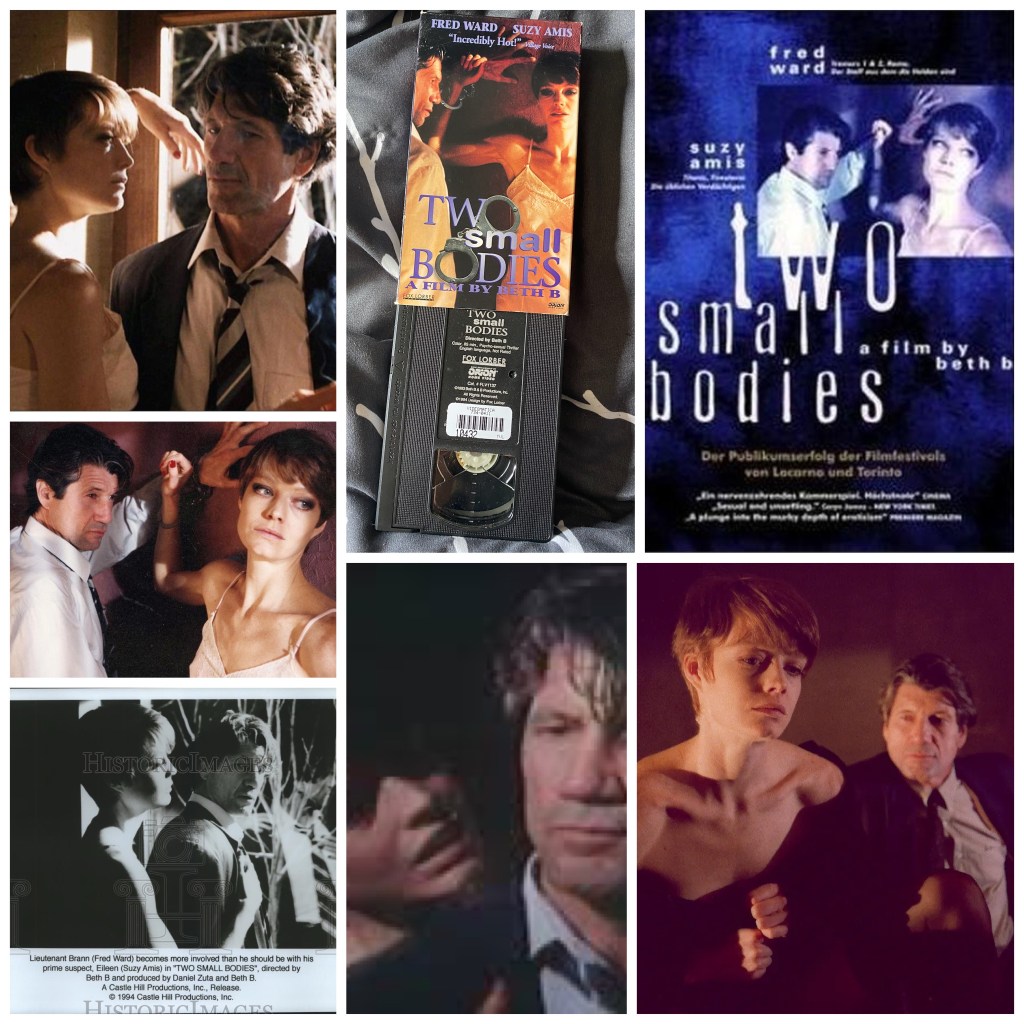
Today’s VHS File is an odd one called Two Small Bodies, essentially a grim two person drama that sees a police lieutenant (Fred Ward) relentlessly interrogate a single mother (Suzy Amis) who has reported her children as missing. They hang about her house as he goads, manipulates, probes and generally just drives a wedge into her life in an attempt to find out what happened to her kids, and he cultivates a growing suspicion that she’s the guilty party herself. This is based on a stage play, so we just have this one location, two actor story without anything else in the way of dynamics. Thankfully our two leads are both excellent, particularly Ward who is at his most… manic, Jim Carrey style acting I’ve ever seen him in a career full of mostly straight shooter authoritarian/cop roles. His cop (I began to wonder if he even was a real cop) here is a piece of work, and takes full advantage of the fact that Amis’s character is a stripper in his tirade of investigative fury towards her. The film is directed by cult filmmaker Beth B so the kinky underground vibe is there, but she struggles somehow in getting this story successfully across. You can only go so far with a constant back and forth barrage between two characters before you need narrative innovation and for your story to, you know… go somewhere! Unfortunately this doesn’t go anyplace concise beyond having the two leads engage in bizarre, borderline surreal roundtable dialogue and questionable behaviour and then just sort of leaves the ending open for us to figure out. I had a vague idea myself of who these two really were, what happened to the kids and what their situation was really about but the film (not sure how the play goes) does little to solidify any concreteness and let’s the final frames billow out in ambiguity like the perpetually windswept curtains in this woman’s nocturnal abode. That’s not to say it’s inherently a bad choice, ambiguity can be an especially *strong* choice if implemented correctly, but you just never know how each viewer will respond to that, and I was left a little lost. A fascinating exercise, if an incomplete one.

-Nate Hill

April Mullen’s Wander

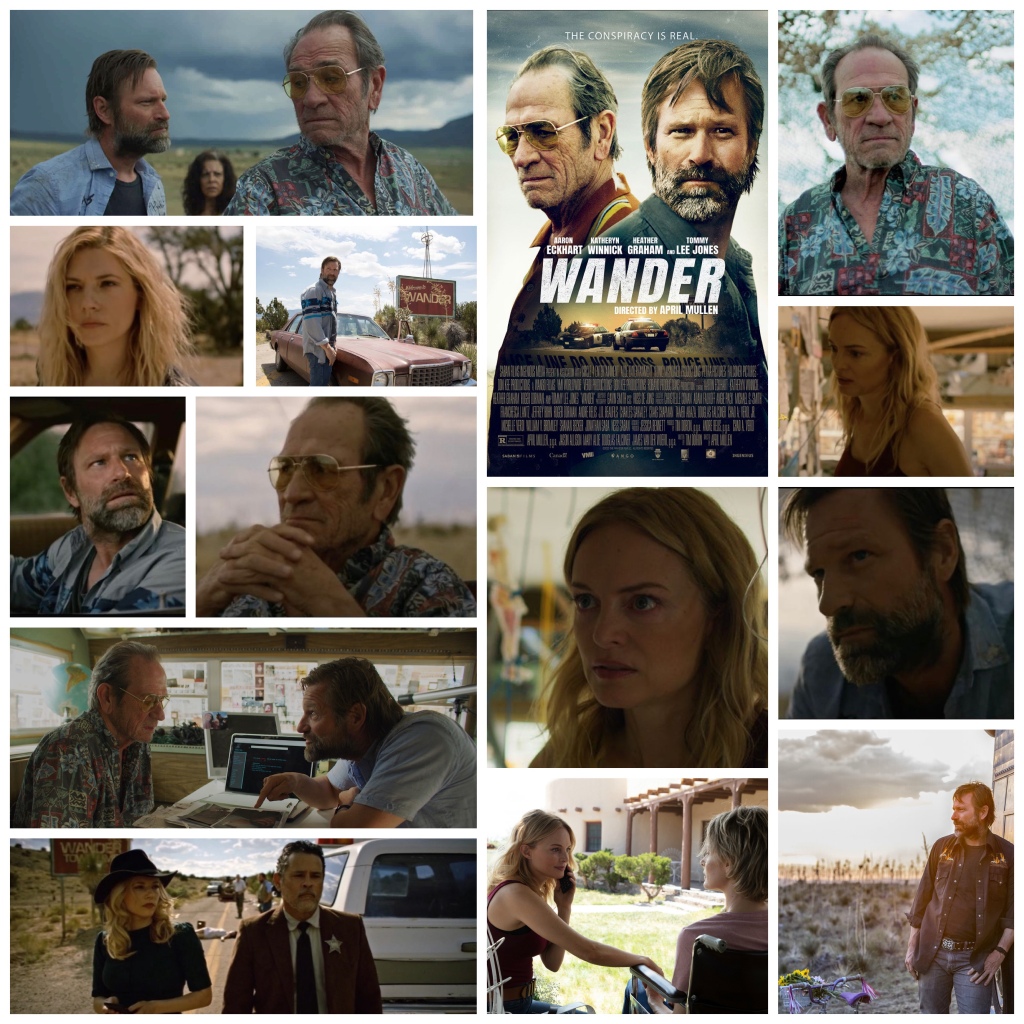
I wasn’t quite sure what to expect with April Mullen’s Wander and my hopes may have not been that high just based on reviews but I honestly loved this wild, scrappy, unconventional, ‘pulp arthouse’, sociopolitically conscious bauble of a film so much. Many won’t vibe with it and that’s okay because it’s supremely weird, visually stylish and kinetic in the fashion that filmmakers like Tony Scott and Oliver Stone traffic in and, quite frankly, all over the place in terms of tone, editing and plot to the point that many viewers will feel assaulted by commotion. I love it for all the reasons mentioned because my tastes always gravitate towards the wild, wooly, artsy and just plain strange. Aaron Eckart and Tommy Lee Jones give perhaps the two performances of their career that are most… ‘unlike their essence’, playing a couple of crusty, paranoid conspiracy theorists who run a tinfoil hat podcast from their dusty trailer. One night a distraught mother calls into their show claiming her daughter was kidnapped by shadowy government factions and corrupt law enforcement and enlists their help, so they pack up and venture out to Wander, NM, a literal one horse town with a nervous sheriff (Raymond Cruz) who knows more than he lets on and a mysterious cowgirl (Kathryn Winnick) who lurks about the place. Eckhart’s character has a lot to contend with beyond the task at hand, he’s ridden with PTSD from a former accident that killed his daughter and left his wife in brain damaged catatonia. Their investigation leads them to some pretty disturbing revelations that I won’t spoil here but there’s an interesting psychological juxtaposition between what’s really going on and what’s a facet of their already fractured collective mental states. Eckhart is wonderfully intense, barking and growling out his lines with the ferocity set on low burn and looking frantic as a wild animal, while Jones is the cunning old dog who is marginally more put together and tries to steady his pal but is still completely out of it himself. Heather Graham gives a wonderfully soulful supporting performance as a good friend of Eckhart’s who does her best to help him through what’s going on. What I really loved about this film is how many tones and styles tributary together for an often raucous but incredibly singular experience. The film opens with a preface paying respect to indigenous and all peoples of colour who have been displaced and mistreated along many borders and immediately begins with a jarring prologue as a Native woman flees unseen forces in a speeding car. Director April Mullens uses elaborate, tricky, swooping, unbelievably dynamic camera movements and chopper/drone shots to bring the story to life in an immersive and breathtaking way, and the musical talent of Canadian indigenous artist Jeremy Dutcher adds haunting atmospherics to the soundscape. This film is a lot of things, and it will no doubt be too much, or too ‘out there’ for many but it’s right up my dusty backcountry alley. Bizarre, confounding, melodic, emotional, frightening, it’s altogether like nothing I’ve seen and truly one for the books.

-Nate Hill

The VHS Files: John Irvin’s Freefall

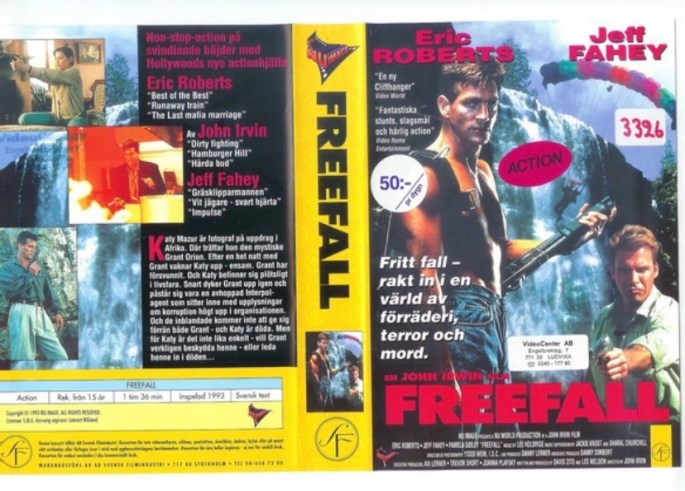
Today on the VHS Files is a super sexy Cliffhanger knockoff called Freefall starring an impossibly sweaty Eric Roberts, a super smarmy Jeff Fahey and a very foxy Pamela Gidley, who actually passed away last year and many of us fondly remember as Teresa Banks from Twin Peaks. This is actually a really solid action flick set in an exotic location and featuring these three B icons at the peak of their physical attractiveness. Pam plays wildlife photographer Katy, sent by her boss and fiancé Dex (Jeff) to get pictures of a rare bird of prey somewhere in deepest Africa. There she meets Eric’s Grant Orion, a daredevil adrenaline junkie who parachutes off waterfalls when he’s not sipping brandy on the hotel veranda, and she falls for him hard, hard enough for us to get to see them bang way up atop a waterfall with a gorgeous view. The plot goes bananas when it’s revealed that Grant is some sort of disgraced former Hollywood stuntman turned double agent for Interpol, all kinds of baddies are introduced including a freaky ass albino assassin and Dex himself who turns out it to not be the perfect fiancé she thought, and a globetrotting cat and mouse game gets underway. Roberts is terrific here, all lithe physicality and southern charm, Fahey himself tries an odd southern accent and comes across as a bit hammy but such is the arena here anyways, while Gidley fills out the action heroine role nicely. The film is directed by a dude named John Irvin who also did stuff like the Patrick Swayze western Next Of Kin, the rough crime pic City Of Industry, the cult Chris Walken curio Dogs Of War, the war film Hamburger Hill and the Schwarzenegger flick Raw Deal so he just knows his way around a good solid action sequence and how to handle tough guy actors. This is good fun with gorgeous locations, three knowingly arch lead performances and a relaxed vibe.

-Nate Hill

The VHS Files: Yesterday’s Target

Today’s VHS File is a dusty old SciFi time travel flick called Yesterday’s Target whose plot I just couldn’t get a handle on, despite it having some cool ideas, ambient atmospherics and neat set pieces. It stars one of the Baldwin brothers, and you pretty much know what you’re in for when they headline something. Daniel Baldwin is an unassuming factory worker who is recruited by a shadow organization because of his untapped psychic talents, targeted by a mysterious rogue military scientist played by Malcolm McDowell in one of his classic mega villain roles but he’s curiously restrained and relaxed here. Baldwin basically goes on a cross country road trip to find other psychics like him including a clairvoyant (Stacey Haiduk), a short order cook who is a firestarter (T.K. Carter from The Thing in this film’s liveliest performance) and others. They’re pursued by McDowell’s top man, a cowboy hat wearing Levar Burton in a bizarrely cartoonish performance that doesn’t work and brings the film somewhat down whenever he’s onscreen. There’s an absolute deluge of expository mumbo jumbo, arbitrary subplots and just garbled SciFi clutter here including some secret society that travels through time to prevent people from having shitty lives, a child prodigy, Vegas card sharking, McDowell’s random personal life with his wife and all sorts of interludes that muck about until I really wasn’t sure what this film was even about beyond a vague idea of ‘time travelling clairvoyants.’ Still, it’s very atmospheric and some of the performances are a lot of fun. It’s also quite muted and laidback and even when there’s gunplay or a pursuit it feels just… hushed and soothing somehow. There’s a deliberately anticlimactic ending as Baldwin and McDowell standoff only to surprise each other with revelations regarding identity, time loops and serendipitous phenomena that again, I wasn’t clear on, but allows Malcolm to inject some real poignancy into an otherwise standard villain role, if even for a brief moment when all is almost said and done. It’s worth a look but nothing special. I have no memory of where I even got the VHS tape but it’s another one of those screeners that nobody is supposed to sell yet somehow find their way to good homes. I see this is also streaming on something called Tubi though, if anyone is at all curious.

-Nate Hill

The VHS Files: Yesterday’s Target

Today’s VHS File is a dusty old SciFi time travel flick called Yesterday’s Target whose plot I just couldn’t get a handle on, despite it having some cool ideas, ambient atmospherics and neat set pieces. It stars one of the Baldwin brothers, and you pretty much know what you’re in for when they headline something. Daniel Baldwin is an unassuming factory worker who is recruited by a shadow organization because of his untapped psychic talents, targeted by a mysterious rogue military scientist played by Malcolm McDowell in one of his classic mega villain roles but he’s curiously restrained and relaxed here. Baldwin basically goes on a cross country road trip to find other psychics like him including a clairvoyant (Stacey Haiduk), a short order cook who is a firestarter (T.K. Carter from The Thing in this film’s liveliest performance) and others. They’re pursued by McDowell’s top man, a cowboy hat wearing Levar Burton in a bizarrely cartoonish performance that doesn’t work and brings the film somewhat down whenever he’s onscreen. There’s an absolute deluge of expository mumbo jumbo, arbitrary subplots and just garbled SciFi clutter here including some secret society that travels through time to prevent people from having shitty lives, a child prodigy, Vegas card sharking, McDowell’s random personal life with his wife and all sorts of interludes that muck about until I really wasn’t sure what this film was even about beyond a vague idea of ‘time travelling clairvoyants.’ Still, it’s very atmospheric and some of the performances are a lot of fun. It’s also quite muted and laidback and even when there’s gunplay or a pursuit it feels just… hushed and soothing somehow. There’s a deliberately anticlimactic ending as Baldwin and McDowell standoff only to surprise each other with revelations regarding identity, time loops and serendipitous phenomena that again, I wasn’t clear on, but allows Malcolm to inject some real poignancy into an otherwise standard villain role, if even for a brief moment when all is almost said and done. It’s worth a look but nothing special. I have no memory of where I even got the VHS tape but it’s another one of those screeners that nobody is supposed to sell yet somehow find their way to good homes. I see this is also streaming on something called Tubi though, if anyone is at all curious.

-Nate Hill

THE ROBERT ALTMAN FILES: BUFFALO BILL AND THE INDIANS, OR SITTING BULL’S HISTORY LESSON (1976)

At the conclusion of Nashville, the camera pans upward into the high heavens and the last image we see before staring off into the ether is the American flag. So it is appropriate that, at the beginning of Buffalo Bill and the Indians, or Sitting Bull’s History Lesson, the film that was released the following year, we see the raising of the American flag over the strains of reveille. Following some narration about the brave men and women who built our country and trudged through hardship after hardship, we witness the scene of an Indian attack on some settlers, driving the narrator’s point home in traditional western style. Once the carnage has concluded, the camera pulls back to reveal the attack has been a recreation and the settlers and natives are actors and this has all been done in the attempt to perfect a scenario for a Buffalo Bill’s Wild West Show. So where Nashville infused Altman’s vision of an America being infested with rot via politics and show business, Buffalo Bill and the Indians aims to almost invert that formula from the jump by giving a tall-tale American history lesson filtered completely through the artifice of show business which, ultimately and paradoxically, overflows with truths.

The year is 1886, and William F. “Buffalo Bill” Cody (Paul Newman) is a bigoted, ridiculously coiffed, narcissistic, and pinheaded blowhard who lives in a cloistered bubble of his own legend that is his Wild West Show where he is the figurehead, president, and CEO. But the new season needs a fresh angle as crowds are dwindling, causing chaos and cutbacks in Codyland. With the help of obsequious press agent Major John Burke (Kevin McCarthy) and ruthless producer Nate Salisbury (Joel Grey), Cody scores a coup when he wrangles Sitting Bull (Frank Kanquitts), whose victory over General George Custer at the battle of Little Big Horn made him a ready-made villain to audiences, into joining his show. Cody, a puffed up man of no small amount of self-importance, is frequently annoyed and enraged at Sitting Bull’s insistence on not rewriting history for the sake of entertainment nor allowing Bill to look like the star-spangled hero to which the latter is accustomed of appearing. Sitting Bull’s lethargic refusal to play the game Bill’s way, backed in full by Annie Oakley (Geraldine Chaplin), the show’s major draw, threatens the Wild West Show and, since he’s mostly a media construction, Bill’s existence.

To audiences of the day, this was maybe the most unwelcome bit of bicentennial cheer since Frank Zappa’s “Poofter’s Froth Wyoming Plans Ahead.” To fans of Paul Newman and westerns, this was an affront to the senses and their patriotic sensibilities. To those that loved Altman and were in the tank for him, it was unsubtle and too on-the-nose. And maybe both of those camps’ criticisms mattered a great deal in 1976 when the nation was struggling with itself as it turned 200 years old. The country’s dichotomous mindset couldn’t be summed up any better than the Academy nominating Taxi Driver, All the President’s Men, and Network for Best Picture only to then turn around and award the Oscar to Rocky, regardless of that film’s bottomless merits and endless appeal. It was clear that America was in the midst of a national case of the DT’s and was desperate to feel better.

Buffalo Bill and the Indians, unfortunately, was not made for people who wanted to feel better. It was made for people who thought all the ballyhoo circling the bicentennial was a racket, and a racist one at that. This kind of disdain made Robert Altman a frequent target of conservative critics who would continue to willfully label his flaming of American culture as a misanthropic attitude about America itself. Of course, this was wrong as Altman loved America and, in fact, embodied its best and greatest characteristics. What Altman hated was the rank hypocrisy and the half-truths that built so much of the American narrative, something that doesn’t seem like an unreasonable point of view. And, after all, what was the Wild West Show but a traveling pack of exaggerations that, nonetheless, blazed a trail in the collective mind of America and ensured that its revisionist tales took the place of actual history? If conservative critics are hell-bent on discussing the effect of television and movies on our citizens, why not extend that same argument to those mythological tales with a reach so far back into America’s past that our country’s mind has been hard-wired to recognize only its supposed benevolent greatness?

And perhaps Altman, whose Nashville was a critical hit but didn’t exactly achieve its goal of changing the way movies were made, earned himself no favors in Hollywood by making show business look like a nepotistic, valueless, and grotesque vessel frequently lost in it own sauce of incompetence and yes men. But by looking into the past and examining how so much of America’s historical foundation is built on myths and legends, he also sees the ability to shape the future. Buffalo Bill is a buffoon but his keen understanding of the power of “the show business” to twist history into something perverted, unfair, disgusting, and beneficial only to him is frightening. “Bill Cody can only trust his senses. And when his senses fail him, he might just see things as they really are,” muses Burt Lancaster’s Ned Buntline, one-time scribbler of penny dreadfuls but current deconstructionist of the myths he once helped create.

Naturally, something like Buffalo Bill and the Indians has aged extremely well and, viewing it in 2021, it’s a little jarring. For much of its running time, it feels like a funhouse mirror put up against our contemporary politics. Inspired by Arthur Kopit’s play Indians, screenwriters Altman and Allan Rudolph keep Buffalo Bill and the Indians confined within the boundaries of the camp of the Wild West Show and by keeping the film more or less stagebound, the Wild West Show and all of its backstage pandemonium begins to look like a lot like the White House of Donald Trump. When Bill meets Sitting Bull, it’s a mock celebration that’s meant to feel like an honorable meeting between two great heads of state but is instead a giant fantasy created to assuage the ego of Buffalo Bill who is such a moron, he has no idea what “incarcerated” means and confuses William Halsey (Will Sampson), Sitting Bull’s interpreter, for Sitting Bull himself. Liikewise, truth has no room within the parameters of the Wild West Show. Ned Buntline’s character is such an unwelcome creature in Bill’s land of fantasy that he attempts to have Buntline tossed from the premises the second Bill hears he’s around. Naturally, Bill delegates this duty to someone else and, likewise, Buntline won’t move until Bill disinvites him personally. This leads to one of the film’s most beautifully written and performed scenes in which Lancaster sighs “You haven’t changed, Bill.” “I’m not supposed to change,” Newman retorts. “That’s why people pay to see me.”

As a document in regards to Altman’s feelings toward the bicentennial, it’s fascinating. As a retroactive treatise on what would exactly happen if we lived in a political environment that operated like in the same fashion as backstage at The Muppet Show, it’s pretty brilliant even if Altman sometimes hard presses his acrid point to the point of smugness. “You know,” President Grover Cleveland coos in admiration as Buffalo Bill struts away from a reception, “it’s a man like that that made America what it is today.” Yeah… we get it. Additionally, Altman sometimes stretches himself for easy laughs and the running gag involving Buffalo Bill’s infatuation with opera singers proves to be more irritating and farcical than it is funny but it does at least set up one of the film’s most sublime moments in which the pack of artless cornballs in the Wild West Show are put to shame and moved to tears by the simple performance of by Nina Cavelini ‘Qui Sola Virgin Rosa’.

But, in the grand scheme of things, the film’s flaws seem minor in comparison to its triumphant execution and its fearless determination to take on both the seemingly unassailable lacquer that protects America’s Disneyfied image of itself and the vainglorious stupidity (and potential danger) of Hollywood. By admitting that America itself is a malleable tall tale if delivered by the right kind of polished huckster and that nobody, no matter how noble, is beneath selling out for the right price and practicality, Altman foretold of an America in ruin, susceptible to the charms of empty-headed, megawatt stars where relationships are transactional and nothing is sacred.

“Boy, I’ll tell you,” Harvey Keitel’s slack-jawed and dim-bulb nephew to Buffalo Bill says at some point in the film as he stares off into the distance, “there ain’t no business like the show business.”

Brother, you ain’t kidding.

(C) Copyright 2021, Patrick Crain