I don’t get the hate for Waterworld, and I can’t wrap my head around the fact that it was was a ginormous flop at the box office. I suppose there has to be one incredibly underrated gem of an adventure film every generation (John Carter comes to mind), and I’m ok with such films becoming cult classics years later, or loved by a small, loyal faction of people, but I still can’t see how such a creative, entertaining piece of cinema was so ignored. The best way I can describe my impression of it is Mad Max set adrift at sea. And what a premise. Kevin Costner and team craft an earthy steam punk dystopia where nearly all of our planet has been covered in oceans, hundreds of years in the future. Costner plays a lone adventurer called the Mariner, a humanoid who has evolved to the point where he sports gills, and can breathe underwater. He’s on a quest to find dry land, and is hindered at every turn by a one eyed tyrannical warlord called Deacon (the one, the only Dennis Hopper), who is on a mad hunt for oil of any kind, laying waste to anything in his way. He runs his empire off of a giant, dilapidated freighter ship, and commands a gnarly army of scoundrels. If they made a post apocalyptic super villain mortal kombat, he would probably face off against Fury Road’s Immortan Joe. Costner is a dysfunctional beast who somewhat befriends a lost woman (Jeanne Tripplehorn) and her plucky daughter (Tina Majorino in what should have been a star making turn), venturing forth into the vast blue on a rickety raft, meeting all sorts of sea bound weirdos on their journey. Kim Coates shows up with a whoville hairdo and an indecipherable accent as a sunbaked pervert who’s probably been afloat for a decade. The film is pure adventure, and loves it’s target audience unconditionally, which begs me to question why the masses savagely bit the hand that graciously feeds them. No matter, it’s a winner regardless of how it was received, and has probably gained a following that they never thought they’d arrive with when they made it. The cast extends further with work from Costner regulars and newcomers alike, including Michael Jeter, Robert Joy, Jack Black, Robert Lasardo, Sean Whalen, Lee Arenberg and R.D. Call. No one who loves a good old adventure can turn this down, and I’m still pissed that my knowledge of its reputation held me back from watching it for so many years. Let that happen no more. Either you’re won over by an inventive, balls out adventure epic like this, or you’re not.
Andrew Dominik’s Killing Them Softly: A Review by Nate Hill
What can I really say about Andrew Dominik’s Killing Them Softly. Well, my bosses named our site after it, and judging by our ongoing excellent taste in film (hehe), the namesake of our moniker should be a masterpiece. It is a masterpiece, a slow burning, truly clever crime yarn that slightly deconstructs the genre, sets it’s story at a pivitol time in American history, and has some of the most hard hitting, intimate scenes of violence I’ve seen on film. Dominik takes his sweet damn time getting to know these characters before any bloodshed occurs, and when it does, it’s a visceral affront to the senses, pulveruzing us with a very un-cinematic, realistic and entirely ugly vision of violence. Ray Liotta plays Markie, an illegal gambling official who once robbed one of his own games, subsequently boasting about it like a chump. When another of his outfits is knocked off by two scrappy losers (Ben Mendelsohn and Scoot Mcnairy) logic dictates that it must be him playing games again, and his superiors send a merry troupe of thugs to find him. The matter is overseen by Jackie Cogan (Brad Pitt) a slick, sophisticated killer who prefers to ‘kill them softly’, in other words, from a distance and with little pleading or fuss. He is employed by “” (an awesome Richard Jenkins), a businessman sort who isn’t above haggling for the price of a killer’s contract down to the very last dime. You see, the film is set during the 2008 financial crisis, and Dominik takes every opportunity he can to fill his frames with debris, dereliction and strife. Even in a world of criminals the blow to the economy is felt, and they too must adjust accordingly. Cogan brings in outsider Mickey (James Gandolfini), an aging wash up who spends more time swearing , boozing and whoring up a storm than he does getting any work done. Gandolfini ingeniously sends up his capable Tony Soprano character with this bizarro world rendition on the Italian hoodlum, a fat, lazy layabout with bitter shades of the threatening figure he must once of been. Before all this happens, though, we are treated to extended interludes spent with Mendelsohn and Mcnairy, and they both knock it out of the park with their shambling, sweaty, reprehensible presence. Mendelsohn is endlessly watchable, muttering his slovenly dialogue through a curtain of heroin and sleaze. Watch for a tiny, super random cameo from Sam Shepherd as a thug who hassles Liotta. There’s a beatdown sequence, and you’ll know when it comes, that pushes the limits to extremes. Every punch is felt like a meteor landing, leaving the victim and the viewer aghast. Dominik never throws gimmicks into his work here. Every scene is insistently unique, and the real hero is pacing. The film moves in fits, starts and eruptions with long flatlines in between, until our instinctual knowledge of a narrative truly is lost to the story, with no idea what will happen next. Genius.
CLOSE ENCOUNTERS OF THE THIRD KIND – A REVIEW BY J.D. LAFRANCE

I have been fascinated by UFOs and the notion of life on other planets ever since I was a kid and saw Steven Spielberg’s film Close Encounters of the Third Kind (1977). At the time, it made a huge impression on me as it did with many of my generation. Nowadays, most people dismiss stories about UFOs or alien abductions as tabloid fare. They laugh at the stories of people being snatched by “little green men,” but over the years there have been some really interesting cases that have come to light.
In the past 40 years, the idea of UFOs and alien sightings has been investigated by numerous psychologists and psychiatrists like Carl Jung. Some of the first recorded sightings can be traced back to the late 1940s and during the 1950s when the UFO craze really took off. After this initial phenomenon died down, reports began to drop off as more and more people scoffed at the idea that people may have been abducted. They say that there’s no physical evidence that UFOs exist, but perhaps there is no publicly acknowledged physical evidence that UFOs exist. Spielberg’s film takes this idea and runs with it in an entertaining and engaging way that continues to fascinate me after all these years.
Close Encounters of the Third Kind begins in the Sonora Desert, Mexico during a blinding sandstorm. A group of scientists drive up in two vehicles. They are there because of a squadron of American World War II era fighter planes that have mysteriously resurfaced minus their pilots after disappearing during a training run in 1945. The scientist, led by a Frenchman named Lacombe (Francois Truffaut) question an old man who was there when the planes appeared and he claims that the sun came out at night and sang to him. I love the opening image of headlights just barely piercing the intense storm. Spielberg establishes a fantastic air of mystery during this sequence, which leads us right into the next scene.
At an air traffic control center in Indianapolis, a controller is in communication with pilots in two different planes that experience a brief run-in with a UFO. Nobody can explain it, but the pilots don’t want to report it as such. What I like about this sequence is that we get a few more teasing details about the alien craft from the pilots, but we don’t actually see anything, which only adds to the intrigue.
In Muncie, Indiana, a little boy named Barry (Cary Guffey) is awoken in the middle of the night by his toys suddenly activating. He’s not scared, but excited as if he’s met some new playmates. The sounds of crickets and the play of shadows across Barry’s room reminds me of summer nights as a child and really draws me in to this scene. The use of light inside and outside the house (including a brief glimpse at an incredible starry sky) is tremendous.
These three atmospheric teasers are all part of the same mystery – that whatever made the planes reappear almost caused two commercial airliners to crash into each other and also activated all of a little boy’s toys. Vilmos Zsigmond’s cinematography really shines in these early scenes, from the sandstorm in Mexico to the rural Muncie home to the beautiful night sky full of stars as electrical lineman Roy Neary (Richard Dreyfuss) goes on a call. Spielberg creates a tangible sense of place that immediately draws you into the film.
Roy is the film’s protagonist and I like how Spielberg expertly sets up the family dynamic of the Neary’s, like how Roy chastises his kids for having zero interest in going to a screening of Walt Disney’s animated classic Pinocchio (1940). He lives in a noisy, chaotic household and kind of acts like a kid himself. Roy soon has his own close encounter that changes his life forever. While he’s out on a call, late one night, a UFO hovers over his vehicle and bathes him in a blinding light. On his C.B. radio, Roy hears of others seeing what he saw and heads off in pursuit. Spielberg continues to tease us as a large shadow flies ominously over the stretch of road that Roy is driving along. He literally crosses paths with Barry and his mother Jillian (Melinda Dillon), narrowly avoiding running over the little boy with his truck. They witness several UFOs flying by in graceful formation at an incredible speed.
After his experience, Roy becomes obsessed with what he saw much to the chagrin of his family who don’t understand what he’s going through. Richard Dreyfuss does a fantastic job at conveying his character’s newfound mania. Roy is practically euphoric, but there is also a sense of child-like wonder and we are meant to share these sentiments. Spielberg takes us back and forth between the global and the personal, with Lacombe and his assistant Laughlin (Bob Balaban) going all over the world gathering evidence, and Roy’s own journey as he tries to make sense of an image of a large mountain in his head, which turns out to be Devils Tower in Wyoming.
Roy and Jillian’s journey to Devils Tower is an exciting adventure as they cover a lot of terrain, first by car and then by foot, facing constant opposition by the military. Throughout, Spielberg creates all kinds of tension as the two run across ominous signs that something isn’t right, like the livestock that lie dead by the side of the road. They risk getting caught several times and when they are captured, even manage to subsequently escape. This sequence also shows the United States’ government’s response to all of this activity. They create a fake threat to get people who live near Devils Tower to evacuate because Lacombe and his team believe that is where the aliens will establish contact. With the scandal of Watergate still fresh in people’s minds at the time, this elaborate ruse must’ve rung true with audiences who had a healthy distrust of their government. Spielberg really uses the environment around Devils Tower to great effect. You get a real sense of place and how imposing a structure it is for Roy and Jillian to traverse.
Fresh from his excellent supporting role in Jaws (1975), Richard Dreyfuss delivers a wonderfully layered performance as a man who doesn’t understand what’s happening to him. He knows what he saw and experienced, but is unable to get anyone to believe him, not even his family. Roy also has visions of a place he feels compelled to go to, but can’t articulate beyond constructing mountain-like images out of his mashed potatoes or mounds of dirt. It drives him and his family a little crazy and there’s a moving scene where Roy breaks down in front of his family during dinner that really makes you empathize with the poor guy. Eventually, his obsession is too much for his wife (Teri Garr) and kids and they leave him, afraid that his madness will consume them as well. It’s really quite incredible how much Roy alienates his family – something that, sadly, Spielberg has said he would never do now that he has a family of his own. It is heartbreaking to see how Roy’s mania affects his kids, causing them to act out, but Roy can’t help himself. Dreyfuss is so good at conveying this compulsion, this drive to make sense of what Roy experienced. Spielberg is unafraid to show the extremes of Roy’s behavior and how it affects his family.
Close Encounters’ impressive practical visual effects still hold up, like the animated cloud formation that occurs when the aliens appear and take Barry away or the colorful quartet of UFOs that Roy chases in his truck. These effects, in particular the show-stopping finale, are still awe-inspiring and have a tangible quality that has not dated at all. With the Barry abduction sequence, Spielberg demonstrates how you can convey so much by doing very little. With the use of lighting effects and some practical tricks, he creates an intense, nerve-wracking scene as the little boy is taken from his mother right from their house. We never actually see the aliens or the craft. This is all left up to our imagination. For most of the film we are only given glimpses of the UFOs as Spielberg gradually builds to the exciting climax where contact is achieved.
Close Encounters of the Third Kind’s influence can be seen either stylistically or thematically in other like-minded film such as The Abyss (1988), Contact (1997), Signs (2002), and, the most obvious homage, Super 8 (2011). For the ending of his film, Spielberg took a page out of Stanley Kubrick’s 2001: A Space Odyssey (1968) by making the aliens benign and enigmatic. Instead of falling back on the tried and true clichés of alien invasion movies from the 1950s, Spielberg presents aliens that only wish to communicate with us. He created a film full of wonder and hope, culminating in the transcendent climax where we make contact with the aliens. It is an incredible display of good ol’ fashion practical effects that is truly something to behold.
Close Encounters of the Third Kind was made by someone who sincerely believed that there was intelligent alien life on other planets and that if it did exist would not want to wipe us out. This yearning for answers, for wanting to believe is embodied perfectly in Spielberg surrogate Roy Neary. Whether or not you believe in life on other planets, this film still tells an entertaining and engaging story – a global-spanning epic that still feels personal and intimate. This was the first film Spielberg had made that he felt truly passionate about it and this is evident in every frame, brimming with sincerity and idealism that flew in the face of a lot cynicism of the 1970s. As a result, Close Encounters was a touchstone film for me. Seeing it a young age affected me profoundly and still does to a certain degree. It also spoke to a young, impressionable generation, instilling in them a fascination and wonder for the possibilities of intelligent life on other planets.
Derek Cianfrance’s The Place Beyond The Pines: A Review by Nate Hill
Derek Cianfrance’s The Place Beyond The Pines is so ambitious in reaching for its themes, it almost seems godlike in its depictions of paternal archetypes. Even gods fall though, and this is a film that grandly shows us the flaws in two very different fathers, how those qualities and the actions they generate can cause damaging rifts for their offspring and those around them years later. Cianfrance seems intent on tackling difficult subject matters with each new film he makes, spiraling systematically into the heart of human behaviour, and mine for the answers to questions which mean so much to him. Mental illness and love were areas he explored prior to this, and now he takes on fatherhood, fateful missteps included. The film is separated into two distinct and very different episodes. We begin somewhere in the 1980’s with Luke Crash (Ryan Gosling) an adrenaline junkie motocross daredevil who is all about little talk, lots of impulse and low rationality. He’s drawn along by a petty criminal (Ben Mendelsohn, superb) on a series of increasingly risky bank robberies, with notions of providing for his wife (Eva Mendes) and infant child. He takes it too far though, and tragedy strikes with the arrival of Avery (Bradley Cooper), a gung ho young police officer who suddenly finds himself in the hot seat after being branded a hero cop. The film then makes a jarring leap in both time and tone to present day. Avery is now a political candidate with powerful friends and some nasty secrets that gave him his position. He has a son (Emory Cohen) who’s on a rocky road of difficult behaviour, estranged and distant from him. Fate steps in and places Luke’s own son (Dane DeHaan) in the mix for a very volatile and prophetic outcome that brings the big picture into full circle. My favourite part of the film is the first segment, particularly the interaction between Mendelsohn and Gosling, and their dynamic. It’s so organic and unforced, everything happening with the cadence and pace that I recognize in my own life. That’s realism. It’s moody, ponderous and has an atmosphere thicker than most films dream of. It’s somewhat strangled by the abrupt change halfway through, but it’s simply one door in the narrative leading into a new room, and is neccesary once I thought about it more. What the film has to day about fathers and sons isn’t your garden variety family drama message. There’s a near Shakespearian darkness to it, the cloak of inevitability laid down by a few lightning quick moments in one’s life that arch out through the years and affect ones children in ways that were never contemplated in that one split second it took to act. Rough stuff, but endlessly fascinating. Ray Liotta does his patented corrupt dick head cop thing nicely, Rose Byrne quietly plays Cooper’s wife, and look out for Bruce Greenwood and Harris Yulin as well. After the titanic undertaking he has striven for here, I can’t wait to see what Cianfrance has in store for us next. Powerful stuff.
JACK CARDIFF’S DARK OF THE SUN — A REVIEW BY NICK CLEMENT

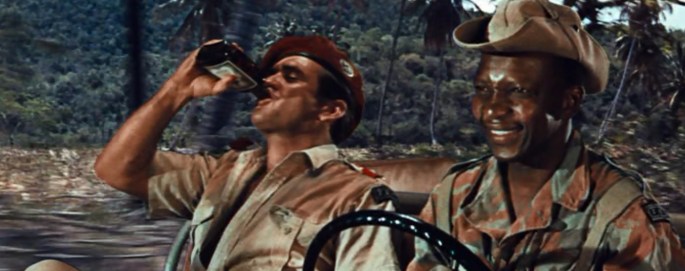
Spectacular. Absolutely spectacular. The amount of overall ass-kicking on display in this reckless, exceedingly entertaining action-adventure film from 1968 can’t be underestimated or denied. For nearly 100 straight minutes, director Jack “I’m More of A Man Than You Are” Cardiff brought the full-throttle action with hardly any relenting, and yet was still able to dole out important character beats and have everything make coherent sense thanks to a terse, extremely macho screenplay by Adrian Spies and Ranald MacDougall, who based their work on Wilbur Smith’s novel. Rod Taylor gave one of the most masculine performances that I’ve ever seen as a Soldier of Fortune who accepts a dangerous job in the Congo — guard a train that’s carrying $50 million in diamonds that needs to make an extremely dangerous journey through the jungle with hostile rebel troops armed and at the ready for battle. And make no mistake, most of the blunt-force narrative consists of massive combat scenes on and off the train, tremendous shoot-outs with huge body counts, hand-to-hand violence galore, and as the all-time great one-sheet suggests, you DO get to see men fighting with chainsaws.

The full-bodied, richly textured widescreen cinematography by Edward Scaife is glorious, the rousing musical score by Jacques Loussier is bold and triumphant, and the extremely tight editing by Ernest Walter kept a rip-roaring pace but still allowed for a few small grace notes. Jim Brown tore it up as Taylor’s right-hand man on the battlefield, while Kenneth More played a hard-drinking doctor who provides key help along the ride. Peter Carsten turned in a very memorable performance as a former Nazi who wants to help the group, and the beyond sexy Yvette Mimieux was on full display as an innocent caught up in all of the madness. Critics lambasted the film for it’s excessive sequences of violence and torture (the rape and pillaging of the village at the film’s midsection is utterly insane to witness) but now the movie is rightfully seen as a lost classic. Quentin Tarantino sampled musical tracks from Dark of the Sun for his WW2 film Inglorious Basterds, and even cast Taylor as Winston Churchill. Dark of the Sun was shot on location in Jamaica, and was also known as The Mercenaries in parts of Europe. Available on Warner Brothers Archives DVD label.

Nicolas Wind Refn’s THE NEON DEMON – A Review by Frank Mengarelli
Nicolas Winding Refn’s cinematic progression is something to be marveled at. With his latest film, THE NEON DEMON, he pushes every boundary imaginable, creating a film with so much impending doom that it will make the most unflappable cinephile become seemingly uncomfortable as his tale of vanity and debauchery comes to a brilliant conclusion.
Refn has reached the top tier brotherhood of self indulgent filmmakers featuring Lars von Trier, Terrence Malick, and Bob Fosse. Making his own films, without having to concede anything to anyone, allowing his own unique kaleidoscope of artistic vision to wash over the screen.
This film is fantastic, and it is Refn’s best film to date. His unbound storytelling is wrapped tautly by Natasha Brier’s fluid cinematography, a perfect ensemble, and one of the best film scores of all time composed by Cliff Martinez.
Refn’s cinematic world is dark and dangerous, vicious and surreal. He monumentally cashed in on DRIVE, allowing himself the freedom to make the films that he wants to make, pushing the boundaries of cinema to new heights. With THE NEON DEMON he forgoes star power and box office anchors, and makes a film so twisted it becomes incredibly serene in a way that would make Stanley Kubrick proud.
Every single actor and crew member deserves all the accolades in the world for their accomplishments on this film. One could spend an entire essay talking about each actor in this film.
Elle Fanning. Wow. She absolutely commands every frame of this film. Keanu Reeves completely shakes his on screen persona in a scummy and sleazy hard supporting role that will leave you wanting more. Desmond Harrington FINALLY got his role. He is silent, gaunt, and cathartic in his few scenes; showing off his previously untapped potential.
Refn’s latter day films are not for the People. They aren’t made for the average Friday night moviegoer, they aren’t made for art house cinephiles. They are made because he has his own story to tell.
In an age where great cinematic story’s are told in a novelization over the medium of television; I don’t know how this film got made, or how it got a wide cinematic release – but we should all celebrate the fact that it did.
Wonderland: A Review by Nate Hill
I’ve always thought of this as the Oliver Stone Movie that the man never made. It has the sordid, excessive sleaziness of U Turn, and the studious inquisition into true crime and intriguing Americana that he showed us in JFK. Both films explore the violence and ugliness that peppers American history in different ways, the brash and the academic which often exist in opposite poles colliding in Wonderland, a wholeheartedly nasty account of a stomach churning multiple murder involving one of the most infamous porn stars who ever lived, John Holmes (Val Kilmer). I don’t know what the real Holmes was like (besides tell rumours of his anaconda cock), but the version we see here is a sniveling, unrepentant scumbag who is very hard to empathize with unless you flip the nihilism switch on in your brain and lose yourself in it. The film follows his association with a group of fellow undesirables, interested only in furthering their own drug habits by any means necessary, legal or otherwise. John is late in bis career and on the cusp of being a washout, his underage girlfriend (Kate Bosworth) pretty much the only friend he has in the world. He spends his days getting involved in all kinds of smutty business, along with a crew of fellow junkies led by loose cannon Josh Lucas, grim biker Dylan McDermott and timid Tim Blake Nelson. When they collectively catch wind of the wealth of one of John’s acquaintances, a dangerous club owning mobster (Eric Bogosian in full psycho mode), the dollar signs swirl in their already dilated pupils. After an ill advised robbery, Bogosian reacts with all the wrath of the Israeli mafia, fuelled by his personal vendetta, brutally slaughtering each and every one of John’s gang, letting him live as a branded snitch. The film is based on notoriously grisly crime scene photos which can be seen online, laying speculation on Holmes’s part in the killings, and spinning a sinfully chaotic, noisy web of pulpy hijinks surrounding the case. The film is told from two different perspectives, a fractured narrative laid down by Kilmer and McDermott in respective and very different summaries of the event. Ted Levine and Franky G. play the two detectives who take it all in and work the case, and the excellent M.C. Gainey plays a veteran ex cop who they bring simply because he’s the only familiar face which skittish Holmes will open up to. This is an ugly, nasty film and I won’t pretend it doesn’t get very gratuitous both in dialogue and action. It goes the extra mile of obscenity and then some in its efforts to make us squirm, but every time I pondered the necessity of such sustained atrocities, I reminded myself that in real life there’s even more of such stuff, and the film is just trying to hit the themes of decay home hard, albeit with a sledgehammer, not a whiffle ball bat in this case. Kilmer is fidgety brilliance as Holmes, a severely damaged dude who hangs onto the last strand of our sympathy by the wounded dog whine in his voice alone. The only time I felt anything for the dude is when he visits his estranged ex wife (a flat out fantastic Lisa Kudrow, cast against type and nailing it) and we see flickers of a dignity in him that’s long since been consumed by darkness. One of his best roles for sure. Watch for further work from Michael Pitt, Louis Lombardi, Janeane Garofalo, Scoot Mcnairy, Christina Applegate, Faizon Love, Chris Ellis, Paris Hilton and Natasha Gregson Warner too. This one is like Boogie Nights, Rashomon and Natural Born Killers tossed in together on spin dry. It’s a wicked concoction, but you’ll need to bring a strong stomach and the foreknowledge that you’re going to be spending two hours with some of the most deplorable human beings this planet has to offer. The silver lining is you get to see it all play out in killer style, smoky and evocative 1970’s cinematography and dedicated thespians branding each scene with their own lunacy. Tough to swallow, but great stuff.
BRYAN SINGER’S THE USUAL SUSPECTS — A REVIEW BY NICK CLEMENT

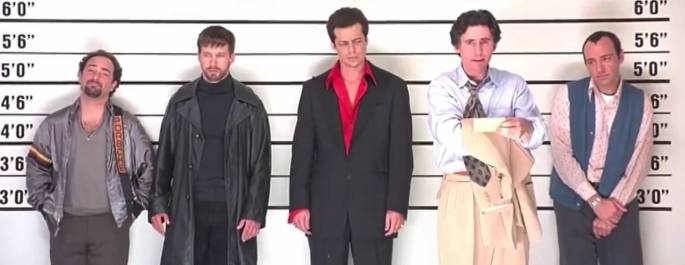
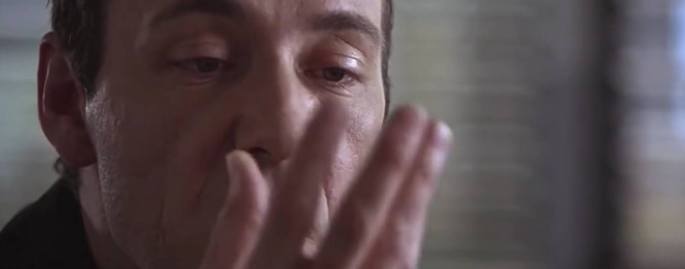
“The greatest trick the devil ever pulled was convincing the world he didn’t exist.” This fantastic line of dialogue, a quote from Charles Baudelaire, is uttered more than once by Kevin Spacey in The Usual Suspects, and pretty much sums up Bryan Singer’s smashing crime picture, which was his second feature film after the little seen Public Access. And in my opinion, The Usual Suspects stands as his best, most satisfying film to date. It’s odd that after The Usual Suspects and Apt Pupil that Singer became a blockbuster comic-book movie director (The X-Men, X-2, Superman Returns, Jack the Giant Slayer, X-Men: Days of Future Past, and X-Men: Apocalypse) with only 2008’s crisply efficient WWII thriller Valkyrie as the other traditional or realistic film that the filmmaker has attempted. Elegantly written by Christopher McQuarrie, The Usual Suspects is an example of low-budget neo-noir done correct, with a twisty, serpentine screenplay that never stops pulling the rug out from underneath the viewer until the very end, but most importantly, adds up and makes sense when all of the pieces are closely examined. McQuarrie’s previous background in private detective work and criminal law also bolstered the film’s authenticity, both in the spoken word and in the small details that fill the edges of this elaborately gripping thriller. And it’s one of those films with a doozy of a twist ending that at the time was nearly impossible to predict, even for the most astute of viewers. Part of that had to do with the relatively unknown quality that Spacey possessed 20 years ago (he’d go on to take the Oscar for Best Supporting Actor for his incredible work in Suspects), and part of it had to do with McQuarrie’s ultimately ingenious screenplay (for which he was bestowed the Oscar for Best Original Screenplay), that tells a convoluted tale that all comes together in the final moments with striking clarity and immense narrative force.

The Usual Suspects is the story of five criminals, all pulled together to do a job for a mysterious gangster, known only by his now famous name, Keyser Soze. After we’re treated to a string of small jobs to establish each man’s particular set of skills, the group encounters a force to be reckoned with. All of the criminals have in one way or another screwed over Soze in previous crime related jobs, and now it’s time for them to repay him, or else. They are tasked with taking over a docked ship at the Port of Los Angeles, in an effort to secure and destroy $91 million dollars of heroin that Soze doesn’t want to end up in the hands of a rival criminal enterprise. Gabriel Byrne is the group’s stoic leader, Dean Keaton, a former corrupt cop who is trying to give up the life of crime in an effort to settle down with his lawyer girlfriend. Spacey is Roger “Verbal” Kint, a half-paralyzed con-man who sits in the office of detective Kujan (a fantastic and surly Chazz Palminteri) and spins a story about the group’s misgivings and various illegal operations and how they all ended up on the boat that left Kint’s entire crew dead or missing. Also rounding out the group are the volatile thief McManus (Stephen Baldwin), McManus’ partner Freddy Fenster (a baby-faced and hilariously accented Benicio del Toro), and Todd Hockney, a skilled hijacker played with crusty attitude by Kevin Pollak. Pete Postlethwaite showed up as the mysterious Kobayashi, Keyser Soze’s legal rep and business associate, and coerces the gang of criminals into the big job for his boss, which will either make them all rich or leave them all dead. Each actor is given more than one moment to shine, with Byrne cutting an imposing portrait of an angry, morally complicated man who while thinking he’s in control, is constantly reminded that he’s not. Baldwin delivered the best performance of his career (I know that’s not saying much!) and del Toro gets some of the film’s biggest laughs, due in no small part to his manner of speech and fun with the English language. But it’s Spacey who totally owns this picture, skillfully portraying a pathetic man who is in way over his head, but who as we all know by now, is really pulling the strings like a magician behind the curtain.

Shot with supreme, noir-drenched style by cinematographer Newton Thomas Sigel (who would later go on to lens Three Kings, Drive, and Confessions of a Dangerous Mind, to name only a few), with dynamic editing and an absolutely propulsive musical score supplied by the uber-talented John Ottman (it’s insane to think about how many trailers have borrowed Ottman’s amazing musical cues from The Usual Suspects), The Usual Suspects succeeds as has visual flair AND dramatic substance, with a couple of action scenes thrown in to spice up the proceedings. But this film is mostly about its characters and how they speak and interact with one another, and how words are used as importantly, and as memorably, as guns, affording the picture a cerebral streak that allows it to tickle your brain every time you watch it. Singer patiently allows the non-linear story to unfold, never rushing anything, but also keeping the film moving at a brisk pace; there’s not one scene of narrative fat or superfluous style on this movie’s cold and calculating bones. It would be great to see Singer tackle something of this sort again, to see him go smaller and more sophisticated. Even the biggest of directors seem to want to change it up every now and again, so it’s curious to observe Singer’s career trajectory, and I think it’s sort of sad how Singer’s talents have really only been transferred to the world of popcorn escapism, because he’s clearly more talented than his later work implies. Shot in a reported 35 days on a budget of $6 million, it’s fascinating to think how Singer has never returned to the smaller-scaled waters of his absolute best film. And I love how the big finale is foreshadowed multiple times before it ever arrives; it’s a testament to everyone’s abilities that the twist was able to take almost everyone by surprise on their first viewing. Because upon further re-visits, you can see how Spacey was able to pull it all off, even noticing some discrepancies which would give away the big reveal if you’re able to spot these secret-breaking instances. I loved all of the dark humor, the tough-guy posturing, the rapid-fire nature of the dialogue, and how it’s the sort of film that obfuscates the truth for as long as humanly possible, and then when the big reveal comes, not only is not a cheat, but it’s something that elevates the film to a new realm, and makes for a wildly satisfying experience because you’re able to see how you were hoodwinked by the filmmakers.

Turbulence: A Review by Nate Hill
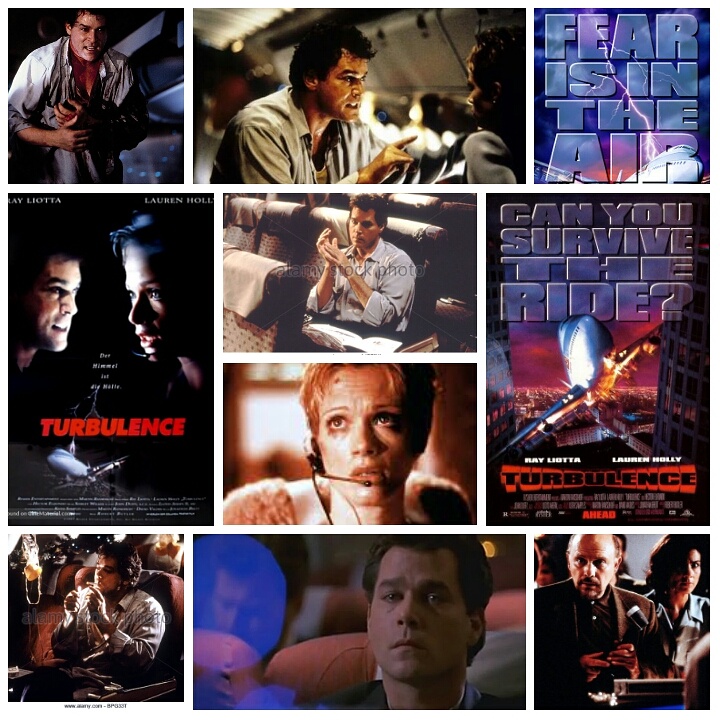
Before there were snakes on a plane, there was a charming serial killer named Ryan Weaver (Ray Liotta). We meet Ryan as he’s about to go on a blind date with a cutie, and he seems like your average sweet guy. The scene plays out in romcom mode… until a SWAT team led by a veteran detective (Hector Elizondo) busts in and arrests Weaver, apparantly just minutes in time. We then learn that Weaver is an extremely dangerous Ted Bundy type of dude who suckers women in with his flashy grin and good looks, only to murder them soon after. With the big bad wolf now in chains, Elizondo can rest easy, as it becomes clear he has been hunting him for some years now. The last step: transporting him by plane to the state where he will be tried and senteanced. Naturally, every security protocol is rigidly in effect, right down to Elizondo stubbornly accompanying the flight. And, naturally, Weaver finds a harebrained way to break his shackles and terrorize the nearest thing to him, which in this case happens to be a gorgeous flight attendant (Lauren Holly). Now they’re 30,000 feet in the air with not a cop in sight but the aging Elizondo, and Weaver free to roam about as he pleases, teasing and taunting Holly with both mirth and menace. The film hinges on an actor’s ability to be convincing, and Liotta is downright perfect in the role. He’s played so many nut jobs and angry lunatics he could do it in his sleep by now, yet he still manages to give each baddie their own unique flavor and flourish. He is downright scary here, geniunly winning you over with his dapper gentleman act, then pouncing like a lion. He’s a one man Con Air, and means business, piloting the movie with a sure hand and leading man talents. I consider this one of the great overlooked thrillers of the 90’s, and certainly my favourite one set on a plane. Watch for appearances from Rachel Ticotin, Ben Cross, Jeffrey Demunn and Brendan Gleeson. Now there’s two sequels: one with Tom Berenger and Jennifer Beals, which I still have to see, and another called ‘Turbulence 3: Heavy Metal’, which is a demented little shit of a flick with Rutger Hauer and Gabrielle Anwar. Neither have Liotta on their side, but the third is worth a watch just for its unintentional hilarity. This first one is the real deal, though.
WERNER HERZOG’S FITZCARRALDO — A REVIEW BY NICK CLEMENT

Fitzcarraldo is nothing less than a herculean achievement in filmmaking. Directed with a serious sense of epic scope yet still with a fine eye for intimate detail by the masterful and eclectic storyteller Werner Herzog, who seems to be attracted to madness in all of its permutations, in the way that a fly is a attracted to animal droppings. Surreal, grand, in love with itself and the very idea of cinema, Fitzcarraldo is one of a few masterpieces for this most eccentric filmmaker, and stands as one of the true awe-inspiring feats that the medium has known. Just thinking about the nuts and bolts logistics of this film gives me a headache, and it goes without saying that a production such as this one would never, ever get attempted in this CGI-infested day and age. The very lack of artifice is what gets me about this movie; it feels as organic as it could possibly get, with the exotic surroundings producing an earthy sense of time and place. Released in 1982, Herzog’s wild narrative centers around an obsessive entrepreneur with dreams of becoming a rubber baron, a role inhabited by the director’s spiritual cousin Klaus Kinski, in a maniacal and wholly committed performance of intense bravado. Already reeling from previous business failures and prone to very large ideas, he becomes overwhelmed with a crushing desire to spread the sounds of big opera all throughout the Peruvian jungle; his dream of a massive opera house nestled in the middle of indigenous territory must be met.

He enlists hordes of natives to help him lug a massive steamship over the steepest of hills in the middle of the Amazon, seemingly unafraid of the various dangers that could cause calamitous ruin. The film is an adventure, a romance, a study of dogged determination, and a sly portrait of the exploitation of human beings for one individual’s personal gain and existential triumph. Based on events surrounding the life of Carlos Fitzcarrald, Herzog was wise to root his story in something tangible, but he never became slavish to history, as so much of the movie feels like in the inner-workings of Herzog’s unhinged and esoteric mind, totally unleashed and splashed all over the screen. The gorgeous Claudia Cardinale was fantastic in the role of Kinski’s adventurous companion and lover, a brothel owner with smart business sense, bringing warmth and heart to an already passionate story that feels as lived-in as a movie could ever possibly feel. Thomas Mauch’s can’t-believe-your-eyes cinematography conjures up one spectacular image after another, filling the frame with vibrant color and a strict sense of unfettered naturalism. Mauch also collaborated with Herzog on the magisterial Aguirre, The Wrath of God and early charmer Even Dwarfs Started Small, and clearly the two men had a superb working relationship, more than likely consisting of some sort of artistic shorthand as their partnerships are some of the most ever-lasting in Herzog’s overwhelmingly amazing filmography. Iquitos POWER. I literally feel this movie in my bones every single day. Enrico Caruso POWER.