Bob Fosse’s ALL THAT JAZZ – A Review by Frank Mengarelli

ATJ2

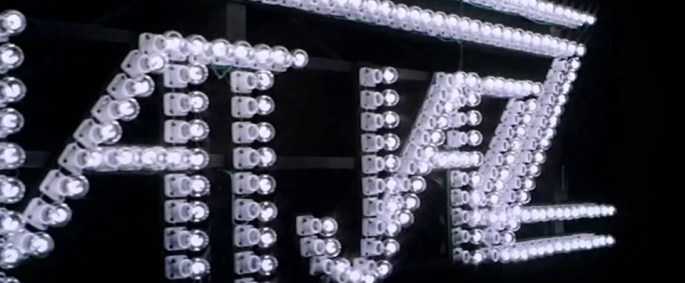
Every once in a great while a film gets made that you hold so sacred to yourself, that you feel it was made specifically for your eyes only. Bob Fosse’s ALL THAT JAZZ is a full out tour de force MASTERPIECE. For me, it’s the finest film ever made, I completely and utterly adore this film. Like any great piece of art, it can affect its audience in a multitude of ways, and mean different things to different people. Over my decade long obsession with the film, I’ve come to see and apply many lessons the film teaches. The most important lesson this film preaches is simply, the heavy price one pays for narcissism.

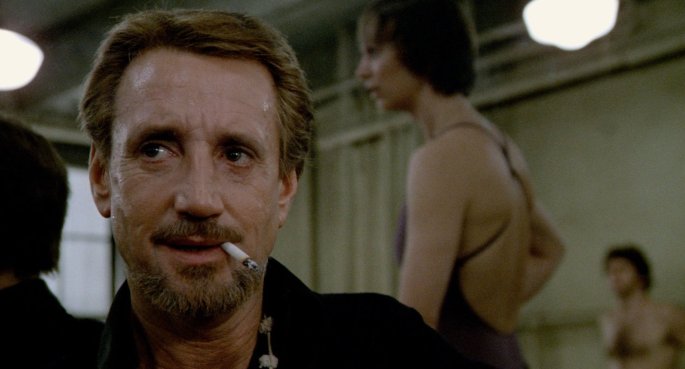
I cannot think of a film that displays more audacity and self-indulgence in such a showy and brilliant way. The casting of Roy Scheider is the most brilliant casting move in the history of cinema. Roy Scheider as Joe Gideon is Bob Fosse. From the facial hair, to the chain smoking, right down to the address on the bottle of his prescription pills in his bathroom. It’s all Fosse. The film follows Gideon navigating his professional life; editing his latest film THE COMEDIAN (LENNY) and reinventing a Broadway play (CHICAGO) under a tight deadline. All the while Gideon is co-raising his daughter (Erzsebet Foldi) with his muse and ex-wife (the remarkable Leland Palmer), and constantly cheating on his current muse and girlfriend (Ann Reinking, who was Fosse’s real life mistress and fierce champion of his legacy). Folded into all this, Gideon’s personal and professional life, he is having a sit down conversation that stretches the duration of the film with the painfully beautiful Angel of Death played by Jessica Lange.
ATJ

Gideon is the contemporary version of Sisyphus, constantly pushing that boulder up a hill, only for it to roll back down to the bottom again. He cannot, and will not compromise with anyone, even himself. He constantly pushes himself physically, mentally, and creatively. An entire dissertation could be written about this film, it is impossible to sum up the importance and greatness of this film in a few paragraphs. Everything in this film is phenomenally executed. All the performances in the film are landmark career highs, the production and costume design is perfect, and the editing in this film by Alan Heim showcases the best cut film ever made.

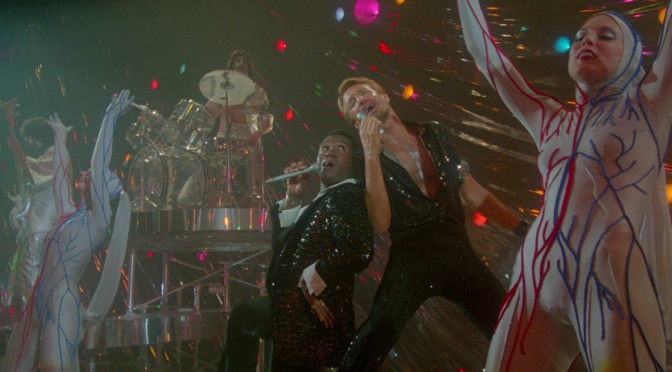
The entire film is perfect, but where my undying excitement and admiration for this film comes to a head is the final act, in particular the final scene. Gideon’s fever-dream send off to a musical performance of The Everly Brother’s BYE BYE LOVE sung by Ben Vereen and Roy Scheider in front of anyone of importance from Gideon’s life. This is cinema at its absolute finest.

There will never, ever be another Bob Fosse. There will certainly never be a film made that is so ingrained with its author like ALL THAT JAZZ. The film remains a cornerstone in not only the history of film, but in the history of art itself.
ALT3

William Friedkin’s Killer Joe: A Review by Nate Hill

image

William Friedkin’s Killer Joe. What, oh what can I say. Upon finishing it, my friend and I shared a single silent moment of heightened horror, looked at each other and chimed “What the fuck?!” in unison. Now, I don’t want our aghast reaction to deter you from seeing this wickedly funny black comedy, because it’s really something you’ve never seen before. Just bring a stomach strong enough to handle dark, depraved scenes and a whole lot of greasy fried chicken that’s put places where it definitely doesn’t belong. Matthew McConaughey is unhinged and off the hook as ‘Killer Joe’ Cooper, one of his best characters in years up until that point. Joe is a very, very bad dude, a Texas police detective who moonlights as a contract killer and is just a lunatic whenever he’s on either shift. Emile Hirsch plays an irresponsible young lad (a character trait that’s commonplace with the folks in this film, and something of an understatement) who is several thousand dollars in debt to a charmer of a loan shark (Marc Macauley). Joe offers to help when Hirsch comes up with the brilliant plan of murdering his skank of a mom (Gina Gershon in full on sleazy slut mode). The ‘plan’ backfires in so many different ways that it stalls what you think is the plot, becoming an increasingly perverted series of events that culminate in the single weirdest blow job I’ve ever seen put to film. Joe has eyes for Hirsch’s underage sister (Juno Temple, excellent as always), and worms his way into her life, as well as her bed. He claims her as collateral, and hovers over the family like some diseased arm of the law. Thomas Haden Church is hilarious as Hirsch’s ne’er do well country bumpkin of a father. Poor Gershon gets it the worst from Joe, in scenes that wander off the edges of the WTF map into John Waters territory. I was surprised to learn that this was a Friedkin film, but the man seems to be the king of genre hopping these days, and it’s always key to be adaptable in your work. A deep fried, thoroughly disgusting twilight zone episode of a flick that’ll give the gag reflex a good workout and keep your jaw rooted to the floor during its final sequence.

BRIAN DE PALMA’S SNAKE EYES — A REVIEW BY NICK CLEMENT

1
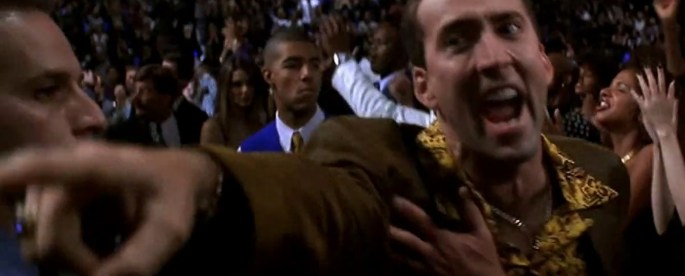
Snake Eyes is electrifying filmmaking from Brian De Palma, who at one point in his career was billed in voice-over during trailers for his films as the “modern master of suspense,” a title he totally earned. The opening 20 minutes of this film are so stunning that we could only hope to get sequences of pure filmmaking like this in every single movie in every single calendar year. And even if many people seem to find fault with the final act, I don’t, and never did; while the “Hand of God” tidal wave sequence would have been cool to see from a visual perspective, the climax works just fine as it is, and wraps everything up the way it should. Also – the absolute final scene between Nicolas Cage and Carla Gugino stings with moral complexity and ends on an untraditional note of uncertainty — shades of 70’s storytelling peeking through the cracks of a big-budget, late 90’s thriller.
4
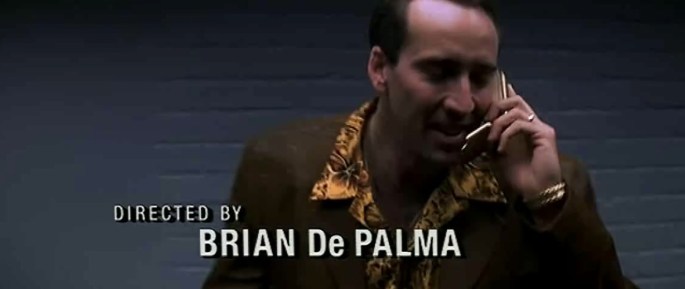
 A sleazy and chest-hair-proud Cage was completely on fire in this film, totally flamboyant and awesomely over the top as a morally bankrupt Atlantic City cop who gets in way over his head at a heavy weight title fight which is taking place at a casino during a hurricane. Oh, and the United States Secretary of Defense is on hand for the bout, and wouldn’t you know it, he’s about to get assassinated in the opening reel. What follows is a battle of wits between Cage, his sketchy military “friend” played by Gary Sinise, and various interactions with a rogue’s gallery of supporting actors including Michael Rispoli, Stan Shaw, Kevin Dunn, John Heard, Joel Fabiani, Luis Guzman, Mike Starr, David Anthony Higgins, Chip Zien, and Eric Hoziel. The alluring Gugino perfectly fit the prototypical De Palma heroine, delivering a sexy and crafty performance as Cage’s reluctant helper, and red-head Jayne Heitmeyer made a very memorable appearance during a crucial portion of the visually audacious protracted opener.
2
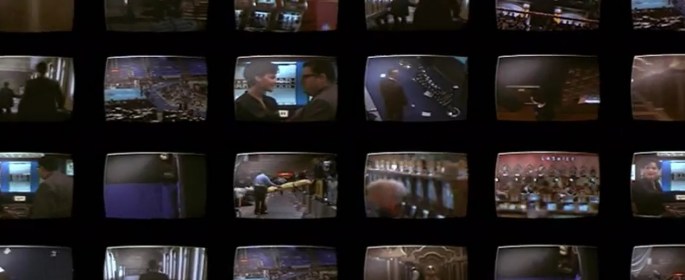
Ryuichi Sakamoto’s bravura score amplified every single sequence – it’s true sonic glory and one of my favorite soundtracks to any De Palma film. And don’t get me started on how much Stephen H. Burum POWER is contained in this film. This was the second to last film that the vastly underrated cameraman shot for De Palma, and in tandem with the legendary stedicam operator Larry McConkey, he crafted one of the most visually muscular and all-together exciting cinematic atmospheres I can think of. From the two or three extended takes that comprise the utterly gripping and fabulous opening sequences, including McConkey pulling off a Dutch angle while operating the rig, Snake Eyes contains passages of purely visual filmmaking that should serve as sequences worthy of study. From De Palma’s obsessive love for the split-screen and overhead photography to his undying fascination for femme fatales and the tropes of the Hitchcockian thriller, Snake Eyes played to the director’s unmatched strengths, while the script, which was concocted by De Palma and big-money-scribe David Koepp, had tons of fun with genre conventions and the upending of our expectations in key instances.
3
De Palma, like few other directors, really knew how to explore paranoia within the narratives to his films, and all of the actors in Snake Eyes brought a level of mystery to their performances. Bill Pankow’s razor-sharp editing knew precisely how long to hold on every single moment, keeping an intense edge present all throughout. And then there’s the film’s elegant and totally amazing theatrical trailer, which is cut and scored with the precision of a diamond. Released in August of 1998, the film was a modest success at the United States box office, a solid worldwide hit, and a massive audience favorite on VHS/DVD/cable. The Blu-ray absolutely pops off the screen. Even in a throwaway genre picture, De Palma brought a sense of pure cinema and consummate craftsmanship to the table.
6

Across The Line: A Review By Nate Hill


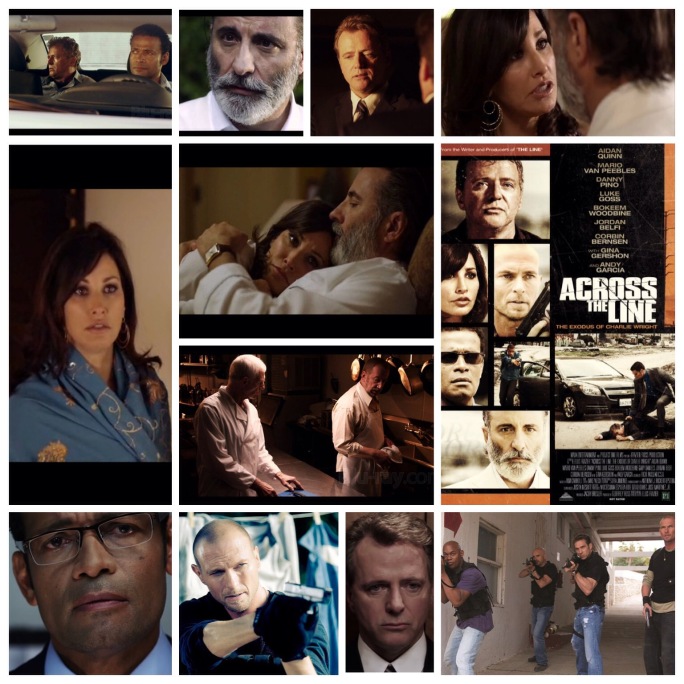
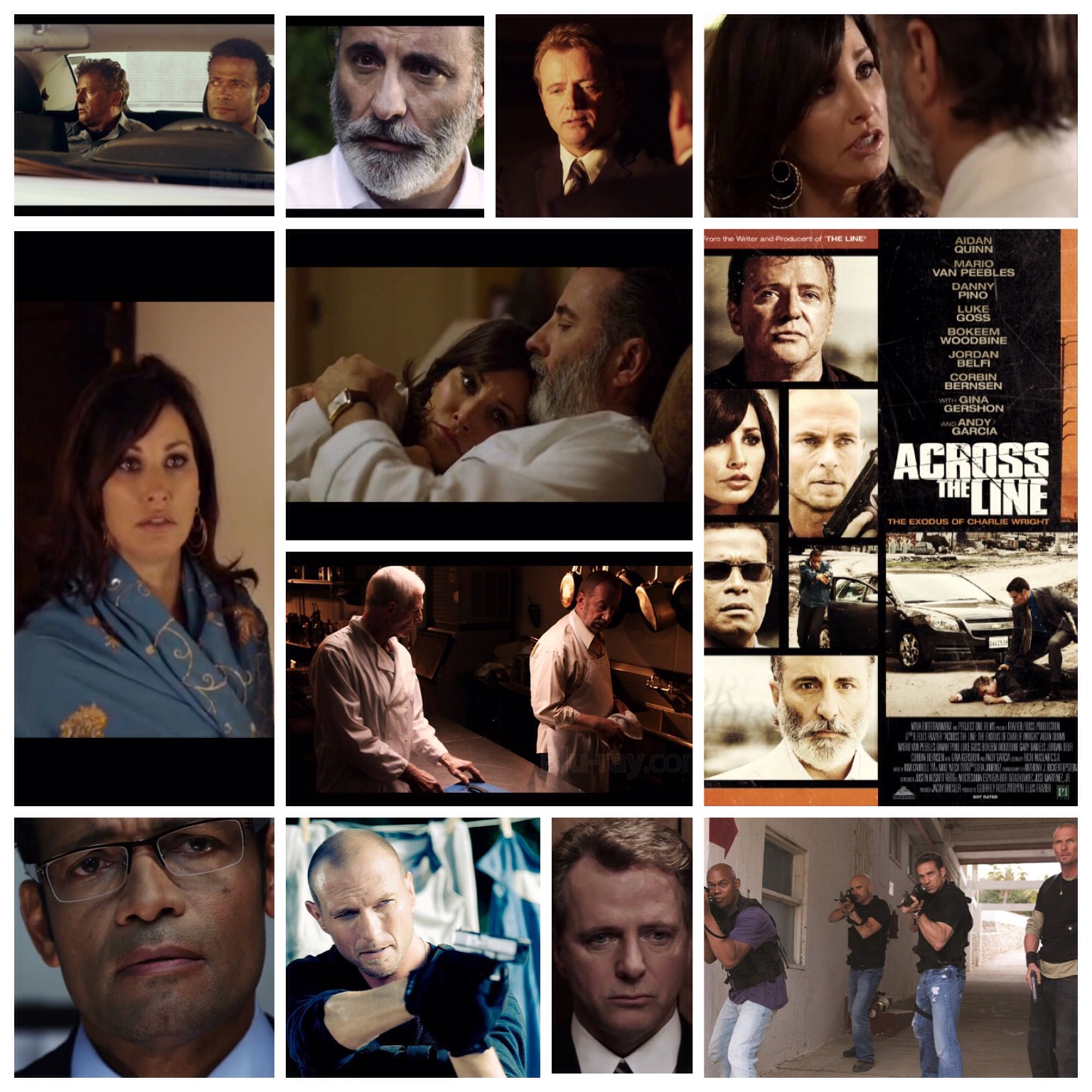
Across The Line: The Exodus Of Charlie Wright is the very definition of overlooked. It was probably underfunded and squeaked forth through meager marketing a few years ago, neither of which has prevented it from triumphing as a sharp little sleeper flick that of course nobody saw. The central theme is age and regret, each character finding themselves at some sad crossroads, placed there by the decisions they’ve made in the past and the ways in which they have conducted themselves up to the final act of their lives. To observe people at such a stage haunts you as much as it does them, and made for a film that took a while to get out of my head. Aiden Quinn plays Charlie Wright, a billionaire financial genius whose empire has been exposed as nothing more than a pitiful ponzi scheme, right under his unwitting nose. He is in self imposed exile in Mexico, and soon the consequences rain down on him in the form of several different pursuers. A Mexican gangster (Andy Garcia) wants him, as well as a Russian (Elya Baskin) and his dodgy American representitive (Raymond J. Barry). The FBI has their sights on him as well, in the form of a weary looking Mario Van Peebles, sanctioned by the Director (Corbin Bernson). There’s also a trio of merceneries headed up by a dogged Luke Goss, Bokeem Woodbine and Gary Daniels who have been deployed south of the border to hunt him. It sounds like a bunch of commotion, but I found it to be a very reserved meditation on just how far people are willing to stand by their life choices when they see what’s become of the goals they had in mind when they made said choices in the first place. Quinn is the most understated, yet speaks the loudest as a man on the run from the world. Gina Gershon makes an emotional impact as a woman involved with Garcia, who is also great. South of the border intrigue. Ponderous introspect. A winning recipe.

Ocean’s Thirteen: A Review by Nate Hill

image

As silly, gaudy and drawn out the Ocean’s franchise had gotten by its third outing, I still somewhat enjoyed Ocean’s Thirteen, an overblown attempt to keep the magic alive that most of the time trips over its own bells and whistles. That being said, the gang is all there, and that alone is good for some laughs. This time around, Eliott Gould’s cranky charmer Reuben has been ousted from his Vegas property by Willie Bank (Al Pacino) a ruthless and ludicrously rich casino tycoon with big plans for the future. Reuben is left in a dazed depression, and the gang all drifts back together to try and rob the hell out of Pacino, using methods and cons so over the top they almost seem like a parody of the former films. Pacino is a bit more clownish than Andy Garcia’s grim Terry Benedict was in the first film, which adds to the cavalier absence of any sense of real danger. In fact, Benedict is now chummy with the gang himself, which is a cute turn of events but kind of seems to silly. Ellen Barkin adds a lot of class as Pacino’s head honcho, fitting into the Ocean world nicely. The gang I’d all back and more eccentric than ever, with Matt Damon scoring comedic points in one of the funniest prosthetic jobs I’ve ever seen. Newcomers to the show include Julian Sands, Oprah Winfrey and a reliably hapless David Paymer. It’s not that this one takes the formula too far, it’s just that we’ve been there, done that, got the t-shirt and there was really not much need for it. I won’t say no though, because the blue print of what made the first so fun is still there, it’s just been jazzed up and adorned with a few too many gilded sequins and fancy jib jab. Still enjoyable.

GRIDLOCK’D – A REVIEW BY J.D. LAFRANCE

coolmoviecaps-gridlockd-143048

“This is gonna be a fucking nightmare day, I can just feel it.” These rather prophetic words are spoken by Stretch (Tim Roth) as he and his best friend, Spoon (Tupac Shakur) start the day trying to kick their drug habit in the film, Gridlock’d (1997). But it’s not going to be that easy as the duo run into bureaucratic red tape at every turn.

The film begins on New Year’s Eve as Spoon’s girlfriend, Cookie (Thandie Newton) overdoses on heroin. This intimate brush with death forces Spoon to face his own mortality. “Do you ever feel like your luck’s run out, man? Lately, I’ve been feeling like my luck’s been running out.” These lines take on a rather eerie significance when you realize that Shakur was killed shortly after this film finished shooting.

And so, the two struggling musicians make a New Year’s resolution: to go into rehab and get off drugs for good. The only problem is that not only are they constantly given the runaround, hassled, and turned away by government workers, but an evil and very persistent drug dealer (Vondie Curtis-Hall) and his henchman (Tom Towles) are also pursuing them.

Now, this may sound like the makings of a moralistic film but Gridlock’d refuses to fall into this trap. Instead, it comes across as a very stylish social satire — a strong indictment against the United States health care system and their welfare programs. The ultimate irony is that Stretch and Spoon want to do the right thing but their attempts are constantly thwarted at every turn by overburdened social workers that are too burnt out to care.

Gridlock’d
marked the directorial debut of Vondie Curtis-Hall, an actor by trade who has appeared in such films as Die Hard 2 (1990), Broken Arrow (1996), and a regular spot on television’s Chicago Hope. Hall wrote the screenplay for Gridlock’d in 1993 and it was originally conceived of as his final film school project, based on his actual experiences with drug addiction in the 1970s in Detroit. “Heroin is the drug of the ’90s. But it was also the drug of the ’70s, when I was doing it,” he said in an interview. Much like the two main characters in his film, Hall and a friend sought treatment for their addiction only to be told that it would take weeks for them to get admitted into a program.

But Hall kicked the habit, paid his dues an actor, and cashed in some favors to get this personal project off the ground. Polygram agreed to finance the film with a modest $5 million budget. Hall sent the script for Gridlock’d to actor Tim Roth while he was working on Rob Roy (1995). Initially, Roth wasn’t interested in doing the film but Hall met and convinced him to do it. For Roth, it was the script that attracted him to the film. “Normally you’d work through a screenplay and say, ‘We’ll have to change that and that and somehow try to make it work’, but here the dialogue was always dead-on.”

Hall wrote the character of Spoon with Laurence Fishburne in mind but couldn’t afford the veteran actor. He had considered Tupac Shakur for the role but thought that the rapper was too young and was also just out of jail. However, someone gave Shakur the script and Hall ended up auditioning the rapper who really wanted to do the film. Shakur made the cut and Hall said that with this film, the rapper “wanted to prove that he was a good actor,” and felt that he was “actually a lot like I was at the time the film was set. He wanted to sort himself out and was looking for some help.”

Gridlock’d
’s strength lies in its two leads. The interaction between Roth and Shakur is excellent. For example, there is a scene where the two men sit at the bedside of their unconscious friend and Shakur delivers a heartfelt speech where he decides to stop doing drugs. It is an emotional moment as Shakur looks over at Roth who says nothing — he gives Shakur a little smile. It is an action that says a lot more about their friendship than any words could. They also display crackerjack comic timing with Roth’s Stretch a manic goofball to the laidback cool of Shakur’s Spoon. They play well off each other which is crucial in a buddy film like this one.

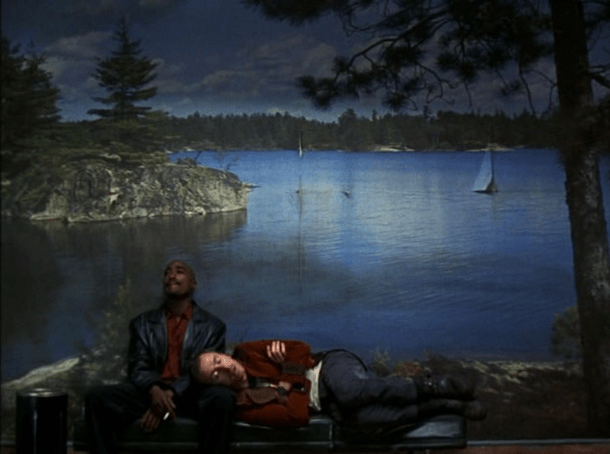
The visuals in Gridlock’d are also worth mentioning. The film’s camerawork is very stylish but never overwhelms or obscures the story or its characters. Instead, the film’s imagery only enhances the mood of any given scene. There is a great shot early in on the film when Spoon and Stretch wait in the hospital to hear any word on Cookie’s condition. The two men are sitting on a bench with a huge mural of an idyllic setting: a peaceful cottage scene complete with lake and a sailboat. It is an ironic image when you consider where they are, what has happened, and how they feel. And yet, coupled with very soulful music on the soundtrack, it is an oddly peaceful image juxtaposed in a fast-paced film.

Gridlock’d
is filled with many clever moments that elevate it above the usual drug movie. Without resorting to preachy sermons, it does an outstanding job of showing how bad the drug problem is the United States and how badly equipped they are in dealing with it. Gridlock’d is a smart film with plenty of humor and action to alleviate the rather serious subject matter. Best of all, it refuses to sentimentalize or romanticize its characters. And in an age of political correctness, this is a refreshing concept.

PTS Presents WHEN PODCASTS COLLIDE with NEVER HEARD OF IT PODCASTERS

WHEN PODCASTS COLLIDE

NEVER HEARD OF ITNick and Frank were extremely lucky to be joined by Craig Moorhead (editor of Damian Lahey’s The Heroes of Arvine Place) and writer Shawn Harwell (Red Oaks, The Campaign, East Bound and Down), the co-hosts of the excellent podcast Never Heard Of It (www.neverheardpodcast.com), to discuss the weird, wild, and totally transgressive 2015 indie black comedy Buzzard, as well as a few other surprises. This is a film that can be rented through the disc-at-home service via Netflix and found on various streaming platforms like Amazon and YouTube and is well worth seeking out, as it combines black comedy, social critique, and unexpected graphic violence to create something tragically original. And if you’re a fan of the obscure movie, be sure and check out Craig and Shawn’s site, as Never Heard Of It routinely shines a spotlight on forgotten cinematic gems that deserve more recognition. We hope you enjoy this extremely entertaining discussion about Buzzard and movies in general!

JOEL POTRYKUS’ BUZZARD — A REVIEW BY NICK CLEMENT

1

There aren’t many movies like Buzzard. This film takes chances, daring the audience to turn it off at times, and features one of the more angry antiheroes that I’ve seen in a movie since Observe and Report. Also taking some visual and thematic cues from Taxi Driver, Joel Potrykus’ movie feels dangerous by design, showcasing 20-something angst in a very visceral fashion. Joshua Burge gives nothing less than a tour de force performance, really going for broke in the final act, but because his character is so relentlessly sullen and more than likely psychotic, it creates this great dichotomy for the viewer: You’re forced to get to know someone who you might not otherwise want to get to know. Burge plays an office temp who is so apathetic towards his own existence that he can barely get through the day without some sort of mental rage flip out. He fills his time by ordering office supplies to his temp jobs, then stealing the supplies to sell back to pawn shops. Then there’s his favorite — close a checking account only to immediately open a new one to make the promotional $50. Things get out of control when an illegal check cashing spree goes upside down, with Burge seeking refuge in the basement of his friend’s house with increasing amounts of paranoia seeping in.

2

And then there’s that old Nintendo Power Glove that he’s been retrofitting into a Freddy Krueger-esque hand weapon. Where this wild narrative goes is for you to discover, but I will allow that very little of anything expected happens during the course of the 90 minutes. There are some shades of societal anger that reminded me of Joel Schumacher’s Falling Down and the film’s anarchic spirit recalls some passages from David Fincher’s Fight Club. But Buzzard isn’t on a level that’s as grandiose as those films, and the film’s low budget and general rough and tumble aesthetic really helps to magnify every single aspect of this crazy little movie that had snuck totally under my radar. Potrykus also appears as Burge’s pseudo-friend; their various interactions are absolutely hysterical. Buzzard made its premiere at the SXSW Film Festival in 2014, before receiving a very small theatrical release in early 2015. Available to stream via ITunes, YouTube and Amazon, while Netflix carries the DVD for disc-in-the-mail subscribers. Dark comedies don’t get much more dark than this one.

3

SIDNEY LUMET’S PRINCE OF THE CITY — A REVIEW BY NICK CLEMENT

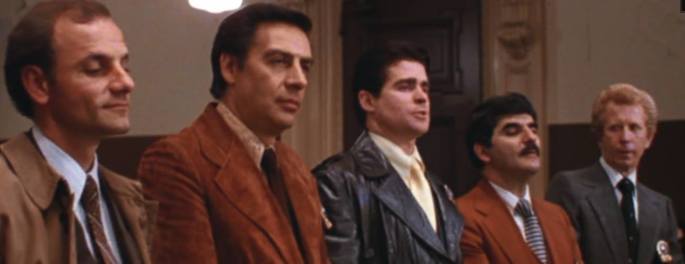
4

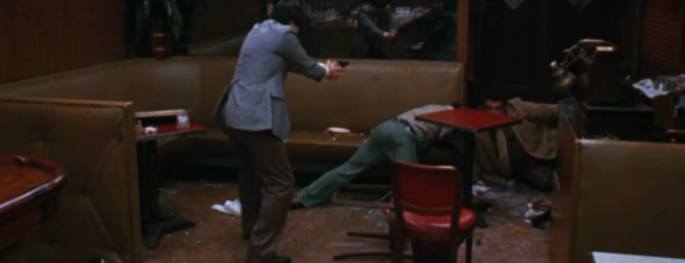
Few did gritty NYC movies better than Sidney Lumet and it’s amazing how his greatest films (many of which were in the 70’s and 80’s) don’t feel like they’ve aged one bit – excellent storytelling will always be excellent storytelling. Morally complex, epic in narrative scope, intimate with its fine details, and having a filmic sweep that rarely graces the cop genre, Prince of the City is easily one of the best, most absorbing cinematic policiers ever crafted. Treat Williams should have been a much bigger star — his fiery, totally riveting performance as a conflicted and corrupt cop investigating internal police transgressions is one for the ages, with one of the best character arcs for any protagonist within this well traveled milieu. Jay Presson Allen’s authentic and minutiae rich screenplay rings true in every scene, and with Lumet’s steady directorial hand guiding us through the many plot threads, the viewer is never lost within the proceedings, despite a no-hand-holding approach by the filmmakers. The great Polish cinematographer Andrzej Bartkowiak’s hand held, extremely naturalistic cinematography amps up the tension resulting in a film that gives off a “fly-on-the-wall” quality.

5

And then there’s LOOK AT THIS CAST POWER — Jerry Orbach, Bob Balaban, Lindsay Crouse, Lance Henriksen, James Tolkan(!), Richard Foronjy, Cynthia Nixon, and Alan King(!), along with tons of perfect character actors with lived-in faces that gave every scene that realistic quality that all of Lumet’s films always possessed. Sadly, Prince of the City was basically ignored by audiences (it recouped its $8 million budget but that’s it), and while certainly getting critical respect at the time, it’s stature as a pinnacle of the genre has been cemented over the years. And with fewer and fewer big-screen cop films getting the greenlight from studio execs in recent years, a film like this deserves to be treasured. The film was nominated for Best Original Screenplay, and despite not being available on home media format, there’s a four hour cut that has made the television airwaves over the years. Let’s hope that someone puts out a much needed Blu-ray release of this seminal American film, with any and all versions. The WB 2-disc DVD does a nice job with image quality and sound so at least we have that for the time being.

6

Outlander: A Review by Nate Hill

image

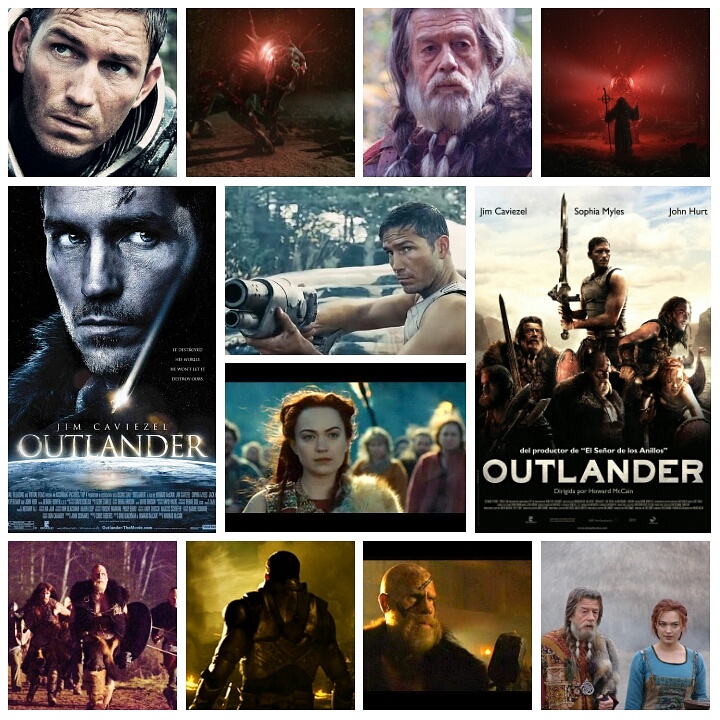
“Beowulf meets Predator” boasts the enthusiastic critic blurb on the poster of one of my favourite sci fi genre benders, Outlander. It’s pure outlandish fun, and better yet it knows it is and therfore doesn’t feel any need to spend a bunch of time on grasping exposition to convince you of any shred of authenticity. It simply hums along on a pure rush of unchecked adventure, always aiming to please and for the very most part, doing so wonderfully. Jim Caviesel stars, and he’s an unassuming Ken doll of an actor who has more intensity than anyone gives him credit for, which always makes me spring to attention when he’s in the driver’s seat. Here he plays Kainen, a voyager from a far away galaxy who has crash landed his spacecraft on earth way back in the time of the Vikings, stranded and in need of refuge. Only problem is, he’s been on the run for some time from a large, hideous and very dangerous creature from his home planet called Moorwen. Moorwen has a very personal and deadly vendetta against Kainen, one which threatens the Viking tribe who give him shelter, led by noble king Hrothgar (John Hurt). Kainen comes from a planet with technology and civilization far advanced from Earth at that time, which makes him a hit with the tribesmen and even more so with Hrothgar’s daughter (Sophia Myles). Moorwen threatens their way of life in its rampage against Kainen, causing tragic collateral damage to a rival clan led by Gunnar (Ron Perlman makes heartbreaking and stone tough work of what is essentially an extended cameo). It’s an awesome movie no matter what anyone says. Any film about an astronaut from a far off galaxy who bands together with friggin vikings to battle a fluorescent space dragon is just automatically a winner. In all seriousness though, this one really is something special,and almost seems like a Dennis Quaid vehicle if it were made in the 80’s. Fun, thrilling and never too serious, it knows it’s place and owns the genre shelf it sits on.