HELLBOY – A REVIEW BY J.D. LAFRANCE

hellboy-movie-screencaps.com-3473

The success of X-Men (2000) and Spider-Man (2002) opened the door for a new wave of comic book adaptations. In the past, studios have played it safe and only green-lighted adaptations of mainstream comic books with large followings. However, this changed with adaptations of independent fare like Ghost World (2000), American Splendor (2003), and with Hellboy (2004). Based on Mike Mignola’s comic book of the same name, the title has a dedicated cult following at best so it was a pleasant surprise to see a major studio take a big budget gamble with it.

October 1944. The Nazis have begun mixing science with black magic in a desperate attempt to regain the advantage in World War II. The seemingly invincible Russian, Rasputin (Karel Roden) has teamed up with the Germans and plans to open a portal to another dimension and bring about an apocalypse. However, American troops arrive and disrupt the procedure just in time. In the process, something comes through: a red-skinned demon baby that the soldiers adopt and call Hellboy.

With the World War II prologue, director Guillermo del Toro does two important things: he vividly introduces this colorful world and the characters that inhabit it by creating just the right moody atmosphere and with detailed production design and excellent special effects. Secondly, Del Toro establishes the film’s mythology and what exactly is at stake through a clever mix of science fiction and the supernatural. He does this via an exciting action sequence as a young Dr. Broom and U.S. soldiers confront Rasputin and the Nazis.

Present day. Rasputin has been resurrected and continues his plans to summon destructive supernatural forces that will result in the end of the world. Hellboy (Ron Perlman) has matured (sort of) and now works for the Bureau for Paranormal Research and Defense (BPRD) in New Jersey — under the guise of a waste management company (just like Tony Soprano). Along with Abe Sapien (Doug Jones with an uncredited David Hyde Pierce doing the voice), an amphibious humanoid (“the fish guy” as a guard puts it), firestarter Liz Sherman (Selma Blair), and the token “normal guy,” John Myers (Rupert Evans), Hellboy tracks down Rasputin and tries to prevent him from fulfilling his nefarious goals.

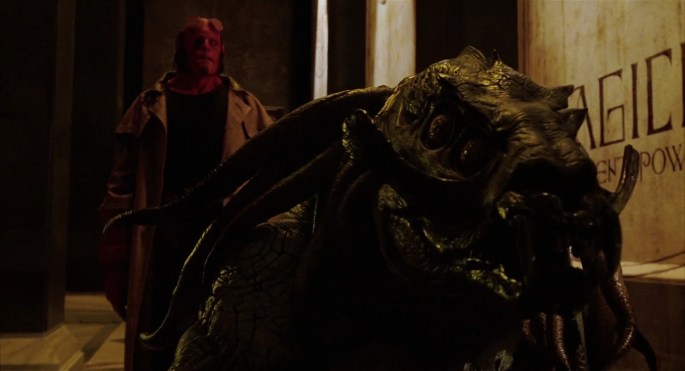
Del Toro, a die-hard comic book fan and self-described film geek, shoots the action sequences much like he did in Blade II (2002), with crazy camera angles and fantastically choreographed fights. Case in point, Hellboy’s extended tussle with Sammael (Brian Steele). It’s like Del Toro took panels right out Mignola’s comic book and made them move but with the same kind of explosive energy that made Jack Kirby’s art so exciting. Del Toro also has incredible production design at his disposal to create a fully realized world rich in detail and drenched in atmosphere. He is heavily influenced by Italian horror films and not only references Mario Bava’s Black Sunday (1960) but also the saturated primary color scheme of Dario Argento’s Suspiria (1977) to name just a couple of examples. This is a great looking film, from the warm colors and ornate architecture of the library where Abe Sapien resides, to the darker, colder colors of Rasputin’s mausoleum in Moscow.

Del Toro was shooting Mimic (1997) and discovered the Hellboy comic book but never thought that it could be made in Hollywood and if it did they would ruin it. He heard that it was going to be adapted into a film at Universal Pictures and started writing a screenplay in 1997. He met Mike Mignola when they worked together on Blade II, which they used as their “rehearsal” for Hellboy. They found out that they read the same comic books and pulp and classic gothic horror novels. With Hellboy, Del Toro wanted to make a self-contained film, “almost a fairy tale, a fable.” His original pitch to executives at Sony-based Revolution Studios was that both The Mask (1994) and Men in Black (1997) were comic books that they were not familiar with and yet went on to become extremely successful films. He told them that the same thing could happen with Hellboy. In April 2002, Del Toro’s film was given the green-light at a budget of $60 million.

Del Toro first saw Ron Perlman in Quest for Fire (1982) and then The Name of the Rose (1986) and was very impressed with his acting, so much so that he ended up casting the actor in his first film Cronos (1994). Del Toro initially wanted him to play Hellboy but Vin Diesel was a rising star at the time and so the director approached him instead for the role. However, with the move from Universal to Revolution, Diesel dropped out of the picture and Perlman was in. Early on, if the actor didn’t work out, Del Toro thought about making Hellboy a mixture of puppet and computer graphics. He talked to James Cameron who warned him that if he went that route he would lose the love story. Del Toro wisely decided to stick with Perlman.

Perlman is perfectly cast as the cigar smoking, two-fisted action hero who eats Baby Ruth candy bars and loves cats. He does a great job of capturing Hellboy’s sarcastic, wise-cracking nature. Perlman gets to utter cool one-liners and looks fantastic in his make-up (thanks to legendary makeup artist Rick Baker). Often, what makes it to the film rarely resembles what was drawn in the comic book. Not the case here — Perlman IS Hellboy. With this role, he firmly established himself as one of the cult film icons of the new millennium (much like Bruce Campbell was in the 1990s). Perlman has got the drop-dead cool action hero shtick down cold. With his hulking, imposing physique, he’s Arnold Schwarzenegger with brains and irony.

Del Toro cast Selma Blair because he always saw a “haunting quality in her eyes and in her look. Sort of a doomed, gothic beauty in her.” He was a fan of The Larry Sanders Show and felt the Jeffrey Tambor had that “smarmy, wannabe bureaucratic presence” that was ideal for Tom Manning. He cast Tambor against type and wanted him to be an “absolute asshole in the beginning, and play it straight.” Del Toro and Mignola created the character of Myers to guide audiences into Hellboy’s world. The director interviewed a lot of young Hollywood actors but many of them were “just too cute and too Calvin Klein beautiful to put in the movie.” He liked Rupert Evans because he had “such an open face, and he had a real innocence about him.” Del Toro saw John Hurt in Love and Death on Long Island (1997) and felt that the actor had “that little air of tragedy about him” that suited Professor Bruttenholm.

hellboy-movie-screencaps.com-5535Hellboy is one of those rare comic book movies with depth. It takes time to develop its characters and the relationships between them. There is the touching father-son relationship between Hellboy and Bruttenholm and the romantic love triangle between Hellboy, Myers and Liz. While the film has the requisite slam-bang action sequences, it is not dominated by them. The film is not driven by them but rather by the characters and the story. And this is because Del Toro has strong source material to draw from: Mignola’s comic book, in particular “Seed of Destruction,” which chronicles Hellboy’s origins. Both Del Toro and Mignola’s works are steeped in the gothic and horror genres, in particular the fiction of H.P. Lovecraft. The author’s influence is all over this movie as Hellboy trades blows with Cthulhu-inspired creatures that would make ol’ Lovecraft proud. While Del Toro’s film didn’t exactly rack up the kind box office numbers the studio was hoping for, it did prove to be quite popular on home video and eventually spawn an even better sequel in 2008.

NASH EDGERTON’S THE SQUARE — A REVIEW BY NICK CLEMENT

1

The 2010 Australian crime film The Square is one of the best thrillers that you’ve never seen. Tautly directed by Nash Edgerton (his brother Joel is one of the main characters and co-wrote the brilliantly layered screenplay), this shady and shifty neo-noir sits atop of the genre pack with titles such as Red Rock West, The Last Seduction, Blood Simple, and Bound – it’s a damn near flawless piece of cinematic screw-tightening and air-tight filmmaking. There is a confidence to this film that’s highly engrossing to observe, as right from the start, you know you’re in the hands of a filmmaker who knew exactly what he wanted. With twists coming left and right and all the way up until the end, The Square requires your attention, for which you’ll be handsomely rewarded. Spoiling any of plot’s surprises would be criminal, but the action centers on an unhappily married guy named Raymond (the gruff David Roberts), who is carrying on an affair with his beautiful young mistress named Carla (Claire van der Boom), who in turn is stealing from her mullet-sporting, low-life boyfriend, Billy (a skeevy and oily Joel Edgerton). When a plan to rob Billy goes haywire and unexpected deaths ensue, all hell breaks loose. Plus, Raymond is dealing with shady contractors at his construction site who may or may not know what Raymond has been up too with Carla.

2

Mysterious notes are sent, people are followed, chased, and killed, and more than one person gets shot. Nobody is safe in The Square. Not even the family pet. All of this is done with expert style and with a minimum of logic lapses and inconsistencies. And across the board, the acting is excellent, with Roberts and Boom registering strongly as two people who never should have met, let alone fallen in love. Mixing a De Palma-esque voyeuristic shooting style (be on the lookout for some amazing stedicam work) with gritty, hand-held realism, Edgerton ramps up the suspense in one scene after another, with maximum results by the conclusion. This is a genuinely unpredictable film that only the smartest genre enthusiasts will be able to guess before the end credits start rolling. Because there is so much going in within the plot during The Square, the film could have easily felt bogged down in exposition or gone off the rails into implausible realms, so it’s a testament to Edgerton’s writing and directing skills that the narrative never grinds to a halt, with the brisk pace complimenting the ruthless action sequences. The Square feels like an early Coen brothers film to me, reminiscent of Blood Simple, a movie totally in command of its story and style, made by people who love the genre they’re working in, and who want to wow people with a good old fashioned crime thriller. Films like this are in short supply.

3


Perrier’s Bounty: A Review by Nate Hill

image

Perrier’s Bounty tries hard to be as pithy and witily profound as In Bruges, but doesn’t quite manage the task. To be fair, Bruges is a masterpiece and a Goliath of a script to aspire too, but this one has its own brand of scrappy crime fun, full of enough beans to keep the viewer jumping for its slight running time. Few films can boast narration provided by the Grim Reaper, and fewer still can say that said Reaper is voiced by Gabriel Byrne. But indeed, Byrne beckons us into this violent fable with his patented tone, both baleful and quaint. The fable in question concerns Michael McCrea (Cillian Murphy) an irresponsible young Irish lad who is seriously bereft of both luck and common sense. He lives in a small town in northern Ireland and owes a hefty loan to local crime lord Darren Perrier  (Brendan Gleeson). Because of how tiny the town is, it’s pretty easy for Perrier’s goons to find and engage him in a road runner goose chase all about the area, forcing him to scoop up his on and off girlfriend (Jodie Whittaker), and head for the hills. He’s also joined by his uber eccentric father (Jim Broadbent) who believes that the Grim Reaper has visited him at night and given him the alarming prognosis that he will die the next time he falls asleep. Broadbent is a solid gold asset to any film he’s in, and practically spews perfectly timed comic banter non stop. Michael thinks he has a way out of trouble with local petty thief The Mutt (Liam Cunningham, aka Ser Davos Seaworth, also a comedic treasure here), which turns out to be another notch in the belt of bad judgment. Meanwhile, Perrier’s crew reels after one of their slain thugs (at Michael’s hand) turns out to have been involved in a love affair with another, who now has the wrath of vengeance in his eyes. There’s a scene where Gleeson  comforts the bereaved hoodlum and seems deeply wounded at the couple’s reluctance to tell him of their love. Gleeson assures them he has no issue with homosexuality and wishes they would have shared with him. In the context of hardened criminals out for blood, this kind of exchange is priceless and brings rigid archetypes right down to earth, for maximum hilarity and well earned pathos. The film meanders a bit, but never out ran my attention span, following through with it’s story in ways both welcomingly bloody and predictably quirky. It doesn’t add up to anything life altering when all is said and done, but damn if the things which are said and are done along the way aren’t just pure genre entertainment, inducing chuckles, thrills and nostalgia for other films withing the niche. In the troupe of writers who look up to Guy Ritchie, Quentin Tarantino and  Martin McDonough, this scribe is on to something. Keep an eye out for Lord Varys, Roose Bolton and a young Domhall Gleeson too.

Commanding the White Walkers, orphaning Bruce Wayne and more- A chat with actor Richard Brake: An interview by Nate Hill

  
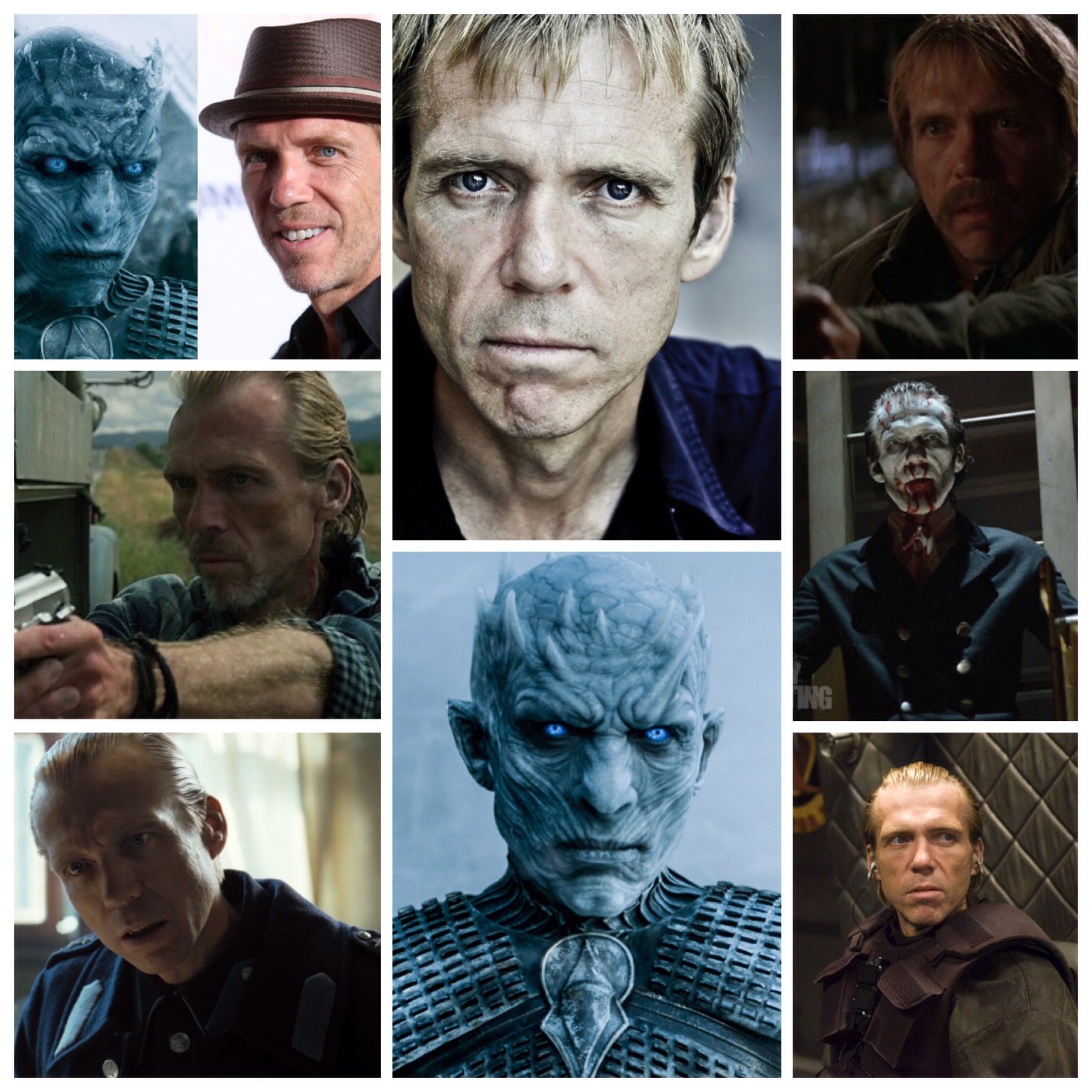
Very excited to bring you my latest interview, with actor Richard Brake! Richard has a legendary career, appearing as the fearsome Night’s King in Game Of Thrones, the murderous criminal Joe Chill in Batman Begins, and in countless films and shows including Ridley Scott’s The Counselor, Hannibal Rising, Rob Zombie’s Halloween II and the upcoming 31, Doom, Spy, Kingsman: The Secret Service, Water For Elephants, Death Machine, The Numbers Station, Ray Donovan, Peaky Blinders, and more. Please enjoy!
Nate: You were born in Wales. Are you purely of Welsh background, and when did you make your way to America? Was acting something you always wanted to do, or did it find you by happenstance? Did you attend any acting schools?
Richard: I’m Welsh through and through. My parents are Welsh and my grandfathers worked in the coal mines. But we moved to America when I was young. I grew up all over, mostly down south. But we came back to Britian a lot and lived there for a while when I was a teenager.  
I wanted to be a writer. I started writing stories when I was very young. When I was 17 I started writing plays, short plays, heavily influenced by Edward Albee. I went to a small high school in Ohio, and one evening I was sitting outside with my best friend when a girl came over and begged us to audition for the school Play. It seemed they didn’t have enough boys auditioning and it was a big cast. Arthur Miller’s The Crucible. My friend and I sort of reluctantly agreed to audition and we got cast as the judges. After a few rehearsals I was hooked. I loved the collaborative nature of it all, rehearsing, playing, all of it. I actually loved that more than the performances. I remember walking back to my dormitory with my friend after one of the rehearsals and saying to him “this is what I want to do for the rest of my life.” I’ve been lucky to see that come true.  
I went to Duke University and studied English and Drama. I did a lot of theatre there, then studied in New York at the Michael Checkov Studio with an amazing actor Beatrice Straight. I knew I wasn’t very good, or at least as good as I wanted to be. So I went to England and Studied at a Mountview Drama school for three years. I was incredibly lucky that they had just hired a Russian teacher named Sam Kogan. He was a genius. An amazing teacher. 
Nate: You have a very distinct style and energy that lends itself to playing larger than life, comic book style characters. Did you mean to take this avenue, or did those types of roles just happen to find you because of your style? 
Richard: I think that just comes from the writing of those particular projects. It lends itself to a certain extreme expression. And I am willing to be extreme if it works for the piece.  
Nate: What does life look like for you besides acting? Hobbies, interests, family? What lines of work did you find yourself in before the industry?
 The usual, waiting tables, telephone sales, all kinds of jobs to make a few dollars. 
 I have two great kids, an ex wife I get on with, and a girlfriend. That keeps me busy!! If I get a chance I play a bit of guitar, badly. I also practice Ashtanga yoga. I’ve been doing that for a long time, almost daily. It keeps me sane in this insane business.  
Nate: I watched an interview with you once where you mentioned that having an active imagination is important in the craft. Would you care to elaborate on that? Does it stem from your training or is this a quality you’ve unearthed in your own exploration of the work?

Richard: Active imagination was a term coined by Sam Kogan. Before I studied with Sam, if I was working on a character, I often saw the character in my imagination as if he was in the third person. I’ll give an example of what I mean, that’s probably the best thing to do. Let’s say my character needs to find out where the money is hidden. He’s a bad guy, a drug dealer. He’s captured the person who knows and tied him to a chair and now he’s torturing him. It’s a lot of money and he wants it so he can quit drug dealing and live on a remote island with the woman he loves.  

 An actor needs to have an objective (Sam called them “purposes”) to motivate his action. That’s a pretty basic acting tenant. You hear that all the time as a young actor. “What’s your character’s objective. What does he want?” So in this case, I want the guy to tell me where the money is. In passive imagination I see my self in the third person standing over the guy as he blurts out the location of the money. In active imagination I see it all through my eyes, feel the temperature of the room, the smell of his sweat, ect. My character has a long term objective of being on the island, peacefully enjoying life with my girlfriend. So in passive imagination, I see myself sitting on a chair in the sun drinking a mai tai, while my girlfriend rubs suntan lotion on herself. It’s like watching a movie. It’s all in the third person. In active imagination, I can feel the chair under me, the heat of the sun, the smell of the lotion, the taste of the mai tai. I see it all through my eyes, rather than watching it outside of myself. It is far more effective to prepare for a role using active imagination than passive. Passive just causes bad acting, because it doesn’t really motivate. Active imagination motivates. It get’s those objectives into the actor’s being not just his head.  
Nate: Game Of Thrones: you made quite an impression as the Night’s King. How were you approached to play the role? How much of you was make up and how much was cgi? How was the battle of hardhome scene for you? Mainly cgi or a lot of practical?

Richard: I auditioned.  
Very little CGI. I was in the make up chair for close to 6 hours. Then a couple of hours to get it off. The contact lenses were massive, as big as you can put in a human eye. Torture. But worth it. I loved the episode and playing the character. I’m very proud of it. It’s an amazing show that has resonated with so many people.   
Unfortunately, I wasn’t available for Season 6. I had a long contractual commitment on The Bastard Executioner. I was very sad about that as I love the show and being a part of it.  
Nate: Another iconic, yet smaller role- Joe Chill, from Batman Begins. How was that experience for you?

Richard: Great. I loved working with Nolan. He is so assured. Great director. And I was a huge Batman fan as a kid, so it was a dream come true to play the guy who killed his parents. Hahahaha, that’s a pretty weird dream, come to think of it, but there you go.  
Nate: You mentioned before on Twitter that your favourite role you have done is Doom Head from Rob Zombie’s upcoming film 31. Why was that? And what can we expect from the film, and from your work in it?  

Richard: I saw the film at Sundance and it rocks! Rob Zombie is a genius. He’s so creative, generous, inspiring. I can’t say enough good things about him. He has this incredible ability to bring out the very best in everyone who works with him. It’s a real gift, and it shows on screen. I can’t wait for people to see it.  
Nate: A film I really enjoyed you in was Good Day For It, with Robert Patrick and Lance Henriksen. Was that an enjoyable experience?
Richard: We had fun. We shot it on a super low budget in the Poconos for 2 weeks or so. We all stayed in this off season ski lodge. All I remember is laughing all the time. Lance is a very funny guy.  
Nate: You appeared in Death Machine in a central role pretty early in your career, with it a lot of previous credits? How did were you cast in that?

Richard: As always, I auditioned. I think I was 27 years old. I was probably a little too young in truth to play the President of an Arms Corporation, but I got it. I was so thrilled to work with Brad Dourif. He’s so focused and very generous. I was young and nervous and he was very kind to me.  
Nate: Besides 31, are there any other projects you are excited for and would like to mention?

Richard: I’m in the new season of Peaky Blinders. It’s going to be the best season yet. It was one of the bests things I’ve read, and the director, Tim, did a great job. I think it comes out in early May. I’m filming Ray Donovan at the moment. It’s also incredibly well written, acted and directed. Two great shows to be a part of. I’m also hoping to shoot a film my friend Jeff Daniel Phillips wrote later this year. He stars in 31 too. It’s a psychological horror we would like to film in Wales. We are raising the money, etc now. I play a reclusive Goth Rocker from the 80’s. Things get pretty crazy and dark when a young woman comes to visit.  
Nate: Thank you so much for your time, Richard, it has been an honour!

Harlan County War: A Review by Nate Hill

image

Harlan County War is a rare little TV movie that takes a partly fictional look at the union wars in rural Kentucky during the 1970’s, when a plucky band of coal miners and their wives took to the picket line in attempt to establish better working and living conditions. The story and title of the film have roots in the union wars of the 1930’s, which set the stage for this tale. Holly Hunter plays Ruby Kincaid, wife of Silas (Ted Levine) a miner who suffers through the harsh labor everyday. The townspeople are tired of the injuries, the deaths and the deadly black lung infections, and are given reluctant hope when compassionate union official Warren Jakopovich (Stellen Skarsgard) arrives to their county, promising change. Many locals are skeptical due to past corruption and disloyalty, but soon the company gets nasty and they realize that Jakopovich may be their only chance. Hunter is as fired up as she always is, her accent thicker than the moonshine everyone swills. I tracked this film down for Levine (Skarsgard too), and this is one of the best roles he’s ever gotten. He’s usually in character parts like the violent thug, stern general, gruff cowboy or yes, the skin stealing serial killer. Here he’s just a plain rural family man, a good hearted fellow who wants the best for his kin and county. Levine works wonders playing it straight here and I wish he’d get thrown more meaty and down to earth roles like this. Skarsgard can jump between being the most terrifying psychopath to the most comforting, sympathetic characters, and plays Jakopovich with compassion and dogged determination. The character building scenes between the three actors is brilliant. I feel like there’s a longer edit out there somewhere, because it jumps a bit and forgets to address one plot turn entirely, but alas it’s a tough one to affordably track down and this is the only version I could get. It’s made for TV and that shows at the seams sometimes, but it’s still solid drama about something important, and crafted very well.

The Fifth Patient: A Review by Nate Hill

image

The Fifth Patient is a super awesome amnesia thriller, in the tradition of The Bourne Identity. It stars Nick Chinlund (in one of his rare lead roles) as John Reilly, an american who awakens in a remote rural hospital somewhere in Africa, with no memory of who he is, how he got there or what’s going on. A local military official (Isaach De Bankolé) interrogates him, believing that he works for the CIA. He has several visitors including a woman who claims to be his wife (Marley Shelton) and a former colleague (Henry Czerny). Gradually he pieces together the fragments of his damaged mind and suddenly has memories of being involved in a terrorism plot, planting seeds of doubt and causing him to suspect he isn’t who they think he is at all. Now all he can trust are his instincts, wary of everyone around him and unsure of his own past. It’s a serpentine story with hefty work from Chinlund who handles all facets of the character superbly, including some third act surprises. Sometimes these type of thrillers fall apart at the seams in the conclusion, tripping over the rug they’re trying to pull out from the audience in terms of plot points. Not this one. It’s well constructed and makes concise sense of its story right up to the last frame. Also watch for work from Brendan Fehr, Olek Krupa as a mysterious russian prisoner and the great Peter Bogdanovitch in a nearly unrecognizable turn. Now, I’m fairly certain that this one was never officially released back in 2007, because you literally cannot find it anywhere, it doesn’t have a legit poster and even seems nonexistent in some databases. Years ago it popped up on Netflix canada for about a month, thus ending my tedious quest to see it. You’d think that such a solid film with the prolific actors in it would have been treated better, but for one reason or another, it’s been forgotten.  Hopefully one day a distributor will pick it up, because it’s quite the well made, entertaining thriller with a crackling lead performance.

Nicolas Winding Refn’s DRIVE – A Review by Frank Mengarelli

13230936_10101542850572367_538049122_o

DRIVE is a film that could have easily been made by Michael Mann in the height of his 80’s neo noir phase. It would have starred William Petersen, Robert Prosky, Tom Noonan, Dennis Farina – the seminal Mann players. Tangerine Dream would have composed a remarkable score. But it wasn’t, and that’s what makes this film an undeniable masterpiece. It was made by Nicolas Winding Refn, with Ryan Gosling transforming himself into a top tier actor, and Cliff Martinez providing a hypnotic score in the year 2011.

There are many aspects of the film to marvel over. The vibrant neon color scheme, the stoicism and deep introspective turn from Gosling, Refn’s tranquil direction. Career pivoting performances from Albert Brooks and Bryan Cranston. There is such a fertile quality to this film that sets the tone for this decade’s cinematic landscape.

DRIVE kiss

Gosling, who has been remarkable since DRIVE, is perfect in this film. His dialogue is minimal, as are his physical actions. His performance is commanded through his eyes. He’s always watching, always internal, he is slowly calculating everything.

The forbidden love between Gosling and Carey Mulligan is handled with such sensibility and grace by Refn. It is never overplayed, and at no point in the film does it become generic. The purity of their relationship splashes off the screen and leaves impending doom on the viewer.

Drive 3

Bryan Cranston and Albert Brooks are phenomenal in the film. Cranston completely shakes his comedic shtick as well as the trajectory of Walter White. He’s likable, due to his casting, but overall he’s smarmy and pathetic. Neck tattoos, chain smoking, hobbling around the frame looking for his next get rich quick deal.

Brooks, who was completely robbed of an Academy Award nomination, is a fascinating antagonist. Yes, he’s the monster, but he’s also genuine. He doesn’t want to do what he does, but his back is against the wall due to the unraveling of the plot. As the viewer, we like him, even when he’s pulling an eyeball from a guy’s head with a fork. Because the guy he’s doing it to had it coming.

Drive 2

Refn struck gold with this film, and by making a mainstream-ish film, he was able to gather the clout to make whatever he wanted in the future, no questions asked. ONLY GOD FORGIVES and the much anticipated NEON DEMON are complete validations. Refn has a progression that is akin to post TREE OF LIFE Malick; with each new film, he’s not only challenging the audience, but himself as an artist. DRIVE is one of the finest films of this decade, and it only grows more poignant and incredible as time passes.

James Foley’s AFTER DARK MY SWEET – A Review by Frank Mengarelli

Original Cinema Quad Poster - Movie Film Posters

James Foley is master of deception, blurred lines, and skeevy noir. AFTER DARK, MY SWEET is a taut and mischievous opus. Jason Patrick gives his finest performance as a mysterious and unstable drifter who crosses paths with Rachel Ward as the sexy femme fatale, and the always superb Bruce Dern who is as sleazy as ever with his mustache, floppy hair, and aviators/Hawaiian shirt/Members Only jacket combination that shows us all we need to know about his character without him having to say anything.

ADMS Patrick

The double, triple, and quadruple crosses that build in this film keep us unsure of how exactly this story of lies and desire will unfold; yet however the plot unravels, it is not going to end well for anyone. Jason Patrick is electrifying as a mentally and physically unstable former boxer who drifts into the wrong place at the wrong time, slowly being groomed by Ward who has a penchant for alcohol, cigarettes, and sexual control.

ADMS Dern

Bruce Dern is the smooth talking man with the devious plan, giving one of his finest performances. Dern has recently been reawakened with NEBRASKA and Quentin Tarantino’s use of him in THE HATEFUL EIGHT and DJANGO UNCHAINED. He remains one of the most underrated and undervalued actors of all time. He is able to blend together sleaziness, affability, and menace all at once in such a way that it is amazing to watch.

ADMS Ward

Foley’s strategically slow camera pans, David Brisbin’s production design, costumes by Hope Hanafin – all these elements are masterclass and create a world of dilapidation and deception. The environment of this film is carefully crafted, and the details of the visuals are so grabbing that you can smell the cigarette smoke and taste the cheap wine. AFTER DARK, MY SWEET is one of those films that anchors itself as not only a staple transition from the 1980’s into the 90’s, but also a one of the best erotic noirs that has ever been made.

THE RUSSO BROTHERS’ CAPTAIN AMERICA: CIVIL WAR — A REVIEW BY NICK CLEMENT

1

The Russo Brothers know exactly how to blend all of the ingredients within the parameters of a Marvel super-production. Captain America was always my #1 Marvel hero, so it’s no surprise that Joe Johnston’s square-jawed and retro-futurist Captain America: The First Avenger remains my favorite film from within the MCU. The Russo brothers’ follow up, Captain America: The Winter Soldier, was a fabulous integration of current pop blockbuster trends and the vibe of a 70’s paranoid thriller, with the added bonus of leathery Robert Redford as the chief baddie. And now, with Captain America: Civil War, the sibling filmmakers have added an epic scope to their already sharp sense of intelligent storytelling, with a superhero royal rumble for the ages, with all sorts of (mostly) seamless special effects being hurled at the audience with an almost elegant sense of wonder, primarily due to Trent Opaloch’s bold, vibrant, absolutely sensational widescreen cinematography. I wasn’t a big fan of The Avengers: The Age of Ultron, so while this film picks up in the aftermath of the destructive events of that recent effort, Civil War boldly sets forth in a seemingly new direction. And even if all of the main characters are on relative speaking terms by the end of the film, we get a sense that an interesting shift has occurred in the overall group dynamics moving forward with this particular world that’s been built over the last 10 years. I just wish that the creative team had called this The Avengers: Civil War, and had included Thor and the Hulk, as they’re off-screen for no discernible reason. Yes, the friendship between Captain America and his buddy Bucky, aka The Winter Soldier, is explored even further, with a crucial plot twist really sealing the deal in terms of an organic reason for the most exciting and hard-core moments of superhero vs. superhero action. But overall, this is a major team-up flick of the first order.

3.jpg

The film feels like a logical extension of the ever growing universe, with the introduction of a new and brash Spiderman (Tom Holland, excellent and joyful), the mysterious and lethal Black Panther (a fierce Chadwick Boseman), and a focus on the civilian collateral damage that has taken place during the various globe-stretching brawls from all of the previous films. The plot involves the creation of a set of rules that are set to govern superhero involvement all around the world, with the numerous group members all displaying their own responses to the idea of being overseen by a higher power. Much like this year’s earlier superhero blow-out Batman vs. Superman: Dawn of Justice, Civil War feels overstuffed, but yet more focused, and while I preferred Zack Snyder’s film more as a whole, that has a lot to do with nostalgia and an intense love for that filmmaker’s particular visual aesthetic, even if I think he could have dialed back some of the CGI this time around. What I admire about the Russo’s is that they ground their film in as much reality as possible, keeping the themes topical and relevant, with a solid emphasis on character motivation and not as much reliance on quirky humor, though the film certainly has its numerous moments of inspired levity. Chris Evans continues to own the role of Captain America, as he dominates the film whenever he’s on screen, and Robert Downey Jr. will forever have a problem shedding the visage of Tony Stark/Ironman, as he’s way too good as the dual characters. Paul Rudd steals the show every time he appears as Ant-Man, while Elizabeth Olsen gets some cool and very comic-booky moments during the numerous action scenes. Daniel Bruhl’s credible villain keeps the film’s main dramatic conflict intimate rather than world-ending, a refreshing change of pace, and while clocking in at close to two and a half hours, the visuals have a snap and the pacing has a pop so that time goes by rather fast while viewing.

1

Undertaking Betty: A Review by Nate Hill

image

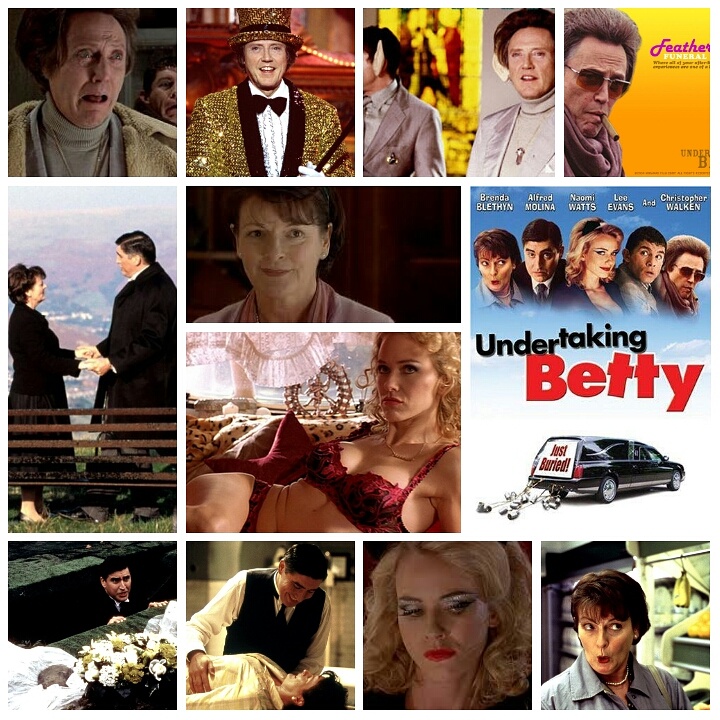
Undertaking Betty (or Plots With A View, as it’s called in the UK) is British black humour at its most brilliant, hilarious and surprisingly touching, in the tradition of stuff like Waking Ned Devine and Monty Python. It’s carefree and harmless but not without a raunchy sting that can’t help but be met with loving reception due to its charm and top drawer silliness. Brenda Blethyn plays a woman who has spent thirty years of her life in a small Welsh town, married to an absolute pig of a man (Robert Pugh). He’s a sleazeball who is shagging his slut of a secretary (Naomi Watts in full gumball sickening skank mode). Blethyn is secretly in love with the local undertaker and mortuary owner (Alfred Molina), the romance sparking up as the two try to find a way to get her away from Mr. Awful husband. Molina has the brilliant idea to fake her own death, letting her off the hook and allowing them to elope. She’s willing but reluctant, and so they proceed. Only one problem: Molina isn’t the only funeral outfit in town. Garish eccentric Frank Featherbed (Christopher Walken) and his peevy associate (Lee Evans) owns his own business and plans to steal Blethyn’s funeral for his own. Walken dials up the kook factor to the maximum and is pure genius, an entertainer at heart who believes that every funeral should have the showmanship and dazzle of a broadway show, leading to some amusingly awkward scenes. Just the fact that an american Chris Walken is working as a funeral home director way out in rural Wales is enough to bust a gut, let alone his off the wall performance. The resolution reaches comic heights that made me truly query why this film’s praises weren’t sung to high heaven upon release, but such is life, and death. The romance between Blethyn and Molina is sweet, endearing and balances out the larger than life sense of humour that the film keeps tossing around like confetti. Walken fans, dark comedy fans, film fans alike…please check this out.