UNCOMMON VALOR — A REVIEW BY NICK CLEMENT

uncommon_valor

This is a real steak and potatoes action film, hold the romantic subplots, with a few side orders of testosterone and piss and vinegar on the side. Blunt, absurd, and frequently entertaining, Uncommon Valor is the sort of 80’s action film that would be tough to get made these days. The men-on-a-mission narrative centers on a retired United States Marine Colonel (Gene Hackman) who believes that his son is still being held as a POW in Laos after the Vietnam War has ended. After getting funded by a rich oil tycoon (Robert Stack) with a missing son of his own, Hackman enlists the help of a group of ex-military personnel and old war buddies of his son, including Fred Ward, Randall “Tex” Cobb, Reb Brown, Michael Dudikoff, Patrick Swayze in a very early role, Harold Sylvester, and Tim Thomerson. If that’s not one of the most masculine casts of cinematic beef then I don’t know what is. Directed with square-jawed efficiency by Ted Kotcheff (Wake in Fright, First Blood, and North Dallas Forty, to name just three) and written with predictable heroics by Joe Gayton (from a story concocted by Wings Hauser), the film features a rousing musical score by James Horner, and sinewy, slow-motion enhanced cinematography by the extremely talented and underrated Stephen H. Burum, who was Brian De Palma’s frequent collaborator behind the camera, and a truly versatile cinematographer, having dipped his cinematic hands into a variety of genres (Body Double, Snake Eyes, Mystery Men, 8 Million Ways to Die, The Shadow, Hoffa, and The Untouchables are just a few of his insane credits). Released in December of 1983 with Vietnam still visible in the rearview mirror, the film would become a solid box office hit, likely capitalizing on the inherently compelling scenario and the film’s numerous and extremely well handled action sequences. The opening act is a little choppy from a directorial stand point, but once this film finds its footing, it hits hard and often, and even if the entire film is just a tad over the top, it’s that special sort of 80’s over the top which feels downright quaint today. The U.S. military apparently refused to help the production due to the perceived anti-government slant to the script. Produced by John Milius, Michael Tolkin, David Brown, and Buzz Feitshans.


ON THE ROAD – A REVIEW BY J.D. LAFRANCE

on-the-road-hedlund-riley

For years, Jack Kerouac’s novel On the Road had been considered unfilmable. That hasn’t stopped people from trying ever since it was published in 1957 with Kerouac himself sending a letter to Marlon Brando asking the actor to star opposite him in a film version. It isn’t the style or the structure that makes the novel difficult to adapt but rather its iconic status as one of the signature books of the 1950s. Even more daunting is its status as a book that millions of people grew up reading, like The Catcher in the Rye. As a result, it has become a much beloved and cherished book for generations of readers. Anyone attempting to adapt Kerouac’s novel into a film faces the intimidating task of living up to the impossible expectations of legions of fans, not to mention somehow making people forget the equally iconic people the characters are based on – Kerouac and his famous friends, Neal Cassady, Allen Ginsberg, and William S. Burroughs.

The path to an On the Road film has been littered with failed attempts from the likes of Francis Ford Coppola, Joel Schumacher, Brad Pitt, Billy Crudup, Colin Farrell, and Gus Van Sant, who were all attached at one time or another. Of all the people linked to the project, it was Coppola who has remained a constant over the years. He bought the rights in 1979 and has managed to steer it clear of Hollywood interference, finally picking Walter Salles (The Motorcycle Diaries) to direct. He saw it through a turbulent period where financing fell through and actors dropped out. He finally made and released the final product in 2012 with up-and-coming actors Sam Riley and Garrett Hedlund, and, oh yeah, a young actress you might have heard of – Kristen Stewart. On the Road debuted to a lackluster reception at the Cannes Film Festival prompting Salles to cut 13 minutes from the film in an effort to tighten things up and focus more on the two main characters – Sal Paradise (Riley) and Dean Moriarty (Hedlund).

On the Road
is a fictionalized account of Kerouac’s numerous journeys across the United States between 1947 and 1950 when he met Neal Cassady, who would become the mythical character Dean Moriarty in the book. The film begins, literally, on the road with a shot of Sal Paradise’s feet walking on several different roads both during the day and at night. Rather interestingly, Salles and screenwriter Jose Rivera’s angle with their adaptation is the theme of absent fathers and Sal and Dean’s yearning for theirs. Sal’s father dies before he first meets Dean and Dean’s elusive father is a semi-famous hobo in Denver who abandoned his family when his son was very young. So, the two men bond over a common missing element in their lives. This is established early on with Sal’s opening voiceover narration that quotes Kerouac’s original scroll manuscript before it was edited into the book most of us know and love: “I first met Dean not long after my father died. I had just gotten over a serious illness that I won’t bother to talk about except that it really had something to do with my father’s death, my awful feeling that everything was dead.” By choosing to quote the scroll instead of the novel, Salles and Rivera are letting fans know that they’ve done their homework and understand the source material.

Sal meets Dean and his beautiful young wife Marylou (Stewart) as the dynamic couple land in New York City to meet a mutual friend. Sal is captivated by Dean’s infectious energy and considerable charisma. Garrett Hedlund does a fantastic job of conveying Dean’s insatiable hunger for learning and for experience. He’s willing to try almost anything once if only for the experience. The actor captures the mischievous glint in Dean’s eye. You can see why he is so initially attractive to people with his dynamic and fascinating personality. However, there are hints early on that he may not be all he’s cracked up to be, like how he glosses over breaking up with Marylou, which was so bad that she called the cops on him.

I will admit that when I first heard of Hedlund being cast as Dean I wasn’t sold on the idea, but after seeing him in the wildly uneven Gwyneth Paltrow vehicle Country Strong (2010), I could imagine him in the role. He was by and far the best thing in that film, bringing a natural charisma that made you want to watch him every time he came on screen. He brings that quality to Dean in On the Road.

Once I got past the fact that none of the actors in the film look like their real-life counterparts, I was able to settle in and enjoy the experience. Salles wisely did not try to go for people who resembled Kerouac and his friends (an impossible task) but rather actors that were able to capture the spirit of the characters in the book. Sam Riley, who was so good as Ian Curtis in Control (2007), is fine as Sal but plays him a little too passively than he comes across in the book. This is due in large part to the fact that Riley is often overshadowed by the more dynamic Hedlund.

For those worried about the presence of Twilight’s Kristen Stewart, you have nothing to fear. Given the strong material and an equally strong director guiding her, the actress sheds her trademark acting tics and affectations and disappears into her character. Freed from not having to carry a massive cinematic franchise, Stewart allows herself to have fun with the role. She is cast wonderfully against type as the sexually hungry Marylou. Despite her movie star status, Stewart only has a supporting role but she makes the most of it and one hopes that a part like this is a sign of things to come for the talented young actress.

While the film is mostly about Sal and Dean, a few of the supporting characters get their moments, chief among them is Carlo Marx a.k.a. Allen Ginsberg (Tom Sturridge) and a memorable extended cameo by Old Bull Lee a.k.a. William S. Burroughs (Viggo Mortensen). A perfectly cast Viggo Mortensen eerily channels Burroughs’ distinctive voice including his trademark drawl as he dispenses pearls of paranoid wisdom to Sal and Dean while Amy Adams grunges herself down as Bull Lee’s equally cryptic wife Jane. They play well off each other and leave us wanting to see more of this odd couple.

To say that On the Road plays like a collection of highlights from the book is not a criticism as the source material is episodic in nature. That being said, Salles’ film is made by and for fans of Kerouac’s novel, possibly alienating the uninitiated. For fans of the novel, your enjoyment of the film will probably be based on how many of your favorite passages made it into the final version as the ones that do are translated quite faithfully with significant chunks of Kerouac’s prose spoken verbatim in the frequent voiceover narration.

For me, it was great to see some of my favorite passages from Kerouac’s novel realized in the film, like Sal’s ride to Denver on a flatbed truck with a hobo by the name of Mississippi Gene and a hitchhiker named Montana Slim that is pretty much the way I imagined it, right down to Gene singing that great little blues song with everyone joining in all photographed during dusk by cinematographer Eric Gautier. None of these characters are identified in the film but fans of the book will recognize them immediately. This scene shows the camaraderie among fellow travelers. Another favorite bit is a brief scene that demonstrates Dean’s amazing ability to park cars on a dime while living in New York. Salles also manages to capture the energy and vitality of be-bop jazz in a sequence early on where Sal and Dean go see a jazz saxophone player in action (Terrence Howard) and we see Dean lost in the music, lost in the beat.

Salles’ film accurately depicts the initial rush of excitement that most of the characters experience with Dean and how this eventually gives way to anger and disappointment when he invariably lets them down in some way. For Sal, it’s disillusionment as Dean turns out not to be the mythic Western hero figure he had imagined but an irresponsible man who does what he wants, oblivious of how it might affect those around him and yet he still loves him like a brother because of the intense bond they developed on their adventures crisscrossing the country. Jose Rivera’s screenplay doesn’t shy away from showing Dean’s poor treatment of women, like how he neglects his wife Camille (Kirsten Dunst) and baby for trivial “kicks,” going out to a jazz club with Sal. The film also shows how he repeatedly cheats on her with Marylou and vice versa, eventually abandoning both. On his path for the ultimate thrill, he leaves a path of failed marriages and destroyed friendships. For Dean, nothing must get in the way of his voracious appetite – be it drink, drugs, women or the open road. He is the quintessential free spirit, a restless soul that burns like the roman candles Sal compares him to.

As far as films directly about the Beat Generation go, On the Road is best one to date. That’s not saying much when its competition consists mostly of failed efforts like Heart Beat (1980), The Last Time I Committed Suicide (1997) and Neal Cassady (2008), which were made by people who understood little about the Beats. Sure, there have been the rare exceptions that got it right, like Naked Lunch (1991) and Howl (2010), but I’ve always felt that the two best unofficial Beat Generation films were Robert Rossen’s adaptation of The Hustler (1961) and Gus Van Sant’s My Own Private Idaho (1991). The former managed to capture the run down, “beat” feeling that is often conveyed in Kerouac’s novels, while the latter brilliantly captures the allure of the open road and the search for a missing parental figure, in this case a mother. At that point in their respective careers, Rossen and Van Sant would have been ideal directors to tackle On the Road.

The attention to period detail is fantastic, from recreating 1940s New York City to the famous ’49 Hudson that Sal and Dean drive across the country. Right from the get-go, Salles immerses us in this time period with the help of jazz music from the likes of Slim Gaillard, Dinah Washington, Charlie Parker, and Dizzy Gillespie. The sets, locations, outfits and music all work together to provide us with a glimpse of that time as seen through Kerouac’s eyes. Rather interestingly, Salles and Rivera don’t shy away from the sex in On the Road as we see Dean with a variety of sexual partners over the course of film as does Sal, which includes his brief relationship with Terry, (Alice Braga), a beautiful Mexican woman he meets in California. The Beat writers were very passionate people and this included their sex lives.

The care and detail applied to every scene clearly demonstrates that this was a passion project for everyone involved. On the Road is not some sterile, impersonal studio film, but rather one made by people with a real affinity for the source material. Salles’ film captures the energy and excitement of Kerouac and his friends who shared a passion for literature and jazz. They lived for the moment, giving into their wildest urges as one sometimes does at that young age where you have your whole life in front of you and feel indestructible. They are the “mad ones” as Kerouac calls them in his book. This is certainly not a film for everyone and rightly so. What it does is perfectly capture the essence and spirit of the novel. It does this so faithfully that it may alienate the uninitiated but so be it. At least Salles has the conviction to pick a specific angle and go for it, making definite choices along the way instead of playing it safe.

FRANCOIS OZON’S SWIMMING POOL — A REVIEW BY NICK CLEMENT

1
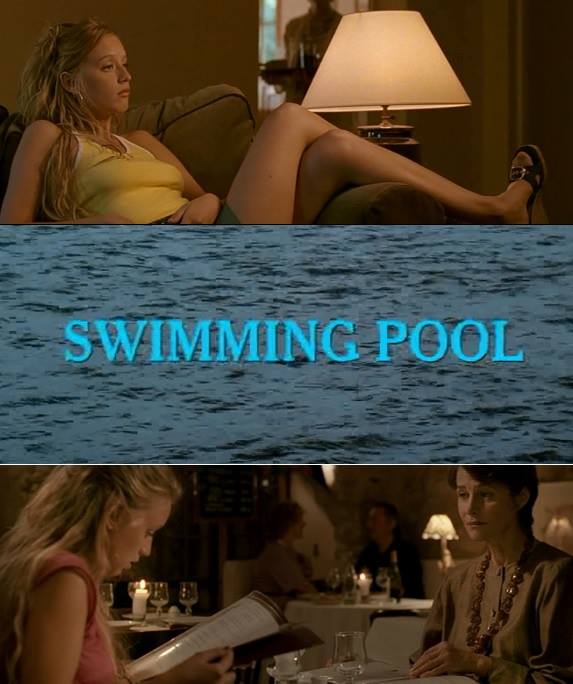
Swimming Pool is one of those erotic dramas that toys with thriller elements without ever really becoming a full blown suspense film, at least not in the traditional sense. Directed with extreme specificity by Francois Ozon, this 2003 British/French mind-teaser features two startling performances, one from lead Charlotte Rampling, and the other from Ludivine Sagnier, who does some of the most effortless on screen nudity that I’ve ever seen in a film. Ozon and co-screenwriter Emmanuèle Bernheim’s narrative is simple on the surface, but beyond tricky in the fine details, and I’d never want to spoil anything, so all that I’ll say is that Rampling plays a successful writer who accepts an invitation from her longtime publisher (Charles Dance, excellent as usual) to spend some time at his gorgeous French country house in an effort to get cracking on her new mystery novel. But before she can get into any sort of creative groove, her publisher’s promiscuous and free spirited daughter shows up, looking to crash at the villa and hang out topless by the pool, while bringing home an interesting selection of men at night to entertain.

This is a very sexy movie, and if you’re looking for a film to get the juices flowing and isn’t afraid to confront hot-blooded sexuality up front and center, this one will certainly do the trick. Sagnier’s glistening body is repeatedly studied by Ozon and cinematographer Yorick Le Saux’s patient camera, and it’s clear that she was an actress very comfortable in her own skin while shooting, because there’s hardly a scene where she’s not unclothed to some degree. Rampling’s internal psyche is explored in interesting ways all throughout the twisty narrative, and while I’m reluctant to describe the plot any further, I’ll allow that the fates of both Rampling and Sagnier become crucially intertwined, with the film coming to a close on an abstruse note of moral questionability and psychological complexity. Philippe Rombi’s playful musical score knew when to twist the screws and when to have some fun. Swimming Pool premiered at the Cannes Film Festival, and Ozon’s unrated director’s cut is available on disc.


Ghost: A Review by Nate Hill


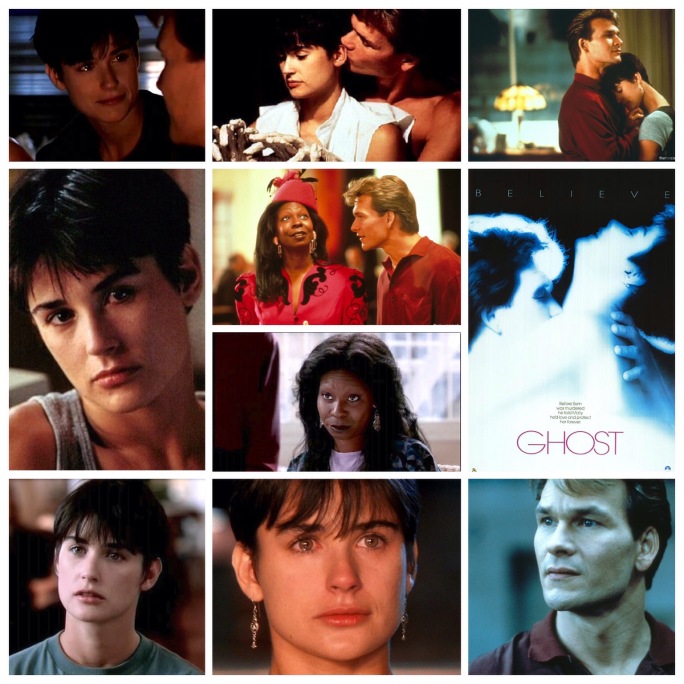
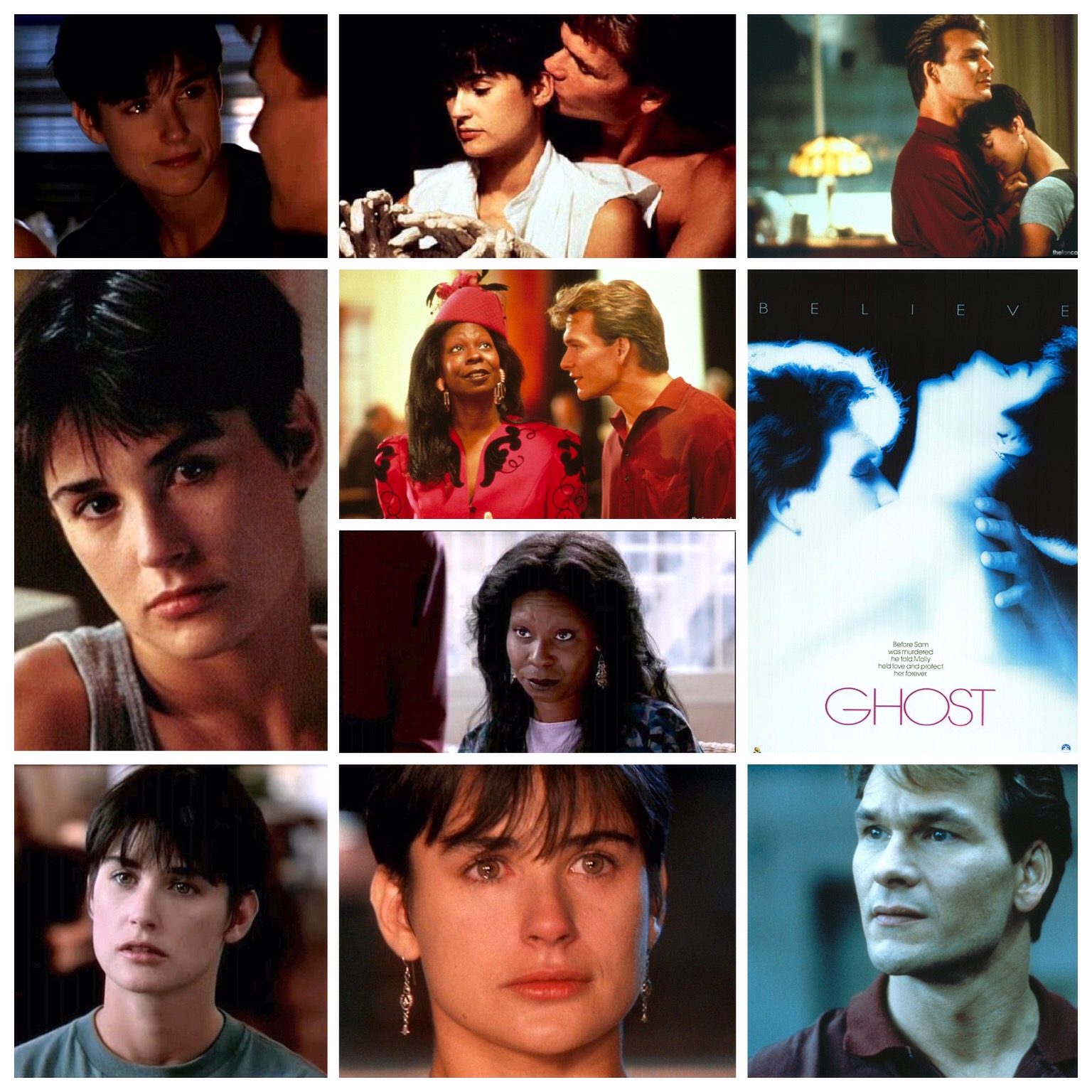
Ahh, Ghost. What an authentic romance classic, a film that puts a big old grin on your face whether you want it to or not, a sloppy, smile that’s just wide enough to catch the tears that fall as a result of the sadness which accompanies the sweet, too essential ingredients in any love story that hopes to affect us in either direction. Balance is key, and Ghost employs both the giddy, heart-skipping joy of romance and the looming possibility of threat and tragedy in equal measures, never getting too dark or to soppy, at least for me. Demi has never been more adorable, in one of her career highlights. Her and Patrick ‘Roadhouse’ Swayze play star-crossed young lovers, in the beginning stages of building their lives together, a time that should be unconditionally happy for both, and is, until one fateful event rips them apart and plunges the narrative into effect. They encounter a thief in an alley one night, and Swayze is killed. Only, his spirit remains behind, for more reasons than he at first realizes. He keeps a protective, loving eye on Moore, and is driven to the notion that his death was no accident, his lingering presence meant for the purpose of both truth, love and retribution. He is aided and assisted by a sassy psychic (Whoopi Goldberg) who acts as his conduit between both realms. There’s supernatural intrigue and conspiracy afoot, but as exciting as that stuff is, it’s the love story between Patrick and Demi that has kept generations rooted to the story. A romance film is nothing without two leads who share both chemistry and a great script, which this one supplies generously. They are a show stopping pair in their scenes together, and if their predicament doesn’t draw forth both smiles and cries from you as a viewer, well, you’re wading through the wrong genre, my friend. The two of them make this one an honest to goodness winner with their performances, supported by narrative elements that only raise the stakes of their relationship. A film which will never not be a classic, and everyone should have in their collection. Ditto.

Cool World: A Review by Nate Hill

image

Cool World is known, by those few who may be aware of its existence, as the ‘other’ film in which live action characters inhabit the same realm as cartoons. The more famous one of course is Who Framed Roger Rabbit, a glorious gem of a film that gets the acclaim, notoriety and long lasting attention, as it well should. (We won’t speak of a third one involving a certain moose and squirrel that really does earn it’s bad rap). Cool World is somewhat maligned as the black sheep of the two, and in some people’s eyes (Ebert laid a stern smackdown on it) downright hated on. It’s no doubt very different from Roger Rabbit, which is admittedly the better film and the easier one to like and relate to. But this one is brilliant in its own right, at least for me. I love the way it uses a sombre tone with its human creations to throw a unique light on them as soon as the Toons show up. It’s quaint and wonderfully inaccessible, with some scenes existing purely of a need to showcase a stream of consciousness type style that doesn’t so much halt the proceedings, as give them their own surreal flavor. Brad Pitt is Frank Harris, victim of a jarring post war tragedy and thrown headlong into the cartoon world, eventually finding himself a Detective in their realm. Outside in our world, lonely cartoonist Jack Deebs (Gabriel Byrne is a sly choice for the role) falls in love with one of his creations, a blonde bombshell named Holli Would (voiced and later played in the flesh by Kim Basinger). Holli is as devious as she is gorgeous, and works to use Jack’s attraction to her as a conduit to escape into our world. Pretty soon a deafening cacophany of cartoon creatures in all shapes, sizes and colours floods out of their dimension and into ours, creating quite the cosmic mess for Pitt to clean up. It’s fun without being too zany, the overblown fuss of the Toons contrasted by a glum human world, reeling from the war and unexpecting of such an event to unfold. Granted, the meshing of the two dimensions isn’t given the precise, big budget fanfare and cutting edge methods of Roger Rabbit, but the world building and special effects here are still pure enchantment and offer a dazzling level of entertainment. Pitt is stoic with flinty sparks of boyish charm, Byrne hilariously plays it dead straight, and Basinger is dead friggin sexy. She steals the show especially as Holli in human form, having a ball with the bubbly bimbo trying to keep a straight face in the real world. The Toons in general really are a diverse bunch, ranging from animals to inanimate objects to tiny little formless cutesy blobs and everything in between, filling their frames with a chaotic, detailed miasma worthy of Studio Ghibli. Lot of hate floating around for this one. You won’t find any from me, I love the film, and accept it for the adult friendly,  experimental oddity it is. Great stuff.

THOR: THE DARK WORLD: A Retrospective by Joel Copling

Rating in Stars: ** (out of ****)
Cast: Chris Hemsworth, Natalie Portman, Tom Hiddleston, Anthony Hopkins, Christopher Eccleston
Director: Alan Taylor
MPAA Rating: (for sequences of intense sci-fi action and violence, and some suggestive content)
Running Time: 1:52
Release Date: 11/08/13

At the start of almost every sequence, Thor: The Dark World seems like it’s heading in the heading in the direction of being a surprisingly, solidly interesting first sequel to Thor. By the time we reach the end of each sequence, though, the screenplay by Christopher Markus and Stephen McFeely has regressed backward to the flippant and familiar. This process is tiresome in its repetition, because here is a narrative that has some real potential to make major steps toward building upon the direction in which the Marvel Cinematic Universe seems to be going. Instead, by giving us all the generic beats of a sequel that feels a lot more like wheel-spinning, the screenwriters offer only the familiar to underwhelming results.

Thor (Chris Hemsworth) is now the protector of the Nine Realms, on one of which he easily defeats a fearsome rock beast to the adulation of the crowd watching (“Maybe next time you should start with that,” exclaims one of his fellows, and we nod in agreement). He’s juggling this responsibility with that of rebuilding the peace left to die by his adoptive brother Loki (Tom Hiddleston) after the disastrous events he facilitated and then committed on Earth (for which he will remain in prison) and the prospect of ascension to a throne currently filled by their father Odin (Anthony Hopkins, once again displaying credence in an underwritten role).

The major conflict here shows up on Earth, though, because Jane Foster (Natalie Portman, looking disinterested), the woman Thor met and fell in love with on Earth during his last visit, has stumbled across an anomaly with the help of Darcy (Kat Dennings, a delight) and Dr. Erik Selvig (Stellan Skarsgård), who kind of went insane after New York’s invasion by aliens. The anomaly’s source is a mysterious rift in the time-space continuum (I think) that leads her to the location of the Aether, a substance that predates existence (I think) and possesses some sort of power to do something. Honestly, by the time Jane is pointing out to the others that it will cause “spatial extrusions” (what?), the audience will have clocked out both intellectually and emotionally.

The film even offers the requisite villain whose main henchman is far more threatening and interesting. The former is Malekith (Christopher Eccleston, embarrassingly hammy), whose major defining feature is looking like a steely-eyed, poodle-wearing cousin of Nosferatu, and the latter is the Kursed, played by Adewale Akinnuoye Agbaje in a convincing physical performance that gains mileage from his silence. They are the last of the Dark Elves, an ancient race whose members (excepting a horde of expendable soldiers, of course) all died as a result of Malekith’s bid for power. It’s dull stuff and, once again, overshadowed by the continued, conflicted relationship between Thor and Loki (Hemsworth and a very good Hiddleston shine in these sequences).

After much to-do (a treasonous escape from his home realm of Asgard, a death, some more expository nonsense about a “Convergence” that I think created the universe), Thor and Malekith do battle that once again introduces a bit of creativity into the mix (The hero, his foe, and a bunch of other things around them dash in and out of different realms) before yet again devolving into murkiness (The final confrontation way overcompensates the lack of distinctive coloring in director Alan Taylor and cinematographer Kramer Morgenthau’s imagery by dousing everything in red). It’s indicative of the constantly shifting process of regression inherent in Thor: The Dark World, which is at least an interesting mishap.

IRON MAN THREE: A Retrospective by Joel Copling

Rating in Stars: ***½ (out of ****)
Cast: Robert Downey Jr., Gwyneth Paltrow, Guy Pearce, Rebecca Hall, Ben Kingsley
Director: Shane Black
MPAA Rating: PG-13 (for sequences of intense sci-fi action and violence throughout, and brief suggestive content)
Running Time: 2:10
Release Date: 05/03/13

If the first film had the opportunity to examine the reasons that its titular superhero had to don the gold titanium alloy suit shot with hot-rod red that has an arsenal of weapons up its sleeves and in its shoulder pads only to thrust him into a generic conflict and its first sequel did nothing to expand upon that potential (It certainly didn’t and, in fact, regressed from it), then Iron Man Three is the first time in this series–or, indeed, in the Marvel Cinematic Universe, considering his appearance in The Avengers was in direct proportion to how he interacts with another superhero–that the man within the suit has been properly examined. What writer/director Shane Black finds is a damaged prodigy from privilege and a source of unflappable sarcasm. It seems that trauma, which is the real conflict in store for the man, activates the defense mechanism of outwardly taking nothing seriously.

That is a quality that Black’s carefully honed screenplay shares, too, as is clear in a sequence wherein Tony Stark (Robert Downey Jr.) visits an anomalous location in Tennessee where an explosion may or may not have occurred that is similar to a series of them that have left many people dead and no trace of a source. He meets Harley (Ty Simpkins), a young, plucky kid whose personality mirrors Tony’s own and who aids in Tony’s investigation of the scene of a crime that left five people dead. The scene is oddly but affectionately balanced between the investigation and their repertoire. Downey’s performance is similarly balanced between the moroseness of Tony’s internal conflict and his sarcastic deflection of it; it’s the actor’s best work to date in the role.

That internal conflict has reared its head in the form of sleeplessness and posttraumatic anxiety following the events that led to New York City being overrun by aliens. Even the mention of the city or the beings from someone as innocuous as a child who wants an autograph on his drawing of the battle sets the stress level to 11 for Tony, whose Iron Man alter ego has gone through an upheaval as of late. The lack of sleep has nonetheless spawned a terrific creative spike in the form of remote-controlled suits and a nifty device that summons them and has been placed subcutaneously in his wrist. When one of those attacks is upon Air Force One, he uses one of them to great effect–until, of course, it meets the front end of a semi truck (The interrupted hero shot is a constant, go-to gag that never fails to illicit a healthy chuckle).

External conflict is two-fold this time around. First, there is the re-introduction of Aldrich Killian (Guy Pearce), whom Tony met in 1999 (a meeting that we see in a prologue amusingly scored to a late-decade one-hit wonder) while working on a project with confidant and sort-of-girlfriend Maya Hansen (Rebecca Hall). He wants to collaborate on his newest bit of technology, which is the rejuvenation of genetic defects through cellular manipulation, with Stark Industries, but Pepper Potts (Gwyneth Paltrow), its C.E.O., thinks it highly weaponizable. The other, seemingly more generic conflict comes from a terrorist calling himself the Mandarin (Ben Kingsley); he is the one responsible for bombings positioned as social experiments for the President of the United States (William Sadler), who has now publicly championed James Rhodes (Don Cheadle), aka Iron Patriot, as an official superhero on the government’s behalf.

Things, though, are not as they seem, and the result is the film within the Marvel Cinematic Universe that feels as if it’s taking the biggest number of chances. Part of that is in the revelation of the Mandarin’s identity (refreshingly played as a joke that might be a barb aimed at the MCU itself for giving us such generic villains); the other part is in the action sequences, which are either creatively conceived (the aforementioned Air Force One rescue or the destruction of Tony’s residence, in which a piano is used as a weapon) or thrillingly staged (the climax, which might predictably be set among crates on a rig in the ocean but is a highlight all the same due to the welcome levity of humor and more of those interrupted hero shots). Iron Man Three is unique and risky, yes, but it’s also a lot of cheeky fun.

JEFF NICHOLS’ MIDNIGHT SPECIAL — A REVIEW BY NICK CLEMENT

midnight

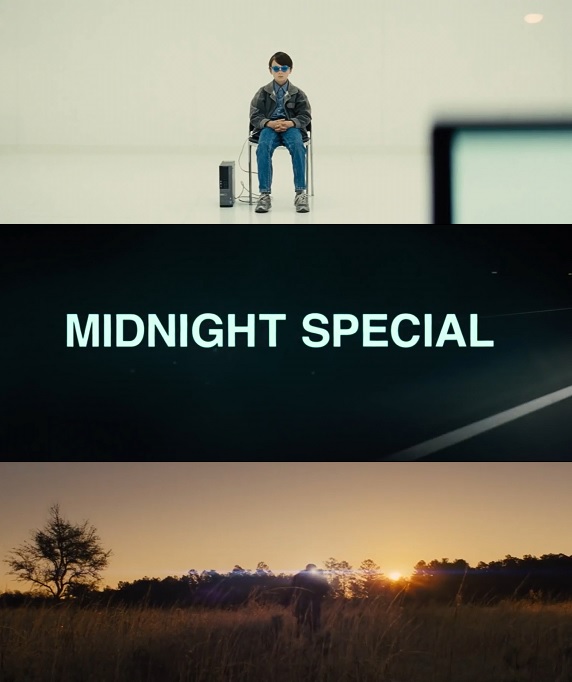
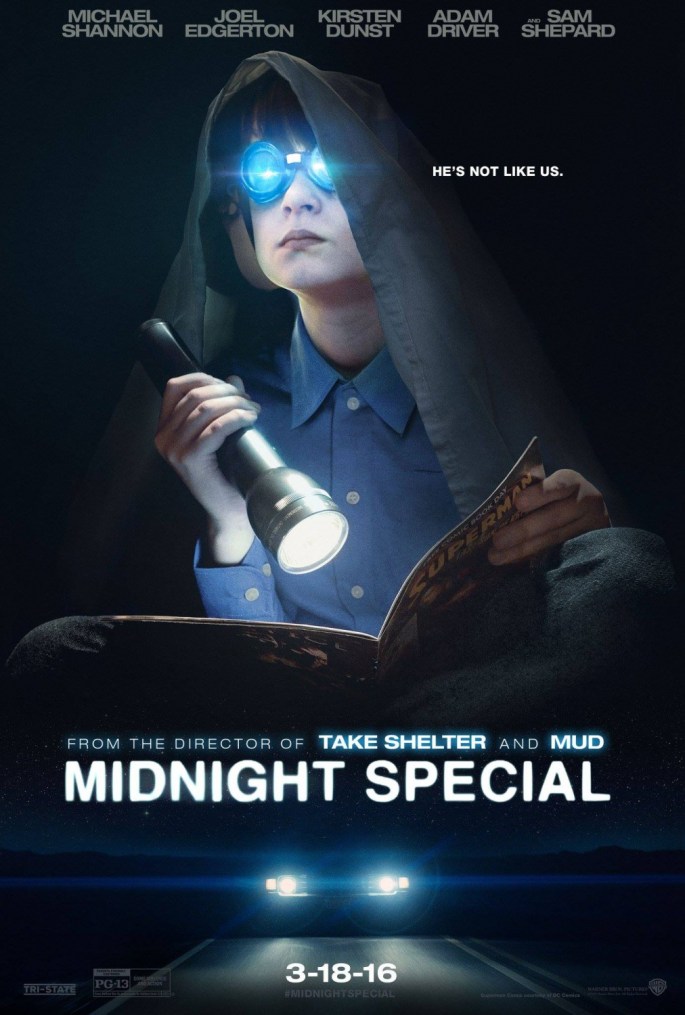
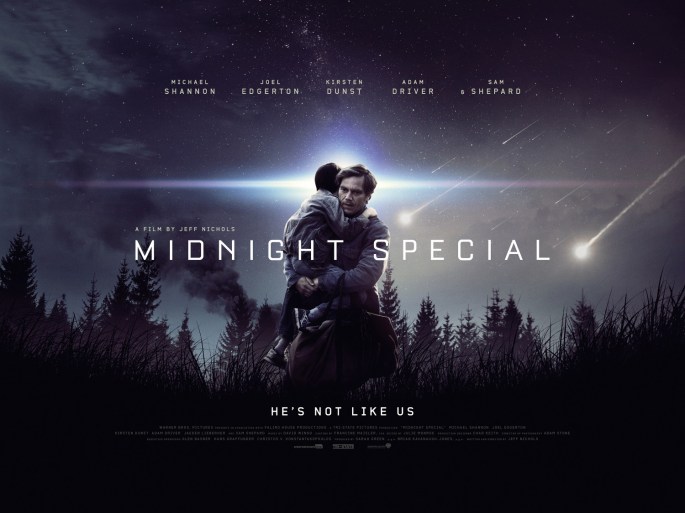
The experience of watching Midnight Special was akin to eating 50 Oreos with a humongous glass of ice cold milk. In short, I loved every single second of this fantastic film, but I’m not too surprised, considering how Jeff Nichols has only made quality films, with his sophomore effort, Take Shelter, registering as a masterpiece of introspective, existential cinema. He’s back in semi-ambiguous mode here after the solid southern drama Mud, and to be honest, I want Nichols to stick to this arena, the thought provoking genre bender that you can’t quite pin down. It’s a miracle that a major studio funded this film – bravo, Warner Brothers. There’s no chance of a sequel or lunchboxes or action figures with this one, and it seems to have been crafted with BRAINS as the motivating factor, not endless action scenes or noisy visual effects. Instead, the audience is treated to tantalizing ideas, smart dialogue and riveting plotting, excellent performances, realistic family dynamics that propel the narrative, and CGI that’s used to enhance the story, and not act as the central focus. I loved the Amblin-ness of Midnight Special, and how it reminded me of John Carpenter’s Star Man and other nostalgic offerings from the 80’s, yet still made with modern panache and overall exquisite style, rarely ever calling overt attention to itself. Adam Stone’s shimmery and bold widescreen cinematography meshed perfectly with Chad Keith’s inspired and subtly stylish production design, which went a long way in evoking these feelings. And the last 20 minutes of the film are spellbinding in their ability to transport you out of the theater and into a movie world where you just have to know what’s going to happen next.

1

If you’ve see the trailer, that’s all you need to know from a plot stand point. There’s a strange and unique child being moved across state lines by two men with a variety of groups giving chase, and for some reason, the kid is able to emit light rays from his eyes. I’m giving nothing away that’s not shown in the trailer. And I’ll reveal no more. This movie has a ton of heart and honest emotion that worked me over like a baby, and a central performance from Michael Shannon that is compelling and totally consuming to observe. Jaeden Lieberher is equal parts spooky and sympathetic as the potentially dangerous cargo, while Joel Edgerton and Kirsten Dunst are both very effective in supporting roles. Adam Driver nails his scenes as an NSA agent looking into the situation, while Sam Shepard has a cameo as a cult leader who feels that, for some reason, the boy is very special. David Wingo’s music is haunting and pulsating and delivers a serious punch, and again, it must be mentioned that the entire film has been shot with casual elegance by Stone, who clearly was favoring a lot of natural light, and knew exactly where to place the camera in some key situations. But the star of the show is Nichols, and his erudite sense of storytelling, never holding the audience’s hand too firmly, and always allowing for tantalizing bits and pieces from his heady narrative to remain unanswered, so that when you leave the theater, you’ll be thinking about the fine details for hours after the film has finished. I can’t wait to see this film again and again and again and I have no doubt that it will be included in my top 10 favorite films of the year.

midnight_special_ver2_xlg

DAVID O. RUSSELL’S THE FIGHTER — A REVIEW BY NICK CLEMENT

the fighter

The Fighter is an inherently compelling piece of entertainment. Christian Bale, as a crack-addicted boxing coach, stole the entire show, but Mark Wahlberg, starring as real life boxer Micky Ward, was low-key terrific and was somewhat overshadowed by the hype that accompanied Bale’s transformative performance. Wahlberg clearly excels while working with director David O. Russell (they previously teamed on the masterwork Three Kings and the criminally underrated I Heart Huckabees) and it’s clear from frame one that this was Wahlberg’s passion project. It’s probably the least idiosyncratic movie that Russell has ever directed, but switching it up a bit thematically and stylistically was probably a good move for him at the time, as he definitely showed that he’s got solid commercial instincts and that he can stay focused with a concise story. The film also has some huge and unexpected doses of humor (mostly at the expense of the broadly drawn characterizations that comprise Ward’s white-trashy sisters) that really bring the laughs.

You might not like the brutality of boxing, you might not want to have your face rubbed in the low-class Lowell-grit-‘n-slime for two hours, and sure, most of the beats in the script are predictable, but it’s got such a rousing finish and the story is so quintessentially American (who doesn’t love a second, sometimes third chance in life?), that it’s hard not to find the film inspiring to a certain degree. The acting across the board was so strong and enjoyable that in tandem with the sharp and believable dialogue, the obviousness of some of the story recedes into the back of my mind. The Fighter has a somewhat traditional boxing movie narrative, but everything is spiced up by the gritty, lived-in atmosphere and by the rough and tumble dynamics of the Ward family. Amy Adams and Melissa Leo were both terrific, and again, it needs to be said, without Wahlberg’s sensitive and quietly observed performance, the film would be without its steady anchor. It’s his best overall performance since Boogie Nights and it’s something that he should be very proud of.

Faster: A Review by Nate Hill

image

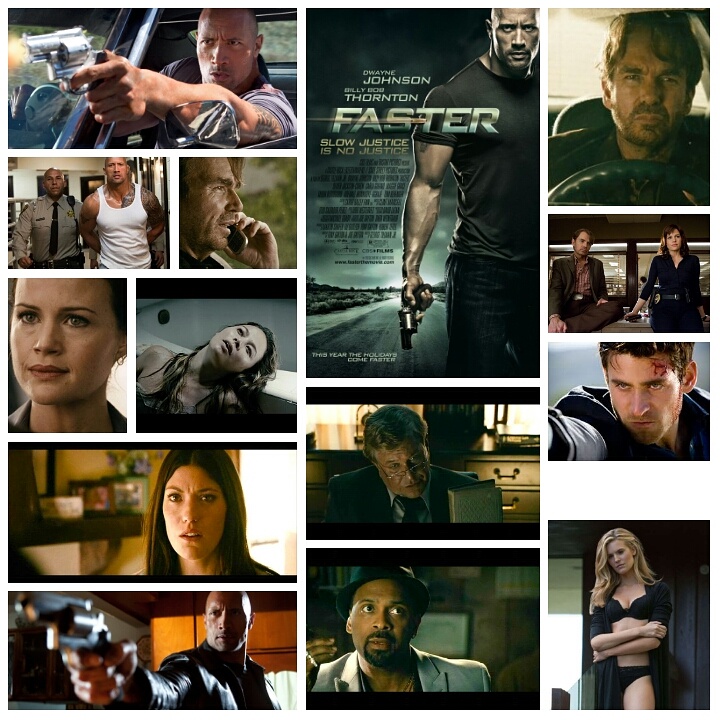
Faster is an action film with an eerie aura and a darkly unnerving bite to it. Don’t get me wrong, it’s action through and through, a genre effort right to its marrow. And yet, there’s something oddly esoteric about it, an obvious extra effort put in by the filmmakers, namely first time action director George Tillman, to give every character an off kilter, bizarre cadence to ensure we won’t forget them. There’s clichés, no doubt, but they’re eclipsed by the strange, full moon weirdness of the rogues running about the film’s story. Dwayne Johnson fires up a furious protagonist in his first action role after a long and ridiculous stint in insufferable family comedies. He plays a quiet, hulking dude known only as Driver, reluctantly released from prison by a watchful Warden (Tom Berenger). Upon exiting the gate, he runs. And runs. And runs. He arrives at a small town junkyard where he tears a tarp of a vintage Chevelle which seems to be left there for him like a care package. From there he launches a bloody crusade of revenge that knows neither mercy nor discretion, and whose reasons we are only slowly allowed to know. He’s a one man wrecking ball, the murders piling up before we really have any idea what this guy is about. He’s been greatly wronged in the past, the culprits of which should all be running scared, as he comes looking for them one by one and with the juggernaut pace of a boulder tumbling down a mountain. Pretty soon there’s two cops on his trail, intrepid Cicero (Carla Gugino) and mopey sleazeball ‘Cop’ (Billy Bob Thornton), a dilapidated piece of work who mainlines heroin and clearly has a murky past. Soon there’s one hell of a hitman (Oliver Jackson Cohen) skulking around looking for Driver, an extreme sports enthusiast who has ‘beaten yoga’ and is avidly looking for the next big thrill. Johnson jumps from one ultra violent encounter to the next with all the corrosive ferocity of the grim reaper, tallying up the corpses until we’re all but sure he’s an inhuman elimination machine. Then.. the film curveballs us and throws a glint of humanity into the mix with some late third act emotion that only goes to show the filmmakers set out with more than a one track mind. Driver has been unspeakably betrayed, and his rampage is undeniably justified, but there’s a complexity to his quest that he didn’t see coming, and neither did those of us who expected pure action without a moral conundrum in sight. I say good on it for grasping something besides the thrills. A terrific cast populates the almost Oliver Stone – esque proceedings, including Maggie Grace, Moon Bloodgood, Mike Epps, Jennifer Carpenter  (always superb), Matt Gerald, Xander Berkeley, Buzz Belmondo, Courtney Gains and more. It’s got the depth of a well written graphic novel and a level of thought out characterization that heaps of stale action entries wish they possessed.