Q & A – A REVIEW BY J.D. LAFRANCE

MSDQANA EC007
Q & A, Nick Nolte (front, left), Timothy Hutton (front right), 1990. ©TriStar Pictures

Among the many genres prolific filmmaker Sidney Lumet has dabbled in, the one in which he excels and demonstrates the most affinity for is the crime thriller. In particular, he is fascinated with police corruption and how the law and order system works (or, in some cases, doesn’t work) in New York City. In the 1970s, he told the story of an undercover cop who deals with corruption among his fellow officers with Serpico (1973). In the 1980s, he depicted the plight of a police detective that informs on his cohorts after being busted himself in the magnum opus Prince of the City (1981). In the 1990s, Lumet tackled police corruption yet again but this time via the angle of racism with Q & A (1990). Based on the novel of the same name by New York judge Edwin Torres, Lumet’s adaptation received mixed reviews from critics and was largely ignored by audiences of the day. It has become something of a forgotten, underappreciated film in Lumet’s filmography and one that deserves to be rediscovered.

During the opening credits we see the rain-slicked streets of New York City through the back seat of a cop car. This sequence sets a nice, gritty tone and takes us on a mini-tour of the city where most of the film’s action takes place. However, Ruben Blades’ jarring song that plays on the soundtrack almost ruins it. I’m not quite sure what Lumet was thinking but it simply does not work here.

Lieutenant Mike Brennan (Nick Nolte) is a dirty cop as evident from his introduction where he ambushes an unarmed Latino drug dealer, blows the guy’s brains out and then bullies two nearby witnesses into saying that the man had a gun in his hand. Assistant District Attorney Al Reilly (Timothy Hutton) is assigned to the case. His boss tells him that the incident is a cut and dry one. He is told that Brennan is a good cop – a little rough in his methods but all of his cases have been tried successfully with no appeals. Reilly is instructed to collect the facts with the help of a stenographer and present them to a grand jury. His boss instructs him that “the Q & A defines what really happened. If it’s not the Q & A, it didn’t happen.”

Reilly is eager to please and is impressed with Brennan’s imposing presence and reputation. The young A.D.A. questions Roberto “Bobby Tex” Texador (Armand Assante), a drug dealer and racketeer, who, along with his wife Nancy (Jenny Lumet), witnessed the aftermath of the murder. He refutes the theory that the gun was found on the murder victim. Reilly begins to suspect that something might not be right with the case. He is also faced with a personal conflict as he used to be involved with Nancy and still has feelings for her. Reilly soon realizes that’s he’s taken on more than he can possibly handle. Sidney Lumet pits Brennan, Bobby Tex and Reilly against one another, each with their own agenda and the film gradually heads towards an inevitable confrontation between the three men.

Nick Nolte is a lot of fun to watch as a larger than life cop. He sports slicked back hair and a thick mustache that threatens to overtake his mouth. There’s a memorable scene early on where his character recounts a story to some other cops about how a mobster gave him a hard time when he tried to fingerprint him that is hilarious and disgusting. The scene has an authenticity of a veteran that delights in telling old war stories to inflate his own ego. Nolte’s Brennan is a chatty guy that loves to tell stories of past glories as he tries to buddy-up with Reilly until the A.D.A. lets him know that he’ll go after the veteran cop if he finds out he’s dirty. Nolte’s whole demeanor changes in a heartbeat and it is quite exciting to see him go from jovial to threatening in the span of a few seconds. Brennan is as corrupt as they get and enjoys the influence he exerts and the power he wields. He uses fear and intimidation to get what he wants. Nolte put on 40 pounds for the role because he felt that the character required it: “just the sheer mass of brutality. I felt that would be the right kind of thing. He had to be on the edge of his own dissipation.”

Armand Assante is a force of nature as Bobby Tex, portraying the crook with an aggressive swagger and an intensity that is impressively conveyed in his eyes. During Reilly’s initial questioning, Bobby oozes casual confidence and Assante does a great job of conveying it. He also imparts a keen intelligence. Bobby isn’t just some two-bit street punk. He doesn’t even blow his cool when Luis Guzman’s cop gets all in his face. Bobby matches his intensity and it is great to see two skilled character actors go at it. Assante ups his intensity when he warns Reilly to stay away from his wife. He gives the A.D.A. a seriously threatening look that would have most people shaking in their shoes. It’s Bobby’s first appearance in the film and Assante makes quite an impression.

Up against two lead actors playing colorful characters, Timothy Hutton wisely underplays Al Reilly. His character may be young and new to the job but he knows the law as demonstrated when questioning a mobster by the name of Pesch (Dominic Chianese) and his lawyer (Fyvush Finkel) in rather confident fashion. At first, it appears that the slick mob lawyer is going intimidate Reilly but the young man expertly turns the tables with his intelligence. Hutton is good as the straight arrow A.D.A. that decides to take on a highly respected cop and in the process uncovers an intricate web of corruption. The actor avoids stereotyping by showing layers to his character through the revelation of his feelings for Nancy which affects his approach to the case. Reilly starts off as an idealistic person but over the course of the film, as he’s exposed to corruption, he gains experience and becomes savvier when it comes to how things work. Early on in Q & A, there is a revealing conversation he has with Leo Bloomenfeld (Lee Richardson), a veteran attorney that has clearly been working in the system for far too many years. He’s jaded and tells the eager Reilly how things really are, giving him a taste of the corruption he will witness first hand later on. To prepare for the role, Hutton went on squad-car runs with police officers in Manhattan in order to get an idea of the challenges they face on the streets. He said of the experience, “in many cases the hands of the officer on the street are tied.”

Lumet shows how close these cops are by the short-hand between them and the familiarity they have with each other. In the scene where Reilly questions Brennan about the homicide in a room full of cops, the director really captures the camaraderie among these men. The dialogue sounds authentic and is delivered by the actors in a way that is so natural you believe that they are these characters. Consummate character actor Luis Guzman has a memorable role as a homicide detective that first suspects the Brennan case is rotten. He has a memorable moment where he jokingly defends Brennan’s casual racism: “He ain’t no racist. He hates everybody. He’s an equal opportunity hater.” Even though this is said in jest, in actuality it’s not far off the mark.

However, in his review for The New York Times, Vincent Canby wrote, “great little scenes overshadow bigger, more important ones. Characters come and go at speed. Watching the movie is an entertaining ride, but when it’s over it’s difficult to remember where, exactly, one has been.” USA Today gave the film two-and-a-half stars out of four and wrote, “Overkill ultimately wears Q & A down, despite two bravura performances and some Hutton understatement that’s adequate to the task. So, too, does unrelenting sordidness, a deadly love angle and a score (Ruben Blades) almost as awful as Cy Coleman’s sabotage of Lumet’s Family Business.”

One of the major themes Q & A wrestles with is racism. There is the casual kind between black, white and Latino cops and there’s the more damaging kind that resulted in the end of Reilly and Nancy’s relationship years ago. Racism informs a lot of the characters’ decisions and often motivates their actions. The film addresses racism in an honest way that you rarely see outside of a Spike Lee film. As he did with Prince of the City and later with Night Falls on Manhattan (1997), Lumet sheds light on how cops and crooks can be intricately linked and just how deep corruption runs in a sprawling metropolis like New York City. These films show how law and order works in fascinating detail and that feels authentic, much like the television show Law & Order does year in and year out.


TOMAS ALFREDSON’S TINKER TAILOR SOLDIER SPY — A REVIEW BY NICK CLEMENT

tinker


Elegant. Cool to the touch. Brilliantly layered and carefully doled out. Possessing a quietly stylish veneer that stresses every single shade of brown imaginable. Tinker Tailor Soldier Spy is one of the more literate modern spy films, directed with classy panache and extreme intelligence by Tomas Alfredson (Let the Right One In), and adapted from John le Carre’s celebrated novel by Peter Straughan (The Men Who Stare at Goats). Released in December of 2011, the film wasn’t given the splashiest push by its distributor, and already feels underrated to a certain degree, despite excellent critical support. Set in 1970’s England, the dense narrative pivots on the actions of MI6 chief, Control (a magnificent John Hurt), who sends one of his best agents (Mark Strong, always persuasive and commanding) to rendezvous with a general from the Hungarian army who might possibly have information leading to the uncovering of a duplicitous Russian agent who has infiltrated the ranks of the British spy organization. Of course, the mission becomes compromised, leading to double and triple crossing, allegiance testing, and a general sense that anyone could be anything at any point.

An ex-British spook named George Smiley (a perfectly weathered Gary Oldman) is called in to weed out the potential mole, in an effort to stop leaked information finding its way into Soviet hands. Filled to the brim with fantastic supporting performances from a stellar ensemble cast including Tom Hardy, Colin Firth, Stephen Graham, Benedict Cumberbatch, Toby Jones, Ciarán Hinds, David Dencik, Kathy Burke, and the always potentially sinister Simon McBurney, Tinker Tailor Soldier Spy hums along without any sense of forced narrative conceits or extraneous plot developments, keeping everything tight and smart. Cinematographer Hoyte van Hoytema (Interstellar, Her) and composer Alberto Iglesias were in perfect aesthetic synch, with fleet editing provided by Dino Jonsäter. There isn’t one false step that this film takes, with everything leading up to a quietly powerful finale. Also, that scene at the airport on the tarmac with the plane landing in the distance and slowly taxiing its way up to the actors – ABSOLUTELY AMAZING.


B Movie Glory with Nate: Catch 44

image

Catch 44 lives in that lurid interzone of direct to video crime thrillers that have the budget for the bare boned minumum: guns, a few big name actors stopping by for a paycheck, and a hard boiled, often ludicrous tale of criminals, cops and sexy chicks knocking each other off for some unnatainable trinket of wealth. Here we meet three lively femmmes fatale: Malin Ackerman, Nikki Reed and Daredevil’s Deborah Ann Woll, the angel’s to Bruce Willis’s Charlie, in this case a sleazy criminal kingpin named Mel. He tasks them with intercepting a mysterious package that passes through a lonesome truckstop diner. All hell breaks loose when the shotgun toting owner (Shea Wigham) takes them off guard,  and blood is shed. From there it all spirals into a mess of chases, strange pseudo artsy setups and the entire cast hamming it up royally as they essentially go nowhere fast. There’s Forest Whitaker who seems to have wandered in from the loony bin, playing a psychotic Sheriff who switches up his accent from scene to scene until we realize we are sitting there watching an Oscar winner warble out a choppy Tony Soprano impression and have to chuckle at the absurdity of it all. Willis has fun doing his nonchalant smirk to kingdom come and sporting a soul patch that steals his scenes before he gets a chance. There’s also an underused Brad Dourif as a confused highway patrolman who wanders in and out of the story. A lot of pulpy outings like this get accused of aping Quentin Tarantino’s style, and while that is often a lazy, bullshit critic’s cliche, here the claim is understandable and not necessarily a bad thing. The soundtrack is appropriately offbeat, the trio of girls have a Death Proof type cameraderie and Willis ambles through his scenes with a verbosity reminiscent of Pulp Fiction. The story is a little haywire and one wonders what the ultimate outcome even means, but it sure has a ball getting there in violent, kooky fashion.

IRON MAN 2: A Retrospective by Joel Copling

Rating in Stars: * (out of ****)
Cast: Robert Downey Jr., Gwyneth Paltrow, Don Cheadle, Scarlett Johansson, Samuel L. Jackson
Director: Jon Favreau
MPAA Rating: PG-13 (for sequences of intense sci-fi action and violence, and some language)
Running Time: 2:04
Release Date: 05/07/10

Iron Man may have contained roughly an equal share of strengths (its central casting coup and the performance that resulted from it, a tone that largely matched the protagonist’s personality in both its good and bad forms) and weaknesses (a structure that was restrictive to a formula shared by many origin stories, a villain who was bland outside of his incidental connection to the hero), but its first sequel exacerbates only the weaknesses and finds a few to call its own, as well. Iron Man 2 is a work of distinct smugness in a way that cannot be attributed to the titular superhero, who here more resembles an anti-superhero (super-antihero?) before becoming a tool of Justin Theroux’ witless screenplay and Jon Favreau’s anonymous direction.

Tony Stark, once again played by Robert Downey Jr. but in a performance that here seems bored with the material already, is dying. The miniaturized arc reactor, powered by palladium that keeps the shrapnel from an attack in the first film from entering his heart and killing him, is killing him. He’s looking for a replacement of the element and having no luck. As his faithful computer-program sidekick J.A.R.V.I.S. (voice of Paul Bettany) keeps telling him, he’s running out of options (His ultimate solution to the problem is muddled beyond belief). He opts not to tell Pepper Potts (Gwyneth Paltrow), his longtime personal assistant, whom he makes C.E.O. of Stark Industries out of fear of leaving the company in the wrong hands.

He’s been thinking about his dad (John Slattery via archival footage of the filming of promos for Stark Industries) a lot during this period of grief. Well, it would be a period of grief, if it wasn’t for the fact that Downey’s performance is almost exclusively a series of sequences in which he looks plaintive after checking the level of toxicity in his blood. Meanwhile, the Iron Man suit has been deemed a weapon by a sleazy Senator (Garry Shandling in a fun cameo that bookends the film), who wants the United States government to reclaim it, and Justin Hammer (Sam Rockwell), a Stark clone of sorts from whom Tony steals publicity with ease.

Everywhere one looks, smugness exists, whether it is Tony’s belief that inspiring the longest period of peace the United States has known (six months and climbing) is all about him or that Hammer’s ultimate endgame is to destroy Tony’s and Iron Man’s legacy by creating a new kind of military. It becomes dull quickly, especially as it all seems to come to a head when Tony, drunk and careless and wearing the suit, battles James Rhodes (Don Cheadle, replacing Terrence Howard for some reason) over ego and destroys most of his house. When Ivan Vanko (Mickey Rourke), a new villain, arises, a different and boring kind of ego also raises its head: Vanko is the son of the co-founder of Stark Industries and resents Tony’s legacy as a man whose actions have caused the deaths of so many.

The pieces of a good movie are here, but most of them are still in the box. Vanko’s entire motivation is just a bland reversal of the previous villain’s motivation, and it’s ultimately glossed over in the action sequences, which approach small-scale warfare with only one instance of ingenuity (the initial moments of Vanko disrupting a race in which Tony has randomly decided to take part) and a whole lot of nondescript visual noise elsewhere (the climax, which pits Tony and Rhodes against Vanko and his drones). The best part of Iron Man 2 is the provision of what amounts to a trailer for what is to come in the Marvel cinematic universe: Samuel L. Jackson (who with ten collected minutes of screen time devoted to exposition still gives the best performance onscreen), Scarlett Johansson, and Clark Gregg as agents of a government organization working in secret. The rest of this affair is dopey and self-obsessed.

WATCHMEN – A REVIEW BY J.D. LAFRANCE

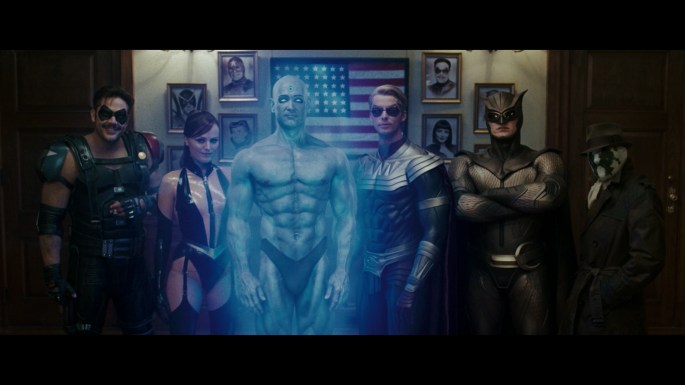
Watchmen-watchmen-13107406-1920-1080

To say the Watchmen film (2009) had a long and checkered production history is a massive understatement. Originally a 12-issue mini-series written by Alan Moore and drawn by Dave Gibbons that was released in 1986, it was a revisionist superhero story about a mysterious assassin killing off costumed superheroes but this is merely a springboard for a brilliant dissection of the genre and comics in general by manipulating symbols and icons. It also addressed the fear of nuclear annihilation that was so prevalent in the 1980’s. The series was a critical and commercial success despite Moore and Gibbons’ intentions for it to act as an epitaph to the superhero genre and ended up revitalizing superhero comics and spawned numerous rip-offs. It wouldn’t take long for Hollywood to come calling.

In 1989, just after he finished making The Adventures of Baron Munchausen, Terry Gilliam was approached to direct a film version of Watchmen by producer Joel Silver. Sam Hamm (Batman) wrote the screenplay, which by all accounts was awful. So, Gilliam discarded this draft and wrote his own with Charles McKeown (his screenwriting partner on Munchausen). Gilliam felt that the mini-series was unfilmable as a traditional two-hour film. The biggest problem lay in the financing. According to Gilliam, Silver said that he had secured a $40 million budget but in actuality he only had about $24-25 million. In 1996, after the success of 12 Monkeys, Gilliam was asked again and turned it down.

Nothing happened with the project for many years until it was announced that screenwriter David Hayter (X-Men) had signed a seven figure deal to adapt Watchmen for the big screen and possibly even direct it for Universal. Larry Gordon, who had long held the rights to Watchmen was going to produce the film. Originally, Hayter pitched Watchmen as a mini-series for HBO but the cost would have been an estimated $100 million. His way to condense the mini-series into a two-hour film was to break down the story points into their main components.

Filming was to being in Prague sometime in 2004; however, the option was picked up in April 2004 with Darren Aronofsky (Black Swan) being named as the director for Revolution Studios. By July, the project had moved over to Paramount when the deal fell through with Revolution. However, by early November 2004, Aronofsky was off the project due to scheduling conflicts with pre-production on The Fountain (2006). Paramount’s insistence on getting Watchmen out in theaters by summer of 2006 forced them to find another director fast. In late November of 2004, they picked Paul Greengrass (The Bourne Supremacy) to direct using Hayter’s script. It did not take long for problems to arise when in April 2005 Paramount was looking to cut the film’s budget by 20% while Greengrass was immersed in pre-production at Pinewood Studios in London, England. One of the reasons cited was the exchange rate of the U.S. dollar to the British pound. However, the studio put the project in the dreaded turnaround (i.e. development hell) in June of the same year because of change of studio heads and the new one felt that the budget for such a risky project was too high.

Finally, in 2005, the film’s producers took the project to Warner Bros. and approached Zack Snyder to direct as they were impressed with his work on 300 (2007), a stylish adaptation of Frank Miller’s graphic novel of the same name. Screenwriter Alex Tse was hired and he took elements from Hayter’s drafts while maintaining the Cold War setting of the comic book. The resulting film polarized critics and was a modest commercial success. Taking his cue from Robert Rodriguez’s adaptation of Sin City (2005), Snyder set out to make a visually faithful adaptation, often recreating certain panels exactly as they were presented in the comic book but ran into trouble when he deviated with his own preoccupations and stylistic flourishes. The end result is a film that is at times brilliantly faithful and also deeply flawed – a mixed bag but also an admirable attempt at an impossible task. The Ultimate Edition version, which fused the director’s cut with the animated short film, Tales of the Black Freighter (a comic book that runs throughout Watchmen, often commenting on the action), is the most complete version of Snyder’s take on the material.

Set during the mid-‘80s amid the nuclear arms race between Russia and the United States, Watchmen begins with two police detectives investigating the mysterious murder of Edward Blake (Jeffrey Dean Morgan) whose alter ego is the costumed superhero known as the Comedian, an amoral mixture of Nick Fury and G. Gordon Liddy. Another costumed vigilante by the name of Rorschach (Jackie Earle Haley) – imagine Travis Bickle mixed with Sam Spade – decides to conduct his own investigation and realizes that the Comedian’s death is only a small fragment of a much larger puzzle. He proceeds to notify the surviving members of the superhero team he belonged to: Dan Dreiberg (Patrick Wlison) a.k.a. Nite Owl, a Batman-esque crusader now retired; Laurie Jupiter (Malin Akerman) a.k.a. Silk Spectre, a beautiful woman pushed into the business by her famous mother, Sally (Carla Gugino), the original Silk Spectre; Adrian Veidt (Matthew Goode) a.k.a. Ozymandias, a billionaire businessman and considered by many to be the smartest man on the planet; and Dr. Manhattan (Billy Crudup), an omnipotent being capable of manipulating matter on a cellular level. As Rorschach’s investigation progresses it appears that someone is trying to eliminate all of his former team members but to what end?

The first indication that director Zach Snyder imposes his trademark style occurs in the prologue when the Comedian is killed by a mysterious assailant. Not only does he drag out the fight, but he also unnecessarily employs his slow motion/speed up technique. However, Snyder makes up for it with a superbly executed opening credits sequence that introduces this world and its alternate history timeline (i.e. the Comedian assassinates President Kennedy on the grassy knoll) while also including all kinds of visual Easter eggs for fans of the comic book (like showing how minor character Dollar Bill died). As a result, there is something for newbies and fans alike.

For everything Snyder gets right – the look and feel of the film, which features some truly astounding production design that completely immerses you in this world – he maddeningly gets other things wrong when he adds bits to scenes that have no purpose except to add a little more action for our ADD culture, like in the scene where Rorschach is discovered by two police officers as he’s searching the Comedian’s apartment. The masked vigilante subdues one of them and disappears before the other can collar him. Why? To show what a badass he is? This is unnecessary as actor Jackie Earle Haley’s excellent performance does that for him.

Another nice addition is the integration of an animated rendition of The Tales of the Black Freighter, a comic book within the graphic novel about the sole survivor (voiced by Gerard Butler) of a shipwreck who desperately tries to make it back home to his family before the pirate ship of book’s title does. Snyder nails the nightmarish Tales from the Crypt vibe of the comic while also restoring the newsstand scenes between the vendor and the kid reading the book, which fleshes out this alternate world.

Snyder makes some blunders with a few of the musical cues, like using “Ride of the Valkyries” in the sequence where Dr. Manhattan slaughters Viet Cong soldiers during the Vietnam War. The director is obviously paying homage to the famous use of the song in Apocalypse Now (1979) but it is unnecessary and too on the nose. However, the most glaring miscue is using “Hallelujah” by Leonard Cohen instead of “You’re My Thrill” as it was in the graphic novel. Do we really need this song played yet again in a film? This song and all versions of it need to be retired from cinema indefinitely.

For the most part the casting is spot on. Patrick Wilson put on weight to portray the slightly out of shape Dan Dreiberg and with his retro haircut and defeated posture certainly looks the part. Wilson gives Dreiberg a slightly sad, pathetic vibe, which suits the character. Billy Crudup nails the eerie detachment of Dr. Manhattan, a god-like being bored with humanity. The actor adopts a neutral tone akin to that of HAL 9000 in 2001: A Space Odyssey (1968). Perhaps the best realized and most faithfully recreated portion of the graphic novel is Dr. Manhattan’s tragic backstory, which also attempts to present his worldview: he perceives the past, present and future simultaneously. Crudup does a nice job of showing the transition of Manhattan from a mild-mannered scientist to omnipotent super being with some eerily uncanny recreations of panels from the graphic novel. We see how Manhattan’s ability to manipulate matter on a cellular level radically changes the course of world history (for example, the U.S. wins the Vietnam War with his help). According to Moore, his aim with Manhattan was to show that he “does not perceive time the same way we do. We have a character who’s post-Einsteinian, who seems to accept that all time is happening at once. Past, present and future. And to him, the past is still there, and the future is there, right now.”

Thankfully, the flashbacks depicting the Comedian’s backstory don’t shy away from his amoral behavior: trying to rape the original Silk Spectre and killing a Vietnamese woman pregnant with his child. Jeffrey Dean Morgan does a fantastic job conveying his character’s skewed worldview: how everything is part of a big, dark joke that only the Comedian gets. In his own way, he realizes that what costumed superheroes do – fighting crime – is ultimately meaningless in the face of nuclear annihilation. The darker and more chaotic things get the more he likes it. Morgan is also able to dig deeper during his tearful late night visitation with an old foe, giving us tantalizing hints at a much, darker and larger scheme at work – the knowledge of which got him killed in the first place.

Easily the strongest performance comes courtesy of Jackie Earle Haley as the sociopathic Rorschach. The most important thing he does is get the voice right. Everyone has their own idea of what he should sound like and Haley got it. Not only does he look great in the costume but also out of it during the portion of the film where he’s unmasked and in prison. The actor is even more chilling as he recounts to a psychiatrist how he became Rorschach and the incident that transformed him permanently into his costumed alter ego. This section of Watchmen offers a glimpse into his disturbing worldview in what is easily the darkest, most bleak part of the film, much like the graphic novel. But again, Snyder imposes his style unnecessarily, adding his own gory flourishes to Rorschach’s showdown with a kidnapper. It is excessive and clumsily executed like something out of a cheap B-horror film whereas the graphic novel was much more horrifying because it left the criminal’s fate to your imagination. Snyder is too busy making Rorschach look cool and failing to realize that in the graphic novel Moore and Gibbons were deconstructing the romantic costumed superhero myth and exploring what motivates someone to dress up and fight crime and how this might warp them. Rorschach wasn’t meant to be a cool character but a depressing, frightening one. His backstory was where, according to Moore, “we actually go for the heart of darkness, we go to the very center of this black, depressing sort of pre-nuclear worldview.”

The most significant miscasting of the film is actress Malin Akerman as Laurie Jupiter. While the attractive actress looks the part, she lacks the acting chops required for the role. Known mostly for romantic comedies, Akerman looks lost in the role, which is unfortunate as it’s the most pivotal part and arguably the most complicated character in the book. Laurie’s relationship with Dan is the emotional center of the story and this is diluted in the film by the casting of Akerman. Carla Gugino, who ironically plays her mother in the film, would’ve actually been better in the role – or, maybe Jennifer Garner who demonstrated a capacity for action and drama in the J.J. Abrams television show Alias.

Another glaring miscast role is that of Matthew Goode as Adrian Veidt. The actor doesn’t look like the character or really act like him either. He’s a little too smug and too over-confident in his portrayal whereas in the graphic novel Veidt was subtly condescending to those around him, coming across as almost distracted, the reasons for which become apparent later on. Snyder has said that he didn’t want to cast recognizable movie stars in the major roles but for Veidt, a celebrity in his own right and by his own making, this would’ve been a wise move. I always thought that Jude Law would’ve been a good choice as he looks the part and showed the capacity to play unlikable characters in films like The Talented Mr. Ripley (1999). Plus, while doing press for Sky Captain and the World of Tomorrow (2004), Law admitted to being a huge fan of the graphic novel and probably would’ve been willing to take a pay cut.

Watchmen perfectly summarizes Snyder’s limitations as a filmmaker. He slavishly recreates panels and sequences from the graphic novel without demonstrating any understanding of what they mean. For example, the climactic scene where Laurie convinces Dr. Manhattan to come back to Earth, that there is more to the universe than random molecules colliding with one another is handled all wrong. In the graphic novel, we find out that Sally loved the Comedian, even after he tried to rape her. The fact that she could feel for a person who committed such a horrible act goes against all logic and that Laurie was the product of their act of love is what convinces the Manhattan to renew his interest in humanity. The film waters this down completely and Sally says that she made a mistake being with the Comedian that one time but that she loves Laurie anyway. Whereas, the graphic novel is a thought-provoking look at human nature and our fascination with costumed superheroes, the film dilutes and tries to make it palatable for a mainstream audience while still trying to appeal to fans of the source material. This schizophrenic attitude is arguably one of the biggest flaws of the film.

Watchmen is a flawed mess of a film – one that gets many things right but also gets a lot of things wrong – but a fascinating one nonetheless. If I’m being overly critical on Snyder it’s only because I love the source material so much that seeing it brought to life in a film was at once exhilarating and depressing. One has to give Snyder credit for making it at all, for using his clout to make sure it was R rated and keeping it set during the ‘80s – two things he went to the mat for with the studio. He made the best possible film one could with the limitations of a feature film format. Ideally, the graphic novel could only truly be done justice in a mini-series format aired on a cable channel like HBO, which would free the filmmakers of the constraints of network television. Watchmen asks many questions but perhaps as Dave Gibbons points out, it really asks the big question: “Who makes the world? Who is responsible for the way the world is? And a lot of it is planned, but a lot of it is just sheer chance. There are patterns, the pattern that we perceive, but there are patterns going on underneath it. And that’s what we tried to show. With these sub, almost subliminal patterns that go through things, echoes, repeating shapes, motifs turning up in unexpected places.” Is the world made of patterns or is it sheer coincidence? The graphic novel expertly examines these questions and offers an entertaining story as well. The film? Not so much.

JONATHAN MOSTOW’S U-571 — A REVIEW BY NICK CLEMENT

u_five_seven_one_ver2_xlg.jpg

Historical inaccuracies notwithstanding, U-571 is excellent in that old-fashioned, paying homage to the classics fashion. If you’re a fan of this well-worn genre, it’s a hard film not to watch when it turns up on cable or one of the HD movie channels. It’s got a fantastic, extremely masculine cast comprising of Matthew McConaughey, Bill Paxton, Harvey Keitel, Jon Bon Jovi, and a host of young hotshots and gruff veterans filling the edges. Confidently directed by journeyman Jonathan Mostow (the terrific Kurt Russell thriller Breakdown, the somewhat ill-advised Terminator 3), the film benefited from a lean screenplay (co-written by Mostow, David Ayer, and Sam Montgomery) that stressed forward moving action with just the right amount of character interplay and human drama. But the filmmakers knew that the star of their modestly scaled but no less thrilling film would be the ship contained in the title, and the numerous action sequences were expertly shot by master cinematographer Oliver Wood (Face/Off, The Bourne Identity) and cut with sharp precision by editor Wayne Wahrman (A Civil Action, I Am Legend). Released in the spring of 2000, the film was a solid box office success and received strong reviews overall, and it’s one of those unpretentious action films that is a perfect rainy Sunday afternoon matinee.


Michael Mann’s Thief: A Review by Nate Hill

image

With Thief, Michael Mann distilled his crime film style into an archetypal, haunting aura that would go on to influence not only his excellent later work, but other filmmakers as well, everything from Refn’s Drive to the police procedural we see on television today. A style that consists of kaleidoscope neon reflections in rain slicked streets, Chrome cars bulleting through restless urban nocturnes and a lyrical, pulsating score, here provided by underrated German electronic maestros Tangerine Dream, who would go on to provide their dulcet tones for Mann’s phenomenal 1983 The Keep. Thief weaves the age old tale of a master safe cracker(James Caan in a beautifully understated performance) the high stakes at risk of him performing one last job to escape, with said stakes represented as his angelic wife (Tuesday Weld) and newborn son. Robert Prosky in his film debut is a serpentine wonder as Leo, Caan’s boss, whose chilling metamorphosis from paternal employer to domineering monster is a joy to watch. The jewel heist scenes are shot with a researched, assured and authentic feel, spurred on by Tangerine Dreams cosmic rhythms and are especially dynamic points of the film. Thief, for me, belongs that special subcategory of Mann’s career along with Heat, Miami Vice and Collateral, (Public Enemies doesn’t get to come in this elite cinematic treehouse club, it didn’t do anything for me) that are very special crime films. They possess an intangible, ethereal quality of colour, metal, music, and shady people moving about a thrumming urban dreamscape, professionals at what they do, cogs in the ticking clock of crime that inexorably drives toward the narrative outcome, be it bitter confrontation and violence (of which Thief has an absolute gorgeous, poetic revenge sequence) or cathartic resolution (like the conventionally satisfying way Collateral ends). Mann has captured neon lightning in a bottle with Thief, and against the odds of people saying you can’t catch lightning twice, he has spark plugged a good portion of his career with that same lightning, creating an artistic aesthetic all his own. To me that is the ultimate outcome of filmmaking, and art as a medium.

Haunted: A Review by Nate Hill

image

Haunted is an atmospheric, valiant yet frustratingly uneven ghost story effort, in the tradition of stuff like The Awakening and The Haunting. If the plot seems close to last year’s Crimson Peak, it’s because it is, and I’d bet that Del Toro had this forgotten entry in mind when he embarked on that journey. I say frustrating because there’s a certain few absolutely terrific moments of gothic horror that truly shiver your timbers, but they’re hopelessly mired in a mucky moor of a plot that unfortunately is not as effective as those key scenes. You David Ash is rough housing around wit his sister in the English countryside when she hits her head on a rock, and drowns in the pond below. He grows up soaked in guilt, dedicated to disproving the existence of paranormal phenomena. As an adult he’s played by Aiden Quinn, who is an average dude with slightly wild looking eyes who is always effective in the sense that he seeks out challenging, odd projects which test his everyday aura nicely. In the early 1900’s he is summoned back to rural Britain by an elderly woman (Anna Massey) who is convinced that she is surrounded by ghosts. He is greeted there by the luminous, attractive Christina (Kate Beckinsale), a friendly young thing with a distinct untrustworthy vibe and a penchant for getting creepy close with her two strange brothers (Anthony Andrews and Alex Lowe). She lives out there in isolation with them as well as their disturbed mother, and one gets the sense right off the bat that something is wonky. I suppose that’s the point though isn’t it? Beckinsale has carved a path of playing either somber, distraught women or tough, silent warrior chicks. This is the most animated work I’ve ever seen from her, and the most radiant she’s ever looked as well. It’s aslso to date the only nude scenes she’s ever put forth, and I don’t use the term lightly… she really bares it all here. The middle portion of the film meanders around with these characters, not revealing enough to push the plot forward enough, until the curtain  is whisked away jarringly in the third act, cementing it’s pacing issues for good. It’s a picturesque enough journey, I just wish we had something to latch onto besides that, some substance and a consistency in the creepiness factor to keep us invested. Alas. It’s got a spookily wonderful beginning, and an electric, full blooded ending, the only two instances where it shows true feeling and commitment. The rest is, well… stale. It’s worth a peek for a few reasons though, including Beckinsale’s solid performance and that one uber-scary scene in the opener.

ROBERT TOWNE’S ASK THE DUST — A REVIEW BY NICK CLEMENT

ask

Back in 2006, the lovely yet sad romantic drama Ask the Dust came and went in theaters after being met with a muted critical response and a noticeable lack of studio publicity, despite a handful of passionate supporters (Ebert, Dargis, and Todd McCarthy most notably), not to mention a starry cast. Written and directed by cinema legend Robert Towne, the film is a honeyed, romanticized version of the 1939 John Fante novel, a clear labor of love and passion project for Towne, who used his clout to tell a uniquely personal story that few others would have likely attempted. I love movies about writers, and that’s what Ask the Dust primarily is – a love letter to the craft of writing and to the passionate spirit that is required to create. If the film is mildly awkward, that’s OK; there’s a traditional quality to the storytelling that feels quaint and old-fashioned, which may not feel modern enough for some viewers. Tremendously evocative of time and place (1930’s Los Angeles), the film was radiantly lensed by master of light Caleb Deschanel (The Natural, The Passion of the Christ, The Right Stuff), and each and every shot is a model of visual perfection, with a quality of light that’s stunning to behold. The Criterion Collection or Twilight Time should be looking into putting out this underrated item on Blu-ray because only a DVD is currently available.

This film was part of that amazing run for Colin Farrell (Alexander, Miami Vice, The New World) and he brought a restless quality to the role of Arturo Bandini, an Italian immigrant who is attempting to write the next great American novel while living in a rundown apartment in Bunker Hill. He unexpectedly falls in love with a Mexican immigrant, Salma Hayek, who has dreams of escaping the only life she knows. Hayek may have been too old for the role, but she brought a passionate sexuality that’s rarely been glimpsed on screen from her. It’s almost as if certain filmmakers have been scared to unleash her full, fiery potential, but in Ask the Dust, Towne got a performance from her that’s full of life and tenacity and zest. I love how Farrell and Hayek throw barbed zingers at each other during their courting process, and when it’s finally time for the two of them to take it to the next level, the inherent drama in the story creates speed-bumps that they don’t see coming. Ask the Dust feels like it HAD to be made by Towne, a movie that clearly was born out of a long-time admiration for the material, and a film that only a Gentlemen of the Cinema could have gotten made. Co-starring a sweaty, disheveled Donald Sutherland, and a pre-infamous Adelle Dazeem, errr, Idina Menzel.


The Killer Inside Me: A Review by Nate Hill

image

Michael Winterbottom’s The Killer Inside Me is one of the most flat out disturbing films ever made under the sun, even if only for a few brief, harrowing sequences encased in a lurid, laconic, southern fried oddity of a story that defies genre confinement while still planting vague roots in crime drama. When the sequences I speak of show up, and you’ll know exactly when, it takes you right off guard and immediately notifies you that the film has no intentions of towing a line within anyone’s comfort zone. It’s an odd story for someone to strive to tell, and one wonders what inky black corners of the psyche that Jim Thompson was spellunking in when he scribed the novel on which this is based. It starts off conventionally enough, under the prosperous sun of the West Texas desert in the heat of the 1950’s. Sheriff’s Deputy Lou Ford (Casey Affleck) is a regular enough guy, tasked with rousing a local prostitute (Jessica Alba) living in nearby suburbia. He also deals with the dodgy real estate kingpin  Chester Conway (a blustery Ned Beatty) and his cronies. He’s also got a cute fiance (Kate Hudson). He’s calm, cool and connected, right up until the part where he turns out to be a certifiable grade murdering psychopath. Affleck let’s the authoritarian composure bleed away and reveal the layers of eveil beneath, until we begin to wonder if the film we are watching has been interrupted by someone taping over it with something far darker. But no… it’s the same movie. It just veers into territory we didn’t expect and may be taken aback by. Affleck discovers the psychopath within himself, and fits inside the characteristics like a glove. The first person to stray into his path is Alba, and there’s a sequence where he gives her a royal, merciless, and bloody beatdown that will shiver your spine in its blunt, head-on realism. It’s seriously stomach churning shit, and levels off both the film and Affleck’s role in pure stone cold seriousness. He’s a budding lunatic, made all the more dangerous by bis position of power within law enforcement and shielded by his trustworthy reputation. The film resists generic story beats, and instead meanders about, diligently following Affleck from encounter to macabre encounter, discovering his dark interior nature without much rhyme or reason as far as conventional plot goes. This has a wickedly prolific cast for such a risky film, with fine work from Bill Pullman, Brent Briscoe, Tom Bower, Simon Baker and the ever reliable Elias Koteas who adds to the cumulative unease. It’s Affleck’s  shown though, and he splinters nerves with his unpredictable, hollow and fascinating portrait of a psychopath. Soon we begin to wonder what he sees and heats is real,   as characters he interacts with seem to come back from the dead and knowingly coach him towards trouble in trademark indications of serious mental distrbance. This one arrives at it’s end severely south of where it started from, taking the viewer off guard. Those who appreciate the tantalizing, prickly nature of a thriller that isn’t afraid to seriously shake up your shit and take you places you’ve only been to on clammy nightmares will appreciate it. Just mentally psych yourself up for that scene I mentioned, because it will scar you and then some.