JOEL EDGERTON’S THE GIFT — A REVIEW BY NICK CLEMENT

1

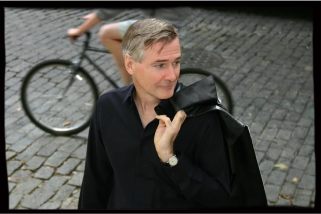
The Gift is a diabolical thriller, less interested in blood and gore, and more interested in mental mind games. Skillfully written and tightly directed by co-star Joel Edgerton (he loves slipping into any role thrown at him, similar to Tom Hardy, but with half the hype), the less you know about this nifty and nasty sort-of-stalker-film the better. Much has been made in the media about the twist ending, and yes, the final act has a couple zigs and zags, with the final one worthy of Hitchcock/Fincher; I did my best to avoid having them spoiled and I’m extremely pleased that I did. If you’ve done the same, then this movie should work you over like a cheap date. Jason Bateman and Rebecca Hall are both very good in somewhat tricky roles, because, as with Edgerton’s sly performance, it’s all about what’s not being said as much as it’s about explicit action. Stylishly if unselfconsciously lensed by the underrated cinematographer Eduard Grau (A Single Man, Buried), The Gift has a sleek and sexy veneer that slowly slips away to quiet, casual menace. And without ever going over the top and sticking to the brass tacks involved on a story level, Edgerton never paints himself into a corner he can’t get out of; he sticks the landing, which for this type of film, is very important. This is a very solid genre entry, and a movie that will certainly have a long shelf life, especially with unsuspecting viewers. And it must be said – TOTALLY screwed up series of final events in this movie! *NO SPOILERS!!*


ADAM MCKAY’S THE BIG SHORT — A REVIEW BY NICK CLEMENT

1

With stunning clarity considering the density of the material and the tendency for excessive jargon, Adam McKay’s phenomenally entertaining dramatization of the 2008 financial collapse shouldn’t be entertaining but it is. All kidding aside, this is a massively fucked up film that details how a group of people got extremely rich while so many were going totally bust, but because of McKay’s zesty filmmaking style, the narrative never gets bogged down in hard to understand plotting or surrounded by characters who we can’t relate too. This is an ensemble in the truest sense of the word, with each major actor doing excellent and generous work, with each performance feeding into the next, which helps to create a full blown tapestry of men pushed to their limits. Christian Bale is low-key awesome here, totally introverted as a genius money man, getting the chance for a number of quietly stellar moments. Steve Carrell is the angry conscience of the piece, representing the frustrations of the common person while also seeing the inner workings of a corrupt system, and after his brilliant work in Foxcatcher, represents another dramatic homerun for him as a dramatic actor. Ryan Gosling is the amoral trickster, and he’s pure energy and comic fizz, getting the film’s single biggest laugh during a small tour de force sequence inside of a men’s room, and Brad Pitt steals a few scenes as the sagacious insider who has become an outsider. All of the familiar faces in the deep supporting cast are terrific, and everyone is used to maximum effect via the long lens cinematography by Barry Ackroyd (United 93, The Wind that Shakes the Barley), who brings his customarily jittery shooting style to the proceedings, always searching and grasping for off the cuff moments, which appropriately sets the tense mood. When combined with the judicious and extremely sharp editing by Hank Corwin, it’s no surprise that the film keeps the pace of a rushing locomotive, yet never at the expense of coherence or intelligence. The numerous instances of the breaking of the fourth wall are smart and well timed, hilariously using real life celebrities in an effort to help the audience better understand some of the more shadowy and arcane bits of information. McKay has taken a HUGE step up with this film as a storyteller and filmmaker, after repeatedly proving to be one of the best directors of studio comedies over the last 15 years (his blockbuster resume includes Anchorman, Talladega Nights, Step Brothers, and The Other Guys). This is his crowning achievement thus far, a piece of topical entertainment that is as enraged as it is playful. It’s one of the best films of 2015. And last but certainly not least, massive Tracy Letts POWER.


Lawrence of Arabia – A Review by Josh Hains

I have been blown away many a time by many a film, though as time passes by at breakneck speed, so few are able to blow me away time and time again in repeated viewings. Lawrence of Arabia is one of those few. While David Lean’s glorious masterpiece (a word I do not toss around often) is not my favourite film, it does sit high upon a pedestal of the greatest films I have ever seen. I can not think of another film of equal or greater length that has managed to sustain my interest as consistently as Lawrence of Arabia does in its nearly 4 hour runtime. Much of what keeps me entertained does not have to do with the plot, the score, or most of the supporting performances, but rather, that eccentric leading performance from the late Peter O’Toole, as T.E. Lawrence, and that absolutely gorgeous cinematography.

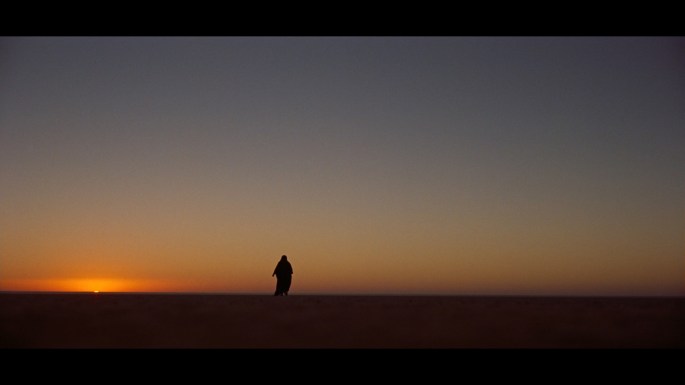
The first time I saw the film, I was completely hooked by the time Sherif Ali makes his grand entrance, initially appearing as nothing more than a speck on the screen, before slowly materializing into a full blooded, and violent figure. I can not think of too many other films that dedicated that much time and effort to introduce a character. I do not think I can name another film that took the time to showcase the rising of a bright orange sun that fills the sky with its warm glow as gracefully as Lawrence of Arabia did. Nor can I think of such a magnetic, yet eccentric and carefree performance as the one Peter O’Toole delivers. Whether he is uttering blunt thoughts or speaking through his eyes, his Lawrence chews up every scene with a delightful cheekiness, spontaneity, and flamboyance. You can hardly take your eyes off him for even a second as he completely dominates every scene he is featured in. At the end of the day when all the dust settles, when I find myself reflecting upon this magnificent work, I am always quietly moved by every single frame of this gorgeous film. I can not find a single visual flaw, a singular moment that sticks out as odd or misplaced or weird. Every frame blends together splendidly, coherently, and perfectly. Lawrence of Arabia, with such a wide visual scope and a story of truly epic proportions, is one of those rare films that makes you feel as small and insignificant as an ant. To see Lawrence in his ceremonial garments, a small silhouetted figure standing against an enormous sky, is to be reminded of how enormous our world really is, and just how beautiful this film truly is.

I honestly believe that the best kinds of films invite you into their worlds, captivate your heart, mind, and soul, and in doing so, help provide you with an escape from the hardships of your life, if only for a couple of hours. The greatest films one can ever watch not only do that, but are of such marvellous quality, one often finds themselves wishing they would never end and that you could continue the journey for hours more. Lawrence of Arabia is one of the finest examples of this ideal, a true cinematic gem. What a wonderful experience.

PETER STRICKLAND’S THE DUKE OF BURGUNDY — A REVIEW BY NICK CLEMENT

2.jpg

Methodical, erotic, and exquisitely photographed and edited, The Duke of Burgundy is one of the more memorable films from 2015, a piece of work that’s in love with the very foundations of cinema and the endlessly possible ways that the moving image can transport the viewer to a richly atmospheric and highly seductive world. A romance, a thriller, a psychological horror story, and above all, a strangely sexy exploration of mental and physical domination, there isn’t a shred of nudity in this hot-blooded independent film, but that doesn’t matter; your pulse will race just from the sight of a person touching another’s leg. Writer/director Peter Strickland has made a film that Brian De Palma would and should be envious of; you feel the stylized filmmaking in this intoxicating and highly artsy effort right from the start, much in the same way that a De Palma film traffics in self-reflexivity and heightened stylistic flourishes. The Duke of Burgundy moves at a purposefully slow pace, inviting the audience into its esoteric and enigmatic playing field, where you observe the back and forth between two very particular women, and how they use sex, lust, power, and potentially love, in an effort to one up each other emotionally and mentally. Chiara D’Anna and Sidse Babett Knudsen are both spellbinding in this film; you literally can’t take your eyes off either of them, if not out of wonder about what they’ll do next, but rather, they’re just so strikingly photogenic in very unique and unexpected ways. The costumes and lingerie featured in this film are also major strengths; the undergarment supervisor is even given an on screen credit which is something I’m not sure I’ve ever noticed before! The entomology subplot puts things into thematic context while allowing Strickland some amazing opportunities for impressionistic filmmaking, while the entire film feels wholly unique in and of itself; there’s very little that I can think of that this film compares too. While not likely for everyone, this is one of those amazing pieces of dreamy and velvety storytelling that will produce a charge out of patient and artistically inclined viewers. The film also features an unsettling and nervy musical score, one that raises the tension levels while still hitting some lovely, romantic beats of sophistication. Available to stream via Netflix and also available on Blu-Ray and DVD.


PTS Presents WRITER’S WORKSHOP with JOHN PATRICK SHANLEY

JPS POWECAST

5beaee3a-69a9-4b9d-9d72-3d9c6a142ff0Podcasting Them Softly is thrilled to present a discussion with the phenomenally talented playwright, screenwriter and filmmaker John Patrick Shanley. An Oscar winner for his MOONSTRUCK screenplay, John has a list of incredible big screen credits which include the Andes mountain plane crash drama ALIVE, the hilarious and offbeat cult classic JOE VERSUS THE VOLCANO, which he also directed, and the 2008 feature film version of his Pulitzer and Tony award winning dramatic play DOUBT, which he also directed, and which starred Meryl Streep, Viola Davis, Philip Seymour Hoffman, and Amy Adams. An NYU graduate, John has written over 20 plays, he’s worked in television, notably on the HBO war drama LIVE FROM BAGHDAD, and has even dabbled in the opera, with a version of DOUBT put on by the Minnesota Opera in 2013. His most recent endeavor on Broadway was the limited engagement of his original play OUTSIDE MULLINGAR, which looked at life on an Irish country farm, and which received a Tony and a Drama Desk nomination for Outstanding Play. It was a real honor to be joined by someone of this magnitude, and we hope you enjoy listening to this fascinating and passionate discussion!

Room: A review by Nate Hill

It’s hard for me to fully express the staggering impression that Room left on me using only the written word, but I’ll have a go at it anyway. First I’ll say that it’s hands down my favourite film of the year thus far, and I left the theatre with many emotions swelling in me, affected in a way the only a small group of films have been able do for me. It’s a patient, mature study in psychology and a sweeping symphony of complicated emotions revolving around a terrible, tragic situation that seems like a well of hurt and pain until in climbs it’s way out into a tenderly heartfelt, incredibly life affirming resolution that never dips into half assed melodrama and feels earned and appropriate. The film casts such a powerful spell that it briefly changed the concept of time for me; Upon arriving near the end, I felt as if years had actually passed for me in theatre since I embarked on the film’s journey. The camera, script and actors kept me so intimately close to the characters for the duration of the piece and made me love and care for them so much that it brought me right into their timeline with an intimacy that rarely happens for me in cinema. Now on to the actors. What brave, compelling work from every single performer on screen, right down to the bit parts. Every role castes with a sharp eye for detail and reverent contemplation of who is right for what, creating a roster of heavy hitters and up and comers to be reckoned with. Brie Larson gives a beyond award worthy turn as Joy, a girl who was kidnapped at a young age and held captive by a horrible man (Sean Bridgers, displaying smouldering volatility in terrifying proportions) who impregnates her. She raises the child in the dour, tiny garden shed he keeps her in. Faced with the unthinkable task of creating a nurturing environment for her little one, she tells him that the shed is ‘Room’, their kingdom, and that the people he sees on their little TV are fake, imparting that they and their captor are the only real ones and there is no outside world. This reminds just how mouldable our minds are when we are small, and the film beautifully explores the psychological ramifications of how we raise our young, how nature vs. nurture comes into play in startling ways during the darkest of times, and the decisions we are forced to make on our own to ensure that our children are safe, even when things have gone beyond wrong, as they have for the poor girl. Old Nick, as she nicknames their captor, rapes her every few days, and treats the two of them like animals. Her son Jack reaches an age where escape becomes vital in his mothers eyes, and she takes her chance, orchestrating a harebrained ditch effort to break free, which is my favourite sequence of the film. It’s also one of the most tension filled, seat gripping scenes I’ve ever seen, as the character buildup has set our personal stakes epically high, which co,vines with the excellent set up makes for a clammy nightmare of an escape. The director makes the fascinating choice not to us any music at all until they reach freedom, which I noted. As soon as they are out, I let out a cathartic, audible sigh of relief, as the dank hell they undeservedly spent almost a decade in gives way to a vibrant, strange new world for little Jack. The camera takes his perspective and pores over every aspect of the outside realm with the patience and curiosity it takes to place us in his psyche, a child viewing the world in its entirety and true form for the very first time, essentially a second birth, a theme which the film handles marvellously. I must speak about Jacob Tremblay, a Vancouver native who plays Jack and gives the most soul wrenching performance I’ve ever seen from a child actor. The levels of sheer intuition and innocent truth he infuses in his work at such a young age are just unbelievable, and he should be in the riding for Oscar gold as well. Larson and him have uncanny chemistry, the love shown in the early scenes a blooming Rose of hope that fends off the looming darkness they dwell in, which is tested by the inevitable complications they face upon entering the real world once again. Larson burst onto the scene with 21 Jump Street and Don Jon, fun but inconsequential fluff. Here she shows us that she means business, and wants to tell stories that are important, and show audiences what it means to be human through her work. I look forward to where this extraordinary girl takes us in her next cinematic journey. Joan Allen makes subtly heartbreaking work as Joy’s mother, William H. Macy is briefly present as her Dad, Tom McCamus makes compassionate work of her stepdad and like I said, everyone else is superb, right down to the day players. I was crippled by emotion and raw with nerve jangling suspense after this one, exiting the theatre soaring on the high I eternally strive for in my cinematic adventures. The fact that only one theatre in Vancouver is playing this one is an affront to the universe. Get down to Tinseltown and see this one before it’s gone. You’ll thank me.  

GREGORY JACOBS’ MAGIC MIKE XXL — A REVIEW BY NICK CLEMENT

3

Gregory Jacobs’ Magic Mike XXL is a hoot and a holler, and a total 180 from the original, far more ambitious film, which I legitimately feel is great, subversive cinema. With Steven Soderbergh handling the cinematography and editing (under his usual pseudonyms of Peter Andrews and Mary Ann Bernard, of course), the entire tech package of Magic Mike XXL is super-slick and extremely thoughtful on an aesthetic level; there are some dynamic shots, either because of the camera movements or the still placement of the camera, and the editing has a pleasant hum that allows for an easy-going time. The script is nowhere near as interesting as the first film, but it’s really no less entertaining; this is the male stripper movie for those who felt that there wasn’t enough stripping and saucy shenanigans in Magic Mike. Whereas Soderbergh clearly wanted to subvert expectations with his surprise 2012 blockbuster, here, the vibrant looking sequel is more interested in having fun with a capital F, with a general party atmosphere firmly set in place right from the start.

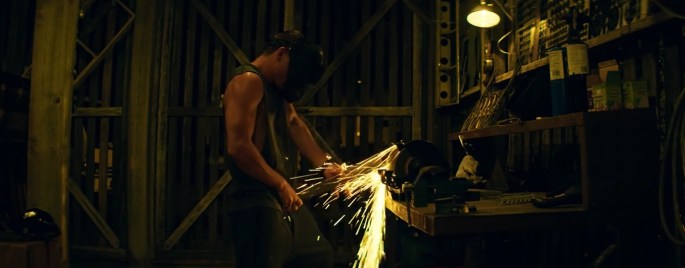
Gone are any discussions of bank loans and start-up capital in favor of a more jocular, rambunctious tone. Channing Tatum is back as our entry point into this wild and wooly world of male entertainment, with most of the original film’s supporting cast making return appearances (notably absent is Matthew McConaughey). The ultra charismatic Joe Manganiello has a terrifically funny scene inside of a gas station convenience store, Twitch from So You Think You Can Dance shows up for some sexy dance routines, and I loved the Cougar Party with Andie MacDowell (she’s looking very fine…!) Also, the extra hot if too skinny Amber Heard shows up for some fun, Jada Pinkett Smith nails her scenes with authority, and the lovely Elizabeth Banks is a stunner in her extra-tight body suit during the protracted and highly spirited finale. There’s a level of innocent cheesiness to the entire thing that helps to make it all very non-threatening and harmlessly enjoyable, and even if it’s not up to the overall brilliance of the original (how could it be?), there’s plenty here to keep you satisfied. And here’s a final thought — now that we’ve gotten TWO high-profile male stripper movies from a major Hollywood studio, how’s about we get Magic Michelle?

JJ ABRAMS’ SUPER 8 — A REVIEW BY NICK CLEMENT

1

Out of all the movies directed by JJ Abrams, that I’ve seen, Super 8 is easily the best. It’s a spot-on and misty-eyed evocation of late 70’s/early 80’s BEARD POWER with nods to countless genre staples. It feels like the ultimate lost Amblin film. Terrific cinematography with an obscenely awesome amount of lens flare POWER, great production design, and energetic and at times exhilarating musical score, and engaging performances from all the kids. It’s not a perfect movie but it’s immediately engrossing, and by the end, completely satisfying. The father-son component was a huge reason for this film’s success as a piece of emotional storytelling; this is the sort of CGI/monster movie I want to see, a film where the need for special effects is born out of the story and the characters and not used as a crutch or for cheap gags. As always, Abrams directs in his awe-shucks style of intensity, making smart creative choices and allowing his innate understanding of entertainment to rule the day. The list of movies that are either visually or thematically referenced in Super 8 is totally wild: Close Encounters of the Third Kind, The Explorers, Poltergeist, The Goonies, The Monster Squad. Gremlins, and E.T., to name only a few and off the top of my head. And yet somehow, the movie feels all its own. And it must be mentioned again — there’s an astonishing amount of lens flares in this movie, which always makes me smile. Kyle Chandler totally owned all of his scenes, bring gravitas and sensitivity to his role as the beleaguered father figure, and as usual, Elle Fanning showed why she’s one of the best talents of her generation. This is an underrated blockbuster and one that’s worth revisiting or catching up with if you initially missed it.

A chat with Actor Wayne Duvall: An interview by Nate Hill

Excited to bring you my latest interview, with actor Wayne Duvall. Wayne has made awesome appearances in many films including O Brother Where Art Thou?, Denis Villeneuve’s Prisoners, Pride And Glory, Lincoln, Apollo 13, Edge Of Darkness, Duplicity, In The Valley Of Elah, Evolution, Hard Rain, Tony Scott’s The Fan, Baja, Disclosure, Falling Down and more. He’s also done stellar work in many TV shows including Fargo, Macguyver, Gotham, HBO’s The Leftovers, Elementary, He’ll On Wheels, Boardwalk Empire, Hawaii Five-0, The Good Wife, Law & Order: SVU, CSI, The West Wing and done voice work for video games including Max Payne 3 and Hitman: Blood Money. Enjoy!

Nate:What led you to acting? Was it something you always knew you wanted to do, or did it take you by surprise?
Wayne: When I was 5 years old I found out that I had a cousin who was a professional actor. I couldn’t believe that was a job. It just didn’t compute for me. My cousin’s mom used to call us when he was going to be on. We would gather around the TV and watch him. The shows were Combat!, The FBI, The Defenders. It was so cool. I knew that was what I wanted to do. Oh, my cousin, he did pretty well……Robert Duvall.
Nate: Some favourite actors/filmmakers/films who have inspired your work?

Wayne: The big influence was cousin Bobby. Others who inspire me for there truth are Sean Penn, Oscar Isaac, Gary Oldman, Kate Blanchett, Robin Wright. Directors Steven Spielberg, David Fincher, Paul Haggis, George Clooney and most definitely The Coen Brothers. There are many others but these are the ones off the top of my head.
Nate: O Brother Where Art Thou: How Wayne experience for you working on that film, alongside the Coen Brothers, and creating that memorable Homer Stokes?

Wayne: That was a magical experience. My first day was the big scene where I get carried out on a rail. Every star was there that day and the main part was me! This was my biggest film part to date and I just remember thinking, “you can’t play it safe”. So I just jumped. I was so supported by everyone. The Coens were fantastic. I was very fortunate to have that as my first big gig.
Nate: Prisoners: Your experience on that film? Working with director Denis Villeneuve? Are you a fan of the film?

Wayne: I’m a huge fan of Prisoners! Denis was amazing as was Jake Gyllenhaal, who I definitely add to the list of influential actors. Denis let’s you improvise and it was so freeing. Jake is a master and will go down as one of the best we have. He’s so grounded in truth. He’s a master craftsman. Working with both Denis and Jake was such a wonderful experience
Nate: Some of your favourite characters you have played in your career so far?

Wayne: Homer Stokes was obviously a fav. I loved playing the Coach in Leatherheads. Lovably dim. That movie was a blast! Clooney is an amazing director. I just played a fun character in the movie Wolves coming out next year. It stars Michael Shannon and Carla Gugino. I played a basketball coach which was a dream role for me. The first 20 years of my life was more focused on playing basketball than anything else. It was so much fun taking that knowledge and using it in my current work. I been fortunate to have played some wonderful characters.
Nate: Do you enjoy doing voice work? How does it compare to live action film?

Wayne: The voice work I do is mostly for commercials. It’s fairly easy and is done mostly for the money. I’ve not done any animated films which I would love to get into. I’ve heard they are a blast.
Nate: Pride And Glory: A very underrated little cop thriller and one of my favourite films you have been in. How was that experience for you?

Wayne: Pride and Glory was great fun, but sadly a lot of my favorite stuff got cut. Gavin O’Connor is one of those uber talented artists who believes in collaboration. One of my favorite moments was when he felt a scene he wrote for Jon Voight and I wasn’t good enough and asked Jon and I to go off and see if we could come up with something. So there I am at about 2am on a Queens Street with the legendary Jon Voight, improv-ing a scene. It didn’t make it in. Jon and I had a whole story line of being good friends that was cut from the film. It was a good decision on Gavin’s part. It wasn’t needed. Loved that film.

Nate: I noticed your credits are all acting. Have you ever considered writing or directing your own material at all? Branching out?

Wayne: I’ve tried writing and it’s just too frustrating. I’m pretty good with characters and dialogue, but that whole plot thing keeps getting in the way. Directing is something I think I’d like to try. Thankfully, acting has been keeping me busy. Maybe one day. i wouldn’t want to direct and star in something that would be too much for me.

Nate: Thank you so much for chatting and for your time Wayne! Keep up the incredible work!
KIMBERLY PEIRCE’S STOP-LOSS — A REVIEW BY NICK CLEMENT

1

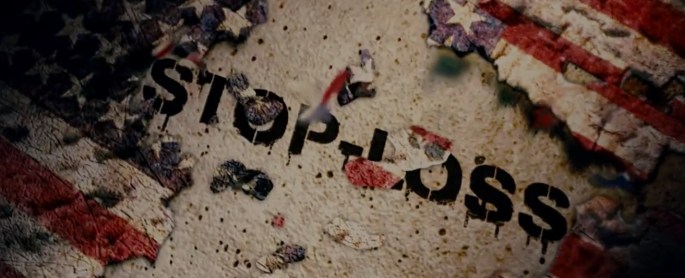
With the exception of one effort, movies about the Iraq war have all faced an uphill battle with American audiences. Continually, it seems that ticket buyers are disinterested in seeing anything remotely resembling real life, featuring performances that are honest and true, and that look to illuminate on topical situations that are important to our societal landscape. For way too many people, it’s all about CGI trickery, franchises, and sequels, and they don’t want to know about anything else. I’ve grown increasingly disinterested in movies that resemble video games, and have been exploring older films and other titles that have slipped through the cracks. A few nights ago while on diaper duty with my infant son, I was surfing the movie channels, and I happened upon Kimberly Peirce’s searing and wildly underrated drama Stop-Loss, which is easily one of the finest contemporary war movies from the past decade, an ambitious work that might have bit off a tad more than it had time to chew (I’ve always wondered if a director’s cut was lurking somewhere…?), but a film that covers intense, hugely emotional material, all centering on a subject that is as enraging as it is frustratingly understandable. This blistering film died an undeserved death at the box office despite mostly positive critical notices, but too often, it seems as if people enjoy ignoring what’s going on around them when it comes to their choices in entertainment. This film simultaneously operates as a tribute to our men and women who put themselves in harm’s way on the battlefield, while also acting as a scathing critique of military policy. That Peirce is able to juggle multiple story strands within a very intimate framework is a further reminder of her excellent filmmaking and storytelling abilities. This was her first film in almost a decade since she burst on the indie scene with the uncompromisingly raw Boys Don’t Cry, and she’d follow up Stop-Loss with her updating of the classic horror entry Carrie; I hope she’s back with a new project very soon on the big screen.
2
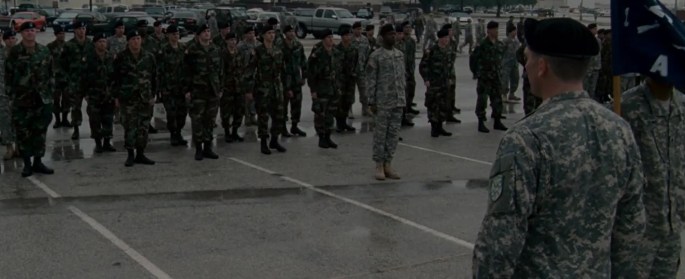
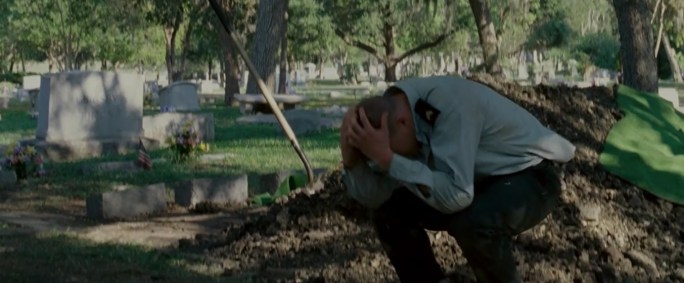
Stop-Loss begins with an intense battle sequence set in Tikrit. A unit of American soldiers led by Brandon King (Ryan Phillippe, never better) chase their enemy into an alley. His squad, made up of two friends from back home and a group of other young soldiers, are ambushed. A few men are killed, some are horribly injured, and all are deeply affected by what they see and what they have to do. This incredibly visceral sequence of action, shot vividly by the phenomenal cinematographer Chris Menges (The Killing Fields, The Three Burials of Melquiades Estrada) and expertly cut by editor Claire Simpson (The Constant Gardener), is scary and relentless. It’s also necessarily bloody and violent; by immediately thrusting the audience into battle without knowing anything about our characters, the viewer is catapulted into this world without warning. Brandon leads his men eventually to safety and we cut to their homecoming in Brazos, Texas where King and soldiers Tommy Burgess (the excellent Joseph-Gordon Levitt) and Steve Shriver (a brooding Channing Tatum) call home. Peirce and her co-writer Mark Richard effectively set the scene once the men arrive back home, with their narrative recalling some beats from Hal Ashby’s Oscar winning Vietnam war drama Coming Home. All of them are hard drinkers, and are not without their own sets of personal issues which stem from before they left for Iraq. Needless to say, the men all have trouble adjusting to life back in the states. Tommy is an alcoholic who can’t control his marriage and Steve is suffering from a serious case of post-traumatic stress syndrome (he’s seen digging fox holes in his front yard, in one of the film’s most harrowing moments, because that’s the only place he can comfortably fall asleep).

But Brandon has a bigger problem. Not home more than a few days, he gets the word that he’s been “stop-lossed” by the military. Considered an important and valuable soldier by his superiors, he’s ordered to go back to Iraq for another tour, despite having served two tours already. It’s in his standard issue military contract but the option isn’t executed for every soldier; this is an at-random thing. Naturally, Brandon objects, as he doesn’t feel it’s fair to send him back to fight, especially now that his opinion of the war has drastically changed. Peirce and Richard’s story stings of authenticity and I’m not surprised; her step-brother signed up to fight for America as a direct result of 9/11, so I’m assuming that some of this material had to have been culled from his experiences. The men in Stop-Loss come from military families and are all cut from the same patriotic cloth. Fighting for their country is as natural of a decision as brushing their teeth. But Brandon feels that enough is enough. He goes AWOL and hatches a plan to drive to Washington to confront a Senator that welcomed him upon his arrival home. Steve’s girlfriend Michelle, the Australian actress Abbie Cornish (gorgeous and extremely sympathetic), has been life-long friends with Brandon, and agrees to accompany him on his trip. Stop-Loss then takes the form of a road-movie for its middle section, where we’re shown what life is like for an AWOL soldier. Brandon runs into some other AWOL soldiers, who tell him of their life on the run from their superiors, and he’s told stories of a mysterious guy in Manhattan who for $1000 can arrange for safe passage to Canada. Only snag — you’re never able to come back to America.
3
Peirce and her creative team also spike the film with cut-ins of the soldier’s experience. Taking the form of personal videos shot during combat and personal downtime, these interludes enrich the story with a sense of the personal and a sense of the dangerous. Peirce uses this technique to heighten the scenes set in Iraq, and as a way of bringing the war back into focus during the road-trip sequences. Cinematographer Menges and Peirce use multiple film stocks and a lot of hand-held camera to ratchet up the intensity all throughout the film. It’s a visually dynamic piece of filmmaking that constantly surprises on a formal level even during the simplest of scenes. During the opening fire-fight, Peirce and Menges‘ camera covers the action in interesting ways that you haven’t quite seen before. The performances are uniformly excellent. Phillippe was fantastic in the lead role, bring conviction and determination to the part of a man at odds with himself and pretty much everyone around him. Because of his good looks, he’s been an undervalued dramatic actor; see his work in Crash, Flags of Our Fathers, and Breach as more examples of his abilities. But his performance in Stop-Loss should be considered a revelation for him as an artist. Sure, he’s still buff and camera-ready, but there was a somber, soulful quality in his performance that’s hard to shake. One scene, in which he’s attacked by some local drunks outside of a bar, is unflinchingly intense; the battle scars he received in Iraq come back to haunt him in a major way. Tatum, who burst on the scene in the indie A Guide to Recognizing Your Saints before recently becoming a mega-star thanks to Magic Mike and the 21 Jump Street series, was also very effective in his role as Brandon’s best friend and severely traumatized soldier. Late in the film, Brandon and Steve get into a physical confrontation that was startling in its believability and sadness. And Gordon-Levitt, who at the time was hot off the success of the ultra-stylized indie Brick, struck all the proper notes as a deeply troubled young man who simply cannot get his personal life in order. This is a big, sprawling, purposefully messy, extraordinarily heartfelt film, one that did not deserve to wither on the vine at the box office. When a filmmaker like Peirce delivers an honest, smart, and entertaining film that’s important to our national conversation, what’s to be said about the lack of interest on the part of our fellow citizens?