Quentin Tarantino’s THE HATEFUL EIGHT – A Review by Frank Mengarelli

Quentin Tarantino’s eighth film, THE HATEFUL EIGHT, came out at a hostile time in contemporary America. Tarantino joined marching protests against police violence; then the overly sensitive millennial online “journalists” chastised the film, and Tarantino, for painting shades of misogyny and racism. Tarantino was unfairly attacked by the extreme wings of each political party. Had no one paid attention to Tarantino films prior? Of course racism and misogyny plays a vital part in this film, because not only did those elements exist in the post-Civil War 1800’s, but also exist in reality.

Hateful Madsen

This film is a cataclysm of Tarantino’s self-indulgence. He constantly references his prior works (mainly RESERVOIR DOGS) while homaging Sergio Leone, Billy Wilder, and John Carpenter. His limited casting is formed of new Tarantino players: Kurt Russell, Walton Goggins, and Bruce Dern who Tarantino has worked with twice prior; as well as his seminal ensemble made up of Samuel L. Jackson, Zoe Bell, James Parks, Tim Roth, and Michael Madsen. Joining the Tarantino crew for the first time is Jennifer Jason Leigh, Demian Bichir, and Channing Tatum.

For as visionary as Robert Richardson’s cinematography is and Ennio Morricone’s Academy Award winning hypnotic score, the greatness of this film lies within one of Tarantino’s best screenplays and one of the best acting ensembles since GLENGARRY GLEN ROSS. Tarantino is one of the most talented actor’s directors who has ever sat behind the camera. He carefully crafts each character with an actor in mind, playing on their strengths and bringing out untapped potential from even the most veteran actor he’s working with. The cast is absolutely brilliant.

Hateful.jpg

Kurt Russell does the best John Wayne impression ever as the hard barked simpleton whose stupidity is even more outrageous than his facial hair. Russell is always a joy to watch, and Tarantino’s use of him are highlights in an already legendary career. Samuel L. Jackson is one of the best linguists to ever grace the screen. Tarantino’s dialogue has never sounded better than coming out of Jackson’s mouth (aside from Harvey Keitel). Tim Roth gives one of his best performances delivering an English shtick of Mr. Orange from RESERVOIR DOGS. Perhaps the most surprisingly great performance in this film is that of Michael Madsen playing a caricature of himself. I can’t say anything more about Jennifer Jason Leigh that hasn’t already been said. She should have won the Oscar.

Tarantino outdoes himself with THE HATEFUL EIGHT; the script is outrageously funny, giving these talented actors so much to play with. Only Quentin Tarantino would be able to craft an epic western built upon heightened paranoia that is three hours long, set inside a tiny cabin that is filled with eight larger than life characters, filmed with a wide angle lens that is constantly on the move. Tarantino has reached Terrence Malick status by making films for himself, not for an audience, or a demographic, and that’s what he has excelled since GRINDHOUSE. No one loves movies more than Quentin Tarantino. Oh, and about that overt racism in this film, did those people not stay until the end?

Hateful ending.jpg

James Foley’s AFTER DARK MY SWEET – A Review by Frank Mengarelli

Original Cinema Quad Poster - Movie Film Posters

James Foley is master of deception, blurred lines, and skeevy noir. AFTER DARK, MY SWEET is a taut and mischievous opus. Jason Patrick gives his finest performance as a mysterious and unstable drifter who crosses paths with Rachel Ward as the sexy femme fatale, and the always superb Bruce Dern who is as sleazy as ever with his mustache, floppy hair, and aviators/Hawaiian shirt/Members Only jacket combination that shows us all we need to know about his character without him having to say anything.

ADMS Patrick

The double, triple, and quadruple crosses that build in this film keep us unsure of how exactly this story of lies and desire will unfold; yet however the plot unravels, it is not going to end well for anyone. Jason Patrick is electrifying as a mentally and physically unstable former boxer who drifts into the wrong place at the wrong time, slowly being groomed by Ward who has a penchant for alcohol, cigarettes, and sexual control.

ADMS Dern

Bruce Dern is the smooth talking man with the devious plan, giving one of his finest performances. Dern has recently been reawakened with NEBRASKA and Quentin Tarantino’s use of him in THE HATEFUL EIGHT and DJANGO UNCHAINED. He remains one of the most underrated and undervalued actors of all time. He is able to blend together sleaziness, affability, and menace all at once in such a way that it is amazing to watch.

ADMS Ward

Foley’s strategically slow camera pans, David Brisbin’s production design, costumes by Hope Hanafin – all these elements are masterclass and create a world of dilapidation and deception. The environment of this film is carefully crafted, and the details of the visuals are so grabbing that you can smell the cigarette smoke and taste the cheap wine. AFTER DARK, MY SWEET is one of those films that anchors itself as not only a staple transition from the 1980’s into the 90’s, but also a one of the best erotic noirs that has ever been made.

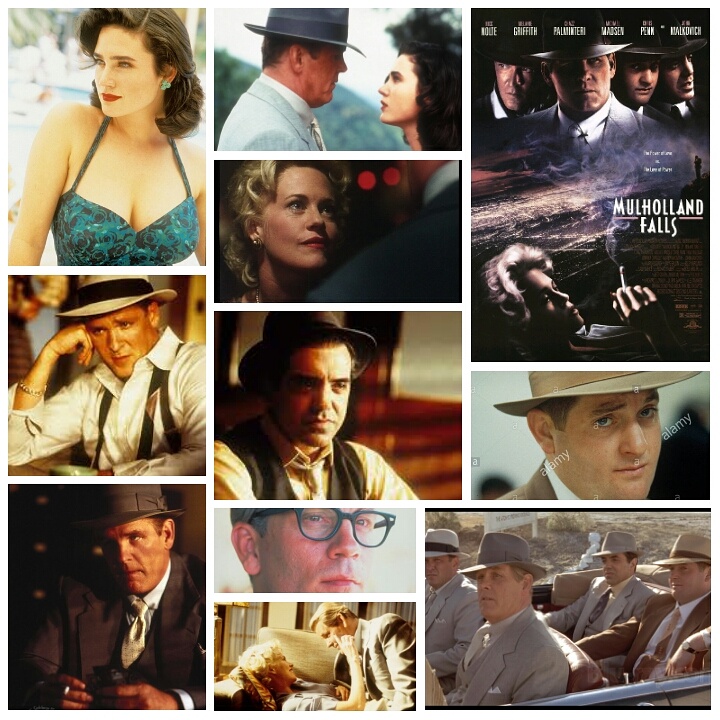
Lee Tamahori’s Mulholland Falls: A Review by Nate Hill

image

Lee Tamahori’s Mulholland Falls gets a bad rap in some circles for being boring and uneventful despite its charismatic cast and opulent setting that’s ripe for peppy action sequences. I think they are confusing boring with the concept of a paced and very slow burn, yet one with all the texture and richness of an action film, one that admirably decides to take the route of the old school noir, with loving care put into story and character, two elements which the action and violence live simply to serve, and not to take the driver’s seat against. Or it’s simply not some people’s cup of tea, which is totally okay too. Personally though, I love a good L.A. cop yarn that has a story to go with the toughness. This one bears striking similarity to 2013’s Gangster Squad, which also had Nick Nolte playing a 1940’s Los Angeles cop in charge of a squad that operates outside of the law. That film is pure cheese, all razzle dazzle and no plot. Mulholland Falls falls somewhere between Gangster Squad and L.A. Confidential; not quite up to delving into the serpentine intrigue of the latter, yet infinitely more interested in telling a worthwhile story than the former. And tell it does, in high flying style that only a crime film set in that time period can do. Nick Nolte plays Hoover, a whiskey voiced, take no prisoners LAPD badass who heads up an elite anti corruption task force that operates far outside the red tape and pretty much do what they want to stomp out corruption. His squad consists of Michael Madsen, Chris Penn and a scene stealing Chazz Palminteri as the oddball of the bunch, with serious impulse control issues. A straight up dream cast of tough guys, and although I’ll admit that Penn and Madsen are a tad underused, their presence alone boosts the film’s credentials into an epic pantheon. The film revs up with a kicker of an opening sequence in which the squad severely roughs up a troublesome mobster (an uncredited William L. Petersen). “This isn’t America, it’s Los Angeles” Nolte growls to him, stating the tone of perverse lawlessness which permeated the city back then. Soon he’s drawn into a tawdry scandal involving the murder of a young prostitute (Jennifer Connelly) who he previously had encounters with. The search leads him far and wide, crossing paths a sleazy photographer (Andrew Mcarthy), a dying air force tycoon (John Malkovich manages to ham it up even at his most laid back) and his stern lieutenant (Treat Williams). Nolte also has a poor jilted wife played nicely by Melanie Griffith in limited but effective screen time. The plot is hard boiled to the bone, with Nolte in one his most gruff mid career roles and loving every stressed out, rage fuelled second of it. The conclusion is his show, with a whacked out Palminteri in tow for a spectacular sequence set aboard a doomed military aircraft. The cast gets deeper, believe it or not, with Daniel Baldwin, Ed Lauter, Kyle Chandler, Titus Welliver, Louise Fletcher, Rob Lowe and Bruce Dern contributing gamely. This one’s got style on it’s side and then some, replicating a sense of time and place with the torque ramped up to near Sin City levels. Admittedly not perfect, but a pure and simple blast of a flick, in my opinion.

Quentin Tarantino’s The Hateful Eight: A Review By Nate Hill

If Quentin Tarantino has achieved anything in his love letters to the spaghetti western genre, it’s his notable subtraction of the noodles from aforementioned dish, leaving decadent swaths of scarlet marinara sauce to be flung about the screen as blazing bullets rock various characters to their bones, sending blood all over the place in quantities that defy physics or biology. He did it with Django, and he does it again with The Hateful Eight, a somber, simmering snow opera that fell just south of winning me over entirely. Don’t get me wrong: there’s much merit to be found here, and as usual QT has a solid gold ear for dialogue that is as pleasing to the ear as Ennio Morricone’s unusually restrained, palm sweating score. He also shows his uncanny knack for chasing awesome actors out of the woodwork and casting them in his films. In his attempts to resurrect 70mm panavision he has achieved undisputed success. I’m also a sucker for both Agatha Christie style mysteries and snowbound locations (and what locations!!), both of which are in abundance here. And yet.. something just didn’t quite click for me, story wise. Perhaps it’s the fact that trailers had worked my imagination up to imposible heights of intrigue that couldn’t be brought to the table with this tale. In that regard, I suppose it’s my own fault. In any case, the eventual revelations just didn’t feel as profound and fitting after having sat through the endless, tantalizing set up. But oh, what a set up. QT deliberately marinates his characters in a stew of unease and malcontent, each player a grizzled picture of vague evil intent, firing missiles of distrust and loathing at one another until the ill will is as thick as the snow drifts they fight through. In the throes of a gathering blizzard, bounty hunter John ‘The Hangman’ Ruth (Kurt Russell in a sly nod of the head to beloved R.J. Macready, only saltier and far meaner) leads shackled prisoner Daisy Domergue (Jennifer Jason Leigh in the best performance of the film) to the town of Red Rock, to be hung. Along the way, and with much chatter, he picks up two stragglers: pissy fellow hunter Major Marquis Warren (Samuel L.Jackson) and one Chris Mannix (Walton Goggins). They arrive at Minnie’s Haberdashery, an oasis in the sea of winter, where four other undesirables have already shacked up in refuge: Owaldo Mobrey (Tim Roth earns his keep and then some) a self proclaimed hangman with some serious pep in his step, crusty confederate Sanford Smithers (Bruce Dern), Bob the Mexican (Demian Bichir is restrained comic perfection) and dangerous looking cowboy Joe Gage (Michael Madsen, that gravel voiced wildcat, is always awesome). They all hunker down to ride out the storm and quickly begin to realize that one or more amongst them isn’t who they say they are, and there’s devilry afoot. Sound intriguing? It did to me too, and I can’t say much about what exactly let me down without giving stuff away, but it just felt like such a pedestrian knockoff of a second act after the absolute slow burning joy of a guessing game which preceded it. Maybe it’s a bit like a Christmas present: you spend months in a giddy daze wondering what you’ll get, you get there christmas morning and there your present is: shiny, gleaming and filled with endless possibility, but unmistakably shaped by your specific anticipation of what lays within. You open your present… and there it is, mystery evaporated, no longer a present but an actual object, or in this case a story that you must wrestle with to appease the lingering wonder of what you expected, as opposed to what you got. I know it’s too much to expect every film to be that perfect christmas present that is as satisfying wrapped as unwrapped, but with QT’s stuff I feel I always act that way a bit, having pictured my definitive version of the films before having seen them, and feelng somewhat underwhelmed. That’s not to say I didn’t enjoy it: It’s chock full of macabre surprises, earnest performances and expectedly nasty violence. Jennifer Jason Leigh owns as Daisy, a frothing feral beast. Leigh has no shortage of courage in taking on courageous, unflattering roles, and she dives right into this one with fists and teeth clenched, eyes narrowed and a steely will to survive. It’s truly a blessing to see her on the big screen again and I hope to see more in the future. There’s one casting decision which almost ruined the last act for me. I won’t spoil it here but the ‘actor’ in question is so unbelievably untalented and sticks out like ten sore thumbs in his ineptitude, really making me wonder about QT’s sanity. The rest of the cast makes up for it in spades though, particularly Madsen, Roth and Russell. Goggins also gets loads to do and does it with grinning flair that would make Boyd Crowder proud. The cinematography by legendary Robert Richardson is staggeringly beautiful. The wintry Vistas sweep by in splendor, eventually moving inward to the firelit cabin where everything has a burnished, lived-in texture that’s transfixing to look at. If only the story had the weight and impact I was expecting, I could have given this glowing accolades, but there’s always next time. Gorgeous Tarantino outing with a cast that chomps at the bit relentlessly, and although it ultimately falls short, it’s quite the piece of cinema all the same.

ALEXANDER PAYNE’S NEBRASKA — A REVIEW BY NICK CLEMENT

nb2

Simple. Sly. Subtle. Sensational. I’ve run out of words that begin with the letter “S” that describe Alexander Payne’s Nebraska. This film keeps popping up on EPIX HD and every time I notice that it’s on I end up watching it from wherever it’s at in the narrative. The colorized version was an interesting experiment, and I can see why Payne would be interested in trying to see how the film would play in a desaturated color zone, but this film truly feels as if it’s living in black and white; there was no other option. I’ve loved every movie that Payne has put his name on – everything always feels just right, as if there were no other options for him (it’s a very similar feeling I get while watching work from the Coen brothers). Bruce Dern breaks your heart slowly and deceptively in the lead role of a lifetime, June Squibb stole every single scene that she appeared in, and Will Forte hit notes of surprising emotional depth that I didn’t know were in him as a performer. This is the sort of movie that might hit home too hard for some people; as always, Payne wraps his dark story with an abundance of dry humor, this time courtesy of debut screenwriter Bob Nelson, whose sardonic touch fits perfectly with the shivery, monochromatic cinematography of long-time Payne collaborator Phedon Papamichael. Bleak yet filled with lots of heart, achingly sad yet strangely upbeat, honest when it needs to be, and frequently laugh-out-loud-funny, this is yet another small gem from one of America’s best and most consistent filmmakers.

DAVID JACOBSON’S DOWN IN THE VALLEY — A REVIEW BY NICK CLEMENT

1

I’ve been curiously drawn to the 2005 film Down in the Valley throughout the last 10 years, if for no other reason than I can’t seem to find too many movies quite like it. Starring a mysterious and characteristically magnetic Edward Norton as a modern day cowboy who “drifts” into town (the oh-so-cinematic San Fernando Valley) and changes the lives of the people he comes into contact with, it’s a strange film, dreamily stylish (Enrique Chediak is the cinematographer), and peppered with colorful and juicy supporting performances from an excellent Evan Rachel Wood, the always terrific David Morse, a sensitive Rory Culkin, and the legendary Bruce Dern. After making its debut in the Un Certain Regard section at the 2005 Cannes Film Festival, the film was released to mostly muted critical response and close to zero box office during a brief limited theatrical run; it’s still not available on Blu-ray with only a DVD and possible streaming options available. Writer/director David Jacobson hasn’t worked much since this film came and went, which seems to be a shame, because the film is an interesting if not entirely successful mood piece that’s heavily interested in character and skewing the expected conventions of the classic “Western” melodrama. Because the film is set in the present day, and it revolves around a delusional lead character (trying not to give too much away, here…), Jacobson is free to upend our common expectations, going in directions you won’t likely see coming, unafraid to present flawed main characters who you may empathize with if not sympathize with. Morse is really outstanding as Wood’s easily angered father who resents the heartfelt if not potentially dangerous Norton trying to make eyes with his sexually blossoming young daughter, with Jacobsen tipping his hat in all manner of auteur-lead directions, evoking Terrence Malick’s Badlands, the works of John Ford, and the occasional surreality of David Lynch or someone along those lines. This is a quirky, cool, and defiantly original piece of work that’s worth tracking down.

2