Lasse Hollstrom’s The Shipping News is two thirds of a great movie, but unfortunately has a first act which introduces it’s main character in the most heavy handed of ways, and sort of shoots itself in the foot. It helps that the rest of the film is lovely, but it takes some time to get the sour taste out of your mouth. Kevin Spacey is Quoyle, a meek milquetoast dude who has spent his entire life moping and whining, constantly being walked all over and never standing up for himself, starting right from his childhood relationship with his father (Jim ‘sippy poo’ Lahey, the glorious bastard). He’s so pathetic and such a loser that one wonders where can you go from here, and why did Spacey choose to start his arc at such a sad extreme, instead of livening it up a bit? By chance (and I mean chance) he marries Petal ( half mad Cate Blanchett), a wayward woman-child with barely an ounce of sanity or sensibility in her, and has a daughter with her. She runs off to a tragic self inflicted end, and he is left to raise the girl. Suddenly he receives news that a relative has passed in a small coastal fishing village his ancestral home of Newfoundland, so he packs it in and the two of them head on out there to begin anew. From there it’s an awakening for him, and bit by bit his character becomes believable and tolerable, two traits that were simply not there up until this point. He meets a long lost relative (a salty Judi Dench), befriends a local gal (Julianne Moore), starts working for the gruff local newspaper magnate (Scott Glenn, wonderful) and essentially finds a self within him that he never had before, a life to fill the pointless void he’s lived in for his whole existence so far. The town is charming, the atmosphere authentic and the acting terrific, including Rhys Ifans and the late great Pete Postlethwaite. I just wish the first act could have measured up to the rest and not stuck out like such a misplaced and noticeable sore thumb. Hallstrom has an ear for intimate, rural set family drama (check out An Unfinished Life with Robert Redford fpr his best work), and for the most part, this one delivers the goods.
Tag: Cate Blanchett
Notes On A Scandal: A Review by Nate Hill
Notes On A Scandal shines an unblinking and often bitterly tainted spotlight into what makes people tick, how they interact with one another and what a slap in the face it can be when you see what they really think and feel, independent of how they may carry themselves in public. Judi Dench is acid personified as an older woman and veteran teacher at a local high school, who’s ranks have recently been joined by a younger art instructor (Cate Blanchett). Dench is jaded, her only friend being her cat Portia, and has an insidious habit of keep a diary in which she writes down prickly little barbs about everyone and everything around her, often cruel and judgmental in nature. She takes a shine to Blanchett, who is married to a much older and renowned man (the excellent Bill Nighy) and has every vibrant thing in life that Dench is bereft of, left with the vacuum of her own empty existence. She envies, aspires to and resents Blanchett’s existence, and pours a malicious cocktail of verbal attacks into her journal, safe in the knowledge that it’s just as personal and private as her own thoughts, and that she’ll never be found out. Or will she? I’ve lived long enough to know that secrets you try to hide have a way of working their way to the surface, becoming known and hurting those you love or try to connect to. Speaking of secrets, things get incredibly complicated when Blanchett gets caught up in a torrid affair with a teenage boy she teaches, lured in by lust’s song and deaf to consequence, which is something that befalls us all more than we’d care to admit. Dench thinks she can use her knowledge of the affair as leverage to get what she wants, which she may not even be sure of at all, beyond it obsessively involving Blanchett. The two of them are dynamite as two sides of the many faced coin of ambiguity. The human behavior in this film somewhat defies the usual story structure and parameters of character we are used to in film. Decisions are arbitrary, ugliness is exposed, people are contradictory and confused in a way that leaves them stranded without beats to fall back on with their work. High praise is deserved to a piece this honest and willing to explore these places.
Veronica Guerin: A Review by Nate Hill
I can remember seeing Joel Schumacher’s Veronica Guerin when I was first allowed to start checking out R rated, more intense fare. Being far more impressionable that the desensitized veteran you see before you today, I had a royal emotional gut punch coming that I wasn’t even prepared for. I didn’t know what it was about or what I would see, all I knew was I loved watching movies and I was going to devour each and every one I could get my hands on. Well, it tells the true and very tragic story of Veronica Guerin, an incredibly fearless Irish journalist who almost singlehandedly waged war on the drug trade back in 1996. It’s a suicidal mission that involves hassling very dangerous people, putting her and her family’s lives in jeopardy and overturning stones that lead to nothing but trouble. But she won’t back down for a second, and Blanchett finds the noble belligerence in her. Now anyone who knows the story also knows that later in life she was assassinated, by order of the very same drug lord she was trying to take down, John Gilligan (Gerard McSorley). I feel like it isn’t really a spoiler and should be spoken of in a review, as it’s a huge beat and the essential part of the film. Poke the hornet’s nest and you’re liable to get stung, it’s just a shame that no one on her side could have done more to protect her and prevent the outcome, but when you have one woman crusading against both evil and casually corrupt indifference then I suppose she’s on her own anyway. “” is a chilling monster, an absolute sociopathic maniac who will go to any lengths of cruelty and darkness to keep his empire, and McSorley will give you shudders with his portrayal. Ciaran Hinds is great as sleazy and slightly conflicted John Traynor, an underworld informant who fed Veronica information and played a big part in her story. Colin Farrell shows up in an odd and completely random cameo, and watch for Brenda Fricker too. The end of the film and the events surrounding her death are intoned with a haunting musical montage, and I dare you not to burst into to tears or be swept away and deeply affected by Schumacher’s tender direction, the cast’s work and the sheer tragedy of it all. There’s another film about Guerin called When The Sky Falls with Joan Allen, and it’s worth a look, but this is the real deal, going to great pains to show the personal nature of Veronica’s quest, how much it meant to her, the sickness of a nation infected with drug addiction and corruption, and the game changing power which one human being can have over it all, even if they must sacrifice their life for it. Powerful stuff.
Sam Raimi’s The Gift: A Review by Nate Hill
Anyone who loves a good slice of southern gothic murder mystery should check out Sam Raimi’s The Gift, one of several films in the eclectic scoundrel’s ouvre which made a departure from his usual brand of chaotic horror. Cate Blanchett stars as Annabelle, a single mother with a very perceptive telepathic ability, which in rural USA is greeted without any skepticism by the locals. She is renowned for her gift, and often approached by people in need. The story sees her trying to locate young Jessica (Katie Holmes), who has gone missing, and discovering some nasty secrets about the people around her in the process, people she thought she knew better. Jessica’s fiance (Greg Kinnear) is desperate but clearly knows something he’s not saying. Also involved is battered housewife Valerie (Hilary Swank), her terrifying abusive boyfriend Donnie (Keanu Reeves), a local mechanic (Giovanni Ribisi) who befriends Annabelle, and others. It’s an ugly tale contrasted by Blanchett’s striking beauty, which the cameras capture in all the right instances. She could be rearranging a bookshelf and still be compelling and elegant, and always is in whichever role she takes on. Reeves is a scary tornado of pent up rage and sickness, cast way against type and loving every rage fuelled second. As if the main cast wasn’t packed enough with talent, we also get stellar work from Gary Cole, Michael Jeter, Kim Dickens, Rosemary Harris, a random cameo from Danny Elfman and a sly turn from J.K. Simmons as the county sheriff. What a cast, eh? Raimi puts them to good use, and each one gets their moment to shine. I’ve never seen a film by the director I haven’t loved; the guy just makes super fun, accessible genre treats that are irresistibly likable. Pair that with the evocative southern tone and Blanchett’s winning presence and you’ve got one hell of a little package. Very overlooked stuff.
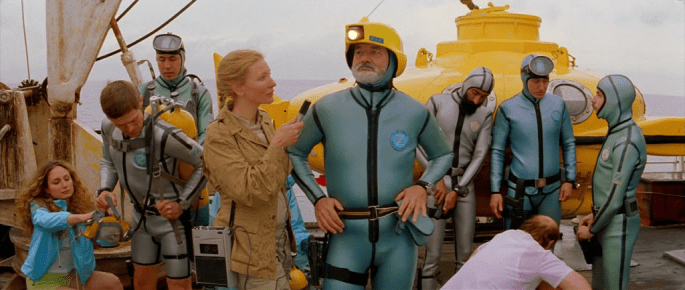
THE LIFE AQUATIC WITH STEVE ZISSOU – A REVIEW BY J.D. LAFRANCE

There’s always a certain amount of trepidation when a filmmaker like Wes Anderson, known for making intimate and personal films, starts making movies on a more ambitious scale – bigger budgets and movie stars in an attempt to appeal to a larger audience – that he will lose all of the qualities that made his movies so interesting in the first place. Easily his most accomplished film, The Life Aquatic with Steve Zissou (2004) merged his stylized dialogue and quirky characters with elaborate sets and action set pieces in an exotic locale.
After his best friend is eaten by a Jaguar shark, famed oceanographer Steve Zissou (Bill Murray) vows revenge. The problem is that the fish is endangered and he’s having trouble raising money for the expedition. He also meets Ned Plimpton (Owen Wilson) who may be his son by a woman he met 30 years ago. So, he convinces the young man to join his expedition in an attempt to make up for three decades of neglect.
Ever since Bottle Rocket (1996), Anderson’s movies feature a water motif in some form or another, whether it is Anthony and Inez’s first kiss in a swimming pool in Bottle Rocket or Max Fischer’s desire to build an aquarium in Rushmore (1998). With Life Aquatic, Anderson finally realizes his fascination with water head on by crafting an homage to Jacques Cousteau.
Life Aquatic also continues Anderson’s thematic pre-occupation with flawed father figures and their sons. There is the burnt out Mr. Blume and Max in Rushmore and Royal and his children in The Royal Tenenbaums (2001). In Life Aquatic, Steve tries to reconnect with Ned in the hopes that they will bond while hunting for the Jaguar shark. Like Blume and Royal, the world seems to have forgotten about Steve. He’s washed up and hit rock bottom now that his best friend has been killed.
The film also continues Anderson’s structuring of his movies into segments. In Rushmore, the story was broken down into months serving as acts in a play, with Tenenbaums, it was chapters as in a book and now with Life Aquatic it is days as Steve’s mission is being filmed for a new documentary. This structure reinforces the magical, almost-fairy tale feeling that Anderson creates in every one of his films by drawing attention to itself as a fanciful tale.
Bill Murray turns in another excellent, low-key performance as the melancholy Zissou. With his beard and gruff, macho attitude, Steve comes across as a Hemingway-esque figure with a dash of Cousteau. And yet, no matter how extravagant things get, Murray always keeps things grounded with his sparse performance. Over the course of his career, the comedian has been gradually refining his style of acting. He gained fame in broad comedies like Stripes (1981) and Ghostbusters (1984) but has fine-tuned his style to a less-is-more approach with movies like Rushmore and Lost in Translation (2003). His turn in Life Aquatic is just the right blend of comedy and pathos.
Most films don’t warrant much thought or discussion, but Anderson gets more and more interesting with each new effort. They are filled with so many fascinating little details crammed in each and every frame, repeated thematic motifs and minor characters who often wander in and out of the background of scenes. His movies are magical, existing in their own unique worlds and bursting with ideas that are almost too much to absorb in one sitting. As was the allure of David Lynch’s short-lived T.V. show, Twin Peaks, one of the appeals of Anderson’s films is that we want to be in these quirky worlds he creates and we want to know his characters. We want to lose ourselves in his universe and the beauty of DVD is that they allow us to revisit the worlds of his movies any time we want.
Anderson is not only more ambitious in terms of structure and scale but also with the visuals of Life Aquatic. Shot in Italy, he utilizes the striking landscape of the country for a sun-kissed warm color scheme of yellows and browns. There are also the striking images that linger long after the film ends: the glowing jellyfish on a beach at night and the stop-motion animated fish (by Nightmare Before Christmas’ Henry Selick) and portrays them so vividly and in an exciting way.
Anderson’s career had been building up to this film. With The Royal Tenenbaums, he was able to juggle a large cast of name stars while still maintaining his artistic integrity. With Life Aquatic, he continued to use stars but upped the ante in production values and scope. However, he did not lose the intimate feeling that all of his movies possess. No matter how ambitious or big the scale, his films have hand-crafted feel to them. One gets the feeling that Anderson cares about every detail and every aspect and it is this personal touch that makes his movies so unique.

Joe Wright’s Hanna: A review by Nate Hill
Joe Wright’s Hanna started as a Vancouver Film School script, funded through grants that would make it the catalyst for the positively unique, incendiary action fairy tale that it is today. It’s crowd pleasing without any superficiality, straight to the point without being over serious, and is made with a slick, vibrant aesthetic that will have your pulse dancing a jig in time with the thumping score by The Chemical Brothers. I held off on seeing this one for years after its initial release, jaded by the prospect of another ‘killer genetically altered female assassin’ flick. One night I finally caved and took a peek on Netflix. I then kicked myself hard for not taking notice sooner, purely on the notion that I wouldn’t dig it based on its formula. I suppose I learnt a little ‘book by its cover’ lesson there, as I was completely enamoured with the film and have seen it at least ten times since then. The tired ingredients of any old formula can be whipped up into a tantalizing new recipe, providing all those involved have the commitment and passion. The filmmakers of Hanna go for broke with one of the best thrillers in years. Saoirse Ronan is an explosive, feral waif as the titular hero, raised in isolation by her badass ex CIA father Erik Heller (underrated Aussie Eric Bana nails the German accent to a T). They reside in the frozen tundras of Lapland, where Erik trains her in the ways of a warrior, instilling survivalism in both physical and intellectual measures, preparing her for their inevitable separation. An enemy from Erik’s past surfaces in the form of evil CIA witch Marissa Wiegler (Cate Blanchett practically breathes fire with a naughty southern accent and a red hairdo that looks acidic to the touch), and both Hanna and him are forced to run, separated from each other. She escapes from a remote facility and begins her journey across Europe, befriended by a lovable squabbling family of travellers, igniting a yearning for companionship in her that Ronan expertly shows the camera. Wiegler enlists the slimy help of a euro trash club owner who moonlights as some sort of freelance über villain (Tom Hollander almost walks away with the movie as the psychopathic, bleached blonde pervo Deutsch-bag) who relentlessly pursues Hanna along with his neo nazi skinhead henchman. The thing about this film is that it’s all been done before, but they find a way to make it fresh, exciting and strike chords which simply haven’t been hit in this sub genre before, providing a film experience that really sticks. Ronan has never been more virile and effective, also proving a mastery of the German accent and embodying Hanna with intense physicality that’s achingly punctuated by a gradual awakening as a person as well. Impressive balance is shown in her character arc, through writing and stunt work alike. This is the first movie to be scored by The Chemical Brothers, and damn I hope we get more. They belt out a technicolor rhapsody of electric music that flows beautifully with the story, hitting every beat, ramping up suspense when needed, being surprisingly weird at times and kicking around your head long after the credits roll. The actors are all easy listening with the dialogue, never feeling forced or making us doubt for a minute that these aren’t real people engaged in genuine interaction. The film neither drags nor rushes, arriving at its often grisly, sometimes touching and always entertaining conclusions exactly when it needs to. It shows uncanny intuition with its pacing, an absence of the need to show off with unnecessary fights or effects which don’t serve the story, and above all a keen desire to entertain us. Terrific stuff.
31st Santa Barbara International Film Festival Centerpiece Film: Terrence Malick’s KNIGHT OF CUPS
“You don’t want love, you want a love experience.”
Despite the little we collectively know about Terrence Malick, it has become apparent since THE TREE OF LIFE that he has been telling us his own story through the guise of abstract filmmaking. His new film, KNIGHT OF CUPS, was this year’s centerpiece film at the 31st Santa Barbara International Film Festival, and it is one of the best films I have ever experienced.
Set in modern day Los Angeles, the camera follows a screenwriter, Rick (played by Christian Bale as a placeholder for the filmmaker), who hasn’t so much lost himself, because he doesn’t know who he is. He has been wandering through his adult life, questing through money, drugs, and women.
This cast is huge, it’s akin to THE THIN RED LINE. Bale is the mainstay, but the abundance of recognizable actors in miniscule parts is awesome. Malick’s producer, Sarah Green, was on the red carpet for the premiere and I asked her what it’s like casting a Malick film and what the actor’s responses are to Malick’s interest. She told me that even though this film did not have an orthodox script, Malick has reached the point in his career where if there is interest shown in the actor, they immediately say yes.

This film marks Green’s four collaboration with Malick, with an addition two more films pending release. I asked her if there was something about KNIGHT OF CUPS that sets it apart from her other films with Malick, and she said that this film was set modern day (like TO THE WONDER) but was set and shot in LA. And that this film was shot on a whim, run and gun style.
KNIGHT OF CUPS is a journey through Malick’s subconscious. It is a remembering of faded memories. Some are reconstructed, some a fantasy. Rick is a placeholder for the camera, who rarely interacts with anyone or anything. He watches, he broods, and most importantly he remembers. When he does interact with others, maybe it is real, maybe it is what he thinks is real, or maybe it is what he thinks he should have done. The film chronicles life–his life, our life. Success, fame, love, emotion, family, safety – that doesn’t even scratch the surface.
A Malick film is like Hemingway’s iceberg theory but reversed. We are shown everything, yet we know nothing. We piece it together through an overwhelming abundance of emotion captured on screen, and what’s beneath the water is Malick’s intent. His answer, his reasoning, his life. KNIGHT OF CUPS is a painfully beautiful and personal journey of escaping the darkness and finding the light.
“You gave me peace. You gave me what the world can’t give. Mercy. Love. Joy. All else is cloud. Mist. Be with me. Always.”