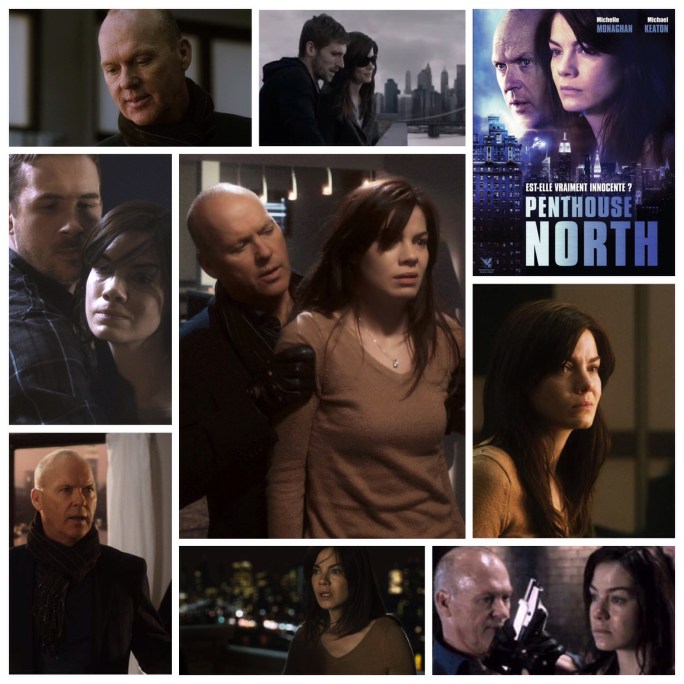
Penthouse North is a vicious little 90’s inspired slice of thriller fun, which sadly seems to have gained zero marketing and promotion, so unless it catches your eye on US Netflix or Shaw On Demand (which is where I watched it), you’ll prolly never even know you missed it. It’s nothing groundbreaking, and sometimes is very predictable, but as I found myself calling plot twists on the dime, and figuring out story beats before they happened, I didn’t find myself frustrated or feeling cheated out. I got a burst of nostalgia for the 80’s/90’s time period when these type of thrillers were in full bloom. Michelle Monaghan throws herself into the role of Sara, an ex-war photojournalist who was blinded in an incident. She lives in an ornate NYC penthouse with her boyfriend now, only just beginning to adjust to her new condition and emerge from reclusiveness. On New Year’s Eve, that auspicious time of year that buzzes with possibility, trouble comes knocking in the form of homicidal criminals in search of something hidden within the apartment. We are then treated to the archetypal game of cat and mouse as she fights tooth and nail for her survival. The film benefits greatly from a frenzied performance from Michael Keaton as Hollander, the lead criminal and a real piece of work. Keaton rarely plays in the bad guy arena (check out Pacific Heights for a more restrained yet equally dastardly turn), but he’s got a reptilian ferocity that’s equally scary and amusing, sometimes both at once. His Hollander is a royal prick, and oodles of fun to watch. Mark Mancini composes a solid score of jangly apprehension, and the film makes great use of its setting, with several clammy moments that didn’t sit well with my fear of heights. Good stuff.
Tag: cinema
The Big Easy: A review by Nate Hill
For a film about violence, crime and police corruption, The Big Easy sure is easy going and colorful. The characters are the liveliest bunch of rascals and it’s a pleasure to spend every minute with them. Dennis Quaid plays cocky New Orleans detective Remy McSwain, a swaggering smooth talker who’s gotten wealthy taking payoffs, a dude whose silky charm matches his swanky suits. He’s gotten used to the easy life in the police department, with a captain who looks the other way (Ned Beatty brings a jovial, rotund presence), and colleagues (John Goodman is perfectly cast as the witty loudmouth of the bunch) who are just as happily willing to bend the rules as him. Trouble arrives in the sultry form of D.A. corruption task force specialist Anne Osborne (a swelteringly hot Ellen Barkin) who leans on Quaid as heavily as he hits on her. There’s immediate and electric chemistry between them, which she adamantly fights, and he chases like a horn dog pursuing the bumper of a speeding Buick. Quaid and Barkin have the same spitfire sheen to their work, their careers dotted with performances that are flashy yet brave, pulpy yet laced with depth. Here they’re having oodles of fun and carry the entire film on their crackling star power and romantic spark alone. There’s also a subplot involving a rash of gang killings, as well as family matters involving Quaid’s vivacious Cajun clan, including his Momma (monumentally talented Grace Zabriskie). It’s a lively hodge-podge of plot elements we’ve seen a zillion times, but given such flippant style and good natured southern hospitality that we can’t help but be won over. There’s some lovely live performed Cajun music as well to add extra spice.
Joe Wright’s Hanna: A review by Nate Hill
Joe Wright’s Hanna started as a Vancouver Film School script, funded through grants that would make it the catalyst for the positively unique, incendiary action fairy tale that it is today. It’s crowd pleasing without any superficiality, straight to the point without being over serious, and is made with a slick, vibrant aesthetic that will have your pulse dancing a jig in time with the thumping score by The Chemical Brothers. I held off on seeing this one for years after its initial release, jaded by the prospect of another ‘killer genetically altered female assassin’ flick. One night I finally caved and took a peek on Netflix. I then kicked myself hard for not taking notice sooner, purely on the notion that I wouldn’t dig it based on its formula. I suppose I learnt a little ‘book by its cover’ lesson there, as I was completely enamoured with the film and have seen it at least ten times since then. The tired ingredients of any old formula can be whipped up into a tantalizing new recipe, providing all those involved have the commitment and passion. The filmmakers of Hanna go for broke with one of the best thrillers in years. Saoirse Ronan is an explosive, feral waif as the titular hero, raised in isolation by her badass ex CIA father Erik Heller (underrated Aussie Eric Bana nails the German accent to a T). They reside in the frozen tundras of Lapland, where Erik trains her in the ways of a warrior, instilling survivalism in both physical and intellectual measures, preparing her for their inevitable separation. An enemy from Erik’s past surfaces in the form of evil CIA witch Marissa Wiegler (Cate Blanchett practically breathes fire with a naughty southern accent and a red hairdo that looks acidic to the touch), and both Hanna and him are forced to run, separated from each other. She escapes from a remote facility and begins her journey across Europe, befriended by a lovable squabbling family of travellers, igniting a yearning for companionship in her that Ronan expertly shows the camera. Wiegler enlists the slimy help of a euro trash club owner who moonlights as some sort of freelance über villain (Tom Hollander almost walks away with the movie as the psychopathic, bleached blonde pervo Deutsch-bag) who relentlessly pursues Hanna along with his neo nazi skinhead henchman. The thing about this film is that it’s all been done before, but they find a way to make it fresh, exciting and strike chords which simply haven’t been hit in this sub genre before, providing a film experience that really sticks. Ronan has never been more virile and effective, also proving a mastery of the German accent and embodying Hanna with intense physicality that’s achingly punctuated by a gradual awakening as a person as well. Impressive balance is shown in her character arc, through writing and stunt work alike. This is the first movie to be scored by The Chemical Brothers, and damn I hope we get more. They belt out a technicolor rhapsody of electric music that flows beautifully with the story, hitting every beat, ramping up suspense when needed, being surprisingly weird at times and kicking around your head long after the credits roll. The actors are all easy listening with the dialogue, never feeling forced or making us doubt for a minute that these aren’t real people engaged in genuine interaction. The film neither drags nor rushes, arriving at its often grisly, sometimes touching and always entertaining conclusions exactly when it needs to. It shows uncanny intuition with its pacing, an absence of the need to show off with unnecessary fights or effects which don’t serve the story, and above all a keen desire to entertain us. Terrific stuff.
Peter Jackson’s The Lovely Bones: A review by Nate Hill
Peter Jackson’s dreamlike adaptation of The Lovely Bones gets unfairly beat down way too much. While I will concede that, having never read the book myself, I’ve heard it differs considerably in story, I view the film on a standalone level. And what a film. It’s an absolute stunner, on every level, from effects and casting to acting and production design. It contains elements of the subconscious and astral planes which are a huge draw in any film for me, and are visualized here spectacularly. Saoirse Ronan plays Susie Salmon, an adolescent girl barely coming into her own when she is cut down like a flower that has jus begun to bloom. Her killer, a skin crawling creep named George Harvey (Stanley Tucci) is a neighbor and well disguises his inner nature, making the search for her murderer lead to cold dead ends. Her father (an oddly cast Mark Wahlberg makes it work) doesn’t give up for a minute, tormented by not knowing what happened to his little girl. Her mother (Rachel Weisz) and grandmother (Susan Sarandon) slowly come apart at the seams from the insidious trauma that such an incident inflicts on loved ones left behind. Only her plucky sister Rose (an excellent Rose McIver) is able to find any clues which lay the blame on Harvey. She quietly scopes him out for proof of the murder, providing a scene of hair raising suspense that will leave you needing a change of pants. Meanwhile, Susie finds herself in a place beyond space and time, a dazzling purgatory filled with the sights, sounds and memories of her short life all projected through the abstract prism of the unconscious mind, and is simply the most innovative and eye opening look into the unconscious dream world of the human mind since Tarsem Singh’s The Cell. Ronan is a beacon of hope in her performance, projecting resilience frayed with the vulnerability of a young soul achingly wounded at the tragedy of her outcome, yet determind to set things right and make peace with the life she was ripped out of so soon. Tucci is flat out genius as Harvey. Gone is his usual spitfire cameraderie, giving us an empty, psychopathic shell of a human with a reptilian gaze that causes shudders all round. He’s made Harvey a truly harrowing movie villain to rank as one of the very best, and when viewed alongside other performances of his, one can scarcely comprehend his versatility, let alone believe it’s the same guy in both roles. Peter Jackson has a yearning for every project he takes on to be the longest, flashiest, most opulent vision he can conjure up, and while that sometimes causes his own masterful technique to buckle in on itself a bit, here its employed wonderfully to make the very best version of this story that anyone probably could have. He also doesn’t shy away from showing the blunt brutality of the situation, or the undeniably ugly event, which is hard to sit through yet neccesary for the arc of the story to have full impact. In the end, elements of the story both nasty and uplifting alike combine with a set of impressive visual effects and earnest acting all across the board to create a treasure of a film.
Peter Weir’s Picnic At Hanging Rock: An appreciation by Nate Hill
Yesterday I went into HMV, looking for a standard Blu Ray edition of a film I’ve recently seen that has stuck with me since in a way that I can’t quite describe, Peter Weir’s Picnic At Hanging Rock. The only version they had was a pricy Criterion Blu Ray/Dvd combo which also included the original novel which Weir based his film on. Now normally I’m reluctant with Criterion, as I almost always disagree with the films they pick for their releases. Also..it was expensive as shit. But then I remembered how much it affected me when I first watched it on my humble iPad, and realized that I wanted to have the snazziest output that money could buy, as this is one I’ll be revisiting probably until my years on this rock have run out. At it’s heart it’s a mystery of the deepest primordial resonance, laced with the burgeoning sexuality of its female lead characters, and ultimately leaving an aftertaste of such yearning, mournful sadness that I had no idea movies were even capable of. Weir sets his story in 1900 Australia, with amusing attempts by the British to tame the near prehistoric nature of the land. Their prim, drawn up customs seem ludicrous and surreal in the face of a wild, abstractly formed landscape that meets their need for order and custom with unimpressed chaos.
A group of girls from a nearby boarding school embark on an annual picnic to Hanging Rock, an ominous geological gnarl set in a scorched, unearthly swath of land that evokes the feeling one might get from a partially recalled dream of some far off dimensional plane. For the conservative visitors and the audience alike, the surface of the moon might feel more at home. In a gust of unsettling foreshadowing, several members of their party note that their watches have mysteriously stopped at dead noon. A group of four girls venture forth to explore the upper plateau of the rock, promising their teacher Mademoiselle (radiant, elemental Helen Morse) they’ll be back before tea. Four enter the jagged, awaiting maze; two disappear and are never heard from again. It’s an enigma that shakes the foundations of the boarding school to its core. From stoic headmistress (Rachel Roberts) to a tragically abandoned orphan girl (Margaret Nelson, staggering for a girl who’d had no previous acting experience) no one is quite the same after the incident, almost as if whatever intangible forces responsible for the girl’s disappearance have reached out and deeply disturbed every form of life in its vicinity, the very madness of the continent itself driving these civilized newcomers to the brink of soul shaking distress. In spite of the film’s beauty, there are also moments of sheer horror that rival anything in your garden variety fright flick. The key scene where the girl’s are last scene is fogged over with such a feeling unshakable dread, crafted through sound and editing alone, no actual discernible violence or threat. It’s utter genius and you begin to question why you’ve got hordes of goosebumps from so ambiguous a scene, but you’re left snatching for the same answers to a feeling akin to the sensation of a quickly dissipating nightmare I mentioned above. That’s how powerful the filmmaking is… You are shaken without ever really knowing why or what’s the matter, which is really the concept of a mystery distilled to its purest form.
What claws at your mind and lingers in the fringes of your awareness long after watching the film is its atmosphere of mounting dread, like knowing for certain the the worst possible type of end is coming for you, yet being utterly unable to articulate exactly what it is. The soundscape is thick with melancholic unease as well, evident in a knockout pan flute solo from Georghe Zamfir, providing a hazy chorus that will stand up the hairs on your arm in its beauty and terror. The scenes at Hanging Rock are lifted straight out of a subconscious place and laid down on the canvas of film with the same exquisite care of pressing flowers, which we see the girls doing early on. Film essentially does this: the painstaking preservation of beauty for countless generations to be pleased, terrified and puzzled by. There’s no better version of this film I’d rather have that with than this one.
The Constant Gardener: A Review By Nate Hill
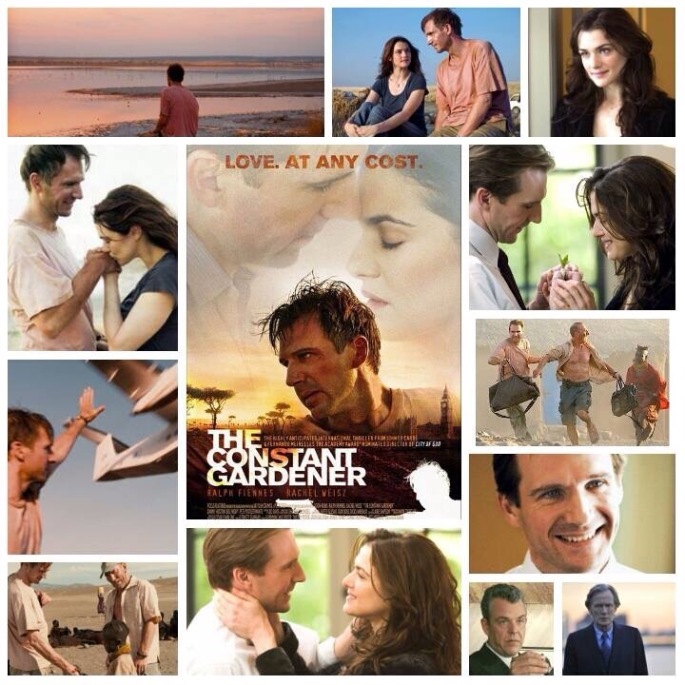
Usually, I’m not super hot on adaptations of John Le Carré novels. His style tends to veer towards dense, impenetrable narratives that confuse and confound me, and are further frustrating because they have such wonderful casts and production value (I’m lookin at you, Tinker Tailor Soldier Spy). The Constant Gardener, however, is a breathtaking story that I’ve enjoyed very much since I saw it in theatres at probably too young an age. It fashions a story that although is complex and refuses to be straightforward about what it’s trying to say, contains essential beats and stunning performances from its actors. It’s also set apart from other Le Carré yarns for having the most humanistic, compasionate core to its story, centering it’s focus on the atrocities that humans can commit upon each other in mass, faceless fashion and showing us the sparse, golden good deeds that a few kind people can put forth to counter such madness. An organic, emotional theme is nice compared to the clinical, detached style we usually see from this writer. The film is lucky in the sense that it has deeply gifted leads: Ralph Fiennes and Rachel Weisz, two actors who always resonate with a relatable human kinship in their work, and are both superb here. Fiennes plays Justin Quayle, a British ambassador in a god forsaken African region whose luminous wife Tessa (Weisz) is found dead in a remote area under suspicious circumstances. She was investigating several high profile pharmaceutical companies, under scrutiny for their sociopathic, amoral drug testing trials on the poverty stricken Africans. Intrigue strikes in after this, as shellshocked Justin pieces together what lead to her death, and how he can cripple those responsible using espionage and a level of keenness that’s well above both his pay grade and mental constitution. Flashbacks abound as we see Justin and Tessa’s early years unfold, adding all the more to the lumps in our throats as we know the ultimate outcome which the film frankly showed us in the opening frames. Welcome supporting turns come from other UK geniuses like Bill Nighy as an icy CEO, Richard McCabe as Fiennes’s courageous brother in law, Danny Huston as a shady friend of Tessa’s and Pete Postlethwaite as a mysterious doctor who figures later in the plot. Cinematographer César Charlone makes sweeping work of bringing the chaotic nature of Africa to life, it’s people, landcsape and aura beautifully rendered in shots that evoke the best of Monét and similar artists. Such beauty brought forth from a story filled with unpleasantness is interesting, almost a refusal to present the depressing story in any other fashion than to show us the virtue in tragedy, the cost of lost lives and unchecked corruption present for all to see and wince at, yet somewhat quelled by the undeniable forces of light also in play. Rachel and Ralph’s work is an example of this; They are compassion incarnate, pools of hurt, determination and love for one another in the face of evil, unfair odds. They should both be very proud of their work here. Direct Fernando Meirelles has helmed Blindness and the classic City Of God, and as such is no stranger to infusing pain and sorrow with esoteric, positive qualities. He takes full advantage of the African setting, where suffering is commonplace and along with his entire troupe, throws all the lush, alluring kindness straight into the face of horror in an audacious stylistic set of choices which make The Constant Gardener one of the most achingly well constructed romantic annd political thrillers of the decade.
Oren Moverman’s Time Out Of Mind: A review by Nate Hill
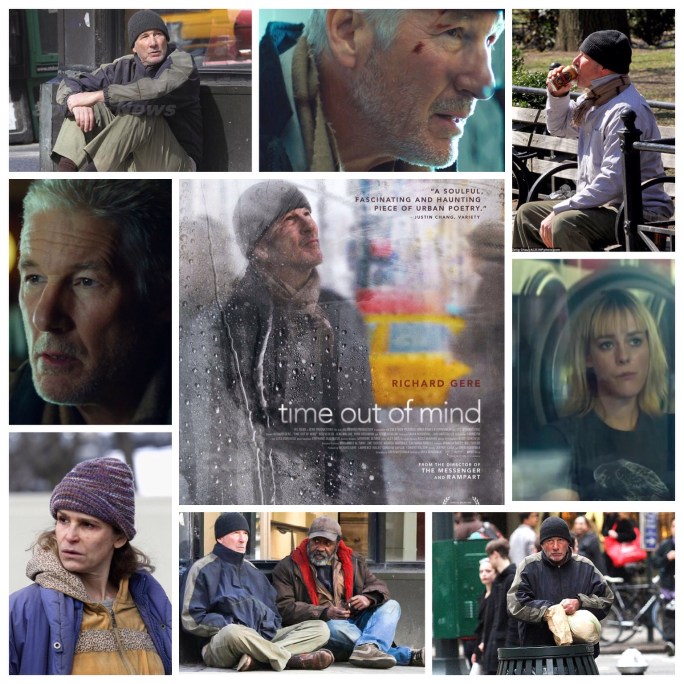
Oren Moverman’s Time Out Of Mind is a film that’s set so decidedly against the grain when it comes to how a story is presented to audience, it’s no wonder that it has been such a divisive experience. It’s almost like the anti-film. I understand it may be quite shocking the way it’s made, or lack thereof. But to hear that people walked out of screenings in droves at TIFF really saddens me. For someone to just not jive with the loose, dreamy aesthetic that serves the subject matter achingly well makes me wonder. But I suppose this is the type of film that really separates those with the power of abstract thought and the will to immerse themselves from those… without. The story in question concerns a homeless man in New York City played to absolute perfection by a haggard, boozed up and ultimately lost Richard Gere. This is the performance of his career, an outing of pure bravery and dedication that glues your eyes to the screen even in the most mundane of moments. You see, Gere himself had no idea when the cameras were periodically filming him, and was actually left stranded in the jungle of NYC, deep in the mindset of a lost soul, creating a minimilist performance that burns through the haze of a life scattered by tragedy. Little is given by the script in terms of back story for Gere, subtle hints given towards a broken life, death in the family and a mysterious injury which has left both body and soul scarred, as well as leaving him with obvious brain damage. If their was an award given out for best film title of the year, this one has earned it. ‘Time Out Of Mind’. Isn’t that the perfect description for a shattered psyche that has been set adrift by life’s cruel tides and left to wander the years, alone.. distraught.. damaged. Gere is a portrait of hurt, confusion and lonliness, wandering the overbearing maze of the city, desperately clinging to any semblance of dignity, as well as the scattered shards of his past that he yearns for. He’s got a daughter (Jena Malone in a conflicted career best) who wants nothing to do with him, making us wonder more about the past. He encounters several people over the course of the film. An energetic fellow vagrant (Ben Vereen) helps bring out a bit of Gere’s dormant coherence via his own nonsensical mania. A shrewd building inspector (Steve Buscemi) gives him the boot from a condemned building. He has a chance romantic encounter with a fellow homeless woman (an unrecognizable Kyra Sedgwick). The film is shot, edited and presented to the audience in a form completely void of structure or narrative beats. Gere wanders aimlessly, his foggy mental state reflected in the way his perceives his world, and in turn the way we perceive his story. It’s both ironic and fitting that we find ourselves so drawn in to a story that is presented as a set of events that are each and every one astray from any sort of cohesion. That’s where the title is so brilliant and touching.. Gere is one step removed from reality via time and injury. He himself mentions at one point that he has forgotten how long it’s been, and that he’s lost the thread of his life via many instances of ‘lost time’. Gere sells it and then some, inhabiting the streets with a worn out, ghostly presence that begs you to place yourself in the shoes and mind of someone who truly has lost their way in life, and to see that for them, such a fork in the road can truly change the concept of time. Seeing this successfully done with film in every aspect was truly an experience for me. Gere is the heart of it, as the camera peers out on him from trash strewn alleys, broken window frames and desolate, uncaring streets that leave him all but invisible, an individual manifestation of a sad fact of life which sometimes sits on the fringes of our awareness. Not with this film.
A chat with John Dahl – An interview by Nate Hill
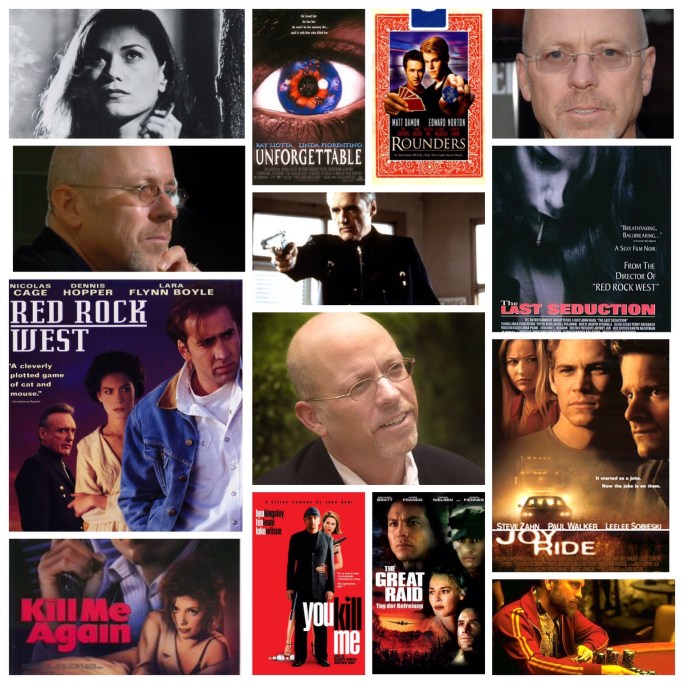
I’m incredibly excited to bring you my latest interview, with veteran director John Dahl. John has a staggering resume, having helmed episodes of television shows including Hannibal, Breaking Bad, Ray Donovan, Justified, Kingdom, House Of Cards, Jessica Jones, The Affair, Californication, Outlander, The Bridge, The Strain, Dexter, Arrow, Homeland, Shameless, Caprica, True Blood, Battlestar Galactica and more. He has also directed some amazing films, including Joy Ride, Rounders, The Last Seduction, Kill Me Again and Red Rock West. It was an honour to speak with him and I hope you enjoy reading it!
Nate: Growing up, what was it about film that attracted you, and how did you discover that you wanted to pursue it? Were there any filmmakers you admired or have inspired your work?
John: I always love going to see movies but then I remember seeing a “behind the scenes” preview of Jeremiah Johnson. They were pushing the camera on dolly track, it was the first time I’d seen anything like that. It started me think about how films were made. Then there was A Clockwork Orange. I was an art student and I loved the production design of the film and the use of Beethoven. Again it occurred to the that someone had to make everything that was in front of the camera. This film has really stuck with me as one of my favorites. As for influences; Kubrick, Coppola, Hitchcock, Spielberg, David Lynch & the Coen Brothers.
Nate: You have spent one portion of you career making feature films, and a more recent section has been centered on episodic TV. How do you find that the two differ? In film school we were told that they get directors for shows who are kind of like ‘guns for hire’, who will be efficient and carry the overall tone of the show without changing it too much. Did you find with any of the shows that you worked on (Ray Donovan, Hannibal, Justified etc) that you were rigidly set within the parameters of the show, or were you able to give them your own style, even a little, at all?
John: In any endeavor I’ve know there was always a practical side to me. From playing in bands, making artwork and certainly in writing and directing. While studying cinema in college I was curious as to how directors got their starts. This is when I came upon Roger Corman and his low budget approach. I noticed that both Jonathon Demme and Martin Scorsese got started with him. At this writing Corman has 409 producing credits and 56 directing credits. Are they all great? No, however If every movie I watched was as good as The Godfather or Rocky I probably never would have left Montana. Corman was a window into how films could be made and how one could grow through time and experience. Supposedly he shot Little Shop Of Horrors in 48 hours. My first professional directing experiences were doing music videos in the 80’s. This was a great playground to learn about lens, lighting, editing and how to work with a budget and a professional crew. I directed about 30 music videos when I got the opportunity to direct my first film. I’ve never worked on a project where money and time were not a factor, in the 8 movies that I’ve done and almost 90 episodes of television. The process is pretty much the same as I can tell – yes when you direct a film you are more in control of the process until you show it to the studio and start testing it. Then you have to respond to the audiences, producers and studio desires to hopefully recoup their investment. When you make television the studio and producers are involved every step of the way. It’s a group effort rather than an individual one. I can’t help but bring my sensibilities to the work I do – so far it hasn’t been a problem because when I’m doing someones tv show I’m trying to figure out how I can make it as great as possible with the time, money and talent available. I see filmmaking as the art of what is possible.
Nate: Rounders: for some reason, feels like the most personal film of you career. Silly for me to say, I know, since I’ve never met you, but it’s such a focused, distilled style and seems like all efforts involved were purely concentrated upon making this something really cool. How was you experience on this film?
John: Rounders what a terrific experience for me. I never really saw myself as much of a writer. I wrote so that I could create opportunities to direct. After four movies I was finally handed a movie and it was Rounders – pretty much the way you see it on screen. I saw it as a sports movie, the sport was gambling, not baseball or golf but a game of chance in which if you study, work hard you would succeed. Miramax supported the project, they liked the script, the cast – everything went fairly smooth. Interesting that you would say it my most personal film. I would probably say Red Rock West would be my most personal film – but to each their own.
Nate: Joy Ride: a colossally fun film. How was your experience making this one? I’m very curious about Ted Levine. On the dvd there test clips for Rusty Nail auditions with both Levine, Eric Roberts and a guy called Stephen Shellan. Were you in control of who nailed the role? Did you get to work a lot with Ted in the recording process?
John: Ted did a great job on the film although he was not my first choice. I pitched the ending of the film to the studio, building on the idea that the movie had to have a suspenseful ending – not more surprise which JJ Abrams was big on. I set up the idea that if Rusty Nail had Venna and the cops were coming to the rescue, if Venna was in jeopardy by say a “shotgun to the head” it would be more exciting – kind of the way Silence Of The Lambs ended. That may have been the take away for JJ – Buffalo Bill thus Ted Levine.
Nate: Red Rock West: Classic desert noir. How was the experience? One thing with your films that always is consistent and incredibly memorable performances from your actors. Particularly Dennis Hopper (Lyle From Dallas haha) and JT Walsh, who was a family friend of my parents. What was it like working with them? This is a Segway into my next question:
John: They say 90% of directing is casting the right actor. I agree. I’ve been blessed to work with remarkable actors. My approach is simple, I try to get great actors, set up the scene and get out of their way.
Nate: Working with actors: how do you approach the working relationship between actor and director? How has that process evolved for you over time and what have you learned from it?
John: I try to say as little as possible. I trust that they’ve done their homework and want to be great in any role they play. I’m there to guide them. Help them do their best work. As long as they end up going where I’m trying to take them — I give them full license to find the role.
Nate: The Last Seduction: I’m very curious about what it was like working with Linda Fiorentino, who is a favorite of mine.
John: Linda was fantastic. It was clear from the moment she entered the room that she was perfect to play that part. She pretty much cast herself, all we had to do is get out of her way and let her be Bridget Gregory.
Nate: You have written both Red Rock West and Kill Me Again. How do you find working with a director with your own material as opposed to other projects where you are dealing with a script crafted by someone else?
John: I like working with a writer – gives me someone to bounce ideas off of – it allows you to challenge the material – make sure you have the best version possible when you start shooting and even while you are shooting. I’ve often thought that the people with the most skin in the game are the director, writer and actors – those 3 jobs live or die each time they make something.
Nate: Are you hooked on tv now, or will we see some more films from you at some point in the future?
John: I like television. I’ve been able to work on great shows with fantastic writing. I don’t see a big difference between the two – if the material is good, I’ll do it. Do I still want to do features? Yes, I just need a great script.
Nate: Thank you so much for your time John, it’s been a pleasure speaking with you, and keep up the great work!
Quentin Tarantino’s The Hateful Eight: A Review By Nate Hill
If Quentin Tarantino has achieved anything in his love letters to the spaghetti western genre, it’s his notable subtraction of the noodles from aforementioned dish, leaving decadent swaths of scarlet marinara sauce to be flung about the screen as blazing bullets rock various characters to their bones, sending blood all over the place in quantities that defy physics or biology. He did it with Django, and he does it again with The Hateful Eight, a somber, simmering snow opera that fell just south of winning me over entirely. Don’t get me wrong: there’s much merit to be found here, and as usual QT has a solid gold ear for dialogue that is as pleasing to the ear as Ennio Morricone’s unusually restrained, palm sweating score. He also shows his uncanny knack for chasing awesome actors out of the woodwork and casting them in his films. In his attempts to resurrect 70mm panavision he has achieved undisputed success. I’m also a sucker for both Agatha Christie style mysteries and snowbound locations (and what locations!!), both of which are in abundance here. And yet.. something just didn’t quite click for me, story wise. Perhaps it’s the fact that trailers had worked my imagination up to imposible heights of intrigue that couldn’t be brought to the table with this tale. In that regard, I suppose it’s my own fault. In any case, the eventual revelations just didn’t feel as profound and fitting after having sat through the endless, tantalizing set up. But oh, what a set up. QT deliberately marinates his characters in a stew of unease and malcontent, each player a grizzled picture of vague evil intent, firing missiles of distrust and loathing at one another until the ill will is as thick as the snow drifts they fight through. In the throes of a gathering blizzard, bounty hunter John ‘The Hangman’ Ruth (Kurt Russell in a sly nod of the head to beloved R.J. Macready, only saltier and far meaner) leads shackled prisoner Daisy Domergue (Jennifer Jason Leigh in the best performance of the film) to the town of Red Rock, to be hung. Along the way, and with much chatter, he picks up two stragglers: pissy fellow hunter Major Marquis Warren (Samuel L.Jackson) and one Chris Mannix (Walton Goggins). They arrive at Minnie’s Haberdashery, an oasis in the sea of winter, where four other undesirables have already shacked up in refuge: Owaldo Mobrey (Tim Roth earns his keep and then some) a self proclaimed hangman with some serious pep in his step, crusty confederate Sanford Smithers (Bruce Dern), Bob the Mexican (Demian Bichir is restrained comic perfection) and dangerous looking cowboy Joe Gage (Michael Madsen, that gravel voiced wildcat, is always awesome). They all hunker down to ride out the storm and quickly begin to realize that one or more amongst them isn’t who they say they are, and there’s devilry afoot. Sound intriguing? It did to me too, and I can’t say much about what exactly let me down without giving stuff away, but it just felt like such a pedestrian knockoff of a second act after the absolute slow burning joy of a guessing game which preceded it. Maybe it’s a bit like a Christmas present: you spend months in a giddy daze wondering what you’ll get, you get there christmas morning and there your present is: shiny, gleaming and filled with endless possibility, but unmistakably shaped by your specific anticipation of what lays within. You open your present… and there it is, mystery evaporated, no longer a present but an actual object, or in this case a story that you must wrestle with to appease the lingering wonder of what you expected, as opposed to what you got. I know it’s too much to expect every film to be that perfect christmas present that is as satisfying wrapped as unwrapped, but with QT’s stuff I feel I always act that way a bit, having pictured my definitive version of the films before having seen them, and feelng somewhat underwhelmed. That’s not to say I didn’t enjoy it: It’s chock full of macabre surprises, earnest performances and expectedly nasty violence. Jennifer Jason Leigh owns as Daisy, a frothing feral beast. Leigh has no shortage of courage in taking on courageous, unflattering roles, and she dives right into this one with fists and teeth clenched, eyes narrowed and a steely will to survive. It’s truly a blessing to see her on the big screen again and I hope to see more in the future. There’s one casting decision which almost ruined the last act for me. I won’t spoil it here but the ‘actor’ in question is so unbelievably untalented and sticks out like ten sore thumbs in his ineptitude, really making me wonder about QT’s sanity. The rest of the cast makes up for it in spades though, particularly Madsen, Roth and Russell. Goggins also gets loads to do and does it with grinning flair that would make Boyd Crowder proud. The cinematography by legendary Robert Richardson is staggeringly beautiful. The wintry Vistas sweep by in splendor, eventually moving inward to the firelit cabin where everything has a burnished, lived-in texture that’s transfixing to look at. If only the story had the weight and impact I was expecting, I could have given this glowing accolades, but there’s always next time. Gorgeous Tarantino outing with a cast that chomps at the bit relentlessly, and although it ultimately falls short, it’s quite the piece of cinema all the same.
Room: A review by Nate Hill
It’s hard for me to fully express the staggering impression that Room left on me using only the written word, but I’ll have a go at it anyway. First I’ll say that it’s hands down my favourite film of the year thus far, and I left the theatre with many emotions swelling in me, affected in a way the only a small group of films have been able do for me. It’s a patient, mature study in psychology and a sweeping symphony of complicated emotions revolving around a terrible, tragic situation that seems like a well of hurt and pain until in climbs it’s way out into a tenderly heartfelt, incredibly life affirming resolution that never dips into half assed melodrama and feels earned and appropriate. The film casts such a powerful spell that it briefly changed the concept of time for me; Upon arriving near the end, I felt as if years had actually passed for me in theatre since I embarked on the film’s journey. The camera, script and actors kept me so intimately close to the characters for the duration of the piece and made me love and care for them so much that it brought me right into their timeline with an intimacy that rarely happens for me in cinema. Now on to the actors. What brave, compelling work from every single performer on screen, right down to the bit parts. Every role castes with a sharp eye for detail and reverent contemplation of who is right for what, creating a roster of heavy hitters and up and comers to be reckoned with. Brie Larson gives a beyond award worthy turn as Joy, a girl who was kidnapped at a young age and held captive by a horrible man (Sean Bridgers, displaying smouldering volatility in terrifying proportions) who impregnates her. She raises the child in the dour, tiny garden shed he keeps her in. Faced with the unthinkable task of creating a nurturing environment for her little one, she tells him that the shed is ‘Room’, their kingdom, and that the people he sees on their little TV are fake, imparting that they and their captor are the only real ones and there is no outside world. This reminds just how mouldable our minds are when we are small, and the film beautifully explores the psychological ramifications of how we raise our young, how nature vs. nurture comes into play in startling ways during the darkest of times, and the decisions we are forced to make on our own to ensure that our children are safe, even when things have gone beyond wrong, as they have for the poor girl. Old Nick, as she nicknames their captor, rapes her every few days, and treats the two of them like animals. Her son Jack reaches an age where escape becomes vital in his mothers eyes, and she takes her chance, orchestrating a harebrained ditch effort to break free, which is my favourite sequence of the film. It’s also one of the most tension filled, seat gripping scenes I’ve ever seen, as the character buildup has set our personal stakes epically high, which co,vines with the excellent set up makes for a clammy nightmare of an escape. The director makes the fascinating choice not to us any music at all until they reach freedom, which I noted. As soon as they are out, I let out a cathartic, audible sigh of relief, as the dank hell they undeservedly spent almost a decade in gives way to a vibrant, strange new world for little Jack. The camera takes his perspective and pores over every aspect of the outside realm with the patience and curiosity it takes to place us in his psyche, a child viewing the world in its entirety and true form for the very first time, essentially a second birth, a theme which the film handles marvellously. I must speak about Jacob Tremblay, a Vancouver native who plays Jack and gives the most soul wrenching performance I’ve ever seen from a child actor. The levels of sheer intuition and innocent truth he infuses in his work at such a young age are just unbelievable, and he should be in the riding for Oscar gold as well. Larson and him have uncanny chemistry, the love shown in the early scenes a blooming Rose of hope that fends off the looming darkness they dwell in, which is tested by the inevitable complications they face upon entering the real world once again. Larson burst onto the scene with 21 Jump Street and Don Jon, fun but inconsequential fluff. Here she shows us that she means business, and wants to tell stories that are important, and show audiences what it means to be human through her work. I look forward to where this extraordinary girl takes us in her next cinematic journey. Joan Allen makes subtly heartbreaking work as Joy’s mother, William H. Macy is briefly present as her Dad, Tom McCamus makes compassionate work of her stepdad and like I said, everyone else is superb, right down to the day players. I was crippled by emotion and raw with nerve jangling suspense after this one, exiting the theatre soaring on the high I eternally strive for in my cinematic adventures. The fact that only one theatre in Vancouver is playing this one is an affront to the universe. Get down to Tinseltown and see this one before it’s gone. You’ll thank me.