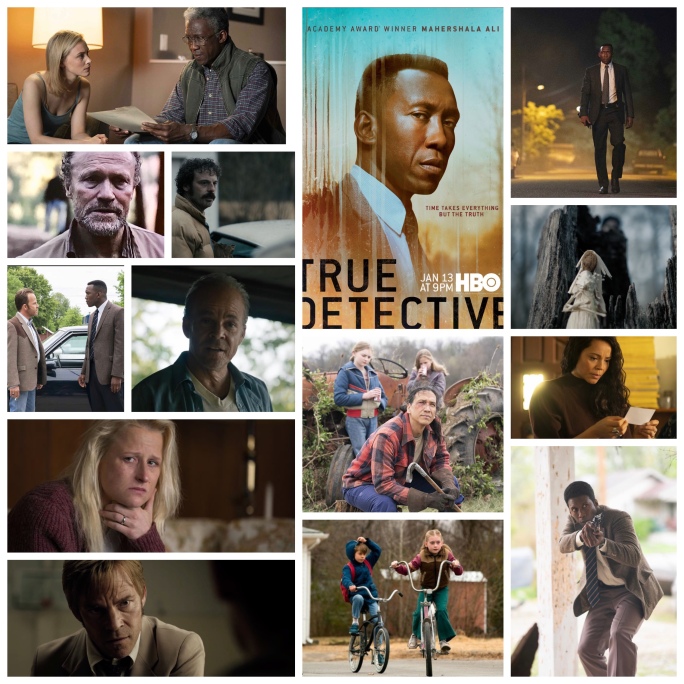
HBO’s True Detective: Season 3

In season 1 of HBO’s True Detective, Matthew McConaughey’s Rust Cohle observed that in a battle between light and dark, it looked to him as if the light appeared to be winning. The spectacular third season has has come to a close and without any spoilers it felt to me like that sentiment has never been more apparent in the series. The first story was a brilliantly existential gothic folk horror show gilded by unsettling conspiracies that went who knows how high up and permeated by the eerie, lived-in grottos of rural Louisiana. The second story was a brilliantly deep, dark, Byzantine labyrinth of California corruption, noir laced nihilism and fatalistic angst. The third story, no less phenomenal, sees a more intimate, emotional tale unfold against the mysterious backdrop of the Arkansas Ozarks, revolving around a crime the mechanizations of which gradually, steadily unfold in ways we both expect and also don’t. There’s a directness and fortitude to the story here where in the past seasons things could be a little more ambiguous and opaque, something I was fascinated by. Every season relies heavily on setting to make the case something you both remember and care about, from the sweaty bayous along the coast to the seedy industrial hum of Vinci. The Ozarks are considerably more picturesque with craggy mountains and thickets of boreal forest, but the atmosphere is no less portentous, the musical cues no less unnerving and the the clues embedded with no less regularity or tact.

One Arkansas evening, young Will and Julie Purcell (Lena McCarthy and Phoenix Elkin) disappear from their neighbourhood while riding bikes, prompting a statewide, decades long search that will go on to greatly affect the lives of everyone involved, especially those of the two lead detectives. Mahershala Ali is a pure sensation as Detective Wayne ‘Purple’ Hays, a haunted yet stalwart Viet Nam vet who can’t let the case go, Ali is a wonder whose eyes, physical mannerisms and tone of voice gravely and soulfully reflect a mystery that has entwined itself into his very essence. Stephen Dorff has been taking it easy for some years now, but casting him as gruff, take-no-shit Detective Roland West has proved a stroke of genius. Dorff has dimension and depth in the role, obstinately turning a somewhat second fiddle character into a complete scene stealer and fleshed out human being who is utterly compelling to watch and listen to. They are surrounded by a pitch perfect supporting cast that all turn in fantastic work. Scoot McNairy and Mamie Gummer are both knockouts as the parents of the missing children, underrated Carmen Ejogo gives a career best as Wayne’s wife and true crime author Amelia Hays, while captivating turns are observed from Brett Cullen, Michael Greyeyes, John Tenney, Ray Fisher, Steven Williams, Lauren Sweetser, Sarah Gadon and a welcome appearance from the legendary Michael Rooker.

‘Time takes everything but the truth’, we see emblazoned on the posters, something that goes from promotional slogan to sediment truth once we see how the show plays out in the unique fashion of three separate timelines unfolding simultaneously in a rhythmic dance that takes time getting used to but is such a fascinating way to tell this tale. We join our detectives in 1980 as the initial disappearance happens, in 1990 as the seemingly wrapped up case is reopened and again in 2015 when new facts come to light and the mystery approaches a conclusion that’s always just around the corner. Hays suffers from dementia in the third timeline and we see how this has affected his memory of the case, relationship to his family and his own familiarity with a psyche that is slowly fragmenting. Such a scattered trio of narratives could have proved too tough to fluidly impart, but there’s a remarkably steady hand in editing, direction and performance that makes the story as a whole, and each circling chapter really shine and come across clearly. Both time and memory are essential in not just understanding this story, but feeling your way through intuitively, because as Wayne’s mind starts to go, that in a sense is all he can do anymore in some instances. This is in many ways a departure from the two other seasons even though on the surface it appears to be very similar to the first. This i believe is a smokescreen of sorts and by every episode we see a unique story unfold that’s filled with secrets and explores obsession, heartbreak, violence, mental illness, the sad plight of Viet Nam vets, corruption, love, family, friendship and the darkness that ever dwells on the fringes of human society, always just a step outside our brightly lit towns, be it in a ghostly fog filled cave or mysterious grove of trees. A story worth telling, and a story worth hearing. Bring on season four please, I don’t see this hot streak stopping anytime soon.

-Nate Hill

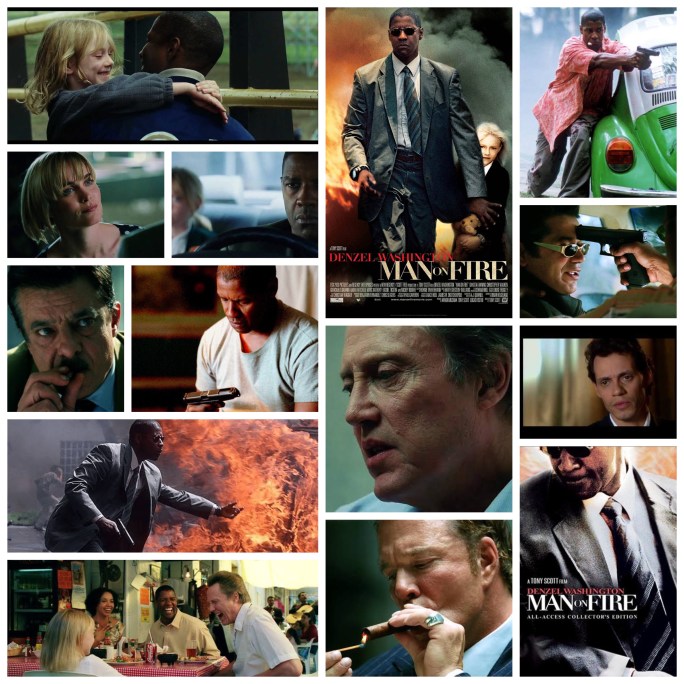
Tony Scott’s Man On Fire

Tony Scott’s Man On Fire is one of those films I can watch time and time again and never get tired of, a magnificently melancholy tale of south of the border justice, criminal intrigue and a tequila shot of pulpy, blood soaked style that gets me every time. It’s loosely based on a 1987 film of the same name starring Scott Glenn, Jonathan Pryce, Danny Aiello and Joe Pesci (there’s a random lineup) but Scott intrepidly branches off into new territory, and thank the gods for his vision. This was the first film where he really explored that sketchy smokehouse of an aesthetic that he would later take to angelic heights with Domino. Colors blur and saturate, editing rockets by with the force of a bullet in a storm, subtitles appear arbitrarily and seemingly of their own volition. It’s a jarring tool set that he employs, and many abhor it. I’m as in love with it as he was though, and whether to throw us right into the protagonist’s psyche or simply because he felt the need to paint his pictures this way, the rest of the films in his remaining career carried the DNA, in varying doses. Fire is the key word for this film, in many of it’s forms. There’s a smoldering ember in Denzel Washington’s John Creasy that is fed by the winds of corruption as the film progresses, erupting into a blazing inferno of violence and fury. Creasy is a broken man, haunted by the questionable, never fully revealed actions of his military past. “Do you think God will ever forgive us for what we’ve done” he grimly asks his old war buddy Rayburn (a scene stealing Christopher Walken). “No” Rayburn ushers back curtly. It’s at this heavy nadir we join Creasy, lost in a sea of alcohol and guilt, an unmooored ship with a shattered hull looking for both anchorage and repair. Rayburn hooks him up with a bodyguard gig in Mexico City, keeping the young daughter of a rich businessman (Marc Anthony, terrific) safe from the very real threat of kidnapping. Dakota Fanning is compassionate, precocious and endearing as young Pita, who spies the wounded animal in Creasy right off the bat and tries to make friends. Creasy draws back in reluctance, but eventually warms up. I love the pace of this film to bits. It spends nearly half of its hefty running time simply getting to know these two characters, forging a bond between them before the inciting incident even looms on the horizon. And when the kidnapping occurs, as it must, the stakes are high as can be and our investment level in the situation is paramount. Setting up character is so key, and Scott nails it with scene after scene of quiet and careful interaction. Then he yanks the lid off the pot, as Pita is snatched in broad daylight, Creasy is shot and the kidnappers vanish into thin air. Pita’s mother (a soulful Radha Mitchell) works with the dodgy Mexican authorities and her husband’s lawyer Jordan (a sleazy Mickey Rourke). Creasy has other plans. Once healed, he embarks on a mission of fury and vengeance, knocking down doors, removing limbs, inflicting gratuitous bodily harm and using every technique in his training (believe me, there are some interesting ones) to track down those responsible and get Pita back. Washington does all this with a calm and cool exterior, letting the heat emanate from every calculated syllable and intense glare. The descent into Mexico City’s criminal underworld is a grisly affair, and all sorts of ugliness is exposed, shredded through the caffeinated prism of Scott’s lens. Two cops do what they can to help Creasy, idealistic Guerrero (Rachel Ticotin) and battle hardened Manzano (the always awesome Giancarlo Gianninni). It’s Creasy’s show though, and he blasts through it like a righteous hurricane of blood and bullets. Scott’s films have a knack for ending in over the top, Mexican standoff style shootouts, but the man subverts that here, going for something far more sorrowful and atmospheric, ending an intense tale on notes of sadness and resolute calm, gilded by the aching tones of songstress Lisa Gerrard and composer Harry Gregson Williams. Walken provides both comfort and catharsis, the only beacon of hope for Creasy other than Pita. Unlike John, Rayburn has moved on from the horrors of their past, but one still sees the trauma in his soul when he looks John in the eye and gets hit with what is reflected back. Tough stuff to get right, but hey, it’s Walken we’re looking at here, and he’s brilliant. Rourke has little more than an extended cameo, but his flavor is always appreciated, and he’s great too. I had no idea Anthony had the chops he exhibits here, but I loved his arc as well and he holds his own in a blistering confrontation with Creasy. Washington is an elemental beast, shadowing what’s left of his humanity under a cloak of booze and brooding contemplation, until he’s coaxed out by the life saver Pita is. Then he’s a lion, riding guns out into a ferocious swan song of a sunset that may just hold rays of redemption for him. This is Scott at his best, his unique brand of storytelling at its height, his creative juices a canister of lighter fluid set aflame with genius and innovation. A masterpiece.

-Nate Hill

Roger Donaldson’s White Sands

Somewhere out there in the gypsum dunes of New Mexico there’s White Sands, a long lost, slightly unfinished yet captivating neo-noir about small town law enforcement, big time gun runners and everyone else who gets caught up in between. Willem Dafoe is Ray, a bored rural sheriff who sees a way out of the dusty hum drum when an apparent smuggler turns up dead on his watch out there in the national park, prompting him to steal the guy’s identity and dive headlong into the illicit arms business with no real crash course or idea of what he’s doing. A risky move that propels the film down an exciting, sexy, ambient journey of untrustworthy alliances, atmospheric shootouts and a dangerously charming Mickey Rourke as Lennox, the kind of reptilian criminal who’s so good at seducing you into the lifestyle that you don’t realize you’re in the snake pit until it’s almost too late. Dafoe and Rourke have shared the screen aplenty before and while my favourite team up has to be their cartel duo in Robert Rodriguez’s Once Upon A Time In Mexico, this film certainly takes second place honours. They just work so well on camera together, a shaky bromance built on Ray’s deception and Lennox’s unpredictable penchant for violence that proves electric as the narrative weaves around them. The always phenomenal Mary Elizabeth Mastrantonio plays an underworld connection who Ray unwisely gets steamy with in probably one of the hottest sex scenes of the 90’s and a complete false advertisement for the success rate of getting it on in the shower. Samuel L. Jackson has a fantastic early career villain role as the kind of corrupt FBI agent in whom it’s very unwise to place trust, and watch for others including the great Maura Tierney, M. Emmett Walsh, James Rebhorn, Beth Grant, Miguel Sandoval, Jack Kehler, Mimi Rogers and a sneaky unbilled double cameo from Fred Dalton Thompson and the inimitable John P. Ryan as slick arms dealers. The setting of White Sands park plays such a role in atmosphere here; the ghostly sight of white sand dunes brings about the thought that something is out of place, rare in nature and the same can be said for Dafoe’s affable sheriff thrown into a mixing pot of big city psychos and genuine menace, a fish out of water shtick that pulls you in the more accustomed to this netherworld the man gets. How about that knockout original score from Patrick O’Hearn too, who only composed for a handful of things since, it’s a hazy, melodic set that suggests both the beauty and danger lurking out there in the Sands, especially in the simmering climax where several characters meet poetically grisly fates. I do have a few minor issues with this film, it could have been at least fifteen minutes longer and rounded out the epilogue with Dafoe’s arc clearer, it almost feels like there’s a missing reel or some editing glitch that marred the final product just a tad, but it doesn’t hurt the film too much overall. This is a lost classic for me, a gorgeously specific film noir with some of my favourite actors giving some of their most fun, playful work, the aforementioned score and some cinematography that won’t quit. Great film.

-Nate Hill

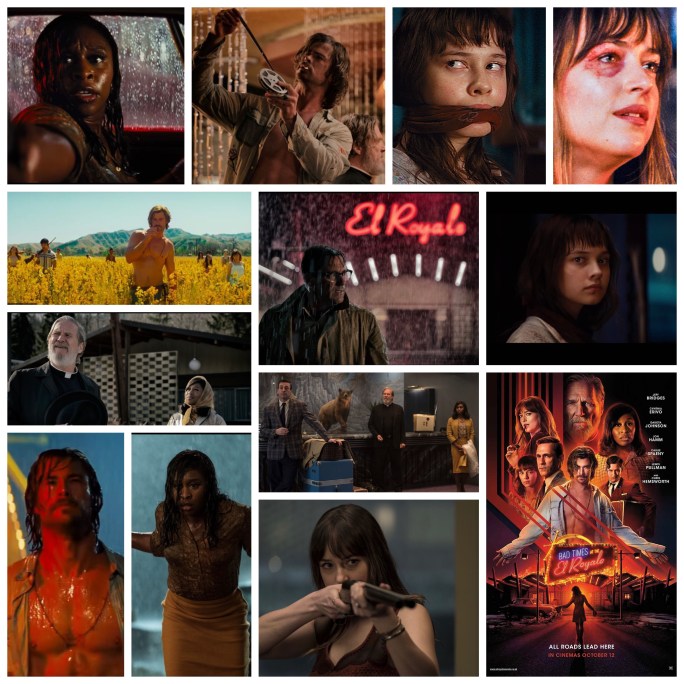
Drew Goddard’s Bad Times At The El Royale

Although not quite the dense, delicious narrative feast I envisioned based on marketing, Drew Goddard’s Bad Times At The El Royale is an impressively mounted period thriller with gorgeous late 60’s production design, fantastic performances from a variety of players and a hard boiled, ultra violent storyline loaded with equal helpings of melodrama and pulp. Somewhere along the Nevada/California state-line lies the ornate El Royale, a retro pop funhouse with a giant chandelier, soda jerk sensibilities and and a jukebox that doesn’t quit. The rooms in California cost an extra dollar a night than those in Nevada because of course they do. A handful of strangers show up one fateful day in 1969, the motives, pasts and true temperaments of which are slowly revealed throughout the rainy night via an elliptical tale that weaves forward, backwards and flows past many perspectives and angles to show what is actually happening. Jeff Bridges is the salty preacher with memory issues, Jon Hamm the chatterbox salesman who moonlights as a clandestine federal agent, Lewis Pullman the dodgy hotel clerk, Dakota Johnson and a scary Cailee Spaeny two hippie sisters on the run and Cynthia Erivo in the film’s best and most human performance as a fledgeling singer just trying to survive the crazy night. Alliances shift, flashbacks sometime prove reliable and sometimes not, people are killed graphically, the rain pours down, intentions are laid bare and that jukebox keeps on keeping on. The soundtrack they’ve amassed is something else here, an old time collection of Mo town, sun n’ surf and heartfelt solos by Erivo that give the film a vibrant personality. And yes, Chris Hemsworth is in it too, playing a volatile, Manson-esque cult leader with a short temper, long hair and a button down shirt that conveniently never gets buttoned down (anything to fill those seats). The character is a bit much and sort of takes over the wheel in the third act, but Chris is too young to pull something that magnetic off as well as others could and I couldn’t help feeling like he was miscast. The film sort of suffers from what I call Hateful Eight syndrome a bit; when you have an Agatha Christie sort of tale to tell, the setup is always a tantalizing mystery that, once unravelled, has to feel worth the build and earn its revelations along the way. The payoff here is better than Hateful Eight and the film overall is stronger too, but I felt just a smidge underwhelmed once everything was laid bare and the wrap up rolled around. Nevertheless, this is a surefire piece of thriller entertainment with many elements that work terrifically, namely acting, dialogue and production design. Erivo seems to have come out of nowhere and also impressed me in Widows earlier this year, she grounds the film in reality and serves as the moral compass of sorts in this miasma of reprehensible human behaviour, I hope to see more of her and hear more of that singing voice in the future. Spaeny too was excellent, playing a pitch perfect acolyte with an unbalanced edge and a dead eyed stare that was truly chilling and definitely reminiscent of what I’d imagine a freaky ass flower power cult chick would have come across as back then. A fine piece of entertainment that wasn’t as deeply plotted as it could have been, but blasts by with admirable energy and streamlined ambition.

-Nate Hill

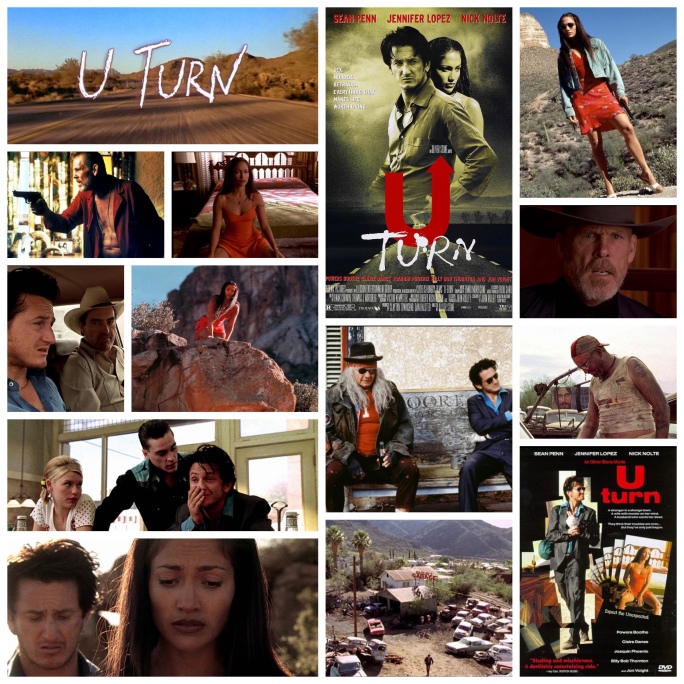
Oliver Stone’s U Turn

Ever had one of those days where literally everything seems to go wrong and there’s some kind of invisible cosmic force aligned against you? Sean Penn’s Bobby has one of those in Oliver Stone’s U Turn, a deranged, sun drunk parable by way of neo-noir and near Boschian displays of brutal human behaviour punctuated by pockets of the blackest comedy one can find. This is a deliberately, brutally unpleasant slice of nihilism that wouldn’t be easy to swallow were it not so fucking funny, so gorgeously visual, so perkily acted by the knockout ensemble cast and so beautifully scored by Ennio Morricone. Penn’s Bobby has the rotten luck of breaking down in the one horse town of Superior, Arizona, where bumpkin mechanic Billy Bob Thornton takes his sweet time patching up the rig, leaving him to drift about town and get in all sorts of trouble. There’s a rockabilly maniac named Toby ‘TNT’ Tucker (Joaquin Phoenix) who wants Bobby’s head for ‘making time’ with his girl (a loopy Claire Danes). The menacing local Sheriff (Powers Boothe) seems hellbent on doing anything other than protecting and serving. Jennifer Lopez is sultry babe Grace, who snares him up in a dangerously lurid love triangle with her husband Jake (Nick Nolte at his utmost Nick Nolte-iest), who also happens to be her stepfather (!). This all boils into a mucky miasma of murder, violence, sex games, insurance fraud, gas station robberies, betrayal, severed limbs, manipulation and any other noisy calamity you could think of to befall a small town in Arizona that the rest of the world has seemingly forgot. Bobby is on the run from a scary Vegas loan shark (Valery Nikoaelev), but nothing he can do compares to the level of hurt these warped townsfolk inflict upon him, so it’s kind of an out of the frying pan into the fire type scenario. The thing is, Bobby himself is something of a reprehensible scumbag anyways, so there’s a cheeky masochist edge in watching him traverse this dusty, 9th ring of Americana hell and circle an ending of inevitable doom. ‘Treat others how you wish to be treated’ is an adage that almost every single character in the film seems to have sadly forgotten or chose to ignore except one individual, a blind old native man played with disarming truth by Jon Voight. Bobby has several encounters with him, and he’s the only one who isn’t after something, doesn’t display hostility or unkindness, he speaks plainly and offers Bobby bitter pearls of wisdom that ultimately go unheeded. Stone employs the same type of jittery, whacked out visual surrealities he used in Natural Born Killers, a deeply saturated colour palette, tumble dry editing techniques and more breathe life into this vivid version of curdled small town life in the vast, lonely desert. Morricone’s score is a spring loaded jack-in-the-box in areas and a melodic, melancholic lullaby in others, an underrated composition that gives the film an eerie sadness and zany vibration all it’s own. There’s more going on than meets the eye here; at surface level it’s a dark crime comedy with a quirky edge, but both Voight’s character and a few mysterious hints at Lopez’s backstory with the tribes in the region hint at a deeper, darker sense of malice lurking out there with the coyotes, suggestive of an almost mythic aspect. Stone gets high praise for his political dramas, but I’ve always loved him best when he’s doing genre stuff, he’s such an expressive storyteller and the real fruit of his imagination comes out when he’s turned loose. For me this is his second finest work after Natural Born Killers and before Savages, the three films that seem most genuine and celebratory of the medium. In any case, U Turn is a southern fried, asphalt laden, angry, sexy, perverse road trip to sunny noir heaven or hell, and a masterpiece. Watch for neat cameos from Laurie Metcalf, Bo Hopkins, Brent Briscoe, Julie Hagerty and Liv Tyler.

-Nate Hill

John Frankenheimer’s Reindeer Games

I’ve always enjoyed John Frankenheimer’s Reindeer Games, despite its chilly critical reputation. It’s a sleazy, nihilistic piece of ultra violent, stylized Christmas noir populated by mean, nasty characters who navigate deliciously convoluted plot turns, double crosses and backwoods criminal enterprise. Ben Affleck plays a hapless ex con having the worst Christmas of his life when his attempts to pose as a murdered cellmate (James Frain) and meet up with the guy’s sexy pen pal (Charlize Theron is next level hot in this) don’t quite go as smoothly as envisioned. He unwittingly gets caught up in a botched casino robbery orchestrated by her volatile career criminal brother (Gary Sinise) and his crew of murderous miscreants. This sets in motion an impossibly elaborate parade of shifting loyalties, multiple seductions on Theron’s part, inventive ways to murder people, Santas with guns, shootouts, chases and car explosions. Much of it is admittedly ridiculous and overblown but it’s never not fun, plus the Grinchy, misanthropic attitude and maladjusted vibe is somehow so infectious. Sinise’s merry little gang are brought to life by recognizable character faces like Donal Logue, Clarence Williams III and Danny Trejo, all charismatic and evil to the bone like a bunch of warped Christmas elves. The late great Dennis Farina plays an obstinate casino owner who makes the heist difficult for everyone, and Isaac Hayes has a bizarre cameo as an inmate who thinks there’s monsters in the prison food and causes an almighty ruckus. Affleck is a mopey guttersnipe here, a ‘wrong place wrong time’ sap who learns to cultivate a badass edge and deal with the kind of psychos he’s up against. Sinise is reliably violent and dangerous, but Theron really steals the show as a crafty, manipulative femme fatale whose true nature is cleverly hidden under a smokescreen of faux intentions. This isn’t an especially classy thriller, doesn’t set any new standards or anything, but what it does do is provide a nut punch of lowbrow thrills, lurid melodrama and bloody action to meet your masochistic Yuletide needs. Great stuff.

-Nate Hill

Tony Scott’s Domino

Domino is Tony Scott’s fire roasted, charbroiled, turbo charged masterpiece. I’ve seen it over fifty times and every time I seem to enjoy it more. It’s pure unfiltered Scott, free from the nagging pressures of the studio, financed by his own company, a loving treatise of pure style and breakneck kamikaze energy that doesn’t let you breathe for a second. It’s loosely based on the life of Hollywood baby turned rough and tumble bounty hunter Domino Harvey (Keira Knightley), daughter of actor Laurence Harvey. She leaves the 90210 world of rich snobs and gilded mansions to pursue a grittier path, in the form of restless underground law enforcement. Now, the film sheepishly admits it’s not entirely based on a true story before the credits even start, so as long as you know that much of it is fantasy going in, you won’t feel cheated. Knightley is a pissed off, sparking roman candle in the role of her career, shedding the dainty image and going full furious grunge, giving Domino an alternative edge and damaged pathos that fuels much of the film’s kinetic energy. Mickey Rourke plays her grizzled boss Ed Moseby, a veteran bounty hunter with a trail of violence behind him, who’s weary and tough in equal parts. Rourke fires on all cylinders, giving some of his simultaneously hilarious, heartbreaking, badass and best work. Edgar Ramiraz plays scrappy Choco, third musketeer and eventual lover to Domino with fiery Latin charisma. Christopher Walken, weird mode fully activated, waltzes in as a reality TV producer with the attention span of a ferret on chrystal meth, Mena Suvari as his squirrelly assistant, Lucy Liu as a prim, OCD afflicted federal agent who verbally spars with Knightley in flash forwards, Delroy Lindo is excellent as their bail bondsman handler Claremont Williams, and there’s scuzzy work from Dale Dickey, Lew Temple, Macy Gray, Monique, Dabney Coleman, Jacqueline Bisset, Jerry Springer and more. Just to sample some of the esoteric weirdness that goes hand in hand with the hard boiled crime elements, Tom Waits has a beautifully perplexing cameo as a spiritual wanderer who has a mysterious meeting with Domino and her friends in the Mojave desert, imparting some prophetic truth to them that only Scott and the sand dunes are in on. This is the kind of film that grabs you by the collar and hurls you down an asphalt horizon of hallucinatory camera work, brings you an intricate, lurid story of true crime gone wrong, and a balls to the wall depiction of life at its fastest, wildest and most out of control, as only the maestro of such things, Scott, can bring you. Domino, at least in this film, lives a crazy life that culminates in a hellish Mexican standoff and subsequent shootout atop a Space Needle-esque Vegas casino, a fitting way for a Scott film to come full circle and certainly not the first time he’s ended one in that situation. He uses cinematic magic to create visual poetry here, his sucker punch editing, nebulous display of scorched out colours, thunderous symphony of sound design and hectic, buzzing aesthetic isn’t for everyone but it’s something truly unforgettable and a style wholly his own, I truly miss the guy and believe he was one of maybe the ten best filmmakers to ever work in Hollywood. This is by far his best film, definitely his most personal and also the most arresting vision he’s ever sculpted, it will leave you haunted, pummelled, fired up and deliciously puzzled. Domino ironically says in voiceover near the end, “I’ll never tell you what it all meant”. Scott tells you, in his own special way, and if you’re tuned in to his otherworldly frequency you’ll treasure this masterwork as much as I do, and will continue to for years to come.

-Nate Hill

Barry Levinson’s Bandits

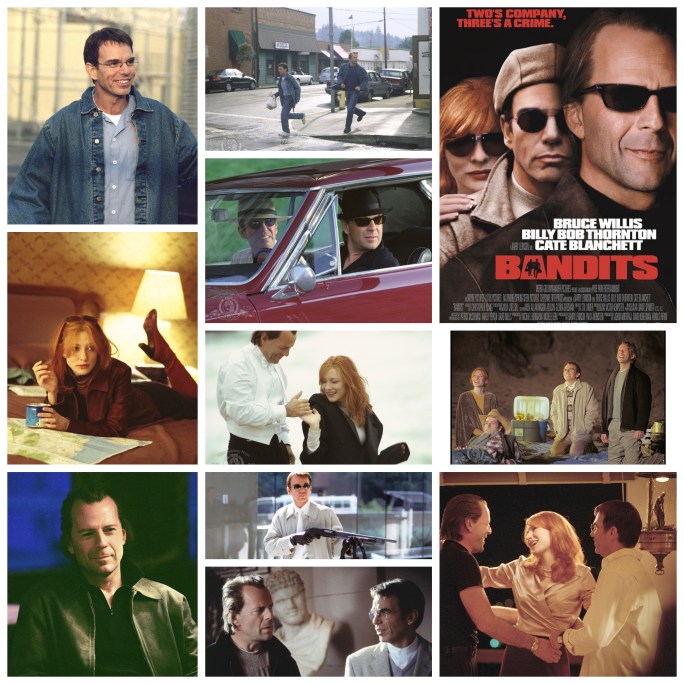
Every once in a while a quirky indie style film slips through the studio system disguised as a star powered blockbuster, and usually isn’t met with the best reception. Such is the case with Barry Levinson’s Bandits, a buddy crime flick by way of an oddball love triangle marketed as Elmore Leonard/Tarantino type fare but emerging as something way more stream of consciousness and weird. Bruce Willis and Billy Bob Thornton play two slippery, bickering bank robbers who bust out of prison using a cement truck (that’s a new one) and continue their nationwide spree of larceny and mayhem, but none of that is even close to as violent or intense as it sounds. There’s a schoolboy charm to these two and every hostage they take, every bank they knock over is a breeze, feeling like a pleasant, quaint experience. Eventually a bored housewife (Cate Blanchett) tags along and they both fall for her, causing friction in a few ways. The three actors are perfect for each other; Willis is the cocky ladies man who has tunnel vision and doesn’t think too hard or too far ahead, Thornton ditches his usual alpha male snake shtick for a jittery, sweet natured hypochondriac fellow and their camaraderie is irresistible. Blanchett is never not in top form and it’s easy to see how a girl like her could stray into their lives, eventually becoming very important to both. Now, anyone looking for taut action scenes, an intricate plot or specifically verbose, showboaty dialogue will be disappointed. As penned by Twin Peaks writer Harley Peyton, most of the character interaction has a spontaneous, free flowing aesthetic and feels improvised half the time, which I loved. As for plot, the bank robber framework simply serves to see these guys meander around beautiful Oregon hanging out and talking with each other, with only a few succinct, clear cut set pieces. This is a film about what happens in between the action scenes or the robberies, about quiet situational humour, quirky romance and organic conversation. It’s tough to adjust to and nothing about the DVD artwork suggests how odd and airy the film will be, but if that’s your bag then you’ll love it. It drags a tad in the third act but pulls together nicely for a cheeky resolution to their story, and is overall an enchanting piece of comedic crime by way of impromptu theatrics. Loved it.

-Nate Hill

Deadfall

Deadfall is a dangerously sexy, offbeat snowbound thriller with a gorgeous cast, wintry photography and a hard boiled noir edge that feels almost mythical at times. Despite an ending that doesn’t come close to wrapping up its multifaceted, emotionally dense story (someone shit the bed in the editing room), I still love it, it’s wonderfully atmospheric, using character and story to transport you into the narrative, while violence and action comes second but with no less of an impact. Eric Bana gives one scary knockout performance as Addison, a charismatic sociopath on the run with his sultry, damaged goods sister (Olivia Wilde) following a casino robbery that ended in bloodshed and a statewide manhunt. After their car gets spectacularly destroyed, they’re forced through the wilderness to a small county and try to evade encroaching law enforcement. At the same time, a troubled ex-prizefighter (Charlie Hunnam) is en route to the same county to spend the holidays with his estranged parents (Sissy Spacek and Kris Kristofferson), and the paths of these ill fated characters inevitably collide in a blood soaked blizzard of cat and mouse games. Kate Mara is also fantastic as the daughter of an asshole local sheriff (Treat Williams) who thinks that women have no business carrying a badge. There’s a lot of plot threads and elements at play, most of which the film handles with adept fluidity, except for the very end where it seems like a scene or two is missing, I could have used a bit more resoluteness in Hunnam’s arc. The film overall is too good to nitpick, especially Eric Bana’s work, the dialogue written for him has a poetic, ponderous cadence. He really sinks into the role, casting a freaky, incestuous eye towards his sister and calmly, deliberately terrorizing anyone who gets in his way, including a mysterious First Nations man (Tom Jackson) who serves to represent the esoteric nature of the landscape clashing with the materialistic, hard edged criminal element trespassing on it, or at least that’s how I saw it. A near excellent film with more going on under the surface than the mounting blanket of snow suggests (I can’t resist the winter metaphors), plenty of thrills and conflict as well as a fine cast all doing great work.

-Nate Hill

Harold Ramis’s The Ice Harvest

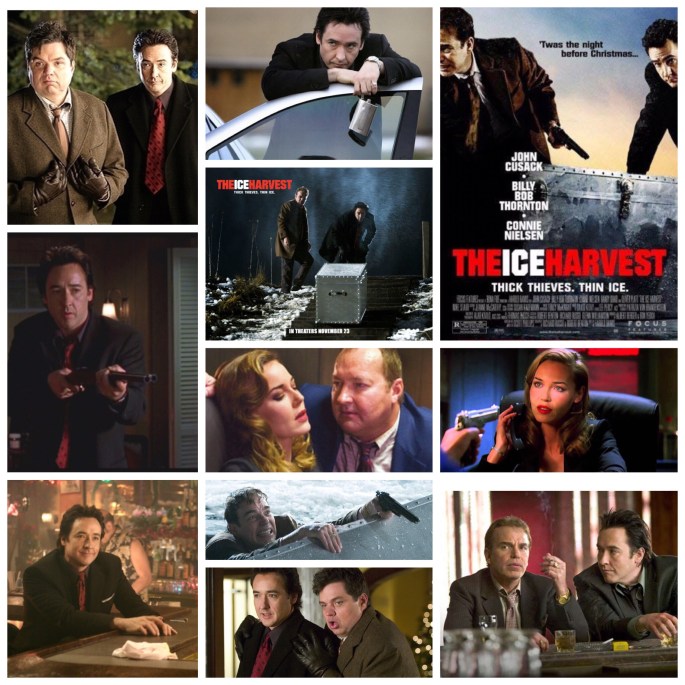
Harold Ramis’s The Ice Harvest is one of my favourite Christmas films and completely overlooked for the dry, sardonic black comedy gold that it is. It’s one of those dour, gloomy Christmas films where not only do things not go the protagonist’s way, but pretty much spiral out of control for everyone else too and the festive setting serves as an ironic lacing to the wry, nihilistic and comically violent story. John Cusack is laconic boozehound mob lawyer Charlie, who has just embezzled his gangster boss for a couple million, with the help of his scheming guttersnipe of a partner Vic (Billy Bob Thornton at his utmost sleaziest). That’s the jumping point for a deliciously warped, noirish descent into deranged family values, deadpan interactions, double crosses and drunken shenanigans, and really is there any other way to spend Christmas Eve? There’s a femme fatale in stripper Renata (Connie Nielsen, rawr), the specifics of whose loyalties remains gleefully ambiguous until later on, a titty bar bouncer (Ned Bellamy) with serious anger issues, a nasty thug (Mike Starr) dispatched to kill them and the vengeful big city kingpin who has been swindled, played by a blustery, cheerfully psychotic Randy Quaid. Speaking of scene stealing, Oliver Platt does an encore as Charlie’s best friend who is now married to his bitch of an ex wife, the impromptu Christmas dinner scene the entire family shares is some kind of fucking demented, mean spirited comedic genius (“Turkey Lurkey!”). It’s interesting because there is not one single redeemable character in the film, they’re all a bunch of conning, backstabbing, murdering, ill adjusted, jaded criminals and severe alcoholics, especially Cusack, who downs enough bourbon throughout the whole night that it’s a wonder he can stand up for the third act. But somehow… somehow there’s a strange likability to these poor souls, trapped in a perpetually snowy Wichita Kansas trying to outsmart, outgun and out-drink each other. Morality rears it’s head but once among the gunplay and verbal sparring, when Charlie imparts a parable to Platt regarding his two uncles, one of whom was a standup guy and died early and the other a scumbag that lived a long life. His point being that it doesn’t matter what we do in the service of morality because it could all end tomorrow, nothing even matters so why waste time trying to be good and get off the naughty list? I enjoy that cheeky justification, and what better time for it than Christmas? A classic for me.

-Nate