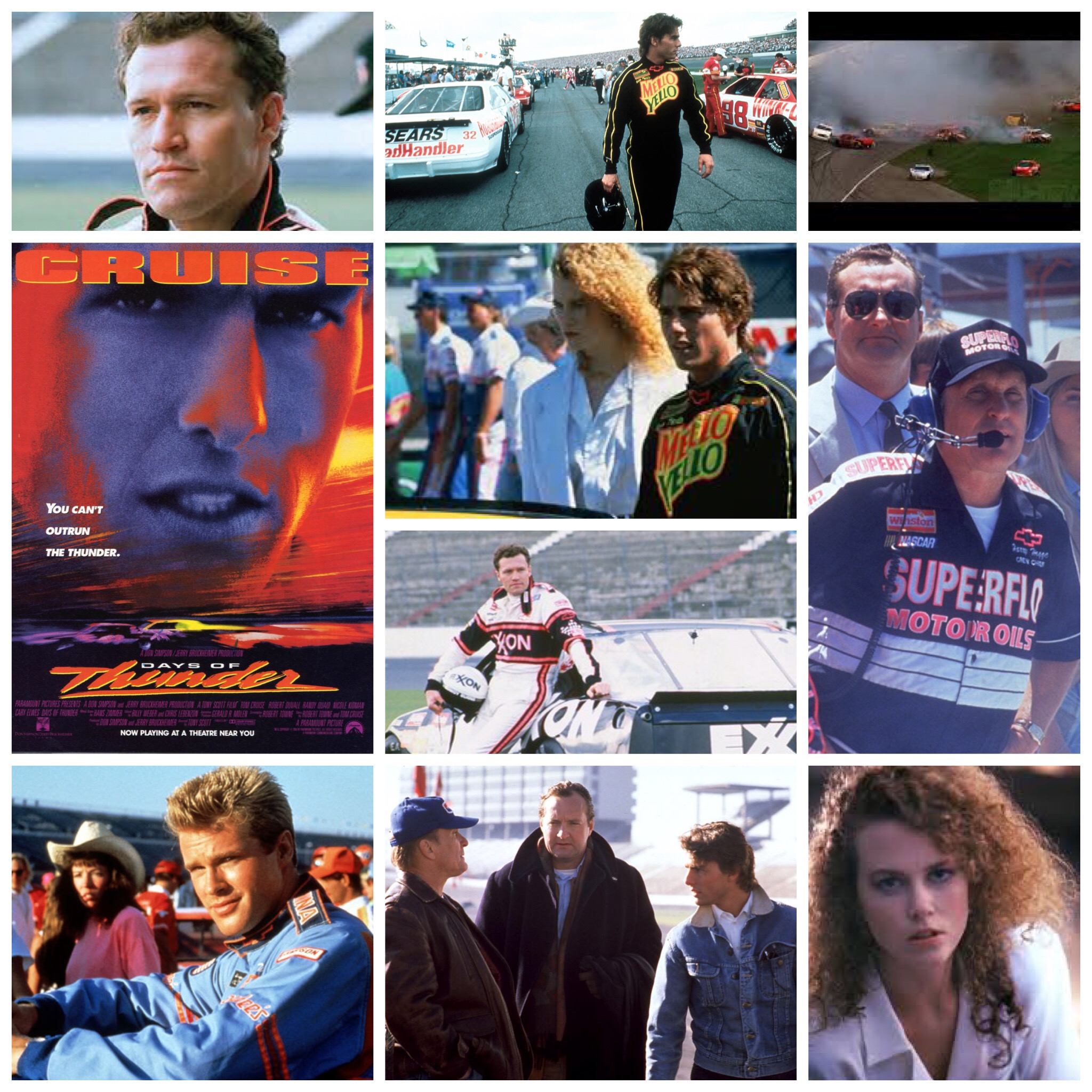
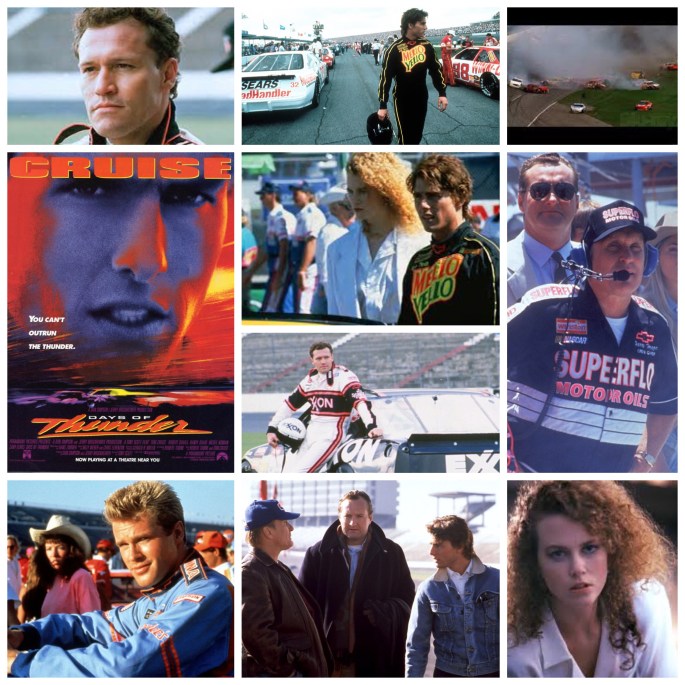
Tony Scott’s Days Of Thunder 


The first ten minutes or so of Tony Scott’s Days Of Thunder should be used to demonstrate the power of any new home theatre/speaker/sound system freshly harvested from Best Buy. As it opens on a piping hot stock car race-track in the midst of noonday sun festivities and preparations for the day’s events, Hans Zimmer’s explosive, patriotic thunderbolt of a score kicks in and you feel that mad rush of adrenaline reserved for only the most combustible, rabidly entertaining movie magic. It’s just too bad that the rest of the film can’t keep up with the level of energy on display in that whopper of a prologue, despite doing it’s very best. An obvious sister film and coattail hugger of Scott’s other ‘loud noises’ film Top Gun, there ain’t much to it other than screaming race cars and a daredevil Cole Trickle (Tom Cruise) trying to prove his sporting worth to various folks including the romantic interest, a doctor played by sexy Nicole Kidman and the sagely Yoda of stock car lore (Robert Duvall). He also has quite a few homoerotic run-ins with rival/partner Rowdy Burns (Michael Rooker is certainly someone I’d tag with the adjective rowdy), and of course races a whole bunch of race cars as well as crashes a few. You gotta hand it to cinematographer Ward Russell, as it can’t be an easy task to do crisply capture those vehicular torpedoes as they careen by at a zillion miles per hour, let alone immortalize the afternoon sun glancing off the Wonderbread sponsor logos so beautifully. Like I said, after that initial banger of an opening credits sequence, its run of the mill in terms of story, albeit dynamite in terms of stunts. Watch for work from Randy Quaid, Cary Elwes, Fred Dalton Thompson, John C. Reilly and mega-producer Don Simpson in a neat extended cameo. The real magic happens with Zimmer’s score though, go check it out on YouTube, as iTunes only has some weak retread by some philharmonic orchestra schmucks. Quite possibly one of the maestro’s best works. 

-Nate Hill

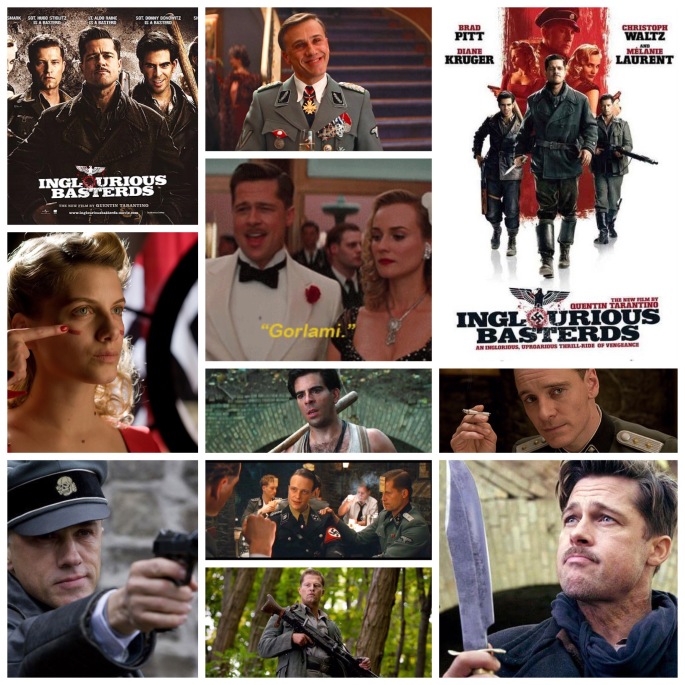
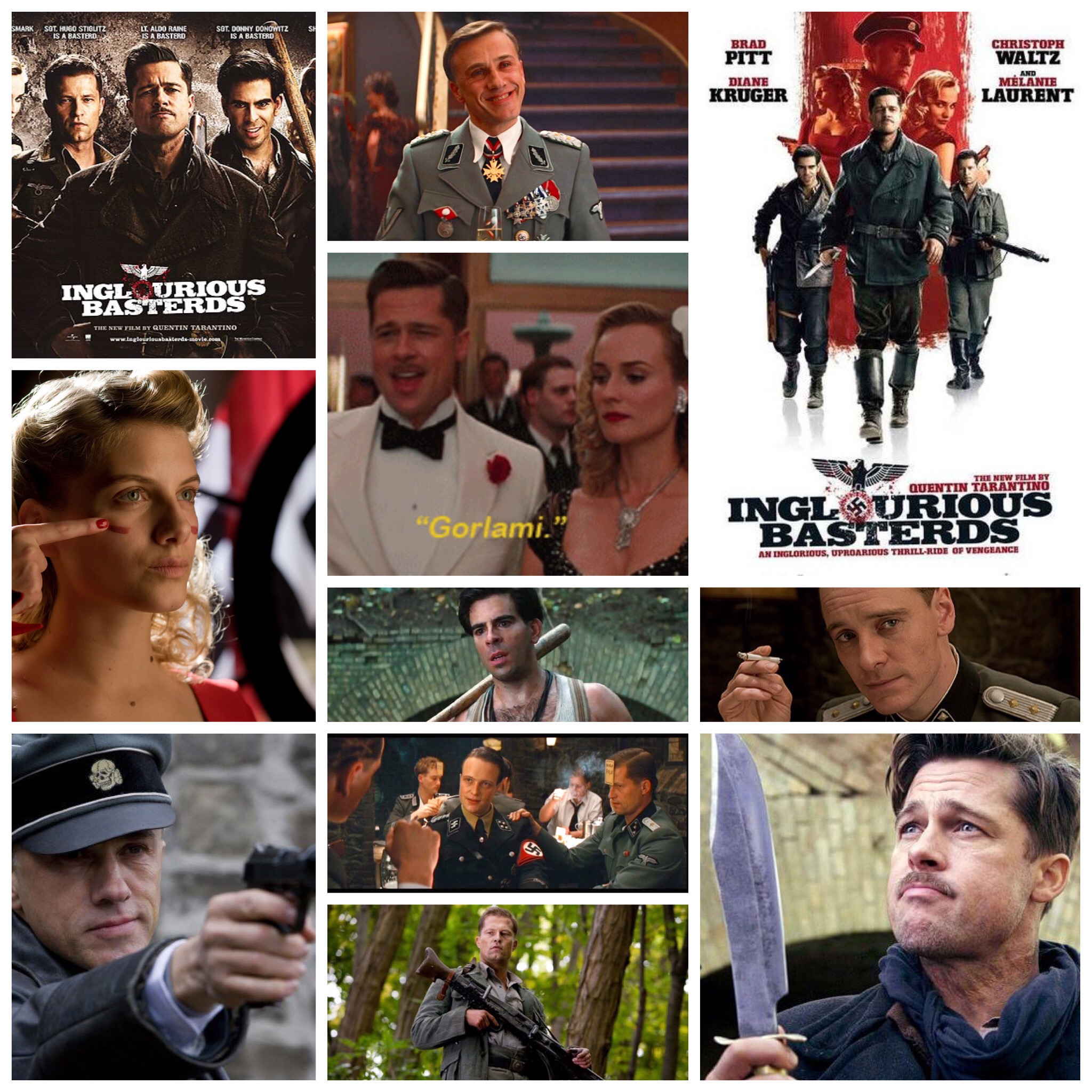
Once Upon A Time In Nostalgia Occupied France: Revisiting Quentin Tarantino’s Inglorious Basterds


Having rewatched Quentin Tarantino’s Inglorious Basterds the other night for the first time in years, I’d since forgotten what a fuckin rip snorting good time at the movies it is. It used to rank fairly low on my Quentin-metre, but not only has it aged quite nicely since 09′, it’s even better than I remember it being in theatres. I think that one of the reasons I didn’t hold it in such high esteem right off the bat is that I wasn’t prepared for the blunt revisionist history approach, which at the time I think felt very silly and fake. I get now what he was going for and appreciate it tenfold more than I did then. From the opening chords of a Morricone piece that signals the portentous arrival of Christoph Waltz’s terrifyingly affable Jew hunting SS nutbar Hans Landa, this film is a near perfect ballet of extended dialogue, shocking musical cues and sporadic bursts of satisfying and graphic violence. It’s an episodic roundtable outing that spins around to focus intently on specific scenarios for quite a bit of time before jarringly shunting off to the next. Young Shosanna (Melanie Laurent) runs a quaint cinema in rural France that garners the attention of a pesky German war hero (Daniel Brühl). Evil Landa and his corps doggedly hunt enemies of the state whilst preparing to act as a security force for a bigwig film premiere attended by the Fuhrur himself, et al. Elsewhere in Germany, a plucky band of double agents led by Michael Fassbender and Diane Kruger await instructions on a small tavern, commissioned by Winston Churchill and Austin Powers to carry out their mission. This sequence is a textbook example on how to whip up vice grip suspense until one can barely breathe, then cut the cord loose all of a sudden, brilliantly structured, written and acted scene all round. Brad Pitt also leads his merry band of Nazi killers all over Europe creating havoc and delivering some of the best dialogue that the Q-Man has ever penned. The sequence where Aldo Raine (Pitt) and his crew must be ‘fake Italian’ to blend in at the film premiere is the single funniest thing in a Tarantino film to date. The cast is layered with all kinds of wonderful work, standouts from August Diehl, Richard Sammel, Eli Roth, a priceless Til Schweiger, as well as quick snippets from Samuel L. Jackson and Harvey Keitel. Waltz made a name for himself with the Landa character, and is a simultaneously freaky and funny villain who steals the film each time he shows up to smarm and charm the pants off of everyone else. Funny beyond words, brutally exploitive in the best possible ways, whip smart in writing and characterization and just a hell of a good time, Basterds has held up and even improved excellently since it’s release, and will likely stand as one of Tarantino’s key films in years to come. Gorlami. 

-Nate Hill

Oliver Stone’s Natural Born Killers


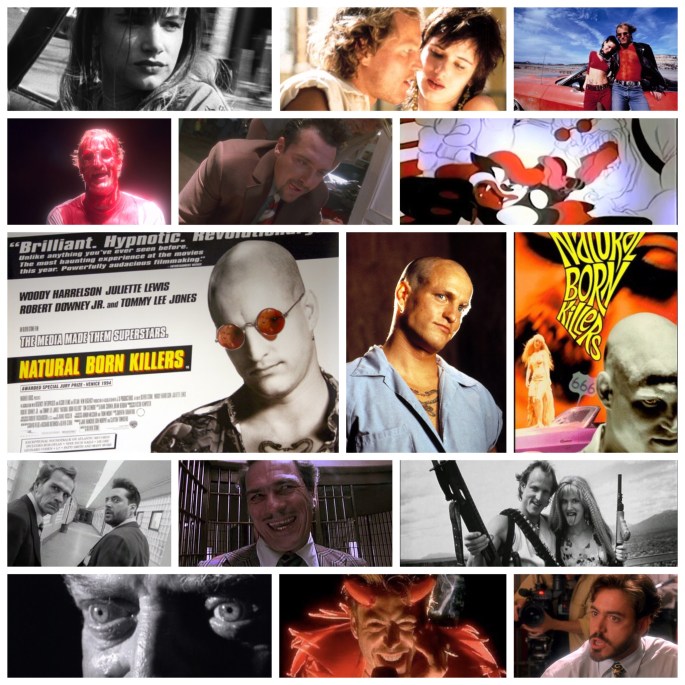
I will sing the praises for Oliver Stone’s Natural Born Killers til the day I either die, am too dementia ridden to compile a coherent review or too arthritic to type anymore (you folks will get some peace and quiet on your social media once any or all of the above happens). This film is less a film than it is a writhing elemental force, a cinematic being brought to life by tools seldom used in Hollywood, namely the sheer audacity of Stone’s frenetic filmmaking style. The MPAA kept an R rating just out of his reach for a while before finally conceding, harping to him that though he cut violent bits here and there to make it semantically tamer, it was the general aura of chaotic madness that irked them so. Stone considers this a compliment, and well he should, for its not everyday that an artist so fluidly taps into the artery of violence and the many catalysts of it in such a primal, intangible way that brilliantly splices what compels us with what appalls is, and the scarily thin line that wavers between them. This film is many things: a psychedelic road flick, a blistering indictment of sensationalist American media and the decaying degeneracy it breeds, a hallucinatory mood piece, a severely expressionistic action film, a thriller, a chiller and the list goes on, but more important than all of those is the love story that ties it all together. Juliette Lewis and Woody Harrelson are sticks of poisoned dynamite as Mickey and Mallory Knox, two twisted up kids on the run from everyone and everything, products of the darkest bowers of bizarro world Americana, deeply scarred by their pasts, fully committed to the wanton murder spree they’ve engaged in and unapologetic about the wave of carnage they’ve left in their wake. Demonized at every turn by the powers that be and everyone else in between, it’s easy to see why a system feeds two sick souls like this with infamy and notoriety instead of helping them. Anything for that big ol’ dollar sign, or simply whatever fills the void. We see the sickness creep after them, ever present in creatures like Tommy Lee Jones’s fire and brimstone prison warden, Robert Downey Jr.’s manic, sickening enabler of a talk show host and Tom Sizemore’s psychotic, gung-ho detective Jack Scagnetti. There’s a saying out there that goes “animals are beasts, but men are monsters, a sentiment that Stone has taken and run right off the cliff with, blasting us in the face with humanity’s very worst for a solid two hours, until he’s damn sure we catch his drift. The film is a stylistic tornado, every kind of colour, lens, filter, soundscape, visual trick and style of editing used until we realize we’re watching something truly unlike anything before, and likely after as well. Mallory’s backstory is staged in a stinging sitcom format as she’s terrorized by her abusive father (Rodney Dangerfield, cast grotesquely against type). Mickey breaks out of prison in black and white Lone Ranger style. A drug store Mexican standoff is painted with swaths of neon vomit green. Shadowy title cards and striking lighting are used in a sequence where the pair visit the lonely desert hut of a prophetic Indian (Russell Means). Visions dance on walls like spectral tv screens, faces leer and loom out of shadows for no apparent reason other than to add to the beautiful commotion, characters skitter through frames looking for a moment like demons. There is no other film like this, no other experience rather, an animalistic treatise on primal human urges, societal constraints that bind them, loosely and laughably out of place when you consider the dark urges within everyone. Amidst all this chaos though, like two corrupted beacons, are Mickey and Mallory. This is their story, and despite being a chief cause of the chaos I just mentioned (the universe has a sense of irony), it’s a love story, they being the centrepiece and everyone else rushing past like dark passengers in a swirling sideshow to their main-tent event. They’re brutal serial killers, no question, but they’re tender and caring with each other, and we see hints at a collective sweet disposition hiding below all those years of built up scar tissue. It’s a gorgeous film, full of scream-at-the-heavens ugliness, imagery that burns a patchwork quilt of impressions straight into your soul, an angry satirical edge that cuts like a knife and so much overflowing style you could watch the thing a thousand times and still pick up on things you never saw before. From the first cacophonous diner slaughterhouse set piece, to the second half of the film that descends into a regular Dante’s Inferno of a prison riot, this film is truly something else, in my top ten of all time and a uniquely affecting experience that has shaped the way I’ve watched films ever since. Plus that soundtrack man.. the story is set to every kind of music out there including Trent Reznor, Lou Reed, Patsy Kline, Peter Gabriel, Dre, Mozart, Marilyn Manson and so many more, with a pair of perfectly nailed opening and closing numbers warbled by Leonard Cohen. Everyone and anyone has quick bits and cameos to support the titanic work of the main cast too, including Denis Leary, Ashley Judd, Arliss Howard, O Lan Jones, Pruitt Taylor Vince, Jared Harris, Mark Harmon, Balthazar Getty, Marshall Bell, Louis Lombardi, Steven Wright, Rachel Ticotin, James Gammon and more. What more can be said about this film? It’s a natural born classic.

-Nate Hill
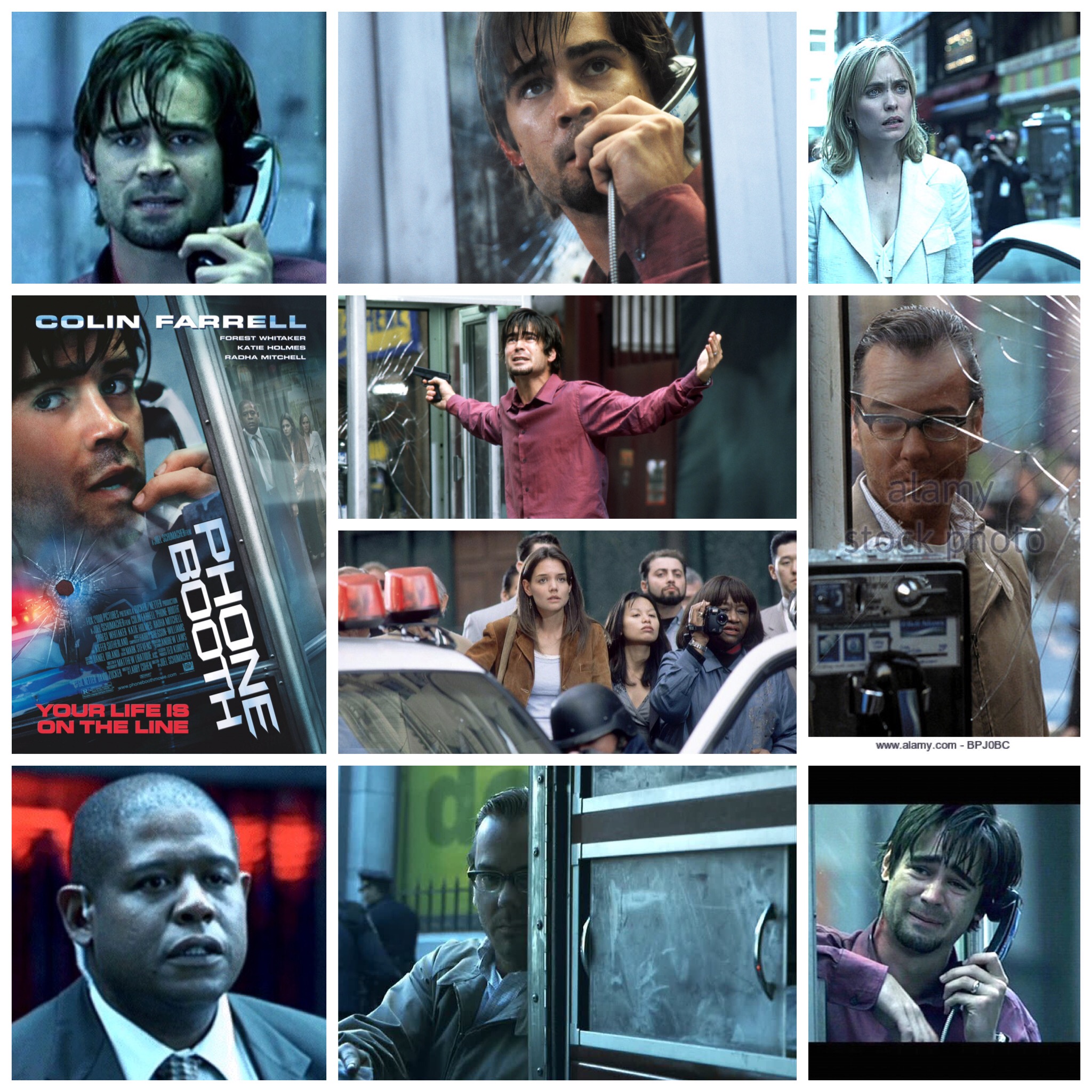
Joel Schumacher’s Phone Booth 


“Isn’t it funny? You hear a phone ring and it could be anybody. But a ringing phone has to be answered, doesn’t it? Doesn’t it?”

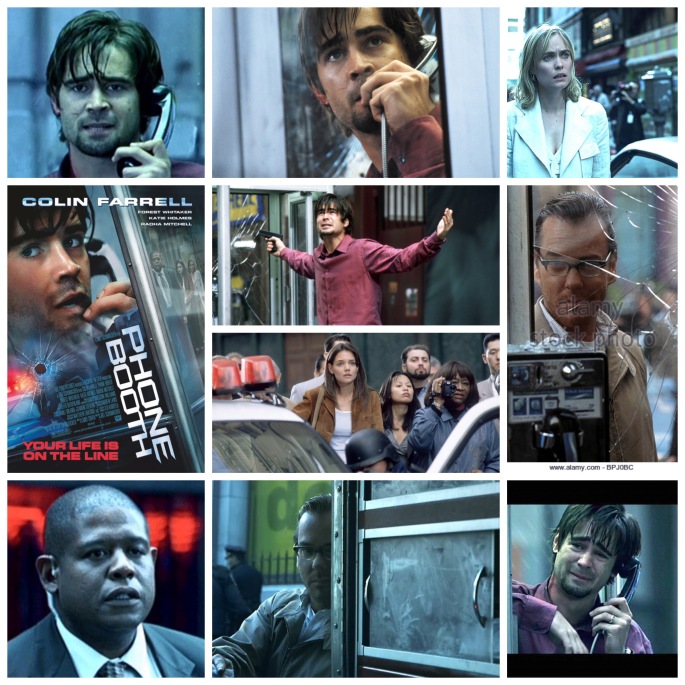
So snarls Kiefer Sutherland’s mysterious telephone terrorist to a petrified Colin Farrell in Joel Schumacher’s Phone Booth,

a taut, entertaining and oh so slightly heavy handed single location thriller that brings home the bacon, albeit messily spilling some grease along the way. Farrell is a hotshot businessman who steps into a phone booth (remember those?) one day, which serendipitously happens to also be the favourite haunt for sniper slinging whackjob Sutherland, who plays sadistic mind games, extorts the poor guy and digs up his darkest secrets, all while keeping him firmly in the crosshairs of his high powered rifle. The cops, led by a stoic Forest Whitaker, are perplexed at first and eventually drawn into this monster’s web too, as Farrell’s life begins to unravel at the whims of this unseen harasser, and the audience gets to see just how far either will go to resolve or escalate the situation. In this day and age there’d never be a scenario like this, the obvious reason being the extinction of phone-booths, but in the era of social media tech giants there’s just too much information and reaction time available for a situation this intimate to play out to the end. These days this nightmare would take the form of account hacking, an equally terrifying prospect, but a far less lucrative idea for a film. Now, we never really see Sutherland but for a few bleary frames, and he probably just recorded his dialogue from a cushy studio in jammies plastered with the 24 logo, but none of that takes away any of the lupine, icy calm malevolence from his vocal work here, and we believe in the ability of this man to freeze someone in their tracks, not only with a gun but with the power of verbal intonation as well. Farrell uses atypical caged animal intensity to ramp up the tension, and the other players, including Rhada Mitchell as his wife, Jared Leto and a very young looking Katie Holmes do fine by their roles. It’s a little glossy, a little too Hollywood if you know what I mean, but it’s a well oiled thriller nonetheless, with Sutherland’s shrouded, edgy persona being the highlight. 

-Nate Hill

Disney’s Big Hero 6


Disney/Pixar’s Big Hero 6 is the perfect example of what we should expect from animated films: dazzling, imaginative, passionate fables set across times and dimensions with no shortage of expanse or varied themes and visual splendour. It does seem that with each new outing (they’ve recently outdone themselves with Inside Out) they reach further for the stars and pull something out of the hat with qualities that somehow get better and better each time around. 6 is a miracle of innovation and future-house scientific pyrotechnics, a story that calls on everyone who ever wanted to try their hand at robotics, engineering or dazzling computer tech to take a look at the images on display here. In the futuristic metropolis of SanfranSokyo, the search for scientific progress and new discoveries reigns supreme, free from other pesky constraints like the R word (the way it should be in every society, tbh), and everybody is a pseudo Asian American brainiac devoted to brilliant new ideas and ingenuity, basically one giant year round science fair that doesn’t quit. Young Hiro (Ryan Potter) worships the endeavours of his prodigy of an older brother, who whips new inventions out of his sleeve every day, until one of them garners the attention of a shadowy arch villain, hijacking it for himself, resulting in his bro’s death. Left behind for comfort and companionship is giant Michelin Man robot Baymax, an adorable fatso who uses his Inspector Gadget level itinerary of utilities and rotund charm to befriend Hiro, while coaching him through the dangerous waters of seeking revenge. He’s joined along the way by many friends with voices from TJ Miller, Jamie Chung, James Cromwell and more, blasting off into one of the most visually stimulating Sci Fi adventures the world of animation has ever seen. Every kind of tool, gizmo and tech marvel is on display somewhere, and not just plonked in there as Dr. Seuss-ical sideshow diversions either, everything has a logical and specific purpose to fit it’s garish appearance and style. Baymax is the highlight, a big baby with a heart as big as his waistline who knows just when to lay down the comic relief when things get heavy. They do get heavy too, this is a mature film that treats subjects like loss, anger and moral corruption seriously, it’s a fantastical world inhabited by humans that couldn’t be more real or fleshed out, a recipe that Pixar has been perfecting for sometime now, since the first human leading characters showed up in The Incredibles. The Sci Fi is laid on thick enough for any geek to run with, and we’re reminded of everything from Stranger Things to Astro Boy and more with this package. If Pixar plans to keep climbing uphill in terms of quality, this is one hell of a brilliant plateau, and I can’t wait to see where they ascend too from it on rocket powered boots of inspiration and magic. 

-Nate Hill

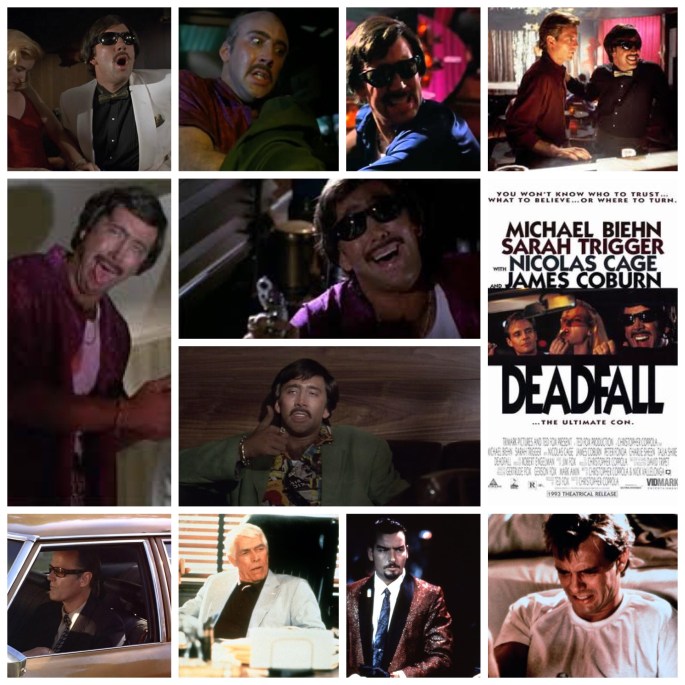
Christopher Coppola’s Deadfall


I hear a lot of talk about how weird Nicolas Cage can get in films, and I’m always seeing top ten craziest Cage compilations on YouTube and such, but people often seem to neglect the veritable cherry on top, the big cheese of nutso Cagery, a terrible conmen flick from back when called Deadfall. This is a film directed by a member of the Coppola family, and anyone who’s done their base research knows that Cage is a member of the brood, which is the only reason he ever broke into the industry in the first place. Now as to why and how he was allowed to give the unapologetically certifiable ‘performance’ we see here, well that remains a mystery. Needless to say, this is Cage unchained, off the leash and out of the Cage, an unnecessarily clownish banshee cry of a turn that derails the entire film, eclipses every other actor and puts a big dark stain on everyone’s career. The protagonist here is Michael Biehn as a shit-outta-luck hustler who accidentally kills his own father (James Coburn, who also does double duties to play the man’s brother), and ends up in the criminal doghouse, reprimanded by his boss (Peter Fonda) and left to flounder in small time stings. Enter Eddie (The Cage) another small-potatoes loser who clashes with anyone and everyone around him, a true lunatic of a character whose left empty of any sort of engaging qualities or charisma thanks to Nic’s utterly bombastic histrionics and lunatic ravings. If I sound like I’m overselling just how fucked up his performance is or making mountains out of molehills, please feel free to jaunt on over to YouTube, type in ‘Nic Cage Deadfall’ and see for yourself. If bad performances were represented as train wrecks, this would be the infamous explosion escape scene from The Fugitive, and even that doesn’t do it justice. This is a giant schoolyard tantrum, an inexcusable, near fourth wall busting bag of uncomfortable verbal utterances and bodily contortions that make you want to call an exorcist for the poor spastic, I really don’t know how the film ever got released with such fuckery on display. Anywho, all that just drowns out literally *everything* else about the film, and when one of your actors acts out so much that they smother work from heavy hitters like Biehn and Coburn, you know your filmmaking process is handicapped beyond repair. As such, brief appearances from Michael Constantine, Talia Shire and Charlie Sheen are subsequently lost to the abyss of Cage’s deafening orbit. A mediocre film without him as it is, but add what he does to the mix and you have a true stinker, the cinematic equivalent of a spittoon filled feces. Don’t bother. 

-Nate Hill

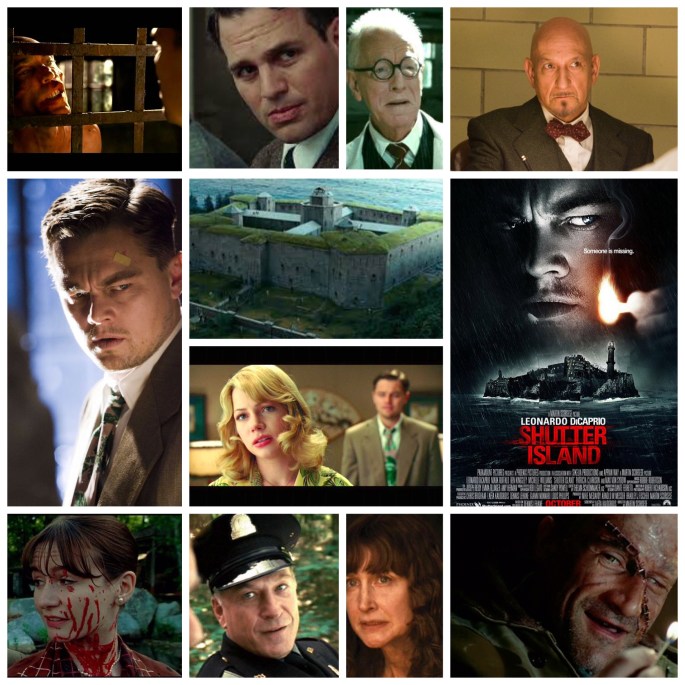
Martin Scorsese’s Shutter Island 


Shutter Island is my favourite film by Martin Scorsese. Now, keep in mind that I still have yet to see heralded classics like Goodfellas and Raging Bull, but that being said I still feel like this clammy psychological opus would remain at the top of the charts. I’m a genre guy at heart, and as such gravitate towards that when watching any director’s work, I just feel more at home wading into fictitious, stylized thrillers than I do with earnest biopics or urban crime dramas, which aren’t always my thing to begin with. Shutter is a brilliant piece, a deliberately dense and serpentine mystery that unfolds step by delicious step, a gift to anyone who loves a good twist and plenty of clues to keep them engaged along the way. Not to mention it’s wonderfully acted, cleverly written and primed with emotional trauma to keep us invested in the puzzle beyond base curiosity. Leonardo DiCaprio is best when portraying intense, tormented people, and his US Marshal Teddy Daniels here is no exception, a haunted man who feels like a caged animal as he investigates the disappearance of a mental patient from a secluded island sanitarium, a place that just doesn’t seem right, with a mood in the air so oppressive you can almost feel the fog, both mental and meteorological, weighing you down. The patient, Rachel Solando (Emily Mortimer will send shivers up and down your spine) seems to have vaporized into thin air, and Teddy’s investigation leads to closed doors, uncooperative staff and a heightened level of dread that lurks beneath every hushed exchange of dialogue and fleeting glimpse at things he, and we, aren’t even sure he really saw. The head doctor (Ben Kingsley, excellent) is clearly hiding something, as is the austere asylum director (Max Von Sydow). The freaky Warden (terrific cameo from Ted Levine, who gets to deliver the film’s best written and most perplexing dialogue) babbles to Teddy in biblical platitudes, and the patients have run amok following a storm that compromised security. Needless to say the plot is deviantly constructed to constantly mess with the audience until the third act revelations, which come as less of a melodramatic thunderclap and more like a quiet, burning sorrow of realization, a tonal choice from Scorsese that hits you way harder. Scorsese has assembled a cast for the ages here, and besides who I’ve mentioned so far we also have Michelle Williams in disconcerting flashbacks as Teddy’s wife, so perfectly played I wish she got a nomination, creepy Elias Koteas as another phantasm from his past, John Carrol Lynch, Mark Ruffalo, Jackie Earle Haley, Robin Bartlett and Patricia Clarkson. The score is a doom soaked death rattle courtesy of Robbie Robertson, not without it’s emotional interludes but thoroughly grievous. There’s also a beautifully slowed down version of ‘Cry’ by Johnnie Ray that accompanies the horrifying dream sequences within the film, adding to the already thick atmosphere nicely. This is a film built to last, both for dutiful rewatches from adoring veterans and discovery by lucky newcomers who get to experience it’s affecting story for the first time. All these boxer biopics, big city mafia ballads and heady stuff seems to have rolled off of me as far as Scorsese goes, I enjoy them, don’t get me wrong, but they’re a one-off as far as how many times I’ll watch them. Give me a well spun, emotionally rich psychological murder mystery with no shortage of style, character and tantalizing thriller elements, however, and I’ll pop that sucker back into the DVD player time and time again. Scorsese’s best effort by far. 

-Nate Hill

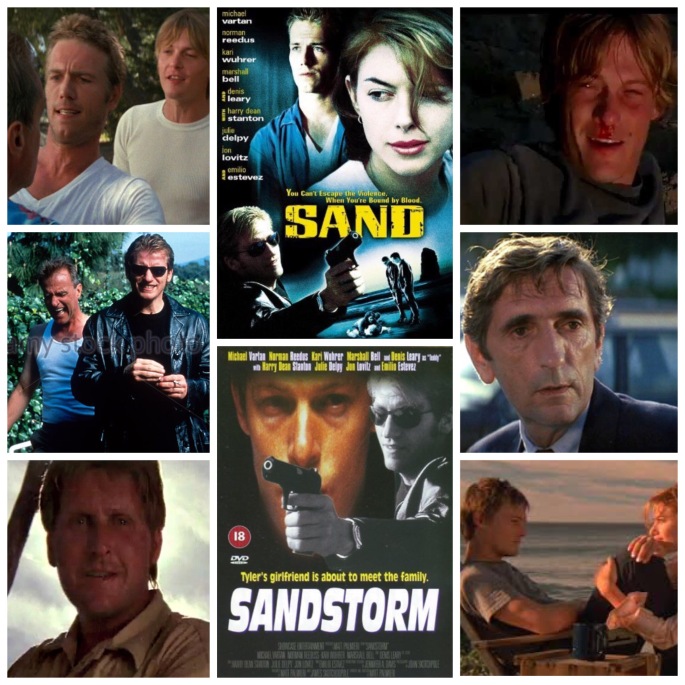
B Movie Glory: Sand


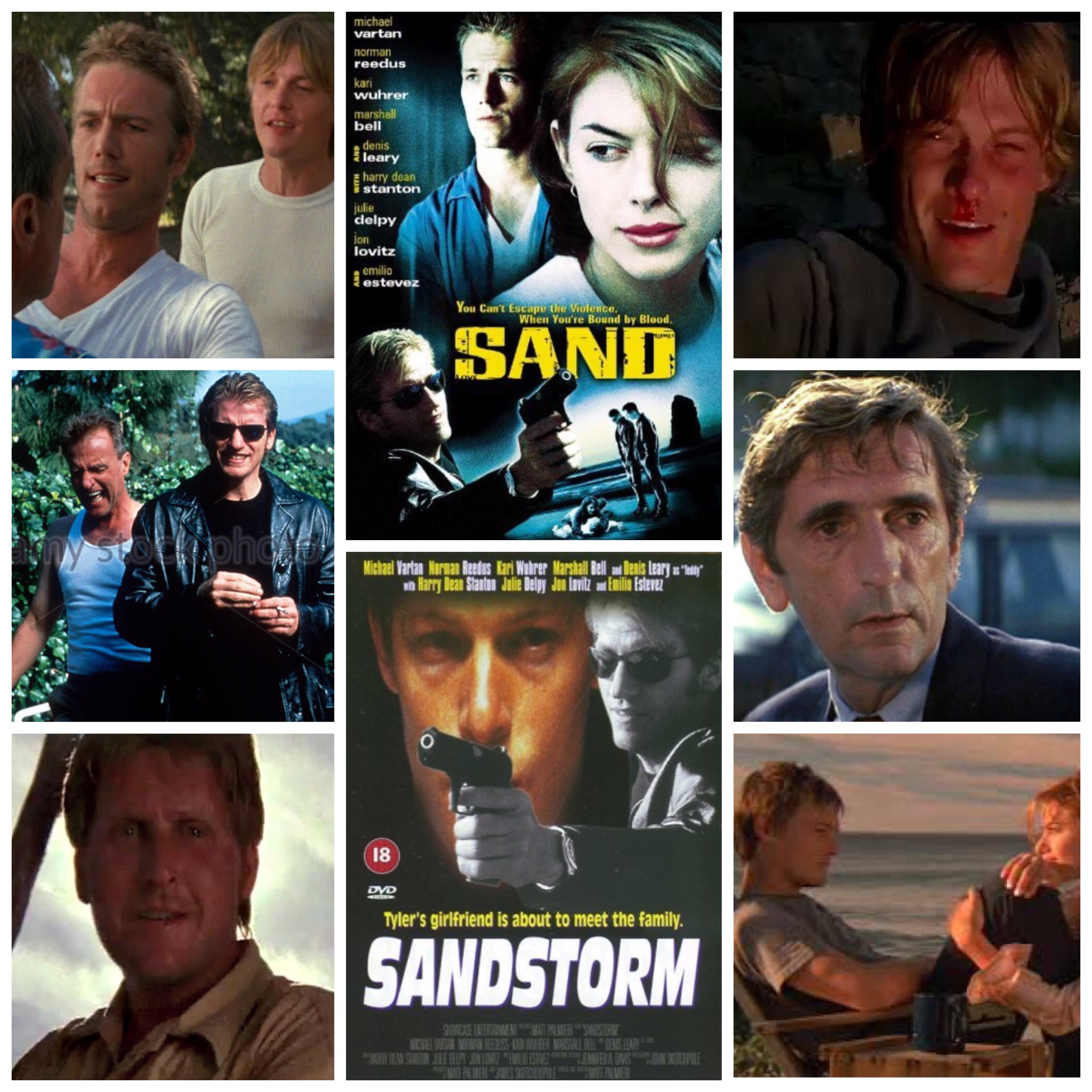
Sand is about as tasteful and memorable as it’s title, a bland, pointless and inconsequential piece of low grade fluff that starts nowhere and ends up just about the same. Funnily enough, it attracted the attention of some fairly notable actors who show up to loiter around in a boring family melodrama that barely registers past a flatline, and wander off again without bothering to bring their character arcs to a satisfactory close. Michael Vartan is some California stud who returns home to the surfing town he grew up in only to run afoul of his nasty criminal father (Harry Dean Stanton), and two deadbeat half brothers (John Hawkes and some other dude). They’ve shown up to lay low from the cops, but instead have eyes for Vartan’s cutie pie girlfriend (Kari Wuhrur) which is where the vague trouble starts. I do mean vague, as no one really makes an effort to convince us that these characters care, let alone know about what’s going on, and any sense of real danger is stifled by lethargy. Denis Leary usually crackles with witty intensity, but not even he seems to want to play, a sorry excuse for a villain who mopes around looking like he forgot his lines and just wants to go home. Norman Reedus is wasted on a quick bit as Wuhrur’s surfer brother, and there’s equally forgettable cameos from Jon Lovitz, Emilio Estevez and Julie Delpy too, but it all goes nowhere. There isn’t even any kind of adherence to genre, no Mexican standoff, no ramp up to revenge, it just kind of drops off and leaves an absence of anything interesting in the air. Some cool Cali scenery that could be Big Sur if I remember correctly, but even then you’re better off ditching this one and going to the beach for real. 

-Nate Hill

Barb Wire


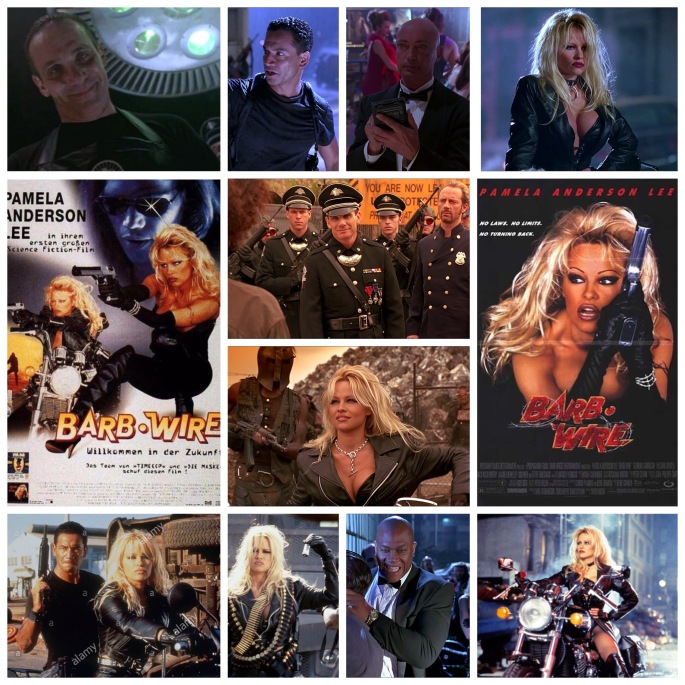
Bear with me here for a sec while I say this, but Barb Wire is actually a genuinely great flick. Based on a kinky Tank Girl-esque comic book and boasting a busty starring turn from Baywatch babe Pamela Anderson, it’s got a lot more going for it than the porn vibes the poster probably gives off at first glance. Picture this: Pam is Barb, night club owning bounty hunter in a Neo-fascist futuristic American industrial town called Steel Harbour, ducking gestapo style soldiers and playing the double agent against a government gone rogue. She’s propelled back into action when her former boyfriend Axel (Temuerra ‘Jango Fett’ Morrison) blows back into town with fellow freedom fighter Cora D (Victoria Rowell). Barb is now faced with protecting her club, extricating all of her friends to a safe haven in Canada (come on up) and battling the forces of supremely evil Colonel Pryzer (Steve Railsback, chewing the scenery and then some). It’s a total blast of perverse steampunk mayhem, Pam solidly playing a badass heroine who’s fun to hang around with. Udo Kier shows up as her friend and club manager Curly, eccentric as ever, and watch for Clint Howard, Nils Allen Stewart, Jack Noseworthy, Xander Berkeley and Tiny Lister as well. Not half as much of a novelty or gimmicky film as some would have you believe, this one actually takes itself seriously for the most part and proves to be a solid genre effort. Good times. 

-Nate Hill

B Movie Glory: Killer Buzz aka Flying Virus


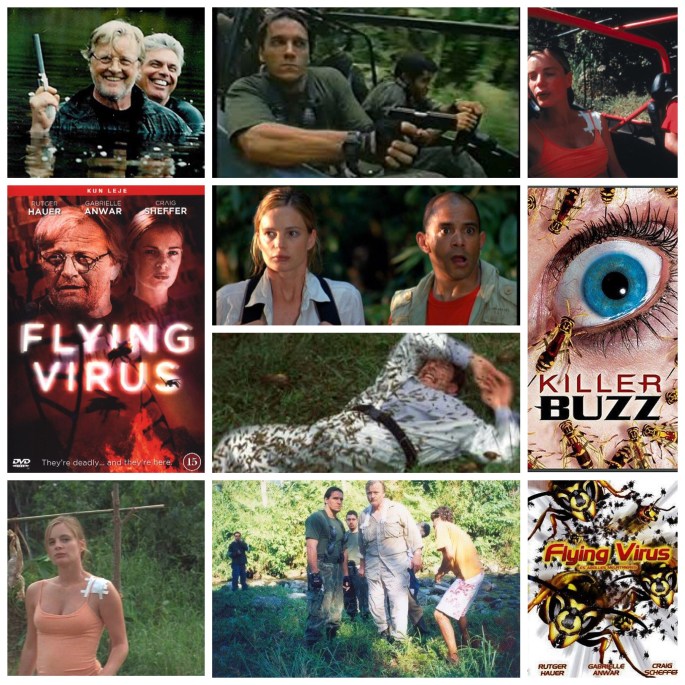
Killer Buzz, aka ‘Flying Virus’, is every bit the ludicrous SyFy turd you’d expect, and follows on the heels of several other B movies starring real life couple Gabrielle Anwar and Craig Sheffer, who inexplicably insist on starring together in bilge water like this (check out the third sequel to Turbulence and you’ll see what I mean). All you need to know about this one, besides the fact that it sucks, is that it’s about genetically altered killer wasps brought to life by windows 98 screensaver effects, and a sorry bunch of actors running away from them, one of which unfortunately happens to be Rutger Hauer. Anwar plays some journalist who uncovers a plot hatched by the government to kill humanity using giant monster wasps (how’s that for a plot), and makes a vague effort to stop it. Hauer is a hard nosed mercenary in charge of distributing these mutant stingers, and the shittiest, bottom feeding schlock ensues for a mercifully short eighty minute runtime. The special effects for the wasps really are a pitiful effort, even by these second tier standards, they look like pixelated crazy-frogs made of yellow paper mâché. The only memorable part is when someone warns Hauer about how dangerous they are and he growls in deadpan, “actually, bees are allergic to me”, brandishing a sidearm that wouldn’t do any good against them anyways. I kind of wanna go get a shirt printed at Bang-On of him saying that and giggle like a hipster when no one on the planet but me gets the reference. In all honesty, Killer Buzz is a giant buzz kill and should be avoided like a swarm of…. wasps. 

-Nate Hill