“I’m disgusted by what we’ve become in America. I truly believe there is brain death in this country.” — John Carpenter

Filmmaker John Carpenter has always considered himself as an outsider in Hollywood. Like Sam Fuller before him, Carpenter makes genre films that are usually regarded by critics as simple thrill rides. However, underneath the surface lurks a strong, often savage social commentary on what Carpenter believes to be the problems that plague the United States. This approach is readily apparent in They Live (1988), an angry film born out of his disgust with the greed and materialism of the Ronald Regan era during the 1980s. What’s interesting is how its scathing critique of homelessness, rampant unemployment and corporate greed has become relevant yet again. Sadly, these problems never really went away, they’ve just become more prevalent because of the current global economic reality.
Nada (Roddy Piper) is a drifter, an amiable blue collar guy looking for steady work in Los Angeles. He arrives in town like the lone gunman in a western, completely with an accompanying soundtrack that even features a lonely harmonica like something out of an Ennio Morricone spaghetti western score (perhaps a nod to Once Upon a Time in the West). Carpenter shows all kinds of homeless people populating the city. Nada is told that there are simply no jobs available by a clearly indifferent government social worker. He wanders by a blind African American preacher (Raymond St. Jacques) who rants about being oppressed, the corruption of the American spirit and tells everyone that it’s time to wake up just before two police officers arrive to deal with him. Nada passes by a store with televisions in the window that present all sorts of cliché images of Americana: Mount Rushmore, the bald eagle, an American Indian dancing, a cowboy riding a wild horse, and a group of guys playing sports together. These are images of propaganda designed to keep us sedated and complacent.
Nada eventually finds a job and befriends a fellow worker named Frank (Keith David), a man who is clearly tired of Capitalism as he says bitterly tells him, “The golden rule: he who has the gold, makes the rules. They close one more factory we should take a sledgehammer to one of their fuckin’ fancy foreign cars.” Nada tells him to be patient but Frank has clearly run out of that particular commodity. He proceeds to lay it all out in a nicely written speech that sums up the American dream in a nutshell: “The whole deal is like some kind of crazy game. They put you at the starting line and the name of the game is ‘make it through life.’ Only everyone’s out for themselves and lookin’ to do you in at the same time. Okay, man, here we are. Now you do what you can, but remember, I’m gonna do my best to blow your ass away.” These sentiments eerily anticipate the anti-materialistic message of Fight Club (1999) by several years. Nada is more optimistic. He believes in playing by the rules as he tells Frank, “I deliver a hard day’s work for my money, I just want the chance. It’ll come. I believe in America. I follow the rules.” But this faith in the system begins to change when the squatter’s camp the men are staying at is suddenly bulldozed by the police one night. At first, there seems to be no reason for this unprovoked attack but over the course of the film Carpenter does an excellent job of gradually revealing what is really going on.
One day, while rummaging through some garbage, Nada comes across a pair of sunglasses that allow him to see things as they really are: the world is seen in black and white. The color facade disappears and billboards reveal their true messages: “OBEY,” “MARRY AND REPRODUCE,” and “SLEEP,” money is merely pieces of paper with the words, “THIS IS YOUR GOD,” written on them. Most shockingly is that with the glasses on, certain people turn out to be aliens in disguise. The glasses are a clever play on the notion of subliminal advertising and capitalism as the root of all evil. Once Nada wakes up, Carpenter has fun with the character, like when he enters a bank armed to the teeth, spots some aliens and says the memorable line, “I have come here to chew bubblegum and kick some ass. And I’m all out of bubblegum.” Or, when Nada confirms the truth of the alien’s existence to Frank when he tells him simply, “Life’s a bitch and she’s back in heat.” From this point, They Live’s pace rarely slackens as Nada and Frank form an uneasy alliance in an attempt to stop this secret alien invasion as if Marshall McLuhan suddenly took over scriptwriting duties and decided to rewrite Invasion of the Body Snatchers (1956) with a dash of Noam Chomsky for good measure.
The idea for They Live came from two sources: a futuristic story, involving an alien invasion, called “Nada” from a comic entitled Alien Encounters. This story was actually inspired from a short story called “Eight O’Clock in the Morning” by Ray Nelson that was originally published in The Magazine of Fantasy and Science Fiction in the 1960s. Carpenter describes it as “a D.O.A. type of story. A fellow is put in a trance by a stage hypnotist. When he awakens, he realizes that the entire human race has been hypnotized. Amongst us are alien creatures that are controlling our lives. He has only until eight o’clock in the morning to solve the problem.” Carpenter acquired the film rights to both the comic book and the short story and wrote the screenplay using Nelson’s story as a basis for the film’s structure.
The more political elements came from Carpenter’s growing distaste with the ever-increasing commercialization of popular culture and politics at the time. As he once remarked in an interview, “I began watching T.V. again. I quickly realized that everything we see is designed to sell us something…It’s all about wanting us to buy something. The only thing they want to do is take our money.” To this end, Carpenter thought of sunglasses as being the tool to seeing the truth, which “is seen in black and white. It’s as if the aliens have colorized us. That means, of course, that Ted Turner is really a monster from outer space.” In regards to the alien threat depicted in the film, the director said, “They want to own all our businesses. A Universal executive asked me, ‘Where’s the threat in that? We all sell out every day.’ I ended up using that line in the film.”
Since the screenplay was the product of so many sources: a short story, a comic book, and input from cast and crew, Carpenter decided to use the pseudonym, “Frank Armitage,” which was a subtle allusion to one of the filmmaker’s favorite writers, H.P. Lovecraft. Frank Armitage is in fact a character in Lovecraft’s “The Dunwich Horror.” Carpenter has always felt a close kinship with Lovecraft’s worldview and his influence can be felt in other films — most notably, The Thing (1982) and In The Mouth of Madness (1995). According to Carpenter, “Lovecraft wrote about the hidden world, the world underneath. His stories were about gods who are repressed, who were once on Earth and are now coming back. The world underneath has a great deal to do with They Live.”
After a budget of around three million dollars was established, Carpenter began casting his film. For the crucial role of Nada, the filmmaker surprisingly cast wrestler “Rowdy” Roddy Piper whom he had met at Wrestlemania III. For Carpenter it was an easy choice: “Unlike most Hollywood actors, Roddy has life written all over him.” Carpenter’s gamble pays off as Piper does a fine job playing an everyman-type hero who, at first plays by the rules, but once he realizes that it’s all a sham, decides to fight back. Piper’s performance is not going to win any acting awards but he does a solid job and brings the physical presence necessary for the role while also conveying a blue collar vibe.
Carpenter was impressed with Keith David’s performance in The Thing and needed someone “who wouldn’t be a traditional sidekick, but could hold his own.” To this end, Carpenter wrote the role of Frank specifically for the underrated actor. David does a great job as the perfect foil for Piper. The two men have this intense relationship that oscillates between outright distrust and grudging respect. This rather volatile alliance reaches critical mass in a wild, fist fight between the two men over a pair of the special sunglasses that lasts for several minutes. The brawl starts off seriously but eventually transforms into an absurd free-for-all. Carpenter remembers that the fight took three weeks to rehearse. “It was an incredibly brutal and funny fight, along the lines of the slugfest between John Wayne and Victor McLaglen in The Quiet Man.”
One of the reasons why They Live works so well is the film’s pacing. It starts off like the original Invasion of the Body Snatchers with the threat of alien invasion being implicit at first. Everything seems normal enough but after a half hour into the film, the threat suddenly becomes shockingly explicit when Nada puts on the sunglasses. From there, the film’s pacing speeds up and They Live begins to incorporate action film sequences into its science fiction premise. And yet, throughout the film, there is always thought-provoking commentary. This is represented by the pirate television broadcasts which, initially, seem like some lone conspiracy nut but eventually his ravings are revealed to be right on the money. His presence is the first sign that something is amiss. The television is presented as an electronic sedative in They Live. It’s a drug to the masses. When the T.V. pirate appears, the mind-numbing routine is broken and people get headaches as a result.
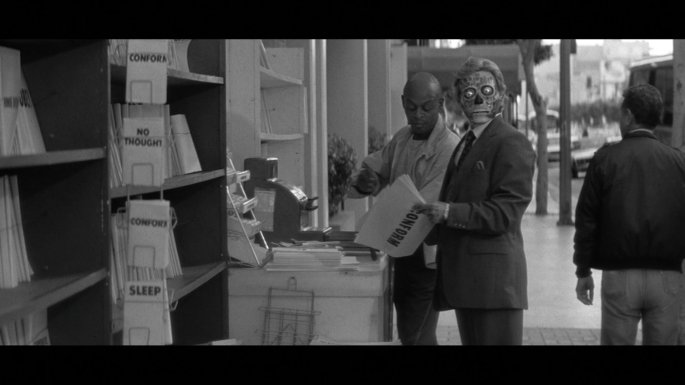 Carpenter sees the commercial failure of his film as a result of “people who go to the movies in vast numbers these days [who] don’t want to be enlightened.” It’s a shame because They Live is far from being an overtly preachy film. On the contrary, it is always exciting and entertaining first, and a scathingly social satire second. However, the director sees the real tragedy to be the lack of humanity in society. “The real threat is that we lose our humanity. We don’t care anymore about the homeless. We don’t care about anything, as long as we make money.” If They Live is about anything, it’s a strong indictment against the capitalist greed that was so fashionable in the 1980s. It’s sentiment that still exists. This makes Carpenter’s film just as relevant today as it was back in 1988.






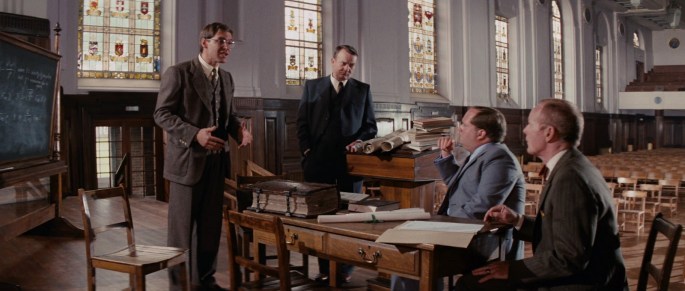 Kasdan’s ability to engage us in the obligatory exposition scene is evident early when Indy and his friend and colleague Marcus Brody (Denholm Elliott) meet with two military intelligence officers about the location of an old colleague of Indy’s – Abner Ravenwood – who might have an artifact – the headpiece of the Staff of Ra – that will reveal the location of the Ark of the Covenant, which the Nazis are eager to get their hands on. Indy and Marcus give the two men a quick history lesson on the Ark and its power. Marcus concludes with the ominous line about how the city of Tanis, that reportedly housed the Ark, “was consumed by the desert in a sandstorm which lasted a whole year. Wiped clean by the wrath of God.” The way Denholm Elliott delivers this last bit is a tad spooky and is important because it lets us know of the Ark’s power, his reverence for it, and why the Nazis are so interested in it. This dialogue also gives us an indication of the kind of danger that Indy is up against.
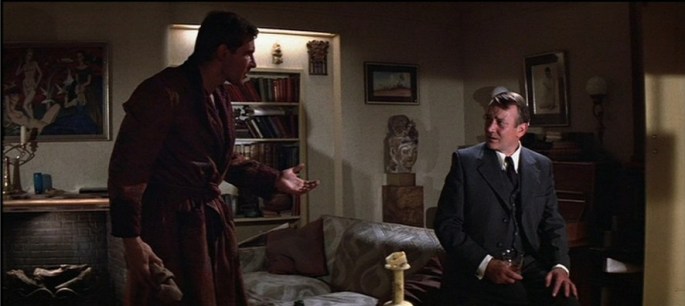 This segues to a nice little scene right afterwards at Indy’s home between the archaeologist and Marcus. He tells Indy that the United States government wants him to find the headpiece and get the Ark. As Indy gets ready they talk about the Ark. The camera pans away from Indy packing to a worried Marcus sitting on a sofa and he reveals his apprehension about what his friend is going after: “For nearly 3,000 years man has been searching for the lost Ark. It’s not something to be taken lightly. No one knows its secrets. It’s like nothing you’ve ever gone after before.” Indy shrugs off Marcus’ warning but his words, accompanied by John Williams’ quietly unsettling score, suggest the potential danger Indy faces messing with forces greater and older than himself.
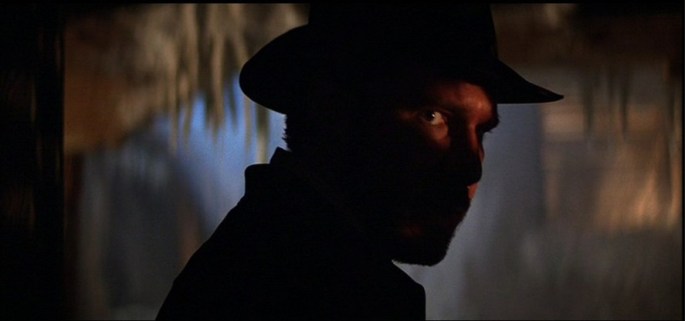
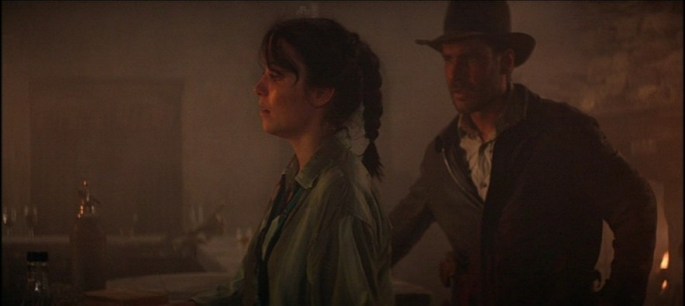 Kasdan also does a great job hinting at a rich backstory between Indy and his ex-love interest, Marion Ravenwood (Karen Allen). When they are reunited at a bar she runs in Nepal, she is clearly not too thrilled to see him, giving Indy a good crack on the jaw. Marion alludes to a relationship between them that went bad. She was young and in love with him and he broke her heart. To add insult to injury, her father is dead. All Indy can do is apologize as he says, “I can only say sorry so many times,” and she has that wonderful retort, “Well say it again anyway.” Harrison Ford and Karen Allen do a great job with this dialogue, suggesting a troubled past between them. In a nice touch, Spielberg ends the scene with Indy walking out the door. He takes one last look back and his face is mostly obscured in shadow in a rather ominous way as he clearly looks uncomfortable having had to dredge up a painful part of his past.
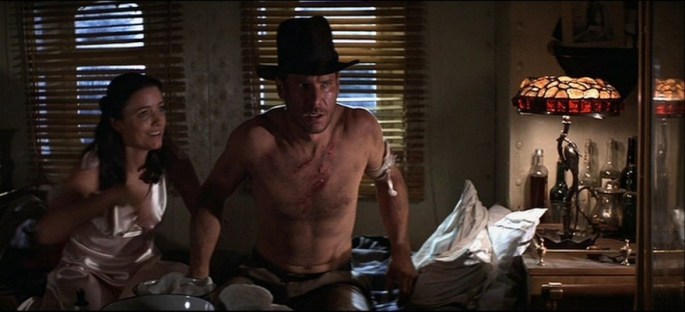
 Indy and Marion have another nice scene together after they’ve retrieved the Ark from the Nazis and are aboard the Bantu Wind, a tramp steamer that will take them to safety. Marion tends to Indy’s numerous wounds and says, “You’re not the man I knew ten years ago,” and he replies with that classic line, “It’s not the years, honey, it’s the mileage.” It starts out as a playful scene as everything Marion does to help hurts Indy’s world-weary body. In frustration she asks him to show her where it doesn’t hurt and he points to various parts of his body and in a few seconds the scene goes from playful in tone to romantic as they end up kissing. Of course, Indy falls asleep – much to Marion’s chagrin. Kasdan’s dialogue gives Spielberg’s chaste, boyhood fantasy serial adventure a slight air of sophistication in this scene as two people with a checkered past finally reconnect emotionally.
 For me, Raiders is still the best film in the series. The pacing is fast but not as frenetic as today’s films. There are lulls where the audience can catch its breath and exposition is conveyed. In many respects, it is one of the best homages to the pulpy serials of the 1930s and a classic example of when all the right elements came together at just the right time. This film has aged considerably well over time and each time I see it, I still get that nostalgic twinge and still get sucked in to Indy’s adventures looking for the lost Ark.

 Podcasting Them Softly