Faster: A Review by Nate Hill

image

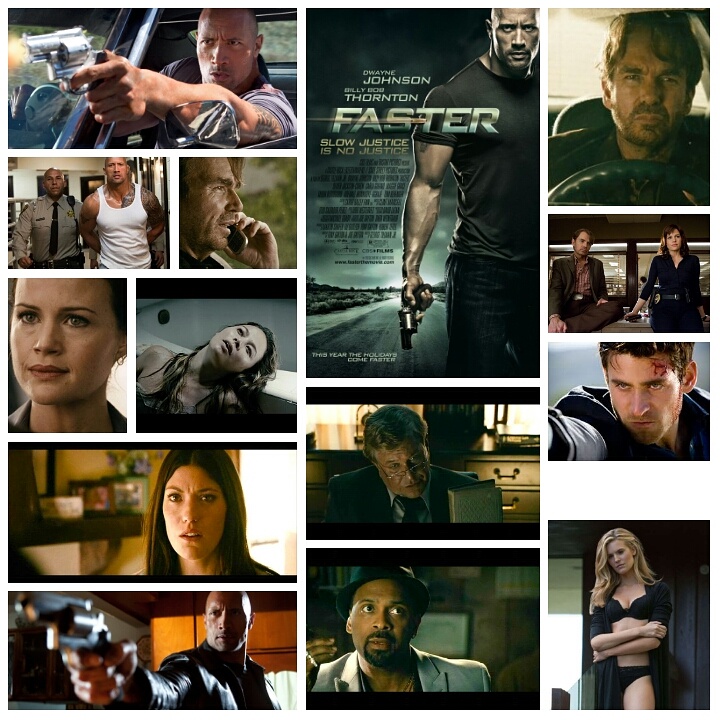
Faster is an action film with an eerie aura and a darkly unnerving bite to it. Don’t get me wrong, it’s action through and through, a genre effort right to its marrow. And yet, there’s something oddly esoteric about it, an obvious extra effort put in by the filmmakers, namely first time action director George Tillman, to give every character an off kilter, bizarre cadence to ensure we won’t forget them. There’s clichés, no doubt, but they’re eclipsed by the strange, full moon weirdness of the rogues running about the film’s story. Dwayne Johnson fires up a furious protagonist in his first action role after a long and ridiculous stint in insufferable family comedies. He plays a quiet, hulking dude known only as Driver, reluctantly released from prison by a watchful Warden (Tom Berenger). Upon exiting the gate, he runs. And runs. And runs. He arrives at a small town junkyard where he tears a tarp of a vintage Chevelle which seems to be left there for him like a care package. From there he launches a bloody crusade of revenge that knows neither mercy nor discretion, and whose reasons we are only slowly allowed to know. He’s a one man wrecking ball, the murders piling up before we really have any idea what this guy is about. He’s been greatly wronged in the past, the culprits of which should all be running scared, as he comes looking for them one by one and with the juggernaut pace of a boulder tumbling down a mountain. Pretty soon there’s two cops on his trail, intrepid Cicero (Carla Gugino) and mopey sleazeball ‘Cop’ (Billy Bob Thornton), a dilapidated piece of work who mainlines heroin and clearly has a murky past. Soon there’s one hell of a hitman (Oliver Jackson Cohen) skulking around looking for Driver, an extreme sports enthusiast who has ‘beaten yoga’ and is avidly looking for the next big thrill. Johnson jumps from one ultra violent encounter to the next with all the corrosive ferocity of the grim reaper, tallying up the corpses until we’re all but sure he’s an inhuman elimination machine. Then.. the film curveballs us and throws a glint of humanity into the mix with some late third act emotion that only goes to show the filmmakers set out with more than a one track mind. Driver has been unspeakably betrayed, and his rampage is undeniably justified, but there’s a complexity to his quest that he didn’t see coming, and neither did those of us who expected pure action without a moral conundrum in sight. I say good on it for grasping something besides the thrills. A terrific cast populates the almost Oliver Stone – esque proceedings, including Maggie Grace, Moon Bloodgood, Mike Epps, Jennifer Carpenter  (always superb), Matt Gerald, Xander Berkeley, Buzz Belmondo, Courtney Gains and more. It’s got the depth of a well written graphic novel and a level of thought out characterization that heaps of stale action entries wish they possessed.

B Movie Glory with Nate: Ticker

image

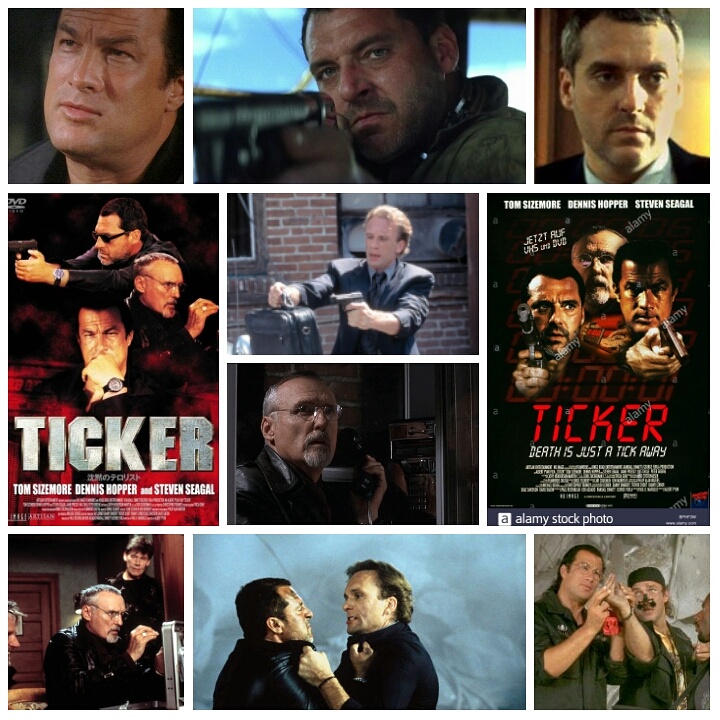
If an eighth grade class raided their parents liquor cabinet, passed around a bottle, got good and loaded and took it upon themselves to make their own version of every 90’s action cliche, it would look something like Ticker, a wonderfully inept mad bomber tale that starts at rock bottom and cheerfully drills farther down, as well as into critics collective patience, it seems. It’s silly clunky and all over the place, but there’s a scrappy likeability to its amalgamated stew of genre tropes, masculine posturing and endless explosions. The bomber in question is Alex Swan (Dennis Hopper), a homicidal Irish extremist intent on making life hard for the San Francisco bomb squad, led by explosives expert Frank Glass (a laughably zen Steven Seagal). Hero cop Ray Nettles (Tom Sizemore) previously lost a partner to bombers and has a big score to settle with Swan. And so it goes. Bombs go off. Cops argue. They chase Hopper, who eludes them until the next set of fireworks destroy a wall glass panels or a bridge. Sizemore is surprisingly sedated, not seizing the opportunity to use his lead role as an excuse to tear through scenery like a bulldozer, as is usually his speciality. Seagal is so silly, his intended gravitas landing with all the profundity of an SNL skit. Hopper is demented, even more so than in Speed, and the rental fee is worth it just to hear his perplexing, absolutely wretched Irish accent. Not since Tommy Lee Jones in Blown Away have I laughed that hard at an actor butchering the dialect to high heaven. There’s appearances from Nas, Jaime Pressley, Kevin Gage and the always awesome Peter Greene as ana a-hole fellow cop that hounds Sizemore any chance he gets. Quite the cast, and in a perfect world the film they wander through would match their talent. I watched this with the same morbid curiosity that the bystanders gawking at the resulting destruction of one of Hopper’s bombs no doubt had: incredulity and the inability to look away for missing a moment of a disaster unfolding in front of you.  

Mr. Brooks: A Review by Nate Hill

image

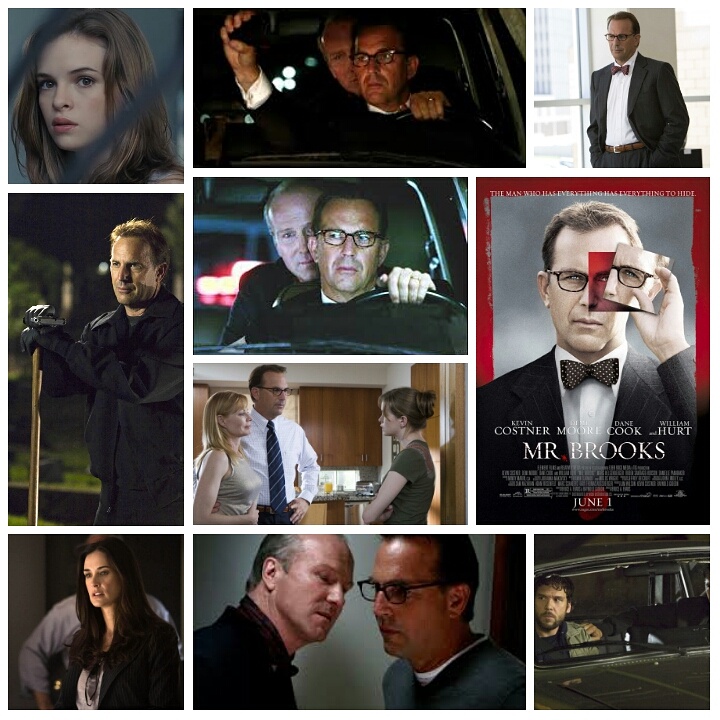
There are a few films Kevin Costner has done in which he has really been allowed and been willing to test the boundaries of what is usually expected from him in a role. 3,000 Miles To Graceland and Eastwood’s A Perfect World are fine examples. Perhaps the finest though is Mr. Brooks, a dark tale that showcases the actor in a terrifying turn and the last type of role you would picture for him on paper. Opposites are paramount in acting and cinema as a whole, and it’s that type of contrarian casting choice that can lead to a performer’s finest hours. In this case it’s certainly one of Kevin’s best outings, and casts him in a frightening new light, or should I say dark. Here he is Earl Brooks, husband, father, businessman and all round stand up guy. Except fpr the fact that he moonlights as a methodical and psychopathic serial killer. He sees it as an affliction, and is almost ashamed of it, whether by a tiny flicker of a soul he may have, or simply by the standards impressed onto society. He’s efficient, cold and hopelessly addicted to the act of murder. His alter ego, or ‘dark passenger’ as the scholars say, is a cynical persona called Marshall, brought to life by a scary William Hurt. “Why do you fight it, Earl?” he drawls in that committed, laconic snarl that only Hurt can do. There’s shades of his character from Cronenberg’s A History Of Violence here, affirming my belief that Hurt is a pure acting prodigy and masterful of both the light and the dark within his craft. Earl has a daughter too (Danielle Panabaker) who he has worrisome thoughts about, and a picture perfect wife (Marg Helgenberger). One can’t keep the turbulent nightlife of the serial killer a secret for one’s entire life though, and pretty soon people start to catch on. A nosy Nelly (Dane Cook) catches a whiff of Earl’s crimes and lives to wish he hadn’t, and a keen Detective (Demi Moore) begins to piece the puzzle together as well. Earl is as clever as he is murderous though, covering his work and tying off loose ends with gut churning gusto. Costner carries the film terrifically, a man who is at once both uncomfortable in his own skin yet fits it like a glove when the camera dutifully bears witness to his killings. He’s like a tiger who really can’t change his stripes but wants to shield them from the judgment of others, and of course his own persecution. The scenes of murder are skin crawling in their frank, fly-on-the-wall nature, no slasher cinematics or gimmicky set ups here, just the icy horror of a predator extinguishing human life to sate the beast, and the nightmarish inevitability of death. Those scenes paint Earl in a horrific light, but the film doesn’t try to convince us he’s a monster using any usual methods, it just presents to us this man, his acts and his life surrounding them, without discernable condoning or condemning. It’s cold, it’s clinical and it’s one of the best serial killer flicks out there.

INHERENT VICE – A REVIEW BY J.D. LAFRANCE

inherentvice1

There are unfilmable novels and then there is Thomas Pynchon, the premiere post-modern novelist responsible for legendary tomes like Gravity’s Rainbow and Mason & Dixon. He is known for producing dense, complex novels that explore themes such as racism, philosophy, science and technology while fusing theological and literary ideas with popular culture references to comic books, films, urban myths and conspiracy theories. Satire and paranoia are common currencies that he uses in his novels. And that’s only scratching the surface.

The 1960s were an important decade for Pynchon. It was at this time that his novels V. and The Crying of Lot 49 were published and the bulk of Gravity’s Rainbow was written. He would revisit the ‘60s again from the perspective of the 1980s with Vineland and, most recently, with Inherent Vice, which was published in 2009. The latter novel has been considered his most accessible work since Lot 49 and has been adapted into a film by Paul Thomas Anderson, the American auteur responsible for such memorable efforts as Boogie Nights (1997), There Will Be Blood (2007) and The Master (2012) among others.

Possibly informed by Pynchon’s stint in Manhattan Beach, California during the mid-‘60s, Inherent Vice is part stoner comedy/mystery and part lament for an era that was all but gone by 1970 when the story takes place. If the ‘60s was about having your head in the clouds then the ‘70s was about having your feet on the ground. Like its source material, the film plays fast and loose with notions of plot and story, riffing on elements of a Raymond Chandler-esque mystery through a counterculture filter.

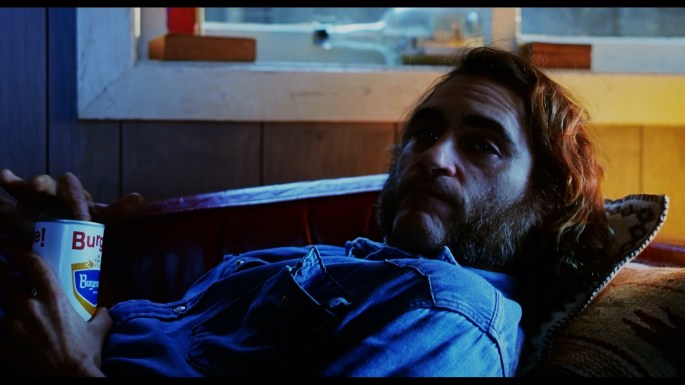
Larry “Doc” Sportello (Joaquin Phoenix) is a private investigator of the rumpled variety. One night, he’s visited by an ex-girlfriend by the name of Shasta Fay Hepworth (Katherine Waterston) whose latest boyfriend, Mickey Wolfmann (Eric Roberts), a big-time real estate developer, and his wife are involved in some kind of shady scheme. Doc soon finds himself framed for murder, Shasta disappears (as does Mickey) and he runs afoul of hardass Los Angeles police detective Christian “Bigfoot” Bjornsen (Josh Brolin). During the course of his investigation, Doc finds himself immersed in the bizarro social strata of California culture, including a drug-addicted surf musician (Owen Wilson), a member of the Black Panthers (Michael K. Williams), a cokehead dentist (Martin Short), and a secret cartel known as the Golden Fang.

Inherent Vice is the second collaboration between Anderson and actor Joaquin Phoenix and the former may have found his cinematic alter ego. Working together brings out the best in both of them with the actor delivering another excellent performance. He portrays Doc as a peaceful hippie P.I. content to coast through life surrounded by a cloud of pot smoke, but is thrust into a strange world when an ex-lover comes back into his life. He acts as our guide on this journey and the key to navigating the sometimes murky narrative waters is to never lose focus of the primary mystery: the disappearance of Shasta. Doc represents the peace-loving idealism of the ‘60s and who is confronted by all kinds of outlandish people that represent the aggressive excessiveness of the ‘70s.

Anderson populates Inherent Vice with a stellar cast of supporting actors that includes Owen Wilson, Reese Witherspoon, Benicio del Toro, and Martin Short, all of whom bring this collection of oddball characters vividly to life. Some may find the cavalcade of recognizable movie stars distracting but, on the contrary, they act as important signposts along the way to help us keep track of the numerous characters Doc encounters during his investigation.

Josh Brolin gets the most screen-time of the supporting cast as Bigfoot Bjornsen, a throwback to cops of the early ‘60s, complete with crew cut and deep loathing of hippies like Doc. Initially, Bigfoot starts off as Doc’s primary nemesis, but over the course of the film he reveals a frustration with his lot in life, displaying a grudging mutual respect. Brolin certainly has the imposing frame to play Bigfoot and wisely plays the role straight, which makes several of his scenes that much funnier because the uptight character is a product of a bygone era that clashes with the more easygoing Doc as much as the excessive culture of the ‘70s.

The trailers for Inherent Vice are misleading in the sense that they sell the film as some kind of madcap comedy and while there are some out-and-out funny scenes, like Martin Short’s cocaine-addicted dentist, there is a melancholic tone that permeates most of the film expanding on “The High Water Mark” speech Raoul Duke gives late in Fear and Loathing in Las Vegas (1998) as he laments the death of ‘60s idealism. Inherent Vice even ends on a surprisingly emotional moment that is quite affecting. Instead of going for quick, comedic beats, Anderson applies the aesthetic he used in There Will Be Blood and The Master by breaking the film down into lengthy, dialogue-heavy scenes between Doc and one of the many people involved either directly or tangentially to Shasta’s disappearance, which may test the patience of some expecting the stylish zaniness of something like Fear and Loathing in Las Vegas. While Terry Gilliam’s film reflected Hunter S. Thompson’s gonzo sensibilities, so too does Inherent Vice reflect Pynchon’s peculiar sensibilities. Like the book, Anderson takes his time and lets you sink into Pynchon’s world, which is certainly not an experience for everyone.

Several reviews have compared Inherent Vice to Robert Altman’s The Long Goodbye (1973) and the Coen brothers’ The Big Lebowski (1998), but they are only similar on a very superficial level. Anderson’s film is its own thing – a shaggy dog journey through a corner of Pynchon’s universe that the filmmaker has brought faithfully and lovingly to life. Much like Walter Salles’ adaptation of Jack Kerouac’s On the Road (2012), Inherent Vice is made by and for fans of Pynchon’s novel, which will leave the uninitiated out in the cold, struggling to follow a film that may seem like an incoherent mess, but is actually quite faithful to its source material with huge chunks of the author’s prose coming out of the characters’ mouths. You shouldn’t have to see a film more than once to “get it,” but there are some that reveal themselves in more detail and whose nuances are appreciated upon repeated viewings. This is such a film. As Pynchon himself once famously said in response to the complexity of his novel V., “Why should things be easy to understand?” The fact that one of Pynchon’s novels has been adapted into a film is quite a significant accomplishment. That it successfully translates his worldview is even more noteworthy.

TWELVE MONKEYS – A REVIEW BY J.D. LAFRANCE

46

“It’s one thing to get lost in your own madness, but to become lost in somebody else’s madness is weirder.” – Terry Gilliam

How do you know when someone is crazy? This is a question that filmmaker Terry Gilliam tries to answer in many of his films, for he is obsessed by the notion of insanity – what makes someone insane and how do others view this person. Is someone really crazy or do they simply have a different view of the world than the rest of society? In the past, Gilliam’s films have presented characters that tend to blur the boundary between sanity and madness, but perhaps his most complex treatment of this subject is Twelve Monkeys (1995). It is with this project that the filmmaker combines his long standing obsession of breathtaking visuals with his knack for working closely with actors. This combination has resulted in more mature films for Gilliam who is normally associated with stylish overkill: films that tend to let the visuals overwhelm the story and characters. And make no mistake, Twelve Monkeys contains some of the most stunning images you are ever going to see but never at the expense of the story or its characters and herein lies one of the reasons why Gilliam remains one of the most interesting people working in film today.

Twelve Monkeys
is a film that constantly plays with, distorts, and more often than not, manipulates time. The film begins in the year 2035. A deadly virus has wiped out almost all of humanity, leaving the survivors to take refuge deep underground. Only the occasional foray up to the surface in protective gear by a select group of “volunteers” offers any clues as to what went wrong. James Cole (Bruce Willis) is one such volunteer who is particularly good at retrieving information. As a result, he soon finds himself being sent back in time to find out how the virus originated and who was responsible. Unfortunately, he goes back too far, arriving in 1990 and is promptly thrown into a rather nightmarish mental hospital in Baltimore where he meets Jeffrey Goines (Brad Pitt), a fellow inmate with a loopy sense of reality that feeds all sorts of paranoid delusions of grandeur. Cole also encounters Kathryn Railly (Madeleine Stowe) a beautiful doctor who feels sympathy for him and his plight.

As Cole travels back and forth in time he begins to realize that one of the most important clues to the source of the deadly virus may lie in the rather enigmatic underground organization known only as The Army of the 12 Monkeys. Soon, Railly and Goines begin to play integral roles in Cole’s search as he consistently crosses paths with them. But is this all taking place in Cole’s mind? Is he really humanity’s only hope at averting a catastrophic disaster or is he just insane? From the first shot to the film’s conclusion we are never quite sure of Cole’s sanity or lack thereof. It is just one of many questions that the audience must think about not only during the film but long after it ends.

The seeds of Twelve Monkeys lie in an obscure French New Wave film called La Jetee (1962) made by Chris Marker. The film was composed entirely of black and white photographs and set in Paris after World War III. It was an apocalyptic vision in reaction to the threat of nuclear annihilation that became prominent in the 1950s and 1960s. Writers David and Janet Peoples were approached by producer Robert Kosberg to do an adaptation of La Jetee. The screenwriting couple wasn’t that keen on the idea, however. “We couldn’t see the point. It’s a masterpiece and we didn’t see that there was anyway to translate that masterpiece,” David remarked in an interview. And he was no slouch to the art of screenwriting, having rewritten the screenplay for Blade Runner (1982) and penned the brilliant Clint Eastwood film, Unforgiven (1992).

Kosberg got the Peoples to watch La Jetee again and the couple began to see possibilities for a different, more detailed take on the material. “How would we react to people who showed up and said ‘Oh I’ve just popped up from the future’ and in turn how would that person deal with our reaction.” With this in mind, David and Janet set out to write a challenging piece of fiction that not only manipulated our conventional views of time but that also dealt with the notion of madness. Janet explained in an interview, “We were very interested in asking questions like ‘Is this man mad? And how about the prophets of the past, were they mad? Were they true prophets? Were they coming from another time? What are all the different possibilities?'” The film’s script argues that certain people who are classified insane by society at large may not really be crazy at all but are in actuality presenting ideas that are way ahead of our time. And perhaps the blame for this misunderstanding should be leveled at the psychiatric profession which, as one character in the film observes, has become the new religion of a society that has deserted traditional faith for modern technology.

After showing the finished screenplay to Marker and getting his blessings, the Peoples were faced with the daunting task of finding someone who would not only click with the material but also have the visual flair that the story needed. The couple figured that the only director to handle such tricky subject matter was somebody like Ridley Scott or Terry Gilliam. The theme of madness that plays such a prominent role in the script fit right in with Gilliam’s preoccupations and so he seemed the natural choice to direct. As luck would have it the filmmaker was between projects and looking for work after several years of seeing potential projects fall through for various reasons.

Gilliam was also eager to take a lot of Hollywood money (a $30 million budget) and create a strange art film that would fly in the face of the traditional mainstream movie. “The idea that someone’s writing a script like this in Hollywood and getting the studio to pay for it was pretty extraordinary. So I thought let’s continue to see how much money we can get the studio to spend.” Gilliam’s battles with Hollywood studios are the stuff of legend – most notably his struggle with Universal over the release of Brazil (1984). They wanted to revoke the director’s final cut privileges to insert a happier ending instead of Gilliam’s decidedly downbeat ending. Gilliam’s vision prevailed in the end, but the ordeal left him understandably wary of further studio involvement. He had reconciled somewhat with Hollywood by making The Fisher King (1991), which turned out to be a surprise commercial and critical success.

Architecture plays an important role in Gilliam’s films and Twelve Monkeys is no different. “I’ve always used architecture as if it was a character.” To this end, he found all sorts of intriguing architecture to populate his film. This included the transformation of an 1820s prison into a 1990s mental hospital where the film’s protagonist, James Cole first meets the Jeffrey Goines. The director found that the structure was designed like a wheel with spokes and hub. And so Gilliam used one section where three spoke-like parts headed off into nowhere. “It seemed to me [that] this trifurcated room was right for multiple personalities.” This feeling of madness is further amplified by the extensive use of skewed, off-kilter camera angles that are often shot at low angles to constantly distort and disorient the scene. “We started doing it and it got more and more fun to see how far we could push it because I wanted to create an atmosphere that you don’t know whether this guy is crazy or whether he actually does come back from the future.” The unusual camera angles not only mimic Cole’s confused state but also reflect Jeffrey’s manic, hyperactive worldview. By presenting the mindsets of these two characters in such a fashion, Gilliam is inviting us to see the world through their eyes and in the process offer a new, unique take on the world that we might not have been aware of before.

Gilliam was not just content to challenge mainstream audiences with unusual visuals and subject matter, but he also wanted to mess with people’s perception of certain movie stars by casting box office names like Brad Pitt and Bruce Willis against type. “One of the reasons [for doing Twelve Monkeys] was taking Bruce and putting him into situations and asking of him things I don’t think he’s ever done before or that people haven’t seen him do … and with Brad Pitt it’s the same thing. Brad is pretty laconic in some ways. Suddenly he’s a blabbermouth, jabbering away at high speed. I love doing that, playing with the public’s perception of that star; otherwise, it wouldn’t be fun.” As a result we get a very different Bruce Willis here than we have come to expect. Gone are the wisecracks and smart-aleck attitude and instead we see Willis impart a real wounded sensibility to the character of James Cole. The reluctant time traveler always seems to be flinching at every little thing, often appearing disoriented or distracted as he struggles to understand what is going on around him. Willis displays great skill in this role – perhaps the best of his career – as he creates a truly tragic figure that may or may not be losing his mind.

Brad Pitt’s character, Jeffrey Goines, resides at the exact opposite end of the spectrum. Where Cole is a sad, brooding figure, Goines is a frenetic psychotic oscillating wildly between paranoid ravings and calm interludes where his madness is kept in check but still resides behind wild eyes. It’s a daring performance for Pitt who lets it all hang out as he gladly chews up the scenery with his loony radical environmentalist cum revolutionary that all but steals every scene he’s in. It’s a performance that Pitt worked long and hard to achieve and it paid off in a Golden Globe Award that year for Best Supporting Actor and an Academy Award nomination in the same category.

It is easy to see what attracted Terry Gilliam to a project like Twelve Monkeys. In keeping with his past films, this one also played “with the same old things – time, reality, madness – so I was intrigued.” Even though it was one of the few projects he did not originate himself, Gilliam quickly made the film his own. In fact, it is Twelve Monkeys‘ unique look that prevents any easy categorization. As Gilliam observed in an interview, “I’m determined to make it indefinable.” It is this avoidance of any clear cut genre that makes the film a riddle waiting to be solved. The film is also structured somewhat like an onion. On the surface, the audience knows very little at the beginning, but gradually as it progresses and the layers are removed, more and more of the mystery is revealed. However, this is not readily apparent after an initial viewing. Only after subsequent screenings does the full impact and brilliance of what Gilliam and his cast and crew have created sink in. It is this great amount of care and detail that has clearly gone into this film that makes Twelve Monkeys worth watching.

Forsaken: A Review by Nate Hill

image

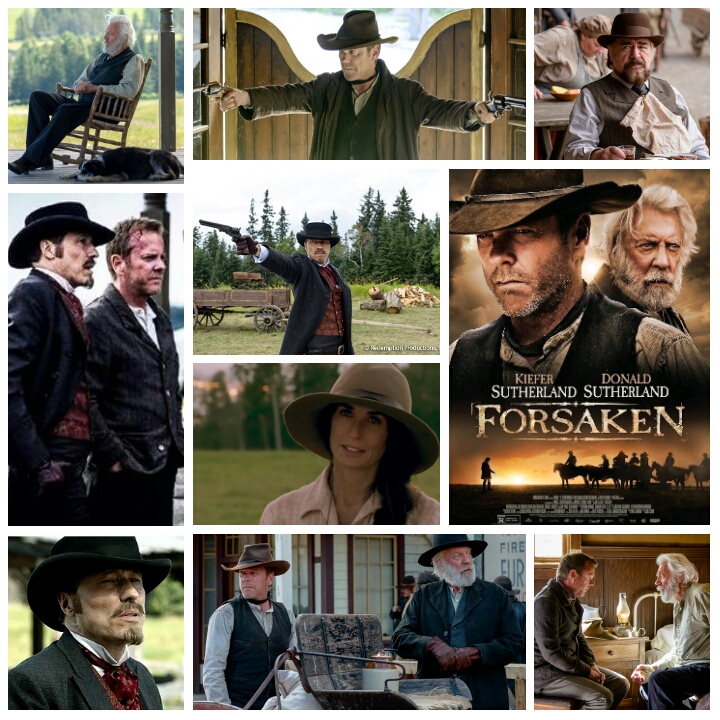
It’s refreshing that in an age populated by revisionist westerns and snazzy new takes on the ancient genre, some filmmakers just want to play it straight and deliver a good old oater without any newfangled bells and whistles. Jon Cassar’s Forsaken does just that, arriving a few years late (turbulent post production issues) but in modest, simple form, here to tell the age old tale of one man who stands up to some evil frontier bankers with stoic heroism. Kiefer Sutherland is John Henry Clayton, a man who has been away from his quiet hometown for nearly a decade. Following a traumatic stint in the war, circumstance led him into the life of the gunfighter. His unannounced return home stirs up old wounds in his preacher father (Donald Sutherland) who cringes in the very presence of his violent aura. John has thrown down the guns and sworn never to pick them up again, but we all know that just ain’t true, and when he meets a certain group of unsavory dudes in town, he becomes a time bomb of righteous anger that’s liable to go off any time. He spends some time mourning his mother and reconnecting with a lost love (Demi Moore), until the inevitable conflict brews. Corrupt banker James McCurdy (Brian Cox) is buying up farms and forcing families who don’t want to sell off their land, using despicable methods carried out by his two goons, vicious Frank Tillman (Aaron Poole) and mercurial ‘Gentleman’ Dave Turner (Michael Wincott). Tensions arise and everyone finds themselves headed for an unavoidable and blistering conclusion. Kiefer always has a jagged rage simmering just below the surface, which is what made him so perfect as Jack Bauer, another time bomb. He’s downright implosive here, delivering the best work I’ve ever seen him give. He’s got a touching scene with his father in which he goes to places I didn’t know he was capable of in his work. Donald is quiet, resentful and compassionate, wrestling internally to keep his serenity in the face of injustice. Cox always puts on a good show as the villain, and he’s exactly what he needs to be here: beaurocratic menace with just a dash of swagger. It’s Wincott who steals the show though, with the best work in the film. He inhabits Dave (and his incredibly dapper costume) with a relaxed, lupine calm, punctuated by sudden bursts of danger and always presided over by the midnight black, raspy croon of a voice that makes him so special. He jaunts along the line between villain and sympathetic antihero so well, the only character in the film to shirk the archetypes, and I was please try reminded of Jason Robard’s Cheyenne from Once Upon A Time In The West. His best work in a while as well, but then he’s always perfect. The film is refreshingly violent in its gunplay, with an earned brutality that never feels gratuituous, and always satisfying. The production took place in wildest alberta, a trip worth the taking for the breathtaking scenery we get to feast on, especially in an opening credit sequence that is very reminiscent of Eastwood films of yesteryear. It’s a landmark in the sense that although both Kiefer and Donald have been in the same film before (Joel Schumacher’s underrated A Time To Kill) they never have shared the same frame until now. Trust me, it was worth the wait. They are both excellent, along with their peers in a simple, honest to goodness Western film that should please fervent fans of the genre and moviegoers alike.

THE LONG GOODBYE – A REVIEW BY J.D. LAFRANCE

longgoodbye

“I felt that the film was almost an essay, an education, to the audience, to say, ‘Stop looking at everything exactly the same way.’” – Robert Altman

When The Long Goodbye was released in 1973, United Artists promptly bungled its ad campaign. Robert Altman’s film radically reworked Raymond Chandler’s novel of the same name and the studio had no idea how to market the offbeat movie. It polarized critics and promptly disappeared from theaters. People weren’t ready for its offbeat vibe and the way it satirized Los Angeles culture. However, it was Elliott Gould’s unusual take on private investigator Philip Marlowe that drew the lion’s share of people’s criticism. His loose, easy-going style flew in the face of the traditional interpretation made famous by Humphrey Bogart and was tantamount to heresy among cinephiles but in retrospect paved the way for a film like the Coen brothers’ The Big Lebowski (1998), which also confounded the mainstream with its own eccentric take on West Coast culture.

While trying in vain to feed his cat late one night, private investigator Philip Marlowe (Gould) receives a visit from his friend, Terry Lennox (Jim Bouton). Lennox asks Marlowe to drive him to Tijuana, Mexico. When he returns home, the police are waiting for him and claim that Lennox brutally murdered his wife. Marlowe does not believe that his good friend is a murderer and refuses to tell the police anything. After three days in jail, he’s released when the police inform him that Lennox committed suicide in Mexico. It’s an open and shut case but something doesn’t quite sit right with Marlowe. He is subsequently hired by the wealthy Eileen Wade (Nina van Pallandt) to find her alcoholic husband, Roger Wade (Sterling Hayden), a famous author with an Ernest Hemingway complex. Marlowe learns that the Wades knew the Lennoxes and that there is more to Terry’s suicide and his wife’s murder than initially reported.

The Long Goodbye
is bookended by the strains of “Hooray for Hollywood” and the song quickly fades out as if to signal that this film will not be a classic noir take on Chandler. Marlowe wakes up after an undetermined period of time. How long has he been asleep? He mutters to himself while trying to feed his cat, a very fickle pet that will only eat a specific brand of food, and when he tries to fool the feline with another brand hidden in an old can, the cat bolts. So what is the purpose of the first ten minutes of the film dedicated to Marlowe feeding his cat? First off, it establishes that this is going to be a very different take on Chandler’s book and that Marlowe’s friend, Terry Lennox, is as fickle as his cat – he only hangs around Marlowe when he needs him but when he’s no longer of use, he splits. This opening scene came from a story a friend of Altman’s told him about his cat only eating one type of cat food.

The Long Goodbye
is much more than a murder mystery. Taking Chandler’s novel set in the 1940s and updating it to the 1970s, Altman is also interested in satirizing the superficiality of L.A. culture. Marlowe is surrounded by an odd cast of denizens that populate the city: his neighbors are a group of women who spend their time getting high and doing yoga with very little clothes on, the security guard for the Wade’s gated community does impersonations of famous actors like Barbara Stanwyk and Jimmy Stewart, and Marty Augustine (Mark Rydell) is a nasty gangster who is proud of his Jewish heritage. Throughout it all, Marlowe repeats his own personal mantra of sorts, “It’s okay with me,” which personifies his easy-going nature.

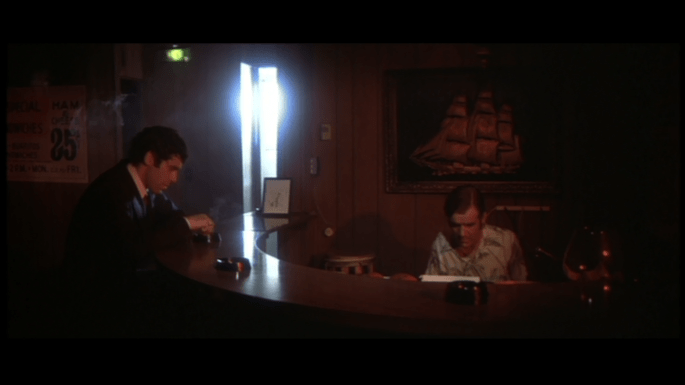
The heart of the film is Elliot Gould. His Marlowe is a laid-back guy in a rumpled suit that wanders through the film muttering jokes to himself and chain smoking constantly. Gould’s character is man out of time, a throwback to another era, which provides a sharp contrast to the trendy, health-obsessed ’70s culture that surrounds him. Altman nicknamed Gould’s character Rip Van Marlowe, as if he had been wandering around L.A. in the early ‘70s but “trying to invoke the morals of a previous era.” The actor delivers a wonderful assortment of smart-ass comments to anyone who gives him trouble but also knows when to play it straight during key dramatic moments. He’s also not afraid to improvise in a given scene like when the police interrogate him and he smears the fingerprinting ink under his eyes like a football player and then applies it to the rest of his face a la Al Jolson, riffing off the police officer that is giving him a hard time. Gould delivers a multi-layered performance that ranks right up there with his other classic Altman films, M.A.S.H. (1970) and California Split (1974). There was clearly a creative synergy between the two men that resulted in both of their best work to date.

Producers Jerry Bick and Elliott Kastner commissioned a screenplay from Leigh Brackett, who had written the script for the Humphrey Bogart version of The Big Sleep (1946). The producers offered the script to both Howard Hawks and Peter Bogdanovich. Both directors passed on it but Bogdanovich recommended Altman, whom he admired. Bick and Kastner sent Brackett’s script to Altman while he was shooting Images (1972) in Ireland. Brian Hutton was supposed to direct but was offered another film and Altman took over. Initially, he didn’t want to do it until he was told that Gould would be cast as Marlowe.

In adapting the book, Brackett had problems with its plot which she felt was “riddled with clichés” and was faced with the choice of doing it as a period piece or updating it. Altman and Brackett spent a lot of time talking over the plot. He wanted Marlowe to be a loser. Her first draft was too long and she shortened it but the ending was inconclusive. She had Marlowe shooting Terry Lennox because it was the way Hutton wanted it. Altman liked the ending because it was so out of character for Marlowe. He agreed to direct but only if the ending was not changed.

Altman conceived of the film as a satire and it was his decision to cast Sterling Hayden and Nina Van Pallandt. The director only knew Van Pallandt from The Johnny Carson Show and from the Clifford Irving scandal. He felt that she resembled a character from Chandler’s novel and the studio allowed him to do a screen test. He also made all kinds of changes to the script, like Wade’s suicide and Marty Augustine smashing the Coke bottle into his girlfriend’s face. Altman did not read Chandler’s book and instead gave copies of Raymond Chandler Speaking to the cast and crew and advised them to study the author’s literary essays. Altman originally wanted Dan Blocker for the role of Roger Wade but he died just before shooting began and the director was persuaded to meet with Sterling Hayden.

When Bogdanovich was briefly attached to the project, he wanted Robert Mitchum or Lee Marvin to portray Marlowe. United Artists president David Picker may have picked Gould to play Marlowe as a ploy to get Altman to direct the film. Bogdanovich did not see Gould in the role because he was “too new” and left the project. Brian Hutton also wanted Gould to play the private detective. At the time, the actor was box office poison in Hollywood after his rumored troubles on the set of A Glimpse of Tiger where he argued with co-star Kim Darby, exchanged blows with director Anthony Harvey, and abused drugs as well as being unreliable and absent. Warner Bros. stopped the production early on and Gould claimed that he was blamed for its failure. The studio collected on an insurance policy that attested the actor was crazy. For The Long Goodbye, United Artists gave Gould the requisite physical before approving his contract and demanded a psychological exam to determine that the actor was mentally stable. Gould read the first draft of Brackett’s script described it as a “pastiche” and very convoluted. Altman called Gould to discuss the film and the actor told him that he always wanted to play Marlowe. Altman asked Gould to read the novel as well as Chandler on Chandler. Gould discovered that he was exactly the same age, height, and weight as Marlowe.

When it came to the scenes between Marlowe and Wade, Altman had Gould and Hayden ad-lib most of the dialogue. Hayden, with his long, scraggily beard and scattershot delivery of his dialogue, is great as the eccentric writer who constantly refers to Marlowe as “Marlboro” (“the Duke of Bullshit,” he adds at one point), in reference to his ever-present cigarette hanging from the corner of his mouth. Hayden delivers a wonderfully unpredictable performance full of bluster and eccentric line readings. According to Altman, Hayden improvised a lot of his dialogue and was drunk and stoned on marijuana most of the time. In the scene where Marlowe tries to save Wade from drowning himself in the Pacific Ocean, Gould almost drowned when he went out too far. He was only able to do three takes. The director decided that the camera should never stop moving and put the camera on a dolly. However, the camera movements would counter the actions of the characters so that the audience would feel like a voyeur. To compensate for the harsh light of southern California, Altman gave the film a soft, pastel look reminiscent of old postcards from the 1940s.

Mark Rydell is something else as Marty Augustine. In the first scene we see him in he threatens Marlowe, then talks sweetly to his girlfriend, and then goes back to menacing Marlowe. At times, Augustine is downright charming and then he suddenly and shockingly smashes a Coke bottle across his girlfriend’s face just to make a point. With the shocking violence of this scene, Altman said, “It was supposed to get the attention of the audience and remind them that, in spite of Marlowe, there is a real world out there, and it is a violent world.” Augustine is clearly a psychopath and Rydell nails the character’s shifting moods with unsettling intensity. The Coke bottle scene is like a cold splash of water to the face and it causes not only the audience to sit up and notice but Marlowe as well, who, up to this point, has mostly been in his own little world. Now, Marlowe has a real, vested interest in what happened to his friend Lennox because he owed Augustine a lot of money and is now threatening Marlowe’s life.

The Long Goodbye
was previewed at the Tarrytown Conference Center in New York. The gala was hosted by Judith Crist, then the film critic for New York magazine. Altman flew in for the Q&A session. The film was not well-received by the audience except for Nina Van Pallandt’s performance, which got good notices. The mood at the Q&A was “vaguely hostile” and afterwards Altman was reportedly “depressed.” The Long Goodbye did not fare well in its limited release in Los Angeles, Chicago, Philadelphia, and Miami. As a result, the New York City opening was canceled at the last minute after several advance screenings had already been held for the press. The Long Goodbye received mixed reaction from critics and performed poorly at the box office because of the unconventional story, plot, and character changes from the novel.

The film was abruptly withdrawn from release by United Artists with rumors that it would be re-edited. Altman went to Picker and told him, “No wonder the fucking picture is failing. It’s giving the wrong impression. You make it look like a thriller and it’s not, it’s a satire.” The studio analyzed the reviews for six months and concluded that the advertising campaign was too narrow. They created a new release strategy for The Long Goodbye with a novel ad campaign that featured a poster illustrated by legendary Mad magazine artist Jack Davis. Altman explained that he “had to prepare audiences for a movie that satirizes Hollywood and the entire Chandler genre.” United Artists spent $40,000, and the New York City première was profitably and critically successful. The Long Goodbye ended up on The New York Times’ year-end Ten Best list. Cinematographer Vilmos Zsigmond won the National Society of Film Critics’ award for best cinematography in 1973. Unfortunately, the damage had already been done and the film still failed to perform well elsewhere.

The Long Goodbye
has endured and become one of Altman’s signature films. It also has some famous fans, chief among them the Coen brothers who cite it as their favorite of Altman’s and an influence on The Big Lebowski. Aside from being a cheeky satire on Hollywood almost as much as The Player (1992) was, a later Altman film that brought him back into the mainstream, it is a film about loyalty. By the end of the film, Marlowe has learned a valuable lesson – there are some friends you don’t stick your neck out for. He is loyal to a fault and realizes that Lennox wasn’t the friend that he thought he was. As the Altman quote states at the beginning of this article, Marlowe is forced to stop looking at everything exactly the same way, just as we are, and see his friend for who he truly is.

B Movie Glory with Nate: Blood Shot

image

Folks, this is one for the books. Ever wish there was a film made about a badass, gun slinging vampire who is secretly contracted by the President of the United States  (Highlander himself, Christopher Lambert) to carry out dangerous missions and thwart evil Islamic terrorists? Well your very specific and demented wish just came true. Imagine for a moment that John Carpenter, Joe Dante and Michael Bay got hammered one night and wrote the most ridiculous script for a horror action comedy this century has seen. The resulting treatise would be Blood Shot, an absolute hoot of a flick that combines elements that wouldn’t be caught dead (or undead) together in any other setting but that of the gloriously unrestricted world of the B movie. The President uses a craggy operative named Sam (ever brilliant Lance Henriksen) to brief the Vampire in question (Michael Bailey Smith) on his missions. He is to hunt down violent Islamic rebels, led by a dude called Bob. Bob is Arabic. Bob is played by Brad Dourif, who is white as a sheet, but here shows up caked in brown makeup and hollering away in the most idiotic accent I’ve ever heard. His casting alone is just hysterical, and should drive the social activists up the wall screaming, while the rest of us howl in with laughter. His character is called Bob because of everyone’s inability to pronounce his real arabic name which is a mile long and completely nonsensical. His crew are terrorists straight from a Mel Brooks film, complete with a midget amongst them. There’s also a lone hero cop (Brennan Eliott channels the hotshot, reckless law enforcers of 80’s movies) hunting both the terrorists and the Vampire, getting in everyone’s way and capping anything that moves. The fact that Highlander plays the President in a film about a Vampire who hunts down terrorists named Bob should be more than enough for any self respecting film fan to drop whatever they’re doing and go bask in this baby’s glow. Despite being a direct to video flick, it contains not a trace of the trademark ineptitude and shoddiness that you’re always likely to find when exploring the genre. Campiness and lunacy, oh yes. But never mediocrity or laziness. But that’s what your friendly neighborhood Nate is here for, to wade through the unwatchable sludge and mine out the priceless gems for you all to see. This one’s funny, imaginitive, off the wall and a pint of B positive fun. 

Passion Of Mind: A Review by Nate Hill

image

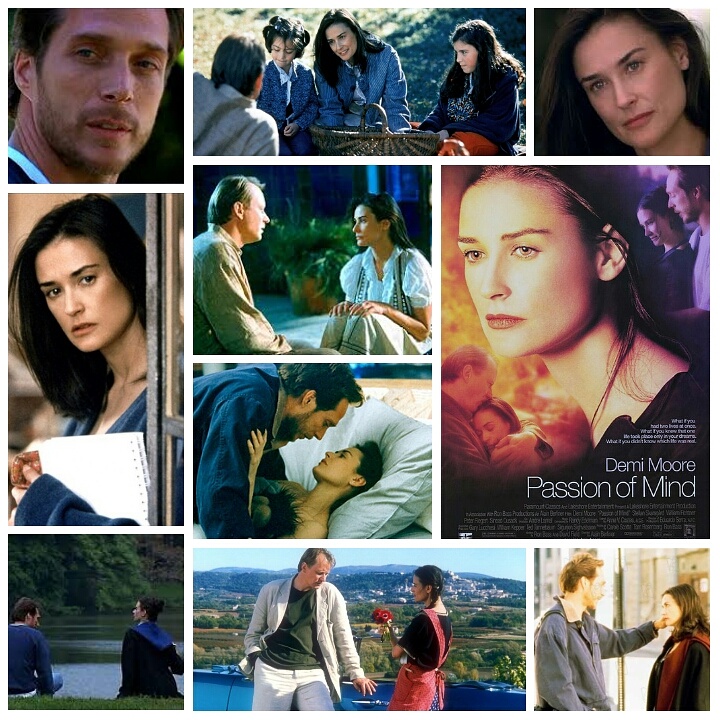
Passion Of Mind is a little seen fantasy romance tale that stars Demi Moore as a woman named Marie, essentially living double lives in a way. She lives and works in New York, and is as ordinary as any other woman in the world, but when she goes to sleep she wakes up to another life in the French countryside, with another job and children who aren’t in New York. She lives a day in the French life, goes to sleep, wakes up back in the New York life and lives for another day before going to sleep and back again. And so it goes. Is one life a dream? Or both? Is she imagining things, or stuck in some rift? To complicate things, as always happens in film, there are two men, one for each life. Aaron (William Fichtner) is a kind, caring businessman in the New York life who she begins a relationship with. In France she meets compassionate, romantic William (Stellen Skarsgard) who she also begins to fall for. Quite the predicament, no? If the premise sounds familiar to you, here’s why: there was a short lived NBC drama called Awake which ran for one season, starred Jason Isaacs and had the exact same setup. Now while the show obviously borrowed it’s central plotline from this film, it’s no big deal because it’s such a great idea it deserves more than just one shot. The film is quiet, pleasent and sweet, never really taking steps to explain it’s concept but simply letting it’s characters live within it in perplexed, whimsical harmony. Moore has an inherent sweetness to her and she’s wonderful here. One might think a protagonist who is put through a scenario would be confused, stressed out and damaged. Moore plays it her own way, as she always had. Her character is enchanted by her situation, if a little wary. Skarsgard and Fichtner are left field choices for romantic leads, as both are kind of considered character actors with stark, specific looks. Both play it straight here and their casting helps the film loads. Marie has two separate therapists, each from one of the lives (an element which the NBC show used as well), played by Joss Ackland and Peter Riegart. It’s not to serious, not too fluffy, just the right kind of low key romance with an imaginitive streak and a high concept that fits neatly into the story.

WONDER BOYS – A REVIEW BY J.D. LAFRANCE

Wonder-Boys-robert-downey-jr-13124127-1280-544

Wonder Boys (2000) is a redemptive tale of a college professor in the midst of a mid-life crisis. It is a film about faded glory and people past their prime. Curtis Hanson’s film is the kind of small, oddball little tale with a decidedly off-kilter, dark sense of humor and a cast of eccentric characters. It was a bit hit with critics but never quite connected with a mainstream audience due in part to a bungled initial promotional campaign that clearly did not know how to convey the quirky tone of the film into an easily digestible soundbite.

Grady Tripp (Michael Douglas) is a burnt out English professor that wrote a much celebrated novel entitled, The Arsonist’s Daughter, but has since been having a hard time with his follow-up. He keeps writing and writing with no end in sight (current page count sits at around 2,100+ pages). His young wife has left him and he’s sleeping with his boss’ wife, Sara Gaskill (Frances McDormand), who is also the Chancellor of the university where he works. His long-suffering editor Terry Crabtree (Robert Downey Jr.) is in town to take a look at the book. He maintains a “what me, worry?” façade but is in danger of losing his job unless he can find a potential best seller and applies subtle but definite pressure on Grady. The professor has also taken under his wing a brilliant but troubled student, James Leer (Tobey Maguire), from his creative writing class. He’s a tortured artist wannabe as evident from his habit of sitting in an empty, dark classroom. He is also ostracized by his classmates who resent his ability to write.

Producer Scott Rudin gave Michael Chabon’s book to screenwriter Steve Kloves. At first, he wasn’t interested – he hadn’t written a word in four years and had never adapted a novel before – but while reading the novel he connected with the material, “and a sort of kinship with Michael Chabon’s tone and the way he looked at his characters, with all their flaws, with a real generous spirit,” he said. Initially, Kloves agreed to adapt the book and talk about directing it but two and half years into working on the screenplay, he decided not to direct. After the success of L.A. Confidential (1997), Hanson was working on a script of his own and reading other scripts with a keen interest for his next film to be a comedy. Actress Elizabeth McGovern once advised him to work with Kloves and was given his screenplay. He was told that Michael Douglas was interested in playing Grady and was impressed by the way in which the characters were presented and “the lack of judgment on their actions and eccentricities.” In addition, Hanson “fell in love with these characters – and they made me laugh.”

Hanson told Rudin, “it’s too bad you can’t have Jean Renoir or Hal Ashby direct this.” Once Hanson was attached to direct, Kloves met with him and was relieved that they were both on the same page in terms of their approach to the material. Chabon encouraged Kloves to make the material his own and this included changing Grady’s Jewish in-laws to gentiles. Additional changes were made once Hanson came on board. For example, he felt that James Leer would be a fan of Douglas Sirk’s films as opposed to Frank Capra as he is in the novel. The studio wasn’t interested in making a quirky, character-driven comedy/drama until Michael Douglas agreed to work well below his usual large fee. One of the challenges for Hanson was to take a plot that he called “meandering and, apparently, sort of aimless,” and a character that “does things that even he doesn’t really know why he’s doing them,” and try to create a “feeling of focus” to keep the audience interested. Another challenge was working on actual locations in very cold weather and constantly changing conditions.

Hanson’s other concern was if Douglas would be willing to take on the role without a hint of vanity but also do it in a truthful way and not in a way that would draw attention to the fact that he was playing an unattractive character. To his credit, the actor disappears completely into this role. He’s not the first person you’d think of to play Grady. When he tries too hard to be funny it can come across as pompous, but he tones it down here and looks completely at ease, comfortable as the frumpy Grady. Douglas hits just the right notes of world-weary cynicism but with a romantic streak buried underneath. For the veteran actor it’s an unglamorous role – he gained 25 pounds for the role, eating pizza, subs and drank a lot of beer. He always looks rumpled, unshaven with unkempt hair and often wearing a ratty old housecoat when he writes. Grady has the capacity to do something about his miserable lot in life and during the course of the film his character undergoes a fascinating arc. In some ways, Grady is a pot-smoking burn-out like the Dude from The Big Lebowski (1998) only with slightly more ambition. He lives outside of normal society in the rarified atmosphere of academia — puttering around, writing his novel and teaching his writing class, but when he crosses paths with James Leer, Grady realizes that he’s got to change.

Wonder Boys
also marked a break-out role for Tobey Maguire. Before he garnered massive mainstream exposure with Spider-Man (2002), he was known mostly for roles in small, independent films. Like everyone else in the cast, he has his memorable moments, like when his character laughs at Q’s (Rip Torn) pretentious speech at Wordfest with a high-pitched giggle that reverberates through the large auditorium. The blissfully stoned expression he gives afterwards is priceless. Everyone in the film keeps harping on what a genius writer Grady is, but it gradually becomes apparent that James is the true genius. He writes pages and pages of beautiful prose in minutes. And like any true talent, it just comes pouring effortlessly out of him. What makes James such a good writer is that his whole life is essentially a lie – he lies about his parents’ past, how they met and where they came from. He even maintains this air of a tortured artist but as we find out that too is a lie. James has it pretty easy, living in a large house in an affluent neighborhood. Good fiction writers have to be masters at making things up.

As always, Robert Downey Jr. knows how to make an entrance, meeting Grady at the airport with a transvestite as his date. The exchange between Terry and Grady quickly establishes their long-time friendship by the familiarity between them. Downey is able to take the most mundane, ordinary line and give it his own unique spin and make it funny or give a look that is memorable. His rapport with Douglas is excellent and they play well off each other as both sides of the comedic equation. Downey was on probation during the winter of 1999 when Hanson considered him for a role in Wonder Boys. The director was cautious because of the actor’s drug history and was concerned because it would be a tough film shot in sequence in Pittsburgh in the winter. Downey flew to Pittsburgh and had a long dinner conversation with Hanson where they addressed his problems. The actor demonstrated a commitment to the film and the director hired him. According to Hanson, Downey acted in a professional manner for the entire four-and-a-half month shoot but after it ended and he returned to Los Angeles, the actor violated his parole.

Frances McDormand knows how to react to those around her, like when she meets Grady, Terry and his date at a party. Watching her react to the charming transvestite is priceless. She and Douglas also have excellent chemistry together as evident in the short hand, the give-and-take between their characters. This is nicely established in their first scene together where Sara tells Grady that she’s pregnant. The music sets a slightly melancholic even whimsical tone as the two characters reveal that they are trapped in relationships that they don’t want to be in. They want to be together but Grady won’t show her how serious he is about them. Ultimately, Grady has to save himself and to in order to do this he must convince Sara that he does love and he want to be with her.

Steve Kloves’ script is a solid piece of writing as he does a great job of adapting Chabon’s book, trimming it of its excess narrative fat (as he also did so well with the Harry Potter books). It has clever, memorable dialogue that speaks volumes about these characters. There is a pleasant mix of off-kilter humor and poignant drama as we are presented with all sorts of colorful characters, like Grady’s bisexual editor and the famous and pompous writer known as Q (played to haughty perfection by Rip Torn) and then have them played by equally eccentric characters actors. The dialogue is humorous and offbeat in one scene, touching and thoughtful in the next. For example, in one scene, James rattles off a list of celebrity suicides in alphabetical order, the dates and how they did it in a mechanical monotone as if he’s reading off a grocery list that adds to humor of the scene because it is such an unusual moment.

Kloves also wisely avoids the usual clichés. like Katie Holmes’ character, the young, nubile co-ed who, in a lesser film would have had a fling with Grady. This would have broken the magical spell that this movie casts and so the filmmakers wisely avoid it. Instead, she helps Grady realize that his book is going nowhere and that he needs to make some choices about it and his life. One of the film’s major themes is about making choices. Grady’s problem is that he is indecisive. He can’t make up his mind about how he feels about Sara and he can’t figure out how to end his wildly out of control novel that is ultimately a metaphor for his life. Grady’s life is in a holding pattern, like his book and both get more complicated as life goes on. As the days go on so does the page count increase on his book. However, the key to his salvation lies in his mission to reach James and nurture his talents. Grady sees some of himself in James – a wonder boy in the making while he is a wonder boy who has lost his way. Terry is the third wonder boy in the film and his luster has been fading over years, unable to find another breakthrough novel like The Arsonist’s Daughter and is generally regarded as a joke at work.

Hanson strips color from the palette, presenting Pittsburgh in blues and grays, a romantic, post-industrial setting that we see through Grady’s car window. It’s subtly presented as Hanson doesn’t hit us over the head with obvious landmarks. He excels at creating just the right mood and atmosphere. For the director, the city mirrors the characters in the film as he commented in an interview, “it’s a city with this glorious past that went into decline…That’s why I wanted to shoot here. I think the city’s so emblematic of the characters’ problems.” The city was experiencing a mild winter during their shoot and they had to use a lot of artificial snow.

The best films are the ones that you lose yourself in completely. There is a scene where Grady sneaks a smoke outside of the Gaskill house at night and a light snow falls. He spies a greenhouse in the distance and it is illuminated in the night looking like “heaven” as James puts it. This is in contrast to the warm, gold interior of the nearby Gaskill house. This is a wonderful little moment frozen in time and the beginning of the friendship between Grady and James.

The attention to detail — a snowy winter in Pittsburgh — is beautifully realized. Hanson does a great job of conveying a sense of place, utilizing locations well. There is the warm, red and gold of a blues bar that Grady meets Terry and James at. It’s a small place packed with people and they sit in a booth that create an intimate feel. There’s a great moment where Grady and Terry spot an odd looking guy across the bar and create an elaborate and colorful backstory for him, including a name – Vernon Hardapple – and who is, among other things, “president of the James Brown Hair Club for Men.” Grady later encounters the man on a couple of very memorable occasions including a funny scene where Grady, Q and Terry try to evade Vernon outside of the bar that ends with the man jumping on the hood of their car with his butt. We see Q and Terry laughing and having fun as Grady tries to escape and in turn it is fun for us to watch.

Hanson had been a fan of Bob Dylan’s music since childhood and a great admirer of his soundtrack for Pat Garrett and Billy the Kid (1973). As it turned out, Dylan was a fan of Hanson’s previous film, L.A. Confidential and after a lot of convincing screened 90 minutes of rough footage from Wonder Boys. Hanson wanted Dylan because “who knows more about being a wonder boy and the trap it can be, about the expectations and the fear of repeating yourself?” In addition to Dylan, Hanson built the score around nine singer-songwriters including Leonard Cohen and Neil Young. The entire soundtrack is integrated into the film and Hanson even played some of the songs for the actors on the Pittsburgh set to convey a scene’s “aural texture,” as the director put it in an interview.

The studio decided to release Wonder Boys in February, notoriously the month where films no one cares about are unceremoniously dumped, and while it connected with critics, flopped at the box office. It came out a week after the Academy Award nominations were announced. The studio spent a lot more money promoting the films of theirs that were nominated and not enough on Wonder Boys. The Wall Street Journal‘s Joe Morgenstern praised Douglas’ work in the movie, but criticized the movie poster, which featured a headshot of Douglas: “a raffishly eccentric role, and he’s never been so appealing. (Don’t be put off by the movie’s cryptic poster, which makes him look like Michael J. Pollard.)” The Los Angeles Times‘ Kenneth Turan also slammed the poster: “The film’s ad poster brings Elmer Fudd to mind.”

Hanson was not happy with how the film was marketed, in particular the poster, which he said in an interview, made Douglas look “like he was trying to be Robin Williams.” Furthermore, he said, “The very things that made Michael and I want to do the movie so badly were the reasons it was so tricky to market. Since films go out on so many screens at once, there’s a need for instant appeal. But Wonder Boys isn’t easily reducible to a single image or a catchy ad line.” The director disagreed with the studio over the film’s original release date and advertising campaign. To make matters worse, the marketing was criticized in the press and in an unprecedented move, the studio canceled the lucrative video contract and pulled the film out of theaters. Hanson and Rudin lobbied to have the film re-released. A new campaign was designed that emphasized the ensemble cast and the film was released in theaters where it promptly flopped at the box office again.

Every scene in Wonder Boys feels warm and inviting and filled with interesting characters that inhabit this world and that allows you to be in it for the duration of the film. By hanging out with James, Grady regains that wonder boy spark while also guiding his young protégé to becoming one himself. What better teacher than someone who was once one? At one point, Grady says that most people don’t think and that books aren’t important anymore. He’s jaded and cynical about the world but over the course of the film James reaches him and changes his outlook on life.