Ryan Whitaker’s After

Countless films give their visual interpretation of what purgatory and the afterlife may look like, and Ryan Whitaker’s After paints a misty, darkly entertaining tale of two souls stuck in the great beyond who must work together to discern their situation and escape. As a greyhound bus ploughs through the rural night, it’s two lone passengers (Steven Strait, Karolina Wydra) are strangers who flirt briefly before the bus takes a wrong turn and crashes horribly, sending them both hurtling out the windows. When they awaken they are trapped in some sort of deserted, hazy twilight zone version of their hometown, as a curtain of ominous black vapour surrounds the area on all sides, walling them in. It soon becomes clear that they are both stuck in comas out there in the real world and inside this sort of, spiritual simulation if you will, they have to delicately find a way out by delving deep into their respective pasts, processing painful memories, finding the right key (literally and metaphorically) to escape this hovering inter-zone and either pass on to the other side in ethereal form or reawaken once again in the physical realm to continue this incarnation. It’s heavy, philosophical stuff that is given the somewhat surface level thriller treatment yet still manages to be just metaphysical enough to keep me intrigued. There’s a terrifying Stranger Things type monster that hunts them and is clearly there to represent the trauma in both their pasts manifesting in tangible form to haunt them. There’s a romance angle that I’m not sure if I altogether bought but the film and actors seem assured enough in and some of the finer plot turns could have been more richly developed, I found myself wishing that this concept could be done as a long form 8 episode miniseries or something, but the film serves well enough as a perfectly decent told story with a truly fascinating concept. Good times.

-Nate Hill

Alien Vs Predator: Requiem

There’s a lot of trash been talked about the Alien Vs Predator films and.. yeah, I’m not going to argue, they’re not the greatest thing in the universe, let alone the canon. But at least the second film, given the appropriate subheading Requiem, had the decency to actually be R rated and go for broke with gore, violence and ooze as we are accustomed to from each respective franchise and, as dutiful fans, no doubt deserve. While the first film was a lore-heavy, multidimensional Antarctic set SciFi horror with a ton of exposition, this one ditches all of that for a lush Canadian Pacific Northwest setting and a very thinly plotted slasher aesthetic wherein the residents of a quiet Vancouver suburb encounter both species when a predator research spacecraft carrying a bunch of alien face-huggers crash lands nearby. I won’t go too much into detail regarding the characters because they are just beyond cliched. Hot dumb blonde dating the asshole jock, underdog pizza delivery boy hopelessly in love with her, cue violent altercations blah blah who honestly cares, the writers literally put less than no effort into that arena. Tough guy town sheriff (John Ortiz) rallying the troops to fight these beasties and a mysterious army colonel (Robert Joy, adding the film’s only recognizable horror pedigree as far as cast goes) who has some egregious agenda connected to the Yutani corporation. Much of the film is shot in dim or dark settings like the first, so the action isn’t always discernible or legible, but there are a whole parade of Xenomorphs just crawling all over the place which is fun. One way this one succeeds is in its gruesome viciousness; the gore, kills, splatter and deaths here are an absolutely spectacular array of surprisingly nasty (we see kids and a pregnant mother in a hospital butchered by the marauding Aliens) set pieces and carnage, and when it comes time for the two species to have their WWE Smackdown the series of fights between them are brutal and not disappointing. The film has zero mythology and strips down all of that world building for a simple tale of one Canadian town being decimated by these two warring species as they beat each other senseless, and that’s pretty much it. I didn’t hate this film, and I didn’t love it but I sure as hell admired its willingness to go full on hard R like these franchises were always meant to be, unlike its pansy ass predecessor. And one more thing: this is the only film on record in either canon to feature an Alien/Predator crossbreed creature that seems to show up out of nowhere, and while that probably just means it was created in a lab by the Predator species who appear to be busy bees as far as experimentation goes here, I’d fondly like to think that at some point two of them fucked and had gnarly acid-lubed intergalactic alien sexy time, and I’ll leave you with whatever lovely mental image that may conjure up. Good bloody fun.

-Nate Hill

Andrew Patterson’s The Vast Of Night

Andrew Patterson’s The Vast Of Night is one of the only films I’ve seen that almost flawlessly captures that incredibly specific feeling of ‘a summer night right around school ending’, that magical, magnetic, ‘stay up all night’ vibe right as the year gets exciting. The film itself is about two high school students in the 50’s who receive a very strange radio frequency signal at a local broadcast station one of them works at, a signal that may or may not be coming from a mysterious unseen UFO hovering above the small town’s airspace. That plot thread is really just the groundwork for what can only be described as a very atmospheric, unbelievably well written and candidly acted mood piece where, for most of the film, we simply follow these characters talking amongst themselves and interacting in a very realistic fashion until slowly, bit by bit, the underlaying SciFi narrative makes itself known. Now, naturally such a style and pace requires a modicum of nearly meditation level patience from the viewer, but when your dialogue, atmospherics, acting and physical blocking of people and objects are this fluid, assured and endearing it’s not a tough task for a viewer to fully surrender themsef to the experience. Our two young leads (Sierra McCormick and Jake Horowitz) are both superb and have the kind of whip smart, intuitive chemistry you can relate to being a teenager once yourself, and every character they meet over the course of this night (unfolding in cohesive real time) is very well casted and acted, from their friends and family, high school faculty and a couple spooky informants who provide theories and personal experience as intel on this UFO scavenger hunt. This is director Andrew Patterson’s debut film and he goes for the boy wonder routine by basically doing almost everything himself including editing, and I have to give it to the guy, this is one hell of a first time effort. The camera moves elemental from scene to scene with unobtrusive cuts, gorgeous nocturnal summer photography and the sheer ballet of movement as characters move across town, in and out of cars, buildings and the central hub of the high school basketball stadium feels like an understated dance of near flawless blocking and storyboard translation. I won’t spoil whether or not these two kids actually find a real UFO or not because this is decidedly a ‘the journey, not the destination’ experience, but what a transfixing little journey it is. Anyone who has ever laid out in a field on a hushed summer evening, gazed up at the stars and felt that special indescribable feeling when they wonder what’s out there and are we really alone will heavily relate to this film and vibe on its atmospheric frequency, because it achieves something that is often so hard for films to tangibly and effectively alchemize onto the screen: a genuine sense of wonder. Very fine film.

-Nate Hill

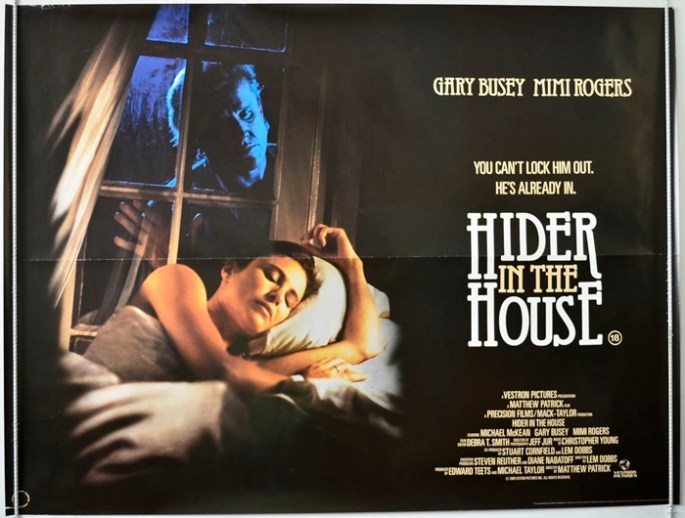
Hider In The House

Hider In The House is pretty much your average ‘unhinged loner stalking a suburban American family’ thriller, and the psycho in question is played by Gary Busey, which seems like your perfect setup for a maniacal ride. However, this film presents its antagonist as a surprisingly sympathetic individual who was abused viciously for year by his own parents until he finally had it and burned the house down around them. Fair enough. Upon being released from psychiatric care and a halfway house as an adult he decides to take up residence in the attic of an empty house, just to see what normal life feels like. Well the house doesn’t stay empty for long as a yuppie couple (Mimi Rogers and Michael McKean) prepare to move in. Busey just keeps on living up there and eventually insinuates him self into their lives under the guise of a ‘neighbour,’ eventually becoming downright disturbed, menacing and dangerous. The film is pretty relaxed as far as thrillers like this go, it takes a while to amp up to anything resembling tension and Busey, given the perfect runway to cut loose and turn in one of his patented loony performances, chooses instead to almost entirely rein it in except when the situation legit calls for a touch of hysteria. It’s decent enough and I’ll pretty much watch the guy in anything, he’s just got such a presence, but this is low budget, melodramatic silliness no matter how you slice it.

-Nate Hill

Arthur Hiller’s Silver Streak

Is this what was considered funny in the 70’s? Because it felt lukewarm, awkward and stretched over a super long runtime to me. Don’t get me wrong I love Gene Wilder with all my heart and Richard Pryor is cool too but if Silver Streak is any kind of barometer as to what their comedic pairing in cinema back then is all about (this is my first one) then, well… meh. Wilder plays a mild mannered businessman on a long distance rail trip who gets unwittingly yanked into all sorts of espionage shenanigans involving a femme fatale (Jill Clayburgh), a malevolent Bond type villain (Patrick McGoohan), a boisterous undercover federal agent (Ned Beatty) and many others aboard the speeding train, all of them looking for some sort of highly incriminating McGuffin object that we never really see. Pryor himself doesn’t even show up until at least halfway through the film playing a rowdy petty thief who is proud of his vocation (“I’m a thief” lol) and sort of forms an uneasy alliance with Wilder to outwit all these competing forces. That sounds like a ton of fun, right? Not so much. It all just comes across as awkward, weirdly paced and WAY too long, this is a brisk 90 minute comedy posing as a two hour big budget thing that just doesn’t have the juice to fill that runtime with enough to keep us occupied. There’s a jarring sequence where Wilder gets done up in blackface, *with* Pryor’s assistance no less, and get coached in jive turkey talk as some harebrained disguise gimmick, but it’s only really in the film as a shtick to serve itself and makes no logical or comedic sense whatsoever. Now I know this was the 70’s and comedy was a lot different back then, and I’m the last one to ruffle my feathers over stuff like that but time period aside it just feels lame, awkward and unnecessary, with both actors making painfully embarrassing asses of themselves. There is one scene that genuinely made me laugh hard, in which a frazzled Wilder frantically tries to explain his predicament to a dozy small town sheriff (Clifton James) who simply cannot wrap his mind around the complexities of a multi-character spy dilemma unfolding in real time. This part is genuinely hilarious and shows some spark but it was the only instance of that for me. The film is packed with recognizable faces including Fred Willard, Scatman Crothers, Ray Walston, Richard Kiel and more, none of whom make very vivid or memorable impressions. This just felt like a misfire to me overall, with two actors who I know to be surefire winners most of the time that just sort of flatline here in oddly conceived skits, a hopelessly cluttered and not particularly engaging caper that just feels like a lot of sitting on a train, running around and then more sitting on the train without much that kept me entertained. Check out the sheriff’s station scene over on YouTube though, it’s a hoot.

-Nate Hill

Brad Furman’s City Of Lies

Question for you: did the LAPD use propagandist maneuvers and media manipulation in the 90’s to fictitiously outline an ongoing east coast/west coast gang war that never even existed and then, using covert tactics and unstable deep cover operatives, deliberately and unlawfully orchestrate behind the scenes murders of influential rappers Christopher ‘Notorious BIG’ Wallace and Tupac Shakur? This film certainly seems to think so, and the fact that it was suspiciously buried in distribution hell for three plus years following its production and snuck unceremoniously into release just this year has me thinking so as well. City Of Lies, based on the documentarian book LAbyrinth, is a fascinating, paranoia laced, very well written procedural thriller starring Johnny Depp as real life LAPD detective Russell Poole who never stopped trying to find out who really shot Biggie and Forest Whitaker as a reporter interested in the case who spends some time with him trying to get to the truth. The film is centralized around 2015 when the final chapter of Russell’s almost career-long investigation arrives at a conclusion but it leaps all over the 90’s for stylish, eerie, memory laden flashbacks that evoke everything from Tony Scott to Bourne movies and the filmmaking aesthetics, score, soundtrack and performances are all exemplary. Depp has had the misfortune of being dealt a few shitty hands lately which I won’t go into too much, but a mystifying scandal was whipped around this film itself to scapegoat him when it appears the real reason this film was buried was… well, just look at the subject matter. He gives a pained, haunted, understated, against type and altogether gripping performance here that hopefully is the start of a surge of roles that sees his phoenix ascent upwards from the quagmire of bullshit he’s been put through. Whitaker is fantastic as well and quite soulful in the third act and director Brad Furman (The Lincoln Lawyer) assembles an unbelievable supporting cast just packed with character actor talent including Michael Paré, Toby Huss, Xander Berkeley, Rockmund Dunbar, Laurence Mason, Louis Herthum, Shea Wigham, Dayton Callie, Biggie’s real life mother Voletta Wallace playing herself, Obba Babatundé, Kevin Chapman, Glenn Plummer and the great Peter Greene as a particularly acid tongued LAPD commander. The film has a way of swerving just south of every question asked and a knack for making you feel like this story is open ended and unsolved. Unsolved is different than unproved though, and if everything that Depp’s Russell Poole cataloged and uncovered is for real then it’s no wonder this film never saw a major release and was held up for so long. Whatever really happened back then, this is one finely crafted thriller with a galaxy of terrific performances, a taut, engaging narrative and an incentive to shed light on those who abuse power, should know better, and need someone to call them out on it. Who better than a good cop like Poole, and who better to bring his story to life than an actor like Depp, who can pretty much do anything but tries something we’re not used to seeing from him everyday: play a regular guy just trying to do the right thing in the face of absolute corruption.

-Nate Hill

THE ROBERT ALTMAN FILES: A PERFECT COUPLE (1979)

Coming off the universally reviled and glum Quintet, Robert Altman began to move back toward the warmth of human relationships with A Perfect Couple, a lighthearted romantic-comedy that tracks a mismatched couple through a series of sweet-natured misadventures as they connect, decouple, and reconnect. Put against Paul Newman’s fight for survival in a world not fit to survive, the synopsis of a middle-aged man (Paul Dooley) falling in love with a backup vocalist in a rock band (Marta Heflin) probably seemed much more in tune with what moviegoers in 1979 were wanting. Unfortunately, Altman wasn’t in much of a mood to tackle such a light project and as a result of being weighed down by a number of elements on top of which it can never seem to climb, A Perfect Couple both registers as one of Altman’s weakest efforts and the one that marked the end of his relationship with 20th Century Fox as his fifth picture delivered to them, 1980’s HealtH, would slowly bump its way down their release schedule, eventually dropping off of it completely, never to return.

The movie opens promising enough as Alex Theodopoulis (Dooley) and Shiela Shea (Heflin) enjoy an outdoor performance at the Hollywood Bowl of the LA Philharmonic, for which his sister, Eleouisa (Belita Moreno), is a cellist. As a torrential downpour disperses the crowd and ends the concert, Alex and Sheila escape to cut short what we learn is their first date which has been powered by their participation in a video dating service. During this time we also learn that Sheila lives in a cramped loft among numerous members of Keepin’ ‘Em Off the Streets, a rock outfit she has just recently joined. Alex, on the other hand, is part of a starchy and conservative Greek family where almost nothing is done individually, Friday nights are spent watching their father (Titos Vandis) mock-conduct along to orchestral music, and men who are almost halfway done with their entire existence on this planet still have to ask for permission to go on a date.

All of this is to set up a story of opposites where two sides of a relationship are viewed with elements in both sets of families that mirror each other and, surprisingly, this is where the film really fails. This is a movie that wants to show how clever it is by drawing parallels between the two disparate worlds but, unfortunately, neither world is appealing and Altman further cheats the audience by giving too much of one and not enough of another. One of the biggest examples of this is how Altman treats the gay characters in his film. Always one step ahead of his peers in his treatment of LBGTQ characters on the whole (most notable in the remarkable Come Back to the Five and Dime, Jimmy Dean, Jimmy Dean), Altman wears down a lot of shoe leather discussing the inner workings of the relationships between three gay members of the band (which is commendable) but then gets tight lipped and opaque when dealing with the other side of the coin, namely, Eleouisa and her relationship to band mate Mona (Mona Golabek) which is clearly non-platonic. It’s unclear if Altman keeps it coy to underline Alex’s clueless, almost juvenile and stunted view of sex and relationships or if Altman is making a point in regards to the sad sickness in Alex’s family that causes Eleouisa to code-talk her way around it but, by doing so, he shortchanges the audience by closing off an interesting avenue for dramatic exploration.

In fact, throwing up road blocks to anything interesting is what Altman seems to do well in this movie. Almost every side character that saunters into the frame is preferable to the couple at the center. Whether it’s co-screenwriter Allan Nicholls popping up as well-meaning suitor Dana 115 or Ann Ryerson’s hilarious turn as a randy veterinarian, the urge overwhelms me to cling to their legs and beg them to take me away with them. Likewise, I’m almost certain a better movie could be made out of the exploits of Alex’s bored yet obsequious brother, Costa (Dennis Franz) and/or his creepy, effete brother-in-law, Fred Bott (Henry Gibson, fabulous as ever), both of whom feel like characters who escaped from an episode of the brilliant sitcom Soap. Hell, give me a movie featuring nothing but the exploits of the emergency room doctor, drolly played by frequent Altman collaborator Frank Barhydt and one of the few in the film who seems to understands he’s in a Robert Altman picture.

Throughout the film, Alex is an uppity scold who is continually turned off by things in both Sheila’s world and outside the confines of his own familial sarcophagus. He’s disdainful of the “weirdos” in her world but he also runs like a scared man-child when he realizes that a video date he is with likes a little slap and tickle. He seems to be a man of little intestinal fortitude, reuniting with Sheila after a disastrous video date only to leave again when he realizes that the rigors of the road and the lack of privacy just aren’t for him. His final return to her, almost insultingly, occurs only after he’s banished from his family following a left-turn tragedy that occurs in the third act and, unfortunately, one which the film simply cannot emotionally support, creating a fatal tonal imbalance. I would almost say that Alex is maybe a spiritual cousin to the distaff sexual cripples that populated 3 Women and That Cold Day in the Park excepting we see the patriarchal squeeze that makes Alex into the person he is and we are triply frustrated when he never does anything proactive about it.

Her performance maybe three slight shades of beige, Marta Heflin makes zero impression in this movie. This is a shame because Heflin is a natural and good actor (she’s underused in A Wedding and she’s perfect in Five and Dime). Only ever getting the heart pumping during a scene where she is roundly humiliated by Alex’s ridiculous family, Heflin never seems like she’s fully bought in to the relationship nor does she give off the impression that she wouldn’t be fine without it. After all and in the end, is Alex REALLY worth all the trouble she goes through in the film? But Altman and Nicholls don’t give her character much life and, like the contrast between the gay characters, the comparison between the stern patriarchs of the Theodopoulis clan and Keepin’ ‘Em Off the Streets is a cosmetic afterthought; the kind of thing you’d be able to show an elective film course made up of seventh graders as to teach about thematic balance.

This is a film that doesn’t resolve as much as it ends. It feels like a much longer film was shot but a hacksaw was taken to it and only the items that really interested Altman (namely, the stuff with the band) were left in. But, by keeping one eye on the clock and delivering a crowd pleasing rom-com (which, at just a hair under two hours, is still overlong) the cuts to the film create gaping holes and so many questions remain as the credits roll. Is Sheila now out of the band and replaced by the singer we see for the first time right before the end? How did the band and the LA Philharmonic wind up playing together at the Hollywood Bowl? Is Alex completely done with his family without ever standing up for himself? How in the world did Alex ever have a first wife without ever telling her he really liked her? Does Sheila even have a backstory? Is she so weak that she takes Alex back with no kind of discussion about his shitty attitude and his penchant for leaving her? If Altman thought he could pull a Minnie and Moskowitz and simply get by with a “love conquers all…EVEN TWO WILDLY OPPOSITE PEOPLE” movie, he missed the gritty charm and the attention to character that infused every frame of that film that made it work despite all of its logical holes and corners cut by its writer and director, John Cassavetes.

And let me pause on here to remark on the thing I most dislike about A Perfect Couple, which is the entirety of Keepin’ ‘Em Off the Streets. From their candy-ass stage routine to their insistence on using two apostrophes in their name to the soft rock musical arrangements that are so tethered to 1979 they sound like they were composed while sitting in wicker furniture and recorded under a hanging plant supported by macrame, I hate everything about this band and despise any and all moments spent with the group in rehearsal or in concert. Like a Grateful Dead full of Donna Jean Godchauxes (but only if Donna Jean Godchaux could actually carry a tune outside of the studio), this is a band far too large to be plausibly functional. Ted Neeley has the thankless role of prick band leader, Teddy, but my disdain for his character goes beyond what’s written given his stupid wardrobe and his annoying habit of jamming his hands in his pockets while he’s performing on stage. All of it combines to create a grating, overexposed idea that is not entertaining nor do I buy any of it as something audiences would care to see, regardless of the fact that they were, indeed, a real band who had split before production but reformed specifically for the film. When people tell me that they have the soundtrack to A Perfect Couple, I have to fight back the urge to snakily tell them that I don’t bother them with my personal troubles so I don’t know why they can’t return the favor.

Throughout the film, we witness a silent “perfect couple” (Fred Beir and Jette Seear) as they pop up in various scenes through the story as a visual counterpoint to the messiness that happens around them. Only at the big ending at the Hollywood Bowl do they fall apart as our imperfect couple of Alex and Sheila reunites for the final time. It’s a cute idea, I guess, but stuck in the midst of one of Robert Altman’s worst films, it’s an idea wasted on a film that doesn’t deserve it.

(C) Copyright 2021, Patrick Crain

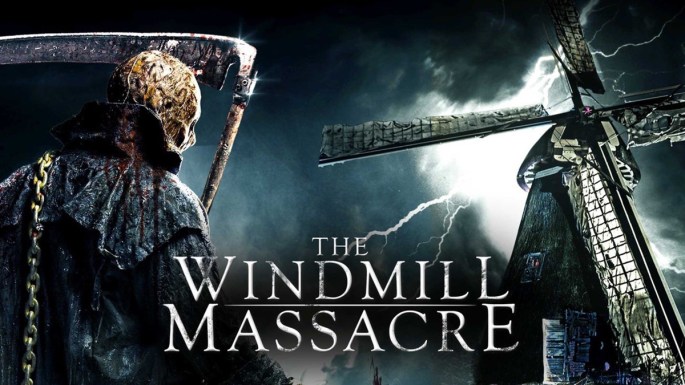
The Windmill Massacre

I mean how amazing could a horror movie about a haunted windmill be? The Windmill Massacre is not bad as far as cheap thrill slashers go and actually gets together an effort to tell a decent story here and there amidst the carnage. Several tourists, runaways and drifters take a guided windmill tour in Holland throughout the countryside one weekend, and when their bus breaks down near a spooky old windmill that doesn’t seem to be on any of their maps, weird shit starts happening. It turns out this particular structure is owned and operated by a miller who once sold his soul to the devil for snazzy witchcraft powers and has been doing naughty things in the several centuries since including using the bones of corpses to grind through his mill and recently, hunting and brutally butchering these poor stranded folks with his scythe thingie. But are they all really just innocent victims? There’s a cool spin on the story where every tourist potentially has a dark past and this miller isn’t just some unhinged clog wearing maniac but serves as a sort of reaper who collects these souls based on their sins. Even our good hearted Australian protagonist (Charlotte Beaumont) has a dark, unfortunate and violent secret in her past that the miller preys upon. The gore is decently vicious, the miller is a threatening enough presence with a neat Leatherface facial aesthetic and all the actors range from good to decent. An entertaining enough time killer now streaming on Shudder, worth it alone just for those two hysterical tag-lines on the two posters. “This isn’t hell, this is Holland!” Ffs lol.

-Nate Hill

THE MICHAEL MANN FILES: BAND OF THE HAND (D. PAUL MICHAEL GLASER – 1986)

The exact formula for 1986’s Band of the Hand is this: The Dirty Dozen minus seven, divided by approximately half in age, strain through Miami Vice, and a tablespoon of sugar stirred in for taste. A corny, violent, foul mouthed, junior varsity Mod Squad with an odd sense of pacing and a structure that feels suspiciously like two episodes of a TV show that never happened but maybe should have, Band of the Hand is both aggressively stupid and thoroughly lovable from the first frame to its last. If I believed in the notion of guilty pleasures, I’d label it as such. But since I harbor zero guilt nor shame in my taste or what brings me joy, Band of the Hand stands as a delicious piece of gorgeous, brainless cheese that was worth the six American dollars I spent on the no-frills and pristine Blu ray from the fine folks at the non-flashy yet solid Mill Creek, the Southwest Airlines of boutique physical media labels.

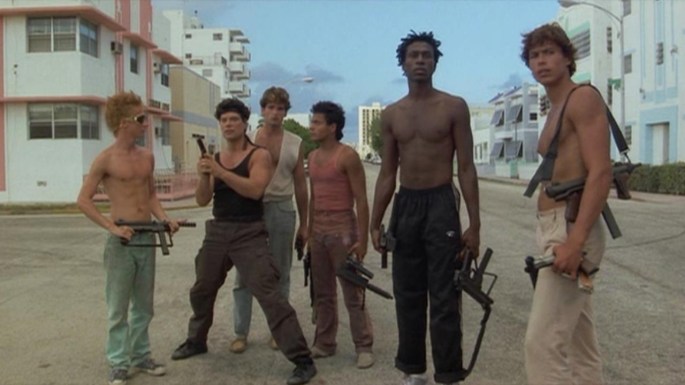
The story is simple: a group of malcontented, underage criminals from all over greater Miami are locked into a paddy wagon and dumped into the middle of the Florida Everglades where Miccosukee Indian Joe Tegra (Stephen Lang… yes, you read that right) teaches them how to survive in the wilderness so they can go back to the urban jungle of Miami and take the streets back from crime lord, coke distributor, and black magic enthusiast Nestor (James Remar… yes, you read that right).

Split right down the middle as if structured as a two-act play, the first half of the film is all set-up and introduction with a generous amount of padding when moving through the Lord of the Flies portion of the film. First we meet our anti-heroes in an excitingly cut montage over which the title track of the film, written and performed by Bob Dylan with backup by The Heartbreakers (yes… you read that right), is laid with such confidence and gusto that it’s likely to never don on the viewer just how incredibly bizarre all of it is. First in the slam are Reuben (Michael Carmine) and Moss (Leon Robinson), the respective heads of rival street gangs, the Cuban Homeboys and the African-American 27th Avenue Players. Next we meet ultra-slick Carlos (Danny Quinn) who is stung by undercover vice cops while trying to middleman a deal for Nestor (and I swear to all that’s holy that I was shocked that someone didn’t scream “Freeze! Miami vice!” when they flashed their badges). The group is rounded out by J.L. (John Cameron Mitchell), a mute demolitions expert who murders his abusive stepfather in the film’s opening moments, and Dorsey (Al Shannon), an illiterate ne’er do well who has an uncanny skill for escaping from from juvenile lock ups. Quite predictably, but no less entertainingly, these rough and incorrigible youths will be taught a thing or seven by the stoic Joe Tegra including how to build a comfortable sleeping area out of branches and leaves and also how to trap and kill a wild boar. You know… as one has to do when fighting drug lords in Miami.

Once conditioned, the group moves their action back into the city where they take over a derelict building in which Haitian squatters are seeking refuge from the drug dealers that are crawling all over the streets outside (marshaled by a slick drug dealer named Cream, played to the nines by Laurence, then Larry, Fishburne). And like the half before it, this portion is padded out with some really time-specific D.A.R.E.-adjacent do-gooding like the sequence where Moss and Reuben rook their gangs Tom Sawyer-style into painting their building (and, naturally, these otherwise deadly gangs with ancient beefs against each other do this task in absolute harmony). But everything takes a deadly turn which sets up a particularly violent third-act that climaxes in the Band of the Hand, as they begin to call themselves, concocting a scheme to kill Nestor’s drug operation at the source.

Also rolling around in the narrative are a couple of side joints involving Carlos’s girlfriend (Lauren Holly) who Nestor keeps as his own after Carlos is disappeared into the juvenile system and Joe’s battle with keeping his reform program alive. A scene involving the man in charge of funding for Joe’s program (Bill Smitrovich) promises more to Joe’s story but winds up being a half-assed dramatic punctuation mark which catapults Joe into a state of complete frustration where he adopts a total ‘fuck the system, I ain’t backin’ down no more’ attitude.

This is the feature film debut by actor/director Paul Michael Glaser who had previously directed a couple of notable Miami Vice episodes for executive producer Michael Mann, filling the same production role here. But even if the film isn’t directed by Mann, none of this would be remotely possible if not for him. It’s hard to imagine this movie looking or feeling like this without Michael Mann injecting the production with his very unique look and style; it’s as much a “Michael Mann film” as Cat People is a “Val Lewton movie.” Additionally, the idea of vigilantism at the core of the film in which the bad guys become good by comparison (a little Magnum Force here), is prime Michael Mann territory.

Given that it’s not a movie that anyone over thirteen should take very seriously, there are things about it that the audience has to put up with which extends beyond the frontiers of the acceptable, even for 1986. Each time a spat between Reuben and Moss breaks out, they cock sideways and slam their torsos into each other to the point where I wasn’t convinced they didn’t think gold coins would fall out of their nipples if the force was great enough. And it’s a cinch that the entire world will hear your audible eyeroll when J.L. breaks his silence because HE’S HAD ENOUGH OF THEM FUCKIN’ AROUND AND THEY NEED TO WORK TOGETHER, GODDAMNIT!!!! LET’S DO IT FOR THE BAND OF THE HAND!!!

But, God help me, I love the film’s go-for-broke and vulgar style and the filmmakers get extra props for plopping this 70’s vigilante movie into the 80’s without the slightest bit of care how dated its premise was. Additionally, all the performances are fun (dig Miami Vice regular Martin Ferrero as a hardware proprietor) and the film is packed with great tunes by Shriekback and the Reds, contributing to a much better soundtrack than it deserves.

In the annals of 80’s pop culture, there were precious few things that didn’t get some kind of splash influence by Miami Vice. Given its production team and cast, most of whom at least contributed one day’s work on Vice, Band of the Hand might be the one piece of entertainment that feels like it organically grew out of the show and, to be honest, it serves as a better back-door pilot than the one that actually occurred in the waning days of Vice’s fifth season. And if you can’t get down with James Remar playing a Latino drug lord, Stephen Lang playing a swamp Indian, and a whole lot of things getting blowed up real good in-between, stay away from Crain Manor because, first chance I get, I’m pairing this beauty with Miami Connection or any random Andy Sidaris film for the people in my life who like to pile into my living room and know how to party correctly.

(C) Copyright 2021, Patrick Crain

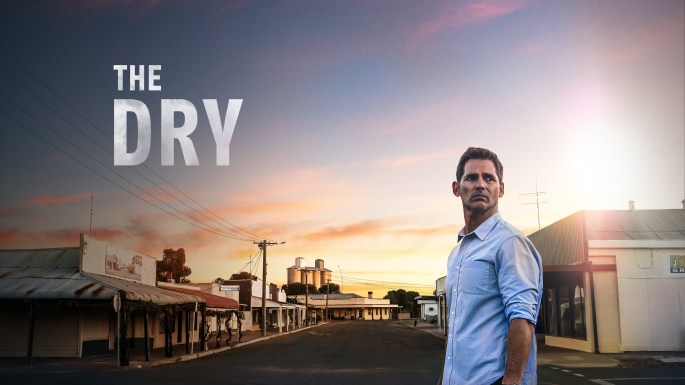
John Connolly’s The Dry

Australia is the perfect place to set a good mystery, there’s just this inherently unexplored magnitude of desolation, otherworldly geological splendour and ghostly vastness to the landscape, an advantage that director John Connolly seizes with The Dry, an absolutely sensational noir singed thriller starring Eric Bana in a galvanizing comeback of sorts, or at least in my eyes I feel like I haven’t seen the dude in a while and he comes roaring back into play here. Based on the novel by Jane Harper, Bana plays Melbourne detective Aaron Falk, who returns home to Kiewarra, the outback bush-town he grew up in after the family of a childhood friend is found brutally murdered, including a young child. He initially only plans to stay for the funeral but the moment he arrives, the entire suppressed collective memory of the townsfolk dredges back up to the surface and before you know it old grudges are stirred and painful memories of the unsolved murder of a teenage girl from their past come back to haunt them, especially Aaron who was unofficially implicated as a teen. As if all this isn’t stressful enough already, the region is also going through an apocalyptic drought that makes the threat of wildfire an ever present source of anxiety and causes threatening, Mordor-esque flares of fiery colour on the horizon. The film expertly meanders through a narrative that feels languid and as slow paced as the sun etching across the desert horizon and as brittle, succinct and unforgiving as the landscape. We weave back and forth between hazily recollected flashbacks to the teenage years of this group, jigsawed together with laser precision and tethered to the present day investigation that bit by bit, conversation by conversation, memory by memory, yields truth to both mysteries. The eventual resolutions to both threads are shocking, cathartic, operatic and intensely emotional experiences impeccably acted by the entire cast, beautifully and eerily scored by Peter Raeburn (check out his amazing musical work in this year’s Amazon Prime show Tell Me Your Secrets as well) and given the evocative atmospheric boost of the ever present Australian wilderness enveloping everything. Great film.

-Nate Hill