Panos Cosmatos’s Mandy

“When I die

bury me deep

lay two speakers around my feet…

wrap two headphones around my head, and rock and roll me when I’m dead”

Panos Cosmatos’s Mandy. Wow. This is a film I have been waiting a year for, and while I eagerly devoured up every production still, sound byte and trailer released for marketing, none of that diminished the thunderous, neon drenched nirvana that was the experience seeing it on the big screen. Cosmatos is madly, deeply in love with 80’s horror/fantasy/scifi cinema, and after the initial stroke of brilliance that was Beyond The Black Rainbow, he has evolved into something more cohesive and specific, but no less balls out surreal and brazenly expressionistic. Set in the same austere, timeless 1983 twilight zone meta-verse as Rainbow, this one sees tortured lumberjack Red (Nicolas Cage) exacting apocalyptic vengeance on both a maniacal cult and a clan of demon bikers for the murder of his beloved girlfriend Mandy (Andrea Riseborough). That is of course the nutshell, analytical summary you’ll see in the online rental guide. What really fills up this two hours of nightmarish bliss is a more free flowing, right brain amalgamation of everything special to Cosmatos in both cinema and music, mottled using material from his own lively imagination, wearing influences both proudly and organically on his sleeve and giving us the gift of one of the most intensely invigorating pieces of art I’ve ever seen. The rage is all about Cage and his gonzo performance, and while that is a sideshow later on, it’s certainly not the main event and the real strength of his performance lies in the restrained, beautiful relationship he has with Mandy, which only makes his crazed rampage cut all the more deep later on. Riseborough is really something special in her role too, she’s the crux of the whole deal and gives Mandy an ethereal, introverted aura that’s just creepy enough and cute enough to live up the film’s title. Linus Roache is really something else as Jeremiah Sand, the fiercely insecure, manically dangerous cult leader, it’s a career peak for the former Thomas Wayne and he plays him like a bratty failed folk musician who’s delusions have fused into his very soul and made him really fucking sick. Ned Dennehy is freakishly deadpan as his second in command, while chameleon actor Richard Brake has a key cameo and veteran Bill Duke shows up to provide both weapons for Cage and a tad of exposition regarding the Hallraiser-esque bikers. This is the final original score composed by Johann Jóhannsson before his untimely passing, and it’s one hell of a swan song. After a gorgeous, arresting opening credit sequence set to King Crimson’s Starless, its all dreamy synths, thunderclaps of metal, extended passages of moody, melodic strains and threatening drones, a composition that leaves a scorched, fiery wake in its fog filled path. One thing that’s missing or at least depleted in film these days versus yesteryear is atmosphere: Back then there were ten smoke machines for every acre of set, title fonts were lovingly hand painted and scenes took their time to unfold, rather than tumbling out of the drawer in a flurry ADHD addled action and exposition. Cosmatos is a physician to this cause and his films feel like both blessed nostalgia and an antidote to that which many filmmakers have forgotten. With Mandy he has created a masterpiece of mood, violence, dark humour, hellish landscapes, softly whispered poetic dialogue, Nic Cage swilling down a sixty pounder of vodka in his undies, fire, brimstone, roaring engines, beautiful music, a tiger named Lizzie, and a pure unbridled dove for making the kinds of films I want to see at the multiplex. Best of the year so far.

-Nate Hill
Barry Sonnenfeld’s Get Shorty

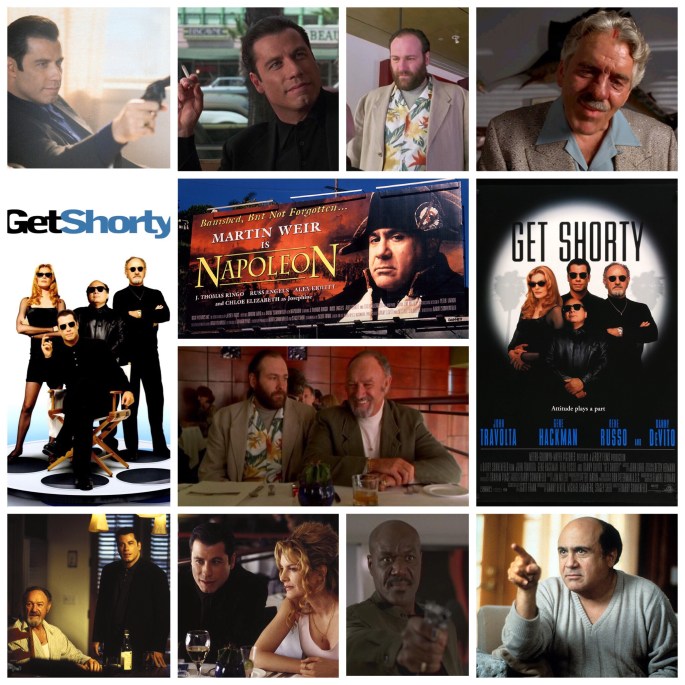
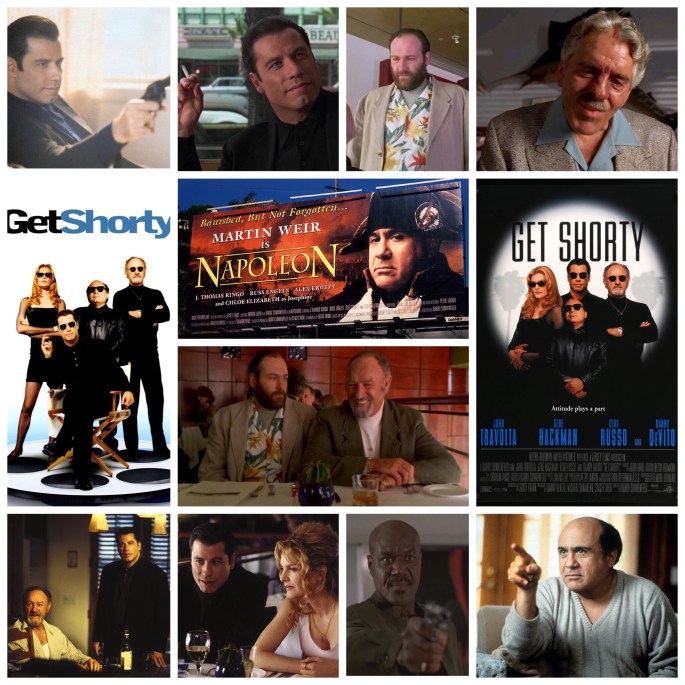
Barry Sonnenfield’s Get Shorty could also laterally be called Elmore Leonard’s Get Shorty, since star John Travolta fought tooth and nail to keep all of the author’s dense, intelligent and pop culture soaked dialogue intact. The film is not only better for it but comes out a glowing gem, a giddy crime/comedy classic that’s as special to me as a comfort blanket to a toddler. A rainy day film, a lazy Sunday go-to DVD, I could watch the thing anytime and not only be consistently entertained with each revisit, but notice something I didn’t the previous couple hundred times. Travolta has never been cooler as Chili Palmer, a silver tongued Miami mobster who is propelled on a meta odyssey to Los Angeles after his boss dies and a whirlwind of confusion is whipped up. There he gets a taste for the film industry after meeting sad-sack B movie mogul Harry Zimm (Gene Hackman, priceless), scream queen actress Karen Flores (Rene Russo, never sexier) and a host of others. It’s a Hollywood satire, a pulpy crime thriller, a brilliant dark comedy and ensemble screwball piece that comes as close to the shores of perfection as movies can get. Dennis Farina gives one of his timelessly precious, angry wiseguy turns as Ray ‘Bones’ Barboni, another Miami hood and the barbaric, obnoxious answer to Travolta’s cool cucumber gentleman act. Delroy Lindo has further villain duties as crime kingpin Bo Catlett, who also has his sights set on celluloid and will intimidate, kill and extort his way there at any cost. Danny DeVito does a sly, biting send up of method acting as Martin Weir, a lovable thespian with his head just a wee bit jammed up his own ass. James Gandolfini is pure class as Bear, the stuntman who moonlights as an enforcer and carries his adorable daughter around anywhere he goes. Rounding out the cast are perfectly pitched turns from Jon Gries, David Paymer, Bette Midler, Martin Ferrero, Miguel Sandoval, Jack Conley and a special surprise cameo that I won’t spoil. Although not my favourite Leonard adaptation (Steven Soderbergh’s Out Of Sight holds those honours), it’s definitely the most fun, and by far the most entertaining. The cleverness of offhand Hollywood jargon, peppered with obscure references that expect the cinephile in you to keep up are pure bliss, not to mention the tongue in cheek tough guy banter, the playful music by John Lurie, the lighthearted, whip crack editing from Jom Miller/Ted Woerner and the showcase performances from all actors involved, feasting on Elmore’s fine dialogue like steak & lobster. There’s a sequel called Be Cool which I have been reluctant to see, so I can’t weight in on it but apparently it doesn’t measure up, so you could always divert and check out Sonnenfield’s 2001 comedy Big Trouble, which is fun too and shares some costars with this (Farina and Russo appear in both). Or you can just pop this masterpiece in for another visit, and let it be it’s own sequel. I do all the time.

-Nate Hill

Terrence Malick’s The Tree Of Life

No other film simultaneously reaches as far as it can to the heavens and remains as grounded in inwardness as Terrence Malick’s The Tree Of Life, an experience that isn’t so much a film as it is a meditative, open ended question, a quiet and gentle nudge that reminds to remember and revere how miraculous life is in the simple fact that it even exists. It also tries to discern what makes a life, from the individual to the human race to the very cosmos around us all, and isn’t something to be even approached in traditional critical analysis. Malick directs Jessica Chastain, Brad Pitt, Hunter McCracken, Laramie Eppler and Tye Sheridan through a series of fly-on-the-wall vignettes in hazy, comforting 1950’s Americana. They are every white picket fence Midwest family. Pitt is firm, strict and fearless in raising his sons with the lessons given to him as a boy, Chastain is warm, compassionate and intuitive, two energies that visibly shape the boys into young men. Decades later, Sean Penn plays the older version of one of them, and ponders on his youthful years as he goes about adult life in an introspective trance. And.. that’s the film. In writing, anyways. What’s special about it can’t really be described, you just have to see and hear it, which is the same for all films, I suppose, but this one really immerses you in something deeply felt. Using emotionally affecting classical music and employing unbelievable visual camera work, Malick sets up time and place like no other filmmaker, making the streets, sun dappled backyards, tree lined laneways and beckoning house interiors come alive in a way that stirs up memories long buried for many who had childhoods just like this. On a grander scale, he also explores the universe in a mid-film sequence that had some walking out of theatres but is really an inspired bit, a time rift to rival the bone toss in Kubrick’s 2001. Malick’s aesthetic isn’t for everyone, you kind of either tune into it wholly or you’re left cold and adrift, but here he spins up something to be marvelled at, his own treatise on human life and the realms around it, both distant and close. A masterpiece, no review I write could properly impart my love for this one, it’s an important, vital film to be absorbed with focus and vulnerability, and thought upon deeply after.

-Nate Hill

Leigh Whannell’s Upgrade

Leigh Whannell’s Upgrade is slick, bloody, wired Sci Fi action pulp and I loved every second of it, mounted on a high concept premise that’s just this side of outrageous and filled with both enough body shredding extreme violence and atmospheric mood to fuel an entire TV show. A quirky, intelligent mix of horror and futurism, Whannell puts the same brains responsible for the first Saw film into the story of Grey (Logan Marshall Green) a mechanic who is given a nifty new implant following the murder of his wife (Melanie Vallejo) that also leaves him a quadriplegic. Dubbed the Stem and cooked up by a weirdo tech mogul (Harrison Gilbertson), it latches onto his nervous system and makes him a super fast, highly capable killing machine and he sets out to find his attackers and… well.. kill them all in just about as violent ways as anyone could think up. There is actual thought, care and innovation put into this world and it’s construction though, until the very exploitive genre material feels lifted up by pure creation and we get something that thinks, feels and ponders just as much as it stabs and bleeds. An organic mix of Blade Runner style setting is welcome, as both the city they live in and the esoteric score by Jed Palmer are very LA 2049 with a hint of steampunk. Green is a great actor who has slowly been building steam in fits and starts, he had a smaller role in Prometheus and headlined the very underrated Cinemax original Quarry recently, but her he shows he can do leading man work in bigger projects, he’s tough, engaging and sympathetic. This is an extreme vision of a futuristic world that although seems alien to us, is not so different in many ways, and that makes it both scary and compelling. One of the best this year so far.

-Nate Hill
Peter Hyams’ End Of Days

Arnold Schwarzenegger versus The Devil. Just let that sink in. It had to happen at some point in the guy’s career, and I’m thankful it turned out to be Peter Hyams’ End Of Days, a slam bang action horror party of a film that is lowkey one of the best things Arnie has ever done, both in terms of production and the character he gets to play. As Jericho Cane, he’s a far cry from the competent badasses he usually plays, an alcoholic ex secret service agent dealing with the trauma of a murdered family. The last thing he needs is Satan setting up shop in Manhattan on his watch, but that’s exactly what’s in store, for every millennium or so, the red guy gets to take a vacation earth-side in a human host, and if he’s able to get laid with a carefully chosen girl, he gets to take over the world. Some dodgy theology there, but this is an Arnie flick. The human host in question happens to be slick stockbroker Gabriel Byrne, who is soon causing havoc all over the Big Apple in his search for Robin Tunney, the girl marked by a satanist cult decades before and groomed to be his concubine. Arnie’s hangdog private security tough guy and sidekick Kevin Pollak are unlikely heroes to stop the prince of evil himself, but Theron lies the fun, and Cane is actually one of his best, most unique characters to date. Throw in Rod Steiger as a priest whose middle name is exposition, Miriam Margoyles as Tunney’s sinister Aunt (also the only 5 foot tall, chubby middle aged woman to whip Arnie’s ass in a fight), Udo Kier as the freaky cult priest, CCH Pounder as a no nonsense NYPD bigshot, Mark Margolis as the melodramatic Pope in Rome and others, you’ve got one solid cast. Byrne really steals the show and is up there with my favourite cinematic incarnations of Beezle, especially in his smooth, smug and smouldering delivery of some truly patronizing, vicious dialogue to try and dispel Jericho. Arnie’s retort? “You ah ah fucking choirboy compared to me!!” Priceless. The action is big, loud and utilizes NYC to its full scope, with subway scenes, a daring helicopter chase sequence and all kinds of explosive mayhem. The horror element is spooky as all hell too, especially in the first third of the film where atmosphere mounts and dread creeps in (that weird albino dude on the train will forever haunt me), plus the score from “ echoes around like a spectre as well. Not one of Arnie’s most celebrated critically, but will always be one of my favourites.

-Nate Hill

Platinum Dunes’ The Hitcher

I won’t pretend to be a fan of horror remakes other than Rob Zombie’s Halloween, but when they cast Sean Bean as iconic highway madman John Ryder in the inevitable second lap of Robert Harmon’s horror classic The Hitcher, I perked up. Bean, like Rutger Hauer in the original, is one of my favourite actors of all time and I had to to see what he did with the character (he pulled out of another contract and jumped a plane just to accept this gig). The good news is.. he lives up to Hauer’s original asphalt angel of death, and I’ll fight anyone who argues. The bad news? The film doesn’t. It’s one of those dodgy, hit or miss Platinum Dunes horror updates (avoid Jason and Freddy like the plague, but their first Leatherface incarnation is quite good) and really misses out on the atmospheric, haunting pace of the first, where nightmares and reality blend into the mirages appearing on the desert horizon for lone motorist Jim Halsey… the thing is, here Jim isn’t alone at all but travelling with his girlfriend and that takes some of the primal fear out of it. Zachary Knighton fills C. Thomas Howell’s shoes and a surprisingly adept Sofia Bush plays the gal, on a road trip for spring break when they’re suddenly tormented by Bean’s Ryder, an intense creation by the actor that carefully avoids any callbacks or mimicry of Hauer. How could he though? Rutger made that role his own and Bean wisely does the same with a sardonic, smouldering aura all his own, and wins a spot in horror pantheon as a worthy update on this boogeyman of the backroads (he’s also better than Gary Busey’s kid was in that god awful sequel that no one wants to admit was even made). Everything here gets a torqued update, from the infamous body tied between two trucks scene (yuck) to the car chases (that Trans Am tho) to the violence itself, to legendary highway super-cop Lt. Esteridge, trading in cucumber cool Jeffrey DeMunn for hilariously hammy Neal McDonough, who kills it as the only officer who isn’t a bumbling moron. But who needs all that sound and fury when you’re trying to throwback to an atmosphere classic? I guess go your own way, but it really doesn’t do the Hitcher legacy any justice. Aside from Bean who elevates his scenes to horror greatness, it’s a slapdash, needlessly gruesome slice of knockoff cash grab slasher fare that takes everything that was spooky, shadowy and mysterious about the first one, shines a big broad daylight aesthetic on it that shakes off the cobwebs we never wanted gone in the first place, like Bon Jovi trying to cover a song by The Cure. There is, however, one moment that gets it right and rises to a level of quality deserving of the Hitcher brand. It’s right at the end, everything has gone haywire, all the cops are dead, all the cars have been thoroughly blown up, and Ryder makes one last dash to escape. Sofia Bush takes up a dead cop’s shotgun and musters one final confrontation with him, as the score by Steve Jablonsky swells to adrenaline heights and we get an exchange of dialogue between the two, both beautifully delivered, that is the first shred of originality the film displays and almost, *almost* redeems itself. Where was that for the previous eighty five minutes? In any case, this holds a spot in my heart simply because I’ve watched it enough times and has crystallized into something nostalgic, which as we all know sometimes supersedes what we know is quality from that which we know is not. Worth it for Bean, the score and that supersonic final scene.

-Nate Hill

Joseph Rusnak’s The Thirteenth Floor

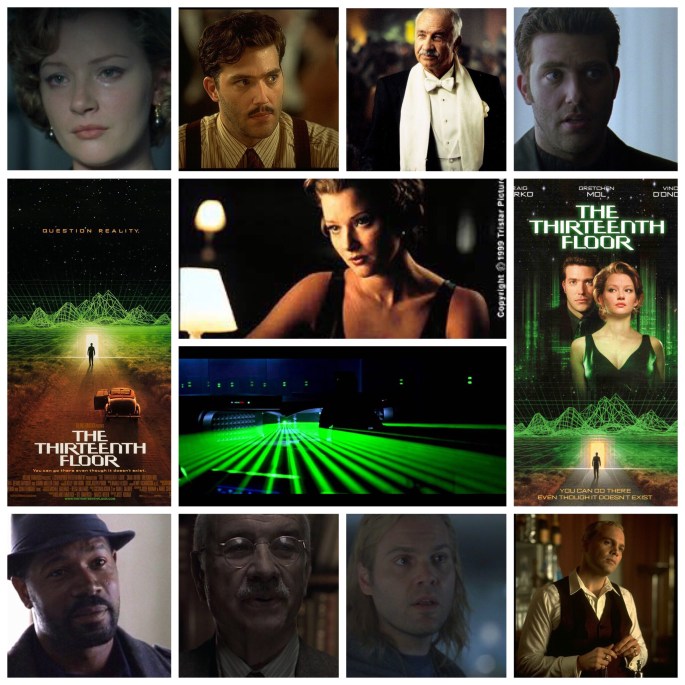
Are you into science fiction infused with film noir? Do you enjoy films like Blade Runner, The Matrix, Inception, Dark City and Source Code? Well, Joseph Rusnak’s The Thirteenth Floor isn’t quite as good as those, but it’s still a welcome addition into stylized 90’s high concept tech retro futurism, given the darkly lit flair of a noir mood-scape. Somewhere in the naughty 90’s, the head scientist (Armin Mueller Stahl) at a research firm has discovered that his advanced software project works a bit too well, and that he’s created a living, breathing virtual reality zone of 1937 Los Angeles where there are consequences to actions and the simulations living there have a rebellious nature. After his untimely murder by an unseen hand, his protege and fellow researcher (Craig Bierko, who does alright but always seems a bit miscast and aloof here) is drawn into a trippy web of intrigue, forced to make the journey into the simulation and search for clues in a hazy, sepia toned LA of the 30’s. Vincent D’Onofrio does double duties as another scientist and a dodgy bartender inside the simulation. Complete with the bumbling, Stetson sporting detective (Dennis Haysbert) and the mysterious, angelic femme fatale (Gretchen Mol), this strives hard to be noir and genuinely does invoke the right feeling, from the feverish, atmospheric lighting of 90’s LA to the production design of the 30’s. Sometimes the muddled elements of romance seem a bit misplaced and awkward, as do a few story elements here and there, but when it works it really works, weaving a thoughtful, twisty narrative that arrives at a reasonably mind blowing conclusion, asking questions about the nature of reality, blurring the lines between soul and software in the best ways. This has been eclipsed by other similar films from that decade, and fair enough as they are admittedly more competent, but I still feel like this is a forgotten gem of sorts and really deserves some love from fans of the several genres it’s composed of. Fun stuff.

-Nate Hill

Rob Schneider’s Big Stan

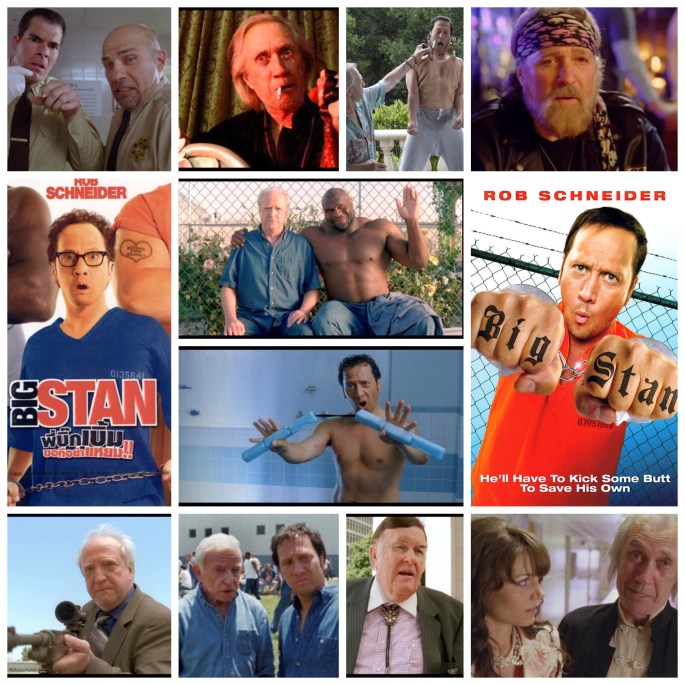
You’d hardly ever catch me giving praise to a Rob Schneider movie as he’s usually intolerable, but Big Stan deserves a shout out, both because it’s almost quality comedy and it has gotten less than half of the publicity given to other Rob flicks, which are all just terrible (remember The Hot Chick? Ew). Schneider is probably the least appealing, most irritating little mole rat out there, so you have to kind of grin and bear it here, but the comedy itself is kind of worth it. As Stan, Rob is a selfish, fraudulent little bastard real estate salesman who is busted selling faulty deals and given a three to five year in prison. When an ex-con bar patron (Dan ‘Grizzly Adams’ Haggarty looks like he can’t believe he agreed to say the dialogue in his script) scares him with tales of rampant rape in the joint, Stan sets out to become ‘un-rapeable’ before his sentence, with a little help from King fu guru The Master, played by a chain smoking, growly David Carradine in a parody of his former career. Armed with skills and sweet karate moves, Stan gets processed and pretty much almost incites a riot the first day, until the prisoners realize there’s no fighting him and he’s pretty much big boss. Abolishing prison rape, setting some new ground rules around violence and introducing salsa dancing are just a few of the changes brought on by him, and the prison sequences are the best of the film. Stan has a sidekick in Henry Gibson, locks horns with the obligatory evil Warden (the great Scott Wilson) and it all parades by with necessary silliness and some semblance of a life lesson that ultimately gets lost in aforementioned silliness. As you can probably surmise, it’s about the farthest thing from politically correct humour as well and very much milks its R rating, so put your thick skin on if you give it a go. Also starring the likes of Jennifer Morrison as Stan’s wife, M. Emmett Walsh as an enthusiastically crooked lawyer, Kevin ‘Waingro’ Gage as the head guard, Randy Couture and others, it’s surprisingly well casted for a such a small movie that almost feels like it was funded by Schneider himself, as he directed it too. Usually I’d be the first to just rip into this guy and his awful, near self destructive output (remember The Animal? Or the Deuce Bigelow sequel?? Fuck), but this one really isn’t all that pitiable, but you’ve been warned, it’s cheerfully in bad taste and if you’re easily offended by off colour humour, steer clear.

-Nate Hill

David Lynch’s Wild At Heart

David Lynch’s Wild At Heart can be given the nutshell description of ‘Lynch does Bonnie & Clyde’, but that doesn’t even begin to scratch the surface of this twisted, surreal, beautifully scarring piece of bizarro cinema cunningly disguised as a love story. It is a love story, first and foremost, but that’s also only a blueprint onto which all sorts of other dreams, visions and nightmares are painted. It’s very, *very* loosely on a book by Barry Gifford, but what Lynch whips up makes the source material seem grey and unrecognizable in comparison. Gifford’s book is the black and white prologue to The Wizard Of Oz and Lynch’s version is the dazzling yet unnerving technicolour dream world that follows, and indeed he uses imagery and gives shout outs to that film any chance he gets here. Nicolas Cage and Laura Dern are Sailor Ripley and Lula Pace Fortune, lovers on the run from the Deep South and Lula’s tyrannical monster of a mother Marietta, played by Diane Ladd in an Oscar nominated turn that doesn’t just chew scenery but devours it with the force of an imploding neutron star that eats galaxies. Marietta is intent on keeping the two of them apart for reasons slowly and subtly unveiled, and she sends everyone and their mother after them including mopey private detective Johnnie Farragut (Harry Dean Stanton) and dangerous mobster Marcellos Santos (the late great J.E. Freeman). Sailor and Lula’s journey is a deranged yellow brick road through 50’s infused Americana, perverse apparitions abound and literally almost everyone they meet ranges from deeply disturbed to outright psychotic to marginally quirky. Santos sends a cabal of weirdo assassins headed up by ghoulish sadist Perdita Durango (Grace Zabriskie in a pants shittingly scary performance) and her cronies (David Patrick Kelly and Calvin Lockhart). In Texas they run into reptilian scumbag Bobby Peru, brought to life by Willem Dafoe in a skin crawling portrait of sexual menace and warped glee that would scare off Frank Booth. Lula tells tales of her delusional cousin Dell (Crispin Glover) putting cockroaches on his anus and of being raped at age thirteen by her father’s business friend (actually shown in a brief but upsetting cutaway). Why all this unpleasantness, you ask? Well… I don’t know, but Lynch seems to and he isn’t sharing the coordinates of his moral compass with anyone, he’s simply storytelling and holding nothing back of the weird or wild variety. Amongst all the violence and monstrosity there’s an undercurrent of tenderness and love that pulses via Sailor and Lula’s relationship, cultivated in an ebb and flow tide of simple, candid pillow talk and unbridled passionate sex that mirrors their frequent and feverish visits to sweaty dance clubs. This is their story, and every ghost, goblin and witch they meet along the way is simply a dark passenger or otherworldly day player in their tale, plus they often make for hilariously off colour vignettes, like Jack Nance’s deranged 00 Spool or Freddie Jones’s gnomish pigeon expert. My favourite sequence is a sobering, haunted diversion off the side of a freeway where they discover a distraught girl (Sherilyn ‘Audrey Horne’ Fenn) rambling through a bout of brain trauma from a car accident. Angelo Badalamenti’s score sings through this to the point of chills, as it does throughout the film. Also traversing down this dark yellow brick road are William Morgan Sheppard, Frances Bay, musician John Lurie, Nicholas Love, Pruitt Taylor Vince, Frank Collison, Ed Wright, Isabella Rossellini and Sheryl ‘Laura Palmer’ Lee herself as Glenda the Good Witch. As proclaimed by Lula at one point, “this whole world is wild at heart and weird on top..” It is indeed, and we’re lucky to have a filmmaker like Lynch to do his part in keeping it that way by making unique, bizarre films like this to remind us just what is possible in cinema with a little invention, a whole lot of colour, splashes of horror and a love of storytelling. Maybe not Lynch’s most prolific or instantly recognizable work, but a full on classic for me and high up on his filmography list.

-Nate Hill

John Herzfeld’s 15 Minutes

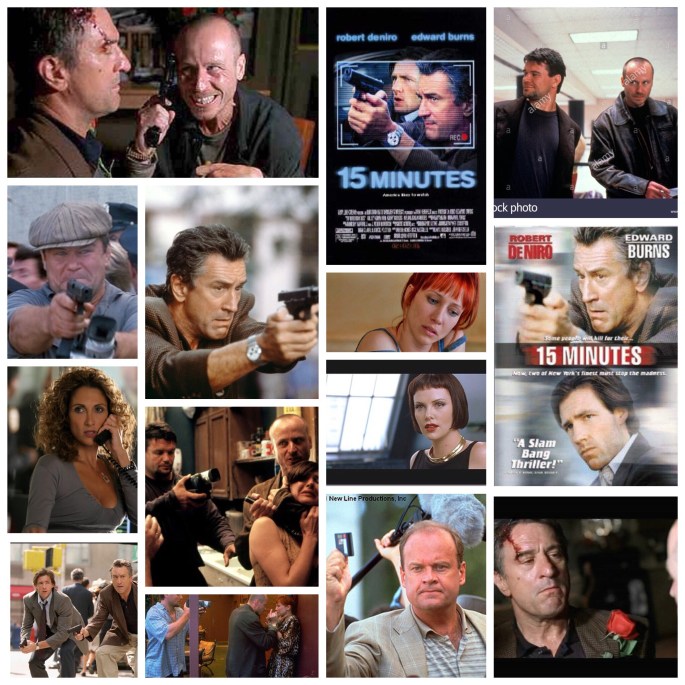
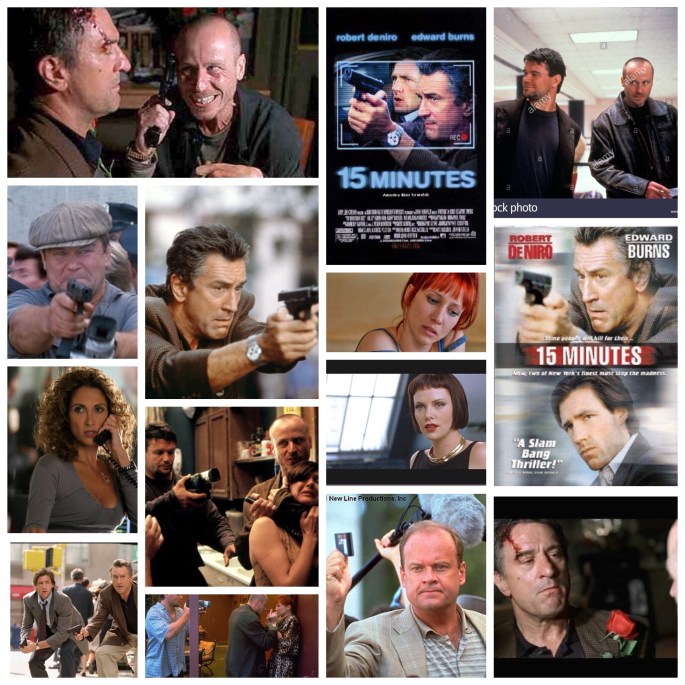
John Herzfeld’s 15 Minutes is a mean, fucked up movie and I love it’s sketched out, darkly satirical edge, its a ruthless sendup of the media that plays like Network by way of Natural Born Killers. America is the land of opportunity, especially for those with sinister intentions, as two nasty Eastern European criminals (Karel Roden and Oleg Taktarov) find out when they step off the boat in New York and almost immediately begin committing heinous acts of wanton violence and murder, filming it with a cheap camcorder and selling the footage to a tabloid news station run by sleazy anchorman Kelsey Grammar. Robert DeNiro angers it up as an alcoholic, loose cannon homicide cop on the trail of these two lunatics and chasing a bit of limelight for himself. It’s a hopped up, very stylized premise that gets the down n’ dirty, highly lurid treatment and doesn’t have much to put in a positive light, but as a farcical thriller it really works. DeNiro gets reasonable facetime and kills it but isn’t in the showcase arc you’d usually see, while Ed Burns plays an arson investigator (“you’re just a fireman with a badge”) who works alongside him. The real star here is Roden though as the chief baddie, a breakout performance as the worst kind of villain, one who isn’t necessarily after anything but just wants to fuck your shit up real bad for fun and then exploit the joke of a legal system and walk scott free. “I love America, nobody is responsible for what they do” he purrs at Burns, and there’s a stinging grain of truth to that. The cast is killer here with work from Vera Farmiga, Martha Plimpton, Melinda Kanakaredes, David Alan Grier, Anton Yelchin, Avery Brooks, Kim Cattrall, Paul Herman, Ritchie Coster and a cool cameo from Charlize Theron. Don’t expect much of an uplift or positive note anywhere here, it’s a thoroughly ill spirited, maladjusted story, but like the messed up crime scenes these two antagonists drum up simply for exposure, it’s kind of hard not to look away or enjoy yourself through pure morbid fascination alone.

-Nate Hill