Frankie & Alice: A Review by Nate Hill


There needs to be more films about mental illness that treat the subject with the vital care and compassion that Frankie & Alice does. It should be re-titled ‘The Halle Berry and Stelllen Skarsgard Show’, because for just over 90 minutes the two of them give some of the bravest, challenging work of their career in telling this story. Granted, it takes a few liberties with what we know about multiple personality disorder and what still to this day lurks in the shadows of the vast human consciousness, but it’s in service to character and story and is never exploitative. This film was made in 2010 and mired in distribute hell for nearly four years before dropping off of a most unceremonious assembly line into weak marketing. No one I’ve asked has even heard about it, which is a shame because it’s Berry at her most shattering, sexy and charismatic, and it’s somewhat based on a true story as well. She plays Frankie here, a wayward exotic dancer prone to destructive episodes in which Alice, an alternative personality, takes over and wreaks havoc in her personal life. Alice is a racist, southern white girl and Frankie is a black stripper in 1970’s New York. You can imagine the predicament. She ends up in a psychiatric halfway house under the care of Dr. Oz (Stellen Skarsgard) a man who is not remotely familiar with the term ‘giving up’. He sees the issues with Frankie clear as day, where his shirt tucking colleagues (Matt Frewer and Brian Markinson) are skeptical and impatient with his process. Oz is trying to unlock the secrets of Franki’s mind through the knowledge of each alter personality, all of whom are related to a tragic incident in her past that we get brief, fractured glimpses of through the broken prism of her mind. Director Geoffrey Sax keeps the melodrama to an agreeable minimum and let’s his two leads feel their way through the work both through each other and the material. Berry and Skarsgard have never been better, setting one another alight with the kind of chemistry many lead pairs can only dream of. Berry writhes with fury, confusion and loneliness, her coherence a flower that begins to bloom when Oz shows her kindness and the desire to really help her, something which. O one has ever done for her before in life. Skarsgard is an interesting guy because he’s equally great at inhabiting cold, sociopathic villains (King Arthur, Ronin) and he’s also compassion manifest when he wants to be (Passion Of Mind, Powder Keg). The performance he gives here radiates with warmth and assurance, a lighthouse in the fog of Frankie’s illness. Newcomer Vanessa Morgan is also excellent as the 16 year old version of Frankie, caught in a hailstorm of racism and sadness that no doubt are the seeds for her future condition. I’d love to know more about the real story of Frankie, and see how it contrasts with the film. Even if the differences are great and the liberties taken are considerable, we are in the end left with a superbly made film that takes mental illness head on and is one step further in erasing the stigma. A film that’s woefully unseen, so,etching I hope this review will change.  
Frankie & Alive: A Review by Nate Hill


There needs to be more films about mental illness that treat the subject with the vital care and compassion that Frankie & Alice does. It should be re-titled ‘The Halle Berry and Stelllen Skarsgard Show’, because for just over 90 minutes the two of them give some of the bravest, challenging work of their career in telling this story. Granted, it takes a few liberties with what we know about multiple personality disorder and what still to this day lurks in the shadows of the vast human consciousness, but it’s in service to character and story and is never exploitative. This film was made in 2010 and mired in distribute hell for nearly four years before dropping off of a most unceremonious assembly line into weak marketing. No one I’ve asked has even heard about it, which is a shame because it’s Berry at her most shattering, sexy and charismatic, and it’s somewhat based on a true story as well. She plays Frankie here, a wayward exotic dancer prone to destructive episodes in which Alice, an alternative personality, takes over and wreaks havoc in her personal life. Alice is a racist, southern white girl and Frankie is a black stripper in 1970’s New York. You can imagine the predicament. She ends up in a psychiatric halfway house under the care of Dr. Oz (Stellen Skarsgard) a man who is not remotely familiar with the term ‘giving up’. He sees the issues with Frankie clear as day, where his shirt tucking colleagues (Matt Frewer and Brian Markinson) are skeptical and impatient with his process. Oz is trying to unlock the secrets of Franki’s mind through the knowledge of each alter personality, all of whom are related to a tragic incident in her past that we get brief, fractured glimpses of through the broken prism of her mind. Director Geoffrey Sax keeps the melodrama to an agreeable minimum and let’s his two leads feel their way through the work both through each other and the material. Berry and Skarsgard have never been better, setting one another alight with the kind of chemistry many lead pairs can only dream of. Berry writhes with fury, confusion and loneliness, her coherence a flower that begins to bloom when Oz shows her kindness and the desire to really help her, something which. O one has ever done for her before in life. Skarsgard is an interesting guy because he’s equally great at inhabiting cold, sociopathic villains (King Arthur, Ronin) and he’s also compassion manifest when he wants to be (Passion Of Mind, Powder Keg). The performance he gives here radiates with warmth and assurance, a lighthouse in the fog of Frankie’s illness. Newcomer Vanessa Morgan is also excellent as the 16 year old version of Frankie, caught in a hailstorm of racism and sadness that no doubt are the seeds for her future condition. I’d love to know more about the real story of Frankie, and see how it contrasts with the film. Even if the differences are great and the liberties taken are considerable, we are in the end left with a superbly made film that takes mental illness head on and is one step further in erasing the stigma. A film that’s woefully unseen, so,etching I hope this review will change.  

Gothika: A Review by Nate Hill


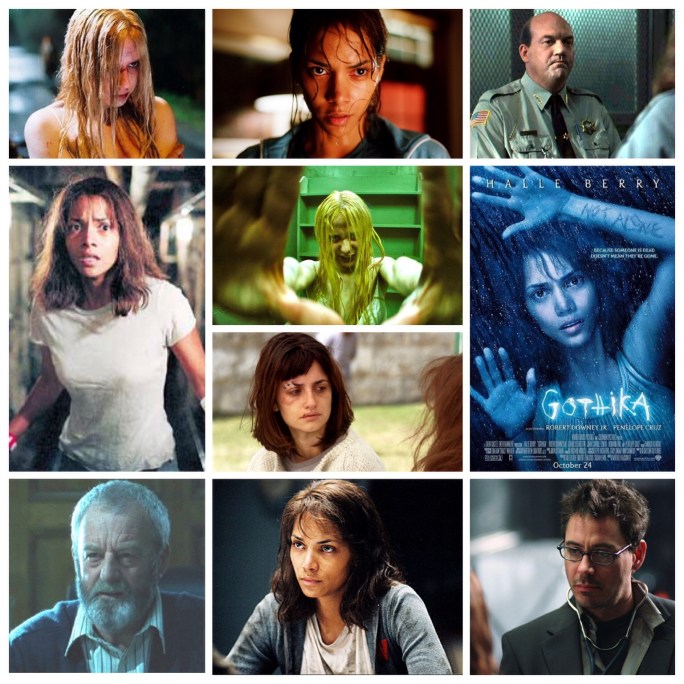
Matthieu Kassovitz’s underrated chiller Gothika is thick with a horror atmosphere that goes straight for the jugular in terms of scares, a psychological ghost story that actually raises hairs a frightens, or at least did for me. It sometimes sacrifices logic for style, but what style it’s got! Any horror flick set in an asylum just has to to be cloaked in workable atmosphere to be effective, and this one is positively dripping with it, hence the evocative title. Halle Berry plays a laid back psychiatrist who wakes up one day in the asylum she works at, only now a patient. She’s told she brutally murdered her husband (Charles S. Dutton) yet has no memory of the act. As if that weren’t a terrifying enough situation for her to be in, she starts having waking nightmares, haunted by a gnarly ghost of a girl (Kathleen Mackey) with mysterious ties to the facility’s past. Her colleague and friend (Robert Downey Jr. gives the dour proceedings his usual chipper pep) seems unable to help her. A guard (John Carroll Lynch) is hostile towards her, angry at the loss of her husband who was his friend. An erratic fellow patient (a de-glammed Penelope Cruz) seems to know more than her vacuous babbling would suggest. The asylum Director (Bernard Hill, excellent) is perplexed by the whole situation. It’s a twisty funhouse of a plot that probably piles on one stark plot turn too many, they’re nevertheless fun to be left aghast by as the rattle by with little regard for plausibility. Berry is convincing in her tormenting position, radiating desperation and resilience that claws at the cobwebs of insanity. Kassovitz piles on the gothic atmosphere relentlessly, and it really works, until we have a visual palette that looks like the dark underside of Tim Burton’s unconscious mind. The ghostly scenes have a threatening, intense edge to them and feel unnervingly realistic, putting us right in the hot seat with wide eyed Berry. Style over substance? Maybe. Okay, probably. But I care not. If the style, composition and palette are enough to draw me into a story, I can roll with it. This one imprints troubling negatives on the celluloid which latch themselves onto your psyche. Maybe it works well because it’s got a European director, and they’re more in tune with the supernatural in general. Maybe it just does a nice job at being effective horror. Either way, I enjoyed. 

Tony Scott’s The Last Boy Scout: A Review by Nate Hill

image

Tony Scott’s The Last Boy Scout is pure stylistic grime, an exercise in early 90’s action with the blackest of humour. The tone is set with a square jaw early on: a star quarterback for a hotshot NFL team is under a lot of underground pressure to make that perfect play and in turn please the loan sharks. He buckles under the heat, ends up pulling a gun on the field and murdering a score of opponents before turning the gun on himself. Now horrifying as that is, if you have a sick sense of humor like me it conjures a dark chuckle of the most guilty variety, because.. well, it’s funny! Albeit in the darkest way possible, which is the arena this one skates in, love it or leave it. Upon closer examination of the script we discover it’s penned by that wonderful man Shane Black, who gave us Kiss Kiss Bang Bang and the upcoming The Nice Guys. No one can produce such heinous mayhem with a cavalier attitude and actually get away with it as well as Black does. The guy is a prodigy of dark humour, and who better to embody his protagonist here than a sheepish Bruce Willis as Joe Hallenbeck, a jaded ex detective who is so sullen and cynical he’s almost comatose. He’s paired with equally slummy former quarterback Jimmy Six (Damon Wayons), lazily trying g to solve a case involving the murderous quarterback and some shady politicians. Along the way that’s paved with many a sarcastic, beleaguered exchange they cross seedy paths with shady villains (Taylor Negron, RIP, and a  youthful Kim Coates), a beautiful working girl with ties to the case (Halle Berry) and Willis’s spitfire of a dysfunctional daughter (Danielle Harris). There’s a wonderfully bloated supporting cast including Noble Willingham, Chelsea Field, Joe Santos, Bruce McGill and more. It’s got a bite that stings, mainly thanks to Black’s frighteningly stinging screenplay which give the film it’s sardonic, put – upon aesthetic. This meshes together nicely with Scott’s trademark sun soaked, pulpy, picturesque tone and provides one hell of an action movie rode.  Nasty in all the right places, funny when the story begs for it, and build to last.

Swordfish: A Review by Nate Hill


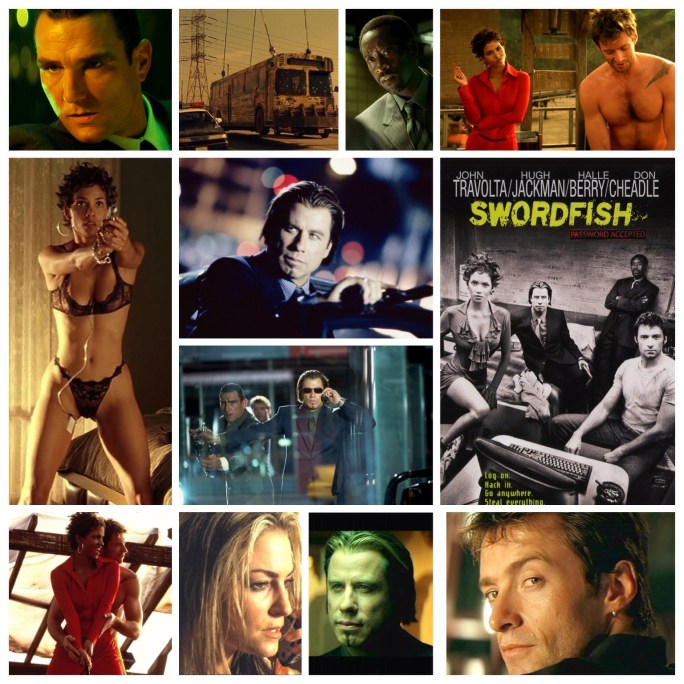
Swordfish tries so hard to be cool, and save for a few moments of smirking silliness, it is pretty goddamned cool. The early 2000’s still carried lingering, reminiscent elements of the 90’s, the super cyber hacker archetype included. The cyber hacker is played by two types of people: basement dwelling, Mountain Dew drinking chatter boxes and virile, sexy supermodels. The latter is employed here, personified by Hugh Jackman as Stanley, a sly devil who can hack into almost anything effortlessly, but has been caught and never allowed to touch a computer again. Enter Gabriel (John Travolta), a silver tongued arch villain out to steal all the money and priceless artifacts he can hope to ever own. Although Travolta isn’t as truly off the rails as in some of his villain roles, the amiable charm he puts forth here is but a ruse to cloud the monster beneath. He’s a very bad man, putting Stanley’s loved ones in jeopardy and forcing him to work computer wizardry for ill gotten riches. Gabriel has a girlfriend named Ginger (Halle Berry, never sexier) who walks a moral tightrope between the two alpha males, torn between roguish indifference and and her conscience. Stanley is also hounded by an FBI Agent (Don Cheadle), with whom he has a tumultuous past. The film resists goin completely by the motions, lulling you just to the border of entropy and then throwing something surprising from a direction you didn’t look in. My favourite scene of the film shows Travolta giving a monologue on bank robbery etiquette, complete with a reference to Sydney Lumet’s Dog Day Afternoon, confirming the fact that this flick has a strong script to go with its pyrotechnics. He flexes his sonic directorial muscles in an especially extraordinary action sequence involving a bus and a helicopter that will seriously make your finger hover over the replay button. Vinnie Jones is an ambassador of cool, in a lively turn as Gabriel’s head thug. Sam Shepherd has fun as a corrupt Senator. There’s also fine work from Zachary Grenier, Tim Dekay, William Mapother, Rudolph Martin and Drea De Matteo. Director Dominic Sena comes from music video land, having also helmed the priceless Nic Cage Bruckheimer-fest Gone in 60 Seconds, as well as the fallout brilliant psycho road thriller Kalifornia. Here he doses the flash and sizzle of 60 seconds with the hard hitting violence of Kalifornia, presented in a story guaranteed to raise a pulse. It’s also got pretty much the coolest poster of 2001. I dare you to find a cooler one, go ahead. Oh, and Travolta’s manscaping here deserves its own spinoff film.