John Dahl’s Rounders: A Review by Nate Hill

image

John Dahl’s Rounders is the premier poker movie, an utterly charming, never too serious and surprisingly slight look at the lives of several very different individuals whose lives revolve around the game in New York City. The main focus lands on two young men who are fast friends, yet reside on somewhat opposite sides of the responsibility coin. Poker prodigy Mike (Matt Damon) has since given up his art after a soul crushing loss to local russian bigwig Teddy KGB (John Malkovich). He’s content to simmer in solitude with his perky girlfriend (Gretchen Mol, who never fails to convince me that she’s Samantha Mathis until I double check on imdb). Right in time to disrupt his quiet life is cocky street rat Worm (Edward Norton), fresh out of prison and looking for the type of trouble that landed him there in the first place. It’s to long before he’s racked up some serious debt to dangerous people with ties to Teddy KGB, and Mike is forced to come out of retirement and risk everything he has once again, this time for his friend. The poker scenes are staged with meticulous eye for detail and mannerisms in attempt to put you at the same table as the players, and it’s nifty to see each acting style played to the microscopic hilt as Dahl maintains patient focus on his work. Norton is appropriately scuzzy with just a dollop of endearing, scrappy charm and Damon fills the protagonist’s shoes very well. It’s Malkovich, however, who pulls the stops out and is my favourite character of the piece. With a muddy russian accent that rivals his french one from Johnny English, a lazily snarky streak with just a hint of intimidation and a bag of oreos at his side without fail, he’s a hoot, holler and a half as the life of the poker party. Sexy Famke Janssen has as great bit as as shady chick with eyes for Damon and connections with dodgy folks, expertly playing the half sweet and seductive, half menacing game. Watch for topnotch work from John Turturro, Josh Pais, Michael Rispoli, Josh Mostel, Adam Lefevre, David Zayas, Goran Visjnic, Lenny Clarke and Martin Landau in an earnest turn as a kindly professor who looks out for Mike. It’s short, sweet, concisely paced, tightly written, flawlessly acted and wonderfully entertaining stuff.

Lee Tamahori’s Mulholland Falls: A Review by Nate Hill

image

Lee Tamahori’s Mulholland Falls gets a bad rap in some circles for being boring and uneventful despite its charismatic cast and opulent setting that’s ripe for peppy action sequences. I think they are confusing boring with the concept of a paced and very slow burn, yet one with all the texture and richness of an action film, one that admirably decides to take the route of the old school noir, with loving care put into story and character, two elements which the action and violence live simply to serve, and not to take the driver’s seat against. Or it’s simply not some people’s cup of tea, which is totally okay too. Personally though, I love a good L.A. cop yarn that has a story to go with the toughness. This one bears striking similarity to 2013’s Gangster Squad, which also had Nick Nolte playing a 1940’s Los Angeles cop in charge of a squad that operates outside of the law. That film is pure cheese, all razzle dazzle and no plot. Mulholland Falls falls somewhere between Gangster Squad and L.A. Confidential; not quite up to delving into the serpentine intrigue of the latter, yet infinitely more interested in telling a worthwhile story than the former. And tell it does, in high flying style that only a crime film set in that time period can do. Nick Nolte plays Hoover, a whiskey voiced, take no prisoners LAPD badass who heads up an elite anti corruption task force that operates far outside the red tape and pretty much do what they want to stomp out corruption. His squad consists of Michael Madsen, Chris Penn and a scene stealing Chazz Palminteri as the oddball of the bunch, with serious impulse control issues. A straight up dream cast of tough guys, and although I’ll admit that Penn and Madsen are a tad underused, their presence alone boosts the film’s credentials into an epic pantheon. The film revs up with a kicker of an opening sequence in which the squad severely roughs up a troublesome mobster (an uncredited William L. Petersen). “This isn’t America, it’s Los Angeles” Nolte growls to him, stating the tone of perverse lawlessness which permeated the city back then. Soon he’s drawn into a tawdry scandal involving the murder of a young prostitute (Jennifer Connelly) who he previously had encounters with. The search leads him far and wide, crossing paths a sleazy photographer (Andrew Mcarthy), a dying air force tycoon (John Malkovich manages to ham it up even at his most laid back) and his stern lieutenant (Treat Williams). Nolte also has a poor jilted wife played nicely by Melanie Griffith in limited but effective screen time. The plot is hard boiled to the bone, with Nolte in one his most gruff mid career roles and loving every stressed out, rage fuelled second of it. The conclusion is his show, with a whacked out Palminteri in tow for a spectacular sequence set aboard a doomed military aircraft. The cast gets deeper, believe it or not, with Daniel Baldwin, Ed Lauter, Kyle Chandler, Titus Welliver, Louise Fletcher, Rob Lowe and Bruce Dern contributing gamely. This one’s got style on it’s side and then some, replicating a sense of time and place with the torque ramped up to near Sin City levels. Admittedly not perfect, but a pure and simple blast of a flick, in my opinion.

MULHOLLAND FALLS – A REVIEW BY J.D. LAFRANCE

600px-Mulfal-ctroop4

They say timing is everything and this certainly applies to the release and reception of movies. Case in point: Mulholland Falls (1996). Released a year before the very similar L.A. Confidential (1997), it was also a retro-neo-noir set in 1950s Los Angeles and featured a murder mystery leading to a vast conspiracy. However, Falls was promptly blasted by the critics and quickly disappeared from theaters while Confidential became the toast of critics and received awards from all over the world. So, what went wrong? Falls featured an impressive cast of solid character actors (it had more name actors than Confidential) and a critically acclaimed director with Once Were Warriors’ Lee Tamahori as opposed to Confidential’s Curtis Hanson who had only done adequate B-movies like The Hand That Rocks the Cradle (1992) and The River Wild (1994). Now that a few years have passed, Mulholland Falls has aged surprisingly well.

Set in 1953, the first image is one of a mushroom cloud from an atomic bomb explosion. It is one of the enduring images from that era and one that hangs like a shadow over the characters and events in the film. Max Hoover (Nick Nolte) leads a group of four cops known as The Hat Squad who do things their own way, like bullying out-of-town gangsters and dropping them off one of the deserted stretches of Mulholland Drive (aka “Mulholland Falls”) as a deterrent for setting up shop in L.A. One day, Max and his crew – Coolidge (Chazz Palminteri), Eddie (Michael Madsen) and Relyea (Chris Penn) – go out to a construction site to investigate the murder of a beautiful woman (Jennifer Connelly) who has been literally pressed into the ground. There is a shock of recognition on Max’s world-weary face. His connection to the dead girl and his subsequent investigation into her murder leads to a dangerous conspiracy involving the United States government and a mysterious General Timms (John Malkovich), head of the Atomic Energy Commission.

After the success of Once Were Warriors, Tamahori was offered many projects before finally choosing Mulholland Falls. Michael Mann was originally attached to the film but left at some point. One of the first things that is so striking about this film is the gorgeous attention to detail with vintage cars, suits and music from the period. This is enhanced by the gorgeous cinematography of the legendary Haskell Wexler who evokes classic film noir in every frame of Mulholland Falls. Tamahori assembled an impressive crew including the likes of production designer Richard Sylbert, who worked on Chinatown (1974) and The Manchurian Candidate (1962), and Wexler, who won an Academy Award for Who’s Afraid of Virginia Woolf? (1966) and worked One Flew Over the Cuckoo’s Nest (1975) and In the Heat of the Night (1967) amongst others.

Tamahori says that people within the industry were surprised that he hired veterans like Sylbert and Wexler and realized that Hollywood was being run by young executives: “It’s a kind of youth-oriented thing, and—blast, blam, blam, blam, make the action for the under-25-year-old crowd. Do this, do that, you’ve got to be on top, you have to be fast. They see age as being old and boring.” Mulholland Falls consciously eschews this approach for a slower paced, more thoughtful vibe that harkens back to films made before music videos and their kinetic editing changed the way films were made in Hollywood.

With his gravelly voice and weathered good looks, Nick Nolte is well cast as the conflicted tough guy, Max Hoover. If there is one significant problem with the film it is the lack of screen time given to the excellent members his crew. They are given little time to develop their characters with only Chazz Palminteri edging out the others. Palminteri plays Nolte’s best friend and second-in-command. He’s the most sensitive of the bunch (although, that’s not saying much) because he’s seeing a female psychiatrist and this makes him the voice of reason, often curbing Max’s more self-destructive impulses. Tamahori met Burt Reynolds and Tom Arnold for the role of Coolidge but felt that Reynolds was a little old for the role.

Little time is devoted to developing the chemistry between them. The filmmakers should have used The Untouchables (1987) as inspiration – although, the crucial difference is that in Brian De Palma’s film we see how Eliot Ness and his crew come together while in Mulholland Falls, Max and his group have been together for some time. Pete Dexter’s screenplay doesn’t do a good enough job making us believe that they are a tight-knit crew. That being said, the chemistry between Nolte and Palminteri begins to kick in towards the end of the film but it is too little, too late.

The casting of actresses Jennifer Connelly and Melanie Griffith is right on the money as they both have the voluptuous body type common to that era, especially Connelly who has curves in all the right places and that were also used to great effect in The Rocketeer (1991). Sadly, Connelly and Griffith aren’t given too much screen time but this does give Connelly’s character something of an ethereal, mysterious quality that is quite haunting and works well in the film.

John Malkovich essays yet another one of his cultured bad guy roles as General Timms. The first meeting between him and Nolte is good as we watch two different acting styles bounce off each other. Timms tries to dazzle Hoover with philosophical double speak while the cop plays dumb but subtly applies pressure on the scientist. What is so interesting about this scene is what is not being said. Watching this film again, I was struck by the eclectic cast featuring the likes of Treat Williams, Andrew McCarthy, Bruce Dern, Daniel Baldwin, William Petersen, and Rob Lowe.

There is somber tone that hangs over Mulholland Falls and the ending is refreshingly downbeat (unlike the very classic Hollywood ending of L.A. Confidential) evoking Chinatown of which it was most often compared to. Like any good noir protagonist, Max’s shattered life stays shattered. The murder has been solved but at a terrible cost to his own life. While Falls is a flawed film and certainly not as strong as Confidential, it is not an awful effort by any means and actually has a lot of merits. It is definitely worth another look if you haven’t seen it since it debuted or if you’ve never seen it before.

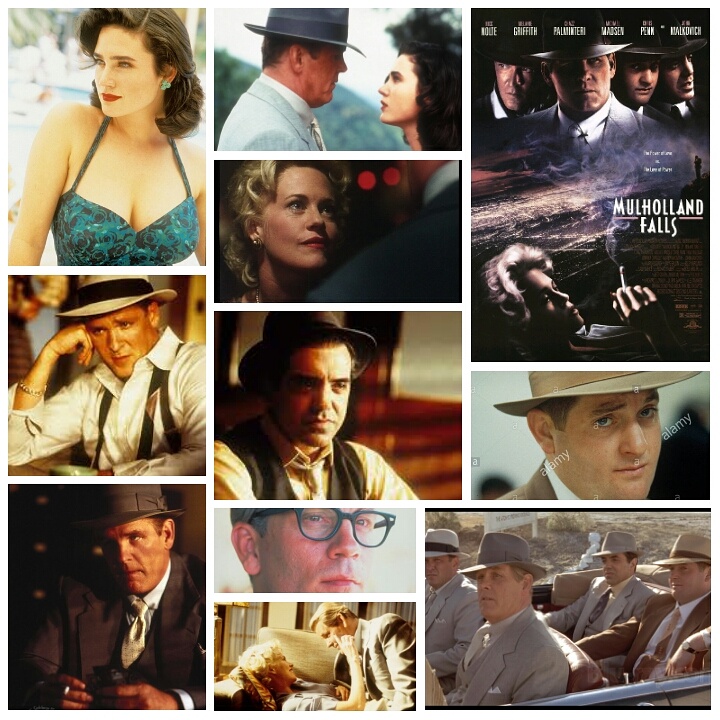
Burn After Reading: A Review by Nate Hill

image

The Coen Brother’s Burn After Reading is the duo at their height of trolling the audience, a mood they seem to make some of the most devilishly funny films of their career. This one reminds me of long days full of running around, confusion and missed appointments, days where I get home and reach the end only to realize that for all the frenzy, nothing I did all day was really of any consequence. This film is sort of like that; a whole lot of clandestine nonsense and tomfoolery that adds up to.. well, not much of anything in the end. If that sounds like I’m being negative, I’m not. That’s part of the Coen’s charm and a core aspect of what makes this one so hilarious. It’s also full of complete dimwitted morons, which only adds to the chorus of lunacy. John Malkovich teeters on the borders of mania, scary and funny as ex CIA half wit Osborne Cox, in a performance so utterly Malkovich that he almost seems like some other actor parodying him. He’s got a cold hearted bitch of a wife (Tilda Swinton) who is fooling around with even bigger idiot Harry Pfarrer (George Clooney  is a riot) who is also fooling around with anything that has a pulse, being the squirrelly sex addict that he is. Cox has started a memoir (or, ‘mem-wah’, as Malkovich ludicrously intones it), the contents of which are on a disc that end up in the hands of yet even bigger idiots. Linda Litzke (Frances Mcdormand) and Chad Feldheimer (Brad Pitt) run a gym called Hardbodies (only the Coens, folks) and see the disc as ‘secret spy shit’ they could use to make a buck. That’s where the plot hollers off the rails into pure madness, as each and every character makes the dumbest possible decision  along the way. J.K. Simmons are gold as two CIA honchos who are more puzzled than the audience, Richard Jenkins trolls perhaps the subtlest of all, and the cast also includes Jeffrey Demunn, Olek Krupa and a meta cameo from Dermot Mulroney. Among the cloak and dagger chaos, the Coen take every chance they get to spoof and lovingly ridiculue society’s cringe inducing stereotypes, until you start to realize they’re levels of exaggeration aren’t all that over the top. Pitt is gold as the air headed gym rat, Clooney pure screwball, and Malkovich is a force of demented nature, his exentuated word pronunciations reaching a boiling point of absurdity here. This is up there with the Coen’s best, and certainly one of their funniest hours.

B Movie Glory with Nate: Mutant Chronicles

image

Mutant Chronicles is a solid gem, as both a b movie and a legit exercise in bloody high concept fantasy. It’s got a sci fi vibe meshed nicely together with a grinding steam punk sensibility, and it’s pure visceral gold. The vague plot, as I best remember it: Some form of extraterrestrial intellegience takes up residence deep within the earth’s core, using a gigantic machine to turn humans into mindless, rabid killing machine with nasty, pokey, king crab looking things for limbs. The warring corporations who control the remaining resources on the planet commission a crew of dirty dozen style bad asses to venture deep into the earth, stopping the mutants and their makers, and silencing the evil contraption forever. Thomas Jane is Major Mitch Hunter, the stoic tough guy leading the group with grit and guts. He’s also searching for his missing superior officer Nathan Rooker (Sean Pertwee). Along with him is strong, silent monk Brother Samuel (Ron Perlman), his mute daughter (Anna Walton), and other assorted warriors including Benno Furmann and Devon Aoki. That’s pretty much all you get for a plot. The rest is screaming zombie esque hordes that ambush them at every turn and provide especially grisly action set pieces. There’s a really impressive journey in a rickety spaceship that looks like a cross between a hot air balloon and a toaster, and a cameo from an extremely bored looking John Malkovich. Jane and Perlman use their tough guy charisma to bring the story to life, and the special effects are pretty damn cool. This one has bite, imagination and buckets of gore, particularly in a frenetic finale deep within the earth’s interior. Great stuff.