Michael Mann’s Miami Vice


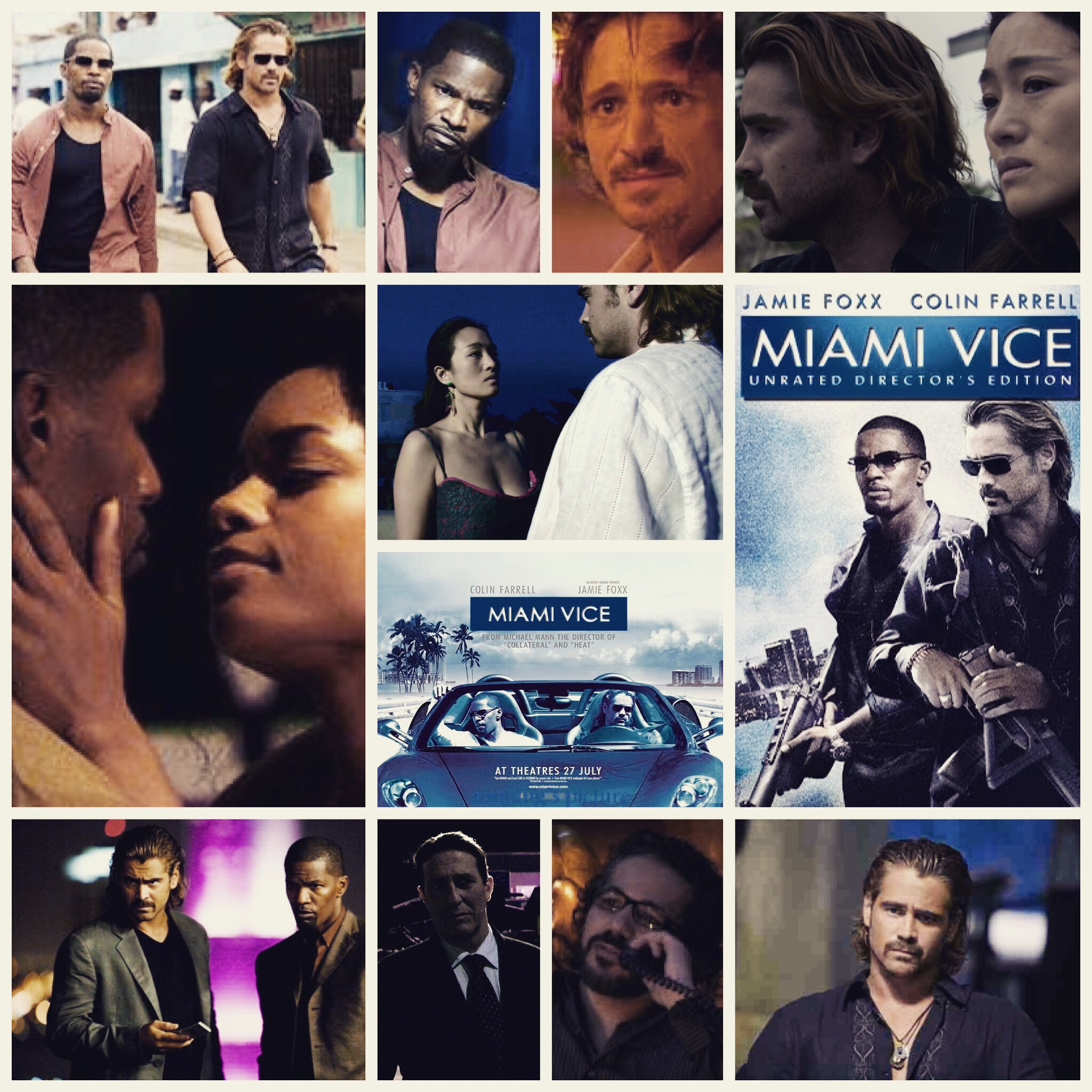
Michael Mann’s Miami Vice is a lot of things. Hypnotic, sedated mood piece. Thrumming, rhythmic action picture. Deeply romantic. More going on underneath it’s surface than what you see onscreen. Masterful crime piece. Showcase for digitally shot film. Restless, nocturnal urban dream. One thing it is decidedly not, however, is anything similar to the bright ‘n sunny, pastel suited 80’s cable TV show of the same name, also pioneered by Mann, at a more constricted and likely very different point in his career. A lot can be said for the show though, it’s instantly iconic and was one among a stable of crimeprimetime™ (The Equalizer and Crime Story did their part as well) to give many actors their break, actors who we take for granted as stars today. Mann’s film version is a different beast entirely, a likely reason for the uneasy audience reception. Let’s be clear: it’s one of the best films of the last few decades. Colin Farrell and Jamie Foxx make a deliberately moodier, more dangerous Ricardo and Tubbs, and their high stakes undercover work is set against an austerely fatalistic Miami that bares little resemblance to travel brochures, let alone the tv show many were used to. Their story starts one of two ways, depending on whether or not you view the extended director’s cut, which is the version I’d choose as it sets up tone before throwing you into a hectic nightclub sting operation they’ve got going, which is hastily interrupted by the exposure of a CI snitch (John Hawkes in a haunting cameo). This sets them on course to take down a powerful Cuban drug syndicate run by a scarily calm Luis Tosar and hotheaded maverick John Ortiz. Farrell gets involved with a girl from their fold, of course (Gong Li is a vision), a romance that has grown on me over the years, while Foxx is involved with beautiful fellow cop Naomie Harris, yielding heart wrenching moments in the final act. Darting in and out of the story as well are Tom Towles, Justin Theroux, Isaach De Bánkole, Eddie Marsan, Barry Shabaka Henley, Tony Curran and Ciaran Hinds, all vital cogs in a well oiled, momentous machine that doesn’t drop it’s pulse for a second. Composer John Murphy piles on the mood with his mournful score, highlighting evening boat-rides, shadowy shoot outs and outdoor nightclubs with a top tier soundscape, while cinematographer Dion Beebe works tirelessly to get shot after shot looking mint, not an easy task with a film this energetic and particularly lit. From start to finish it’s to the point as well, Mann has no interest in useless exposition, mapped out play by plays or cheesy moments. Everything careens along at a realistic pace and you’re on your own if you can’t keep up or make sense of the off the cuff cop jargon. There’s stillness too though, in a torn up Farrell watching his love disappear on the horizon, Foxx looking on from beside a hospital bed or simply either of them glowering out at the skyline from a rooftop pulpit before things Heat up. Like I said, do the extended version and you’ll get that terrific opener to set you up, instead of being thrown in the deep end right off the bat. Either way though, Miami Vice is one for the ages. 

-Nate Hill

Michael Mann’s Luck: A short lived masterpiece 


Michael Mann’s Luck was a painfully short lived HBO original series with reach-for-the-stars potential, a mind blowing cast and a terse, eccentric script from David Milch, all fuelling a brilliant ensemble storyline set in a pristine Los Angeles horse racing track. I’ll get the elephant out of the room right away: the series was cancelled due to a few of the horses dying on set, for whatever reasons. Had it been allowed to continue though, I imagine it would have gone on to become one of the network’s, and Mann’s, most hallowed and heralded works. Dustin Hoffman is the centrepiece of the cast as Chester ‘Ace’ Bernstein, a sharp witted Jewish mobster who’s recent stretch in the joint has somewhat dulled his edge. Nevertheless, he slyly takes a stab at playing his hand with horse ownership, joined by his charismatic driver Gus (Dennis Farina, reliably wonderful). There’s all kinds of other hoopla going on, and it’s cool to see the story focus on both the upper crust elite doing their shady deals as well as everyday joes tossing their money into these worshipped games. Kevin Dunn is terrific as a disabled firebrand of a gambler, joined by his two scrappy pals (Ritchie Koster and Jason Gedrick) as they try out their own brand of luck. Jill Hennessy is a determined horse trainer who clashes with a belligerent owner (Yul Vasquez), and there’s two ominous crime kingpins played by Michael Gambon and Ted Levine who hover in the shadows as well. Further still is a heartbreaking turn from Richard ‘Bing Bong’ Kind as a stressed out jockey manager, Nick Nolte as a crusty, broken-down horse trainer, Joan Allen, Alan Rosenberg, Spencer Garrett, Don Harvey, Ian Hart, W. Earl Brown, Shaun Toub, Bruce Davison, Frank Collison, Mercedes Rhuel, Tony Curran and a cameo from Jurgen Pröchnow as the stern owner of the whole track. How’s that for a cast. I must say that the dense, peculiar dialogue from Milch takes some time getting used to, but once you tune in to it’s jive, it’s pure poetry being rattled off by every character, and a gorgeously structured, meticulously layered script at that. The actors are all on a plane of pure excellence as well, many of them turning in career best efforts and bringing their roles vividly to life. The cinematography from various artists is pure spun gold too, every sparkling irrigation sprinkler, glistening horse coat, careful closeup and crop of dirt kicked up by hooves captured succinctly and smoothly. This seriously is as near to a perfect season of television as one can get, and it kills me that it got cut down before it had a chance to really get going, because just think of the places it could have gone. At least we still have this first glorious season to admire, and I recommend every minute of it. 

-Nate Hill

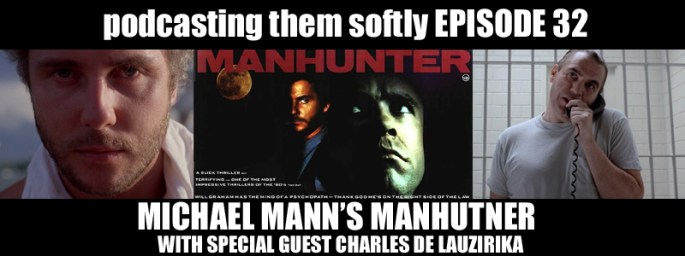
Episode 32: 30th Anniversary of Michael Mann’s MANHUNTER with Special Guest Charles de Lauzirika

episode-32

charlie
Photo by Carlee Baker.
This year marks the 30th anniversary of Frank’s all time favorite film, Michael Mann’s MANHUNTER.  Frank is joined with returning guest, Charles de Lauzirika who produced Ridley Scott’s home video releases of everything from BLADE RUNNER to THE COUNSELOR to THE MARTIAN and the ALIEN QUADRILOGY.  Everyone who owns the ALIEN QUADRILOGY and the silver BLADE RUNNER briefcase, thank Charlie he was a producer and consultant on it, from the packaging to the menu navigation, supplements.  Anyway, Frank and Charlie gush about their love for MANHUNTER, and speak about the other films, novels, the HANNIBAL TV show, and the Shout Factory MANHUNTER release.  Please check out our previous chat with Charlie here.


ALI – A REVIEW BY J.D. LAFRANCE

Ali-Michael-Mann

Ever since Ali was released in 2001, I have felt that it has been one of Michael Mann’s most under-appreciated films. It received decidedly mixed reviews and underperformed at the box office. While Will Smith was praised for his impressive physical transformation into legendary boxer Muhammed Ali, the film itself was criticized for revealing nothing new about the man. Herein lies the problem that Mann faced: how do you shed new light on one of the most documented historical figures of the 20th century? His angle on the material was to look inwards.

Proposals for an Ali biopic had been around since the early 1990s when producer and one-time business partner of the boxer, Paul Ardaji, pitched the idea to the man on his 50th birthday. Ali gave the project his blessing and financing quickly fell into place. A number of scripts were written by the likes of Gregory Allen Howard (Remember the Titans) and Stephen J. Rivele and Christopher Wilkinson (Nixon), but they all failed to please the powers that be. The project bounced around various studios for years as executives tried to decide who should make it, who should star in it, and would it even make a profit? In 1991, Oliver Stone met with Ali about making a film about his life but the collaboration ended when the director refused to share creative control. In 1992, Ali’s best friend and personal photographer Howard Bingham and Ali’s wife Lonnie got together with Ardaji. Gregory Allen Howard’s take on Ali was delivered in 1996. His angle was that the key to the boxer’s life was his relationship with his father, who ignored him.

When Will Smith met Ali in 1997, the boxer asked the actor to play him in the film. Smith was flattered but said no. He was not ready and too intimidated for such a demanding role. The actor almost did it when Barry Sonnenfeld agreed to direct. Both men had worked together on the Men in Black movies and Wild Wild West (1999). Thankfully, their version never saw the light of day. After he turned 30, Smith realized that he had to make the decision about playing Ali. However, when no one could settle on a script, Sonnenfeld dropped out. There were several more rewrites and directors, including Curtis Hanson who expressed interest. Smith was ready to give up on the project.

It then came down to Spike Lee or Michael Mann to fill the director’s chair left empty by Sonnenfeld. Sony Pictures, the studio bankrolling the film, was faced with a $100+ million budget and went with Mann who had just received several Academy Award nominations and all kinds of critical praise for The Insider (1999). Upset, Lee voiced his anger through a friend in The New York Post: “Only a black man could do justice to the Cassius Clay story,” he was reported as saying. Mann responded that he “wanted the film to come from the point of view of the main character, Muhammed Ali. I’m not interested in showing a white man’s idea of how someone suffered racism. The perspective of the film has to be African-American.” When asked why he did not pick a black director Ali said that he wanted the best qualified person regardless of color, and his wife said, “Muhammad didn’t want it to be a movie just for black audiences. He wanted it to be a movie for all cultures and all people.”

When Mann was approached to direct he wasn’t even sure if he wanted to tackle such challenging subject matter but was sure of one thing; he did not want to make a docudrama or idealize Ali’s life. After meeting with Ali and his wife, they told him that they did not want “a teary Hallmark-greeting version of Muhammad Ali … What they didn’t want I didn’t want,” Mann remembers. The director liked Rivele and Wilkinson’s screenplay but rejected their flashback structure and their use of Ali’s 1978 fight, the “Thrilla in Manila,” as the present frame of the story. Mann felt that Ali’s 1974 fight in Zaire was more significant. He was also not interested in spelling things out for the audience: “I wanted to insert you into the stream of this man’s life, orient you without doing it in a blatant way with exposition.” Ironically, this is what would scare off a lot of people.

Smith’s agent arranged a meeting with Mann that changed his attitude towards the film. According to the actor, it was “the clear picture he had of the road from Will Smith to Muhammed Ali. He explained it in a way that made it seem, in my mind at least, not so utterly impossible, just marginally improbable.” Smith and Mann agreed that the film’s focus should be on ten turbulent years of Ali’s life, from 1964 to 1974. The director set the film during these years because “that formation of everything by ’74 is the beginning of what is now culturally in the United States.” Mann identified Ali with the spirit of change that occurred in the 1960s. “He consistently defied the establishment and its conventions, and we loved him for it.” Ali led such a colorful, eventful life that a focused story was crucial to the film. Mann said in an interview, “It would be catastrophic to divert into every interesting story. Everything this guy does is fascinating. I could have made an entire movie about Ali’s relation to women. Music, Cadillac convertibles and women. It would have been great.”

By February 23, 2000, Mann signed on to the film and went to work transforming Will Smith into Ali. Smith remembers that Mann created the “Muhammad Ali Course Syllabus” that began with a study of the boxer’s physical attributes: “learning to run how he ran, to eat the food he ate, spar the way he sparred. Essentially creating the physical life and physical appearance of Muhammad Ali.” From there, Smith moved on to the mental and emotional aspects and finally the man’s spirituality. Boxer trainer-choreographer Darrell Foster spent a year training Smith. Foster was Sugar Ray Leonard’s conditioning coach when the boxer turned pro. According to Foster, the key to becoming Ali was “looking for specific movements. Hand speed, ring generalship, how he made guys miss. Will had to become Ali, because you can’t demonstrate those moves through choreography.” Foster created a high-carb, high-protein diet for Smith and had him run in combat boots through snow in the thin air of Aspen, Colorado for ten months before the start of filming. His training schedule consisted of five miles of roadwork starting at 5:30 am, in the gym at 11:30 am, six days a week for three hours of ring work and weight training, watching fight films at 3 pm, and weight training in the evening. Smith put on 35 pounds of pure muscle in four months and went from bench-pressing 175 pounds to being able to press a very impressive 365 pounds. The finishing touch was being fitted with a hairpiece and a prosthetic nose.

For the fights, Foster started Smith on the basics: balance, footwork and defense. Then, he worked with the actor on the offensive aspects: a mix of overhand rights, hooks and upper cuts. Foster remembers that Smith “thought he knew how to fight because he had some street fights. But really, he couldn’t fight at all.” Smith worked on his hand and eye reflexes in order to perform eleven of Ali’s signature moves. Smith spent days studying film of Ali, including early footage shot when he was an Olympic boxing champion to interviews with Howard Cosell. Much of the material, unseen for years, was supplied by Leon Gast, a documentary filmmaker who made When We Were Kings (1996), a celebrated and acclaimed documentary about Ali’s championship bout with George Foreman. Smith also took classes in Islamic studies at the University of California.
aliThe focus on the years 1964 to 1974 are arguably the most fascinating ones of Ali’s life because they are so rife with dramatic possibilities. It was during this period that Ali became the World Boxing Champion after beating Sonny Liston, then lost it when he refused to serve as a foot soldier in the Vietnam War, and finally reclaimed the Championship Title after beating the odds-on favorite, George Foreman in Zaire. It was also a time of great social and political upheaval in the United States with the assassinations of Malcolm X and Martin Luther King, Jr. Finally, Ali also shows the man’s private side: his numerous wives and failed marriages, and his friendships with Malcolm X and Howard Cosell.

Mann immediately immerses the audience in the time period with a montage of footage that features Sam Cooke performing in front of a live audience juxtaposed with Ali jogging alone at night and being harassed briefly by the police. Mann then goes into a montage of Ali training and two boxers fighting with Ali watching. Mann fractures time by also intercutting footage of Ali as a child witnessing the brutality of racism and its effects as he sees a newspaper article about the vicious beating of Emmet Till. The film then cuts back to a mature Ali sitting in on a lecture by Malcolm X. The entire montage is masterfully edited to the beats of a medley of Sam Cooke songs. This opening sequence establishes the Impressionistic take that Mann is to going to have on Ali’s life. It is also one of his most complex, layered opening credits sequence because he shifts time frames and presents us with all of these apparently unconnected images without explaining them. This is done on purpose in order to establish a mood, give an impression of the look and feel of the film and to set up that we are seeing the world through Ali’s eyes.

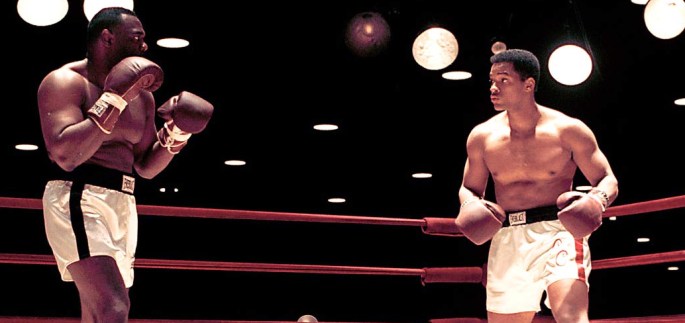
The fight scenes are covered from every conceivable angle as Mann cuts back and forth from shots outside and inside the ring. The first shot we get of the ring is a close-up of the red ropes and in Mann’s films this color signifies danger. There is the potential for Ali to not just lose the fight but possibly his life. This is a risk every time a boxer steps into the ring. In the Liston fight, Mann alternates between camerawork inside the ring, with tight and close point-of-view angles so that we are right in the ring with the boxers, and shots just outside of the ring but still close to the fighters. This gives the fight scenes a real visceral impact and immediacy that has not been seen since Martin Scorsese’s Raging Bull (1980). The Liston fight also shows how Ali could work a crowd of boxing fans just as well and in just the same way as the crowd of journalists before the fight.

Unlike most boxing films, Mann wanted to get inside the ring in order “to bring you inside the strategy and tactics, to bring you into the round as far as I could.” To this end, Mann would often be in the ring with the fighters with a very small digital camera. To achieve the most realistic fight scenes possible, Mann really had Smith and the other boxers hit each other. The director recalled one such incident: “When James Toney as Joe Frazier knocks Will down, we did three takes of that — every single one of those left hooks he connected. When Will stands up on the one that’s in the film, that wobble is not acting — you can tell how shaky he is.”

Mann also uses a cool, blue color to suggest intimacy and does so in the scene where Ali and Sonji (Jada Pinkett Smith), who would become his first wife, dance in a nightclub. They are close together, flirting with each other as Mann drenches the scene in blue much like he did with Neil McCauley entering his house in Heat (1995) and Will and Molly making love in Manhunter (1986). Ali is temporarily in an area of safety and love but this will change very soon.

After an interview with legendary broadcaster Howard Cosell (Jon Voight), Ali’s life takes a turn for the worse as he refuses to be inducted in the Army and is arrested. He then denounces the war in an interview and is subsequently labeled as being unpatriotic. He is stripped of his boxing title as Heavyweight Champion of the World, his boxing license and his passport. Like Jeffrey Wigand in The Insider, Ali is threatened by the powers that be for telling the truth and being his own man. It becomes obvious that this is a war of attrition in an effort to bleed Ali dry financially and threaten him with five years in jail. Then, as if to add insult to injury, the Temple of Islam suspends him just like they did to Malcolm X.

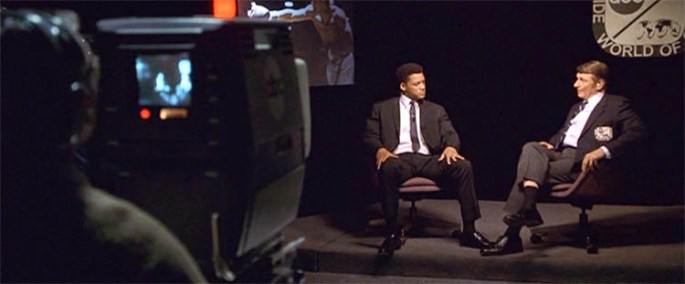
Cosell and Ali meet up and the veteran broadcaster, conscious of how bad off his friend is but not acknowledging it publicly, puts him on television despite network pressure. Cosell allows Ali to speak his piece about his ban and dazzles everyone again with his showmanship. It really is a testimony to Cosell that he did this. When everyone else had abandoned Ali, the T.V. personality stuck by him and used his considerable clout to put him back in the public eye. This interview is the turning point for Ali who wins a fight. Only then does Herbert and the Temple of Islam come back to him but Ali makes it clear that they do not own him. His eyes have been opened and he now knows just how much he can trust them.

Ali culminates with the legendary Rumble in the Jungle where Ali fought George Foreman in Zaire. Ali was not the favorite going in as Foreman was younger, stronger and the Champ. Mann, again, hints at the potential danger of this opponent when we see Foreman training, pounding a punching bag with powerful hits all with a greenish filter, a sign of peril in a Mann film. Sure enough, during this period Ali drives away his second wife (Nona Gaye) who does not like his relationship with the Temple of Islam because she feels that they are exploiting him. While still married to her, Ali becomes interested in a female journalist (Michael Michele) from Los Angeles who is in Zaire doing a profile on the boxer. This relationship effectively ruins his second marriage and Mann does not gloss over this showing that Ali was clearly in the wrong.

This portion of the film was shot in Johannesburg, South Africa and from there, an hour journey to Maputo, Mozambique because Mann liked the architecture in Maputo. In 1974, the legendary “Rumble in the Jungle” bout between Ali and George Foreman took place in Kinshasa, Zaire which had since become the Democratic Republic of Congo, but there was too much political unrest for Mann to shoot there in 2000. Associate producer Gusmano Gesaretti remembers that Mann fell in love with the architecture in Maputo. It was predominantly built by the Portuguese during the middle to later part of the century with buildings done in Art Deco-style curves and arches alongside others with straight lines in the block style of the 1960s. All were very aged and weather-beaten and looked very much the way Kinshasa was in the 1970s.

The “Rumble in the Jungle” was filmed over five weeks in Machava Stadium, five kilometers northwest of Maputo. The stadium was used to host large international soccer tournaments but had fallen into disrepair — there wasn’t even any electricity. The production spent $100,000 repairing and upgrading the 64,000-seat capacity stadium. They structurally engineered and replicated a ring and canopy that was 40 feet high, 82 feet wide and weighed over 40 tons. Over 10,000 extras were needed for the scene where Ali makes his entrance into the stadium. Fliers were distributed in Maputo inviting people to watch the filming. The production also cast 2,000 extras that would be costumed and fill seats on the floor around the ring. On the night of the scene, over 30,000 people showed up.

Known mostly for mindless, yet entertaining action films like Bad Boys (1995) and Independence Day (1996), Will Smith was not exactly most people’s first choice to play Muhammad Ali. However, Smith shows that he has the capacity for more substantial work with Six Degrees of Separation (1993) but he had never attempted anything as challenging as this project. Smith captures Ali’s distinctive speech patterns, especially his flamboyant, larger-than-life public persona. Like Anthony Hopkins before him in Nixon (1995), Smith does not look exactly like the actual person he is playing. Instead, he manages to capture the essence and the spirit of the man. He also does a good job of conveying Ali’s conflict between his loyalty to Islam and to his family and friends. Smith peels back the layers to show that there was so much more than Ali’s flashy public side. For example, most people only saw Ali and Cosell as antagonists, but this was only for show. In fact, they were good friends and the sportscaster was willing to help him out in any way possible.
Ali-Howard-CosellWhile Smith was praised for his impressive physical transformation into legendary boxer Muhammed Ali, the film itself was criticized for revealing nothing new about the man. Herein lies the problem that Mann and company faced: how do you shed new light on one of the most documented historical figures of the 20th Century? Ali eschews the traditional docudrama for a more impressionistic take on the man and life. Mann’s film may not say anything new about the famous boxer, but it does depict an exciting ten years of his life in a masterful and richly evocative fashion. It’s a surprisingly soulful take on Ali and an excellent addition to Mann’s impressive body of work.

CRIME STORY – A REVIEW BY J.D. LAFRANCE

z9270693Q,Crime-Story

Fresh from the success of Miami Vice in the mid-1980’s, Michael Mann parlayed his powerful clout within the industry to produce a new television show entitled, Crime Story. It was a pet project that he developed with good friend Chuck Adamson and Gustave Reininger. Like Vice, Crime Story was a cop show but set in the early 1960s and with a grittier, darker edge as opposed to the stylish, brightly-lit pastel look of its predecessor. To this end, Mann not only cast Hollywood outsider Dennis Farina (whose unconventional looks must’ve terrified NBC executives), but had exploitation filmmaker Abel Ferrara direct the pilot episode. The result is a lean, mean drama that features politically incorrect police officers battling it out with nasty criminals.

The pilot episode for Crime Story begins with a daring restaurant robbery gone badly. Del Shannon sings “Runaway” (re-recorded especially for the show) as the hold-up turns into a hostage situation. Three police detectives led by Mike Torello (Farina) race to the scene (blink and you’ll miss a young Michael Rooker as a beat cop). No words are spoken between the men as they calmly check their guns and get ready. As the criminals are about to take off with their hostages, Torello leans in menacingly and says to one goon, “You hurt anybody else, when this is all over I’m gonna find what you love the most and I’m gonna kill it. Your mother, your father, your dog. Don’t matter what it is – it’s dead.” Welcome to the world of Crime Story.

It turns out that the criminals are working for local wise guy Ray Luca (Anthony Denison), a vicious thug with a short fuse and an awesome pompadour that defies gravity. This guy isn’t afraid to smash bottles and furniture over hapless underlings to get his point across. Luca plans to steal some valuable European royalty jewels from the Lakeshore Museum but Torello intends to link the restaurant robbery to the thug and stop the heist from going down.

Mann has said that he was influenced by working on the Police Story T.V. series (1973-1977), which was run by playwright Liam O’Brien and included famous crime writer, Joseph Wambaugh (who wrote The Onion Field) as a contributor. Each episode was based on a real event, working with the policeman whose story it was based on. Mann “learned a lot about writing and about working with real guys.” Crime Story was based on the experiences of Chuck Adamson, a former Chicago police detective of 17 years. He claimed that the stories featured on the show were composites rather than actual events that happened, “but they’ll be accurate.” According to Mann, the genesis of the project was to follow a group of police officers in a major crimes unit in 1963 and how they change over 20 hours of television. He asked Reininger and Adamson to write the series pilot and a “Bible.”

Reininger was a former Wall Street international investment banker who had come to Mann’s attention based on a screenplay he had written about arson investigators, and a French film that he had written and produced. Reininger researched Crime Story by winning the confidence of Detective William Hanhardt who put him in touch with undercover officers in Chicago. They sent him on meetings with organized crime figures. Reininger risked wearing a body microphone and recorder. After visiting the crime scene of a gruesome gangland slaying of bookmaker Al Brown, Reininger backed off his Mob interviews.

Mann said that the first season of the show would go from Chicago in 1963 to Las Vegas in 1980 where the characters would have “very different occupations, in a different city and in a different time.” He said, “It’s a serial in the sense that we have continuing stories, and in that sense the show is one big novel.” Mann and Reininger’s inspiration for the 1963-1980 arc came from their mutual admiration of the epic 15+ hour film, Berlin Alexanderplatz (1980) by German director Rainer Werner Fassbinder. Mann said, “The pace of our story is like the speed of light compared to that, but that’s the idea – if you put it all together at the end you’ve got one hell of a 22-hour movie.”

NBC President Brandon Tartikoff gave an order for a two-hour movie, which had a theatrical release in a handful of U.S. theaters to invited guests only. Tartikoff also ordered 22 episodes which allowed Reininger and Adamson to tell a story with developing character arcs, and continuing stories (instead of episodic, self standing shows). Mann predicted a five-year network run for the show. However, due to budgetary constraints (the need for four sets of vintage cars proved to be too expensive). Tartikoff eventually allowed their series to move to Las Vegas for the last quarter of the 22 episodes. By the second season, an average episode cost between $1.3 and 1.4 million because it was shot on location, set during the 1960s and featured a large cast.

However, they realized that it was too expensive to go through several different period changes in one season. Universal Pictures decided not to make Crime Story because they deemed it too expensive and a small studio called New World Pictures Ltd. stepped up to finance it. It allowed them to work in the big leagues with a major T.V. network like NBC and a chance to sell the show overseas while Universal would retain the domestic syndication rights. The production schedule was a grueling two episodes every three weeks shooting 12 hours a day or more every day of the week.

One of the most distinctive aspects of Crime Story is the look, the attention to period detail. Hilda Stark worked as an art director on the pilot and was asked back by Mann after seven episodes to be the production designer. To achieve the show’s period look, she and her team would go to second-hand and antique stores, run ads in the in newspapers seeking articles from the period, and sometimes build furniture if they could not find it. According to Stark, the overall design or look of the show featured “a lot of exaggerated lines. We go for high style – sleek lines and high style…We go for the exaggerated shapes that recall the era.” Stark and her team also came up with a color scheme for the show that featured “saturated color, and certain combinations – black, fuchsias – reminiscent of the ‘50s.” She finds inspiration from a library of old books and magazines, in particular Life. For the vintage cars in the show, they would buy or rent from private owners.

It’s a testimony to Mann’s reputation at the time that Crime Story was even greenlighted. NBC would have never gone for the casting of Dennis Farina, with his pockmarked face and lack of acting experience, had Mann been a neophyte producer with no proven track record. The choice of cult film director Abel Ferrara must have also freaked out network execs. His previous films included The Driller Killer (1979), where a deranged psycho gruesomely kills people with a power tool, and Ms. 45 (1981), where a rape survivor viciously kills the men who attacked her with a .45 pistol.

And yet, the final product proves that Mann’s instincts were right on the money. Farina delivers the hard-boiled dialogue with the perfect amount of intensity (Torello orders a loose cannon cop, “Why don’t you get unconscious for awhile.”). You can see it in his eyes and the way he barks out orders that this a no-nonsense guy who isn’t going to let anything get in the way of his job. In many respects, he is the prototype for Al Pacino’s equally driven cop in Mann’s Heat (1995). Farina’s Torello is the prototypical Mann protagonist: professional and a perfectionist, all at the expense of everything else.

Ferrara directs with the same proficient skill of crime auteur, Don Siegel. Like Siegel’s two best crime films, Charley Varrick (1973) and The Killers (1964), Crime Story depicts a harsh world where life is cheap and characters will do anything – even if it means bending or breaking the law – to achieve their goals. Crime Story would provide the blueprint for Ferrara’s later forays into urban crime films like The King of New York (1990) and Bad Lieutenant (1992).

tumblr_m5dqibKT7Z1r14f8v

One of the most striking aspects about Crime Story is that it feels like it was ripped right from the pages of a James Ellroy novel. It is even more surprising that this show was done before Ellroy had written his famous L.A. Quartet of books that featured L.A. Confidential, which Crime Story most closely resembles. The author claims that he hadn’t seen the show until after he wrote these novels but he does admit to being a fan since then. In an interview with Paul Duncan, Ellroy said, “I think Dennis Farina as Lieutenant Mike Torello is a force of nature. When the hatred between him and Anthony Denison fuels the plot, it’s great, it’s epic. but after a while it just goes to hell.”

PUBLIC ENEMIES – A REVIEW BY J.D. LAFRANCE

Public-Enemies-4-790022

Public Enemies (2009) marked Michael Mann’s fourth foray into American history with The Last of the Mohicans (1992), The Insider (1999), and Ali (2001) being his previous efforts. The director got his start making documentaries and always been interested in achieving absolute authenticity in the depiction of the professions that his protagonists practice, be it safecracking in Thief (1981) or serial killer profiling in Manhunter (1986). Born and raised in Chicago, it is easy to see what drew Mann to the story of John Dillinger, a famous bank robber during the 1930s. He and his crew were the best of the best at the time and so, he certainly fits the kind of protagonist Mann is drawn to.

Public Enemies begins in 1933 during the golden age of bank robbery and Mann wastes no time getting into it as he opens the film with an exciting escape from an Ohio prison orchestrated by Dillinger (Johnny Depp) and his crew. Soon after, we meet FBI agent Melvin Purvis (Christian Bale) in action as he takes down Pretty Boy Floyd (Channing Tatum) with a hunting rifle from an impressive distance. In no time at all, Mann has established the film’s protagonist and antagonist. They are smart, super efficient men of action that are single-minded in their respective goals.

Unable to get funding and criticized by his superiors, FBI Director J. Edgar Hoover (Billy Crudup) needs high-profile busts and enlists Purvis to find and stop the country’s Public Enemy No. 1 – John Dillinger. The more notorious he becomes the more this angers not just the FBI but also the Chicago mob because his actions put extra heat on them. There is a nice scene where he meets with a mob representative who basically tells him that he is a dying breed. The money he makes knocking over one bank, they make in one day through illegal gambling.

Mann demonstrates that he is a master at orchestrating action sequences. They are cleanly photographed and edited so that there is no confusion. You can always tell what is going on and who everyone is instead of the kamikaze, headache-inducing editing and slapdash camerawork in films by the likes of Michael Bay and McG. The shoot-out at Dillinger’s hide-out in Little Bohemia is the film’s show-stopping action sequence much like the bank heist in Heat (1995) and the nightclub shoot-out in Collateral (2004). It is powerfully executed and full of tension and excitement as well as an impressive display of firepower with the deafening blasts of tommy guns and shotguns.

Public Enemies reunited Mann with key collaborators, chief among them cinematographer Dante Spinotti who has shot his most memorable films (including Manhunter, The Last of the Mohicans, Heat, and The Insider). Mann has come under considerable criticism for making the move to digital cameras and even more so with Public Enemies because it is a period film and audiences are used to seeing them done on traditional film stock. However, it looks great with crisp, clear images, especially at night where there is an impressive depth of field. Certain scenes have a graininess to them inherent with digital cameras but, in this case, it gives a tangible, gritty texture that works. There are some truly beautiful shots in this film, like one in which a car carrying Dillinger and his crew hurtle down a road surrounded by a vast forest of trees that tower over them.

Mann is also reunited with composer Elliot Goldenthal who worked on Heat. Since The Last of the Mohicans (1992), Mann has relied on soundtracks comprised mostly of disparate tracks from various sources. Being a period piece, obviously Public Enemies really doesn’t lend itself to that kind of a soundtrack and Goldenthal expertly augments the drama that unfolds in various scenes, creating one of the best scores in a Mann film to date.

The attention to period detail is fantastic with classic trains, cars, and classic gangster iconography like tommy guns, fedoras and trenchcoats permeating the film. Mann really immerses us in the time period but not in a way that calls undo attention to itself. It’s just there in the background of every scene with vintage period architecture. Ever the perfectionist, Mann shot on location, often at the actual locations that Dillinger and his gang frequented. Whether you are consciously aware of this or not, the film just oozes authenticity.

Dillinger certainly enjoys the fruits of his labor but is always planning his next job. He follows his own personal code: he doesn’t kill unless absolutely necessary and doesn’t think about the future, living only in the present because he could easily end up in jail or dead. He is also very conscious of how he’s perceived by the public, enjoying the notoriety his exploits create. Johnny Depp portrays him as a very confident guy who is always in control. There is often this mischievous glint in his eye like he’s in on a private joke. Depp plays Dillinger with a lot of charm, like when he addresses the media while being booked in an Indiana jail. He knows how to work the crowd and the charismatic actor is excellent in this scene. However, Public Enemies is not afraid to point out that Dillinger is no hero. The man has no problem with killing someone if they got in his way but the film goes to great lengths to point out that he did so only when there was no other option. Dillinger was clearly a man who didn’t believe in wasting time, much like Frank, the safecracker in Thief. Depp inhabits the role with his customary dedication, adopting a specific voice, accent and effortless delivery of period lingo that sounds natural and genuine.

Christian Bale is quite good as the very determined Purvis. While Mann doesn’t create the balance of cop vs. robber as he did in Heat, Bale has a significant amount of screen-time in the film. Like other law enforcement figures in Mann’s films, Purvis uses state-of-the-art technology, for the time, to track Dillinger and his crew. As determined as Purvis is, Mann allows some humanity to seep in, like when he stops the brutal interrogation of Dillinger’s girlfriend Billie Frechette (Marion Cotillard) and personally helps her get cleaned up. It is this small moment that adds a welcome layer to his character.

There are all kinds of parallels between Public Enemies and Heat. In both films we are meant to sympathize with the bank robber. Also, the two leads only meet face-to-face in one scene. There is a climactic gun-battle where both sides take on significant casualties that alter the conclusion of the story. And, like McCauley in Heat, there is an inevitability to Dillinger’s life; that he will run out of time and luck; that Purvis and the FBI will close the net around him. That being said, Public Enemies is not a carbon copy of Heat. Personality-wise, Dillinger and McCauley are very different people with the former being a risk-taker and the latter being overly cautious. The same goes for the lawmen. Purvis is not the larger-than-life extrovert that Hanna is, but rather a no-nonsense man who gets the job done and that’s it. There’s even a loose cannon in the form of Baby Face Nelson (Stephen Graham) who is to Public Enemies what Waingro was to Heat. A psychopath that the bank robbers initially ally themselves with but end up cutting loose when he proves to be too unstable. Structurally, both films couldn’t be different as Mann continues to experiment with narrative structure in a fascinating way. This isn’t your typical, cookie-cutter A to B to C plotting, which may frustrate some (see Ali or Miami Vice) but if you the patience and can get into it, watching Public Enemies is a very rewarding experience.

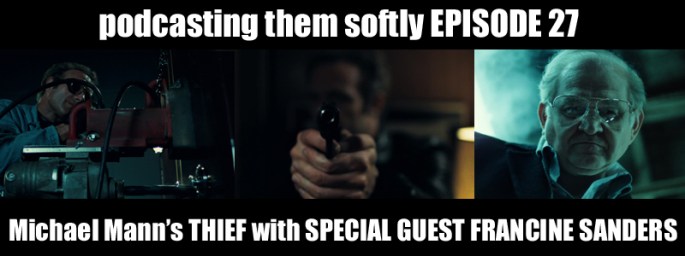
Episode 28: Michael Mann’s THIEF with Special Guest FRANCINE SANDERS

FRANCINE POWERCAST

We covered Michael Mann’s 1981 neo noir Chicago crime film, THIEF, that starred James Caan, Tuesday Weld, James Belushi, Dennis Farina, and Willie Nelson.  We’re joined with Frank’s former film professor, Francine Sanders, who teaches classes at Columbia College of Chicago.  Frank took her Studies of the Films of the 1970’s.  Francine teaches film courses at Oakton Community College’s Emeritus Program, and has served on the faculty of Tribeca Flashpoint Media Arts Academy and Roosevelt University.  Not only is she a published and awarded writer, but she worked for the Chicago Police Department for eight and half years as a civilian investigator for the Office of Professional Standards and helped uncover police torture and corruption under Chicago Police Department’s former Cmdr. Jon Burge.  Francine is a key component for Frank’s love of film, and there wouldn’t be a Podcasting Them Softy (at least from Frank’s end) without her!

Michael Mann’s Thief: A Review by Nate Hill

image

With Thief, Michael Mann distilled his crime film style into an archetypal, haunting aura that would go on to influence not only his excellent later work, but other filmmakers as well, everything from Refn’s Drive to the police procedural we see on television today. A style that consists of kaleidoscope neon reflections in rain slicked streets, Chrome cars bulleting through restless urban nocturnes and a lyrical, pulsating score, here provided by underrated German electronic maestros Tangerine Dream, who would go on to provide their dulcet tones for Mann’s phenomenal 1983 The Keep. Thief weaves the age old tale of a master safe cracker(James Caan in a beautifully understated performance) the high stakes at risk of him performing one last job to escape, with said stakes represented as his angelic wife (Tuesday Weld) and newborn son. Robert Prosky in his film debut is a serpentine wonder as Leo, Caan’s boss, whose chilling metamorphosis from paternal employer to domineering monster is a joy to watch. The jewel heist scenes are shot with a researched, assured and authentic feel, spurred on by Tangerine Dreams cosmic rhythms and are especially dynamic points of the film. Thief, for me, belongs that special subcategory of Mann’s career along with Heat, Miami Vice and Collateral, (Public Enemies doesn’t get to come in this elite cinematic treehouse club, it didn’t do anything for me) that are very special crime films. They possess an intangible, ethereal quality of colour, metal, music, and shady people moving about a thrumming urban dreamscape, professionals at what they do, cogs in the ticking clock of crime that inexorably drives toward the narrative outcome, be it bitter confrontation and violence (of which Thief has an absolute gorgeous, poetic revenge sequence) or cathartic resolution (like the conventionally satisfying way Collateral ends). Mann has captured neon lightning in a bottle with Thief, and against the odds of people saying you can’t catch lightning twice, he has spark plugged a good portion of his career with that same lightning, creating an artistic aesthetic all his own. To me that is the ultimate outcome of filmmaking, and art as a medium.

Michael Mann’s The Insider: A Review by Nate Hill

There are some films that are so perfectly made in every way possible that
I sit there thinking ‘Every persons effort and every element of creative energy that went into making this movie has been implemented flawlessly, arriving here and now to give me the viewing experience I’m getting. A perfect movie’. Michael Mann’s The Insider is such a movie. I held off on reviewing it for a couple days after seeing it, partly to let it sink in but mostly to see if I’d feel any different about it once my synapses had cooled down and the frames had dimmed from my consciousness. Perhaps the fiery reaction it drew from me in the moment was cheaply earned, or I was just in the right mood to love it at that time. Not a chance. If anything I’ve become more enraptured by it as time has passed, already aching for a second viewing. Every performance and aspect of is just so rich, deep and rewarding that for its two and a half hour runtime I found myself externally distracted not once. Occasionally Mann deviates from his comfort zone in the nocturnal crime zone. The occult themed period piece, the colonial adventure, the psychological horror, and this, the blistering drama based on a true story. One might not think the subject matter deserves a two and a half hour film, let alone would make a great one, but Mann has the cinematic Midas touch, and never half asses it. His films always contain traces of a true master at work, telling little details that engrave the film with a sense of immaculate skill and unwavering dedication to telling the story in its finest, and most honest form. The Insider tells the story of Jeffrey Wigand (Russell Crowe), a chemist who turns whistleblower on the tobacco corporation he was once employed by, finding shelter under the wing of CBS News’s 60 minutes, and particularly hard nosed reporter Lowell Bergman (Al Pacino). The network wants his take, in order to do an exposé on Big Tobacco, a plan with predictably disastrous and dangerous results, for both Wigand and CBS. The film shakes off any impending sensationalism or deliberately emotional stylistic cheats, instead keeping a microscope focus on the three lead performances and letting all the hurt, determination and emotion come forth naturally through their work, as opposed to smothering their story with an overbearing score and cheap cinematic manipulation. I’ve never been that won over by Russell Crowe until now. He always seems ‘halfway there’ in his work, like he’s missing something. This changed things for me. He’s like a raw nerve here, a family man pushed to the precipice of an impossible decision. One can almost see him wrestling with his conscience behind those haunted eyes, a storm with a lid barely kept on and anchored by Crowe in his finest hour. Pacino holds us captive with his work until we realize we’re not breathing. He’s the moral compass of the piece, and to see him explode at the injustices served up to him will give you goosebumps. The third leg of the table is Christopher Plummer as Mike Wallace, the 60 minutes anchor who also struggles morally with the situation they are in. Plummer is so good you forget you’re watching a film, giving Wallace buried gentleness and chiselled emotional intensity that you can scarce believe is even possible through the craft of acting. The supporting cast is peppered with bushels of talent. Colm Feore, Philip Baker Hall, Gina Gershon, Stephen Tobolowsky, Diane Venora, Nester Serrano, Rip Torn, Michael Gambon and an unusually sedated Debi Mazar are superb. It’s Bruce McGill, however, who almost steals the film in one blistering scene, playing a lawyer with enough righteous anger to shatter your tv screen. A career best for him. No one puts you into a story by forcing you to feel alongside the characters quite like Mann. Here he guides us through the trials that Crowe, Plummer and Pacino face with steady hand and heart until we are invested. Then he pulls the ripcord and let’s the sparks fly, making monumentally intense work of events that could seem pedestrian in lesser hands. We really feel for Crowe and clutch the seat with the same desperate intensity that he clings to his family, and sanity. We feel the same jilted fury alongside Pacino as he wades through sickening bureaucracy for a shot at retribution. We take pause with Plummer as he ponders his legacy and are incredulous with all three at the snowball effect the entire proceeding has had on them, devastating us as an audience the same as them, in turn making us feel closer to them. This is all laced with the incredibly heartfelt music from Lisa Gerrard, who sang alongside Crowe in Gladiator and was a favourite of Tony Scott as well. Mann is a ceaseless monster of storytelling, tone and pacing. The story has flair simply because he doesn’t wantonly throw it in the mix; the feeling and reaction come from story and character and not the razzle dazzle. Mann knows this, and let’s the fireworks naturally spring from the absence of deliberation, like music in the vacuum of space. This one will live on to stand the test of time far longer than the decade and a half its help for already. It’s a revelation. 

Episode 23: Chicago Films with Mike Krumlauf

Episode 23

We were joined by Chicago native and independent filmmaker, Mike Krumlauf.  The three of us discuss our favorite films set and/or shot in Chicago.  We had a great time chatting, and hope you guys enjoy the chat as much as we enjoyed recording it!