
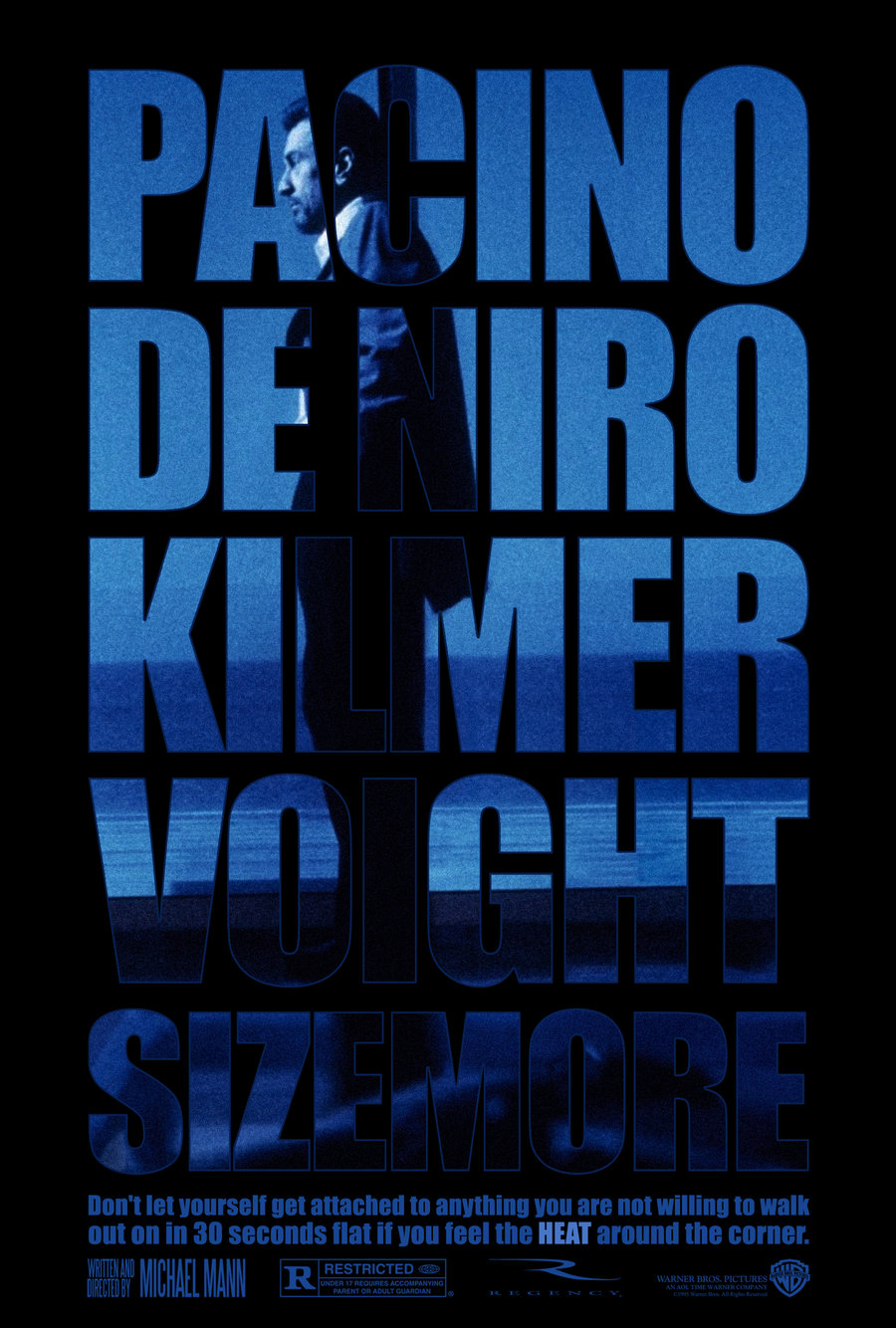
Michael Mann’s Heat represents the finest distillation of the filmmaker’s stylistic and narrative obsessions, the ultimate synthesis of plot, character, and action, all fused together in a nouveau package that still feels fresh and contemporary 20 years after its initial release. Mann, a writer/director who has often reached greatness throughout his career, appears to be most comfortable when telling stories about crime and its effects on the various people that surround his multilayered stories. A reworking of his earlier NBC movie of the week, L.A. Takedown, Heat still holds up now even in the face of stiff genre competition, and looking back on it, it’s incredible how little it has aged, and even more remarkable to notice how many other filmmakers have been lifting Mann’s striking visual aesthetic after all of these years. Critics took Heat a bit for granted when they first encountered it, as response was mostly positive and respectful, though not overly effusive, and while a solid success at the box office, it didn’t do massive numbers. However, over the years, audiences have turned the film into a cultural touchstone, as it represents the type of film that rarely gets made anymore: The introspective Hollywood drama with smarts and action that features big stars and a name director all working at the top of their games. The films that Mann had done preceding Heat (Thief and Manhunter most especially) clearly influenced numerous decisions on his magnum crime opus, and the works he’d go on to make in the future have all been fairly (or unfairly) compared to this epic 1995 crime saga.

Mann has found his obvious home in the crime genre, with his name associated on TV projects (Starsky & Hutch, Police Story, Police Woman, Miami Vice, Crime Story, and the wildly underrated Robbery Homicide Division) and on various feature films (Collateral, Miami Vice, Public Enemies, and Blackhat), all of which hum with a distinct personality and unified vision, no matter in what capacity Mann served. Part of what differentiates Mann from other filmmakers is his unique sense of habitation and dedication to realism; no matter how busy the narrative or how jargon fueled the dialogue may be, there’s always a clear sense of how every detail might fall into place, allowing the audience to follow the demands of the plot while still having the capacity to be surprised and draw conclusions on their own. And in Heat, there’s a level of streamlined perfection to the story that might have been unattainable by another, less in-control filmmaker, considering just how many moving pieces are involved in making Heat the success that it became. What I love so much about Heat is that, like James Mangold’s 1997 policier Cop Land, the film operates as a sly, contemporary Western, but Heat, unlike many other genre efforts, transcends the themes that it so dutifully explores, vaulting the picture into rarefied, existential territory that Mann always seems interested in exploring no matter the milieu. He also managed to craft the Ultimate Los Angeles Movie, but more on that later.
Not that a plot explanation should be necessary at this point, but I’ll break down the basics. Robert De Niro is a master thief. Al Pacino is a master cop. They both have dedicated crews (Val Kilmer, Tom Sizemore, Danny Trejo, and Dennis Haysbert on Team De Niro; Wes Studi, Mykelti Williamson, and Ted Levine on Team Pacino), that will follow them anywhere. The city of Los Angeles is their deadly playground. The film revolves around the notion of duality, and how the De Niro and Pacino characters are essentially the same person, just on opposite sides of the law, completely consumed by their work, with a constant sense of professionalism and integrity guiding them through their perilous daily life. De Niro assembles his team to do a major score, the daring robbery of a bank, and it’s up to Pacino and his band of fellow officers to bring them down. Mixed into the main story are the various relationships that De Niro, Pacino, and their men have with the women in their lives: Wives, girlfriends, and in one instance, a step-daughter. Instead of just a nuts and bolts crime film, Mann opened up his generous narrative to include real conversations between real people that drive all of the action in a grounded, thoughtful manner. How it all ends is the stuff of cinema legend, and if you don’t know by now I’ll allow you to discover for yourself, but I will concede that Heat operates on multiple narrative tracks all at once, with side-jobs bringing along potentially fatal consequences for De Niro and his men, and the emotionally taxing rigors of having to balance your family life and your cop life for Pacino.
De Niro’s Neil McCauley is a criminal driven by and to perfection. He lives by a serious, permanent moral code: Never become attached to something that you can’t walk out on in 30 seconds flat if you spot the heat around the corner. No wife, no family, a true lone wolf in a sharp gray suit (a costume obsession of Mann’s for years), McCauley is the kind of man who thinks he has everything under control, and is used to getting his way in almost every situation. Then, things change when he meets a woman who might be a reason to leave his dangerous life behind for. She gives him a new reason to live, or at least he thinks she does from time to time. Because of the way that De Niro brilliantly plays the character, all inward quiet and small glances to suggest intent and feeling, you never truly know what he’ll do at any given moment. We know he’s pulled off various high-stakes jobs with total ease and precision, but he’s not used to letting his emotional guard down, and then when coupled with the fact that he’s got a Super Cop looking for him, he understands the need to take decisive action in an effort to complete his goals. This is one of De Niro’s least flashy and totally reserved performances, bringing a masculine grace to the role of leader and friend to his teammates, and while clearly a man capable of more than just violent action and air-tight planning, he’s still a human being, capable of making emotionally misguided mistakes which could prove to be his undoing.
In Pacino’s Vincent Hanna, Mann has created an amazing dichotomy with McCauley, because while both men certainly share similar traits and attributes, the recklessness of the Hanna character is what allows him to constantly move throughout the night, never resting for a moment, constantly thinking and plotting, always trying to one up his stealth opponent. Pacino brings a live-wire spark to the role of this driven detective, hollering out orders at his underlings, busting down doors, always ready to mix it up with an opponent. While listening to the Blu-ray audio commentary with Mann, it’s revealed that he had written a casual but possibly slightly out of control cocaine habit into the Hanna character, which would help explain the sudden outbursts of physical energy and verbal profanity, as well as all of the jaw chomping and twitching that he exhibits all throughout the film. I’m not fully sure why this angle was cut out of the film (I guess it cuts down on the sympathy factor for the character), but I really do wish that Mann had kept this edgy bit of business in the final cut, as it would have further contextualized Hanna as a man of steady habits and unpredictable behavior. Pacino, no stranger to large emoting, especially during the 90’s in films such as Scent of a Woman and The Devil’s Advocate, chews the scenery when called for, but also allows small moments of stern quiet to seep in around the edges. He’s a man who is always assessing the situation, whether on the job or at home, and it’s the way that Pacino burrows deep into Hanna as a man that we come to understand the method to his madness. I also find it curious how Mann introduces his top-cop character at the start of the film, during a morning lovemaking session with his wife, as opposed to on the streets chasing down some random bad guy. Romance is another aspect that Mann’s films always deal with, and the way that Pacino balances his home life and professional life is of key consequence to his character and the story in general.
The romantic angle and the concentration on the female characters also help separate Heat from lesser genre entries. Not content to tell an all-boys story with guns and explosions, Mann, as he’s been prone to do in the past, allows for the leads to have personal relationships which amp up the narrative tension and reason for being. McCauley meets an enchanting young woman who he feels might be worth running away with (a super young Amy Brenneman), and it isn’t until the film’s final moments where you learn his ultimate decisions regarding their unique relationship. This relationship takes the normally rigorously disciplined McCauley out of his comfort zone, which allows for shards of humanity to creep in around the edges. Hanna, meanwhile, is a two time divorcee who is in the middle of an about to fail marriage (Diane Venora is his sharp witted wife); it’s clear that he can’t keep things on the up and up at home while still traversing the streets of Los Angeles looking for all of the city’s transgressors. The scenes between Pacino and Venora have a palpable tension, because while they clearly loved each other once, they are so obviously drifting away from each other, and their confrontations carry a verbal weight and sting that elevates the material from mere soap opera to fully fleshed-out human dramatics. To further complicate Hanna’s life, his mentally unstable step-daughter (played by a then emerging star Nathalie Portman) also looms over the proceedings, creating a sense of unease that becomes essential to one aspect of the script. In retrospect, Heat does sort of resemble a male soap opera of sorts, as the two lead characters are emotionally stunted and need to sort out their issues through a variety of ways, some involving words, and others involving guns and violent conflict.
Heat has action peppered all throughout the runtime, but the film’s opening set-piece, involving the robbery of an armored truck, and the unfortunate execution of the truck’s drivers, immediately grabs the viewer by the throat, never letting you up for air. De Niro and his team orchestrate the perfect smash and grab, stealing only what they need, and leaving hardly a trace of evidence. It’s a brilliant way to establish the effectiveness of De Niro and his outfit, and it allows Mann the chance to show his methodical directorial style, almost journalistic in its small details, while you watch De Niro plan and then execute what should be the perfect heist. But you can only prepare so much, and because you never truly know who you’re working with, there’s a wild card in the equation that De Niro could never have prepared for. He goes by the name Waingro (the scary Kevin Gage), and he hovers over the narrative like the Devil himself, always appearing at the proper moment to set something in motion. But the scene that everyone loves to discuss and re-watch is arguably the greatest single sequence of action fireworks ever put on film, the robbery of a downtown Los Angeles bank in broad daylight, with all manner of civilians running for their lives, and an armada of cops battling De Niro and his crew. This bravura sequence is nothing short of staggering, with very few (if any) other films from over the years capturing the same sense of immediacy and violent impact that this monumental sequence contains, no matter how hard they try, Mann included (the gun battles in Public Enemies, Miami Vice, and Blackhat are terrific and at times extraordinary, but none match the rawness of what was captured in Heat). While never overly bloody, the street rampage is filled with all sorts of deadly implications, from numerous police officers and innocent bystanders being killed in the crossfire, and various members of De Niro’s crew either getting hurt or killed. Thousands of rounds of ammunition were expended during this blistering sequence of sustained fury, with the sensational sound team capturing every single bullet strike and muzzle blast. Mann saves the bloodiest bits of violence for the moments that really count (Waingro, Van Zant, the climatic moments between McCauley and Hanna), so that when we see someone go down hard and viciously, the consequence can be felt on a stark and visceral level, rather than everything becoming a senseless blur of unending and gratuitous graphic violence. As a filmmaker, Mann knows more about what to show and when to show it than few other currently working directors.
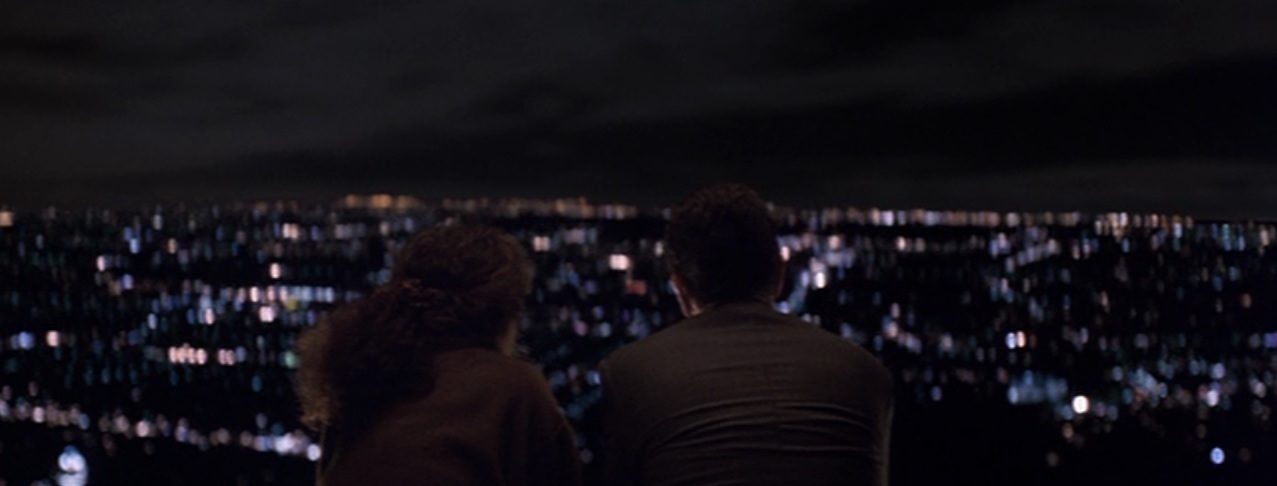
The cinematography, editing, music, and production design are all in total harmonious synch in Heat. Dante Spinotti’s naturalistic if at times slightly heightened images, in full 2.35:1 anamorphic widescreen, fill the edges of the frame with visual information and precise detail, with Mann’s “always-looking-into-the-future-of-the-night” style mixing with Spinotti’s elegant use of color and depth of field. Shots are framed a tad off center, with the character’s heads filling the foreground or background or side of frame, almost so that the camera is entering the minds of the story’s inhabitants, creating a lyrical and thought provoking tone that suggests a cerebral nature as much as it does anything else. The physical locations chosen for Heat showcase Los Angeles in all of its ethnically diverse and cement-sexy splendor, with the vapors and reflections of street lamps bouncing off the flat concrete surfaces, as industrial landscapes dot the horizon, with parking garages, empty lots and fields, side-streets, and the vast expanses of the city’s various skyscrapers and office buildings suggesting endless possibilities. And then there’s the amazing musical score, which ranges from ambient to grand, sweeping to soft, always in perfect tandem with the bright daytime and dark nocturnal images on screen, with some Miami Vice-inspired guitar riffs thrown in for those paying close attention. Heat is a nearly three hour picture, but because of the crispness and the judiciously timed editing, the film never sags or allows itself to slow down; once the story kicks into gear it never lets up, with a final hour that packs various dramatic conflict and incident into the narrative yet never feels rushed or forced. The swift pace created by the seamless editing patterns goes a long way in keeping this lengthy but forceful film moving along, with Mann pulling all the elements together in a way that few could ever have when it comes to material such as this.
By its powerful and well-earned conclusion, Heat is a film that is consumed with the ideas of studied professionalism, and the costs of committing 100% to any area of life. It’s just that in this story, that area of life is the criminal vs. the cop. And during the film’s electric final moments of action at a busy LAX and in the galvanizing final scene accompanied by Moby’s epic and poetic song God Moving Over The Face of The Waters, you get the sense that Mann has crafted two characters that, while resting on opposite sides of the law, have come to mutually respect each other as men and as adversaries. It all goes back to their fantastic meeting at the coffee shop at the film’s midsection, and how the two of them look clear into each other eyes and tell one another that the life they’re living is the only life they know how to live. More than any other great piece of work from Mann, Heat is his definitive masterpiece of filmmaking, the sublime end result of all of his ticks and tendencies as a storyteller, filtered through that indelible and totally dynamic visual aesthetic that has subtly morphed over the years while still retaining its core elements. It’s a film that I remain blown away by every single time I take in a viewing, and I love how I can vividly recall the first time I experienced it on the big screen with my father back in my high school days. Years late, I had a second opportunity to see the film in theaters, this time with Mann doing live Q&A (he took a break from editing duties on Ali to run over to LACMA for the screening). Heat will always be one of my favorite films of all time, for so many reasons, not the least of which is that, simply stated, it is great, enduring cinema that stirs the soul.
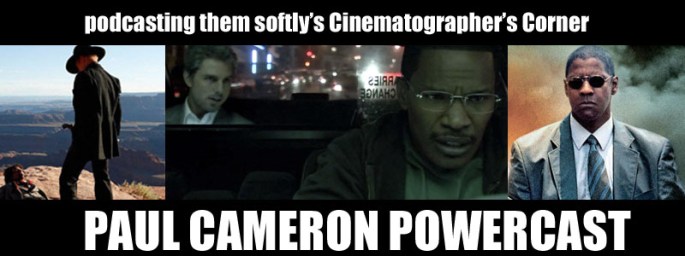
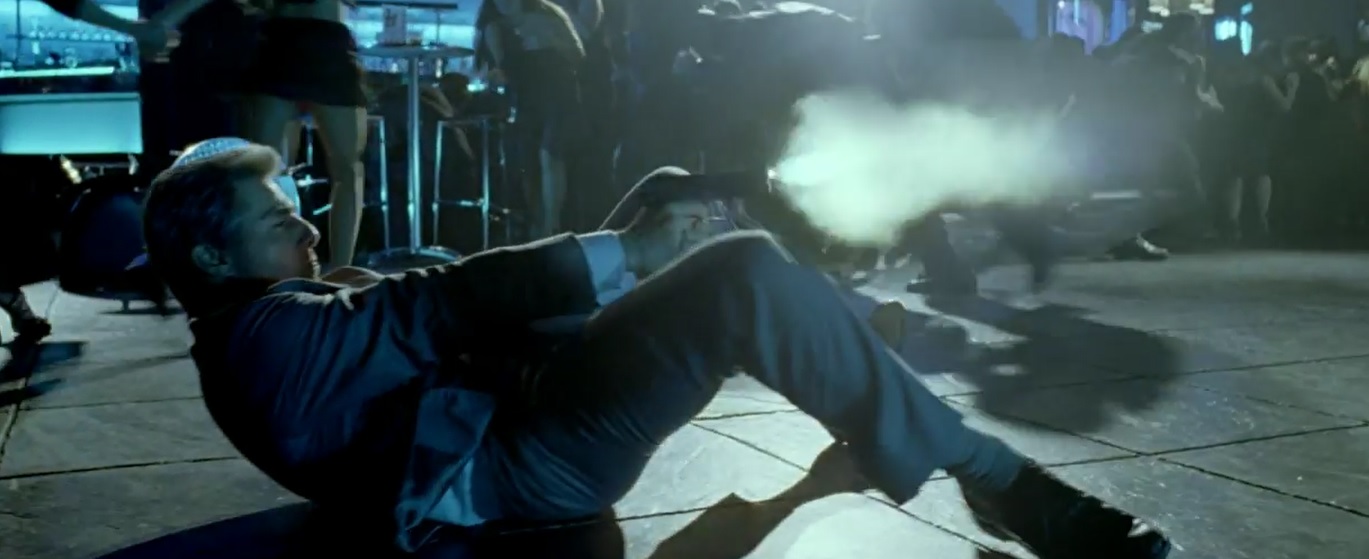
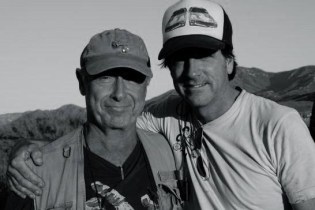 Podcasting Them Softly is extremely honored to present a chat with the fantastic cinematographer Paul Cameron. Paul has been responsible for shooting some of our absolute favorite modern action films, from his collaborations with the late Tony Scott including MAN ON FIRE, DEJA VU, and the BMW films entry BEAT THE DEVIL, to his groundbreaking work on Michael Mann’s COLLATERAL. Other efforts include the slick and gritty actioners GONE IN SIXTY SECONDS from director Dominic Sena and producer Jerry Bruckheimer, the crazy-fun cyber-terrorism thriller SWORDFISH with John Travolta and Hugh Jackman, the lens-flare gorgeous Total Recall remake, and the underrated thriller Dead Man Down. Paul has some massive projects coming up next year and beyond, with the HBO series WESTWORLD from Jonathan Nolan hitting TV screens in 2016, and he’s just wrapped principal photography on the latest PIRATES OF THE CARIBBEAN installment which is set for release in summer 2017. As most listeners of this podcast will know, we are both huge fans of Tony Scott and his artistically expressive aesthetic, so it was a real highlight to get a chance to speak with one of his key camera collaborators. We hope you enjoy!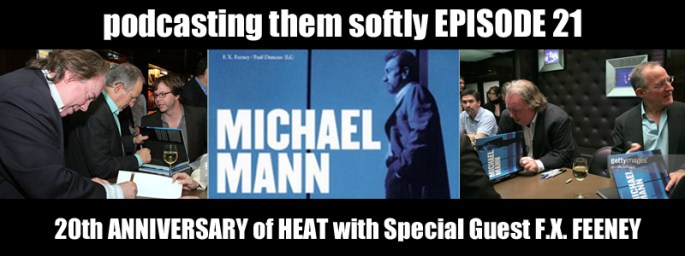
 It was an absolute honor to be joined by film critic, historian, screenwriter, and author F.X.



 STEPHEN LANG is an award-winning actor known for his work on TV, film and stage. Lang has been cast in a recurring role as Waldo in the upcoming AMC genre-bending material arts series INTO THE BADLAND. He will also be reprising his role as Colonel Miles Quaritch from James Cameron’s AVATAR in the three upcoming sequels. Lang can be seen starring in WGN America’s hit series SALEM as Increase Mathers. Recently, Lang took his acclaimed stage production of BEYOND GLORY on the road to eight cities nationwide. You can also watch Lang in the documentary BEYOND GLORY which the actor as he tracks the ten year odyssey behind his one-man show about eight medal of honor recipients.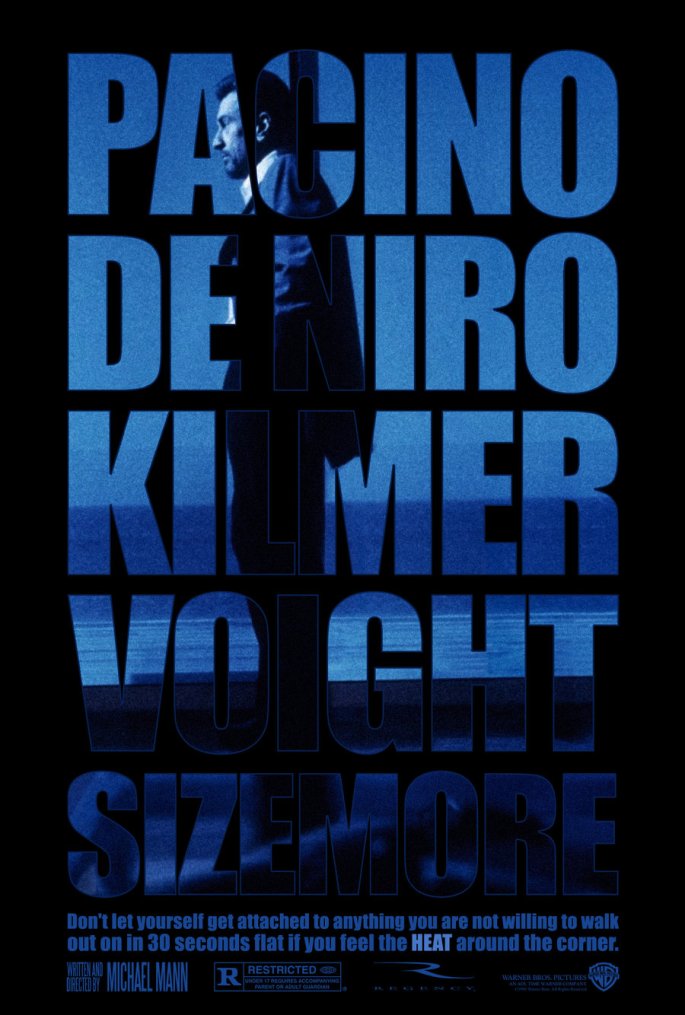
 Podcasting Them Softly