Worlds Greatest Dad is a true curiosity, a film I had to sit back and really think about right after I had watched it. It has such a strange arc, and wasn’t the pithy dark comedy I was expecting from the trailers. I mean, it is a pithy dark comedy, just not in the way you’d think at all. I still can’t even figure out if I liked the thing, but it wouldn’t leave my head for a while after, so it certainly has a kick to deliver, one that’s decidedly below the belt. Williams is Lance, a high school English teacher with traces of old world in his methods. He prefers to instruct his students in poetry, which makes him a bit unpopular, sadly. He also has an absolute snot nosed, shithead fuckwit douchebag of a son, played by Spy Kid’s own Daryl Sabara. Think my description of him is too harsh? Nah, son. This kid is a royal asshole of the highest degree, and one wonders what Lance did in a previous life to deserve such evil spawn. He’s a mean, spiteful, discouraging, porn addicted little piss stain, and ironically enough, it’s the spank material that results in his untimely death. I won’t say exactly how it happens, but for those who know what I’m talking about, he and David Carradine share an embarrassing fate. What’s curious is Lance’s reaction upon discovering the body: the kid treated him with nothing but disdain and disregard for years, but he’s still devastated. A father’s love, I suppose. He then writes a passionate suicide note and passes it off as his son’s, to hide the perverse truth. Everyone at the school, in town, even the local newspaper goes ballistic and praises the deceased boy’s work. Suddenly he’s a local hero, a beacon of hope for troubled youth everywhere, and a martyr to spur copies in flying off the shelves. There’s the joke, though. He was pretty much the worst person ever in the world, and now the writing Lance worked so hard on is being not only credited to, but hailed as that of his shitty dead kid. Even in death, one final jab of abuse bites back. Like I said, a very odd turn of events, and definitely like no other dark comedy, or other film, for that matter. When you consider this is a script by irreverent comedian Bobcat Goldthwait, who also directed, it’s easier to understand and appreciate the twisted nature of the story, and the places it goes. Williams is inspired, turning Lance from a sulky mess to a hero behind the curtain, finding his own life in Sabara’s demise, as wrong as that sounds. I guarantee you’ve never seen a film like this, and we probably will never get another just like it.
Tag: movie review
Disney’s Flubber: A Review by Nate Hill
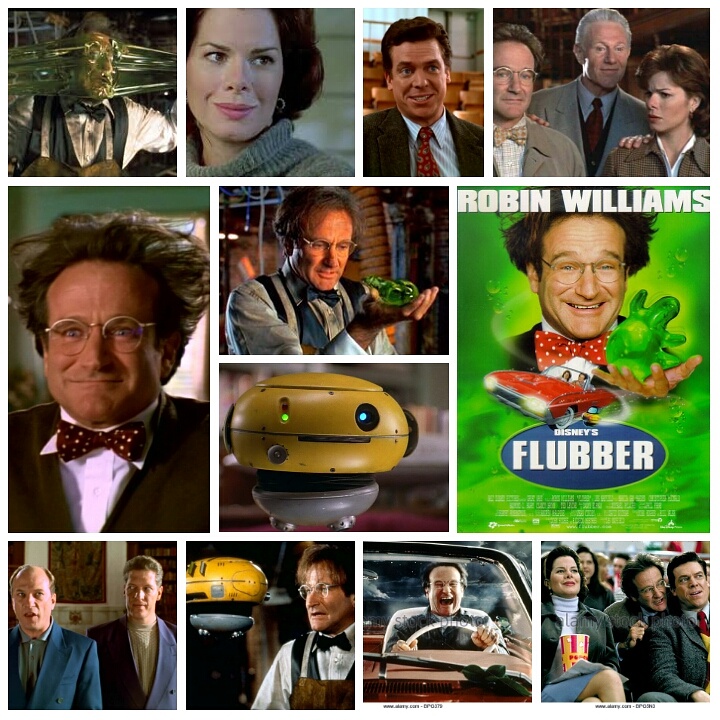
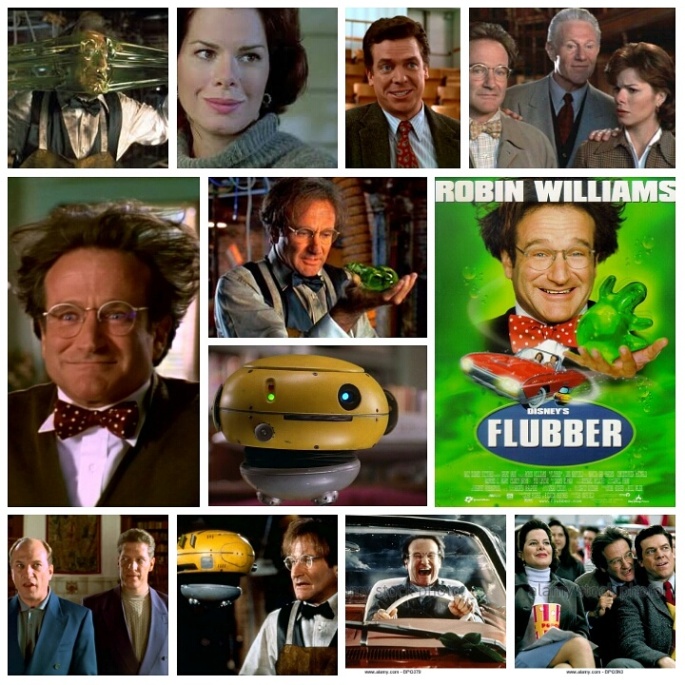
A remake of an old black and white Disney flick called The Absent Minded Professor that has long since gotten a bit stale, Flubber took all the best elements of that and breathed new 90’s life into the premise, most of the pep in its step coming from star Robin Williams. Keep in mind it was a critical bomb though, which just doesn’t make a shred of sense to me. It’s fun, lighthearted, hilarious and just a bit raunchy in places where it can pull it off. For whatever reason, it didn’t sit well with anyone other than fans like me who will furiously shove a copy in your face if we hear that you haven’t seen it. Williams is college professor Philip Brainard, who is so absent minded it borders on dementia. He leaves his lovely fiance (Marcia Gay Harden) at the alter TWICE, prompting the advances of irksome college dean Shooter Mcgavi- I mean Christopher Mcdonald. He’s on a quest, you see, an obsessive quest to find the formula for… something. That something turns up after a destructive whirlwind of disasters in his basement lab, and in the form of Flubber, a lovable ball of green goo, infected with incurable ADHD and an inexhaustible sense of humour. While the utter the life of the party, Flubber does have its practical uses, such as making cars fly and turning the hopeless varsity basketball team into a bunch of flying Tasmanian devils who nail every dunk. This all gets the attention of insidious local philanthropist and lowlife Chester Hoenicker (Raymond J. Barry) who greedily wants the discovery for his own. He sends his two goons Smith (Ted Levine) and Wesson (Clancy Brown) to rob Brainard of his precious sentient mucous, which turns into one of the most hilarious displays of slapstick comedy since the Three Stooges. Oh, did I mention Williams has a little flying UFO sidekick named Weebo, who has a perfect GIF reaction to everything, before GIF’s were even a thing? So much to love about this little classic. Williams is his usual buoyant self, with some of his trademark razor focus diminished in favor of doe eyed, vacuous forgetfulness that would make Jason Bourne guilty for ever whining about his predicament. Special effects are top drawer too, Flubber would look dapper in Blu Ray if they ever felt so inclined as to release one, not to mention aforementioned airborne automobiles and dear little Weebo. Can’t give enough glowing praise to this little treasure, and hiss enough venom towards those sourpuss critics who assaulted it. Flubber for the win.
B Movie Glory with Nate: Pawn
Pawn is another gift from the assembly line of slightly muddled second tier crime dramas, cobbled together with elements of greats from yesteryear, and barely held together at the seam by acting titans who have fallen on hard times chasing that almighty paycheque. That’s not to say it’s bad (although plenty of its breed are woeful), but simply inconsequential and forgettable. Starting off with a simple diner robbery that will inevitably spiral beyond control, we meet a band of clueless petty thieves lead by Michael Chiklis, doing his utter best with a silly cockney accent that has no reason to exist here. Little do these geniuses know, the diner they picked to lift happens to be a front for the Russian mob, setting off a chaotic chain of events that could end in all their deaths. The mob panics, and brings in everyone they can to clutter things up. Two corrupt cops show up, one inside the diner, played by Forest Whitaker, looking like he had some trouble understanding his portion of the script, and one outside, played by Marton Csokas who is underused a lot it seems. Common shows up as a hostage negotiator of all things, which made me chuckle. Stephen Lang is dangerously quiet as the restaurant owner and strong arm of the Russians. He hires a chatty Ray Liotta to hold one of the thieves wives (Nikki Reed) hostage and appear vaguely menacing until everything blows over. So we have scenes of him talking to her in cyclical metaphors interspersed with all the intrigue going down at the diner, and it all amounts to… what, exactly? Well, you’ll have to take a look for yourself, but the while thing seemed rather pointless to me.
CONSTANTINE – A REVIEW BY J.D. LAFRANCE

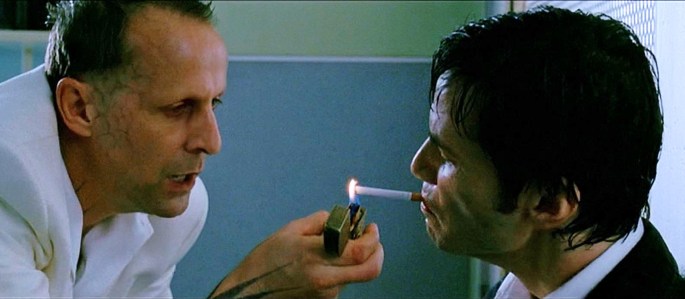
Constantine (2005) marked the feature film debut of music video director Francis Lawrence who, judging by the look of this movie, would like to follow in the footsteps of David Fincher. For his first time out, Lawrence takes on the daunting task of adapting the excellent comic book, Hellblazer. Its main character, John Constantine first appeared in the pages of Swamp Thing, during an illustrious run by Alan Moore. Eventually, Constantine got his own series with the launch of DC Comics’ Vertigo line. Jamie Delano was the primary writer and fleshed out the character’s backstory, his friends (like Chas the cabbie) and family. These stories typified late 1980s comic book horror and provided a bridge between Moore and the next creative heavyweight to tackle the character, Garth Ennis. His run on Hellblazer is where the movie gets most of its material from. Constantine is a chain-smoking, hard-drinking guy suffering from terminal lung cancer. He becomes embroiled in a complex war between Heaven and Hell with humanity caught in the middle.
The movie moves the comic’s setting from London to Los Angeles with John Constantine no longer being a blond-haired Englishman who looks like Sting to a very un-British-looking Keanu Reeves. The opening sequence introduces Constantine as an expert demon hunter trying to get back in with the good graces of God and the way he figures it, buy his way back into Heaven, but it isn’t that easy. We meet him as he exorcises a nasty demon from a young girl (a snazzy CGI updated riff on The Exorcist) while his twentysomething sidekick, Chas (Shia LeBeouf) waits in the car and perfects his Travis Bickle routine. Despite these cliches, this introduction is quite impressively shot and Lawrence successfully establishes this supernatural world and wisely limits Reeves’ dialogue, conveying most of what we need to know through the visuals.
Angela (Rachel Weisz) is a police detective whose twin sister has just died, committing suicide in a psychiatric hospital. Angela suspects foul play and this leads her to Constantine. They learn that demons are finding a way to crossover into our world and it has something to do with the Spear of Destiny (the weapon used to kill Jesus) being instrumental in summoning the son of Satan. To make matters worse, Constantine is rapidly dying from lung cancer and this gives his mission a certain sense of urgency.
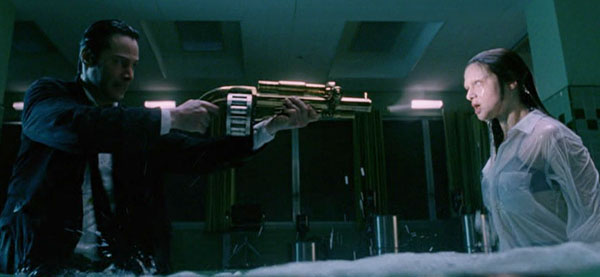
Fans of the comic book are probably not going to like this movie. Constantine is supposed to be world-weary, a sarcastic drunk and womanizer but Reeves doesn’t quite pull it off. He presents a more sanitized version of the comic book character and even that feels forced. Another major betrayal of the character is having him wield a gun (a cool-looking crucifix shotgun), something that the Constantine of the comic would never do. Guy Pearce or Clive Owen would have been a much better choice to play Constantine.
Rachel Weisz is also miscast as Constantine’s potential love interest. Her line delivery throughout the movie is flat and lacks passion. She has zero chemistry with Reeves (didn’t they learn anything from Chain Reaction?) and someone like Fairuza Balk or even Drea DeMatteo would have been much better in this pivotal role. On the plus side, alternative rocker Gavin Rossdale plays a very dapper Balthazar who looks like he stepped right out of a GQ photo shoot. He has a lot fun chewing up the scenery and his confrontation with Reeves is one of the highpoints of the movie.
Lawrence certainly knows how to establish atmosphere and does an excellent job of presenting a seedy, Los Angeles underworld populated by bars filled with demons, dilapidated apartments and grungy city streets slicked with rain. Thankfully, he doesn’t fall into the trap of shamelessly ripping off Blade Runner’s (1982) dystopic cityscape. If anything, his vision of Constantine’s world is like an episode of the television show Angel on big-budget CGI steroids. He also is able create an effectively creepy mood throughout. For example, there’s a nice, throwaway scene where Constantine and Angela are on a city street when all the lights systematically go out as a slew of nasty, winged demons swarm all over them.
Despite the miscasting of Reeves and Weisz in the two main roles, Lawrence’s take on Constantine is actually quite entertaining, even more so if you haven’t read the comic book. However, fans of the series will have problems with the major liberties the filmmakers have taken with the characters – especially Constantine and Chas. Like most comic book adaptations, this film only sprinkles certain elements from the source material, just enough to vaguely resemble it while watering it down for mainstream consumption. It’s a shame because in the right hands, Constantine could have been more like Hellboy (2004) instead it’s closer to the flawed, missed opportunity of The Punisher (2004).
Marcus Nispel’s Conan The Barbarian: A Review by Nate Hill
I’ve never seen any of the original Conan films with Ahnuld (I know, get the torches and pitchforks), so I don’t really have anything to compare Marcus Nispel’s remake to, but on it’s own I found it to be a solid, servicable sword and sandal outing with a welcome hard R rating and some neat work from legendary actors. Jason Momoa was fresh of his Game Of Thrones stint, jumping right into a very similar role as iconic Conan, a musclebound soldier of fortune on a grisly quest to exact revenge against warlord who decimated his village when he was but a pup. Momoa exudes a different aura than I imagine Schwarzenegger must have, a stoic, silent tunnel vision style as opposed to posing theatrically. It works, but it’s a new Conan from the one I’ve seen in many a trailer and snippet on tv, that’s for sure. My favourite part of the film is the extended prologue, which just somehow feels like the most grounded part, whereas everything else is almost cartoonish, reminding me of stuff like The Mummy. The opening is terrific though, introducing us to a young Conan (Leo Howard) and his father Corin (Ron Perlman, who else?), living in their nomadic village on the edge of nowhere. Enter tyrannical villain Khalar Zym (Stephen Lang) and his super freaky daughter Marique (Ivana Staneva), played later down the line by Rose McGowan, before she got all lame on us. Laying waste to Conan’s home and killing countless people including Corin, he is left to breed fearsome vengeance for years, until he sets out into the wide world on a journey to find Zym and mess him up real good. The story is standard, the action is well staged by Nispel, who has a golden eye for spectacularly orchestrated displays of violence in his films, and pulls no punches here. He also casts roles on the nose, and has for years. Lang is in overdrive, practically frothing at the mouth and turning Zym into something scary indeed. McGowan is straight out of a Takahashi Miike film, all bone white hissing snarls and needle sharp appendages, a hellcat with supreme bloodlust that you just don’t want to encounter. Momoa has the brawn for Conan, but a few extra syllables of dialogue wouldn’t have hurt, if only to round the guy out some more and give Jason something to say, which he rarely gets to do in his work it seems. I think parts of the film, especially the finale, were somewhat ruined for me by the catastrophically bad 3D they used (when oh when will they learn with the damned 3D), so I feel like a Blu Ray revisit is nigh, in which I can fully appreciate some of the set pieces without being reminded of a popup book. It’s a good time at the movies, but like I said, I have nothing to compare it to as far as Conan goes.
Tombstone: A Review by Nate Hill
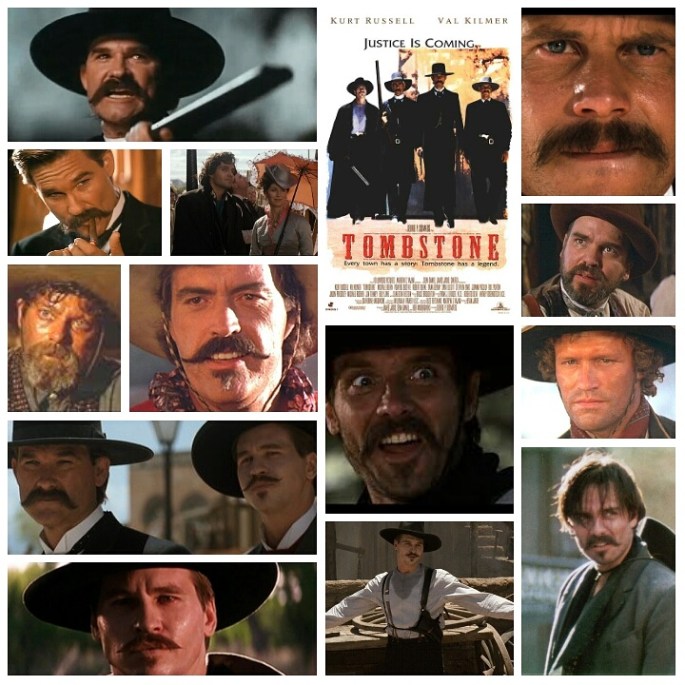
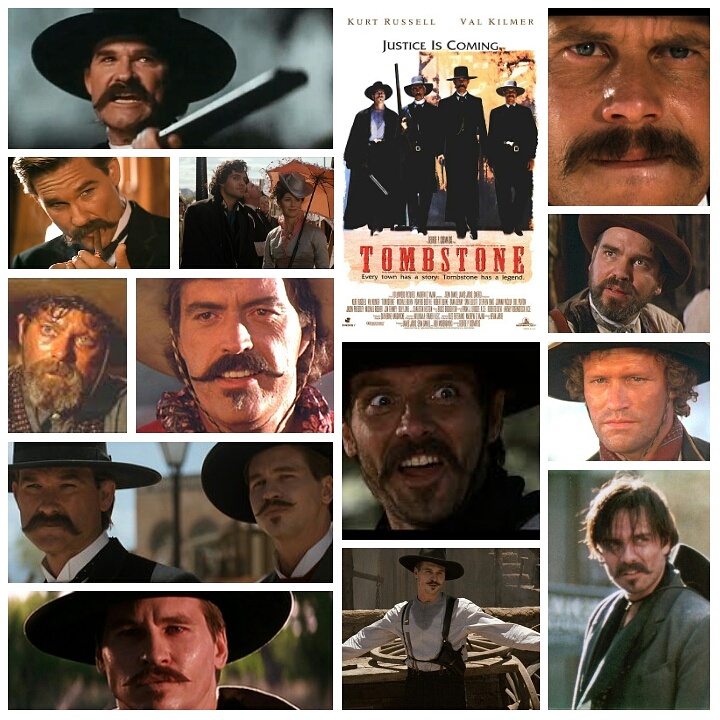
There are two main film versions based on the life of infamous outlaw Wyatt Earp: a serious, sombre one with Kevin Costner (and a whole lot of others), and a rolkicking circus sideshow starring Kurt Russell, bedazzled with a jaw dropping supporting cast that doesn’t quit. Both films are great, but if you held a six shooter to my head and demanded a preference, I’d have to give Tombstone the edge. It’s just too much fun, one wild screamer from start to finish, filled with swashbuckling deeds, evil outlaws and bawdy gunfights galore. It should have been called It’s A Mad Mad Mad Mad World In The Wild West. Kurt Russell is in mustache mode again here, but looks younger and leaner than last year’s western double feature his mutton chops starred in. Along with his brothers Virgil (Sam Elliott) and Norman (Bill Paxton) he arrives in Tombstone with a life of law enforcement in his dust and designs on retirement and relaxation. He gets pretty much the opposite though, when every lowlife bandit and villain in the area comes crawling out of the woodwork to give him trouble. Michael Biehn is the worst of them as crazy eyed Johnny Ringo, a deadly smart and ruthless killer, and Powers Boothe hams it up terrifically as drunken scoundrel Curly Bill Brocius. They are the two main causes of grief for the Earps, backed up by all sorts of goons including Michael Rooker, Billy Bob Thornton and a petulant Stephen Lang as Ike Clanton. Russell is joined by an off the wall Val Kilmer as Doc Holliday, the wheezy southern prince with a silver tongue that’s constantly fuelled by booze. He gives the best work of the film, and it’s fascinating to compare it to its counterpart, Dennis Quaid’s turn in the other version. Theres also great work from Billy Zane, Dana Delaney, Thomas Haden Church, Paula Malcomson, Tomas Arana, Johanna Pacula, Paul Ben Victor, Robert John Burke, John Corbett, Terry O Quinn, Robert Mitcham and even Charlton Heston good lawd what a cast. The standoffs, both verbal and physical, are a thing of beauty and the reason we go to the movies. Of all the westerns out there, this has just got to be the most fun. It’s constantly alive, there’s always something going on, a cheeky glint in its eye and a vitality in every corner of every frame, like a kid that won’t sit still. Russell is a champ as Earp, a no nonsense killer, plain and simple, but a man of both style and charisma, two weapons that are equally as important as his side arms. Kilmer gets all the best lines and goes to town with his portrayal, creating electric tension whenever he faces off with Biehn, who is equally mesmerizing in a more intense way. The three of them kill it, and along with the howling mess hall of a supporting cast, make this simply the liveliest western I’ve ever seen in the genre.
Alan Rudolph’s Trixie: A Review by Nate Hill
What the hell did just watch. Oh boy, what can I say about this one without tearing it a new one. Alan Rudolph’s Trixie is a dud, a paperweight, a misguided, clumsy disaster of the highest order. It has the tonal equilibrium of heart attack on a flow chart, and a troupe of actors who mercilessly embarrass themselves into the ground with work that goes beyond tireless pantomime. It’s sad, because I’ve seen this type of thing work nicely before, with the right amounts of quaint and quirky qualities, but here the mixture tanks in a god awfully messy cannonball of a landing. It tries to be a detective story, but fails to realize that you need some semblance of a story to care about, and I just…. didn’t care. It’s a slog to get through, a struggle to stay focused on, and basically a big awkward failure on every level. Also puzzling is the fact that cast, all of which are excellent actors who I love in almost everything they do, all made me want to hit them here, and when you’ve got a cast this good, that’s no easy feat. Emily Watson will make you want to tear your hair out as titular Trixie, a casino security guard with aspirations of taking on a big detective case, an irritating Chicago accent and apparantly mild brain damage that causes her to mispronounce every expression, figure of speech and slang term in a fashion that is neither cute nor funny. She’s wooed by Dex (Dermot Mulroney) a goon who works for sleazy land developer Red Rafferty (Will Patton). Soon, through a set of circumstances both inane and cartoonish, they find themselves deep in some sort of backhanded scheme involving murder most foul, tied to a corrupt state senator played by Nick Nolte, who is the peacock of the bunch, sucking all the energy out of the room with dialogue that is literally lifted straight from political speeches from the past. I’m not even kidding, he blusters out platitudes that vaguely have a place in whatever seen is going on, but barely. There’s also a hot young waitress (a bouncy Brittany Murphy), a flamboyant lounge singer (Nathan Lane is excruciating), a washed up pop star (Lesley Ann Down) and a bizarre cameo from Stephen Lang who attempts an accent that made me supremely uncomfortable. It’s weird, cumbersome and altogether pointless as everything it tries: comedy, thriller, romance, whodunit.. all fall miserably flat. Bummer. I’m gonna go make a list of all the things I could have been doing with the two hours I spent on this wreck.
RADIOLAND MURDERS – A REVIEW BY J.D. LAFRANCE

Radioland Murders (1994) was one of George Lucas’ rare forays outside of the Star Wars universe and like others (Willow and Howard the Duck) it was a critical and commercial failure. Lucas seemed to be following in the footsteps of Woody Allen’s Radio Days (1987) by paying homage to the heyday of radio in the 1930s before television and when it was the source of news and entertainment for millions of Americans. It was a time when The Shadow captured people’s imaginations and Orson Welles’ War of the Worlds broadcast fooled thousands into believing we were actually being attacked by Martians. It is the twilight of this era that Lucas’ film depicts.
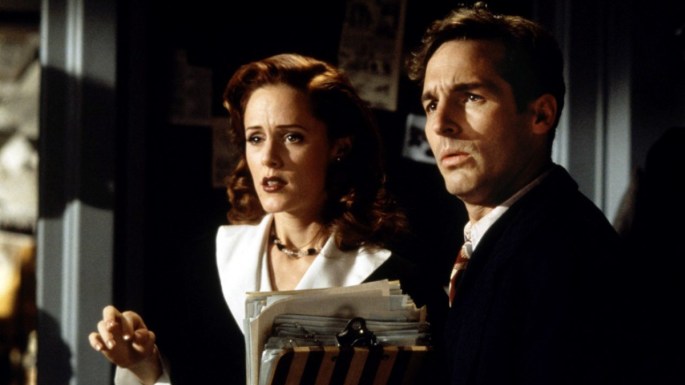
It’s 1939 on the night that WBN radio goes nationwide and the whole station is abuzz with activity. Roger Henderson (Brian Benben) is the head writer and his wife Penny (Mary Stuart Masterson) is an assistant to the director (Jeffrey Tambor). They are forced to deal with an unhappy sponsor who doesn’t like the scripts, unhappy writers who don’t like their working conditions, and unhappy actors with inflated egos. As if that wasn’t bad enough, during the opening musical number the orchestra’s trumpeter dies from a heart attack.
Soon, the station’s director turns up dead as well from an apparent suicide. However, it is revealed that both deaths are actually murders. Radioland Murders starts off as a farcical comedy and gradually mutates into a classical whodunit with no shortage of suspects and with the Hendersons out to solve the case while keeping the radio show going. Roger and Penny are married but their union is in big trouble because she caught him with another woman (the star of the station’s radio programs no less) and hasn’t forgiven him while he claims that nothing happened. To make matters worse, Roger ends up becoming one of the primary suspects and has to rush to clear his name.
Mary Stuart Masterson looks beautiful and is lit like a glamourous 1940s movie star but with screwball tendencies. However, she’s let down by the screenplay and saddled with a miscast co-star in the form of Brian Benben who’s not very funny. His character is a sap and it’s hard to see what Penny sees in him.
The problem with Radioland Murders is that it relies too much on broad, slapstick humor with many of the jokes falling flat. There is also too much going on. The movie gets too busy at times. A stronger director might have been able to handle it better but then again, maybe not because the problems are inherent in the screenplay. The movie is written by four different people and this may explain why it is such a mess. Screenwriting by committee is rarely a good idea.
The vintage big band music and the slick production values are the film’s only highlights. There are even cameos by Rosemary Clooney and George Burns (unfortunately his last film role) but they do little to help this mess of a movie. It’s not hard to see why Radioland Murders failed and why Lucas returned back to the safety of the Star Wars universe. One of his contemporaries, Francis Ford Coppola, also ran into difficulties trying to recreate a bygone era with The Cotton Club (1984). Obviously, people are not particularly keen on revisiting the 1920s and the 1930s, or, at least, the way Coppola and Lucas envisioned it.
B Movie Glory with Nate: An Occasional Hell
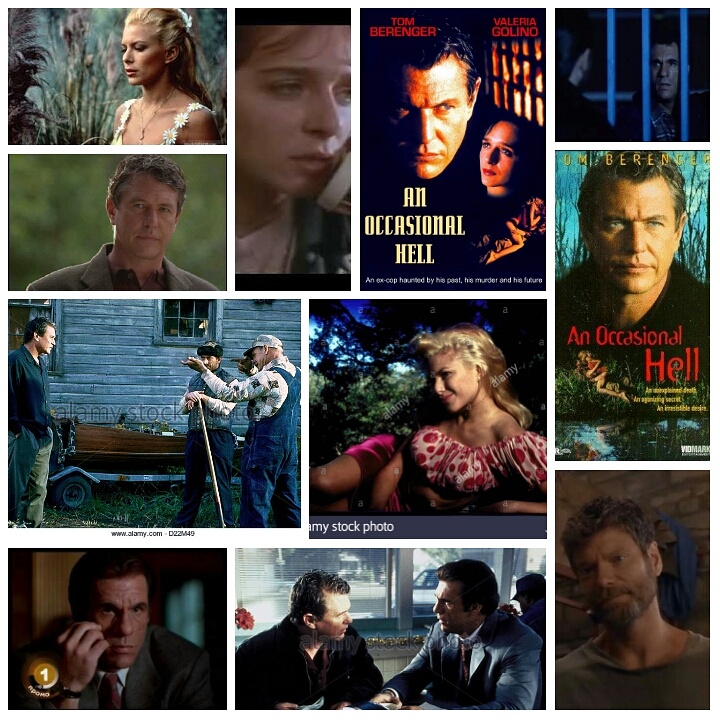
An Occasional Hell is one of countless cable TV crime melodramas that start to blur together if you’ve seen enough. They don’t often have high budgets, and as such usually only contain a few elements: a handful of actors, a murder mystery, deception, eroticism and very little in the way of fancy special effects. This one has a solid lead in Tom Berenger, who can make anything watchable, and great supporting players who pitch in as well. The story, or lack thereof, is where the problem arises. Berenger plays an ex cop and forensics wizard turned college professor, who is hired by sultry widow Valeria Golino (remember her from Hot Shots? Lol) to solve the murder of her husband and his hot young mistress (Kari Wuhrer), who has vanished. It turns out the mistress may have been involved with drug runners (random) the state troopers get involved and it’s all one big mess that neither Berenger nor the plot can seem to figure out. There’s a cynical lead Trooper played by a snarky, laid back Robert Davi, and other assorted people including Richard Edson, Ellen Greene, Geoffrey Lewis and a kooky Stephen Lang, who shows up in flashbacks as Golino’s eccentric civil war enthusiast husband. None of it makes all that much sense or seems to flow in a way that’s believable, but Berenger makes it somewhat worthwhile, as do that other players. Just below average stuff.
The Men Who Stare At Goats: A Review by Nate Hill
Stephen Lang Week: Day 2
There’s a scene early on in The Men Who Stare at goats where hapless General Dean Hopgood (Stephen Lang) attempts a platform 9 & 3 quarters style sprint towards a solid wall, in attempt to use ‘psychic abilities’ he is being taught at a hush-hush military base. He smashes headlong into it, and in the most deadpan drawl, mutters “damn” in all seriousness. This one moment sort of sums up the absurd vibe that thrums throughout the whole film. It’s kind of like a Coen Brothers thing; you either get it or you don’t. This film isn’t quite as hilarious as it’s sister, Burn After Reading, but damn if it doesn’t try, and come out with some really weird and memorable stuff. It’s colorful hogwash that the cast sells with the enthusiasm of a drunken used car salesman, and speaking of cast, wow there are a lot of heavy hitters playing in the sandbox here. George Clooney, in yet another of his patented lovable goof roles, plays Lyn Cassidy, a former US Army nutjob who claims to have been a part of a clandestine program called the New Earth Army, employing paranormal powers in their missions. Bemused journalist Ewan McGregor is shanghai’d into following him on a mad goose chase to find out if any of his stories are true, but mostly just to babysit him, as he’s kind of a walking disaster. Ineptitude reaches a breaking point when we meet pseudo hippie Bill Django, played by Jeff Bridges who channels every other oddball role he’s done for maximum effect. Bill headed up the program until he got stymied by opposing official Larry Hooper (Kevin Spacey), a tight ass skeptic with no patience for such silliness. In fact, one must have a huge tolerance for such silliness to sit through this, and a sense of humour just south of normal to appreciate what it has to offer. I have both, and greatly enjoyed it, despite being thoroughly bewildered. Watch for Stephen Root, Glenn Moreshower, Rebecca Mader, Nick Offerman and good old Robert Patrick in a cameo as some sort of vague spy dude. A clown show to rival a high school play, no doubt, and I mean that as a compliment.