Bang, a film by Ash. It’s a tough one to find, but it’s a scrappy little treasure trove of a flick. It’s a guerrilla film in the sense that the filmmakers had no permits, schedule, a puny budget and a barebones script which is mostly hijacked by wicked improv thanks to the cast. This seat of the pants storytelling technique doesn’t exactly ensure a wide distribution of any efforts in marketing, but they managed to pull of one of the most galvanizing, unpredictable and emotional films of the 1990’s, as far as I’m concerned. On a bright sunny morning in Beverly Hills, a young Asian American actress (Darling Narita in an arresting, pulverizing debut performance) heads to a make it or break audition with a hotshot Hollywood producer (David Alan Graf), who turns out to be an outright scumbag rapist, leaving her distraught and afraid. Her only friend seems to be Adam (Peter Greene), a ra,bun riots and slightly unstable homeless man who valiantly defends her by trashing every garbage can on the block, handling the arrival of a motorcycle cop (Michael Newland) who chases our heroine down, and attempts to persuade her into sucking him off as an exit to vandalism charges. Her fuse reaches its end and all of a sudden she overpowers him, take his gun and clothes and assumes much feared mantle of the LAPD. From there on in its a surreal odyssey of crime, mistaken identity, personal awakening and a riveting exploration of what makes a person powerful, what it takes for a woman to gain respect in a cutthroat city where misogyny runs rampant and unchecked, and ultimately how a downtrodden individual can regain their footing through the most traumatizing of encounters. It’s like baptism by fire, only the fire comes from the end of the police issue handgun she never wanted, and the baptism from the death it’s deals out in the extreme circumstances she finds herself in because of what the uniform, the symbol, represents. Narita is a startling wonder, attacking each scene with renewed intuition and never missing a beat. Greene is a rare revelation; he almost always plays nasty psychos, and here is given a shot at the eccentric loony toons style character that would usually be given to to Jim Carrey or Robin Williams. He shows what a talent he is as everyone’s favourite livable bum, displaying a gift for improv and off the cuff performing. Narita and him have an unforced friendship that blossoms early, ebbing and flowing as both find a modicum of solace within each other’s company that is periodically broken and reunited. Watch for Lucy Liu as a reprehensible young hooker as well. Ebert sung this ones praises when it came out.. No one heard. I imagine because of its extremely indie nature. It’s worth seeking out for the important message it brands upon the viewer, it’s frank and very candid approach, and it’s rabbit hole glance at one woman in trouble, navigating a zone out of her depth in an unchosen guise. One of the best films of the 90’s.

Tag: movie review
Rain Fall: A Review by Nate Hill
Rain Fall, like the meteorological event of its namesake, came and went with little fanfare when it was released. Based one novel in a series by Barry Eisler, it follows John Rain (Kippei Shina), a Japanese assassin for hire who becomes deeply embroiled in a hunt for a mysterious flash drive, the contents of which could have nasty consequences if released. Between the Yakuza, Japanese government and the CIA, Rain has his plate full, especially when he has to take a young girl under his wing who is in danger from all factions involved. Gary Oldman makes twitchy work playing William Holtzer, the unsavory and corrupt Token CIA station chief. He barks orders like he’s in a Bourne film, bends rules and is a morally blank, ruthless A-hole. Oldman plays him without his usual villainous and eccentric flair, opting for a stressed out, nervy turn which suits the gloomy tone of the film. It is a drab yet exciting affair, the intrigue dimmed down to dull greys and muted gunfights that ebb and flow with a minimal pulse. Shina is awesome as Rain, and seems born to play the spy thriller protagonist. Under the radar is how this one plays it, an atmospheric cloak and dagger outing well worth a watch.
The Chronicles Of Riddick: A Review by Nate Hill
David Twohy’s Pitch Black was a dank, murky horror sci fi that took place inside a claustrophobic killing jar, all the action unfolding on one planet, and over a short amount of time. With The Chronicles Of Riddick, he lifts the lid off that jar, unveiling more planets, characters, creatures and broadening both the scope of what is seen visually and what takes place in the story. What began as a simple human vs. monster survival tale crystallizes into a full blown operatic space saga, and I loved every minute of it. Now there are a lot of people who hate it, and fine for them if they want to live inside such negativity. I was sold after the intro, in which a snarky, canine – like bounty hunter (Nick Chinlund) chases a haggard looking Riddick a across the bizarre, jagged face of a planet that would make the asteroid from Armageddon sweat. This film takes place sometime after Pitch Black, the few survivors scattered across the galaxy. There’s a price on Riddick’s head, which Toombs (Chinlund) intends to collect. Riddick unwittingly wanders into the path of something far more dangerous in his evasive efforts: a powerful, fascist master race known as the Necromongers are cutting a swath through the known universe, converting or killing anyone they find. They are led by the “” (Colm Feore), and commanded by Lord Vaako (another badass character for Karl Urban to another do to his rogue’s gallery), a nasty piece of work who is futher soured by his insidious wife (Thandie Newton). Riddick has encounter with them, as well as an old friend from former times (an all too brief Keith David) and is taken far and away, to a dangerous prison on a planet called Crematoria, where the wrecking ball of a sun fries everything on the surface every half hour or so. It all happens fast (and furious hehe), in a somewhat rushed frenzy of sci fi action, cool effects and surprisingly vicious antics for a PG-13 flick. Diesel was born to play Riddick, a growling night wolf of an antihero and endlessly watchable. There’s all sorts of half Cooke ideas running around, some fun and others left unexplored. There’s a prophecy involving the Purifier (Linus Roache) who has ties to Riddick’s tragic past and the fate of his race, a strange elemental (Judi Dench looking confused), another person from his past (Alexa Davalos) and other intrigue involving Urban. Best to sit back and let it wash over you like the fun it is. Chinlund is hilarious as Toombs, the only character who seems to have wandered in from inner city L.A., a wide ass prick with a hate streak for Riddick and that old school charisma that carries scenes. The set pieces are exhilarating and make up for the plot which is at times spread too thinly, but never hurts the film. I love it, watch it all the time, let the haters sulk… more for us.
John Boorman’s The Emerald Forest: A Review by Nate Hill
John Boorman’s The Emerald Forest is the kind of exotic, intoxicating, wildly adventurous, unbelievable and unforgettable film that comes along once in a decade, if that. These days this sort of film would be gilded to the hilt with unnecessary Cgi, a burden which filmmakers just can’t seem to free themselves from in this age. Back in 1985, they had to use what they had, filling every frame with on-location authenticity, genuine realism which prompts a feeling of wonder and sense of mysticism from the viewer, which any computer generated effort just cannot compete with (I will concede that this year’s The Jungle Book came up aces, so there are a few cutting edge exceptions). This film is quite the undertaking for both cast and crew, and one can see from scene to scene the monumental effort and passion that went into bringing this story alive. It’s also partly based on true events, adding to the resonance. Powers Boothe plays technical engineer Bill Markham, who is living with wife (Meg Foster) and two small children in Brazil, while he designs plans for a great river dam which will allow further development. One day, on a picnic at the edge of the rainforest, his son Tommy disappears, after spotting an elusive tribe of Natives. Gone with no trace but an arrow lodged in a nearby tree, Bill launches a search for his son that spans a decade, returning year after year to probe the vast, untamed jungle in hopes of somehow finding Tommy. Tommy, now a young man and played by the director’s son Charley Boorman, has been adopted and raised by the kindly tribe, known as ‘The Invisible People’ for they way they remain unseen as they move about their home in the forests. Tommy is very much one of them, taken up their customs and traditions, with nothing but vague memories of Bill in his dreams, which he doesn’t believe to have actually happened. One day in the hostile territory of ‘The Fierce People’, Tommy and Bill are reunited, Tommy taking his wounded father to his home village. Bill is heartbroken that his son is essentially no longer his, conflicted by the situation. Tommy has just entered his life as a man, taking a gorgeous wife (Dira Paes) from his village and starting a future. Trouble brews as The Fierce People threaten Tommy’s village, and their women, prompting him to seek Bill’s help. It’s interesting to see how a tribe who have had little to no contact with the outside world react to it, calling it ‘the dead world’ and referring to the developers as the Termite People who cut down the grandfather trees. The environmental message is never preachy, always feeling like a vital and important truth that is organic and unforced, emerging through the characters and their interactions. The Natives possess an innate spirituality and connection to the intangible which we have forgotten as progress alters us, still rooted deeply in forces beyond our 21st century comprehension. Boothe is deeply affecting in one of his best roles, a desperate father through and through, while also filling out the broad shoes of the wilderness adventurer he has become over the years. He fills his performance with pathos, longing and is the emotional soul of the piece. Boorman is spry and takes up the aura of Tommy well, mastering the complex linguistics and mannerisms of the tribe admirably. One of my favourite aspects of the film is its exquisite and moving score, the main theme evoking wild romanticism, old world secrets and the unending beauty of nature so well that one feels goosebumps as if we’re really there in that setting. Pure cinematic magic, a timeless story told without flaw or hitch, and a breathtaking piece of film.
B Movie Glory with Nate: Wyvern
As far as SyFy Channel flicks go, Wyvern is a really not bad little effort, kind of like North Of 60 meets Reign Of Fire. It concerns a group of people in a small Alaskan town who come across an ancient beast called a Wyvern, which is basically a winged serpent dragon that breathes fire and causes all manner of havoc for the local residents. The melting ice caps have caused a great thawing, in which this creature has been freed from its icy prison, now roaming the land, barbequing livestock and being a great big nuisance. Local trucker Jake Suttner (Nick Chinlund) bands together with rowdy outdoorsman Hass (Barry Corbin), Claire (Erin Karpluk) and eccentric ex army curmudgeon Colonel Travis Sherman (Major Briggs himself, the late great Don S. Davis). It’s a pleasent affair as far as horror/sci fi flicks go, with likable characters, not too much gore or unpleasantness, and that small town vibe of comfort that helps you care for the people in such a silly movie. One of SyFy’s best in recent years.
The Onion Movie: A Review by Nate Hill
That’s right, the Onion News Network made a movie, back in 2008, and it’s every bit as irreverent, satirical and wantonly bizarre as you would imagine. They have been comically killing it for years with their online platform, and the film is a nice extension of that. It’s episodic, meandering and devoid of plot, made up of many little sketches and vignettes, some gut bustingly funny, others just plain odd. I have three favourites which pretty much sum up their inane, Monty Python type shtick: An out of work actor named Bryce Brand (Nick Chinlund is priceless I just a few minutes of screen time) arrives back home from drug rehab and is hounded by his agent to nab new scripts. He promptly falls into a weird new addiction that gets slapped sillily onto the headlines, thus ending his arc with deranged efficiancy. Steven Seagal shows up as a fat slob of an action hero aptly named ‘The Cock Puncher’, a lumbering buffoon who punches people in the cock, naturally. The third, and funniest sequence features a riff on the celebrity roasts of the 60’s, with some kind of amazing group of crusty old crooners hurling stinging and incredibly raunchy insults at each other with the subtlety of a sledgehammer. It’s tough explain just how funny that bit is in a review, but suffice to say it had me roaring as loud as the obscene bunch of wrinkled baboons in the in the skit. There’s a plethora of other sequences which I’ve since gotten hazy about, but I remember many other instances of pure hilarity to be had. Watch for further celebrity appearances including Eric Stolhanske, Michael Bolton, Richard Fancy, Daniel Dae Kim, Brendan Fletcher, Rodney Dangerfield, Joel McHale and more. Side splitting stuff, if you’re into this type of humour.
B Movie Glory with Nate: Unspeakable
Unspeakable revels in its southern fried trashiness, pulling forth a lurid and grotesque pseudo mindfuck serial killer story that I don’t recall making a whole lot of sense, yet is still barrels of fun to behold the seasoned cast play out. The film’s writer, Pavan Grover, also stars as Jesse Mowatt, a mysterious serial killer with ties to the occult who frames an innocent Mexican migrant (Marco Rodriguez) in several horrific murders. When a scientist (Dina Meyer) uses an experimental mind mapping and truth seeking method on the wrongfully accused man, she is led to Mowatt via some dodgy telepathy. To be sure that Mowatt is guilty, she tries the same method on him and comes across readings that suggest he may be not only inhuman, but altogether unspeakably evil. The gung ho, sadistic prison warden Earl Blakely (a hopped up Dennis Hopper) is ready to pull the switch, but Meyer wants more time to examine Mowatt. Her colleague and mentor Jack Pitchford (Lance Henriksen) advises her against it, sensing the evil. She appeals to the state Governor (a brief Jeff Fahey) who happens to be her former lover, but he is unyielding. Her curiosity towards Mowatt puts her in grave supernatural danger, as Mowatt leers from the shadows of his cell and causes all sorts of unexplainable havoc. It’s a B movie thrill ride through and through, the plot barely registering to the viewer beyond the shock value tactics it employs, mainly giving Grover and Hopper scenery to voraciously gnaw on. In fact, Hopper is so rabid in one particular sequence it makes the viewer question whether the director just told him to ‘go full retard’. I enjoyed it for the actors, all of which I greatly admire. It’s schlock, of the marginally nonsensical variety. As long as you go in with that pre-notion, you can’t blame me for the reccomendation. At least the startling instances of gore are guaranteed a spike in our pulses.
Felon: A Review by Nate Hill
Felon is a bitter,and tragic prison drama that’s packed with wrenching injustice, simmering anger and caged animal violence. Loaded with the kind of tough guy elements which make prison films exciting (check out Lock Up with Stallone), it’s also has a tender side brought forth by its extremely thoughtful and well written script, which explores ideas that are both hard to swallow and very sad. Stephen Dorff, a guy who already has the gritty look as soon as he walks into a frame, plays Wade Porter, a simple family man who is just starting out at life along with his wife (Marisol Nichols). Their hopes and dreams turn into a nightmare, however, when a violent intruder breaks into their home one night. Wade strikes out in defence of himself and his wife, accidentally killing the criminal. Because of the backwards ass way the States run things, he is accused of manslaughter and sentenced to serve out jail time. He is then thrown into the dog pit, literally and figuratively. The penitentiary he is sent to is run by sadistic and corrupt Lt. Jackson (Harold Perrineau) along with his brutal enforcer Sgt. Roberts (Nick Chinlund). Jackson organizes vicious fight club style matches between the inmates, totally off the books and beyond any correctional legislations. Wade is forced to adapt, adjust and bring out monstrous aspects within himself to survive, and make it through his sentence with both his life and humanity intact. It’s not an easy turn of events to watch unfold onscreen, but necessary in the sense that this probably happens quite frequently to people in real life, and should be seen. The only solace Wade finds is with his gruff, veteran cell mate John Smith (Val Kilmer) a lifer who once went on a massacre of revenge against individuals who murdered his family. Smith is his guiding light, steering him through the hellish carnage of what he’s forced to do and helping him to keep the candle of compassion alive within him, never losing sight of what is essential in his fight to claim his life once more. Kilmer is a force that will knock you flat in this role, an old bull with dimming fury in his eyes, a man with a bloody history that has forged the weary dog we see in the film. Late in the film he has an extended monologue to Wade, giving him both blessing and advice with some of the most truthful and affecting gravity Kilmer has showed in his career. The writer/director, who appears to be primarily a stuntman, should be commended for such a script, that could have easily been a straight up prison flick without the pathos that drips off its heartstrings. We as an audience view this painfully and prey nothing like this ever happens to us or anyone we know, hoping to see a light of hope at the end of the dark tunnel for Wade. I won’t spoil it, but it’s worth the hit that your emotions will take while watching, and there is hard earned catharsis to be had, and penance for the characters you want to shoot in the face along the way. The extends to brilliant work from Chris Browning, Anne Archer, Nate Parker, Johnny Lewis and a fantastic Sam Shepherd as another seasoned convict. This was correct to video as I recall, which is a crime. It’s up there as my favourite prison set film that I’ve ever seen, a soul bearing piece.
ROCK ‘N’ ROLL HIGH SCHOOL – A REVIEW BY J.D. LAFRANCE

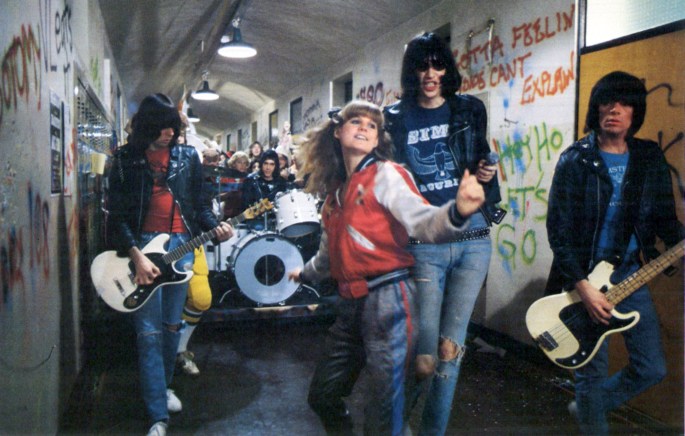
Hey Ho! Let’s Go! Listen up, kids. Rock ‘n’ Roll High School may have been released way back in 1979 but it still kicks the ass of any of those square MTV movies. Forget about Britney Spears and Mandy Moore’s brand of bubblegum pop music and their equally bland movies – they don’t hold a candle to the unbridled power of those punk rockers from New York City… the Ramones! Making a band the central focus of a film is nothing new. The Beatles did it with A Hard Day’s Night (1964) and The Monkees with Head (1968). Hell, the Spice Girls even did it with Spice World (1997). But to do it with an anti-social punk rock band like the Ramones?! And to have it produced by legendary B-movie mogul Roger Corman?! The results: a cult classic in the proud tradition of juvenile delinquent films of the 1950s.
Riff Randell (P.J. Soles) is the ultimate Ramones fan. She’s introduced gleefully bypassing Vince Lombardi High School’s PA system so that she can blast “Sheena is a Punk Rocker” to the entire school population. The energetic song wakes up the students, shatters glass, and shakes tables and pictures right off the wall. The school erupts into complete anarchy as the student body begins to spontaneous dance to the boisterous rock ‘n’ roll music. How kick ass of an opening sequence is that? It also does a great job of conveying the excitement and energy of the Ramones’ music.
Riff dreams of meeting the Ramones and giving them a song she wrote entitled, “Rock ‘n’ Roll High School.” She tries it out on her gym class causing all the girls in their skimpy gym outfits (ah, Corman and his exploitation tendencies) to dance around in what can only be described as the greatest gym class ever.
Riff even camps out for days to get tickets for the Ramones’ upcoming concert while her best friend, Kate Rambeau (Dey Young) covers for her by telling the nasty, shrewish Principal Togar (Mary Woronov) that various members of Riff’s family have died. Not surprisingly, Togar doesn’t fall for it and takes Riff’s ticket away, forcing the two girls to find another way to meet their heroes. Meanwhile, good girl Kate has a major crush on the school’s quarterback, the bland Tom (Vincent Van Patten), but he has his sights on the dynamic Riff.
The film was originally called Girls Gym, then it was changed to Disco High by Corman, who wanted to capitalize on the disco craze, but was (fortunately) persuaded otherwise by director Allan Arkush. Originally, the filmmakers wanted Devo and then Van Halen before approaching the Ramones. They finally settled on Rock ‘n’ Roll High School after Arkush convinced Corman that the Ramones were the perfect band for the film. To their credit, the Ramones knew that it was the right move. Guitarist Johnny Ramone was a huge fan of Corman’s films and when he heard that the producer was behind the film, he agreed to do it. And the rest, as they say, is history.
Rock ‘n’ Roll High School does a great job of playfully championing the Ramones as rock gods and yet shows them being accessible to their fans as well. The band first appears in a car driving down the street on the way to their venue as they play “I Just Wanna Have Something To Do.” Once outside the club, they get out of the car and interact with the crowd of ticket buyers (who were, incidentally, actual Ramones fans). The editing, coupled with the insanely catchy song, gives the scene an infectious energy that is so much fun to watch. Incidentally, Dean Cundey was the film’s cinematographer and he would go on to shoot some of John Carpenter’s best films, including Halloween (1978) and Escape from New York (1981).
From B-movie veterans like Paul (Eating Raoul) Bartel and Mary (Death Race 2000) Woronov to newcomers (at the time), P.J. (Halloween) Soles and Dey (Strange Invaders) Young, the entire cast has a lot of fun spouting the film’s wonderfully inspired cornball dialogue (“If you don’t like it, you can put it where you the monkey puts the nuts,” Riff says defiantly to Togar at one point) courtesy of National Lampoon magazine writers Richard Whitley and Russ Dvonch. I would be remiss without also mentioning the presence of Corman regular Dick Miller (as a cop) and Clint Howard who plays matchmaker for Tom. The Ramones are good sports and mumble their way through the film and truly come alive during the music sequences like the pros that they are. This film rightfully cements their reputation as legends.
Shot in only 15 days (which, when you think about it, is entirely appropriate for this kind of film), Rock ‘n’ Roll High School embodies the essence of the punk rock music that made the Ramones famous. The film is bursting with youthful energy, a dose of good ol’ fashion anarchy, and is loads of fun to watch. These are also the ingredients that made Rock ‘n’ Roll High School a cult film. Corman cannily marketed it as a Midnight Movie in the hopes that the same people who flocked religiously to The Rocky Horror Picture Show (1975) would come to see the Ramones. It was a modest commercial success upon its initial release and actually garnered critical praise – very unusual for a cult film.
While Rock ‘n’ Roll High School will appeal predominantly to fans of the Ramones (duh!), it is also one of those fun, goofy movies to invite friends over and watch with copious amounts of junk food on hand. This film is all about loving music and a particular band unabashedly. Riff gives herself up to the music and this translates into an enthusiastic celebration of the Ramones and the rowdy, rebellious spirit of rock ‘n’ roll music. Repeated midnight screenings, coupled with steady appearances on T.V., have helped the film endure over the years so that is has become a beloved cult classic.
Antoine Fuqua’s Tears Of The Sun: A Review by Nate Hill
Antoine Fuqua’s Tears Of The Sun is a brutal, tough war machine of a flick in the tradition of the old 70’s war films, kind of like a brooding Dirty Dozen. Bruce Willis stoically heads up a team of special ops soldiers who are sent into a war torn region of Africa to rescue a doctor (Monica Belucci) from a missionary camp. Genocidal maniacs are encroaching into the area and it’s no longer safe for locals or relief workers. His orders are simple: locate and extract the doctor, and no one else. However, when he comes face to face with the refugees, and their situation, he simply can’t find it in himself to turn his back on them when he can do something to help. He then disobeys his orders, collects both his team, Bellucci and the Africans and makes a run through the jungle for diplomatic protected soil. His team are a grizzled band of warriors, each with their own unique qualities and opinion on his decision. Kelly (a badass, mohawk adorned Johnny Messner) believes it’s too much of a risk, and not their concern). Michael ‘Slo’ Slowenski (Nick Chinlund, excellent and understated) takes a compasionate standpoint. Second in command Red Atkins (Cole Hauser) trusts Willis is making the right call. Soon they are pursued by the extremists, led by a hulking Peter Mensah, before King Leonidas kicked him into the Sarlak pit. The combat scenes are hard hitting, seemingly very well rehearsed and researched. The only problem for me was the overbearing and extended sequences of genocide, which are harrowing and quite tough to watch. When it’s combat based it’s a damn fine piece, with a rugged, thoughtful band of heroes who are an absolute joy to see in action. Rounding out the team are Eamonn Walker, Charles Ingram, Paul Francis, Chad Smith and a briefly seen Tom Skerritt as Willis’s commanding officer. Tough, muscular and no nonsense, with burgeoning compassion that gives that soldiers purpouse beyond the cold lethality of the mission. Fuqua has a terrific collection of lean and mean action flicks under his belt, and this is one of the best.