Perrier’s Bounty tries hard to be as pithy and witily profound as In Bruges, but doesn’t quite manage the task. To be fair, Bruges is a masterpiece and a Goliath of a script to aspire too, but this one has its own brand of scrappy crime fun, full of enough beans to keep the viewer jumping for its slight running time. Few films can boast narration provided by the Grim Reaper, and fewer still can say that said Reaper is voiced by Gabriel Byrne. But indeed, Byrne beckons us into this violent fable with his patented tone, both baleful and quaint. The fable in question concerns Michael McCrea (Cillian Murphy) an irresponsible young Irish lad who is seriously bereft of both luck and common sense. He lives in a small town in northern Ireland and owes a hefty loan to local crime lord Darren Perrier (Brendan Gleeson). Because of how tiny the town is, it’s pretty easy for Perrier’s goons to find and engage him in a road runner goose chase all about the area, forcing him to scoop up his on and off girlfriend (Jodie Whittaker), and head for the hills. He’s also joined by his uber eccentric father (Jim Broadbent) who believes that the Grim Reaper has visited him at night and given him the alarming prognosis that he will die the next time he falls asleep. Broadbent is a solid gold asset to any film he’s in, and practically spews perfectly timed comic banter non stop. Michael thinks he has a way out of trouble with local petty thief The Mutt (Liam Cunningham, aka Ser Davos Seaworth, also a comedic treasure here), which turns out to be another notch in the belt of bad judgment. Meanwhile, Perrier’s crew reels after one of their slain thugs (at Michael’s hand) turns out to have been involved in a love affair with another, who now has the wrath of vengeance in his eyes. There’s a scene where Gleeson comforts the bereaved hoodlum and seems deeply wounded at the couple’s reluctance to tell him of their love. Gleeson assures them he has no issue with homosexuality and wishes they would have shared with him. In the context of hardened criminals out for blood, this kind of exchange is priceless and brings rigid archetypes right down to earth, for maximum hilarity and well earned pathos. The film meanders a bit, but never out ran my attention span, following through with it’s story in ways both welcomingly bloody and predictably quirky. It doesn’t add up to anything life altering when all is said and done, but damn if the things which are said and are done along the way aren’t just pure genre entertainment, inducing chuckles, thrills and nostalgia for other films withing the niche. In the troupe of writers who look up to Guy Ritchie, Quentin Tarantino and Martin McDonough, this scribe is on to something. Keep an eye out for Lord Varys, Roose Bolton and a young Domhall Gleeson too.
Tag: movie review
Harlan County War: A Review by Nate Hill
Harlan County War is a rare little TV movie that takes a partly fictional look at the union wars in rural Kentucky during the 1970’s, when a plucky band of coal miners and their wives took to the picket line in attempt to establish better working and living conditions. The story and title of the film have roots in the union wars of the 1930’s, which set the stage for this tale. Holly Hunter plays Ruby Kincaid, wife of Silas (Ted Levine) a miner who suffers through the harsh labor everyday. The townspeople are tired of the injuries, the deaths and the deadly black lung infections, and are given reluctant hope when compassionate union official Warren Jakopovich (Stellen Skarsgard) arrives to their county, promising change. Many locals are skeptical due to past corruption and disloyalty, but soon the company gets nasty and they realize that Jakopovich may be their only chance. Hunter is as fired up as she always is, her accent thicker than the moonshine everyone swills. I tracked this film down for Levine (Skarsgard too), and this is one of the best roles he’s ever gotten. He’s usually in character parts like the violent thug, stern general, gruff cowboy or yes, the skin stealing serial killer. Here he’s just a plain rural family man, a good hearted fellow who wants the best for his kin and county. Levine works wonders playing it straight here and I wish he’d get thrown more meaty and down to earth roles like this. Skarsgard can jump between being the most terrifying psychopath to the most comforting, sympathetic characters, and plays Jakopovich with compassion and dogged determination. The character building scenes between the three actors is brilliant. I feel like there’s a longer edit out there somewhere, because it jumps a bit and forgets to address one plot turn entirely, but alas it’s a tough one to affordably track down and this is the only version I could get. It’s made for TV and that shows at the seams sometimes, but it’s still solid drama about something important, and crafted very well.
The Fifth Patient: A Review by Nate Hill
The Fifth Patient is a super awesome amnesia thriller, in the tradition of The Bourne Identity. It stars Nick Chinlund (in one of his rare lead roles) as John Reilly, an american who awakens in a remote rural hospital somewhere in Africa, with no memory of who he is, how he got there or what’s going on. A local military official (Isaach De Bankolé) interrogates him, believing that he works for the CIA. He has several visitors including a woman who claims to be his wife (Marley Shelton) and a former colleague (Henry Czerny). Gradually he pieces together the fragments of his damaged mind and suddenly has memories of being involved in a terrorism plot, planting seeds of doubt and causing him to suspect he isn’t who they think he is at all. Now all he can trust are his instincts, wary of everyone around him and unsure of his own past. It’s a serpentine story with hefty work from Chinlund who handles all facets of the character superbly, including some third act surprises. Sometimes these type of thrillers fall apart at the seams in the conclusion, tripping over the rug they’re trying to pull out from the audience in terms of plot points. Not this one. It’s well constructed and makes concise sense of its story right up to the last frame. Also watch for work from Brendan Fehr, Olek Krupa as a mysterious russian prisoner and the great Peter Bogdanovitch in a nearly unrecognizable turn. Now, I’m fairly certain that this one was never officially released back in 2007, because you literally cannot find it anywhere, it doesn’t have a legit poster and even seems nonexistent in some databases. Years ago it popped up on Netflix canada for about a month, thus ending my tedious quest to see it. You’d think that such a solid film with the prolific actors in it would have been treated better, but for one reason or another, it’s been forgotten. Hopefully one day a distributor will pick it up, because it’s quite the well made, entertaining thriller with a crackling lead performance.
Undertaking Betty: A Review by Nate Hill
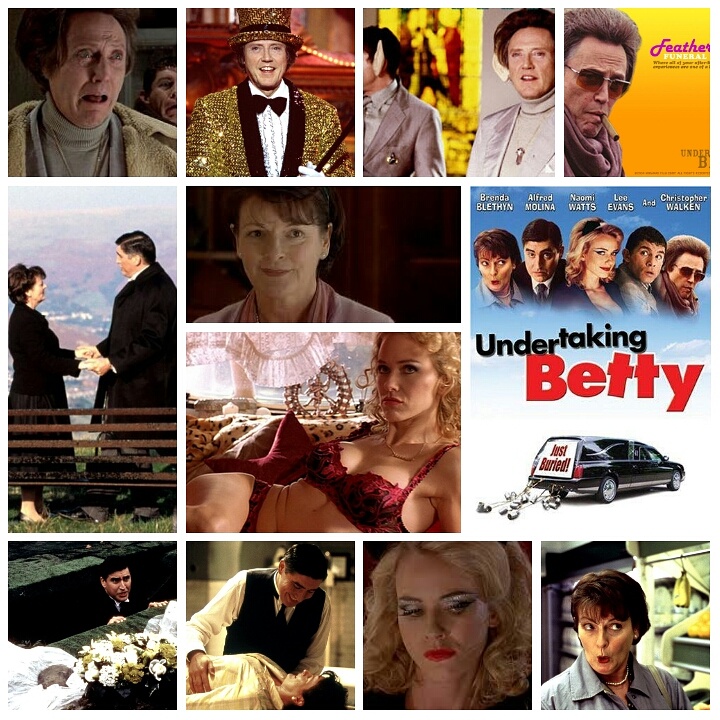
Undertaking Betty (or Plots With A View, as it’s called in the UK) is British black humour at its most brilliant, hilarious and surprisingly touching, in the tradition of stuff like Waking Ned Devine and Monty Python. It’s carefree and harmless but not without a raunchy sting that can’t help but be met with loving reception due to its charm and top drawer silliness. Brenda Blethyn plays a woman who has spent thirty years of her life in a small Welsh town, married to an absolute pig of a man (Robert Pugh). He’s a sleazeball who is shagging his slut of a secretary (Naomi Watts in full gumball sickening skank mode). Blethyn is secretly in love with the local undertaker and mortuary owner (Alfred Molina), the romance sparking up as the two try to find a way to get her away from Mr. Awful husband. Molina has the brilliant idea to fake her own death, letting her off the hook and allowing them to elope. She’s willing but reluctant, and so they proceed. Only one problem: Molina isn’t the only funeral outfit in town. Garish eccentric Frank Featherbed (Christopher Walken) and his peevy associate (Lee Evans) owns his own business and plans to steal Blethyn’s funeral for his own. Walken dials up the kook factor to the maximum and is pure genius, an entertainer at heart who believes that every funeral should have the showmanship and dazzle of a broadway show, leading to some amusingly awkward scenes. Just the fact that an american Chris Walken is working as a funeral home director way out in rural Wales is enough to bust a gut, let alone his off the wall performance. The resolution reaches comic heights that made me truly query why this film’s praises weren’t sung to high heaven upon release, but such is life, and death. The romance between Blethyn and Molina is sweet, endearing and balances out the larger than life sense of humour that the film keeps tossing around like confetti. Walken fans, dark comedy fans, film fans alike…please check this out.
David Twohy’s Below: A Review by Nate Hill
David Twohy’s Below cleverly combines two genres which seem to be made for each other, yet had never met up until this film. The atmospheric ghost thriller goes on an underwater ride with the submarine film for quite the unique and eerie experience. Strange occurances happen aboard a US army submarine during a routine WWII patrol mission, starting with the rescue of several stranded British castaways from a decimated ship, including Olivia Williams and Dexter Fletcher. The Captain (Bruce Greenwood) attempts to keep his crew calm, but apparantly it’s bad luck to have a woman onboard and soon uneasiness creeps in amongst them. There’s a mystery about their quarters as well, involving the supernatural, and pretty soon crewmembers are seeing, hearing and reporting eerie stuff, which adds to the tension. The crew is rounded out by an eclectic bunch of actors including Nick Chinlund, Holt McCallany, Matthew Davis, Christopher Fairbank, and Zach Galifianakis as a guy named Weird Wally who really lives up to the name. There’s some spooky moments, high drama between the cast which they pull off well, and a twist ending that explains the ghostly elements. Underrated stuff.
The Hunger Games: A Review by Nate Hill
I have never read the Hunger Games books, and didn’t rush out to see this first installment when it was released. I have this thing where I sometimes resist a largely popular project simply because it’s buxzingwith so much hype. There’s a word for that that I resist even more, which starts with H, but good luck getting me to admit to that. Anywho, I did watch it one day on netflix, loved the hell out of it, and have seen every subsequent entry, up til last year’s final one. It’s damn great storytelling that soars on a brilliant extended performance by Jennifer Lawrence, who is the actress of her generation and a genius of the craft no matter what anyone says. People called this a slick version of Battle Royale, and while that may be true, it’s certainly not a bad thing, and not the sole extent of what the franchise achieves. There’s stinging social commentary which both condemns and makes satirical light of modern North American culture. It examines the power of propoganda for both good and bad ends. It looks at the abuse of power, and the potent rise of fascism and fear tactics, and how quickly they can become commonplace. And this is all in a young adult orientated film that stars a strong, unhindered female protagonist. Gives you hope for the world. Lawrence is powerful as Katniss Everdeen, a young woman chosen from her district to compete in the much celebrated and very violent Hunger Games, a death tournament which serves as a purge and reminder to the citizens what it cost them to rebel against their oppressors years before. This is all at the behest of mega villain President Snow (Donald Sutherland oozes quiet malice with every articulate and icy syllable), who lives in the wealthy and decadent capitol city of Panem, a dystopian version of North America. Along with Katniss there’s also Peeta (but no hummus) a local baker’s boy played by Josh Hutcherson, who really struggles to match the skill level of almost everyone around him, especially Lawrence. They are thrust into the posh and stylized razzle dazzle of Capitol life as they train for the ruthless games, watched over by previous Victor and proud alcoholic Haymitch Abernathy (Woody Harrelson), as well as preening diva Effie Trinket (Elizabeth Banks channellig Marie Antoinette crossed with a poodle). The film takes some time to ramp up to the games, but as soon as it does the events unfold in breathless fashion set against a lush wilderness background, each and every member fighting tooth and nail to stay alive against both each other and the obstacles which gamesmasters have placed in their way. Anyone with an intense fear of wasps will want to be warned. A clever riff on the talk shows of our climate is shown, as the competitors are quizzed by Ceasar Flickerman (Stanley Tucci) a manically hopped up pop personality with a hairstyle that would make a samurai jealous and teeth so white they get accused of stealing oscar nominations. Tucci is truly a well of energy and the proceedings go electric whenever he’s around. Watch for Paula Malcolmson, Liam Hemsworth, Wes Bentley, Toby Jones and Lenny Kravitz as Cinna, a kindly fashion guru who takes a shine to Katniss and designs her a dress to end all dresses. Lawrence carries the entire thing on her mockingjay wings, making Katniss a spirit of unrest, a true symbol of hope and above all, a scared girl tossed into events she can’t possibly imagine navigating. Her performance is most of what makes these films so solid, and they couldn’t have made a better casting choice. Be sure to stay fpr the credits to hear ‘Abraham’s Daughter’, a fittingly grandiose original song by Arcade Fire.
Spotlight: A Review by Nate Hill
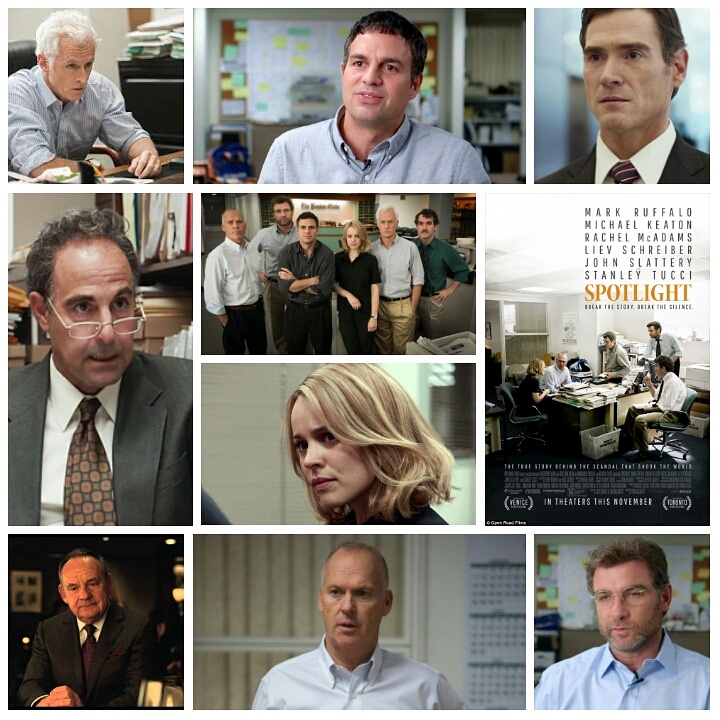
Spotlight focuses on a devastating turn of events which were ripe for melodrama, and instead turns out to be a spare, minimalistic entry that knows how to keep things close to the chest and still be deeply affecting. Director Tom McCarthy takes a fly-on-the-wall approach to his technique, showing us an intimate glimpse at what it no doubt must have been like for these Boston reporters as they brought to light one of the most sickening and heinous atrocities of our time, the sexual abuse scandal of the Catholic Church, which rotted through many a priest, parish and law firm who insidiously kept their mouths shut about the whole deal. For the reporters, ignorance was just not on the table, no matter what the consequences. Rachel McAdams is tender and fearless as Sacha Pfeiffer, a keen operative who is first to smoke out a lead, bringing it to her boss, the legendary Walter ‘Robby’ Robinson, (Michael Keaton), and the executive in charge of the paper, Ben Bradlee Jr. (John Slattery). The matter is brought to further attention by Marty Baron (Liev Schreiber), who arrives from out of state. It’s Mike Rezendes though, played by a stunning Mark Ruffalo, who drives the point home, refusing to give up and shoving loads of empathy down the throats of those who would look the other way. Ruffalo is note perfect, his determind sentiment delivered with compassion and impact that lingers. He hounds diamond in the rough lawyer Mitchell Garabedian (Stanley Tucci hides the sympathy behind the sass) to allow him access to the victims, giving him something concrete to go on. The bitter side of the lawyer coin comes in the form of Eric McLeish (underrated Billy Crudup), a passively belligerent guy who is anything but cooperative until the hammer comes down. Richard Jenkins proves that he can turn in excellent work with nothing but his voice, playing a source who is heard only via phone calls. Keaton is brilliant, bringing the laid back nature and giving the character an easy listening style Boston accent. McAdams mirrors the hurt in those she interviews with eyes that echo years of suffering. Tucci comes the closest the film gets to comic relief, and then veers into dead serious mode as he realizes his character is in control of lives with the info he has, snapping to rigid attention. Watch for work from Jamey Sheridan, Len Cariou, Brian D’Arcy James and Paul Guilfoyle as well. The film arrives at its destination free from obvious emotional fireworks, on screen text or sensationalism, elements which often permeate true life stories. It’s simple, to the point, grounded and diligent to story, character and truth. That approach makes it all the more shattering.
REALITY BITES – A REVIEW BY J.D. LAFRANCE

The early to mid-1990s was a period of time when popular culture was dominated by Generation X, from films like Richard Linklater’s Slacker (1990) to Douglas Copeland’s book, Generation X to the massive popularity of Seattle music spearheaded by Nirvana. During this decade three films were made that provided a fascinating spectrum of how this generation was depicted. On one end, there was Linklater’s low-budget independent film. On the opposite end there was the glossy, studio picture Reality Bites (1993). Somewhere in between was Singles (1992), which shared the big studio backing of Reality Bites but with the authenticity of Slacker.
I can remember when I first saw Reality Bites, I hated it. I had recently seen and was blown away by Slacker, which felt so authentic. In comparison, Reality Bites tried in vain to capture the essence of Gen-X, but came across more like an episode of Friends. Slacker presented everyday settings with realistic, albeit eccentric people, warts and all, while Reality Bites introduced perfect looking people with perfect problems. Now that some time has passed and the whole Gen-X thing has died down, I see Reality Bites in a different light now. When I think of the film, I think of the videos for “Stay” by Lisa Loeb and “Spin the Bottle” by Juliana Hatfield – the two big singles to come off the soundtrack album. Back in the day, it seemed like those two songs were everywhere. The film is still lightweight material but it has a more nostalgic vibe now as a dated piece of mainstream ‘90s culture. It’s a pretty decent snapshot of that time and reminds me a lot of what I liked about the decade.
Reality Bites also features one of my favorite performances of Winona Ryder’s entire career. She had just come off making several period piece films and was clearly looking to do something contemporary, something that spoke to her generation. She used her star power to pluck an unknown screenwriter out of obscurity and, with the help of Ethan Hawke, got the film made where it would normally have languished in development hell for years. However, Reality Bites was seen as and marketed as a Gen-X film and its supposed target audience wasn’t interested in seeing their lives and interests writ large in a mainstream commercial film. It underperformed at the box office but has since gone on to develop a sizable following. I don’t want to say cult following because it isn’t that kind of film but it does have its fans.
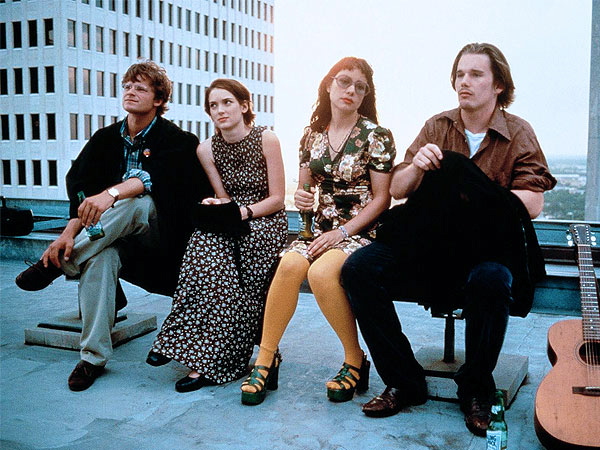
Reality Bites is about four college graduates dealing with life after school as they try to figure out what they want to do with the rest of their lives. Vickie (Janeane Garofalo) works as store manager at a local Gap. Sammy (Steve Zahn) is trying to figure out a way to tell his conservative mother that he’s gay. Troy (Ethan Hawke) is a struggling musician. Lelaina (Ryder) aspires to be a filmmaker and chronicles the ups and downs of her three friends for a documentary about her generation.
Lelaina, like her friends, is a child of divorce and her parents (Swoosie Kurtz and Joe Don Baker) want her to get a regular 9-to-5 job so that she can become a productive member of society. To pay the bills, she works as an assistant/gofer for a morning television talk show called Good Morning Grant! where she caters to the whims of its obnoxious host (played with two-faced gusto by John Mahoney). She’s roommates with Vickie and their friendship is summed up rather nicely in a scene where we see them singing along to Squeeze’s “Tempted” in Lelaina’s car. Who hasn’t done that with their friend(s) at some point in their lives? I don’t mean necessarily to that song but to music in general.
One day, she literally runs into Michael Grates (Ben Stiller), an executive at MTV wannabe, In Your Face TV, when they get into a minor car accident. She finds herself attracted to his inability to articulate a sentence much less a thought and he’s drawn to her nervous, awkward energy. It’s baffling what they see in each other but they’re both young and attractive and start dating. However, when Troy is fired from his day job, Vickie invites him to stay at their place (“Welcome to the maxi-pad.”) until he can find work, much to Lelaina’s chagrin (“That’s the American Dream of the ‘90s. That could take years!”). Me think she doth protest too much (“He will turn this place into a den of slack!”). See, Lelaina has a thing for Troy and he for her but they’re too busy getting on each other’s nerves in a meet-cute kinda way to do anything about it.
Lelaina’s first date with Michael has to be one of the most inarticulate ones ever put on film as they stammer their way through dinner. They each come up with some real gems to woo each other, like he tells her about how Frampton Comes Alive! changed his life while she explains why the Big Gulp is the most profound invention in her lifetime (?!). Maybe these two are really made for each other. As superficial as Lelaina comes across a lot of the time, Winona Ryder, with her adorable presence, keeps me interested and engaged. Away from Michael’s I.Q.-sucking black hole presence, Lelaina seems smarter.
When he’s not spending time pretending he can’t stand Lelaina, Troy writes awful, subpar Beck lyrics and quotes from Cool Hand Luke (1967). While he waits for her to realize that he loves her, he has sex with a succession of not-too bright groupies (one of them is a blink and you’ll miss her, Renee Zwelleger). Vickie also has a revolving door of sexual partners – so much so, that she gets an AIDS test and anxiously awaits the results – her character’s big dilemma that is resolved fairly quickly and a little too neatly.
Ben Stiller, in what was not only his first major acting gig, but also his directorial debut, does a good job of portraying a guy who means well but is so clueless when it comes to things that really matter. He isn’t afraid to come off as an idiot while also hinting that underneath it all Michael does appear to have the best intentions, he just goes about articulating them in all the wrong ways. Troy, on the other hand, is mean-spirited and channels his jealously in vindictive ways, like when he pretends to tell Lelaina that he loves her. The hurt that registers on her face, especially in her eyes, says it all, reminding one of how good a silent actress Ryder could have been if she had acted in another bygone era.
Ryder shows a capacity for comedy in a montage where Lelaina applies for a series of film and T.V.-related jobs featuring brief but amusing cameos by Andy Dick, Keith David, Anne Meara, and David Spade. Watching Ryder try to define irony under pressure always gives me a chuckle as does her interaction with Spade’s condescending burger jockey (“Ms. Pierce, there’s a reason I’ve been here six months.”). She was one of my earliest cinematic crushes and I know I shouldn’t like this film but dammit, she’s in vintage adorable Manic Pixie Dream Girl mode – smart and gorgeous with a vulnerable quality that I find irresistible. Sorry Natalie Portman, Zooey Deschanel and you other Pixie Dream Girls, Ryder is the original – accept no substitutes!
Coming from the world of stand-up comedy, Janeane Garofalo gets some of the film’s funniest lines (“I think I was conceived on an acid trip.”) and delivers them effortlessly like she was born to play Vickie. She also interacts well with Ryder and an even more interesting film would’ve been one where Vickie’s friendship with Lelaina was the focus. Obviously, others thought she had something special and for a brief while, Garofalo flirted with a mainstream film career with The Truth About Cats and Dogs (1996) and The MatchMaker (1997). Out of the four friends the one that suffers most in terms of screen time is Sammy. It often feels like his storyline was reduced so that more time could be devoted to the Michael-Lelaina-Troy love triangle. It’s a shame because Steve Zahn is such a gifted comedic actor with excellent timing and he’s given little to do in Reality Bites.
If I sound a little too harsh on Reality Bites, I don’t mean to be. The film does nail what it’s like to sit around with your friends, get high and comment ironically on old 1970s sitcoms. There is a fun bit where our four friends go out to get junk food and dance spontaneously to “My Sharona” by the Knack. It’s nice to see the normally reserved Ryder cut loose and act goofy. The film’s best scenes are the ones where all four friends are interacting with each other, bantering back and forth in a way that feels authentic and has a relaxed air that only comes from people who have known each other for some time.
In 1991, the producer of The Big Chill (1983), Michael Shamberg wanted to make a like-minded film for people in their twenties. He read Helen Childress’ Blue Bayou, a writing sample from the 23-year-old University of Southern California film school graduate. He liked it and wanted her sample to be the basis for his project. She met with him and told him about her life and friends and their struggle to find work during the recession that had hit the United States at the time. She had used her friends, their personalities and some of their experiences as the basis for her script. Shamberg, along with co-producer Stacy Sher, saw the pilot for The Ben Stiller Show and approached him to direct not act. At the time, Sher and Childress were developing the screenplay and had Lelaina and Troy figured out but couldn’t quite come up a credible character to complete the love triangle.
In February 1992, Shamberg sent Ben Stiller a copy of Childress’ script while he was editing the pilot for a show on Fox. He soon signed on to direct and worked with Childress for nine to ten months, developing her script. He suggested that he could play the third person in the love triangle. Over time, the Michael Grates character changed from a 35-year-old advertising man attempting to market Japanese candy bars in America to a twentysomething executive at a music video T.V. station. Childress and Stiller also changed the structure of the film, with the focus changing to the relationship between Lelaina and Troy while the stories about Vickie and Sammy, which were originally more fleshed out, were scaled back.
Childress and Stiller had a script that could be filmed by December 1992 and began shopping it around to various Hollywood studios all of whom turned it down because it tried to capture the Generation X market much like Singles had attempted to and failed. They finally got TriStar interested and began developing it there. The studio soon put it in turnaround. Childress, Sher and Stiller managed to convince the Film Commission of Texas to fund a location scouting trip to Houston despite no studio backing, no budget and no cast. As they arrived in the city, they got a call and learned that Winona Ryder had read Childress’ script. She wanted to do it and Universal Pictures agreed to finance the film. Coincidentally, Childress had Ryder in mind when she wrote the character of Lelaina.
The previous three films Ryder had made were period pieces and she needed a break. She wanted to do “something about people my age and in my generation growing up in today’s society.” She read Childress’ script while making The House of Spirits (1993) and it made her laugh: “It was very familiar to me – the way they talk, the attitude they have towards each other, the places they go. These were things I could relate to.” It was exactly the change of pace she wanted. At the time, Ethan Hawke’s career was in a rut after the buzz from Dead Poets Society (1989) had subsided. Up to that point, he had been known mostly for playing clean-cut characters and so the role of Troy would be something of a departure for him. Ryder was a fan of Hawke’s work and stipulated in her contract that he would co-star opposite her.
Stiller met Steve Zahn through Hawke as they were doing a play together at the time and was impressed by how funny he was. Zahn borrowed some money from his agent and went to Los Angeles to test for the film. He responded strongly to portraying a gay character coming out of the closet. Janeane Garofalo knew Stiller through their work together on his show and the producers felt that her style of comedy was perfect for the role of Vickie. According Garofalo, it came down to her, Parker Posey, Anne Heche and Gwyneth Paltrow. The studio loved and wanted Paltrow but Ryder liked Garofalo and had developed an instant connection with her.

Ultimately, Reality Bites plays it too safe and veers dangerously close to being a feature-length sitcom by wrapping things up too conveniently. The characters often come across as superficial which tends to undercut the sincerity of the film’s message. Singles and the hilarious short-lived MTV sitcom, Austin Stories, were much more successful in documenting the trials and tribulations of Gen-X. And yet I’m oddly fascinated with Reality Bites, mostly because of Garofalo and Ryder. They play characters that deserve to be in a better film. I always thought that at the end of the film, Lelaina should’ve dumped both guys and stayed single. I mean, look at her options: Michael is a clueless T.V. executive that listens to generic gangsta rap and Troy is a pretentious wannabe musician that screws around with her emotions. Hell, she should’ve hooked up with Vickie, who is funny in wonderfully sarcastic way and digs ‘70s popular culture in a sincerely ironic way. Despite all of its flaws, I still enjoy watching Reality Bites when I just want to turn off my brain and let a film wash over me – junk food for the mind. Films like that have their place, too.
Robert Redford’s The Company You Keep: A Review by Nate Hill
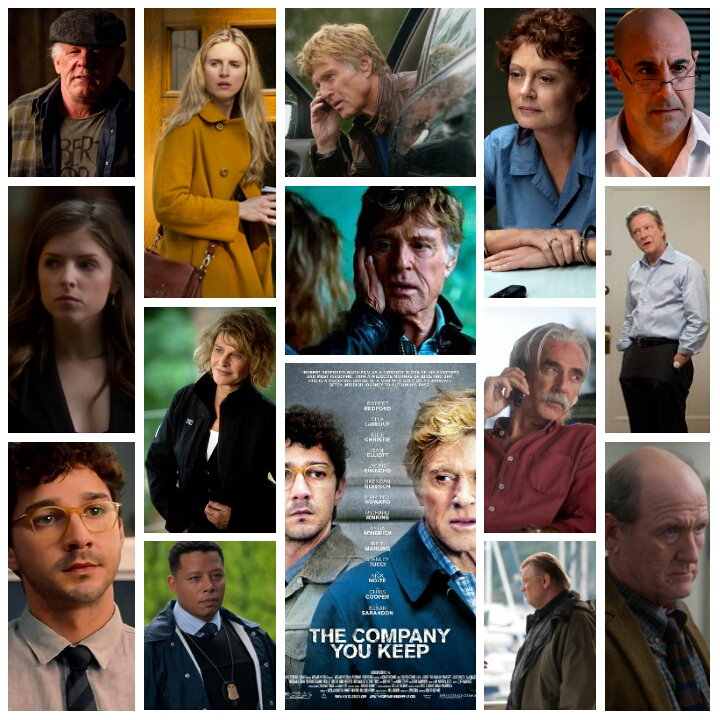
Robert Redford’s The Company You Keep is a powerful, smart, grounded drama revolving around the seriousness of one’s actions, the consequences they may make even decades down the road, and the lengths that some people will go to put things right. Redford has shown only improvement throughout his career, and has been really awesome as of late (All Is Lost was a favourite for me) and he directs here with as much confidence and empathy as he puts into his performance. He plays Nick Sloan, a former underground activist who was involved in a tragic accident as a result of his protesting, and branded a domestic terrorist. He went into hiding for nearly 30 years, until an intrepid journalist (Shia Lebeouf) uncovers traces of his tracks, and he’s forced to go on the run, leaving his young daughter with his brother (Chris Cooper). Lebeouf suspects his agenda is to do more than just hide, and indefinitely stay on the run. A federal agent (Terrence Howard) makes it his tunnel vision mission to find him. Sloan’s agenda only gradually becomes clear to us, as he navigates a tricky, treacherous web of former acquaintances, trying to locate his former lover and fellow activist (Julie Christie, phenomenal in a comeback of sorts). Old wounds are slashed open, the law closes in, and Nick wrestles with the notion that despite the good he tried to do in his idealistic youth, he is indirectly responsible for bloodshed. It’s enthralling to watch Redford play this man in his twilight years trying to put things right, waist deep in decades of acting experience, supported by an amazing script and a supporting cast that you couldn’t dream up . There’s memorable appearances from Stanley Tucci, Richard Jenkins, Brit Marling, Stephen Root, Susan Sarandon, Anna Kendrick, Brendan Gleeson, Sam Elliott, Susan Hogan and Nick Nolte, all in top form. For a thriller that takes itself seriously, takes its time building character and suspense, and sets itself in a realistic, believable tale that completely engrosses you, look no furthe
Easy A: A Review by Nate Hill
The best way to describe Easy A is calling it a wiseass high school retelling of The Scarlet Letter. That can also be a temperature gauge for someone to tell ahead of time if it’ll be there thing, or not. I enjoyed it a lot, thanks to a funny as hell Emma Stone who doesn’t leave out the vulnerability peeking through her guise as strong young woman. It’s a little more relaxed in the content department than some of the bawdier stuff that she got her start in, but still contains sufficient amounts of raunch to please the comedy hounds. Stone also has a veritable army of seasoned pros backing her up, an element which helps her, however she’s quite capable of carrying a film and does so as well. She plays Olive, a spitfire high school girl who finds herself in a funny yet unfortunate situation after her dunce of a friend starts a wildfire sexual rumor about her. Soon the whole school is talking about it, and she takes action in a bizarre move to fight fire with fire…of a certain kind. She boldly takes up the mantle of the school harlot, forever changing things in her quiet serengetti of suburban youth. It all spins wildly out of control, a common characteristic of adolescence, with poor Olive stuck right in the middle of the debacle, which sucks for her but is too funny not to enjoy. Stanley Tucci (“The Bucket List”) and Patricia Clarkson are darlings as her parents, Thomas Haden Church scores points as a deliberately hip and sympathetic literature teacher, and Lisa Kudrow that old flamingo, has fun as a dour guidance counselor. There’s also work from Amanda Bynes as an unhinged religious nut, the perpetually wooden Cam Gigandet, Penn Badgley and a brief cameo from Malcolm McDowell as the world’s most cynical high school principal. As a riff on The Scarlett letter it keeps theme alive, and as a teen comedy with a gaggle of adults trying to keep up with the youngsters, it’s a charmer. Stone holds the proceedings together very well.