What’s The Worst That Could Happen? : A Review By Nate Hill

  
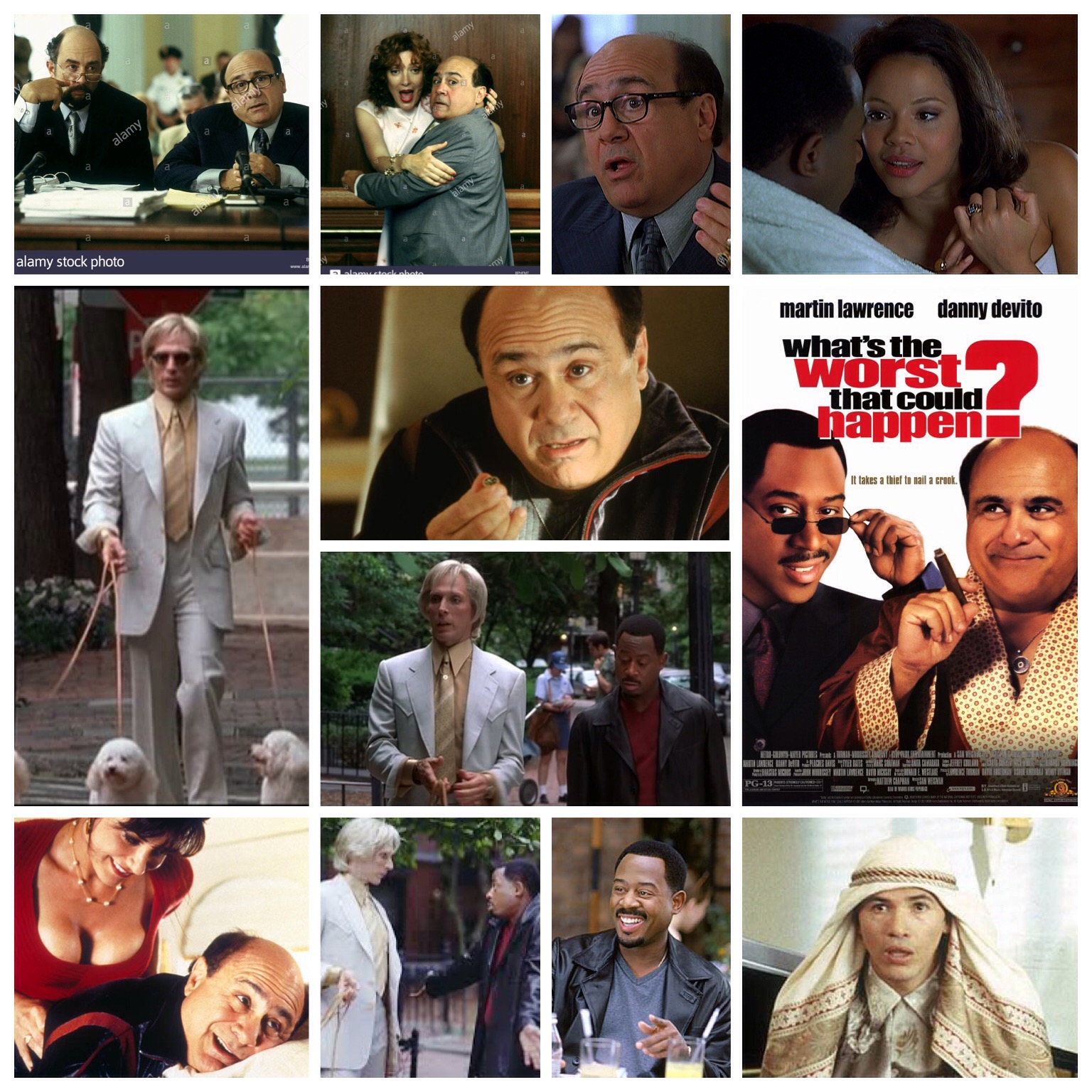
People rag on What’s The Worst That Could Happen all the time. Let em, and screw em while we’re at it. Implausible? Yes. Silly? Yup. Ridiculous? Oh yes. Funny? You bet your ass. It’s one of those lighthearted Martin Lawrence comedies like Blue Streak or National Security, tripping along an alleyway of lowbrow humour and bawdy antics that you just can’t stay mad at, like a friend who does something really dumb and follows up with something that cracks a grin on your face. Lawrence also has the luck to be paired with Danny Devito here, who is funny even when he isn’t trying to be. Lawrence plays Kevin, a cocky cat burglar who bungles the wrong dude when he breaks into the not so vacant summer home of sleazy billionaire Max Fairbanks (Devito). Max catches him red handed, holds him at gunpoint and convinces the cops that a family heirloom ring on Kevin’s finger is part of the stolen goods, adding insult to arrest. That dick move launches an ego fuelled battle of wills as these two morons find more and more elaborate ways to incite each other’s wrath. They each have a little armada who back them up when they aren’t questioning their every idiotic movie. Kevin has his gorgeous girlfriend (Carmen Ejogo has sadly made a career of being underused), his partner Berger (John Leguizamo plays around with accents like you ain’t never seen) who is the Dumber to his Dumb, and his sassy handler (Bernie Mac). Max is hounded by his witchy wife (Nora Dunn), shunned by his much abused attorney (a dry, delightful Richard Schiff), pawned over by his mistress (Glenne Headly) and secretly lusted for by his chief of security (you haven’t lived until you’ve seen Larry Miller do his thang here). Max and Kevin are engaging arch enemies, with Lawrence mugging for face time a tad too much, and Devito perfectly settled into his shtick as always. I must make note of probably the best performance of the film, from William Fichtner as a flamboyantly gay police detective who hounds all parties involved. He’s one part frightening with a side of classy charm, subverting his usual weirdo tough guy image for something even weirder and totally out there. Watch for Lenny Clarke and Siobhan Hogan as as pair of squabbling fellow burglars, and work from Cam Neely, Kevin Chapman and Garry Shandling as well. It’s a screwball caper. I love it. Many don’t. They can suck it. Check ‘er out and make up your own mind. 

William Friedkin’s Killer Joe: A Review by Nate Hill

image

William Friedkin’s Killer Joe. What, oh what can I say. Upon finishing it, my friend and I shared a single silent moment of heightened horror, looked at each other and chimed “What the fuck?!” in unison. Now, I don’t want our aghast reaction to deter you from seeing this wickedly funny black comedy, because it’s really something you’ve never seen before. Just bring a stomach strong enough to handle dark, depraved scenes and a whole lot of greasy fried chicken that’s put places where it definitely doesn’t belong. Matthew McConaughey is unhinged and off the hook as ‘Killer Joe’ Cooper, one of his best characters in years up until that point. Joe is a very, very bad dude, a Texas police detective who moonlights as a contract killer and is just a lunatic whenever he’s on either shift. Emile Hirsch plays an irresponsible young lad (a character trait that’s commonplace with the folks in this film, and something of an understatement) who is several thousand dollars in debt to a charmer of a loan shark (Marc Macauley). Joe offers to help when Hirsch comes up with the brilliant plan of murdering his skank of a mom (Gina Gershon in full on sleazy slut mode). The ‘plan’ backfires in so many different ways that it stalls what you think is the plot, becoming an increasingly perverted series of events that culminate in the single weirdest blow job I’ve ever seen put to film. Joe has eyes for Hirsch’s underage sister (Juno Temple, excellent as always), and worms his way into her life, as well as her bed. He claims her as collateral, and hovers over the family like some diseased arm of the law. Thomas Haden Church is hilarious as Hirsch’s ne’er do well country bumpkin of a father. Poor Gershon gets it the worst from Joe, in scenes that wander off the edges of the WTF map into John Waters territory. I was surprised to learn that this was a Friedkin film, but the man seems to be the king of genre hopping these days, and it’s always key to be adaptable in your work. A deep fried, thoroughly disgusting twilight zone episode of a flick that’ll give the gag reflex a good workout and keep your jaw rooted to the floor during its final sequence.

Across The Line: A Review By Nate Hill


Across The Line: The Exodus Of Charlie Wright is the very definition of overlooked. It was probably underfunded and squeaked forth through meager marketing a few years ago, neither of which has prevented it from triumphing as a sharp little sleeper flick that of course nobody saw. The central theme is age and regret, each character finding themselves at some sad crossroads, placed there by the decisions they’ve made in the past and the ways in which they have conducted themselves up to the final act of their lives. To observe people at such a stage haunts you as much as it does them, and made for a film that took a while to get out of my head. Aiden Quinn plays Charlie Wright, a billionaire financial genius whose empire has been exposed as nothing more than a pitiful ponzi scheme, right under his unwitting nose. He is in self imposed exile in Mexico, and soon the consequences rain down on him in the form of several different pursuers. A Mexican gangster (Andy Garcia) wants him, as well as a Russian (Elya Baskin) and his dodgy American representitive (Raymond J. Barry). The FBI has their sights on him as well, in the form of a weary looking Mario Van Peebles, sanctioned by the Director (Corbin Bernson). There’s also a trio of merceneries headed up by a dogged Luke Goss, Bokeem Woodbine and Gary Daniels who have been deployed south of the border to hunt him. It sounds like a bunch of commotion, but I found it to be a very reserved meditation on just how far people are willing to stand by their life choices when they see what’s become of the goals they had in mind when they made said choices in the first place. Quinn is the most understated, yet speaks the loudest as a man on the run from the world. Gina Gershon makes an emotional impact as a woman involved with Garcia, who is also great. South of the border intrigue. Ponderous introspect. A winning recipe.

Ocean’s Thirteen: A Review by Nate Hill

image

As silly, gaudy and drawn out the Ocean’s franchise had gotten by its third outing, I still somewhat enjoyed Ocean’s Thirteen, an overblown attempt to keep the magic alive that most of the time trips over its own bells and whistles. That being said, the gang is all there, and that alone is good for some laughs. This time around, Eliott Gould’s cranky charmer Reuben has been ousted from his Vegas property by Willie Bank (Al Pacino) a ruthless and ludicrously rich casino tycoon with big plans for the future. Reuben is left in a dazed depression, and the gang all drifts back together to try and rob the hell out of Pacino, using methods and cons so over the top they almost seem like a parody of the former films. Pacino is a bit more clownish than Andy Garcia’s grim Terry Benedict was in the first film, which adds to the cavalier absence of any sense of real danger. In fact, Benedict is now chummy with the gang himself, which is a cute turn of events but kind of seems to silly. Ellen Barkin adds a lot of class as Pacino’s head honcho, fitting into the Ocean world nicely. The gang I’d all back and more eccentric than ever, with Matt Damon scoring comedic points in one of the funniest prosthetic jobs I’ve ever seen. Newcomers to the show include Julian Sands, Oprah Winfrey and a reliably hapless David Paymer. It’s not that this one takes the formula too far, it’s just that we’ve been there, done that, got the t-shirt and there was really not much need for it. I won’t say no though, because the blue print of what made the first so fun is still there, it’s just been jazzed up and adorned with a few too many gilded sequins and fancy jib jab. Still enjoyable.

Outlander: A Review by Nate Hill

image

“Beowulf meets Predator” boasts the enthusiastic critic blurb on the poster of one of my favourite sci fi genre benders, Outlander. It’s pure outlandish fun, and better yet it knows it is and therfore doesn’t feel any need to spend a bunch of time on grasping exposition to convince you of any shred of authenticity. It simply hums along on a pure rush of unchecked adventure, always aiming to please and for the very most part, doing so wonderfully. Jim Caviesel stars, and he’s an unassuming Ken doll of an actor who has more intensity than anyone gives him credit for, which always makes me spring to attention when he’s in the driver’s seat. Here he plays Kainen, a voyager from a far away galaxy who has crash landed his spacecraft on earth way back in the time of the Vikings, stranded and in need of refuge. Only problem is, he’s been on the run for some time from a large, hideous and very dangerous creature from his home planet called Moorwen. Moorwen has a very personal and deadly vendetta against Kainen, one which threatens the Viking tribe who give him shelter, led by noble king Hrothgar (John Hurt). Kainen comes from a planet with technology and civilization far advanced from Earth at that time, which makes him a hit with the tribesmen and even more so with Hrothgar’s daughter (Sophia Myles). Moorwen threatens their way of life in its rampage against Kainen, causing tragic collateral damage to a rival clan led by Gunnar (Ron Perlman makes heartbreaking and stone tough work of what is essentially an extended cameo). It’s an awesome movie no matter what anyone says. Any film about an astronaut from a far off galaxy who bands together with friggin vikings to battle a fluorescent space dragon is just automatically a winner. In all seriousness though, this one really is something special,and almost seems like a Dennis Quaid vehicle if it were made in the 80’s. Fun, thrilling and never too serious, it knows it’s place and owns the genre shelf it sits on.

B Movie Glory With Nate: Dark Reel

  
Dark Reel is severely damaged goods no matter how you look at it. It sucks because there’s some good ideas trying their best to flourish beneath a mountain of sludge, but nothing of any value can breech the surface of this purely shitty B movie with scant traces of a decent outing. It starts off with a black and white prologue that looks like the only part of the film that wasn’t shot with an etch-a-sketch. Scarlett, a young aspiring actress, is lured into a dark abandoned set warehouse under the pretence of an audition, and brutally murdered. Fast forward about six decades, where a young groupie (Edward Furlong, looking like a sack of shit warmed over) wins a walk on role in a sickeningly trashy B movie monstrosity, starring a legendary scream queen (Tiffany Shepis, also a legendary scream queen in real life). It’s not long before so,done with ties to the murder in the prologue starts skulking around the set after hours and hacking people to pieces in ways that are as tasteless as they are cheap looking. The film has one redeeming quality, if you are a fan: Lance Henriksen. He plays Connor Pritchett, schlock movie producer and general whacko. Lance seriously plays the part like he has no idea what the script is, making up verbal diarrhea on the fly, undergoing titanic mood swings and displaying the coherency of someone with serious issues. It’s fun to watch him crash and burn, and even in the most awful poop material like this, he still shines, as batshit crazy as he is. There’s also a cop played by Tony Todd who acts just as unstable as Lance, and Todd rides the wave of his awfully written dialogue and poor direction like a sheepish pro. This is literally one of the worst movies I’ve ever seen, and the funny thing is that it didn’t have to be. The premise itself is great, and even on the couch change budget it was stuck with, they could have at least tried. But no, they threw in the bloody towel and instead of a gem or even an admirable failure we get this monumental piece of festering garbage instead. I had to keep myself occupied in any scenes without Henriksen by hitting half speed fast forward so the characters sound like chipmunks. It says a lot about a flick when you have to do that. Avoid at any cost.

Jim Jarmusch’s Down By Law: A Review by Nate Hill

image

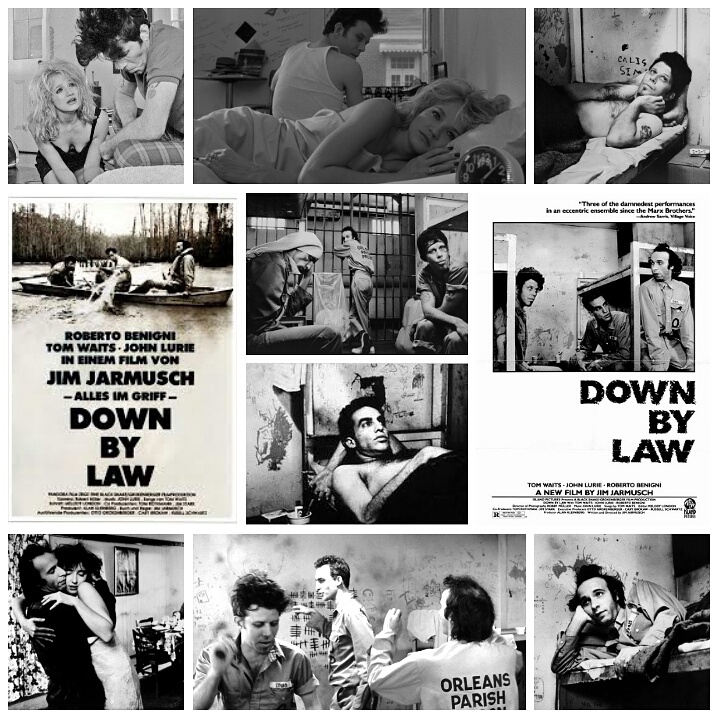
You have to be in a very particular type of mood to properly tune into a Jim Jarmusch film. He populates his often black and white and always slightly mournful films with awkward, dazed individuals who more comfortable in the uncertain pauses between dialogue than the actual words themselves. When I feel like a Jarmusch film (other than Dead Man which is an all timer for me) it’s always during times when I feel the daydreamy grey matter coming on, an otherworldly, downbeat relaxation that his  work is rife with. Down By Law is a signature example of this, and most likely the film I connect with most of his, after Dead Man. This one concerns three wayward and very different souls who by fate and unfortunate circumstance end up in jail together. Zach (Tom Waits) is a radio DJ who is hounded by his girlfriend (Ellen Barkin) to be more proactive and less relaxed. Jack (John Lurie) is a laid back pimp, and they both find themselves incarcerated in a Louisiana prison where they meet the eccentric Italian tourist Roberto (Roberto Benigni, hilarious). The trio are a puzzling gaggle of misfits, moments of startling pathos and stinging humour sprouting as their time together goes on. Soon they discover that Roberto may know of a way to escape, and see it as their chance. The characters in any given Jarmusch film never seem the same as usual film archetypes; they’re always quirky and completely their own person, which is no doubt a product of a very intuitive directorial process, and an excellent relationship with the actors. It can be disarming to spend time with such distinct people in film, but when you stop to realize just how weird everyone around you in real life is vs. what is common for movie scripts, it feels geniune. This one is lived in, authentic and funny in that intangible way where you can’t even say why it’s so hilarious. We all a-scream for ice  a-scream!

Lulu On The Bridge: A Review by Nate Hill

image

Lulu On The Bridge is an odd one, and that’s a compliment. It subtly strains at the constrictions of genre until you realize just how unique it has gotten right under your nose. I’ve always thought of it as the Abel Ferrara fiom that he never made. Harvey Keitel delivers a home run of a lead performance as Izzy Maurer, a renowned jazz musician who loses his ability to play after he is shot by a lunatic gunman (Kevin Corrigan) while he is performing his music in a cafe. He sinks into a deep depression following the incident, and then something curious happens. One day he finds a mysterious stone, with a phone number attached to it and some seemingly mysterious qualities which alter the psyche, mood and perception of anyone in its vicinity. The phone number leads him to Celia Burns (the ever excellent and under estimated Mira Sorvino), an aspiring actress who’s fallen just south of the success line, and has a taste for Izzy’s music. The two seem destined to meet and as you might guess, begin a passionate love affair that begins to get a bit obsessive, with strong hints directed towards the stone that seems to govern will and volition. Their romance is hot, heavy and volatile, threatened when a mysterious man named Dr. Can Horn (a classy but dangerous Willem Dafoe) separately kidnaps them in attempt to retrieve the stone. The script deliberately shades over its true intentions until the very last minute, stopping to pick many dialogue and thematic flowers along the way, as well as leave a few red herrings behind. Gina Gershon is great as Izzy’s ex wife, and the monumantal supporting cast also includes Richard Edson, the great Victor Argo, Harold Perrineau, Mandy Patinkin, Vanessa Redgrave and a brief Lou Reed who is pricelessly credited as ‘Not Lou Reed’. If you snag a dvd you can also see deleted scenes work from Stockard Channing, Jared Harris, Josef Sommer and Giancarlo Esposito. The film attempts music, mystery, doomed love, urban mysticism, thriller and drama elements. I’m happy to report that it succeeds at all of them, a gem not unlike the mcguffin stone within the plot, and a haunting little modern fairy tale. Check it out.

The Adventures Of Buckaroo Banzai Across The 8th Dimension: A Review by Nate Hill

image

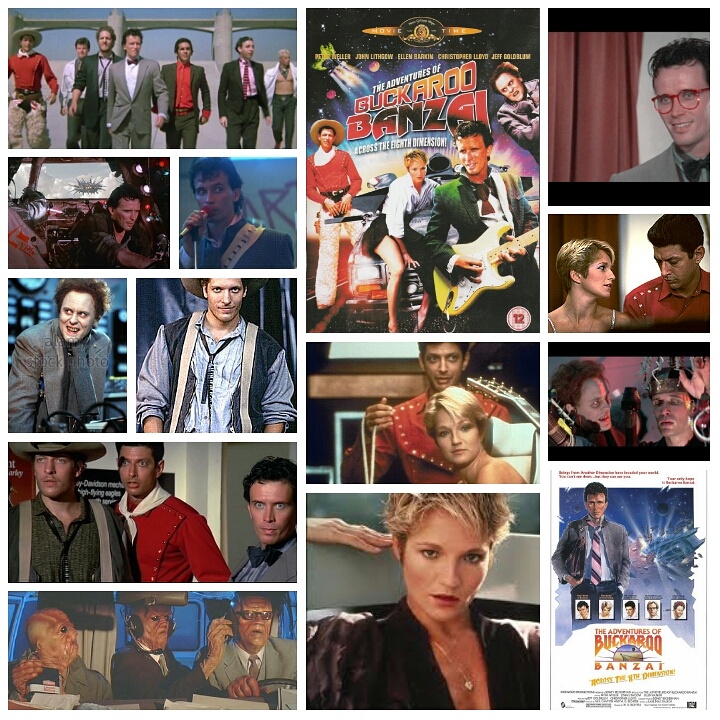
The Adventures Of Buckaroo Banzai Across The 8th Dimension. There’s a title, eh? The film lives up to it too, and is simply one of the most unique, bizarre and original sci fi flicks out there. It’s the very definition of cult to its abstract bones, filled to the brim with eccentricities and idiosyncrasies. For me it represents a certain genre niche that’s nestled squarely in goofball mode, splayed out across the borders of science fiction, comedy and farce, without a care in the world and not an iota of self consciousness or any fucks given. Call it Buck Rogers meets The Avengers meets Bonanza doesn’t even scratch the surface. Peter Weller, that eternally cool bastard, plays Buckaroo Banzai, who is somewhat of a renaissance man. He’s a neurosurgeon, a rock star, a scientist and above all a lover of adventure, always sporting Weller’s unmistakable deadpan charm. Buckaroo and his band are also a crime fighting team called The Hong Kong Cavaliers, and include roughneck but lovable cowboy Rawhide (Clancy Brown) and slick New Jersey (Jeff Goldblum). Buck has perfected a device called the oscillation overthruster, which allows him to travel through solid matter and on into the eighth dimension. Only problem is, the red lectroids, an alien race from planet 10, want to steal the device for their own. They are led by an unbelievably funny John Lithgow who gets the spirit of the film and then some. Buck also finds romance with the adorable Penny Priddy (Ellen Barkin), whisking her off into super sonic adventure with him and the Cavaliers. It’s beyond silly, super arbitrary and random, and I love every glorious unfiltered minute of it. This type of wantonly bizarre stuff is my cinematic bread and butter, especially  when it’s done with such pep in its step, as well ass love and commitment to being an oddball venture. The cast is huge and all in that loopy sleep deprived state where everything is funny and strange organic creation comes from the abstract. Watch for Dan Hedaya, Lewis Smith, Pepe Serna, Vincent Schiavelli, Jonathan Banks, John Ashton and Christopher Lloyd too. A wacky gem with a style all its own, constantly tapped into a well of creation, humour and fun.

TRON – A REVIEW BY J.D. LAFRANCE

tron1

When Tron came out in 1982, it was intended to be a visually stunning parable against the abuse of powers by computers and technology. More than thirty years later, the film plays more like a nostalgic ode to the early 1980s than a simple good vs. evil morality tale. Tron evokes the heady days when video games like Pac-Man, Defender and Centipede ruled the arcades and when it seemed like everyone owned a Commodore 64 or an Atari 2600 – the eight track of personal computing. It also anticipated the proliferation of CGI special effects and was not a big hit back in the day but its influence is widespread – it enjoys a loyal cult following today.

Kevin Flynn (Jeff Bridges) is a hot shot computer programmer turned computer hacker after being fired three years ago by ENCOM corporate big wig, Ed Dillinger (David Warner). To add insult to injury, the executive stole a series of video games that Flynn created and transformed them into wildly popular and profitable products, chief among them Space Paranoids – much to the young programmer’s chagrin. Flynn can prove true authorship of the games but only if he can gain direct access to ENCOM’s mainframe. Enter ex-girlfriend Laura (Cindy Morgan) and her current beau, Alan (Bruce Boxleitner) – both disgruntled employees at ENCOM – who give Flynn the access he needs to find out the truth. However, the corporation’s artificial intelligence, the tyrannical Master Control Program, discovers what Flynn is doing and uses a high tech laser to digitize the troublesome hacker and transport him inside the computer world.

This is where Tron really begins to get interesting as writer/director Steven Lisberger creates a flashy, neon-drenched world, a cybernetic version of Social Darwinism where lowly computer programs must participate in gladiatorial battles against the Master Control’s ruthless minions. These involve games where opponents throw glowing discs at each other or, in another game, hurl a ball of energy at one another. If either one of these things hits someone, they are killed or de-rezzed – slang for deresolution. Even though the computer effects are primitive by today’s standards, back then they were considered ahead of their time. There is a certain clunky charm to the effects that makes Tron all that more endearing to its fans. The look of the computer world is all blacks and dark blues, which is in nice contrast to the vivid neon red and blue of some of the characters and vehicles that inhabit it.

Undeniably, the coolest sequence in the film is the light cycle race where Flynn, Ram (Dan Shor) and Tron take on three of the MCP goons. It involves futuristic vehicles made out of energy and that leave behind a solid trail that one uses to block in their opponent and destroy them. The action is fast-paced and exciting to watch with dynamic visuals. The computer world is beautifully realized in vivid detail that immerses one fully and is obviously a large part of the film’s appeal. Lisberger adopts a pretty simple color scheme of predominantly primary colors. Tron is one of those rare examples where style over substance works. The computer world that Lisberger and his team worked so hard to create is rich in detail. It also plays on our romantic notions of what really goes on inside our computers – not a collection of microchips and circuit boards but a vast world where programs fight each other for survival. It’s no wonder that visionary science fiction writer, William Gibson once commented in an interview that the cyberworld in Tron is how he envisioned the cyberspace in his own novels.

The film’s genesis began in 1976 when Lisberger, then an animator of drawings with his own studio, looked at a sample reel from a computer firm called MAGI (Mathematical Applications Group, Inc.). At the time, he was researching technology in the late 1970s. Shortly afterwards, Atari came out with Pong and he was immediately fascinated by them. He wanted to do a film that would incorporate these electronic games. According to Lisberger, “I realized that there were these techniques that would be very suitable for bringing video games and computer visuals to the screen. And that was the moment that the whole concept flashed across my mind.” He was frustrated by the clique-ish nature of computers and video games and wanted to create a film that would open this world up to everyone.

tron2

Lisberger and his co-producer Donald Kushner borrowed against the anticipated profits of their 90-minute animated television special, Animalypmics to develop storyboards for Tron. They moved to the west coast in 1977 and set up an animation studio to develop Tron. Originally, the film was conceived to be predominantly an animated film with live-action sequences acting as book ends. The rest would involve a combination of computer generated visuals and back-lit animation. Lisberger planned to finance the movie independently by approaching several computer companies but had little success. One company, Information International, Inc., was receptive. He met with Richard Taylor, a representative, and they began talking about using live-action photography with back-lit animation in such a way that it could be integrated with computer graphics.

Lisberger and Kushner took their storyboards and samples of computer-generated films to Warner Bros., MGM and Columbia – all of whom turned them down. Lisberger spent two years writing the screenplay and spent $300,000 of his own money marketing the idea for Tron and had also secured $4-5 million in private backing before reaching a standstill. In 1980, Lisberger and Kushner decided to take the idea to Disney, which was interested in producing more daring productions at the time. However, Disney executives were uncertain about giving $10-12 million to a first-time producer and director using techniques that, in most cases, had never been attempted.

The studio agreed to finance a test reel which involved a flying disc champion throwing a rough prototype of the discs used in the film. It was a chance to mix live-action footage with back-lit animation and computer generated visuals. It impressed the executives at Disney and they agreed to back the film. The script was subsequently re-written and re-storyboarded with the studio’s input. At the time, Disney rarely hired outsiders to make films for them and Kushner found that he and his group were given a less than warm welcome because “we tackled the nerve center – the animation department. They saw us as the germ from outside. We tried to enlist several Disney animators but none came. Disney is a closed group.”

One the reasons why the cyberspace in Tron is so striking is because of the creative brain trust assembled to help realize it. Futuristic industrial designer Syd Mead, legendary French comic book artist Jean “Moebius” Giraud, and high-tech commercial artist Peter Lloyd served as special visual consultants. Mead designed most of the vehicle designs (including Sark’s aircraft carrier, the light cycles, the tank and the solar sailer). Moebius was the main set and costume designer for the film. Lloyd designed the environments. However, these jobs often overlapped with Moebius working on the solar sailer and Mead designing terrain, sets and the film’s logo. The original Program character design was inspired by the main Lisberger Studios logo, a glowing body builder hurling two discs. CGI had been used in films before, most notably in Westworld (1973) and Star Trek: The Motion Picture (1979), but it was used much more extensively in Tron. In order to pull it off, four of the United States’ foremost computer graphics houses produced the computer imagery for the film. They invented the computer techniques and created the visual effects in approximately seven months. More than 500 people were involved in the post-production work, including 200 inker and hand-painters in Taiwan.

Jeff Bridges brings a playful energy to the film both in the real world – like when he breaks into ENCOM – and in the computer world, like when he gets acclimatized to his new surroundings. Tron is the no-nonsense hero while Flynn provides comic relief. We are introduced to Flynn in his environment – the video arcade that he owns, beating the world record score for Space Paranoids, one that he invented but was stolen from him. Now, he plays the game and the only profits he sees from it are the quarters that kids put in it. Bridges brings an engaging, boyish charm to the role as is evident in the way he gleefully circumvents ENCOM security and then proceeds to sneak in so that he can find and use an unattended computer terminal. There are the little touches, like when Flynn sneaks on ahead and hides from Laura, that keep the mood light and fun, just before our hero is zapped into the computer world.

In the real world, Tron’s alter ego, Alan is a bespectacled, slightly bookish programmer who is frustrated by the lack of access he has to his company’s computer system. Bruce Boxleitner plays these two contrasting roles quite well. He knows he’s the straight man to Bridges’ charismatic goofball Flynn. We meet his character as he tries to access a high level of security so that he can run his Tron program, an independent security program that would act as a watchdog to the company’s MCP computer. There is a cut to a long shot and we see that Alan’s cubicle is one of hundreds – impersonal and he is treated as an insignificant cog in a massive corporation. Interestingly, the corporation’s name is ENCOM, which eerily foreshadows another evil empire, but in the real world – ENRON.

tron3Amazingly, Tron wasn’t even nominated for a special effects Academy Award because “the Academy thought we cheated by using computers,” Lisberger remembers. However, his film and the world he and his team created captivated a small group of moviegoers. A loyal cult following developed around Tron over the years. The film may have not captured the public consciousness when it first came out but it has since developed a loyal following that loves it dearly. In many respects, Tron is a snapshot of the early ’80s when video games were just starting to take off, but it also was a harbinger of things to come. It paved the way for the elaborate computer graphics we see in movies like The Matrix (1999) and the new Star Wars movies. However, Tron warns that we cannot rely totally on computers to do everything because in doing so we run the risk of losing our humanity. I always imagine Flynn going on to become Bill Gates or maybe Steve Jobs.