The Chronicles Of Riddick: A Review by Nate Hill

image

David Twohy’s Pitch Black was a dank, murky horror sci fi that took place inside a claustrophobic killing jar, all the action unfolding on one planet, and over a short amount of time. With The Chronicles Of Riddick, he lifts the lid off that jar, unveiling more planets, characters, creatures and broadening both the scope of what is seen visually and what takes place in the story. What began as a simple human vs. monster survival tale crystallizes into a full blown operatic space saga, and I loved every minute of it.  Now there are a lot of people who hate it, and fine for them if they want to live inside such negativity. I was sold after the intro, in which a snarky, canine – like bounty hunter (Nick Chinlund) chases a haggard looking Riddick a across the bizarre, jagged face of a planet that would make the asteroid from Armageddon sweat. This film takes place sometime after Pitch Black, the few survivors scattered across the galaxy. There’s  a price on Riddick’s head, which Toombs (Chinlund) intends to collect. Riddick unwittingly wanders into the path of something far more dangerous in his evasive efforts: a powerful, fascist master race known as the Necromongers are cutting a swath through the known universe, converting or killing anyone they find. They are led by the “” (Colm Feore), and commanded by Lord Vaako (another badass character for Karl Urban to another do to his rogue’s gallery), a nasty piece of work who is futher soured by his insidious wife (Thandie Newton). Riddick has encounter with them, as well as an old friend from former times (an all too brief Keith David) and is taken far and away, to a dangerous prison on a planet called Crematoria, where the wrecking ball of a sun fries everything on the surface every half hour or so. It all happens fast (and furious hehe), in a somewhat rushed frenzy of sci fi action, cool effects and surprisingly vicious antics for a PG-13 flick. Diesel was born to play Riddick, a growling night wolf of an antihero and endlessly watchable. There’s all sorts of half Cooke ideas running around, some fun and others left unexplored. There’s a prophecy involving the Purifier  (Linus Roache) who has ties to Riddick’s tragic past and the fate of his race, a strange elemental (Judi Dench looking confused), another person from his past (Alexa Davalos) and other intrigue involving Urban. Best to sit back and let it wash over you like the fun it is. Chinlund is hilarious as Toombs, the only character who seems to have wandered in from inner city L.A., a wide ass prick with a hate streak for Riddick and that old school charisma that carries scenes. The set pieces are exhilarating and make up for the plot which is at times spread too thinly, but never hurts the film. I love it, watch it all the time, let the haters sulk… more for us. 

John Boorman’s The Emerald Forest: A Review by Nate Hill

  
John Boorman’s The Emerald Forest is the kind of exotic, intoxicating, wildly adventurous, unbelievable and unforgettable film that comes along once in a decade, if that. These days this sort of film would be gilded to the hilt with unnecessary Cgi, a burden which filmmakers just can’t seem to free themselves from in this age. Back in 1985, they had to use what they had, filling every frame with on-location authenticity, genuine realism which prompts a feeling of wonder and sense of mysticism from the viewer, which any computer generated effort just cannot compete with (I will concede that this year’s The Jungle Book came up aces, so there are a few cutting edge exceptions). This film is quite the undertaking for both cast and crew, and one can see from scene to scene the monumental effort and passion that went into bringing this story alive. It’s also partly based on true events, adding to the resonance. Powers Boothe plays technical engineer Bill Markham, who is living with wife (Meg Foster) and two small children in Brazil, while he designs plans for a great river dam which will allow further development. One day, on a picnic at the edge of the rainforest, his son Tommy disappears, after spotting an elusive tribe of Natives. Gone with no trace but an arrow lodged in a nearby tree, Bill launches a search for his son that spans a decade, returning year after year to probe the vast, untamed jungle in hopes of somehow finding Tommy. Tommy, now a young man and played by the director’s son Charley Boorman, has been adopted and raised by the kindly tribe, known as ‘The Invisible People’ for they way they remain unseen as they move about their home in the forests. Tommy is very much one of them, taken up their customs and traditions, with nothing but vague memories of Bill in his dreams, which he doesn’t believe to have actually happened. One day in the hostile territory of ‘The Fierce People’, Tommy and Bill are reunited, Tommy taking his wounded father to his home village. Bill is heartbroken that his son is essentially no longer his, conflicted by the situation. Tommy has just entered his life as a man, taking a gorgeous wife (Dira Paes) from his village and starting a future. Trouble brews as The Fierce People threaten Tommy’s village, and their women, prompting him to seek Bill’s help. It’s interesting to see how a tribe who have had little to no contact with the outside world react to it, calling it ‘the dead world’ and referring to the developers as the Termite People who cut down the grandfather trees. The environmental message is never preachy, always feeling like a vital and important truth that is organic and unforced, emerging through the characters and their interactions. The Natives possess an innate spirituality and connection to the intangible which we have forgotten as progress alters us, still rooted deeply in forces beyond our 21st century comprehension. Boothe is deeply affecting in one of his best roles, a desperate father through and through, while also filling out the broad shoes of the wilderness adventurer he has become over the years. He fills his performance with pathos, longing and is the emotional soul of the piece. Boorman is spry and takes up the aura of Tommy well, mastering the complex linguistics and mannerisms of the tribe admirably. One of my favourite aspects of the film is its exquisite and moving score, the main theme evoking wild romanticism, old world secrets and the unending beauty of nature so well that one feels goosebumps as if we’re really there in that setting. Pure cinematic magic, a timeless story told without flaw or hitch, and a breathtaking piece of film. 

B Movie Glory with Nate: Wyvern

image

As far as SyFy Channel flicks go, Wyvern is a really not bad little effort, kind of like North Of 60 meets Reign Of Fire. It concerns a group of people in a small Alaskan town who come across an ancient beast called a Wyvern, which is basically a winged serpent dragon that breathes fire and causes all manner of havoc for the local residents. The melting ice caps have caused a great thawing, in which this creature has been freed from its icy prison, now roaming the land, barbequing livestock and being a great big nuisance. Local trucker Jake Suttner (Nick Chinlund) bands together with rowdy outdoorsman Hass (Barry Corbin), Claire (Erin Karpluk) and eccentric ex army curmudgeon Colonel Travis Sherman (Major Briggs himself, the late great Don S. Davis). It’s a pleasent affair as far as horror/sci fi flicks go, with likable characters, not too much gore or unpleasantness, and that small town vibe of comfort that helps you care for the people in such a silly movie. One of SyFy’s best in recent years.

The Onion Movie: A Review by Nate Hill

image

That’s right, the Onion News Network made a movie, back in 2008, and it’s every bit as irreverent, satirical and wantonly bizarre as you would imagine. They have been comically killing it for years with their online platform, and the film is a nice extension of that. It’s episodic, meandering and devoid of plot, made up of many little sketches and vignettes, some gut bustingly funny, others just plain odd. I have three favourites which pretty much sum up their inane, Monty Python type shtick: An out of work actor named Bryce Brand (Nick Chinlund is priceless I  just a few minutes of screen time) arrives back home from drug rehab and is hounded by his agent to nab new scripts. He promptly falls into a weird new addiction that gets slapped sillily onto the headlines, thus ending his arc with deranged efficiancy. Steven Seagal shows up as a fat slob of an action hero aptly named ‘The Cock Puncher’, a lumbering buffoon who punches people in the cock, naturally. The third, and funniest sequence features a riff on the celebrity roasts of the 60’s, with some kind of amazing group of crusty old crooners hurling stinging and incredibly raunchy insults at each other with the subtlety of a sledgehammer. It’s tough explain just how funny that bit is in a review, but suffice to say it had me roaring as loud as the obscene bunch of wrinkled baboons in the in the skit. There’s a plethora of other sequences which I’ve since gotten hazy about, but I remember many other instances of pure hilarity to be had. Watch for further celebrity appearances including Eric Stolhanske, Michael Bolton, Richard Fancy, Daniel Dae Kim, Brendan Fletcher, Rodney Dangerfield, Joel McHale and more. Side splitting stuff, if you’re into this type of humour.

B Movie Glory with Nate: Unspeakable

image

Unspeakable revels in its southern fried trashiness, pulling forth a lurid and grotesque pseudo mindfuck serial killer story that I don’t recall making a whole lot of sense, yet is still barrels of fun to behold the seasoned cast play out. The film’s writer, Pavan Grover, also stars as Jesse Mowatt, a mysterious serial killer with ties to the occult who frames an innocent Mexican migrant (Marco Rodriguez) in several horrific murders. When a scientist (Dina Meyer) uses an experimental mind mapping and truth seeking method on the wrongfully accused man, she is led to Mowatt via some dodgy telepathy. To be sure that Mowatt is guilty, she tries the same method on him and comes across readings that suggest he may be not only inhuman, but altogether unspeakably evil. The gung ho, sadistic prison warden Earl Blakely (a hopped up Dennis Hopper) is ready to pull the switch, but Meyer wants more time to examine Mowatt. Her colleague and mentor Jack Pitchford  (Lance Henriksen) advises her against it, sensing the evil. She appeals to the state Governor (a brief Jeff Fahey) who happens to be her former lover, but he is unyielding. Her curiosity towards Mowatt puts her in grave supernatural danger, as Mowatt leers from the shadows of his cell and causes all sorts of unexplainable havoc. It’s a B movie thrill ride through and through, the plot barely registering to the viewer beyond the shock value tactics it employs, mainly giving Grover and Hopper scenery to voraciously gnaw on. In fact, Hopper is so rabid in one particular sequence it makes the viewer question whether the director just told him to ‘go full retard’. I enjoyed it for the actors, all of which I greatly admire. It’s schlock, of the marginally nonsensical variety. As long as you go in with that pre-notion, you can’t blame me for the reccomendation. At least the startling instances of gore are guaranteed a spike in our pulses.

Felon: A Review by Nate Hill


Felon is a bitter,and tragic prison drama that’s packed with wrenching injustice, simmering anger and caged animal violence. Loaded with the kind of tough guy elements which make prison films exciting (check out Lock Up with Stallone), it’s also has a tender side brought forth by its extremely thoughtful and well written script, which explores ideas that are both hard to swallow and very sad. Stephen Dorff, a guy who already has the gritty look as soon as he walks into a frame, plays Wade Porter, a simple family man who is just starting out at life along with his wife (Marisol Nichols). Their hopes and dreams turn into a nightmare, however, when a violent intruder breaks into their home one night. Wade strikes out in defence of himself and his wife, accidentally killing the criminal. Because of the backwards ass way the States run things, he is accused of manslaughter and sentenced to serve out jail time. He is then thrown into the dog pit, literally and figuratively. The penitentiary he is sent to is run by sadistic and corrupt Lt. Jackson (Harold Perrineau) along with his brutal enforcer Sgt. Roberts (Nick Chinlund). Jackson organizes vicious fight club style matches between the inmates, totally off the books and beyond any correctional legislations. Wade is forced to adapt, adjust and bring out monstrous aspects within himself to survive, and make it through his sentence with both his life and humanity intact. It’s not an easy turn of events to watch unfold onscreen, but necessary in the sense that this probably happens quite frequently to people in real life, and should be seen. The only solace Wade finds is with his gruff, veteran cell mate John Smith (Val Kilmer) a lifer who once went on a massacre of revenge against individuals who murdered his family. Smith is his guiding light, steering him through the hellish carnage of what he’s forced to do and helping him to keep the candle of compassion alive within him, never losing sight of what is essential in his fight to claim his life once more. Kilmer is a force that will knock you flat in this role, an old bull with dimming fury in his eyes, a man with a bloody history that has forged the weary dog we see in the film. Late in the film he has an extended monologue to Wade, giving him both blessing and advice with some of the most truthful and affecting gravity Kilmer has showed in his career. The writer/director, who appears to be primarily a stuntman, should be commended for such a script, that could have easily been a straight up prison flick without the pathos that drips off its heartstrings. We as an audience view this painfully and prey nothing like this ever happens to us or anyone we know, hoping to see a light of hope at the end of the dark tunnel for Wade. I won’t spoil it, but it’s worth the hit that your emotions will take while watching, and there is hard earned catharsis to be had, and penance for the characters you want to shoot in the face along the way. The extends to brilliant work from Chris Browning, Anne Archer, Nate Parker, Johnny Lewis and a fantastic Sam Shepherd as another seasoned convict. This was correct to video as I recall, which is a crime. It’s up there as my favourite prison set film that I’ve ever seen, a soul bearing piece. 

Antoine Fuqua’s Tears Of The Sun: A Review by Nate Hill

  
Antoine Fuqua’s Tears Of The Sun is a brutal, tough war machine of a flick in the tradition of the old 70’s war films, kind of like a brooding Dirty Dozen. Bruce Willis stoically heads up a team of special ops soldiers who are sent into a war torn region of Africa to rescue a doctor (Monica Belucci) from a missionary camp. Genocidal maniacs are encroaching into the area and it’s no longer safe for locals or relief workers. His orders are simple: locate and extract the doctor, and no one else. However, when he comes face to face with the refugees, and their situation, he simply can’t find it in himself to turn his back on them when he can do something to help. He then disobeys his orders, collects both his team, Bellucci and the Africans and makes a run through the jungle for diplomatic protected soil. His team are a grizzled band of warriors, each with their own unique qualities and opinion on his decision. Kelly (a badass, mohawk adorned Johnny Messner) believes it’s too much of a risk, and not their concern). Michael ‘Slo’ Slowenski (Nick Chinlund, excellent and understated) takes a compasionate standpoint. Second in command Red Atkins (Cole Hauser) trusts Willis is making the right call. Soon they are pursued by the extremists, led by a hulking Peter Mensah, before King Leonidas kicked him into the Sarlak pit. The combat scenes are hard hitting, seemingly very well rehearsed and researched. The only problem for me was the overbearing and extended sequences of genocide, which are harrowing and quite tough to watch. When it’s combat based it’s a damn fine piece, with a rugged, thoughtful band of heroes who are an absolute joy to see in action. Rounding out the team are Eamonn Walker, Charles Ingram, Paul Francis, Chad Smith and a briefly seen Tom Skerritt as Willis’s commanding officer. Tough, muscular and no nonsense, with burgeoning compassion that gives that soldiers purpouse beyond the cold lethality of the mission. Fuqua has a terrific collection of lean and mean action flicks under his belt, and this is one of the best.

HELLBOY – A REVIEW BY J.D. LAFRANCE

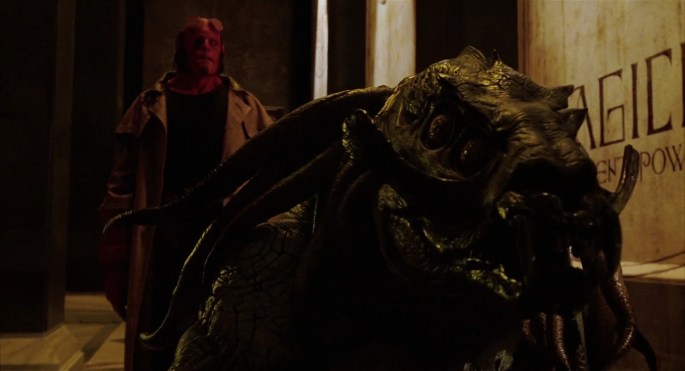
hellboy-movie-screencaps.com-3473

The success of X-Men (2000) and Spider-Man (2002) opened the door for a new wave of comic book adaptations. In the past, studios have played it safe and only green-lighted adaptations of mainstream comic books with large followings. However, this changed with adaptations of independent fare like Ghost World (2000), American Splendor (2003), and with Hellboy (2004). Based on Mike Mignola’s comic book of the same name, the title has a dedicated cult following at best so it was a pleasant surprise to see a major studio take a big budget gamble with it.

October 1944. The Nazis have begun mixing science with black magic in a desperate attempt to regain the advantage in World War II. The seemingly invincible Russian, Rasputin (Karel Roden) has teamed up with the Germans and plans to open a portal to another dimension and bring about an apocalypse. However, American troops arrive and disrupt the procedure just in time. In the process, something comes through: a red-skinned demon baby that the soldiers adopt and call Hellboy.

With the World War II prologue, director Guillermo del Toro does two important things: he vividly introduces this colorful world and the characters that inhabit it by creating just the right moody atmosphere and with detailed production design and excellent special effects. Secondly, Del Toro establishes the film’s mythology and what exactly is at stake through a clever mix of science fiction and the supernatural. He does this via an exciting action sequence as a young Dr. Broom and U.S. soldiers confront Rasputin and the Nazis.

Present day. Rasputin has been resurrected and continues his plans to summon destructive supernatural forces that will result in the end of the world. Hellboy (Ron Perlman) has matured (sort of) and now works for the Bureau for Paranormal Research and Defense (BPRD) in New Jersey — under the guise of a waste management company (just like Tony Soprano). Along with Abe Sapien (Doug Jones with an uncredited David Hyde Pierce doing the voice), an amphibious humanoid (“the fish guy” as a guard puts it), firestarter Liz Sherman (Selma Blair), and the token “normal guy,” John Myers (Rupert Evans), Hellboy tracks down Rasputin and tries to prevent him from fulfilling his nefarious goals.

Del Toro, a die-hard comic book fan and self-described film geek, shoots the action sequences much like he did in Blade II (2002), with crazy camera angles and fantastically choreographed fights. Case in point, Hellboy’s extended tussle with Sammael (Brian Steele). It’s like Del Toro took panels right out Mignola’s comic book and made them move but with the same kind of explosive energy that made Jack Kirby’s art so exciting. Del Toro also has incredible production design at his disposal to create a fully realized world rich in detail and drenched in atmosphere. He is heavily influenced by Italian horror films and not only references Mario Bava’s Black Sunday (1960) but also the saturated primary color scheme of Dario Argento’s Suspiria (1977) to name just a couple of examples. This is a great looking film, from the warm colors and ornate architecture of the library where Abe Sapien resides, to the darker, colder colors of Rasputin’s mausoleum in Moscow.

Del Toro was shooting Mimic (1997) and discovered the Hellboy comic book but never thought that it could be made in Hollywood and if it did they would ruin it. He heard that it was going to be adapted into a film at Universal Pictures and started writing a screenplay in 1997. He met Mike Mignola when they worked together on Blade II, which they used as their “rehearsal” for Hellboy. They found out that they read the same comic books and pulp and classic gothic horror novels. With Hellboy, Del Toro wanted to make a self-contained film, “almost a fairy tale, a fable.” His original pitch to executives at Sony-based Revolution Studios was that both The Mask (1994) and Men in Black (1997) were comic books that they were not familiar with and yet went on to become extremely successful films. He told them that the same thing could happen with Hellboy. In April 2002, Del Toro’s film was given the green-light at a budget of $60 million.

Del Toro first saw Ron Perlman in Quest for Fire (1982) and then The Name of the Rose (1986) and was very impressed with his acting, so much so that he ended up casting the actor in his first film Cronos (1994). Del Toro initially wanted him to play Hellboy but Vin Diesel was a rising star at the time and so the director approached him instead for the role. However, with the move from Universal to Revolution, Diesel dropped out of the picture and Perlman was in. Early on, if the actor didn’t work out, Del Toro thought about making Hellboy a mixture of puppet and computer graphics. He talked to James Cameron who warned him that if he went that route he would lose the love story. Del Toro wisely decided to stick with Perlman.

Perlman is perfectly cast as the cigar smoking, two-fisted action hero who eats Baby Ruth candy bars and loves cats. He does a great job of capturing Hellboy’s sarcastic, wise-cracking nature. Perlman gets to utter cool one-liners and looks fantastic in his make-up (thanks to legendary makeup artist Rick Baker). Often, what makes it to the film rarely resembles what was drawn in the comic book. Not the case here — Perlman IS Hellboy. With this role, he firmly established himself as one of the cult film icons of the new millennium (much like Bruce Campbell was in the 1990s). Perlman has got the drop-dead cool action hero shtick down cold. With his hulking, imposing physique, he’s Arnold Schwarzenegger with brains and irony.

Del Toro cast Selma Blair because he always saw a “haunting quality in her eyes and in her look. Sort of a doomed, gothic beauty in her.” He was a fan of The Larry Sanders Show and felt the Jeffrey Tambor had that “smarmy, wannabe bureaucratic presence” that was ideal for Tom Manning. He cast Tambor against type and wanted him to be an “absolute asshole in the beginning, and play it straight.” Del Toro and Mignola created the character of Myers to guide audiences into Hellboy’s world. The director interviewed a lot of young Hollywood actors but many of them were “just too cute and too Calvin Klein beautiful to put in the movie.” He liked Rupert Evans because he had “such an open face, and he had a real innocence about him.” Del Toro saw John Hurt in Love and Death on Long Island (1997) and felt that the actor had “that little air of tragedy about him” that suited Professor Bruttenholm.

hellboy-movie-screencaps.com-5535Hellboy is one of those rare comic book movies with depth. It takes time to develop its characters and the relationships between them. There is the touching father-son relationship between Hellboy and Bruttenholm and the romantic love triangle between Hellboy, Myers and Liz. While the film has the requisite slam-bang action sequences, it is not dominated by them. The film is not driven by them but rather by the characters and the story. And this is because Del Toro has strong source material to draw from: Mignola’s comic book, in particular “Seed of Destruction,” which chronicles Hellboy’s origins. Both Del Toro and Mignola’s works are steeped in the gothic and horror genres, in particular the fiction of H.P. Lovecraft. The author’s influence is all over this movie as Hellboy trades blows with Cthulhu-inspired creatures that would make ol’ Lovecraft proud. While Del Toro’s film didn’t exactly rack up the kind box office numbers the studio was hoping for, it did prove to be quite popular on home video and eventually spawn an even better sequel in 2008.

Perrier’s Bounty: A Review by Nate Hill

image

Perrier’s Bounty tries hard to be as pithy and witily profound as In Bruges, but doesn’t quite manage the task. To be fair, Bruges is a masterpiece and a Goliath of a script to aspire too, but this one has its own brand of scrappy crime fun, full of enough beans to keep the viewer jumping for its slight running time. Few films can boast narration provided by the Grim Reaper, and fewer still can say that said Reaper is voiced by Gabriel Byrne. But indeed, Byrne beckons us into this violent fable with his patented tone, both baleful and quaint. The fable in question concerns Michael McCrea (Cillian Murphy) an irresponsible young Irish lad who is seriously bereft of both luck and common sense. He lives in a small town in northern Ireland and owes a hefty loan to local crime lord Darren Perrier  (Brendan Gleeson). Because of how tiny the town is, it’s pretty easy for Perrier’s goons to find and engage him in a road runner goose chase all about the area, forcing him to scoop up his on and off girlfriend (Jodie Whittaker), and head for the hills. He’s also joined by his uber eccentric father (Jim Broadbent) who believes that the Grim Reaper has visited him at night and given him the alarming prognosis that he will die the next time he falls asleep. Broadbent is a solid gold asset to any film he’s in, and practically spews perfectly timed comic banter non stop. Michael thinks he has a way out of trouble with local petty thief The Mutt (Liam Cunningham, aka Ser Davos Seaworth, also a comedic treasure here), which turns out to be another notch in the belt of bad judgment. Meanwhile, Perrier’s crew reels after one of their slain thugs (at Michael’s hand) turns out to have been involved in a love affair with another, who now has the wrath of vengeance in his eyes. There’s a scene where Gleeson  comforts the bereaved hoodlum and seems deeply wounded at the couple’s reluctance to tell him of their love. Gleeson assures them he has no issue with homosexuality and wishes they would have shared with him. In the context of hardened criminals out for blood, this kind of exchange is priceless and brings rigid archetypes right down to earth, for maximum hilarity and well earned pathos. The film meanders a bit, but never out ran my attention span, following through with it’s story in ways both welcomingly bloody and predictably quirky. It doesn’t add up to anything life altering when all is said and done, but damn if the things which are said and are done along the way aren’t just pure genre entertainment, inducing chuckles, thrills and nostalgia for other films withing the niche. In the troupe of writers who look up to Guy Ritchie, Quentin Tarantino and  Martin McDonough, this scribe is on to something. Keep an eye out for Lord Varys, Roose Bolton and a young Domhall Gleeson too.

Harlan County War: A Review by Nate Hill

image

Harlan County War is a rare little TV movie that takes a partly fictional look at the union wars in rural Kentucky during the 1970’s, when a plucky band of coal miners and their wives took to the picket line in attempt to establish better working and living conditions. The story and title of the film have roots in the union wars of the 1930’s, which set the stage for this tale. Holly Hunter plays Ruby Kincaid, wife of Silas (Ted Levine) a miner who suffers through the harsh labor everyday. The townspeople are tired of the injuries, the deaths and the deadly black lung infections, and are given reluctant hope when compassionate union official Warren Jakopovich (Stellen Skarsgard) arrives to their county, promising change. Many locals are skeptical due to past corruption and disloyalty, but soon the company gets nasty and they realize that Jakopovich may be their only chance. Hunter is as fired up as she always is, her accent thicker than the moonshine everyone swills. I tracked this film down for Levine (Skarsgard too), and this is one of the best roles he’s ever gotten. He’s usually in character parts like the violent thug, stern general, gruff cowboy or yes, the skin stealing serial killer. Here he’s just a plain rural family man, a good hearted fellow who wants the best for his kin and county. Levine works wonders playing it straight here and I wish he’d get thrown more meaty and down to earth roles like this. Skarsgard can jump between being the most terrifying psychopath to the most comforting, sympathetic characters, and plays Jakopovich with compassion and dogged determination. The character building scenes between the three actors is brilliant. I feel like there’s a longer edit out there somewhere, because it jumps a bit and forgets to address one plot turn entirely, but alas it’s a tough one to affordably track down and this is the only version I could get. It’s made for TV and that shows at the seams sometimes, but it’s still solid drama about something important, and crafted very well.