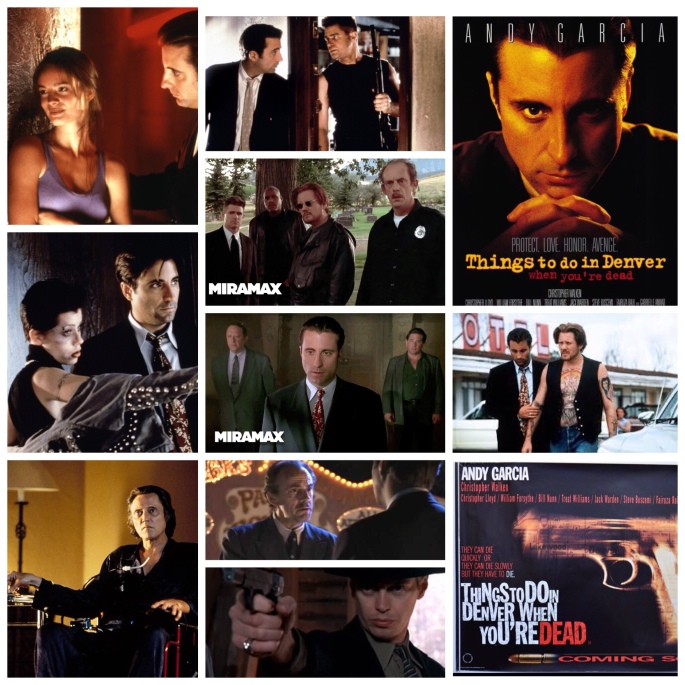
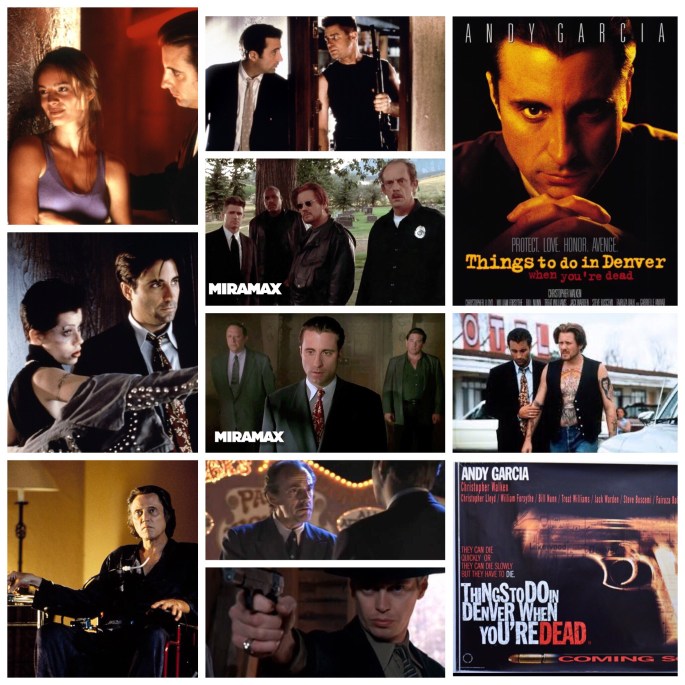
Gary Fleder’s Things To Do In Denver When You’re Dead

The 90’s was a heyday of hard boiled, ultraviolent film noir, a ripple effect that can undeniably be traced back to Quentin Tarantino’s Pulp Fiction, however it’s silly to say that they all are derived from that film, because plenty of them have their own distinct groove and flavour. One such flick is Gary Fleder’s Things To Do In Denver When You’re Dead, a mouthful of a title that serves as harbinger to one of the most idiosyncratic, verbally flamboyant scripts Hollywood ever produced, penned by Scott Rosenberg. They scored the cast to back it up too, for a beautifully melodramatic neo-noir pulp opus that should be as legendary as any of the household name films to come out of that era. Andy Garcia is the definition of slick as Jimmy The Saint, an ex mobster on the straight and narrow who’s pulled back into the game by The Man With The Plan (Christopher Walken) his former employer and the most dangerous crime boss in all the land. Hired to scare the piss-ant boyfriend who stole Walken’s son’s girl, Jimmy rounds up a crew that shouldn’t be trusted to watch a junkyard. Pieces (Christopher Lloyd, brilliant) is a diseased old porn shop owner, Easy Wind (Bill Nunn), tough guy with a heart of gold Big Bear Franchise (William Forsythe) and Critical Bill (Treat Williams) the psychopathic wild card who uses his day job at a mortuary as an anger outlet by pummelling the corpses like punching bags. Of course they royally fuck up the job, and Walken places scary, symbolic ‘hits’ on each of them. The clock ticks as they all try to either leave town or face the music, but Jimmy is the one with something to lose as he’s fallen in love with elegant, posh rich girl Dagney (Gabrielle Anwar). The script could have easily gone for just colourful carnage and glib posturing, but there’s real, palpable gravitas to the character relations, especially between Jimmy and Walken, who’s history is hinted at and brought to complex life by the two pros. This is Walken at his weirdest and wildest, confined to a spooky wheelchair and locked up in a guarded, dimly lit estate like Count Dracula. There’s a touching subplot involving wayward hooker Lucinda (Fairuza Balk, always terrific) that brings out the dormant humanity in hardened Jimmy. The cast here really is a marvel, and includes Don Cheadle and Glenn Plummer as a couple of loudmouth criminals, Jack Warden, Jenny McCarthy, Tiny Lister, Marshall Bell, Bill Cobbs, Michael Nicolosi, and Steve Buscemi as a freaky hitman named Mr. Shhhh, because he shoots first and doesn’t ask any questions at all. The dialogue is unique and flows from the actors like urban Shakespeare, it’s one of the coolest scripts ever written, and serves not just to be slick for the sake of it, but use jive and jargon to bring forth character naturally, and effortlessly provide buoyancy to the story. One of the great hidden gems out there. Boat Drinks.
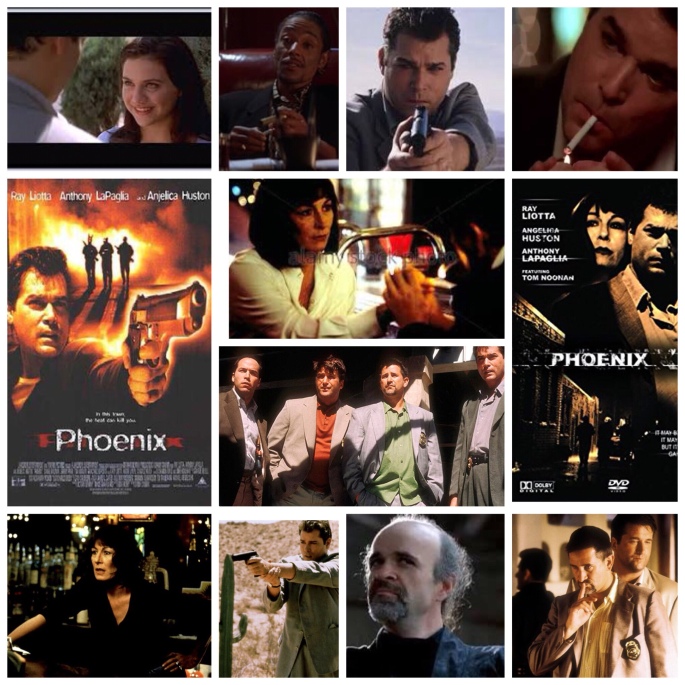
Danny Cannon’s Phoenix

Phoenix is a half forgotten, neat little Arizona neo-noir noir that isn’t about much altogether, but contains a hell of a lot of heated drama, character study and hard boiled charisma anyways, which in the land of the crime genre, often is an acceptable substitute for a strong plot. Plus, a cast like this could hang around the water cooler for two hours and the results would still be engaging. Ray Liotta is terrific here in a mid-career lead role as an a police detective with a nasty temper, huge gambling problem and just an all round penchant for trouble. He’s joined by his three partners in both crime and crime fighting, Daniel Baldwin, Jeremy Piven and Anthony Lapaglia. There’s no central conflict, no over arching murder subplot and no orchestrated twist or payoff, it’s simply these four sleazy cops just existing out their in the desert on their best, and it’s a lot of sunbaked, emotionally turbulent fun. Liotta vies for the attentions of a weary older woman (Anjelica Huston, excellent) while he’s pursued by her slutty wayward teen daughter (Brittany Murphy) at the same time. He’s also hounded by eccentric loan shark Chicago (Tom Noonan with a ray ally funny lisp) and trying to close countless open cases in his book. Piven and hothead Lapaglia fight over Piven’s foxy wife (Kari Wuhrur) too, and so the subplots go. The supporting cast is a petting zoo of distinctive character acting talent including Glenn Moreshower, Royce D. Applegate, Giovanni Ribisi, Xander Berkeley, Al Sapienza, Giancarlo Esposito and more. I like this constant and obnoxious energy the film has though, like there’s something in that Arizona sun that just drives peoples tempers off the map and causes wanton hostility, a great setting for any flick to belt out its story. Good fun.

-Nate Hill

Alan Parker’s Angel Heart 


No other film has the seething elemental power of Alan Parker’s Angel Heart, a detective story propelled by a murder mystery, all the while cradled in the sweaty, unnerving blanket of a satanic horror story. Get the extended unrated cut if you can, as it cheerfully amps up both the queasy gore and kinky sex in spades. The time is postwar 1940’s, the setting New York, or at first anyways. Shabby private detective Harry Angel (Mickey Rourke) is hired by sinister clandestine gentleman Louis Cyphre (Robert De Niro) to find a missing lounge crooner named Johnny Favourite, for nasty reasons shrouded in thinly veiled threats. Harry is stalled at every turn, kept just out of the loop on every plot twist and soon seems to be a magnet for violence, troubling hallucinations and all the eerie hallmarks of a case he should have stayed far away from. The grisly clues lead him from Brooklyn to the smoky ghettos of Harlem, then south to voodoo soaked swamps of Louisiana and beyond, chasing illusory information and feeling more like the hunted than the hunter with each step. The film feels at times like a shrinking steel cage of unease and dread, a trap that closes in on both Harry and the viewer until the soul crushing revelations of the final act have been laid bare. This is hands down the best work Rourke has ever done, and it’s priceless listening to him try and to downplay it on the DVD commentary, classic ice cool Mickey. De Niro is the kind of quietly dangerous that leaves a deadly vacuum in the air of each scene, underplaying evil expertly and laying down more mystic mood by simply peeling a boiled egg than most actors could with a twenty page monologue. Ex Cosby Show darling Lisa Bonet sauces up her image here as a Bayou voodoo princess with ties to the mystery, and the steamy, no holds barred sex romp she has with Rourke has since become the stuff of legend, a feverish cascade of blood and other bodily fluid that almost gave the MPAA a coronary. The one area this film excels at most is atmosphere; there’s something intangibly wild about everything we see, hear and feel on Harry’s journey, from the supernatural tinged, noirish hues of Michael Seresin’s cinematography to the haunted, hollow tones of Trevor Jones’s baroque, restless original score, everything contributes to forging a world in which we feel enveloped in and can’t quite shake after, like a bad dream that creeps out into waking life for a while after the night. Angel Heart is a horror classic, a blood red gem amongst genre fare and one in an elite group of films that are pretty much as close to perfect as can be. 

-Nate Hill

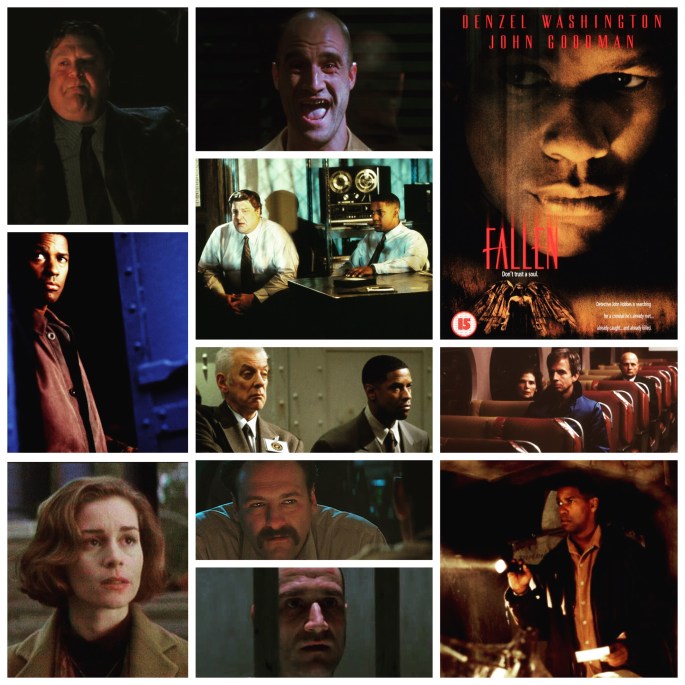
Gregory Hoblit’s Fallen


A demon angel. A Badass Denzel Washington. Tony Soprano singing the Rolling Stones. Creeping psychological dread. Browned, burnished production design. A deliciously mean spirited, ballsy twist ending. All this and more can be found in Gregory Hoblit’s Fallen, an atmospheric spook-house of a flick that gets tone, fright and suspense just right. Nestled in that sweet spot of the 90’s where detective stories often had a neat supernatural twist (The Prophecy is another dope one), it’s a film that demonstrates the power of storytelling and atmosphere done right, like a campfire tale that cops tell their youngsters. Denzel is Hobbs, a detective who oversees the graphic execution of serial killer Edgar Reese (Elias Koteas, terror incarnate), a monster he once caught. Case closed, right? Not so much. Soon after he kicks the bucket, one or more copycat killers show up, and once again the crimes happen under Hobb’s watch. Coincidence? Paranormal? It’s a neat, eerie game of cat and mouse with an antagonist who possesses a few unearthly methods of skulking around in the dark. Hobbs is helped by his two colleagues, salt of the earth John Goodman and hothead James Gandolfini, bumps heads with the obstinate police captain (Donald Sutherland), and runs into his foe at every turn, each time in a new vessel which gives the actors, right down to extras, an opportunity to have some devilish fun. Embeth Davidz is her usual withdrawn self as a woman with ties to the killer’s past, and watch for Robert Joy and Gabriel Casseus as well. Composer Dun Tan’s unearthly drone of a score compliments the drab shadows, oppressive nocturnes and threatening frames of the film eerily as well, creating a mood-scape that drips ambience. The end is an acidic kick in the nuts, and I admire a film that has the stones to chuck in such a shock tactic, embracing the dread that has been built up to that point with one last sardonic, hopeless cackle. Film noir to it’s roots, subtly mystical, a perfect one to settle down with as we move into the Halloween season. 

-Nate Hill

Indie Gems: American Perfekt


American Perfekt is a disjointed yet darkly compelling little nightmare of a road movie, a dusty ode to bowers of the American southwest left unchecked and decayed, populated by wayward souls with perpetual heat delirium, vixens, psychopaths and hustlers alike, who saunter through lurid storylines that often end in bloodshed and madness. In the vein of stuff like Oliver Stone’s U-Turn and Kalifornia, we once again pair up with some extremely off colour characters as they navigate both the tangled web of highways that lace the States as well as the human capacity for greed, lust and heinous physical violence. The characters, and actors for that matter, who populate this stretch of highway are an especially bizarre bunch, starting with Robert Forster’s vacationing criminal psychologist Jake Nyman. Forster is quite the unpredictable guy, usually found in calmly benign protagonist roles, yet just as capable of stirring the pot with evil antics. Here’s he’s opaqueness incarnate, driving from one place to another until he runs into two sisters played by another couple of acting hellcats, Amanda Plummer and Fairuza Balk. Jake is basing each decision of his trip upon the flip of a coin a-lá Harvey Dent, a tactic which simultaneously causes trouble and indicates how unhinged he might really be.

Plummer is weird and Balk is weirder, but neither as weird as David ‘Professor Lupin’ Thewlis as an awkwardly placed character who seems to exist just to jump into a scene and throw the mood off kilter. There’s others running amok too, including Geoffrey Lewis, as well as Paul Sorvino and Chris Sarandon as a pair of state troopers who serve as comic relief. Forster is scary here, playing a guy who is psychologically hard to pin down or get a read on, and he’s got some dynamite scenes with Balk in the third act, the two talents lighting up the frame. It’s pretty far south of coherent though, mostly just these freaks terrorizing each other and engaging in puzzling romantic flings that only make sense to them, I suppose. If feverish, borderline abstract, sun-stroked neo noir is your thing, go for it. You can certainly do worse than spend a certifiably bonkers ninety minutes with this terrific bunch of actors. 

-Nate Hill

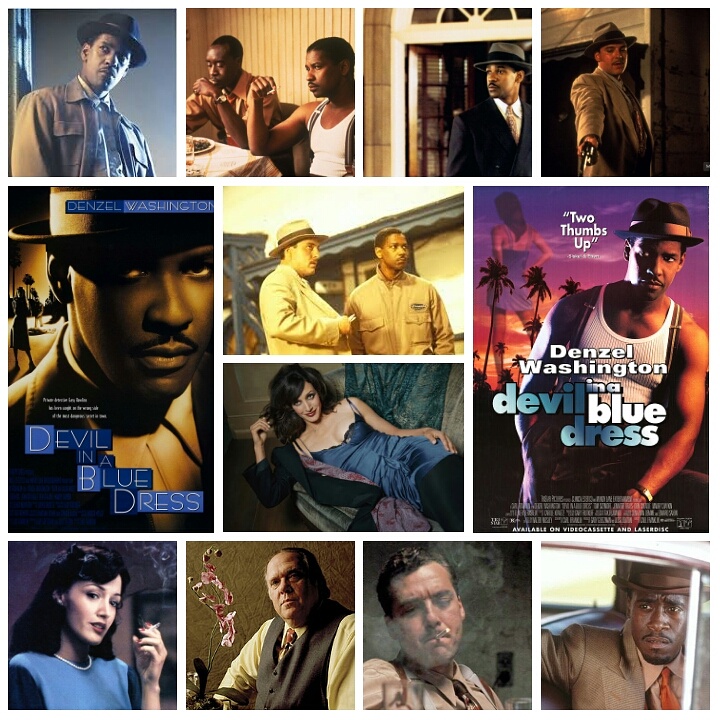
Devil In a Blue Dress: A Review by Nate Hill 

Devil In A Blue Dress takes the classic Raymond Chandler mystery form and uproots it just a smidge, setting it in the African American community of 1948 Los Angeles, with terrific results. Noir takes on a double meaning (naughty pun) as WWII vet turned private eye Ezekial “Easy” Rawlins (Denzel Washington) finds himself mired in the quick sands of corruption, coersion and murder most foul after taking on a job that’s led him straight to the dirtiest little secret in town. After he accepts a missing persons inquiry from mysterious DeWitt Allbright (Tom Sizemore, first shady and then downright scary when we see what he’s really about), he finds himself searching for a girl named Daphne (Jennifer Beals) a runaway with ties to a very powerful politician (Maury Chaykin makes your skin creep and crawl) with some seriously disturbing extra curricular activities. Rawlins recognizes danger when he sees it and tries to back out, but by then he knows too much and it’s way late in the game. Now he must navigate the scene like the pro he to escape not only with answers, but perhaps his life. Washington gives him the underdog treatment, a worn out gumshoe who still has some grit left, enough for one last ride in any case. There’s an L.A. Confidential type feel to the plot in the sense that it ducks some conventions in order to service true surprise from its audience. Sizemore is a charming viper as the kind of dude you never want to trust (isn’t he just the best at playing that?) and Beals subverts the damsel in distress archetype by injecting her performance with a jolt of poison. In terms of L.A. noir this baby is fairly overlooked, but holds its own to this day. Watch for Don Cheadle as well.  

Fallen Angels: Dead End For Delia- A Review by Nate Hill

image

Fallen Angels was a super cool L.A. film noir television series that ran in the 90’s, only never to be heard from again, curiously. It attracted an incredible lineup of directors including Tom Hanks, Alfonso Cuaron, Steven Soderberg, Peter Bogdanovitch, Jonathan Kaplan, John Dahl, Keith Gprdon, Tom Cruise and more, with an even more unbelievable troupe of prolific actors. For whatever sad reason though, it was never really released or marketed well, and has never seen the light of day. Dead End For Delia is the first, and one of the best of the bunch, directed by Phil Joanou, with the lead roles taken by Gary Oldman and Gabrielle Anwar. I’ve always wanted to see the two of them do something together, and funnily enough they share almost no screen time, but having the two occupy space in any project is electric enough. Oldman plays Pat Keilly, a police sergeant who is summoned to the scene of a crime, only to find out that the murder victim is his wife Delia (Anwar). As he is led along a trail of clues as to who her killer might be, he discovers things about her and realizes that he may have never really known his wife, or the person she really was. Oldman does something interesting here; for most of the film his trademark intensity sits at a low boil, lulling us into a false sense of calm and seeming to be one of his more restrained exercises. Then, all of a sudden in the last act he downright explodes and goes on a tirade of fuming emotion that is quite something to see. Makes me wonder if he planned this with his performance, or if he surprised himself with the unexpected outburst. The whole series is solidly star studded, and in addition to Oldman and Anwar we get to see Meg Tilly, Wayne Knight, Paul Guilfoyle, Vondie Curtis Hall and the great Dan Hedaya who works overtime playing at least ten different characters all throughout the show. It’s filmed through a lacy lens, the windows on set always open, the gauzy curtains set unearthly adrift to let in that clammy, humid L.A. breeze that promises secrets you wish you never knew as soon as it brushes against you. Perhaps one day this forgotten show will get a lovely dvd box set. Until then you have to scavenge for fragments over in the scrap yard of youtube. Good luck.

Brown’s Requiem: A Review by Nate Hill

image

Brown’s Requiem is a neat little slice of Los Angeles film noir in the tradition of L.A. Confidential and Mulholland Falls. It’s based on a book of the same name that’s written by James Ellroy, who actually wrote L.A. Confidential as well, so the crime vibe here is thick, rich and geniune. Michael Rooker is flat out fantastic as Fritz Brown, a world weary, hard bitten private investigator who is hired by a rotund caddie named Fat Dog (Will Sasso) to find his kid sister (Selma Blair) a wayward girl who has apparantly run off with a her sugar daddy, and may be in danger. Brown noses around and before he knows it he’s neck deep in police corruption, violence and murder. It’s convoluted, but film noir always is, and when the plot is left to bake in the California sun, it’s going to be nicely sinewy and labyrinthine to please all the filmgoers put there who fancy themselves gumshoes and like to decipher the happenings along with the protagonist. The trail leads Brown to sinister police captain Cathcart (the late Brion James), brutal thug Richard Ralston (Jack Conley) and many other bottom dwelling nasties. This is a rare lead role for Rooker and he’s riveting, fitting this genre protagonist like a glove. His innate menace and gruff whisper of a voice are put to good use as the hangdog tough guy takes care of business in style. Watch out for Kevin Corrigan, Tobin Bell, Christopher Meloni and a brief but darkly funny cameo from Brad Dourif. Where L.A. Confidential hid it’s grit beneath a sheen of glamour, Brown’s Requiem wears it proudly on its seedy sleeve, a scrappy little cousin to Confidential, and a sturdy little noir mystery boosted by Rooker’s work.

B Movie Glory with Nate: The Box

image

The Box is a moody little crime drama thriller starring James Russo, whose appropriately brooding persona lends itself to grim neo noir films such as these. He’s an actor who has almost entirely worked in B movies for a long time, and while you have to watch out for most as they are usually geniune piles of dog shit, this one is a jewel amongst the rubbish. Russo plays Frank Miles here, an ex con trying to go straight, sticking with the dead end job his P.O. has given him to stay out of trouble. Soon he meets beautiful waitress Dora (Theresa Russell) who falls in love with. The two of them try to start a new life together, but as we all know sometimes it’s very hard to run from your past, and soon enough trouble comes looking for them. Frank tries to get some money owing to him from his sleazebag of an ex-associate Michael Dickerson (a detestable Jon Polito) and things go wrong. Violence ensues, and Frank finds himself in the possession of a mysterious box which he can’t open and hasn’t a clue about. Dora has a scumbag boyfriend in club owner Jake Ragna (a terrifying Steve Railsbac) who I’d dangerous, volatile and obsessive about her. Soon, an evil corrupt Police Detective named Stafford (Michael Rooker) makes their lives hell as he searches for the box. Frank and Dora take refuge at the home of Stan (Brad Dourif, excellent), Frank’s former cell mate,  friend who is now a weed dealer. Even this may not be enough to keep them safe, as the long arm of the crooked law probes, and Stafford gets closer and closer. It’s a depressing situation forged by bad decision and the perhaps inescapable knack for trouble that some people tend to have, whether it’s coincidence or a measurable character flaw is eternally up for debate. The pair try so hard to fix their lives and still seem to be headed for a tragic dead end. Russo has sadness in his eyes in every role, as well as a boiling anger to match it, he fills out his protagonist very well. Rooker and Railsback make scary work of the two villains, especially Rooker who uses the kind of blatant brutality and abuse of power that are essential ingrediants in very dangerous men. Dourif is Dourif, which is never not mesmerizing, and Russell does the wounded angel thing down to the bone. A sad story, with a dream cast (for me, at least), a downbeat reflection on lives gone down the wrong path, a diamond in the rough noir thriller of the best kind.

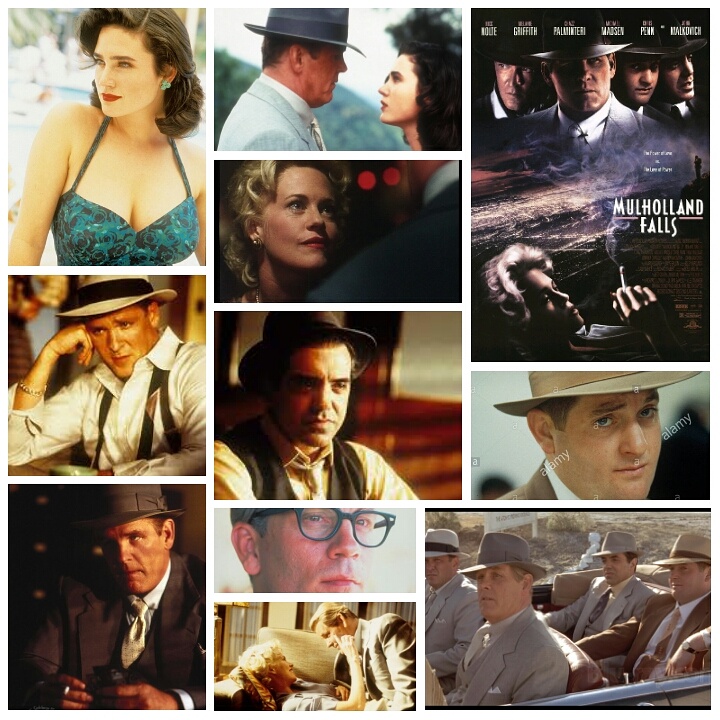
Lee Tamahori’s Mulholland Falls: A Review by Nate Hill

image

Lee Tamahori’s Mulholland Falls gets a bad rap in some circles for being boring and uneventful despite its charismatic cast and opulent setting that’s ripe for peppy action sequences. I think they are confusing boring with the concept of a paced and very slow burn, yet one with all the texture and richness of an action film, one that admirably decides to take the route of the old school noir, with loving care put into story and character, two elements which the action and violence live simply to serve, and not to take the driver’s seat against. Or it’s simply not some people’s cup of tea, which is totally okay too. Personally though, I love a good L.A. cop yarn that has a story to go with the toughness. This one bears striking similarity to 2013’s Gangster Squad, which also had Nick Nolte playing a 1940’s Los Angeles cop in charge of a squad that operates outside of the law. That film is pure cheese, all razzle dazzle and no plot. Mulholland Falls falls somewhere between Gangster Squad and L.A. Confidential; not quite up to delving into the serpentine intrigue of the latter, yet infinitely more interested in telling a worthwhile story than the former. And tell it does, in high flying style that only a crime film set in that time period can do. Nick Nolte plays Hoover, a whiskey voiced, take no prisoners LAPD badass who heads up an elite anti corruption task force that operates far outside the red tape and pretty much do what they want to stomp out corruption. His squad consists of Michael Madsen, Chris Penn and a scene stealing Chazz Palminteri as the oddball of the bunch, with serious impulse control issues. A straight up dream cast of tough guys, and although I’ll admit that Penn and Madsen are a tad underused, their presence alone boosts the film’s credentials into an epic pantheon. The film revs up with a kicker of an opening sequence in which the squad severely roughs up a troublesome mobster (an uncredited William L. Petersen). “This isn’t America, it’s Los Angeles” Nolte growls to him, stating the tone of perverse lawlessness which permeated the city back then. Soon he’s drawn into a tawdry scandal involving the murder of a young prostitute (Jennifer Connelly) who he previously had encounters with. The search leads him far and wide, crossing paths a sleazy photographer (Andrew Mcarthy), a dying air force tycoon (John Malkovich manages to ham it up even at his most laid back) and his stern lieutenant (Treat Williams). Nolte also has a poor jilted wife played nicely by Melanie Griffith in limited but effective screen time. The plot is hard boiled to the bone, with Nolte in one his most gruff mid career roles and loving every stressed out, rage fuelled second of it. The conclusion is his show, with a whacked out Palminteri in tow for a spectacular sequence set aboard a doomed military aircraft. The cast gets deeper, believe it or not, with Daniel Baldwin, Ed Lauter, Kyle Chandler, Titus Welliver, Louise Fletcher, Rob Lowe and Bruce Dern contributing gamely. This one’s got style on it’s side and then some, replicating a sense of time and place with the torque ramped up to near Sin City levels. Admittedly not perfect, but a pure and simple blast of a flick, in my opinion.