Twin Peaks: on the eve of revival – a rambling write-up by Nate Hill


When I first discovered David Lynch’s Twin Peaks some ten years ago, I was hooked from that first lilting chord of the opening theme, a Pacific Northwest lullaby that dreamily pulled back a red curtain to reveal the mesmerizing realm of sawmills, Douglas firs, cherry pie, secrets, metaphysics, owls, murder mysteries, eccentricities, FBI Agents, roadside diners and so much more. There was nothing quite like it under the sun. Lynch had tapped into the intangible flavour in the ice cream parlour, an undefinable conduit to the subconscious, an emotional fever dream of haunting music, beautiful storytelling and vivid, compelling character arcs, and I knew from that moment on I’d be living in this world, in whatever capacity, for the rest of my life. Since then I’ve seen the entire run of seasons one and two at least thirty to forty times, and watched Fire Walk With Me, Lynch’s big screen masterpiece and companion song to the show, even more. Twin Peaks is the one thing I can revisit at any crux of the story, during any phase of my life, and it will always draw me right back in like the beckoning grove of sycamore trees who stand as sentinels to the great beyond lying just around the bend in the woods. There was just one problem with it all: the show was tragically cancelled on the penultimate beat, a cosmic cliffhanger that left fans reeling and plunged the legacy into exile for decades, a vacuum left in air that once housed a worldwide phenomenon, which is the only way to describe what season one did not just for television, but for the arts themselves, a thunderous ripple effect that has inspired generations of fan culture and adoration. To quote another film that finds its home in the trees, “If you ride like lightening, you’re going to crash like thunder”, which in a way is what happened to Twin Peaks. That lightening was captured in a bottle, which unfortunately shattered to shards via a combination of network interference and creative differences. Needless to say, the thought of a possible return to the show was beyond low on my list of things that could happen, right down there next to dinosaur cloning. Life finds a way though, and so apparently does Lynch. When it was announced that he had struck a deal with Showtime for an epic eighteen episode return to those Douglas firs, the internet nearly imploded upon itself. The golden age of television had just gone platinum, for Twin Peaks is the cornerstone of a generation of storytelling, a mile marker of stylistic structure and expression that gave life to countless other legacies in its wake. If any fragmented, incomplete tale deserves another day in court, it’s Peaks. For a while we sat on our hands and held our breath, the words ‘too good to be true’ ringing around in our heads. After a few hitches in the giddyup, however, and some three years of development later, we have arrived on the day that the new season premieres, and it still hasn’t set in for me. Eighteen brand new episodes. All written and directed by the man himself. A titanic sized cast of Twin Peaks residents both old and new, from every walk of Hollywood, genre town, music world and indie-ville. It definitely does seem to good to be true, and yet here we are, on the eve of a television paradigm shift. Any new fans who have hurriedly made their way through the original series run for the first time should pause for a moment and realize just how infinitely lucky we are to get this, how special this truly is, and will be for the entire summer. I feel as though this will be the second wave of Lynch’s magnum opus, a stroke of creative brilliance that has come full circle, and in just a few hours time those beloved chords will once again flow out from our television screens, as the journey continues onward to a destination whose coordinates Lynch guards like Pandora’s Box. Come what may, I will be tuned in to whatever the man and his team of actors, artists and musicians have in store for us. See you in the trees.

-Nate Hill
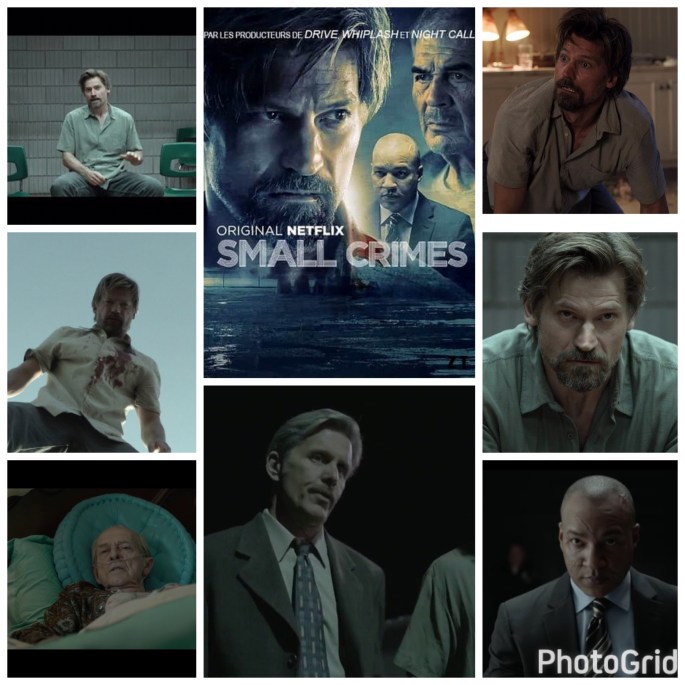
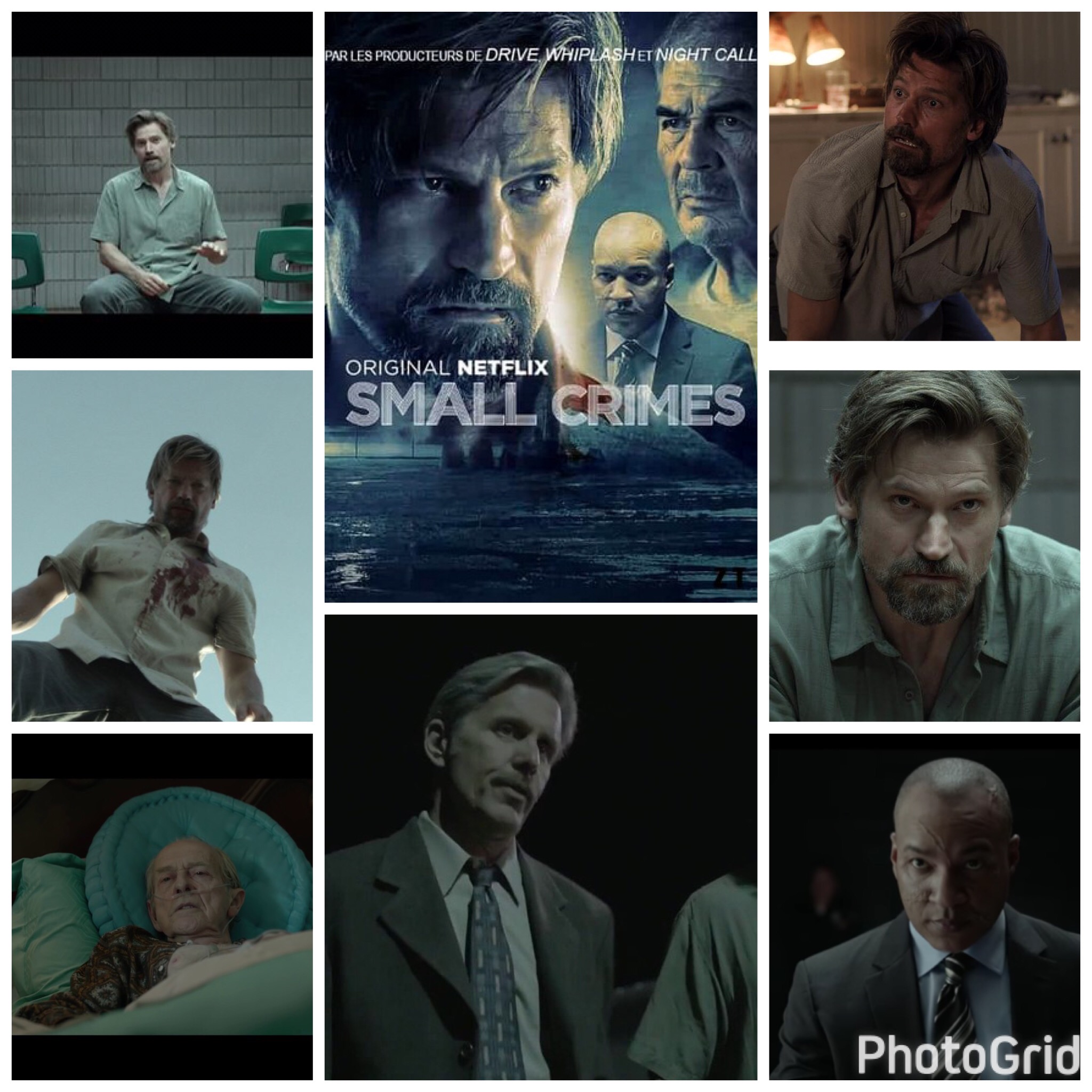
Netflix’s Small Crimes


Netflix’s Small Crimes is a bitter, barren, gnarled piece of work that leaves an uneasy vacuum in the air as it passes. If you haven’t heard of it yet, that’s because the platform does almost zero promotion when new content comes off the assembly line, quietly slipping it onto the site without so much as a tv spot. Some are forgettable, and some are gems that could have done with a bit of buildup. This one is like David Mamet, Cormac McCarthy and Elmore Leonard sipping whiskey sours one cold, empty night and brainstorming ideas. I love the time honoured themes presented here, but what I love and admire more is the filmmaker’s courage in completely subverting, perverting and putrefying the formula. There’s countless films about disgraced cops, criminals or what-have-you who return home to a small town with designs on putting the wrong things right and finding a modicum of redemption. Thing is, in 99.999% of these films, we end up with a happy ending where all the kinks are ironed out and bygones are left as such, a trend which really cripples the stakes and grinds our expectations down with a blunt, predictable Hollywood ending. Not this one. Nikolai Koster-Waldau, aka Jamie Lannister, is a wiry, cracked out ex con who used to be a cop, before he viciously, and I do mean viciously, sliced up the town DA at the behest of a crime kingpin. Moping back into the county following a six year stretch in the pen, it’s inevitable that his very presence will stir up a few noxious vibes. Sure enough, he runs into trouble from all angles, including the vengeful DA (“, looking like he shaves with a wheat thresher), a scummy corrupt detective (Gary Cole eats up the dialogue like candy), the mobsters he used to be employed by, and even his parents (Robert Forster & Jacki Weaver), who are clearly broken by the past. There’s a feeling of inescapable doom, an inevitable choking quicksand that Waldau wades deeper into,

his seemingly noble intent on reconnecting with his wife and daughters gradually ground away to reveal the true nature of his path, and it ain’t pretty. Gary Cole has a way with words and mannerisms, and he runs away with his bent cop role, stealing scenes like nobody’s business. Forster has salt of the earth gravitas in spades, and nails a near career best scene with clear eyed conviction, nailing our attention to his presence. It’s not a perfect film though, there’s pacing issues, sometimes it gets a little vague or scattered and a romantic subplot involving a nurse (Molly Parker) seems glaringly out of place. Waldau anchors it though, a twitchy, unpredictable ne’er do well who seems cosmically incapable of getting his act together. The ending floored my expectations and remind that there is hope for fresh narratives and abstract thinking amongst writers. You’ll come out of this one bruised, but you’ll be glad you sat through the beating. 

-Nate Hill

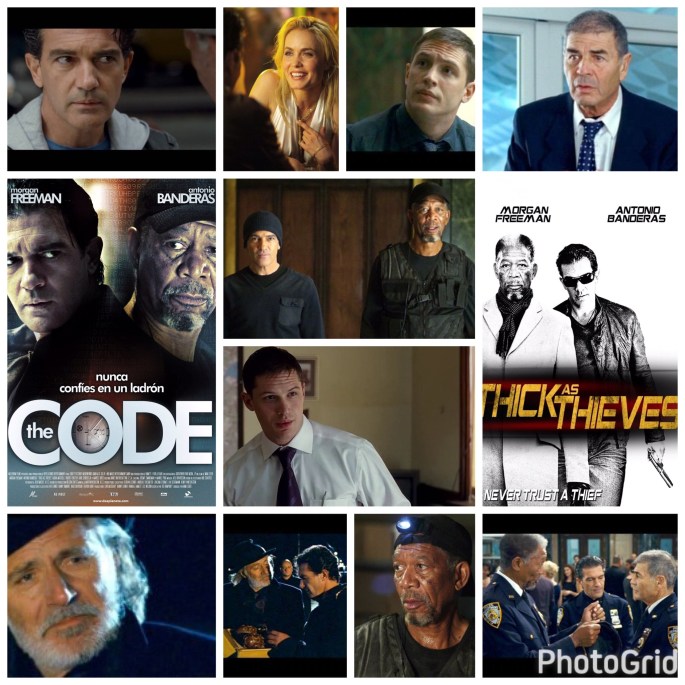
B Movie Glory: The Code


The Code, or Thick As Thieves as it’s known on DVD in some regions, is pretty much just Morgan Freeman and Antonio Banderas strutting their way through a B-grade, R-rated Ocean’s Eleven. It’s second tier stuff, but it has one hell of a cast and enough serpentine twists and betrayals to keep the viewer interested. Freeman plays a slick master burglar, recruiting Banderas’ younger thief to pull off one of those ‘impossible’ heists that requires all kinds of over elaborate planning and stylish execution. This is all in order to pay an outstanding debt to the Russian mob in the form of dangerous Rade Serbedzija, aka Boris the Blade, aka Boris the Bullet Dodger, who has a few surprising secrets of his own. All of them are also hounded by a classically dogged detective (Robert Forster, intensely excellent) and his rookie partner, who of all people is played by Tom Hardy in a role so small and random I’d love to hear the tale behind his casting. There’s also an obligatory love interest for Antonio, played by leggy Radha Mitchell. Now, it’s all mostly as pedestrian as it sounds, except for a few garnishing touches that elevate it just enough that it sticks in your memory. The master thief. The Ahab-esque cop. The vicious Eastern European gangster. The love triangle. Backstabbing. These are all ancient archetypes that have been done quite literally to death, and they’re all present and accounted for here, but there’s a few moments that genuinely surprise and break feee of that somewhat. Revelations involving the Russian who isn’t what he appears to be, a third act twist that feels welcome, and snares of dialogue that snap our attention amidst the cliches. For what it is, it does its job well enough, and a few times shows actual inspiration. Not bad at all. 

-Nate Hill

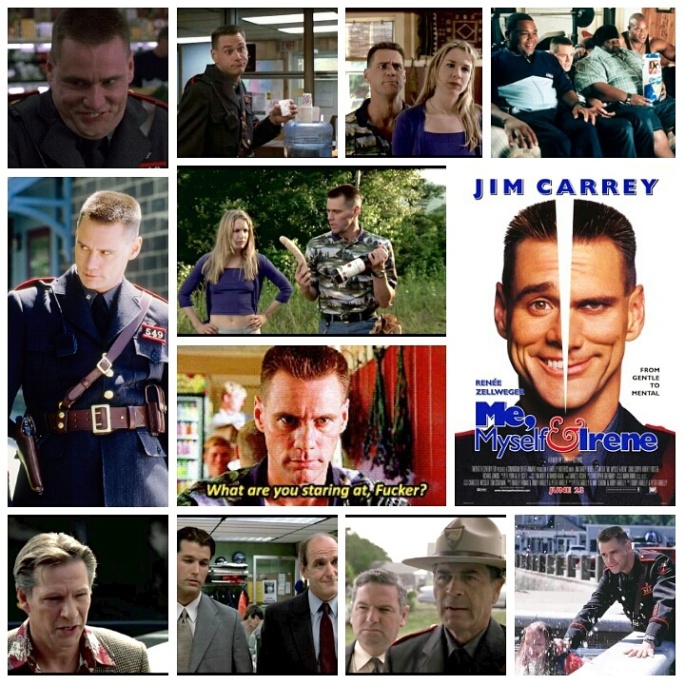
Me, Myself & Irene: A Review by Nate Hill 

Probably the most ridiculous outing the Farrelly brothers have ever taken us on, Me Myself & Irene cares not a whiff who it offends, how many eyes are rolled or how badly the scales of humour are tipped, or rather yanked, in the direction of extremely bad taste. With the exception of Stuck On You where they played it safe, every dirty little flick in their career is a testament to the utmost raunch in film, the very definition of lowbrow humour and never not flat out totally hilarious. Obesity, dates gone wrong, Amish people, conjoined twins, bowling, physical disability, they’ve tackled every scatalogical venture you could dream up. This time it’s mental illness, in a completely unapologetic depiction that will leave most people red faced, either from fuming or laughing their asses off. Jim Carrey plays Charlie, a meek little pussy who spends one day with his newlywed bride, before she’s whisked away by a black midget played by Tony Cox, who gets all the black midget roles, that little bastard. Charlie has a knack for never standing up for himself, and letting anyone walk all over him. He’s a Rhode Island State Trooper with no balls to back up his badge, and is pretty much the laughingstock of the town. All this bottles up and reaches a boiling point, resulting in a classic Carrey meltdown of rubbery expressions and spastic gutteral incantations. Emerging from the mess is Hank, Charlie’s abrasive, dysfunctional and borderline psychotic alter ego, a result of what the film imagines multiple personality disorder just must be like. Hank causes all hell, and the first time he shows up is the funniest bit in the film, an extended montage of hair raising antics that oddly seems to sum up the Farrely’s career. Charlie/Hank then get caught up in some intrigue involving beautiful Renee Zellweger, back when she was still Renee Zelweger. The scattershot story is just a playground for Carrey though, and this is some of the edgiest R rated mayhem he’s ever caused, guaranteed to arch the backs of some of the more, shall we say… *sensitive* folks we have to deal with running around these days. Charlie has three loudmouth black sons that were dumped in his lap, and they’ve now grown into profane geniuses who love their pops to bits, and it’s here the film finds its only bit of heart amidst the crass vulgarity. The baddies are the classic slimy Farrely cretins, a dirty cop played by Chris Cooper, and an unsavory golf club owner (Daniel Greene). Robert Forster makes a welcome appearance as Charlie’s Trooper boss, and keep a look out for Anthony Anderson, Cam ‘Sea Bass’ Neely, Richard Tyson, Lenny Clarke, and the always hilarious Richard Jenkins. Like I said, this is likely the lowest rung of the ladder in everyone’s career, but it’s a splendidly offensive, colorfully trashy piece of gross out bliss, and definitely the dirtiest of the Carrely team ups. Where else can you see Jim stare a five your old kid down and growl “What are you staring at, fucker?”

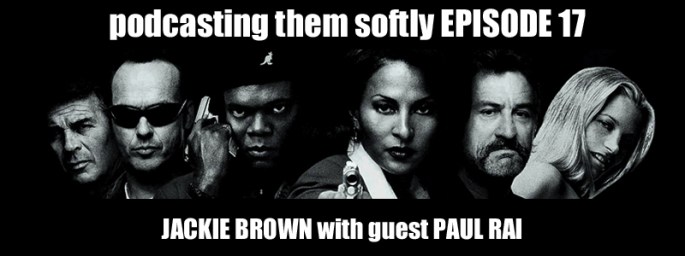
Episode 17: Quentin Tarantino’s JACKIE BROWN with guest PAUL RAI

EPISODE 17

We were joined with Facebook friend Paul Rai to discuss Quentin Taratino’s masterpiece JACKIE BROWN and Tarantino’s work in general.  It’s been a while since we’ve done a a regular podcast!  Enjoy!

QUENTIN TARANTINO’S JACKIE BROWN — A REVIEW BY NICK CLEMENT

1

Jackie Brown is the most mature film from Quentin Tarantino to date. It’s the Quentin Tarantino film that’s safe to show your parents. And I don’t mean that in an negative way – all of QT’s stylistic and narrative flourishes from his previous films were still on display, except this time, rather than being obsessed with guns and the messy violence that bullets can create, he was even more interested in his usual and extra-special brand of vulgar, beautiful poetry, this time stemming from the pages of Elmore Leonard’s classic novel Rum Punch. Resurrecting old movie stars has always been QT’s favorite thing to do, and here, he brought back both Pam Grier (lovely and clearly enjoying every moment of being front and center at that stage in her career) and Robert Forster (who gives what amounts to my favorite performance from any actor in any QT film – period) from the dust-bins of the 70’s movie graveyard, and gave them tons of room to shine with an amazing supporting casting including Samuel L. Jackson, Robert De Niro, Bridget Fonda, and Michael Keaton giving them tons of colorful back-up. Chris Tucker’s cameo is an all-timer, the visual texture resembles something old and tea-stained, and the funkadelic soundtrack grooves to a fantastic beat all-throughout. When it was released, the film received plenty of critical support, but looking back on it, I feel that people were more muted than they should have been. Expectations are inevitable, and sometimes dangerous, and the fact that Jackie Brown was not necessarily a logical follow-up to Pulp Fiction might have initially thrown some people for a loop. But over time, it’s become clear that QT was up to something very special with this piece of work, which feels both cut from his moving-loving-heart and the conventions of the crime drama, with enough to satisfy everyone on both sides of the coin.

2