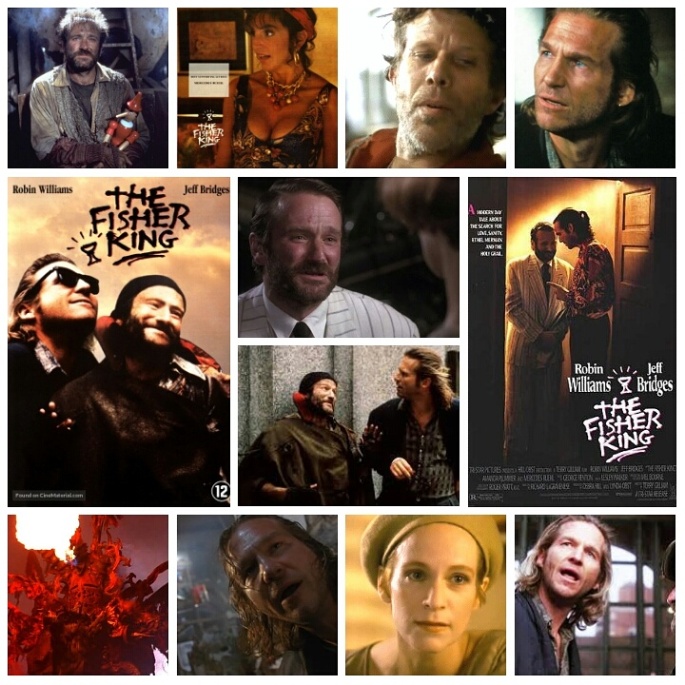
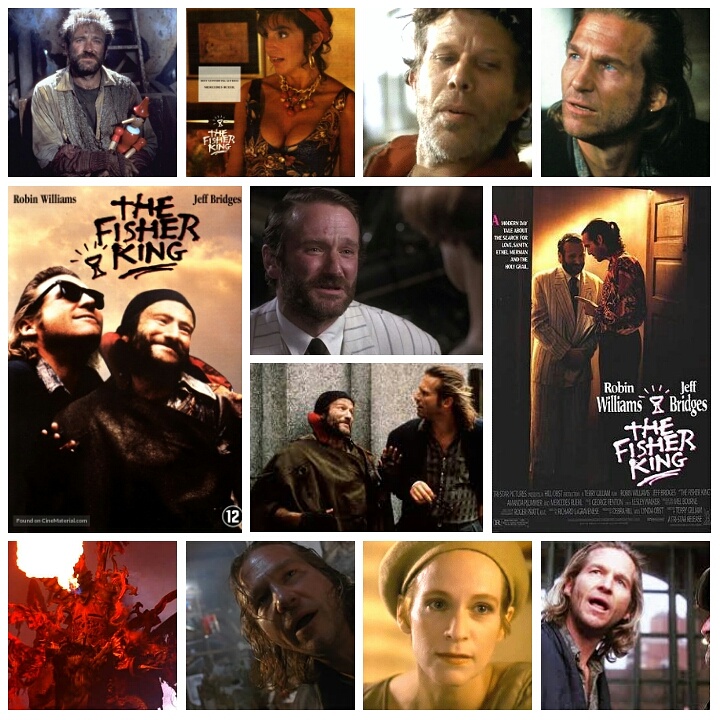
Tragic. Uplifting. Comical. Bittersweet. One of a kind. Terry Gilliam’s The Fisher King takes on mental illness by way of a fantastical approach, an odd mix on the surface, but totally fitting and really the only way to put the audience inside a psyche belonging to one of these beautiful, broken creatures. Sometimes an unlikely friendship springs from a tragedy, in this case between a scrappy ex radio DJ (Jeff Bridges) and a now homeless, mentally unstable ex professor of medieval history (Robin Williams). Bridges was partly responsible for an unfortunate incident that contributed to William’s condition, and feels kind of responsible, accompanying him on many a nocturnal odyssey and surreal journey through New York City, an unlikely duo brought together by the whimsical cogs of fate that seem to turn in every Gilliam film. Williams is a severely damaged man who sees a symbolic ‘Red Knight’ at every turn, and seeks a holy grail that seems to elude him at every turn. Bridges is down to earth, if a little aimless and untethered, brought back down from the clouds by his stern, peppy wife (Mercedes Ruehl in an Oscar nominated performance). They both strive to help one another in different ways, Williams to help Bridges find some redemption for the single careless act that led to violence, and Bridges assisting him on a dazed quest through the streets to find an object he believes to be the holy grail, and win over the eccentric woman of his dreams (Amanda Plummer). In any other director’s hands but Gilliam’s, this story just wouldn’t have the same fable-esque quality. Straight up drama. Sentimental buddy comedy. Interpersonal character study. There’s elements of all, but the one magic ingredient is Gilliam, who is just amazing at finding the way to truth and essential notes by way of the absurd and the abstract. Watch for fantastic work from Michael Jeter, David Hyde Pierce, Kathy Najimy, Harry Shearer, Dan Futterman and a quick, uncredited Tom Waits as well. The hectic back alleys and silhouetted trellises of NYC provide a sooty canvas for Gilliam and his troupe to paint a theatrical, psychological and very touching tale of minds lost, friendship found and the past reconciled.
Tag: Robin Williams
Christopher Nolan’s Insomnia: A Review by Nate Hill
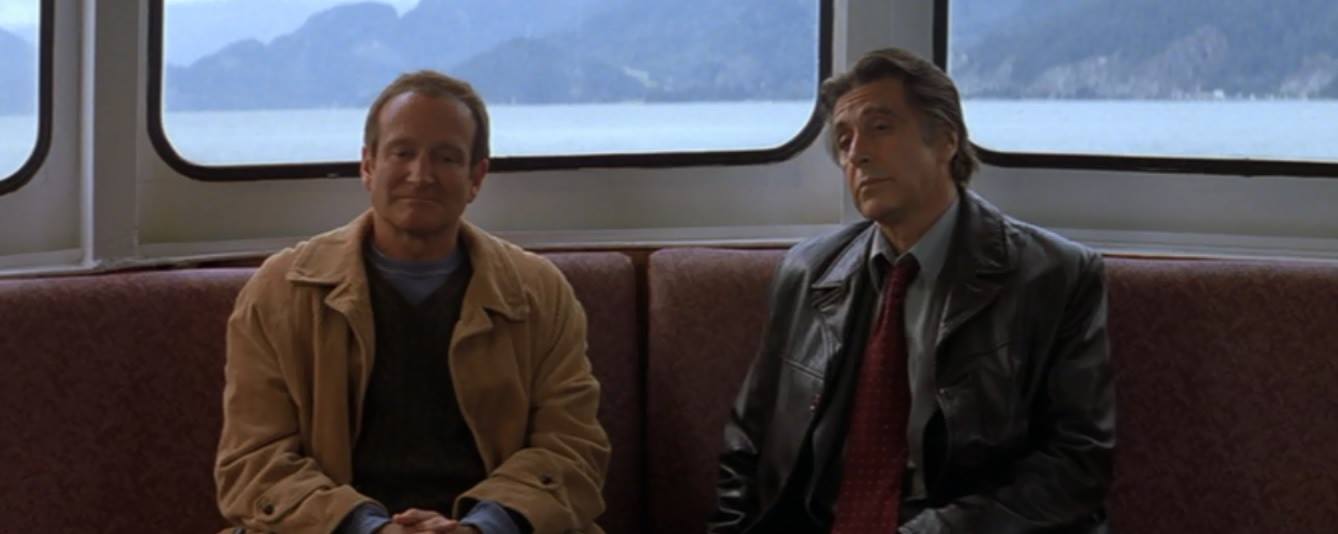
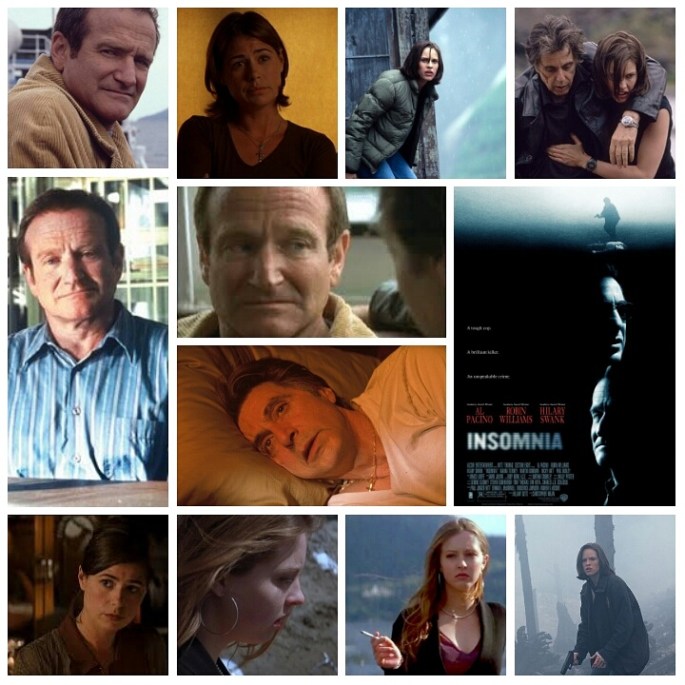
Christopher Nolan has a monumental filmography full of lofty cerebral ideas, superheroes mythic in nature, and incredibly complex morality plays. The one time he hit the road in a straight line is Insomnia, a fairly standard cat and mouse thriller given the obvious boost of having Chris at the helm, as well as two actors who get dangerously out of control, in the best possible way. Al Pacino plays Will Dormer, an L.A. cop who treks out to small town Alaska to solve the mystery of a murdered local girl. The twist: they’re in the region where it’s daylight for a month straight, and if that’s something you’re not accustomed to, it’ll throw you way off. It’s fascinating to watch Pacino roll in sharp as a razor and completely in control, then observe his lack of sleep eat away at the frills of his perception and start to play tricks on his weary mind. The film has one of those narratives that gives us a heads up as to who the killer is nearly right off the bat, in this case personified by Stephen King esque novelist Walter Finch, played by a vastly creepy Robin Williams. He and Pacino do an eerie dance through the foggy local geography and small, gaunt townscape, Pacino looking for clues and proof while trying to hold onto his sanity, and Williams unnervingly playing a macabre mind game, perhaps only for his own amusement. There are shades of Vincent Hanna in Pacino’s work here, the extremely stressed out LA detective from Michael Mann’s Heat. One gets a sense of the same world weariness and feral ferocity of that character, especially in a heartbreaking monologue to the local innkeeper, played by underrated Maura Tierney, who is brilliant in the scene that requires her mostly to listen, a much harder task than delivering any page of dialogue. As for Williams, he’s never really done anything this specific before. I mean, he’s played freaks and villains all across the board, but none quite like Walter Finch. He’s detached in a way that still clings to a humanity he may have lost through so many years writing stories that only happened in his head. He’s both dangerous and rational, and when those two are fuelled by emotional trauma… watch out, because there’s damage to be done. There’s further work from Hilary Swank as Will’s partner, Nicky Katt, Emily Perkins, Martin Donovan and edgy Vancouverite Katherine Isabelle, who just excels in anything, here playing the murder victim’s troubled best friend.
Now, this film is based on a chilly Swedish thriller of the same title, starring Stellen Skarsgard in Pacino’s role, and Williams nowhere to be found, naturally. I connected with Nolan’s version far more, the original seeming rather bland and lacking personality, but it’s got a huge following and a Criterion release, so what the hell do I know, go see for yourself. I do know that nothing stands up the hairs on my neck quite like the portentous back and forth between Pacino and Williams here, the icy inaccessibility of the central mystery and the feeling that there’s always something bubbling just below the surface of a seemingly civilized interaction. Barring Memento, which even rose to flights of fancy, this is the most down to earth Nolan has ever been in his exploration of the psychological landscape. Dreams, outer space, damaged memory and morality are for another day here. It strips away any of that, leaves it’s characters stranded in a misty, threatening environment that mirrors their own starkly layered perception, and sits back to observe. Rats in a maze of the human mind, if you will. It’s an important film in Nolan’s career for this very reason; a departure from ambitions grandiose in nature, a vacation from fantasy, and a forceful glimpse at two men with minds holding on by just a thread, like a spider’s web, beaded with dew in perpetual sunlight that refuses to set and give them solace. A masterwork of tension, with few instances of release.
Patch Adams: A Review by Nate Hill
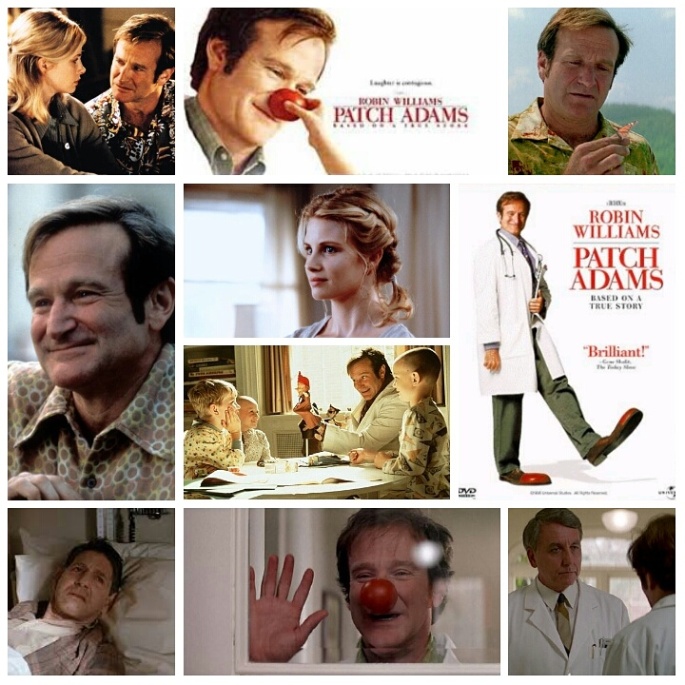
Yes, Patch Adams is a pile of sentimental mush. Yeah, the filmmakers took severe liberties with the source material until their protagonist scarcely resembled the fellow they based him on. Sure, it’s soppy to all hell. My thoughts on all of the above: So freakin what. None of that has stopped me from loving the film growing up as a kid, and continuing to do so these days too. The message it delivers and the values it supports can be relatable to anyone in any walk of life, not just the medical field. Robin Williams had his demons, but he could be the brightest beacon of love and optimism a lot of the time, and he carries that wonderfully throughout the film. Patch Adams is a manic depressive, deeply sad man who finds his calling in the field of medicine following an epiphany involving a fellow patient (Michael Jeter, always great) at the psychiatric facility he is staying in. Upon enrolling in medical school he finds the cold, clinical atmosphere of his field uninviting. Patch is a vibrant soul who wishes to combat illness and despair not just with medicine, but a healthy dose of humour, empathy and the readiness to listen to your patient, think outside the box and have compassion. His methods are seen as unorthodox, especially by the college dean (Bob Gunton), whose ass is so tight that when he farts only dogs hear it. Patch both struggles and triumphs, finding solace and inspiration in daily interaction with patients, and hits walls with his superiors, who neither trust nor understand his ways. It’s always an uphill journey for any sort of pioneer, but he soldiers on, aided by William’s remarkable work. Patch starts his own independent clinic along with fellow student and girlfriend Carin (the lovely and very underrated Monica Potter), and life is good. But it’s never safe from tragedy, as we tearfully bear witness to in a plot turn that will rip out your heart and huck it off a cliff. Patch is undeterred though, adamant in his quest to bring light, levity and love into the lives of the people he works with, regardless of how much time they have left on this earth, or who tells him what he should and shouldn’t do. That’s essentially what the story is about: helping others any way you can. That extends beyond simply trying to cure their disease, remove a tumor, prescribe a medication or diagnose an illness in a dry, detached manner. It’s about alleviating suffering not only with the tools of your practice, but with those of your heart and soul as well. Patch knows this, and won’t back down from the good fight. Bless his heart, and William’s too, for a performance of warmth and affection. Watch for work from Philip Seymour Hoffman, Josef Sommer, Ryan Hurst, Richard Kelly, Harve Presnell, Daniel London, Irma P. Hall, Barry Shabaka Henley, Alan Tudyuk and and excellent Peter Coyote as a stubborn cancer patient. There’s naysayers galore buzzing around this film like gnats. Swat ’em harshly, and don’t let ’em get you down. Those of us who appreciate the film know what’s up.
The Big White: A Review by Nate Hill
Snowbound location. Pitch black comedy. A corpse that’s central to the plot. The Big White was obviously influenced by Fargo, the Pulp Fiction of wintry crime comedies, but holds its own fairly well thanks to solid acting and writing. It’s nothing new or incredible, but it’ll get you your perversely humerous noir fix, and who can say no to Robin Williams, playing a pitiable travel agent who spies a risky way to end his financial problems. Discovering a frozen corpse, he has the brilliant idea to pass it off as his deceased brother and collect the insurance money. A few problems lie ahead: a dogged insurance investigator (Giovanni Ribisi), two moronic hitmen (Tim Blake Nelson & W. Earl Brown) and the small detail that his brother isn’t actually dead, and comes waltzing back into his life in the form of a rampaging, unstable Woody Harrelson. William’s spitfire wife (Holly Hunter) looks on in exasperation as her husband turns their lives into disaster, while everyone is somewhat clueless and misinformed, leading to great amounts of hilarity. Sound chaotic? It is, sort of. It’s also kinda laid back and deadpan enough to make the Coen brothers proud. Harrelson and Williams both bring their very different brands of manic, Williams I’m a forlorn desperate sense, and Harrelson just the unhinged wildcard. Alison Lohman is also running about, but it’s been so long since I saw it I can’t remember exactly who she plays. Fans of Fargo will be tickled, those with a weird sense of humour as well. Fun stuff.
Jumanji: A Review by Nate Hill
In the jungle you must wait, until the dice reads five or eight. So professes a mysterious board game possessed by dark magic to young Alan Parrish (Adam Hann-Byrd), a boy with no clue just how far an innocent roll of the dice can take you. From the first ominous drumbeat the game utters, until the last fading tones it plays the film out with, Jumanji is a giddy rush of pure adventure, with a refreshingly dark and primal side to its mayhem. Alan disappears from the 1950’s and we fast forward 25 years later. Young orphans Peter and Judy (Kirsten Dunst & Bradley Pierce) are moving into his old family home, so fate (and those damn creepy drums) would have them find the Jumanji in the attic, and continue the game Alan started with Sarah (Bonnie Hunt) over a decade ago. Suddenly every jungle creature, meteorological phenomenon and 90’s CGI monster erupts from the game into their little town, causing a mess that goes beyond the word havoc. This includes a near feral middle aged Alan, now played by Robin Williams. Together with a most reluctant Sarah, the quartet try to stop the destruction, play the game, but mostly just survive this onslaught. Psychotic monkeys, mutant mosquitoes, an elephant stampede, monsoons, giant spiders (fucking shudder) and crocodiles are but a few of the wonders awaiting them. My favourite has to be murderous Victorian game hunter Van Pelt, played mightily by stage actor Jonathan Hyde, with a pith helmet and an epic mustache that would make Kurt Russell chortle. Hyde does excellent double duty as both the deranged hunter and Alan’s stern but loving father, a tough contrast he handles like a champ. I admire the film’s willingness to go creepy and dark, despite being geared towards kids. The danger feels real, the game has an eerie mysticism to it, a life of it’s own that gives you goosebumps. Not often do family orientated films have a shred of real fear in them anymore, so let’s count our blessings with this one, still holding strong today. The special effects are dated in places (those monkeys, man) and wonderful in others (that hardwood floor quicksand tho), but you have to cut them some slack, it being 1996 after all. Williams and Hunt have snarky banter that barely hides their love for each other, and it’s one of my favourite onscreen pairings he ever had with a gal. He makes Alan resourceful, kind and just a little bit crazy, but the guy did spend years alone in a treacherous jungle straight out of your nightmares, so that can be expected. Amidst the chaos you can look out for Patricia Clarkson, a deadpan Bebe Neurith and David Alan Grier as well. There’s a lot of stuff crammed into the film, but never does it feel bloated or crippled by it’s own weight, flowing nicely and taking time where it can to develop character and give it’s human cast just as much to do as all the crazy jungle stuff. I’m surprised I never saw any of this go down as a kid, because parts of it were filmed blocks from my neighborhood, and CGI was scant back then, so much of it would have physically been there, large and loud. Maybe I did, and have since forgotten. I definitely haven’t forgotten any of the film, though, and allow for repeated viewings whenever I have the time. It’s one of the best, most thrilling adventure stories of its time and ages well as each year passes. Cue the drums.
One Hour Photo: A Review by Nate Hill
One Hour Photo is as stark and unnerving as the clinical, creepy photo negatives being developed in the darkroom of your local London Drugs, or whatever the equivalent is stateside. Back in the days before the social media boom, every single photographic memento passed through those hallowed halls, and through the hands of the hard working folks at the photo counter. One such person is Seymour Parrish (Robin Williams), a sweet, good natured guy with a subtle and growing offset in his personality. He loves his job, and finds solace and ritual in handling the precious memoirs of the masses, even getting to know many of them in a friendly manner. He takes a particular shine to the Yorkin family (Connie Nielsen and Michael Vartan), gradually becoming obsessed with the life they have that he observes through the constant stream of photos he develops. Friendly soon turns to freaky as he becomes a bit too fascinated in them, and he finally takes up the mantle of disturbed stalker, digging up dirty secrets they have that he has no right to know about, and even less to interfere with. It’s a nightmare for any unsuspecting family to got through, but the real horror story is Seymour’s damaged psyche, set off by this idyllic lifestyle he watches from haunted eyes. Williams has the hard task of making him sympathetic, which he does, but we are only willing to give pity at arms reach; this is a scary, twisted man we see, with demons bottled up so tight he isn’t even aware they exist anymore, until they come crawling forth for a psychologically naked and raw final sequence that will leave you reeling. An unpleasent film in almost every way, bathed in an eerie sickness that matches the sheet white fluorescent glow of the store that is Seymour’s world, externally and in his tragic, broken mind. Bring a steady set of nerves and a strong stomach.
Bobcat Goldthwait’s World’s Greatest Dad: A Review by Nate Hill
Worlds Greatest Dad is a true curiosity, a film I had to sit back and really think about right after I had watched it. It has such a strange arc, and wasn’t the pithy dark comedy I was expecting from the trailers. I mean, it is a pithy dark comedy, just not in the way you’d think at all. I still can’t even figure out if I liked the thing, but it wouldn’t leave my head for a while after, so it certainly has a kick to deliver, one that’s decidedly below the belt. Williams is Lance, a high school English teacher with traces of old world in his methods. He prefers to instruct his students in poetry, which makes him a bit unpopular, sadly. He also has an absolute snot nosed, shithead fuckwit douchebag of a son, played by Spy Kid’s own Daryl Sabara. Think my description of him is too harsh? Nah, son. This kid is a royal asshole of the highest degree, and one wonders what Lance did in a previous life to deserve such evil spawn. He’s a mean, spiteful, discouraging, porn addicted little piss stain, and ironically enough, it’s the spank material that results in his untimely death. I won’t say exactly how it happens, but for those who know what I’m talking about, he and David Carradine share an embarrassing fate. What’s curious is Lance’s reaction upon discovering the body: the kid treated him with nothing but disdain and disregard for years, but he’s still devastated. A father’s love, I suppose. He then writes a passionate suicide note and passes it off as his son’s, to hide the perverse truth. Everyone at the school, in town, even the local newspaper goes ballistic and praises the deceased boy’s work. Suddenly he’s a local hero, a beacon of hope for troubled youth everywhere, and a martyr to spur copies in flying off the shelves. There’s the joke, though. He was pretty much the worst person ever in the world, and now the writing Lance worked so hard on is being not only credited to, but hailed as that of his shitty dead kid. Even in death, one final jab of abuse bites back. Like I said, a very odd turn of events, and definitely like no other dark comedy, or other film, for that matter. When you consider this is a script by irreverent comedian Bobcat Goldthwait, who also directed, it’s easier to understand and appreciate the twisted nature of the story, and the places it goes. Williams is inspired, turning Lance from a sulky mess to a hero behind the curtain, finding his own life in Sabara’s demise, as wrong as that sounds. I guarantee you’ve never seen a film like this, and we probably will never get another just like it.
Disney’s Flubber: A Review by Nate Hill
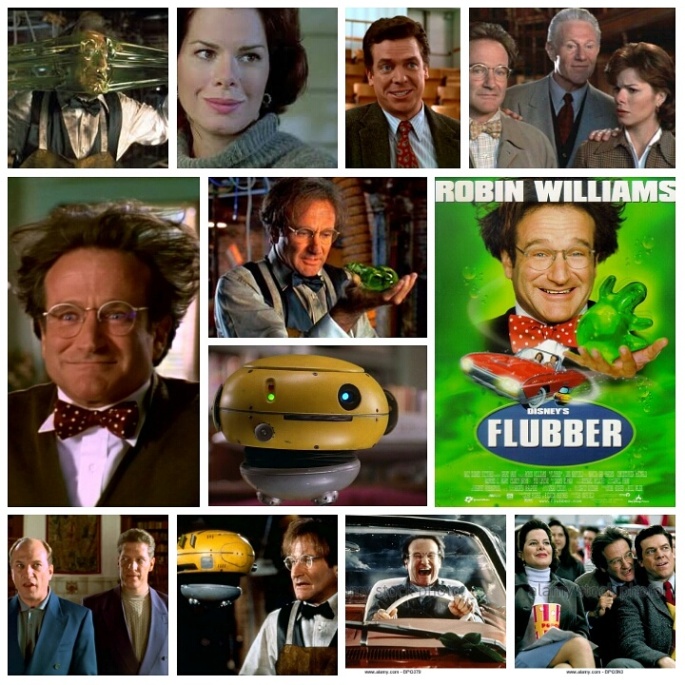
A remake of an old black and white Disney flick called The Absent Minded Professor that has long since gotten a bit stale, Flubber took all the best elements of that and breathed new 90’s life into the premise, most of the pep in its step coming from star Robin Williams. Keep in mind it was a critical bomb though, which just doesn’t make a shred of sense to me. It’s fun, lighthearted, hilarious and just a bit raunchy in places where it can pull it off. For whatever reason, it didn’t sit well with anyone other than fans like me who will furiously shove a copy in your face if we hear that you haven’t seen it. Williams is college professor Philip Brainard, who is so absent minded it borders on dementia. He leaves his lovely fiance (Marcia Gay Harden) at the alter TWICE, prompting the advances of irksome college dean Shooter Mcgavi- I mean Christopher Mcdonald. He’s on a quest, you see, an obsessive quest to find the formula for… something. That something turns up after a destructive whirlwind of disasters in his basement lab, and in the form of Flubber, a lovable ball of green goo, infected with incurable ADHD and an inexhaustible sense of humour. While the utter the life of the party, Flubber does have its practical uses, such as making cars fly and turning the hopeless varsity basketball team into a bunch of flying Tasmanian devils who nail every dunk. This all gets the attention of insidious local philanthropist and lowlife Chester Hoenicker (Raymond J. Barry) who greedily wants the discovery for his own. He sends his two goons Smith (Ted Levine) and Wesson (Clancy Brown) to rob Brainard of his precious sentient mucous, which turns into one of the most hilarious displays of slapstick comedy since the Three Stooges. Oh, did I mention Williams has a little flying UFO sidekick named Weebo, who has a perfect GIF reaction to everything, before GIF’s were even a thing? So much to love about this little classic. Williams is his usual buoyant self, with some of his trademark razor focus diminished in favor of doe eyed, vacuous forgetfulness that would make Jason Bourne guilty for ever whining about his predicament. Special effects are top drawer too, Flubber would look dapper in Blu Ray if they ever felt so inclined as to release one, not to mention aforementioned airborne automobiles and dear little Weebo. Can’t give enough glowing praise to this little treasure, and hiss enough venom towards those sourpuss critics who assaulted it. Flubber for the win.
CHRISTOPHER NOLAN’S INSOMNIA — A REVIEW BY NICK CLEMENT
Attempting a remake of any great film is always a questionable endeavor. I can remember seeing Erik Skjoldbjærg’s terrific Norwegian psychological thriller Insomnia at the theater on my college campus back in 1998 and thinking that an American remake would be rather pointless. The themes would never travel (especially the underage sexuality), how could one outdo Stellan Skarsgård, and how could a filmmaker capture that eerie atmosphere in a new and unique way? It was never going to be an easy task, but Christopher Nolan continued his hot streak with his stylish and underrated 2002 updating, which felt like the next logical step for him as a filmmaker after his breakout indie success Memento. Al Pacino gave a tired and tortured lead performance as a cop struggling with intense inner demons not to mention the inability to get any sleep; this is a film that touches on noir (daytime noir!) and the serial killer genres but still remembers to load the narrative with interesting character beats and small bits of surface details that all add up to a riveting mystery. Robin Williams gave one of the best performances of his career as a chilling psychopath who always seems to be one step ahead of Pacino and the authorities – that chase sequence he has with Pacino across those drifting logs in that chilly river is spellbinding stuff, with Nolan using incredible sound effects and expert spatial geography to heighten the tension. Williams brought a devilish smile to numerous scenes, and his unpredictability always kept you guessing, even within the relatively predictable confines of studio based genre entertainment. Martin Donovan, Nicky Katt, Hilary Swank, and Maura Tierney all offered solid support. This was a nervous, jittery piece of work from Nolan, who would later fashion a more controlled, rigid aesthetic in Inception and The Dark Knight trilogy (The Prestige looks even more unique these days) before moving on to his magnum opus, Interstellar. Wally Pfister’s slick yet gritty cinematography worked in perfect tandem with David Julyan’s haunting music and Dody Dorn’s taut editing. Remakes of already excellent films are rarely this effective.