WRONG: DULL ISLAND

kong-skull-island1

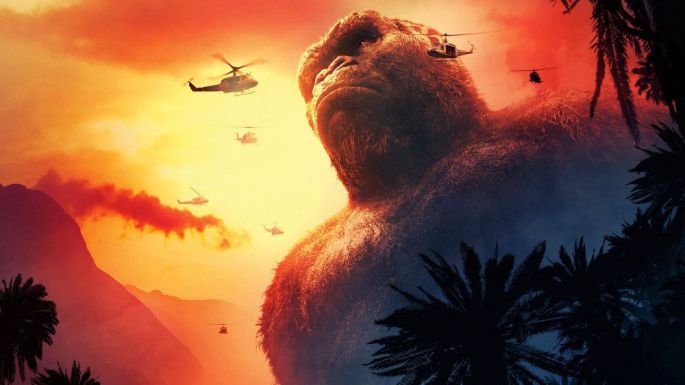
He’s bigger, he’s better and he’s back. He’s King Kong, and this time he is not going to be dragged off Skull Island and taken back to civilization to be paraded around till he takes exception to being someone’s meal ticket, breaks loose his chains and starts a city smashing rampage which ends with a barrage of bullets and a long fall to the asphalt below.

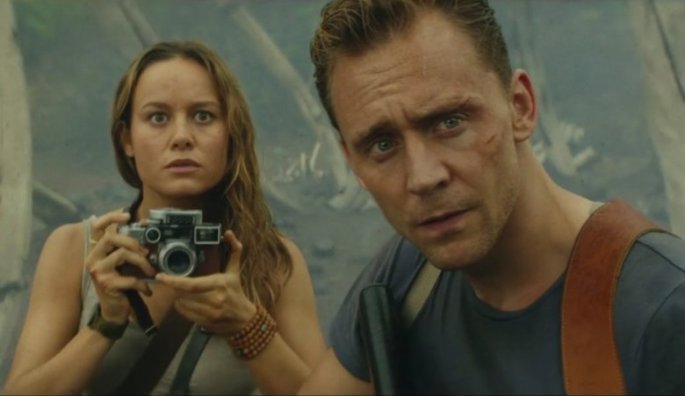
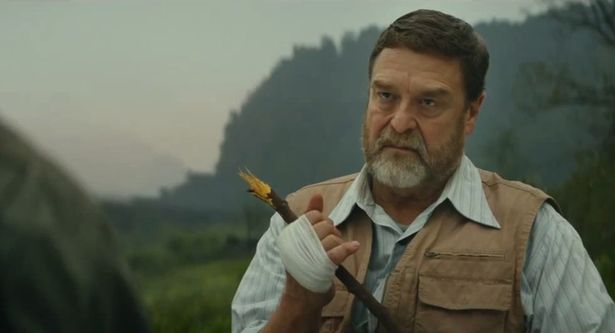
No folks, this time round Kong, now the size of a mountain, is hanging out and keeping the peace on his island. That is until and group of curious humans, led by an alleged Bear Grylls, Tom Hiddleston, Oscar winner Brie Larson who shifts between looking wide-eyed at things and taking photos, John Goodman who knows the truth is out there and Samuel L. Jackson. When you absolutely, positively have to kill every monkey in the room – accept no substitute. This group headlines a cast of who-gives-a-shit characters on a trip to Skull Island where everything is big. Even the ants apparently, but that’s a set piece too far.
Kong-Skull-Island-Trailer

The journey to the island is mandatory – montage and music stuff. Then we break through the perpetual storm clouds and have ourselves a bit of an Avatar moment as the crew marvel at the grandeur and beauty of this lost wilderness. Then Kong shows up and goes apeshit. He smashes up the Apocalypse Now homage and then walks off to enjoy a little calamari, ’cause they just don’t make bananas that big. So,  with the cast all over the place, Tom and snap-happy Brie and their group are headed from the rendezvous point, Sam and John and that guy who played Private Wilson in Tigerland, plus the other soldiers are off to get some more guns to aid in Sam’s desire to turn the King into fried funky monkey meat.

There’s a giant spider that should make Jon Peters happy. There’s the Watcher in the Water moment. The Soldier who writes to his son bites it, or gets bitten by something unusual, but we don’t get the exposition till we meet up with John C. Reilly looking like his character Gershon Gruen from The Extra Man, minus the collection of souvenirs and the no-testicle high voice. This guy though gives the film a pulse. Oh, and he was the pilot from the beginning, SPOILER! He’s been hanging out on the island with the tribe that speech forgot, waiting to come in and add some much needed comic relief. Turns out there are huge nasties that you can call whatever you want under the ground that Kong has kept from emerging to prominence and getting there own spin-off movie.
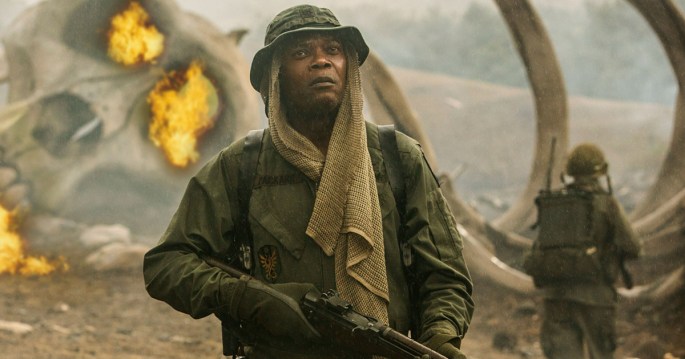
10-apocalypse-now-kong-skull-island_w1200_h630

This task used to be in the hands of more Kongs, but there is a ‘big one’ of these things that lay waste to them. Now Kong is the only one left who can keep cool, sit tight and keep the creatures in there holes. Of course this film falls into the cash-cow category. They brought back Godzilla, now they make a Kong that’s to scale, in order for the pair to have a decent scrap. But sadly it is a joyless ride. Predictable, laughable, with (and I’m quoting a prior review I’ve read) cardboard cut-out characters that are simply there to fill in the time between Kong and his monster-bashing bits. Heck my son started talking at least 45 minutes out from the end. This tells me that he is board out of his mind and I was with him. But I tried to hang on. I did not fall asleep like I did after the first fifteen minutes of the Conan remake. I have since completely avoided the try-again versions of Clash of the Titans, RoboCop, Ben Hur, Point Break, Total Recall as so on and so forth.

There is a line from James Ivory’s Surviving Picasso in which Anthony Hopkins, as the title character, refers to the methods of artists who have found fame and fortune. He says they make themselves little cake-molds and bake cakes, one after the other, all the same. He then  stresses to Natascha McElhone’s Francoise, not to become your own connoisseur. This is extremely relevant and typical of the modern Hollywood. There is little to no attempt at originality, and if there is, it takes place within a film that fits into the friendly confines of a pre-branded property.
kong-skull-1

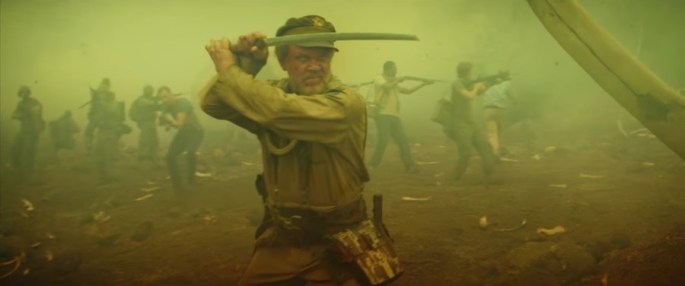
But the big ape lives and walks off into the center of his jungle home. He survives his encounter with dim-witted humanity, only to go off and fortify himself for the coming sequels and, quick note on cinematography, Larry Fong gets to send a love letter to his buddy Zack Snyder with a little samurai sword in green smoke action. We have reached that point in the history of the movies dear readers, in which the dead horse has been flogged so often that they have been whipping the bones. Soon all that will be left is the dust of said bones under foot. What are we to expect then? I’m reminded of one of Kevin Costner’s lines from his summation speech in JFK, “perhaps it will become a generational thing.” Ten years goes by  and it’ll be, “Well, time to drag a King Kong movie out again.”

Sam Jackson buys the farm much like he does in Deep Blue Sea, swiftly and unexpected, at least for him. I’m starting to believe Hollywood is looking at us the same way. Here we stand, full of confidence, about to witness triumph in whatever form it may appear. Then it becomes like the lead up to the first ever screening of the Phantom Menace. The audience was cheering, poised, ready for the planets to align in complete and utter harmony. The Fox logo. The Lucasfilm logo. A long time ago, in a galaxy far far away. Star Wars. If you watch the documentary The People Vs. George Lucas, one interviewees describes this as perhaps one the greatest moments in cinema history, then, then the film started.

I think it is a frequent occurrence today. There is so much pomp and pageantry surrounding these tent-pole movies that more often than not bad, because to achieve the same level as the hype generated is near impossible. Mind you, there are a few that defy this convention but they are few and far between.

So my favorite Kong is still the one I grew up with, the John Guillermin 1976 version.

People tell me they hate that one too. But to each his own. Kong will most likely be back in a decade after this lot. He’ll be half the size of the planet, ripped and ready to rumble against the Independence Day giant aliens when they decide to return to the best place in the universe, Planet Earth: home and the re-imagination of the adaptation of the sequel of the remake.

He’ll take a huge crap in his mighty hand and fling it at them. Oh if only…

The Dude in the Audience

flat,550x550,075,f.u1

Writing with Fire: An Interview with Matthew Greenberg by Kent Hill

Chatting with Matt felt like getting together with a buddy you’d been out of touch with for too long. He is an explosion of wit and joy; even though he works in a town that can at times be a realm of foreboding dread.

“I failed at everything else,” he said, when I asked him how he came to be an adventurer in the screen trade. Matt has felt the highs and the lows – he has climbed up the mountain that is the film industry, slipped, and started climbing again. Yet, even with broken fingernails, he has managed to pen a wild array of movies. They’ve a little of everything in them that a growing boy needs as part of his complete breakfast: from faceless killers to fire-belching dragons to spooky hotel rooms. They may in part be “significantly different” from the scripts he turned in, but if you listen to Matt, that same exuberance and enthusiasm he carries for his work manages to make the final cut.

He came to Hollywood with enough money to buy a plane ticket (that got him there) and a car. Since then he has made it – in place where momentum is everything and the decisions handed down from the hierarchy don’t always make sense. From that place where all the leaves are brown and skies are grey, Matt showered me with tales of his journey through the savage land known as Hollywood and how with a genteel parlance, you may perhaps survive.

Ladies and gentlemen, I give you, Matthew Greenberg…


Hard Eight: A review by Patrick Crain


The screen is black and the opening credits begin. The first thing we hear is a dirge called Clementine’s Loop, composed by Jon Brion. The mood it pitches is stark and foreboding. The audience is immediately keyed in to the notion that the next 102 minutes will probably not be a reflection of the life-affirming highlights of the characters’ lives.

When the image comes up, we’re outside a Denny’s. Well, a reconverted Denny’s. The world of Hard Eight is one of unshakable reputations; it can say Ray’s Cafe on the sign but it’s still a Denny’s that has been broken down, sold off, and is quietly functioning in its new skin. Walking towards this cafe is Sydney, a shadowy, yet direct man who, seemingly at random, offers to buy a poor stranded soul named John a cup of coffee.

It seems appropriate to note that, once upon a time, Peter Yates directed Robert Mitchum in a film called the Friends of Eddie Coyle which was not too dissimilar from Hard Eight. Set in the less-cinematic parts of Boston, that film chronicled the lives of the lowest-level functionaries in the organized crime business; bottom feeders who would feed on each other if need be. And in that film, everyone spoke with a clarity that ensured that whoever was listening understood what was said and what was not being said.

Hard Eight is very much like this world. In the earlier film, Robert Mitchum got to put the fear of God into a hot shot gunrunner by explaining why you never ask a man why he’s in a hurry. In Hard Eight, Sydney helpfully reminds John never to ignore a man’s courtesy. In both scenes, the veteran looks dog-tired and slow but you never once doubt his wisdom and respect the commanding way he delivers it.

In Hard Eight, Sydney is played by Philip Baker Hall and John is played by John C. Reilly. During the course of the opening scene, we will learn just enough about each character to want to tag along with them; Sydney is a well-dressed, professional gambler and John is a sweetly dim loser who only wants to win enough money in Vegas to pay for his mom’s funeral. Fifteen minutes into the film, we’re hanging on Sydney’s every word and John’s receptiveness to them. By the time sad-eyed cocktail waitress-cum-prostitute Clementine (Gwenyth Paltrow) and reptilian casino security manager Jimmy (Samuel L. Jackson) are added to the mix, we slowly begin to see the ingredients of disaster come together and, like John, we look to Sydney for his guidance and trust his every movement. For there’s no doubt he’s seen disaster before.

What’s most astonishing about the debut film of Paul Thomas Anderson is how subdued it is, Made by a young man of 26, Anderson refuses to fall into the trap that 99% of nascent filmmakers do which dictates that one must be as flashy as possible by jamming in as many cinematic references and tricks that they can. In his first time out as a filmmaker, Anderson shows a real maturity in his restraint and his ability to approach material correctly and there is an amazing wisdom in the dialogue.

The film’s setting is interesting, too. Like Robert Altman’s California Split, Hard Eight takes place in the unglamorous world of daytime nightlife. Garish hotel rooms, eerily desolate roads, and the sparse, Wednesday afternoon crowd in dumpy Reno casinos are all writ large on cinematographer Robert Elswit’s wide canvas. And John Brion’s Hammond B3-laced score injects the right amount of lounge-lizard sleaze into the atmosphere. The characters and plot, a potent blend of a Jean Pierre Melville’s Bob Le Flambeur, Louis Malle’s Atlantic City, and an Elmore Leonard novel, mix with its harsh, cinematic world in such a way that you can smell the stale cigarette smoke on every frame of film.

To achieve this, a film has to be extraordinarily observant and meticulous in its details. Take, for instance, a scene in which Clementine, who has to leave town with John in a hurry, gives Sydney instructions for feeding her cats and how to unlock her apartment door with a key ring we never see, but can hear is ridiculously overloaded with keys and trinkets. It’s not played for laughs and it doesn’t even call attention to itself. It’s simply a detail that serves as a reminder that Anderson knows characters like Clementine; someone who sadly, and in the name of basic survival, gives so much of herself away that overloading her keychain with goofy charms and ephemera seems like one of the few remaining frontiers of self-expression and individuality.

As well-realized its world and well-written its dialogue, Hard Eight is, above all, an actor’s film.

Philip Baker Hall, an actor who before Hard Eight was mostly known as Richard Nixon in Robert Altman’s film adaptation of Secret Honor, got one of the biggest gifts from the gods with a role for the ages. Stoic and precise, Hall gets the immense actor’s pleasure of both being able to express himself with his stoney face and the right to spit hot-fire lines of dialogue like “You know the first thing they should have taught you you at hooker school? You get the money up front.” It’s a performance of masterful skill, immense control, and sheer perfection. I’ll fight the man, woman, or child that disagrees.

John C. Reilly can never get enough credit and is one of the finest character actors working today. In Hard Eight, he turns in one of his greatest performances as a truly pitiful lug who needs a hug and an emotional anchor. While Hall is tasked with the heavy lifting during the scenes of severe gravity, Reilly gets a few astonishing moments of emotional counterbalance, most especially during a telephone conversation in a key scene in the film’s third act. Also bringing the lumber is Gwenyth Paltrow who summons up the depressing cheapness that runs through her character while also making her vulnerable and human. It helps that her character is the hooker with a heart of despair and loneliness, not gold and half of the time her smeared lipstick makes her look like a clown that escaped a black velvet painting.

Fourth-billed Samuel L. Jackson brings fire to the film as the charismatic yet crudely loathsome security manager who knows everything that goes on in, and out, of the casino. With his wide grin, his maroon leather jacket, and his driving gloves, Jimmy is a study in someone who wouldn’t know class if he fell into it, yet is supremely lethal and projects a menace that, once he’s introduced, hangs like a pall over every remaining second of the film.

Looking back on how Hard Eight was marketed, it must be said that the trailer for the film is ridiculous. Obviously cut to capitalize on the then-red hot Samuel L. Jackson and Quentin Tarantino vibe, the film was marketed as a explosive fire of witty banter, cool Vegas shenanigans, and gritty gangster action. To give the film more of that post-Rat Pack fetish vibe that washed all over indie cinema in the mid to late 90’s, the trailer assigns face-card titles to the characters (Gwenyth Paltrow is the Queen!). That the film had none of the aforementioned elements probably surprised the few that were able to overcome the distributor’s shameful mismanagement and see it in a theater. For some, the surprise was likely a let down. Regardless of quality, there was an audience that ate up every single post-Pulp Fiction-ish film indiscriminately. This, by the way, is how the noxious Boondock Saints, the Sublime of the Pulp Fiction wannabes, ever became the hot property it did. If a film didn’t have that same pop, slash, and burn, it was chucked as boring. And Hard Eight doesn’t have that pop. Despite the use of a quick pan here or there and one tremendous tracking shot of Sydney moving like a shark across the casino floor, the film’s dynamism comes solely and bravely in its silences and what it doesn’t say. The electricity it emits is a slow burning charge that feels confident.

But, finally, Tarantino fashioned the mood of Pulp Fiction after those deliciously chosen pop tunes, Anderson fashioned Hard Eight after a Tom Waits song; a broken boulevard of heartache and misery where, after an evening of carnage, one can merely adjust their coat sleeve to cover up the bloodstains and move about their day unmolested.

hard-eight-poster

MARVEL’S THE AVENGERS – A REVIEW BY J.D. LAFRANCE

Scarlett-Johansson-The-Avengers-movie-image

The Avengers (2012) was the culmination of an ambitious project that was carefully planned by Marvel Studios over several years and spans several films utilizing characters, both major and minor, from each. While the notion of a shared universe with characters from one franchise appearing in another is a relatively novel idea in film, it is nothing new in comic books where costumed superheroes cross-pollinate all the time and even contribute to a larger story (see Secret Wars II). With Iron Man (2008), Marvel decided to do in film what they’ve been doing in comic books for decades. Its commercial success paved the way for subsequent adaptations of The Incredible Hulk (2008), Thor (2011) and Captain America: The First Avenger (2011), each one featuring a scene that hinted at something bigger and it has finally arrived with The Avengers, which features heroes from all of these films banding together to form a super team of sorts.

The challenge that Marvel faced was to find a director that could successfully bring all of these wildly different heroes together and also handle the movie stars playing them. Up to that point, Marvel had employed journeymen studio directors like Jon Favreau (Iron Man 1 & 2), Louis Leterrier (The Incredible Hulk) and Joe Johnston (Captain America: The First Avenger). But with Kenneth Branagh directing Thor, it was the first time the company had hired someone with auteurist sensibilities since Ang Lee and his fascinatingly flawed yet ultimately ill-fated take on the Hulk in 2003. And so, the hiring of Joss Whedon to direct The Avengers surprised some. With only one feature film on his resume – the cult film darling Serenity (2005), and known mostly for his television work on Buffy the Vampire Slayer, its spin-off Angel and sci-fi western Firefly, there was some question if he could handle a $200+ million blockbluster populated with movie stars.

Whedon got his start as a screenwriter and honed his chops over the years on T.V. sitcoms and as a prolific and often uncredited script doctor (Speed, Twister, etc.), but more importantly were his hardcore comic book fan credentials, having actually written a brief run for The X-Men, so he knew how they worked in terms of dialogue, plotting and depicting visual action – perhaps the most important criteria for The Avengers gig. It was a calculated risk that paid off as the film amassed an impressive box office result and received strong critical response.

The Tesseract, a powerful energy source that was featured prominently in both Thor and Captain America, has activated itself and appears to be trying to open a portal to outer space. Sure enough, exiled Norse god Loki (Tom Hiddleston) arrives with the intention of using it to take control of Earth and enslave its inhabitants. To this end, he brainwashes brilliant physicist Dr. Erik Selvig (Stellan Skarsgard) and S.H.I.E.L.D. (a top secret government organization) operative Clint Barton a.k.a. Hawkeye (Jeremy Renner) to help him do his bidding. This doesn’t sit too well with S.H.I.E.L.D. director Nick Fury (Samuel L. Jackson) and he decides to enlist Earth’s mightiest heroes to stop Loki.

This includes Russian super spy Natasha Romanoff a.k.a. Black Widow (Scarlett Johannson) who quickly finishes her “interrogation” of Russian gangsters to approach Dr. Bruce Banner (Mark Ruffalo), a philanthropic scientist now staying “off the grid” by working in the slums of India and trying hard not to unleash his Hulk persona, a being with superhuman strength that is off the charts. Captain America (Chris Evans) has been thawed out since being trapped in ice at the end of World War II and is still trying to sort things out with Fury’s help. S.H.I.E.L.D. also approaches Tony Stark a.k.a. Iron Man (Robert Downey Jr.), interrupting his work on a clean energy source. Norse god of thunder Thor (Chris Hemsworth), and Loki’s adoptive brother, is the wild card, arriving out of nowhere to intervene when Iron Man and Captain America attempt to capture him, resulting in an impressive skirmish. This all builds up to a spectacular climactic battle between Loki and an alien army that comes swarming out of the portal created by the Tesseract and the Avengers.

With the unfortunate exception of Jeremy Renner, the entire cast gets a chance to flex their acting chops the best they can between massive action set pieces. Mark Ruffalo, the third person to play Banner after Eric Bana and Edward Norton, really nails the human side of his character, playing him as slightly twitchy and paranoid drifter. He appears confident (because, hey, he can turn into the Hulk) yet distracted – a jumble of emotions. This is easily the best representation of the Hulk on film, both visually in terms of CGI and also how he’s portrayed – as a rampaging monster – the Mr. Hyde to Banner’s Dr. Jekyll.

Not surprisingly, Robert Downey Jr. gets the lion’s share of the funny quips – he was born to spout Whedon’s witty dialogue. It is a nice return to form after the cluttered rush job that was Iron Man 2 (2010). Based on Whedon’s perchance for having prominent strong-willed female characters in his projects, Scarlett Johannson’s Black Widow gets a beefed up role and proves to be an integral part of the team. Not only does she show off a considerable physical prowess but she also holds her own against the likes of Robert Downey Jr. and Mark Ruffalo.

Chris Evans and Chris Hemsworth carry on with their characters from their respective films without missing a beat, each adding their own unique flavor to the team. In particular, Evans does a good job when Captain America steps up and takes tactical control during the war in New York while Hemsworth has some nice moments with Tom Hiddleston as warring brothers who just happen to be gods.

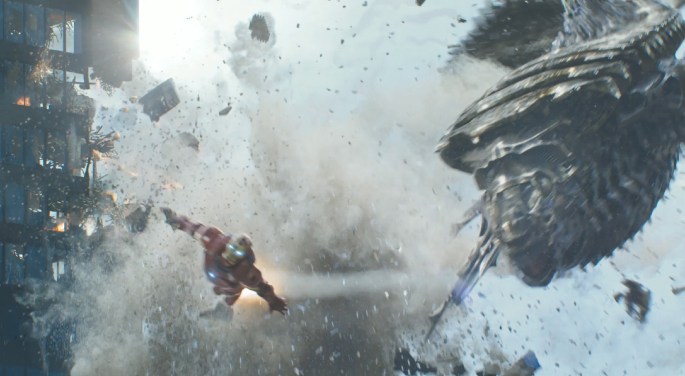
The Avengers is chock full of eye candy for comic book fans, from the S.H.I.E.L.D. Helicarrier to actually seeing superheroes fight each other – something, oddly enough, you don’t see in most films but that happens all the time in the comics. It is pretty cool to see the likes of Thor, Iron Man and Captain America duke it out while engaging in playful superhero banter. Unlike the other Marvel films starting with and including Iron Man, Whedon creates a real sense of danger for our heroes. There’s a feeling that they might fail and this tension is thrilling because it is so rare in these kinds of films, except maybe The Dark Knight (2008). It also raises the stakes when Whedon’s film needs it because there is a real sense that the Avengers are fighting for something tangible. He gives them something personal to fight for than just the usual let’s save the world goal. This culminates in the climactic battle in New York City between Loki and his alien army and the Avengers in one thrilling sequence after another, each filled with large-scale slugfests. The choreography during this massive battle is top notch. There is never any confusion as to what is happening and where, which is quite refreshing. The end result is pure, unfiltered comic book geek nirvana.

avengers2The Avengers falls rather nicely within Whedon’s wheelhouse as it is all about a group of misfits that band together to save the world from a great evil, just like Buffy the Vampire Slayer, Angel, Firefly, and so on. It doesn’t get any more disparate than a Norse god, a billionaire playboy, a World War II super soldier, a brilliant scientist, and two spies. Like much of the aforementioned work, the heroes in The Avengers bicker and fight amongst themselves but when the need to step up for the greater good arises, they put their differences aside and make a stand together. Loki continues in the tradition of eloquent Whedon villains who are incredibly confident because, well, in his case he wields great power and knows it. However, Loki isn’t just out to rule the world. For him, there is a personal component – he seeks vengeance for the slights he feels were incurred in Thor. This film was a great way to kick off the summer blockbuster season in 2012 and is a potent reminder of what a filmmaker who knows how comic book works can do if given the chance. The result is a smart, witty film that is a throwback to entertaining, crowd-pleasing comic book adaptations like Superman: The Movie (1978) and Batman (1989).
Sea Of Love: A Review by Nate Hill

image

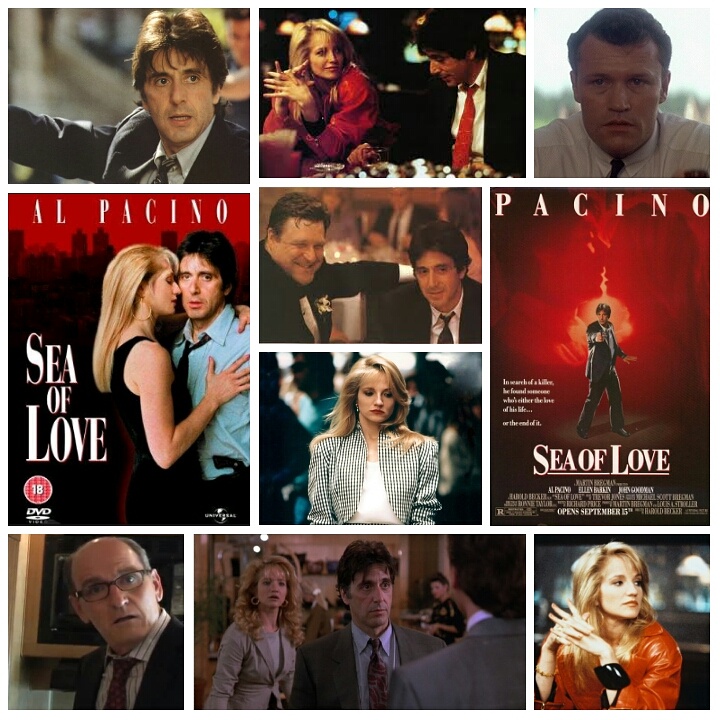
Sea Of Love is one of my favourite romantic thrillers of the 80’s. It’s perfectly structured, riveting the whole way through, and just as steamy as you’d imagine a pairing between Al Pacino and Ellen Barkin to be. It’s so well made that we don’t even notice pieces of the puzzle falling into place until the image they make is staring us right in the face and we sheepishly snap out of the sensual trance the film has laid upon us. It’s never too grisly, never sappy, but strikes every note in time with the rhythm of both its script and the acting style of the two leads. Pacino is Frank Keller, a police detective pursuing a killer who is choosing their victims based on personal ads placed in the newspaper. This provides a readily made paper trail for him to follow and hopefully find his man, but in the process he must stage a bunch of blind dates that are essentially theatrical stake outs, in attempt to lure his prey into the open. Pacino is always keen and sharp when playing detective roles, but only in this one does the romantic side of his life play just as important of a part as the thrill of the hunt and the crime dynamics, which makes the role unique in his career. Things get complicated when he gets involved in a torrid and unpredictable affair with Helen, a mysterious girl who replies to one of the adds and quickly becomes a prime suspect. Aided by another detective (John Goodman is fantastic as always) from a few precincts over, he tries to race against both time and the spiderweb of danger which is unseen yet slowly winches tighter on everyone involved, as the killer circles them all. Watch fpr suppoetin turns from Michael Rooker, William Hickeyn, Paul Calderon, Richard Jenkins, Larry Joshua, John Spencer and a cery young Samuel L. Jackson who is simply credited as ‘black guy”, which cracked me up. It’s got rocket fuel for pacing and I mean that as a compliment; It’s pure cinema from both a genre standpoint and in general. Fairly forgotten these days, but one of the very best to come out of its era.

The Caveman’s Valentine: A Review By Nate Hill


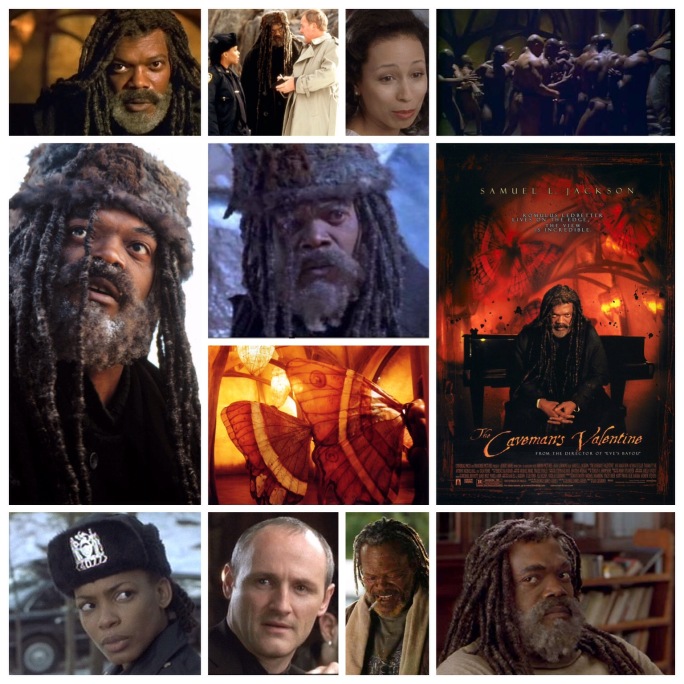
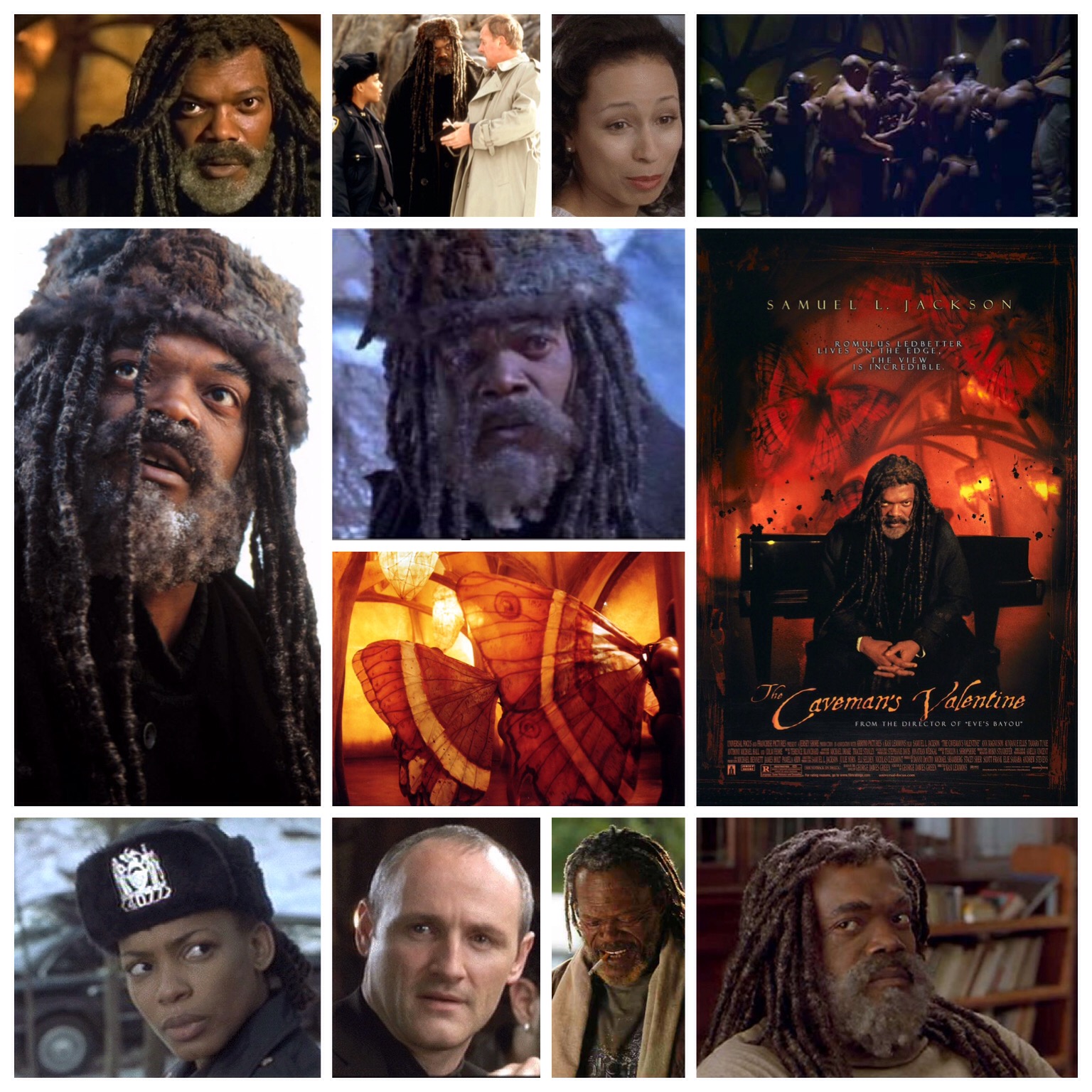
 The Caveman’s Valentine has always fascinated me. As someone who has a mental illness, I’ve always tried my best to seek out films that portray such conditions in a respectable, inquisitive and enlightening tone. While this one cushions it’s earnestness with a slightly lurid and generic murder mystery, much of its desire to explore its character’s inner mindset shine through superbly and with much more authenticity than other films that try the same. Unless you suffer through, or have some intimate experience with someone like this protagonist, it’s tough to artistically represent their state. This one manages very well, and Samuel L. Jackson gives one of the most memorable, affecting and curiously overlooked performances of his career so far. Jackson is an actor who almost always gets cast in assured, authoritative roles. Here he portrays exactly the opposite of that as Romulus, a severely schizophrenic man who lives in a cave in Central Park, New York City. Romulus was once a brilliant pianist and a student at Juilliard, before his illness cut his career and personal life painfully short. He spends his days in confusion, raving in delusion about an all powerful man named Stuyvesant who secretly manipulates everyone in the city. When a young man is found murdered near his cave door, he feels an internal compulsion to find out what happened to him. As you might imagine, a man with his affliction might not make the most reliable detective, but Romulus tries his best and in between bouts of paranoia he makes his way towards weirdo avant grade photographer David Leppenraub (always excellent Colm Feore) who may have had something to do with the homicide. He also has a daughter (Aunjanue Ellis) who is a policewoman and somewhat resents him through her ignorance, and a wife (Tamara Tunie) who no doubt left, but still speaks to him in segments of his visions. Because his perceptions can’t be trusted, even by himself, it makes it a touch and go plot-line that’s heavily accented by frequent visual detours into his own consciousness, where humanoid Moth Sarefs hauntingly play unearthly instruments. Director Kasi Lemmons is not only a woman, but an actress herself, both traits which I believe lead to a certain intuitive advantage in filmmaking. I absolutely love how she moulds the narrative to patiently linger with Romulus’s perception of events and never make them sensationalistic or rushed. Even though Romulus walks through a dangerous, real world story of murder and corruption, the film always sticks with his childlike, abstract and very intangible internal view of the world, a choice which most films either don’t possess the courage or aren’t allowed to do. Jackson is subtle, complex dynamite in what is for me the best work of his career, playing completely against type and most definitely the opposite of his usual instincts to give us something truly special, to any viewer who wishes to exhibit the same patience and understanding that the filmmakers have strived for in making this unique piece. 

Quentin Tarantino’s THE HATEFUL EIGHT – A Review by Frank Mengarelli

Quentin Tarantino’s eighth film, THE HATEFUL EIGHT, came out at a hostile time in contemporary America. Tarantino joined marching protests against police violence; then the overly sensitive millennial online “journalists” chastised the film, and Tarantino, for painting shades of misogyny and racism. Tarantino was unfairly attacked by the extreme wings of each political party. Had no one paid attention to Tarantino films prior? Of course racism and misogyny plays a vital part in this film, because not only did those elements exist in the post-Civil War 1800’s, but also exist in reality.

Hateful Madsen

This film is a cataclysm of Tarantino’s self-indulgence. He constantly references his prior works (mainly RESERVOIR DOGS) while homaging Sergio Leone, Billy Wilder, and John Carpenter. His limited casting is formed of new Tarantino players: Kurt Russell, Walton Goggins, and Bruce Dern who Tarantino has worked with twice prior; as well as his seminal ensemble made up of Samuel L. Jackson, Zoe Bell, James Parks, Tim Roth, and Michael Madsen. Joining the Tarantino crew for the first time is Jennifer Jason Leigh, Demian Bichir, and Channing Tatum.

For as visionary as Robert Richardson’s cinematography is and Ennio Morricone’s Academy Award winning hypnotic score, the greatness of this film lies within one of Tarantino’s best screenplays and one of the best acting ensembles since GLENGARRY GLEN ROSS. Tarantino is one of the most talented actor’s directors who has ever sat behind the camera. He carefully crafts each character with an actor in mind, playing on their strengths and bringing out untapped potential from even the most veteran actor he’s working with. The cast is absolutely brilliant.

Hateful.jpg

Kurt Russell does the best John Wayne impression ever as the hard barked simpleton whose stupidity is even more outrageous than his facial hair. Russell is always a joy to watch, and Tarantino’s use of him are highlights in an already legendary career. Samuel L. Jackson is one of the best linguists to ever grace the screen. Tarantino’s dialogue has never sounded better than coming out of Jackson’s mouth (aside from Harvey Keitel). Tim Roth gives one of his best performances delivering an English shtick of Mr. Orange from RESERVOIR DOGS. Perhaps the most surprisingly great performance in this film is that of Michael Madsen playing a caricature of himself. I can’t say anything more about Jennifer Jason Leigh that hasn’t already been said. She should have won the Oscar.

Tarantino outdoes himself with THE HATEFUL EIGHT; the script is outrageously funny, giving these talented actors so much to play with. Only Quentin Tarantino would be able to craft an epic western built upon heightened paranoia that is three hours long, set inside a tiny cabin that is filled with eight larger than life characters, filmed with a wide angle lens that is constantly on the move. Tarantino has reached Terrence Malick status by making films for himself, not for an audience, or a demographic, and that’s what he has excelled since GRINDHOUSE. No one loves movies more than Quentin Tarantino. Oh, and about that overt racism in this film, did those people not stay until the end?

Hateful ending.jpg

CAPTAIN AMERICA: THE WINTER SOLDIER – A REVIEW BY J.D. LAFRANCE

4110469-1460867178-img19

When we last saw Steve Rogers a.k.a. Captain America (Chris Evans), he had just helped save New York City from an alien invasion and was still acclimatizing himself to modern life having been frozen in ice since World War II as chronicled in Captain America: The First Avenger (2011). The sequel, The Winter Soldier (2014), takes place two years after the events depicted in The Avengers (2012) and sees Cap working as an agent of S.H.I.E.L.D., a top-secret spy organization that, among other things, deals with the fallout from the adventures of superheroes like Iron Man and Thor. However, as hinted at in The Avengers and the television show Agents of S.H.I.E.L.D., there is something rotten at the core of the spy organization and Cap soon finds himself not only embroiled in a vast conspiracy, but also confronting someone from his past he thought had died in the war. The result is a fantastic fusion of the super hero movie with the conspiracy thriller.

Cap and Black Widow (Scarlett Johansson) are now a team and as the film begins they intercept a covert S.H.I.E.L.D. ship in the Indian Ocean that has been hijacked by Algerian terrorists led by French mercenary Batroc the Leaper (Georges St-Pierre). In a nice touch, the filmmakers manage to transform Batroc, who was a pretty ridiculous villain in the comic books, into a bit of a badass. Afterwards, S.H.I.E.L.D. director Nick Fury (Samuel L. Jackson) lets Cap in behind the scenes, showing him three Helicarriers armed with state-of-the-art jet fighters that are linked to spy satellites created to anticipate global threats in a program known as Project Insight.

Cap is not at all comfortable with Fury’s secret project and the notion of creating a climate of fear that potentially robs people of their basic freedoms. However, when Fury suspects something is wrong with Project Insight he voices concern to senior S.H.I.E.L.D. official Alexander Pierce (Robert Redford). Immediately afterwards, Fury is attacked on the streets of Washington, D.C. by S.H.I.E.L.D. operatives and an enigmatic figure known as the Winter Soldier (Sebastian Stan). Fury barely escapes and finds Cap before being gravely injured. It’s up to Cap and Black Widow, along with the help of Sam Wilson (Anthony Mackie), a war veteran and post-traumatic stress disorder counselor that Cap befriends early on, to uncover the corruption rampant in S.H.I.E.L.D. and stop it.

Chris Evans does an excellent job of reprising his role of Captain America and providing layers to a character that is essentially a super strong boy scout who comes from a simpler time. He is now immersed in a convoluted conspiracy where he doesn’t know who to trust. As a result, he has to do a bit of soul-searching, which Evans handles well. He also has nice chemistry with Scarlett Johansson, especially when Cap and Black Widow go off the grid together and try to find the Winter Soldier. There’s a hint of sexual tension going on as two people with wildly different backgrounds and approaches to life are forced to look out for each other. Johansson finally gets some seriously significant screen-time than she did in Iron Man 2 (2010) and The Avengers and it’s nice to see her character fleshed out a bit more as well as giving her plenty of action sequences to kick ass in.

A film like this, which intentionally raises the stakes in comparison to the first one needs a credible threat that makes us feel like Cap and his allies are in real danger and the Winter Soldier does that. He rarely speaks, but looks cool and is extremely dangerous so that we anticipate the inevitable showdown between him and Cap. He isn’t some anonymous bad guy, but something of a tortured soul and the screenplay by Christopher Markus and Stephen McFeely (who also wrote the first film) offers some tantalizing details of his backstory and how it ties in with Cap’s past.

Markus and McFeely have crafted a solid script that is well-executed by directors Anthony and Joe Russo. They establish just the right rhythm and tone with well-timed lulls between action sequences that are used wisely to move the plot along and offer little moments of character development that keep us invested in the characters and their story. For example, there is a nice scene where Cap goes to an exhibit dedicated to his World War II exploits at the Smithsonian, which succinctly recaps his origin story in a rather poignant way that reminds us of his internal conflict of being stuck in the past while living in the present. One way he deals with this is befriending Sam and they both bond over being war veterans – albeit from very different eras. In addition, the script features several well-timed one-liners and recurring jokes that add moment of much-welcomed levity to an otherwise serious film.

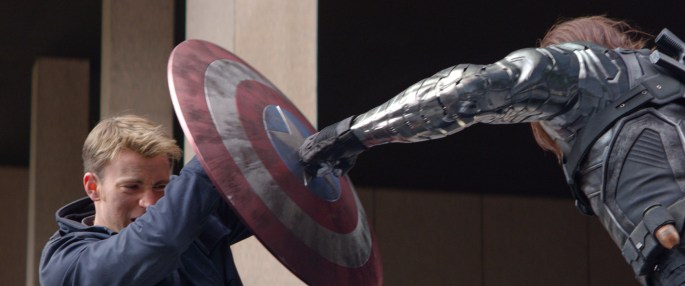
The action sequences are exciting and expertly choreographed with the exception of the opening boat siege, which takes place at night and involves way too much Paul Greengrass/Jason Bourne shaky, hand-held camerawork. Once the filmmakers get that out of their system and Cap takes on Batroc, the camera settles down and is a decent distance from the combatants so that we can see what’s going on. There is also an intense car chase involving an injured Fury in an increasingly bullet-ridden SUV that has the feel of the exciting car chase in William Friedkin’s To Love and Die in L.A. (1985) and a little later Cap takes out an elevator full of S.H.I.E.L.D. agents intent on neutralizing him that evokes an elevator scene in Brian De Palma’s Dressed to Kill (1980). The fights between Cap and the Winter Soldier are fast and frenetic, but never confusing as they convey the frighteningly deadly speed of the latter’s moves, so much so that I really felt like Cap was in some serious danger.

Drawing elements from writer Ed Brubaker and illustrator Steven Epting’s 2005 “Winter Soldier” storyline in the comic book, this film has a decidedly darker tone than The First Avenger as our hero is nearly killed on several occasions and his world is shaken to the very core as he uncovers all sorts of ugly secrets. In this respect, The Winter Soldier is reminiscent of paranoid conspiracy thrillers from the 1970s and this is acknowledged with the casting of Robert Redford who starred in two of the best films from that era – Three Days of the Condor (1975) and All the President’s Men (1976).

It is refreshing to see a sequel that isn’t merely content to rehash the first film. Where The First Avenger was essentially a mash-up of a super hero movie and war movie, The Winter Soldier is super hero movie and a political thriller with events that are a major game changer for the Marvel Cinematic Universe. In the past, S.H.I.E.L.D. had been the connective tissue that linked several of the films together that led up to The Avengers. It should be interesting to see how the events depicted in this film set the stage for Avengers: The Age of Ultron (2015). That being said, The Winter Soldier has its own self-contained story that is engrossing with a lot at stake for our hero and this in turn gets you invested in what is happening to produce a rare super hero movie with heart.

Top Ten Quentin Tarantino Characters: A Write Up by Nate Hill

Quentin Tarantino’s career has been vividly defined by all the beloved qualities which we hold dear in film: visuality, music, dialogue, emotion, conflict and especially character. His films contain some of the most captivating, idiosyncratic and unique people to ever grace the screen, played by an incredible lineup of actors, some of which he would go on to use time and time again. Below you will find my personal top ten picks from the rogues gallery of individuals who have appeared in his stories. Please keep in mind these are characters from films he has both written and directed only, not just ones he has written. Enjoy, and if you do, please share!

10. Zed, played by Peter Greene in Pulp Fiction. 


      Greene refused this part multiple times, causing Tarantino to hunt him down like a dog and basically beg him to play the role. When the director has a face in mind for a role and won’t quit like that, you’d better believe he’s gonna make magic with it if he ever manages to sway the actor. He does, and so does Greene, an actor with a distinct, sinister look who plays the absolute hell out of the character, spinning a small supporting turn into one of the most terrifying movie villains ever, and certainly the scariest character in Tarantino’s career. Everyone’s favourite redneck rapist sheriff, Greene leaves quite the unsettling impression with his work. 

9. Texas Ranger Earl McGraw, played by. Michael Parks in Kill Bill, Grindhouse and From Dusk Till Dawn


Tarantino casted underrated acting chameleon Parks as this character several times, each appearance resulting in pure gold. My personal favourite has to his bit in Kill Bill Volume 1, where he’s called to the El Paso wedding chapel massacre. Parks can literally play any part thrown his way, be it melodramatic French Canadian drug runner, neo-nazi hit man or the laconic southwestern lawman archetype, which he nails down to the detailed mannerisms here. McGraw is a lynchpin of Tarantino lore and an absolute pleasure to see every time he pops up. 

8. Captain Koons, played by Christopher Walken in Pulp Fiction


Walken balances weirdness and gravity like no other, often blurring the lines between the two to amusing and touching effect. When given what is perhaps the juiciest monologue ever written by Tarantino, Walken gives us a mesmerizing account of his time in the war, and his efforts to protect a coveted family heirloom which he then presents, with much ceremony, to a young Butch Coolidge. The film halts the momentum dead in its tracks to allow Walken to do his thing, completely off the leash and inhabiting his own special corner of the beloved film. He’s unforgettable, and makes a two minute appearance speak the volumes of eons.   

7. Bill, played by David Carradine in Kill Bill


There’s a scene in Kill Bill Volume 2 where Uma Thurman discovers Bill waiting for her outside the wedding chapel, playing his pan flute. There’s an epic passage of Morricone music, and he looks her dead in the eye. Upon reviewing a rough cut, Tarantino turned to Carradine and said “I think this is your best moment of the film.” Carradine’s response was, “Hell, I think it’s the best moment of my whole career!.” Bill is a mythic, titular antagonist who is built up no end for the duration of the films, the ultimate badass villain, and when the climax arrives in the eleventh hour, Tarantino writes an exodus for the character that is far more personal, emotional and grounded than I imagine anyone saw coming. It’s a gift to Carradine and fans alike, a villain with depth and purpose who exists in a surreal comic book world where the people couldn’t be more human or real. Carradine purrs his way through the role of his career and on into legend. 

6. Budd, played by Michael Madsen in Kill Bill


Tarantino brings out the best in Madsen, a purely charismatic dude who unfortunately makes a lot on unwatchable junky poo movies these days, squandering his obvious talent. This is is shining hour, playing Budd as a bitter backwater kid and younger sibling, nearing the end of his road and fermenting in bitter loneliness way out in the California desert. Madsen channels tough guys of the golden age as Budd, a rotten son of a bitch with a glint of humanity showing through his booze-dimmed eyes. 

5. Hans Landa, played by Christoph Waltz in Inglorious Basterds


Quite possibly the most entertaining villain in Tarantino’s work, due the the exuberant and absolutely committed performance of Waltz, in a trailblazing turn that would put him on the map in a big way. Beaming from ear to ear in almost every scene with a charming grin that dissipates occasionally, showing traces of the spider beneath, he’s a wonder in the role, a nazi A-hole rotten straight to the core. He doesn’t even possess any constitution or debt of faith in the cause which his smartly emblazoned SS uniform advertises; he’s in it for himself only, which is one more despicable quality to add to the list of traits one might use to define him. Perhaps the biggest Basterd of them all, and a joy to watch. 

4. Vincent Vega, played by John Travolta in Pulp Fiction


Pulp Fiction kickstarted Travolta’s career back into gear in a huge way, and it’s easy to see why as we watch his Elvis-esque slickster prance about the screen with effortless, heroin addled coolness and one hell of a dance sequence. His hair deserves its own spinoff film, he steals scenes by simply laying low and playing the dude with flair that never makes itself overly known. 

3. Mr. Blonde, payed by Michael Madsen in Reservoir Dogs


A stone cold psycho to the bone, Madsen relishes in brining this cop killing sadist to life, and dancing his way through one of the most iconic Tarantino scenes to date. Madsen has a rumbling threat to his work, a paced, portentous vibe that suggests the onset of a dangerous storm, but always seems to veer on the edge. With Mr. Blonde he crosses that line and shows us what a true madman looks like, without even raising his voice above a willowy growl. A class act in violent behaviour that laced with the blackest humour that we feel bad for laughing at. Mr. Blonde all the way. 

2. Jules Winnfield, played by Samuel L. Jackson in Pulp Fiction


A rain of hellfire awaits any viewer who has the privilege of seeing Jackson bellow forth biblical fury in his first collaboration with Tarantino. He’s the life of the party in Pulp Fiction, an articulate, relentless loudmouth with a character arc that amusingly negates his belligerent nature and makes Jules all the more fascinating for it. Jack sonics at his most magnetic when he’s in Tarantino films, and this is mile zero, baby. Not for a second does the spark leave his eye, or the threat of violence evaporate from his wake. Criminals who ruminate on life, love and cunnilingus have become a goldmine for writers post Tarantino, and one which he only mined the first nuggets of. Jackson is ground zero for the character type, and fires it up in a way which none of us will ever forget. 

1. The Bride a.k.a. Beatrix Kiddo, played by Uma Thurman in Kill Bill


Tarantino’s muse has been Uma Thurman since the days of Pulp Fiction, and here he writes a titanic revenge epic in which the actress gets to bare her claws and sink her teeth into the single most affecting and arrest in female role that he has ever written, also forging the best, or at least my favourite performance from any actor or actress in his films. The Bride is the revenge archetype, an angry blonde angel forsaken by her lover and dead set on a bloody warpath. Tarantino isn’t above writing in moments of stirring emotion, including the final twenty minutes of Volume two which is Thurman’s showcase piece as an actress and an achingly appropriate send-off for The Bride, as well as the one which she deserves. 
Thanks for reading, more to come!

STAR WARS EPISODE I: THE PHANTOM MENACE – A Review by Frank Mengarelli

It’s no secret that many high brow cinephiles have their knives out when it comes to STAR WARS, but in particular the prequels.  To be fair, my film snobbery overflows onto big blockbuster franchises, but STAR WARS, all aspects of it; the films, the novels, the video games, collectibles are so ingrained in my life since childhood that it’s fair to say I will never have as much passion for anything as I do for STAR WARS.

image

THE PHANTOM MENACE is a stark contrast from the original trilogy, and that’s exactly what it is supposed to be.  Yes, there are many missteps, including the casting of some actors, and the dialogue at times is lackluster and unintentionally laughable but there is so much more at stake when you look at the big picture.

Set decades before A NEW HOPE, Episode I shows us the beginning.  We see a vibrant and fertile galaxy before the desolate dilapidation that the Empire brings to not only the aesthetics but also thematically in the original trilogy.  This is a time of prosperity, a time when the Jedi oversaw peace in the galaxy.

image

But.  This is also the beginning of the galaxy being divided in a full-out war.  Planets pitted against each other by fear and economics.  All the workings of seminal STAR WARS villain, Emperor Palpatine, who in Episode I is nothing more than the affable senator from the peaceful planet of Naboo.  His Sith alter ego, Darth Sidious, does all the dirty work.

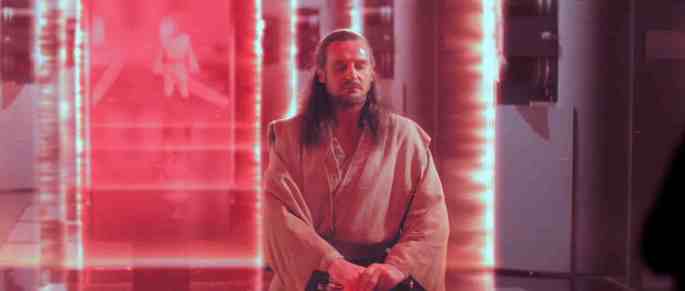
I know.  Jar Jar Binks is the go to hangup.  Yes, Jar Jar is annoying until you get over it and embrace him.  Liam Neeson as the Jedi Master who is the hierarchy of the Skywalker lineage more than makes up for Jar Jar.  As does John Williams’ AMAZING score, particularly DUEL OF THE FATES which loudly surrounds the greatest lightsaber battle in the STAR WARS saga: Qui Gon Ginn AND Obi Wan Kenobi versus fan favorite, Darth Maul.

Yes, THE PHANTOM MENACE is the weakest of the STAR WARS saga, but it is also a solid foundation of what’s to come after.  The chaos that engulfs the galaxy.  The tangible rise of Palpatine’s dark powers.  For all of Lucas’ faults, he does an excellent job guiding the camera through the birth of galactic turmoil.  His casting of Liam Neeson, Ewan McGregor, Samuel L. Jackson, and Terence Stamp are wonderfully perfect additions to the series, and his vibrant aesthetic is a pleasant contrast from the darkness of the original trilogy.