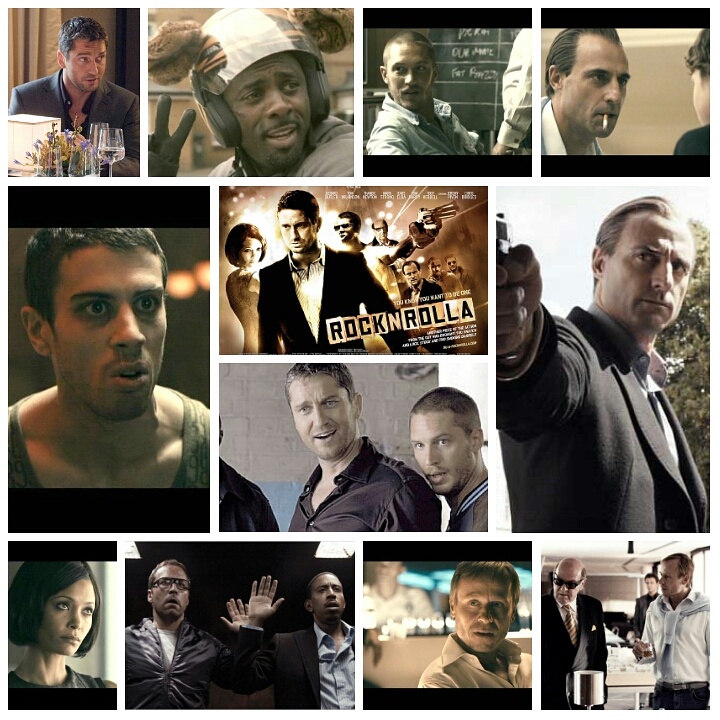
Guy Ritchie’s Rocknrolla was the third British crime comedy caper for the director, and it could have easily been the misstep that signaled him wearing out his welcome. Happily I can tell you that it’s a winner, and although not as cracking as Lock Stock or Snatch, it sinks into its own distinct groove that’s fairly removed from it’s two predecessors. Once again we are treated to the life and times of a bunch of hoods and gangsters in London, but not the grungy, back alley soup kitchen London that we’re used to from Ritchie. No, this is a glistening, prosperous London, filled with real estate money ripe for the taking and developers making underhanded deals with shady businessmen. The climate has definitely changed in Ritchie’s aesthetic, but the characters remain the same, just as witty, eccentric and chock full of piss and vinegar. The story centers around the wild bunch, a cozy little clan of East end petty thieves led by One Two (Gerard Butler) and Mumbles (Idris Elba). Their third musketeer is Handsome Bob, played by a hilarious Tom Hardy who has a secret up his sleeve that spills out in what is the most adorable scene Ritchie has ever written. The gang is hired by a mysterious chick (Thandie Newton) to rob some dudes, and that’s where the trouble starts. Elsewhere in town, arch gangster Lenny Cole (a frothing Tom Wilkinson) negotiates a land deal with dangerous russian billionaire Uri (Karel Roden switches up his trademark psychosis for smooth talking menace here) that hinges on a missing painting. Lenny dispatches his right hand bloke Archie (Mark Strong, subtly trolling us) to find it along with his rock star nephew Johnny Quid. Got that? Nevermind, half the fun is the how and not the why of Ritchie’s stories, and I find it best to just let the flow of it wash over you as opposed to thinking out each detail and missing the sideshow. Toby Kebbell is off the hook as Quid, a wiry stick of dynamite and a comic force to be reckoned with, truly the most exciting performance of the film. Ritchie has a knack for bringing out the funny side in actors, even ones that aren’t usually the type to make you laugh. Strong is terrific, with a few carefully timed moments of sheer hilarity that deftly make you forget how dangerous he is. Ludacris and Jeremy Piven are fun, if a bit out of place as two event promoters. Butler and Elba have an easy-peasy rapport that’s light, friendly and believable. Wilkinson dances between alpha assuredness and aging buffoonry nicely, always commanding the scene and oddly reminding me of Mr. Magoo. There’s a playful tone to this one, glitzy and celebratory in places where Snatch was grim and sketchy, and the whole affair feels like a new years party with a bunch of old friends. Watch for cameos from Matt King, Nonzo Anonzie, Jimi Mistry, Mundungus Fletcher and Gemma Arterton. Very fun stuff.
Tag: Tom Hardy
INCEPTION – A REVIEW BY J.D. LAFRANCE

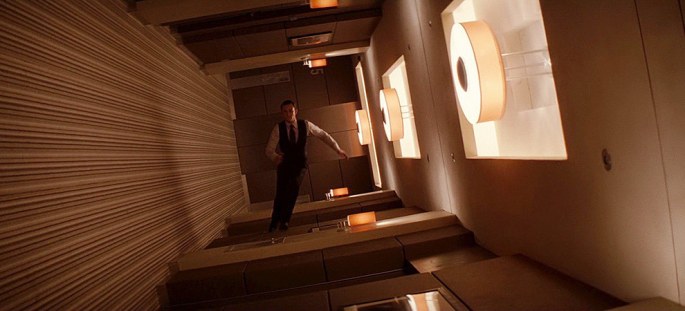
Ten years in the making, Inception (2010) was the culmination of Christopher Nolan’s career up to that point in time. This film mixed the ingenious plot twists of his independent film darling Memento (2000) with the epic scale of his Hollywood blockbuster The Dark Knight (2008). It took the heist genre to the next level by fusing it with the science fiction genre as a group of corporate raiders steal ideas by entering the dreams of their targets – think Dreamscape (1984) meets The Matrix (1999) as if made by Michael Mann. While Nolan and his films certainly wear their respective influences on their sleeve – and this one is no different (2001: A Space Odyssey, Blade Runner, Heat) – there is still enough of his own thematic preoccupations to make Inception distinctly his own. This film continues his fascination with the blurring of artifice with reality. With Inception, we are constantly questioning what is real right down to the last enigmatic image.
Dom Cobb (Leonardo DiCaprio) and his team extract thoughts of value from people as they dream. However, during his jobs, he is visited by his deceased wife Mal (Marion Cotillard), a beautiful femme fatale character that serves as an increasingly dangerous distraction from the task at hand. The film’s opening sequence does an excellent job establishing how Cobb and his team extract information from the dream of Saito (Ken Watanabe), a Japanese businessman, in a visually arresting sequence. He catches up with Cobb in the real world and offers him a new deal: plant an idea in Robert Fischer’s (Cillian Murphy) mind that will help break-up his father’s vast empire before it becomes too powerful, and do it in a way so that it seems like Fischer thought of it for it to work. This is something that has only been done once before and Cobb was the person that pulled it off but can he do it again? In exchange for completing the job, Saito will make the necessary arrangements so that Cobb can return home to the United States where his children live but where he is also wanted by the authorities in connection with his wife’s death. So, Cobb recruits a literal dream team of experts to help him pull off the most challenging job of his career.
Inception delves into all kinds of aspects of dreams as evident in a scene early on where Cobb explains how they work, how to design and then navigate them. While there is a lot of exposition dialogue to absorb during these scenes, Nolan also keeps things visually interesting at the same time. This is arguably the most cerebral part of the film as he explores all sorts of intriguing concepts and sets up the rules for what we’ll experience later on – pretty heady stuff for a Hollywood blockbuster. And when he isn’t examining fascinating ideas, he’s orchestrating exciting and intense action sequences. There’s an incredible sequence where Nolan juggles three different action sequences operating on three different levels of dreams that are all impressively staged while also a marvel of cross-cutting editing. He anchors Inception with the character of Cobb and his desire to return home to his children while also dealing with the death of his wife. It gives the film an emotional weight so that we care about what happens to him. It also raises the stakes on the Fischer job.
Cobb continues Nolan’s interest in tortured protagonists. With Memento, Leonard Shelby tried to figure out who murdered his wife while operating with no short-term memory. Insomnia (2002) featured a cop with a checkered past trying to solve a murder on very little sleep. The Batman films focused on a costumed vigilante that waged war on criminals as a way of dealing with the guilt of witnessing his parents being murdered when he was a child. With The Prestige (2006), magician Robert Angier is tormented by the death of his wife and an all-consuming passion to outdo a rival illusionist. Inception’s Cobb also has a checkered past and is haunted by the death of loved one. Leonardo DiCaprio delivers what may be his finest performance to date, playing a complex, and layered character with a rich emotional life. Cobb must come to terms with what happened to his wife and his culpability in what happened to her. DiCaprio conveys an emotional range that he has not tapped into to this degree before. There’s a captivating tragic dimension to Cobb that the actor does an excellent job of expressing so that we become invested in the dramatic arc of his character.
Nolan populates Inception with a stellar cast to support DiCaprio. The indie film world is represented by the likes of Joseph Gordon-Levitt and Tom Hardy while also drawing from international cinema with Ken Watanabe and Cillian Murphy. Gordon-Levitt and Hardy, in particular, are stand-outs and their banter provides several moments of enjoyable levity during the course of this intense, engrossing film. And it wouldn’t be a Nolan film without his good luck charm, Michael Caine, making an appearance. As he has done in the past, Nolan plucks a once dominant actor from the 1980s, now languishing in relative obscurity – think Rutger Hauer in Batman Begins (2005) or Eric Roberts in The Dark Knight – and gives them a high-profile role. Inception gives Tom Berenger some well-deserved mainstream exposure after languishing in direct-to-video hell, reminding everyone what a good actor he can be with the right material.
Regardless if whether you like Inception or not, you’ve got to admire Nolan for making a film that is not a remake, a reboot, a sequel or an adaptation of an existing work. It is an ideal blend of art house sensibilities, with its weighty themes, and commercial conventions, like exciting action sequences. Capitalizing on the massive success of The Dark Knight, Nolan wisely used his clout to push through his most personal and ambitious film up to that point. With Inception, he created a world on a scale that he never attempted before and was able to realize some truly astonishing visuals, like gravity-defying fight scenes and having characters encounter a location straight out of the mind of M.C. Escher. It has been said that the power of cinema is the ability to transport you to another world and to dream with our eyes open. Inception does this. Nolan created a cinematic anomaly: a summer blockbuster film with a brain.
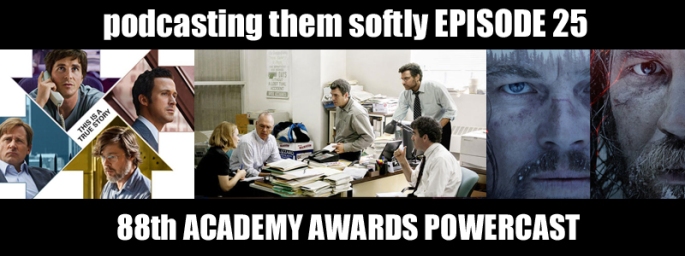
Episode 25: 88th ACADEMY AWARDS POWERCAST

Join us for our Oscar podcast. We give our predictions in all the major categories, and we discuss what we think will win and what should win. Tune into the Oscar’s and see if we are geniuses or complete idiots!
PTS Presents NICK AND FRANK’S BEST OF 2015

We returned to form with our first new recording together since the newest addition to Nick’s family, and the STAR WARS overload that Frank has been overwhelmed by. We go over our top ten films of the year, top five directors, actors, actresses, supporting actors, supporting actresses, screenplays, cinematographers, score, ensemble and television shows. We were both very excited to do this, and we hope you enjoy!
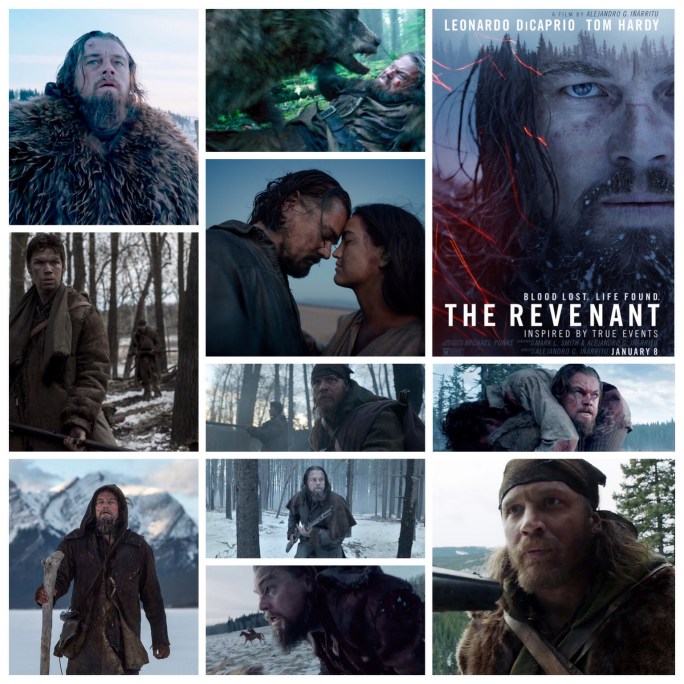
The Revenant: A review by Nate Hill
If the rumblings from director Alexander Gonzalez Inarritu and his intrepid cast and crew about The Revenant being the most tumultuous, challenging shoot of their lives, it’s all in service of the loftiest of causes one could achieve: to produce great art. I say that without pretension or monocle wagging patronization, and mark my words: The Revenant is by and far the greatest film this year, and possibly of the last decade. It is monumental in scale, meticulous in pacing and erects the fundamental pillars of the human condition so flawlessly that we feel we are watching actual history materialize before our eyes, untethered from the notion that it’s just a movie.
Let’s start with the ocular deity that is Emmanuel Lubezki: This film contains the best cinematography I have ever seen in my life. The bold location scouting is a catalyst for the prodigy of a DOP to work his ethereal magic. Time and time again throughout the film I found myself marvelling at the stunning patience and skill displayed by the man in attaining his precious shots, constantly chafed by what I imagine was an impossibly stressful environment, bogged down by time constraints and the pure, uncaring call of nature itself. He shot with natural light for all but one scene, an unimaginable achievement that plays out in endless beauty that rocks your soul to its foundation for the entire two and a half hour running time. The locations, lovingly culled from deep within northern Canada and briefly Argentina, are an unforgiving cacophony of serene snowfalls, cascading rivers and jagged, untamed mountain ranges. This is the landscape I have grown up in and call home and to such holy places captured with such reverence on film, gilding a story of such primordial importance had me next to tears.
Leonardo DiCaprio pulls out all the stops in his ferocious portrayal of Hugh Glass, a frontiersman who lives by his feral gut instinct alone, attempting to guide his fur trapping expedition through the terrain while looking out for his half Pawnee Native son who he already rescued from aching tragedy years before. After a harrowing raid in the dawning minutes of the film that makes it abundantly clear how serious the film intends to be, he and a small band of men are stranded and forced to contend with the land, and the threat of the natives finding them. Glass then gets attacked by a bear in a nerve shattering sequence that had my adrenal glands running a marathon. The frank, unapologetic nature in which the scene plays out reminds us all that nature isn’t our playground of opportunity and commerce, but a living organism that can bite the hand that it refuses to feed with alarming abandon. The sheer level of carnage inflicted upon Glass by both beast and man will shake you to your core, as will the excellent makeup and CGI effects that drive the point deep into your retinas. Tom Hardy disappears into his role better than Glass’s expedition blends into the treacherous blizzards, playing John Fitzgerald, a cowardly motherfucker who is content to leave Glass to the elements and seek fortune elsewhere, dragging sympathetic Jim Bridger (Will Poulter, excellent) along with him. The military component of their expedition (Domhall Gleeson, superb) suspects Fitzgerald and is wary. Hardy is the very definition of an acting chameleon, and disappears headlong into the role that had me riveted, and rooting for a best supporting actor win. The entire cast was subjected to a brutal nine weeks exposed to the elements, each other, and the raw, archetypal narrative of the piece that was being made, and each of them shows it in spades.
At its core it’s a revenge piece, spurred by aching character interaction involving Leo and his family in affecting flashbacks. Leo goes through somewhat of a transformation here.. He loses all he has left to an uncaring, cold faced world that would sooner see him tossed around a moss stained forest in pieces than avenged. But his Hugh Glass rages against the dying of the light right alongside Lubezki’s lens, creating in tandem the perfect voyage of a man who has become so consumed with the forces of nature in his quest to attain some semblance of his former self, that he has become somewhat of an element himself. Leo truly deserves gold this time around.
Adventure/survival epics are my favourite. This one stands out, and yet.. does more than that, if possible. It delves deep into the lush, echoing vastness of the past and pulls forth a story so human, so recognizable, in such a force of construction where the fruits of everyone’s labour are so obvious, it can’t help but be worshipped as a classic in the art form of cinema and a treatise on how to excel in every single area of the medium.
STEVEN KNIGHT’S LOCKE — A REVIEW BY NICK CLEMENT

Locke is a mesmerizing film to study. Dominated by a spellbinding, tour de force performance from Actor of the Moment Tom Hardy, Steven Knight’s fascinating existential drama Locke is nerve-rackingly intense, fully absorbing and completely unpredictable, due in no small part to the narrative conceit of the entire film taking place from the interior of a car. Confined to the driver’s seat of his BMW SUV, Hardy gives an all-stops-out performance – this guy is the real deal, seemingly capable of any role that’s asked of him, always able to elicit sympathy no matter how ragged the character, going from subtle to big at the drop of a hat. The dreamy, artsy cinematography by Haris Zambarloukos leaps off the screen; it’s London-street-lamp-at-night-gorgeous, cousins with Collateral in some respects, with reflections and window patterns dotting the expressionistic 2.35:1 widescreen space. Because the story is exclusively delivered via a series of desperate phone calls that Hardy is having with a variety of people, there’s always the question of how realistic can this scenario play out. But because Knight is so strong with his words and so precise with his visuals, the film becomes more than just a trick-stunt – it’s a gripping, all-together brilliant ride that will leave you with sweaty palms by the finish.

NICOLAS WINDING REFN’S BRONSON — A REVIEW BY NICK CLEMENT
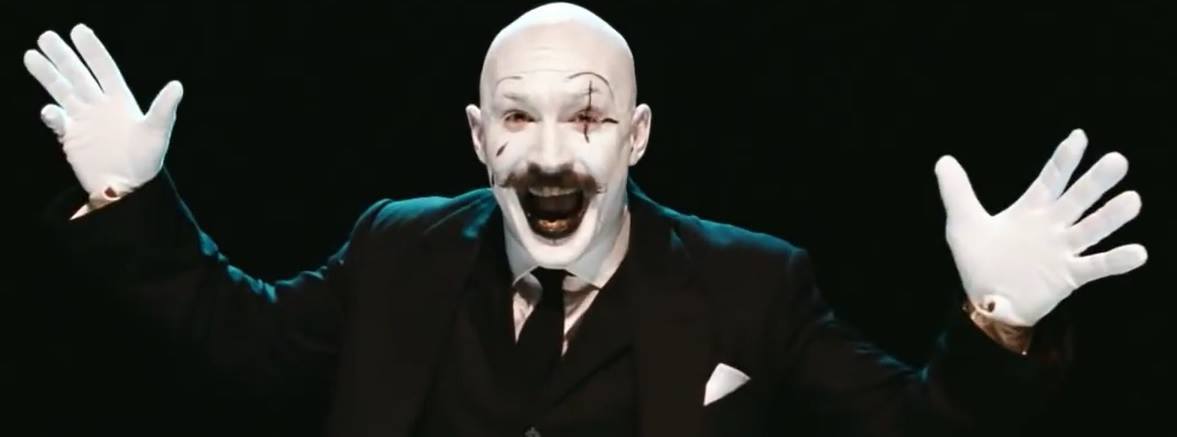
Bronson was the film that brought director Nicolas Winding Refn and actor Tom Hardy into my cinematic sights, and since then, I’ve followed both artists with intense fervor and anticipation. This film is like nothing else I’ve ever seen, and even if it blends elements from other films within its framework, the overall originality of the entire endeavor is wild to watch unfold. The film uses a highly stylized structure consisting of surrealistic performance art, abrupt flashbacks, and jarring tonal shifts which makes sense given the extremely heightened aesthetic. Hardy stars as real life British convict Charlie Bronson, aka, The Most Violent British Criminal Ever, a man given to massive fits of rage and stunning moments of primal, animalistic physical violence. The film is a crazy, bloody, kinky kaleidoscope of his oversized life, showing him in an out of the slammer, trying to adjust to the outside world, falling in love, getting mixed up with a variety of wacky side characters, and always spinning back on Bronson’s violent tendencies in almost every situation that he faced. Hardy is extraordinary, giving quite literally one of the best performances I’ve ever seen from any actor in any film. This is a forcefully bizarre movie, and he carries the entire thing, appearing in almost every scene, and letting it all hang out (literally and metaphorically), giving a ferocious performance of astonishing energy and personal chaos. His character is so unpredictable and so unstable that the viewer is constantly left to wonder what will happen next. All of the supporting performances are stellar and help contribute to the zany mood of the entire piece.
And then there’s the eccentric, eclectic soundtrack, featuring numerous classical opera pieces, as well as stuff from The Pet Shop Boys, Doris Day, and David Cassidy, all of which adds to the dense sonic layers of the soundtrack. I love how Refn brilliant subverts your expectations at almost every turn with this perverse movie. He knows you’ve seen other prison films and biopics, and I love how he defiantly refuses to play anything safe in this movie, which is probably the best overall piece of work in his already sensational career. He downplays the customary visual language of this particular genre, going for something more aggressively stylish and baroque than usual, and I love how he’s constantly undermining the inherent masculinity of Bronson as a character and the thugs that he encountered. The way Refn views his psychologically complex lead character suggests that he’s both in awe of Bronson, and totally in fear of him. Macho posturing is elegantly skewered all throughout, with the interesting layer of homosexual social commentary thrown in to spice things up, and also demonstrating the interesting duality to Bronson’s unique persona. Refn is constantly provoking his audience with every film he makes, always throwing multiple layers at you, and it seems to be his M.O. as a filmmaker to challenge whatever genre he’s working in, and it’s going to be extremely exciting to see how he develops as a filmmaker.