Twin Peaks: on the eve of revival – a rambling write-up by Nate Hill


When I first discovered David Lynch’s Twin Peaks some ten years ago, I was hooked from that first lilting chord of the opening theme, a Pacific Northwest lullaby that dreamily pulled back a red curtain to reveal the mesmerizing realm of sawmills, Douglas firs, cherry pie, secrets, metaphysics, owls, murder mysteries, eccentricities, FBI Agents, roadside diners and so much more. There was nothing quite like it under the sun. Lynch had tapped into the intangible flavour in the ice cream parlour, an undefinable conduit to the subconscious, an emotional fever dream of haunting music, beautiful storytelling and vivid, compelling character arcs, and I knew from that moment on I’d be living in this world, in whatever capacity, for the rest of my life. Since then I’ve seen the entire run of seasons one and two at least thirty to forty times, and watched Fire Walk With Me, Lynch’s big screen masterpiece and companion song to the show, even more. Twin Peaks is the one thing I can revisit at any crux of the story, during any phase of my life, and it will always draw me right back in like the beckoning grove of sycamore trees who stand as sentinels to the great beyond lying just around the bend in the woods. There was just one problem with it all: the show was tragically cancelled on the penultimate beat, a cosmic cliffhanger that left fans reeling and plunged the legacy into exile for decades, a vacuum left in air that once housed a worldwide phenomenon, which is the only way to describe what season one did not just for television, but for the arts themselves, a thunderous ripple effect that has inspired generations of fan culture and adoration. To quote another film that finds its home in the trees, “If you ride like lightening, you’re going to crash like thunder”, which in a way is what happened to Twin Peaks. That lightening was captured in a bottle, which unfortunately shattered to shards via a combination of network interference and creative differences. Needless to say, the thought of a possible return to the show was beyond low on my list of things that could happen, right down there next to dinosaur cloning. Life finds a way though, and so apparently does Lynch. When it was announced that he had struck a deal with Showtime for an epic eighteen episode return to those Douglas firs, the internet nearly imploded upon itself. The golden age of television had just gone platinum, for Twin Peaks is the cornerstone of a generation of storytelling, a mile marker of stylistic structure and expression that gave life to countless other legacies in its wake. If any fragmented, incomplete tale deserves another day in court, it’s Peaks. For a while we sat on our hands and held our breath, the words ‘too good to be true’ ringing around in our heads. After a few hitches in the giddyup, however, and some three years of development later, we have arrived on the day that the new season premieres, and it still hasn’t set in for me. Eighteen brand new episodes. All written and directed by the man himself. A titanic sized cast of Twin Peaks residents both old and new, from every walk of Hollywood, genre town, music world and indie-ville. It definitely does seem to good to be true, and yet here we are, on the eve of a television paradigm shift. Any new fans who have hurriedly made their way through the original series run for the first time should pause for a moment and realize just how infinitely lucky we are to get this, how special this truly is, and will be for the entire summer. I feel as though this will be the second wave of Lynch’s magnum opus, a stroke of creative brilliance that has come full circle, and in just a few hours time those beloved chords will once again flow out from our television screens, as the journey continues onward to a destination whose coordinates Lynch guards like Pandora’s Box. Come what may, I will be tuned in to whatever the man and his team of actors, artists and musicians have in store for us. See you in the trees.

-Nate Hill

Top Ten David Lynch Characters: A list by Nate Hill

The cinematic universe in which legendary director David Lynch has chosen to tell his stories is a yellow brick road which leads the way to a rabbit hole, wherein can be found dreams, nightmares, horror, love, spirits, small towns, psychological torment, offbeat humour, danger and endless gallons of hot black coffee. Within this mesmerizing realm lives a whole armada of strange and wonderful human beings, often with antennas extended out into both the metaphysical, the supernatural and the just plain undefinable. This makes them some of the most richly fascinating, deeply felt individuals to ever dance across our screens. If you have clicked on this post, you will see below a list of my personal top ten characters to have ever wandered out of the one of a kind mind of Mr. Lynch and been brought to life by the intuition, grace and startling gut instinct of many fine actors. Enjoy!
 
10. Marietta Fortune, played by Diane Ladd in Wild At Heart


Diane Ladd plays the ultimate mommy from hell in Lynch’s wacky, colourful romance road trip flick and livens the proceedings up no end with her mental instability, overprotective mania and frequent banshee screams that echo the terrifying melodrama of an exaggerated and psychotic Joan Crawford. Ladd rightly earned an Oscar nomination for her feral work, and one only needs to witness the unnerving sight of her sprawled across the bathroom floor with a liver full of martinis and a face smeared with crimson lipstick to appreciate the work funnelled into both the performance and direction to give us this horrific harpy.  

9. The Man From Another Place, played by Michael J. Anderson in Twin Peaks 
  

No other character solidifies Lynch’s pipeline to the collective subconscious like the red suited, inter-dimensional man of limited stature, a haunting presence who dances, speaks backwards and is always one step ahead of every fellow character and watching audience member who lays eyes on him. He serves as an image of what lays beyond, and no doubt an experimental choice for Lynch, one that would go on to become a token image of the television series, and his career as well. 

8. Bobby Peru, played by Willem Dafoe in Wild At Heart
  

The uniting forces of Willem Dafoe’s brand of creepiness morphed together with Lynch’s intuition for everything weird resulted in Bobby Peru, a disgusting psychotic whacko who only shows up in the last quarter of the film, yet dominates every frothy frame. Peru is a scary son of a bitch, and Dafoe lends every Joker grin, sallow grimace and harsh syllable he can muster in a very discomforting scene in which he abuses Laura Dern’s character to squirm inducing effect. This heinous outburst only makes the explosive end he meets all the more satisfying. A true Lynch monster, a Dafoe creation to remember and spin yarns about in years to come beside the cinematic campfire. 

7. Nikki Grace/Susan Blue, played by Laura Dern in Inland Empire
  

Dern turns the performance of her career in what is perhaps Lynch’s most peculiar film to date, a purposefully meta, altogether perplexing soul bender of a tale that revolves around two incredibly strong female characters, both played by her. There’s a galvanizing monologue buried within the heart of this dense saga that’s at once both a savage outcry and a self reflective summary to the character, Dern nailing every sharp turn of both that passage, and her work in the film as a whole. Lynch sat on Hollywood Boulevard with a cow and a sign advocating an Oscar nomination for her powerful work here, and upon viewing it it’s easy to see why. ‘A woman in trouble’ cries the DVD cover. Dern cries out into the dark and lets us know this character is exactly in that place, but her and Lynch lay out the breadcrumb trail in an ambiguous fashion that never really lets us in on the how and the why of said trouble. Such an achievement is pure collaboration, and worth every penny spent on the cow rental. 

6. Margaret Lanterman, aka The Log Lady, played by Catherine E. Coulson in Twin Peaks
  

The Log Lady is the symbolic lynchpin of Twin Peaks, a woman who lost her husband in a fire long ago, and quite literally carries a log around in memorial, speaking to it as if it were a person. Such a concept could be seen as silly, but in Lynch’s hands it simply is compelling. Coulson too treats it with reverence, giving her the undefined gravity that is a key ingredient in the Twin Peaks mystery and will be remembered by fans, loved by veterans and discovered by newcomers for eons.

5. Frank Booth, played by Dennis Hopper in Blue Velvet
  

The third scariest person on this list comes in the form of Booth, an oxygen loving, volatile kinkster played with primordial menace by a wild eyed Dennis Hopper. Booth took audiences by storm when Blue Velvet was released, showcasing a villain’s ability to completely shatter the idealistic and womblike notions of small town, old world bliss that came before him. He barges into the film and immediately flips the table as far as tone goes, catching everyone off guard with his criminal and very twisted antics. A true Pabst Blue villain and force of perverted nature that we won’t soon forget. 

4. BOB, played by Frank Silva in Twin Peaks
  

No demon has shivered the timbers of viewers quite like Killer Bob. He was a fluke, a lightning bolt of creative energy that Lynch channeled into what would become the scariest and strangest villain in his stable. A nightmarish and all too real apparition who feeds on rape, murder, fear, abuse and all the tools which reside within the darkest corners of humanity’s toolkit. Silva is a salivating horror, feeling his way through a performance that is rooted directly within the forces of undiscovered nature and firmly committed to scaring the pants off of us. 

 3. Mystery Man, played by Robert Blake in Lost Highway
  

Blake unsettles big time as a pasty faced, hollow laughed denizen who torments the protagonist at the most unexpected of moments and can’t help but utter a grinding giggle every time he can harvest an iota of confusion from his quarry. Whether the accusations against Blake in real life are true or not, the guy just has a corrosive vibe to his work and it kills me that he never got a chance to live out more years in cinema. This was one of his last two roles, and he’s the acrid soul of the piece, a snarling symbol of mental instability and otherworldly nastiness within the main character’s psyche.

2. Special Agent Dale Cooper, played by Kyle Maclachlan in Twin Peaks
  

Ahh, Dale Cooper. No one puts a big old smile on my face like him. In a career that has a whole bunch of lunatics and weirdos running amok, Lynch has given us the ultimate good guy, a comforting, likeable lawman with a keen sense of character and a deep love for both coffee and copious amounts of cherry pie. Maclachlan soars into pop culture legend with his winning smile, delightful idiosyncrasies and unyielding dedication to the law. 

1. Laura Palmer, played by Sheryl Lee in Twin Peaks
  

The battered angel, the homecoming queen, the beauty wrapped in plastic. No one represents both the decaying, corrupted human spirit and the same purity that wages war upon the sickness as well as Laura. When Twin Peaks was cancelled and Lynch launched plans for a big screen follow up, he stuck with the one element that made the show so special: Laura. Through hell, high water and every horror in between he stuck with Laura, turning the film into a final loving ode to her that would be seen by many as too much, and a stark deviation from the show. He was simply following through with the uneasy themes which mean so much to him, represented by the ultimate girl in trouble, whereby spiritual forces or simply the malfunction within humanity. Lee has never been better, serving as the rose within the centre of the dark bouquet of characters which Lynch  draws forth from his dreams. 

David Lynch’s Twin Peaks Fire Walk With Me: A Review by Nate Hill

  
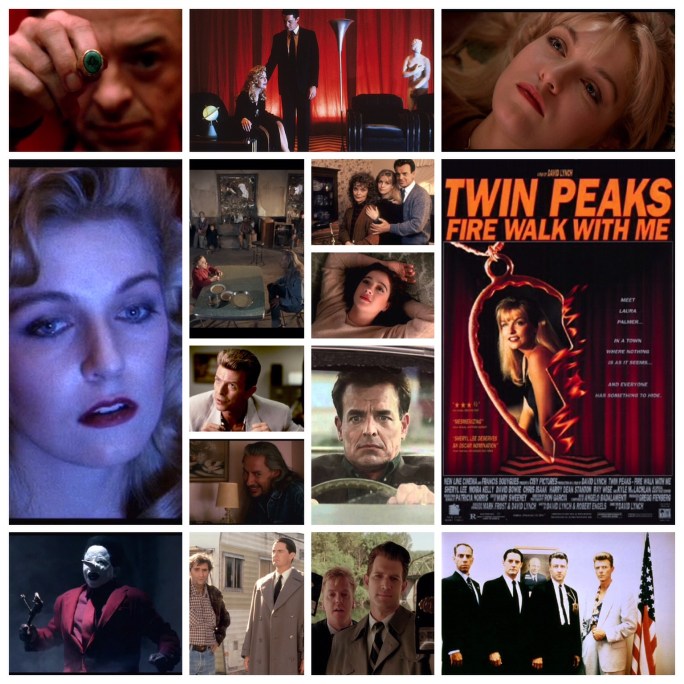
David Lynch’s big screen prequel/sequel to his television phenomenon Twin Peaks departs from the shows light, kooky and benignly eccentric sensibilities. It starts at the more surreal, dark atmosphere which sometimes materialized in the show, especially in the last episode, and plunges headlong down a rabbit hole of sex, murder, mysteries, federal agents, parallel universes, psychological torment, otherworldly spirits, supernatural phenomena, incest, more cups of coffee (Im not even kidding, there’s a scene where a stressed out looking Harry Dean Stanton makes a ‘cup of good morning America’), and above all, Laura Palmer. The beautiful, mysterious homecoming queen we only saw as a corpse in the series comes to wild, screaming life in this film, and what a performance from the gifted Sheryl Lee. She perfectly captures the menace, hurt, confusion, hope, torment and wild desperation of Laura, in a towering, stunning performance. Ray Wise is equally magnificent as Leland Palmer. Angelo Badalamenti switches up the tone as well, letting the beautiful Laura theme and the classic Twin Peaks tones only play in limited, selective fashion. His theme for the film is a powerfully dark, otherworldly melody which lulls you right into the film’s deep velvet grasp and haunts you in ways you can’t describe. The angel of the Roadhouse, Julee Cruise, gets another tune to croon as well, and it might just be my favourite of the bunch. Laura tearfully looks on as Cruise intones ‘Questions In A World Of Blue’, a transfixing lament that seems to be meant for her alone. Lynch is a true master of the subtle touch, and you’d have to read many an online forum as well as watch the film and the show several times to pick up on all the hidden implications and shrouded ideas that aren’t readily presented to you in a traditional narrative. That inaccessibility and refusal to play by the rules by serving things straight up is difficult for many people to get their heads around. To me though it’s such a fascinating way to tell a story. He doesn’t necessarily leave everything open to interpretation, he just hides the answers in a bewitching blanket of surreality, subtlety and dream logic, challenging the viewer to think using the unconscious mind and intuition to feel your way through the story, as opposed to tallying up facts and plot turns to analytically arrive at your cinematic destination. Perhaps this is why he meticulously oversees many of the DVD releases for his films, leaving out scene selections and unnecessary bells and whistles. The story matters most to him, in singular, unbroken form, a segment of his soul encapsulated on film in one cohesive effort, like a dream caught unawares by the lens. Fire Walk With Me was unfairly bashed, booed and downright critically clobbered for its stark and outright changes from the shows lighter tones, as well as its leaving out of some of the more popular characters that fans loved. Although this is jarring, I feel like Lynch has distilled all the elements in the show that mattered the most to him, and woven a gorgeous, seductive tapestry of pure Twin Peaks ‘feel’ and spectacle, as a loving gift to the fans who truly get it and are open to the wilder ideas explored briefly in the show. The film expands greatly on the ominous Black Lodge, and it’s dwelling spirits, including the strange Tremonds, the one armed Mike, and the little red suited Man From Another Place. The killer demon Bob is very prevalent in this film, and if you thought he was scary in the show, well.. His scenes in this are downright soul shatteringly. Moira Kelly makes a softer, doe eyed version of Donna Hayward, which I quite liked. Miguel Ferrer returns as the cynical wise-ass Albert, Lynch as the hard of hearing FBI boss Gordon Cole, as well as Heather Graham, Grace Zabriskie, Eric DaRe, Madchen Amick, Peggy Lipton, etc. Newcomers to the Twin Peaks mythology are great as well, including Chris Isaak and Kiefer Sutherland as more FBI agents investigating the case of Teresa Banks in Deer Meadow, Jurgen Prochnow as a trapped soul in the spirit world, and a confused looking David Bowie as an agent who has been mired in the time bending fog of the spirit world long enough to render him brain fried. It’s a love letter to the fans, really, but one that doesn’t compromise an inch and is every ounce a Lynch picture, capturing the director at his most creative adventurous. He strives to plumb the depths of human behaviour and the forces beyond our perceptions which govern and influence from other planes. Seeing these tricky themes explored so rawly in a film based upon a TV show that had heavy roots soap opera and an often lighthearted tone only garnished with the disturbing elements in the film can be hard to swallow, which is no doubt the reason for the sour reception upon release. The film has stood the test of time and aged wonderfully though, seen by many grateful, loving fans as a dark dream straight from the heart, and a perfect film. If one is willing to accept the changes in tone and ambiguous, challenging nature of Lynch’s storytelling (which I love!) then Fire Walk With Me is a sumptuous, gorgeous looking, vital piece of the Twin Peaks world, and in my mind Lynch’s masterpiece. 

TWIN PEAKS POWERCAST No. 4: AN INTERVIEW WITH JOHN NEFF

Blue Bob

When David Lynch set about making a home studio in the late 1990s, he liked the work studio engineer John Neff did in designing it so much that he hired him to run it.  Thus began a partnership that lasted over two albums, three films, a website and a one-off concert in Paris for the ages.  Nate and Tim had the pleasure of picking the talented and generous Mr. Neff’s brain for loads of anecdotes about working with Lynch, projects that almost came to pass, the origins of some of Lynch’s most challenging work, and more.  Truly a David Lynch insider, this is essential listening for any fan of this enigmatic genius.