THE LIFE AQUATIC WITH STEVE ZISSOU – A REVIEW BY J.D. LAFRANCE

the-life-aquatic-with-steve-zissou-1024x435

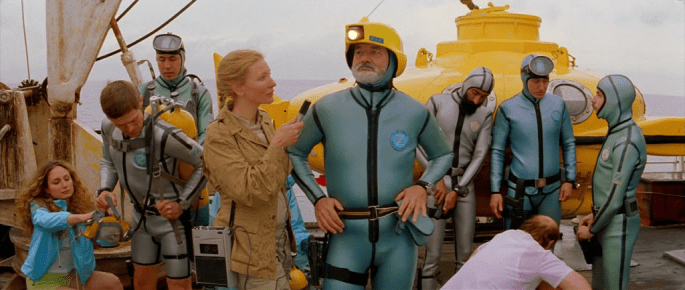
There’s always a certain amount of trepidation when a filmmaker like Wes Anderson, known for making intimate and personal films, starts making movies on a more ambitious scale – bigger budgets and movie stars in an attempt to appeal to a larger audience – that he will lose all of the qualities that made his movies so interesting in the first place. Easily his most accomplished film, The Life Aquatic with Steve Zissou (2004) merged his stylized dialogue and quirky characters with elaborate sets and action set pieces in an exotic locale.

After his best friend is eaten by a Jaguar shark, famed oceanographer Steve Zissou (Bill Murray) vows revenge. The problem is that the fish is endangered and he’s having trouble raising money for the expedition. He also meets Ned Plimpton (Owen Wilson) who may be his son by a woman he met 30 years ago. So, he convinces the young man to join his expedition in an attempt to make up for three decades of neglect.

Ever since Bottle Rocket (1996), Anderson’s movies feature a water motif in some form or another, whether it is Anthony and Inez’s first kiss in a swimming pool in Bottle Rocket or Max Fischer’s desire to build an aquarium in Rushmore (1998). With Life Aquatic, Anderson finally realizes his fascination with water head on by crafting an homage to Jacques Cousteau.

Life Aquatic also continues Anderson’s thematic pre-occupation with flawed father figures and their sons. There is the burnt out Mr. Blume and Max in Rushmore and Royal and his children in The Royal Tenenbaums (2001). In Life Aquatic, Steve tries to reconnect with Ned in the hopes that they will bond while hunting for the Jaguar shark. Like Blume and Royal, the world seems to have forgotten about Steve. He’s washed up and hit rock bottom now that his best friend has been killed.

The film also continues Anderson’s structuring of his movies into segments. In Rushmore, the story was broken down into months serving as acts in a play, with Tenenbaums, it was chapters as in a book and now with Life Aquatic it is days as Steve’s mission is being filmed for a new documentary. This structure reinforces the magical, almost-fairy tale feeling that Anderson creates in every one of his films by drawing attention to itself as a fanciful tale.

Bill Murray turns in another excellent, low-key performance as the melancholy Zissou. With his beard and gruff, macho attitude, Steve comes across as a Hemingway-esque figure with a dash of Cousteau. And yet, no matter how extravagant things get, Murray always keeps things grounded with his sparse performance. Over the course of his career, the comedian has been gradually refining his style of acting. He gained fame in broad comedies like Stripes (1981) and Ghostbusters (1984) but has fine-tuned his style to a less-is-more approach with movies like Rushmore and Lost in Translation (2003). His turn in Life Aquatic is just the right blend of comedy and pathos.

Most films don’t warrant much thought or discussion, but Anderson gets more and more interesting with each new effort. They are filled with so many fascinating little details crammed in each and every frame, repeated thematic motifs and minor characters who often wander in and out of the background of scenes. His movies are magical, existing in their own unique worlds and bursting with ideas that are almost too much to absorb in one sitting. As was the allure of David Lynch’s short-lived T.V. show, Twin Peaks, one of the appeals of Anderson’s films is that we want to be in these quirky worlds he creates and we want to know his characters. We want to lose ourselves in his universe and the beauty of DVD is that they allow us to revisit the worlds of his movies any time we want.

Anderson is not only more ambitious in terms of structure and scale but also with the visuals of Life Aquatic. Shot in Italy, he utilizes the striking landscape of the country for a sun-kissed warm color scheme of yellows and browns. There are also the striking images that linger long after the film ends: the glowing jellyfish on a beach at night and the stop-motion animated fish (by Nightmare Before Christmas’ Henry Selick) and portrays them so vividly and in an exciting way.

Anderson’s career had been building up to this film. With The Royal Tenenbaums, he was able to juggle a large cast of name stars while still maintaining his artistic integrity. With Life Aquatic, he continued to use stars but upped the ante in production values and scope. However, he did not lose the intimate feeling that all of his movies possess. No matter how ambitious or big the scale, his films have hand-crafted feel to them. One gets the feeling that Anderson cares about every detail and every aspect and it is this personal touch that makes his movies so unique.

Lulu On The Bridge: A Review by Nate Hill

image

Lulu On The Bridge is an odd one, and that’s a compliment. It subtly strains at the constrictions of genre until you realize just how unique it has gotten right under your nose. I’ve always thought of it as the Abel Ferrara fiom that he never made. Harvey Keitel delivers a home run of a lead performance as Izzy Maurer, a renowned jazz musician who loses his ability to play after he is shot by a lunatic gunman (Kevin Corrigan) while he is performing his music in a cafe. He sinks into a deep depression following the incident, and then something curious happens. One day he finds a mysterious stone, with a phone number attached to it and some seemingly mysterious qualities which alter the psyche, mood and perception of anyone in its vicinity. The phone number leads him to Celia Burns (the ever excellent and under estimated Mira Sorvino), an aspiring actress who’s fallen just south of the success line, and has a taste for Izzy’s music. The two seem destined to meet and as you might guess, begin a passionate love affair that begins to get a bit obsessive, with strong hints directed towards the stone that seems to govern will and volition. Their romance is hot, heavy and volatile, threatened when a mysterious man named Dr. Can Horn (a classy but dangerous Willem Dafoe) separately kidnaps them in attempt to retrieve the stone. The script deliberately shades over its true intentions until the very last minute, stopping to pick many dialogue and thematic flowers along the way, as well as leave a few red herrings behind. Gina Gershon is great as Izzy’s ex wife, and the monumantal supporting cast also includes Richard Edson, the great Victor Argo, Harold Perrineau, Mandy Patinkin, Vanessa Redgrave and a brief Lou Reed who is pricelessly credited as ‘Not Lou Reed’. If you snag a dvd you can also see deleted scenes work from Stockard Channing, Jared Harris, Josef Sommer and Giancarlo Esposito. The film attempts music, mystery, doomed love, urban mysticism, thriller and drama elements. I’m happy to report that it succeeds at all of them, a gem not unlike the mcguffin stone within the plot, and a haunting little modern fairy tale. Check it out.

Top Ten David Lynch Characters: A list by Nate Hill

The cinematic universe in which legendary director David Lynch has chosen to tell his stories is a yellow brick road which leads the way to a rabbit hole, wherein can be found dreams, nightmares, horror, love, spirits, small towns, psychological torment, offbeat humour, danger and endless gallons of hot black coffee. Within this mesmerizing realm lives a whole armada of strange and wonderful human beings, often with antennas extended out into both the metaphysical, the supernatural and the just plain undefinable. This makes them some of the most richly fascinating, deeply felt individuals to ever dance across our screens. If you have clicked on this post, you will see below a list of my personal top ten characters to have ever wandered out of the one of a kind mind of Mr. Lynch and been brought to life by the intuition, grace and startling gut instinct of many fine actors. Enjoy!
 
10. Marietta Fortune, played by Diane Ladd in Wild At Heart


Diane Ladd plays the ultimate mommy from hell in Lynch’s wacky, colourful romance road trip flick and livens the proceedings up no end with her mental instability, overprotective mania and frequent banshee screams that echo the terrifying melodrama of an exaggerated and psychotic Joan Crawford. Ladd rightly earned an Oscar nomination for her feral work, and one only needs to witness the unnerving sight of her sprawled across the bathroom floor with a liver full of martinis and a face smeared with crimson lipstick to appreciate the work funnelled into both the performance and direction to give us this horrific harpy.  

9. The Man From Another Place, played by Michael J. Anderson in Twin Peaks 
  

No other character solidifies Lynch’s pipeline to the collective subconscious like the red suited, inter-dimensional man of limited stature, a haunting presence who dances, speaks backwards and is always one step ahead of every fellow character and watching audience member who lays eyes on him. He serves as an image of what lays beyond, and no doubt an experimental choice for Lynch, one that would go on to become a token image of the television series, and his career as well. 

8. Bobby Peru, played by Willem Dafoe in Wild At Heart
  

The uniting forces of Willem Dafoe’s brand of creepiness morphed together with Lynch’s intuition for everything weird resulted in Bobby Peru, a disgusting psychotic whacko who only shows up in the last quarter of the film, yet dominates every frothy frame. Peru is a scary son of a bitch, and Dafoe lends every Joker grin, sallow grimace and harsh syllable he can muster in a very discomforting scene in which he abuses Laura Dern’s character to squirm inducing effect. This heinous outburst only makes the explosive end he meets all the more satisfying. A true Lynch monster, a Dafoe creation to remember and spin yarns about in years to come beside the cinematic campfire. 

7. Nikki Grace/Susan Blue, played by Laura Dern in Inland Empire
  

Dern turns the performance of her career in what is perhaps Lynch’s most peculiar film to date, a purposefully meta, altogether perplexing soul bender of a tale that revolves around two incredibly strong female characters, both played by her. There’s a galvanizing monologue buried within the heart of this dense saga that’s at once both a savage outcry and a self reflective summary to the character, Dern nailing every sharp turn of both that passage, and her work in the film as a whole. Lynch sat on Hollywood Boulevard with a cow and a sign advocating an Oscar nomination for her powerful work here, and upon viewing it it’s easy to see why. ‘A woman in trouble’ cries the DVD cover. Dern cries out into the dark and lets us know this character is exactly in that place, but her and Lynch lay out the breadcrumb trail in an ambiguous fashion that never really lets us in on the how and the why of said trouble. Such an achievement is pure collaboration, and worth every penny spent on the cow rental. 

6. Margaret Lanterman, aka The Log Lady, played by Catherine E. Coulson in Twin Peaks
  

The Log Lady is the symbolic lynchpin of Twin Peaks, a woman who lost her husband in a fire long ago, and quite literally carries a log around in memorial, speaking to it as if it were a person. Such a concept could be seen as silly, but in Lynch’s hands it simply is compelling. Coulson too treats it with reverence, giving her the undefined gravity that is a key ingredient in the Twin Peaks mystery and will be remembered by fans, loved by veterans and discovered by newcomers for eons.

5. Frank Booth, played by Dennis Hopper in Blue Velvet
  

The third scariest person on this list comes in the form of Booth, an oxygen loving, volatile kinkster played with primordial menace by a wild eyed Dennis Hopper. Booth took audiences by storm when Blue Velvet was released, showcasing a villain’s ability to completely shatter the idealistic and womblike notions of small town, old world bliss that came before him. He barges into the film and immediately flips the table as far as tone goes, catching everyone off guard with his criminal and very twisted antics. A true Pabst Blue villain and force of perverted nature that we won’t soon forget. 

4. BOB, played by Frank Silva in Twin Peaks
  

No demon has shivered the timbers of viewers quite like Killer Bob. He was a fluke, a lightning bolt of creative energy that Lynch channeled into what would become the scariest and strangest villain in his stable. A nightmarish and all too real apparition who feeds on rape, murder, fear, abuse and all the tools which reside within the darkest corners of humanity’s toolkit. Silva is a salivating horror, feeling his way through a performance that is rooted directly within the forces of undiscovered nature and firmly committed to scaring the pants off of us. 

 3. Mystery Man, played by Robert Blake in Lost Highway
  

Blake unsettles big time as a pasty faced, hollow laughed denizen who torments the protagonist at the most unexpected of moments and can’t help but utter a grinding giggle every time he can harvest an iota of confusion from his quarry. Whether the accusations against Blake in real life are true or not, the guy just has a corrosive vibe to his work and it kills me that he never got a chance to live out more years in cinema. This was one of his last two roles, and he’s the acrid soul of the piece, a snarling symbol of mental instability and otherworldly nastiness within the main character’s psyche.

2. Special Agent Dale Cooper, played by Kyle Maclachlan in Twin Peaks
  

Ahh, Dale Cooper. No one puts a big old smile on my face like him. In a career that has a whole bunch of lunatics and weirdos running amok, Lynch has given us the ultimate good guy, a comforting, likeable lawman with a keen sense of character and a deep love for both coffee and copious amounts of cherry pie. Maclachlan soars into pop culture legend with his winning smile, delightful idiosyncrasies and unyielding dedication to the law. 

1. Laura Palmer, played by Sheryl Lee in Twin Peaks
  

The battered angel, the homecoming queen, the beauty wrapped in plastic. No one represents both the decaying, corrupted human spirit and the same purity that wages war upon the sickness as well as Laura. When Twin Peaks was cancelled and Lynch launched plans for a big screen follow up, he stuck with the one element that made the show so special: Laura. Through hell, high water and every horror in between he stuck with Laura, turning the film into a final loving ode to her that would be seen by many as too much, and a stark deviation from the show. He was simply following through with the uneasy themes which mean so much to him, represented by the ultimate girl in trouble, whereby spiritual forces or simply the malfunction within humanity. Lee has never been better, serving as the rose within the centre of the dark bouquet of characters which Lynch  draws forth from his dreams. 

Walter Hill’s Streets Of Fire: A Review by Nate Hill

image

Walter Hill’s Streets Of Fire is just too good to be true, and yet it exists. It’s like the type of dream concept for a movie that you and your coolest friend think up after a bunch of beers and wish you had the time, money and resources to make yourself. It’s just cool right down to the bone, a beautiful little opus of 1950’s style gang trouble set to a so-good-it-hurts rock n’ roll soundtrack devised by the legendary Ry Cooper, Hill’s go to music maestro. It’s so 80’s it’s bursting at the seams with the stylistic notes of that decade, and both Hill and the actors stitch up those seams with all the soda jerk, greaser yowls and musical mania of the 50’s. Anyone reading up to this point who isn’t salivating right now and logging onto amazon to order a copy, well there’s just no hope for you. I only say that because for sooommeee reason upon release this one was a financial and critical dud, floundering at the box office and erasing any hope for the sequels which Hill had planned to do. I guess some people just aren’t cool enough to get it (can you tell I’m bitter? Lol). Anywho, there’s nothing quite like it and it deserves a dig up, Blu Ray transfer and many a revisit. In a nocturnal, neon flared part of a nameless town that looks a little like New York, the streets are humming with excitement as everyone prepares for the nightly musical extravaganza. Darling songstress Ellen Aim (young Diane Lane♡♡) is about to belt out an epic rock ballad in a warehouse dance hall for droves of screaming fans. There’s one fan who has plans to do more than just watch, though. Evil biker gang leader Raven Shaddock (Willem Dafoe, looking like Satan crossed with Richard Ramirez) kidnaps her as the last notes of her song drift away, his gang terrorizes the streets and disappears off into the night with poor Ellen as their prisoner. The locals need a hero to go up against Raven and rescue Ellen, and so estranged badass Tom Cody (Michael Paré) is called back to town after leaving years before. He’s a strong and silent hotshot who takes no shit from no one, and is soon on the rampage to Raven’s part of town. He’s got two buddies as well: two fisted, beer guzzling brawler chick McCoy (Amy Madigan), and sniveling event planner Billy Fish (Rick Moranis). That’s as much plot as you get and it’s all you need, a delightful dime store yarn with shades of The Outsiders and a soundtrack that will have your jaw drop two floors down. The two songs which Ellen sings are heart thumping legends. ‘Nowhere Fast’ gives us a huge glam-rock welcome into the story, and ‘Tonight Is What It Means To Be Young’ ushers us out with a monumental bang before the credits roll, and damn if Hill doesn’t know how to stage the two songs with rousing and much welcomed auditory excess that’ll have you humming for days. Paré is great as the brooding hero, and you won’t find too many solid roles like this in his career. He’s a guy who somewhat strayed off the path into questionable waters (he’s in like every Uwe Boll movie) but he pops up now and again I’m some cool stuff, like his scene stealing cameo in The Lincoln Lawyer. Dafoe clocks in right on time for his shift at the creepshow factory, giving Raven a glowering, makeup frosted grimace that’s purely vampiric and altogether unnerving. Him and Paré are great in their street side sledgehammer smackdown in the last act. Bottom line, this is one for the books and it still saddens me how unfavorably it was received… like what were they thinking? A gem in Hill’s career, and a solid pulse punding rock opera fable. Oh, and watch for both an obnoxious turn from Bill Paxton and a bizarre cameo from a homeless looking Ed Begley Jr.

Anamorph: A Mini Review by Nate Hill


Anamorph is a loving ode to the wilfully nasty serial killer flicks of the 90’s, obviously borrowing heavily from a few specific ones, the clearest example being Fincher’s Sev7n. It’s got the same dank, dispirited tone of that one, a restless urban nightmare wherein one lone detective searches for a heinous murderer that seems to elude him every step of the way, leaving increasingly grisly crimes in his wake. The detective here is Stan Aubrey (Willem Dafoe), a troubled fellow suffering from OCD, as if he didn’t have enough to handle, with a killer on the loose. Dusky New York streets are the predator’s playground, and he kills using some very elaborate, and very u settling techniques. Anamorphosis is a method used during times such as the Renaissance, where a painter would create a seemingly nonsensical sprawl with neither shape nor form, but when looked at through a tiny window of exposure (camera obscure), or from a painstakingly meticulous angle, a new image comes to light, in this case providing Dafoe with clues. Now this isn’t any Renaissance painter we’re dealing with, and he doesn’t use oil base, if you catch my drift. The crime scenes in this film are very, very horrifying and hard to watch, almost on the level of Sev7n. Dafoe gets help from his art fanatic buddy Blair (Peter Stormare), and tries to look after the troubled Sandy (a moody Clea Duvall), the relative of a deceased friend. There’s also work from Yul Vasquez, Scott Speedman, Don Harvey and the late James Rebhorn. Nasty stuff, this one, but stylish and well worth a late night watch with the lights low and your nerves on edge. 

The Boondock Saints: A Retrospective Review by Nate Hill

image

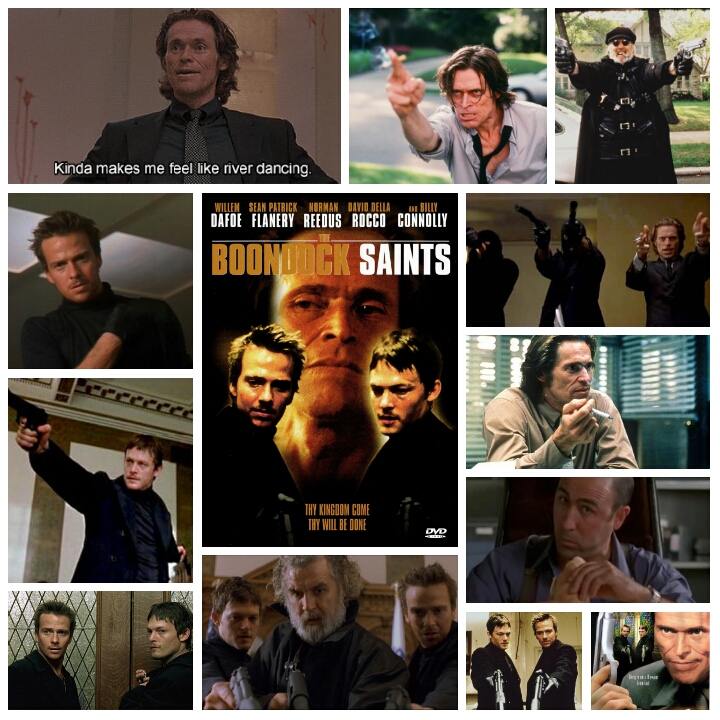
The Boondock Saints is an interesting movie for me, as it’s kind of evolved along with my consciousness as I’ve gotten older. Some films you initially dislike, yet they grow on you gradually until you see them in a new light. Some films you are crazy about right off the bat, yet over time the attraction dims and you realize you don’t really care for them anymore. And then there’s this one. While I can’t say I’ve grown to dislike it, because that’s just not the case, I will concede that as I’ve gotten older and new information on it has crossed my path, I’ve come to regard it in a new light. Also, the parts of my personality which went ape shit for anything pulpy and crime ridden back then have receded a bit as my tastes matured. But try as I might, I can’t bring myself to completely see it in a negative light, despite recognizing certain negative aspects of it which were once not so obvious to me. Saints is a tricky film because on the one hand you have the rabid fans who make up the cult following and have brought it the infamy it has today, as well as it’s sequel, which is really not that great. On the other hand you have the lofty monarchy of high film criticism, bashing it six ways to Sunday, the bad taste of it’s conception and production still on their tongues. Recently I watched the documentary Overnight (a biased film with its own glaring issues, but that’s another story), which chronicles the meteoric rise and fall of director Troy Duffy, who foolishly squandered a gift horse with immature and selfish behaviour, or at least that’s what the film shows. The film had the potential to be a big budget flick with huge stars involved and the backing of Weinstein. That never happened. Duffy’s ego swiftly sent the script into oblivion, until it finally got made years later for less than half the original offered budget, and landed in film purgatory before being squeaked into a meager distribution. A tragedy, say some. But.. is it though? Fate is a strange beast, and if everything went according to plan, we’d have a slick studio monster that might have been good, and no choppy, unique cult favourite to gain unprecedented momentum decades after its chaotic birth. Some food for thought. Anywho, on to the film. It’s low budget for sure and one can tell it’s made by a guy who’s never directed before, but it’s got a silly, cartoonish charm and cinematic flair for style that will keep you watching. Two rowdy Irish brothers named Connor (Sean Patrick Flanery) and Murphy (Norman Reedus) accidentally kill some scary russian mob soldiers in one of the most inventive scenes ever staged, and they discover they have a spiritual affinity for knocking off evil men. So, with no tactical experience whatsoever, they set out on a mission from God to end the lives of the Boston criminal underworld. Dragging their hapless, loveable buddy Rocco (David Della Rocco) along, its only a matter of time before the law tags them, and soon they have loony FBI honcho Paul Smecker after them. Willem Dafoe has to be seen to be believed in what is a career weirdest for him. He plays it like the Joker crossed with Bugs Bunny, never allowing an ounce of restraint or subtlety into the performance. I’d be interested to see the actor/director relationship which led to getting something this zany in the can. Smecker struggles morally, part of him believing the Saints to be a necessary force. They are faced with Italian mafia bosses including a scuzzy Ron Jeremy and Carlo Rota as Giuseppe ‘Pappa Joe’ Yakavetta, a ham fisted Don who wants the Saints gone. Rota is the only one who comes close to matching Dafoe’s maniacal energy, playing Yakavetta to unhinged, mustache twirling delight. Reedus and Flanery hold up their end with physicality and quite a lot of energy, making the McManus brothers two fun protagonists to hang around with. Billy Connolly shows up as Il Duce, an almost invincible assassin from hell who proves to be quite the obstacle for our boys. The concept for the film is relentlessly juvenile, and the action set pieces veer into silliness quite a bit and there’s a slapdash, haphazard feel to the whole thing, an unfinished varnish, or lack thereof to the whole process. It’s just such lurid, reckless fun though, filled with excessive profanity, comic book violence, laughable religious symbolism and deeply questionable morals that seem to have been penned by an eighth grader who’s just completed a John Woo and Charles Bronson marathon back to back. This is a movie that loves the fact that it’s a movie and acts accordingly, throwing everything it can get its hands on at you and yelling ” Look! Look how cool I am”. Is it cool? Up to you. It’s certainly one you won’t forget about. It almost ducks the ‘good film’ litmus test in the sense that you’d be wasting breath in claiming it’s a bad movie. It couldn’t care less about that, and the fans, of which I have to say I still am, seem not to either. It’s not really good, bad, terrible or anything. It’s just The Boondock Saints.

WILD AT HEART – A REVIEW BY J.D. LAFRANCE

12f6e7965cb2fbac31c874eb42335413By 1990, David Lynch was at the peak of his popularity and enjoying the most productive period of his career. His television show Twin Peaks had captivated American audiences and he was directing a number of commercials and performance art pieces (Industrial Symphony No. 1). This all culminated with Wild at Heart (1990), an adaptation of Barry Gifford’s novel, which went on to win the coveted Palme d’Or at that year’s Cannes Film Festival. It also helped establish Lynch as America’s premier cinematic surrealist. At its core, the film is a touching love story between two people whose love for each other remains constant despite all of the obstacles that life throws at them, including an overly-protective mother, a dentally-challenged psychopath, and a grizzled rocket scientist. This film is, oddly enough, Lynch at his most romantic, a rock ‘n’ roll opera with vibrant, fiery imagery.

Sailor Ripley (Nicolas Cage) and Lula Pace Fortune (Laura Dern) are young lovers on the run from her crazed and over-protective mother, Marietta (Diane Ladd). Sailor has jumped parole after serving time for manslaughter and takes off with Lula for sunny California. This doesn’t sit too well with Lula’s mom who sends her boyfriend and private investigator Johnny Farragut (Harry Dean Stanton), and, unbeknownst to him, her lover and ruthless gangster Marcellos Santos (J.E. Freeman) on the trail of the young lovers.

As he would do with the opening scene in Twin Peaks: Fire Walk With Me (1992), Lynch kicks things off with a shockingly brutal act of violence that establishes a confrontational tone – this is a violent world where Sailor is prepared to kill a man with his bare hands in order to protect the woman he loves. The first image is the striking of a match followed by images of flames announcing the color scheme that would be prevalent throughout the film. This is continued in the love scenes between Sailor and Lula that are bathed in red, yellow and orange – all representing their burning love for each other. During the course of the film there are countless shots of cigarettes being lit, matches being struck, an exploding car, and a house on fire. This film is vibrantly alive and energized more than anything Lynch had done before or has done since.

In the summer of 1989, Lynch had finished up the pilot for Twin Peaks and tried to rescue two of his projects – Ronnie Rocket and One Saliva Bubble – that were owned by Dino de Laurentiis when his company went bankrupt. Independent production company Propaganda Films commissioned Lynch to develop an updated noir screenplay based on a 1940s crime novel while a filmmaking friend of his by the name of Monty Montgomery optioned Barry Gifford’s book, Wild at Heart: The Story of Sailor and Lula in pre-published galley form. Montgomery gave him Gifford’s book and asked Lynch if he would executive produce a film adaptation that he would direct. Lynch remembers telling him, “That’s great Monty, but what if I read it and fall in love with it and want to do it myself?” And this is exactly what happened as Lynch recalls, “It was just exactly the right thing at the right time. The book and the violence in America merged in my mind and many different things happened.” Lynch was drawn to what he saw as “a really modern romance in a violent world – a picture about finding love in hell.” He was also attracted to “a certain amount of fear in the picture, as well as things to dream about. So it seems truthful in some way.”

Once Lynch got the okay from Propaganda to switch projects, he wrote a draft in a week. Within four months, he began filming with a budget of $10 million. Lynch did not like the ending in Gifford’s book where Sailor and Lula split up for good. For Lynch, “it honestly didn’t seem real, considering the way they felt about each other. It didn’t seem one bit real! It had a certain coolness, but I couldn’t see it.” Samuel Goldwyn, who ended up distributing the film, read an early draft of the screenplay and didn’t like Gifford’s ending either so Lynch changed it. However, the director was worried that this change made the film too commercial, “much more commercial to make a happy ending yet, if I had not changed it, so that people wouldn’t say I was trying to be commercial, I would have been untrue to what the material was saying.”

When Lynch read Gifford’s novel, he immediately wanted Nicolas Cage to play Sailor and Laura Dern to play Lula. The actor said that he was “always attracted to those passionate, almost unbridled romantic characters, and Sailor had that more than any other role I’d played.” In Dern’s case, this was the first opportunity she had “to play not only a very sexual person, but also someone who also was, in her own way, incredibly comfortable with herself.” During rehearsals, Lynch talked about Elvis Presley and Marilyn Monroe with Cage and Dern. Around this time, Lynch bought a copy of Elvis’ Golden Hits and, after listening to it, called Cage and told him that he had to sing two songs, “Love Me” and “Love Me Tender.” The actor, a big Elvis fan, agreed and recorded each song so that he could lip-sync to them on the set.

Before filming started, Lynch suggested that Dern and Cage go on a weekend road trip to Las Vegas in order to bond. Dern remembers, “We agreed that Sailor and Lula needed to be one person, one character, and we would each share it. I got the sexual, wild, Marilyn, gum-chewing fantasy, female side; Nick’s got the snakeskin, Elvis, raw, combustible, masculine side.”

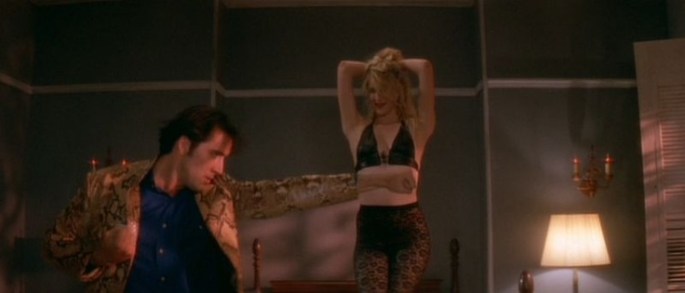
Lynch’s two leads are also on the same page in this respect, especially Cage who affects an Elvis Presley-like drawl and sings two songs made famous by the King. Sailor, like many of the characters in this film, is larger than life with his snakeskin jacket credo, his unorthodox style of dancing (involving martial arts kicks and punches) and his habit of singing Elvis songs to Lula in public. There is a show-stopping moment where he instructs Powermad, a speed metal band, to back him on a note perfect rendition of “Love Me” while the women in the audience scream in adoration in surreal slow motion like something out of a dream. Cage plays Sailor as an instantly iconic figure, where pointing an accusing finger at Marietta is akin to a declaration of war.

Dern plays Lula to gum-chewing perfection, delivering a completely uninhibited performance as Lula. She exudes a captivating sensuality in the way she carries herself and makes a line like, “You got me hotter’n Georgia asphalt,” sound like an enticing come-on. Lula is a young woman full of energy and vitality as is evident in the scene where she and Sailor dance to the music of Powermad. There is genuine chemistry and heat between her and Cage — rather appropriate for a film dominated by images of fire. However, as the film progresses and the tone becomes darker, Lula’s optimism is chipped away and this culminates in a terrifying scene where Bobby Peru (Willem Dafoe) verbally rapes her in a way that echoes a similar scene in Blue Velvet (1986).

Amidst all of this madness and brutality is a touching tenderness between Sailor and Lula, like the way he softly kisses her after a passionate bout of sex, or a moment where he places her hand over his heart without a word. Nothing needs to be said between them because they understand each other intimately. As she tells him at one point, “You mark me the deepest.” And Lynch takes the time to show a series of conversations between Sailor and Lula where they talk about their respective childhoods (“I didn’t have much parental guidance.” Sailor tells her, not surprisingly.), their dreams, random thoughts, and past relationships. This allows us to get to know and care about them while also taking the occasional breather from all of the weirdness that Lynch throws our way.

Diane Ladd is fantastic as the wicked witch cum mother-from-hell, gleefully chewing up the scenery as evident even in the way she vigorously drinks from her martini glass and the way she delivers threats to Sailor with venomous gusto. Also prevalent is Lynch’s trademark fascination with the dark underbelly of America as personified by the character of Bobby Peru, one of Lynch’s most disturbing psychopaths (right behind Blue Velvet’s Frank Booth). With his horrible teeth and all-black attire (to match his pitch black heart), Peru sets his sights on Sailor and Lula with the intention of killing the former and seducing the latter.

Lynch juxtaposes this darkness with his trademark absurdist humor in the guise of the various oddballs Sailor and Lula meet along the way, like the man at a bar (Freddie Jones) who talks about “pigeon-spread diseases” in a goofy, high-pitched, sped-up voice. Or, Lula’s wildly eccentric cousin, Jingle Dell (Crispin Glover in a memorably bizarre cameo), who believes aliens are after him, enjoys placing cockroaches in his underwear and exhibits odd, nocturnal behavior (“I’m making my lunch!”). There is also a memorable scene that introduces Bobby Peru and his friends, including Lynch regular, Jack Nance in a scene-stealing role as Boozy Spool, a dazed and confused rocket scientist who may have been sampling his own rocket fuel. He delivers a brilliantly surreal monologue that is amongst some of the best moments in any Lynch film and reminiscent of the joyride interlude at Ben’s in Blue Velvet.

Wild at Heart
also features stunning cinematography by Frederick Elmes (who also worked with Lynch on Eraserhead and Blue Velvet). In particular, there is a scene where Lula and Sailor pull over to the side of the road as she is upset and disgusted with all of the terrible news that she’s heard on the radio. He finds Powermad on a station and they get out of the car and dance before embracing passionately. Lynch cuts to a long shot and pans away to a gorgeous shot of a sunset that captures the poetic beauty of this moment perfectly.

Wild at Heart
is a film rich in emotion and feeling as everything is heightened to an operatic level. Surreal is an adjective always used to describe Lynch but he is also a very romantic filmmaker. There is the Douglas Sirkian melodrama of Blue Velvet, the emotional journey Alvin Straight takes in order to reconnect with his brother in The Straight Story (1999), and the town of Twin Peaks dealing with the grief over the death of Laura Palmer. Perhaps the most emotional scene in Wild at Heart is when Sailor and Lula drive along a deserted stretch of highway late and night and while an instrumental version of “Wicked Game” by Chris Isaak plays on the soundtrack, he tells her about how he knew her dead father. The reaction she gives is so heartbreaking, like a daughter who realizes that her father isn’t perfect.

Sailor, in some ways, is a father figure to her. He makes her feel protected and she even comments on how some of his physical features resemble her dad’s. This scene represents the first seed of doubt in their relationship. It is the first step off the yellow brick road and this is reinforced by Lula’s nightmarish vision of her mother as the Wicked Witch. And then they come across a horrible car accident and find one person still alive – a woman (Sherilyn Fenn) walking around in shock from a head wound. She eventually dies in Sailor and Lula’s arms. It is a tragic moment accentuated beautifully by Angelo Badalamenti’s moving score. This scene is a crucial turning point in the film as it descends into much darker territory as Sailor and Lula make a series of bad decisions, most notably getting involved with Bobby Peru.

Lynch loved The Wizard of Oz and put a lot of references to it in his own film. Boozy Spool talks about his dog, comparing it to Dorothy’s pooch Toto; Marietta’s picture disappears at the end of the film just like the Wicked Witch; there’s Lula’s vision of her mother as the Wicked Witch of the East; Sailor has a vision of the Good Witch (Sheryl Lee) at the end of the film, who convinces him not give up on love; and Lula clicking the heels of her shoes together after the terrifying encounter with Bobby Peru.

Early test screenings for the film did not go well with the intense violence in some scenes being too much. Lynch estimated that between 100-120 people walked out. The scene in question was the torture and killing of Johnny Farragut. “I didn’t think I’d pushed it to the point where people would turn on the picture. But, looking back, I think it was pretty close. But that was part of what Wild at Heart was about: really insane and sick and twisted stuff going on.” Lynch decided not to edit anything from the film and at the second screening another one hundred people walked out during the same scene. Lynch remembers, “By then, I knew the scene was killing the film. So I cut it to the degree that it was powerful but didn´t send people running from the theatre.”

The film was completed one day before its premiere at the 1990 Cannes Film Festival. Its first screening was in the 2,400-seat Grand Auditorium and afterwards it received “wild cheering” from the audience. Barry Gifford remembers that there was a prevailing mood among the media that hoped Lynch would fail. “All kinds of journalists were trying to cause controversy and have me say something like ‘This is nothing like the book’ or ‘He ruined my book.’ I think everybody from Time magazine to What’s On In London was disappointed when I said ‘This is fantastic. This is wonderful. It’s like a big, dark, musical comedy.’” When Jury President Bernardo Bertolucci announced Wild at Heart as the Palme d’Or winner at the awards ceremony, the boos almost drowned out the cheers with film critic Roger Ebert leading the vocal detractors.

Wild at Heart
perfectly illustrates Lynch’s love-hate relationship with America. The film is filled with beautifully shot iconography of Americana, like big convertible automobiles from the ‘50s and rock ‘n’ roll music from the period. Sailor and Lula are loving (albeit tweaked) homages to Elvis Presley and Marilyn Monroe. It is also something of an underrated film that is often ignored in favor of Lynch’s more well-known work, like Blue Velvet or Mulholland Drive (2001). One can see the film’s influence in a film like True Romance (1993), with its Elvis-obsessed protagonist and his gum-chewing white trash girlfriend as they are pursued by psychotic gangsters, or Natural Born Killers (1994) with its white trash lovers on the run, or even U-Turn (1997) with its town full of eccentric weirdoes. But no one can pull this stuff off quite like Lynch and his film is a true original that deserves to be re-discovered and re-evaluated.
PTS Presents Cinematographer’s Corner with KEN KELSCH Vol. 1

KELSCH POWERCAST

kelsch ferraraPodcasting Them Softly is honored to add Ken Kelsch, as the latest cinematographer to our series, Cinematographer’s Corner. Ken’s work helped shape my love for film with his frequent partnership with one of my absolute favorite filmmakers, Abel Ferrara. They have worked together on twelve films, starting with their first feature THE DRILLER KILLER, BAD LIEUTENANT, DANGEROUS GAME, THE ADDICTION, THE FUNERAL (which he was nominated for best cinematographer at the Independent Spirit Awards), Abel Ferrara’s segment in SUBWAY STORIES, THE BLACKOUT, R-XMAS, THE NEW ROSE HOTEL, CHELSEA ON THE ROCKS, 4:44 LAST DAY OF EARTH, and finally one of the very best films from last year, WELCOME TO NEW YORK. Ken has also collaborated with Stanley Tucci’s directorial efforts, THE BIG NIGHT and THE IMPOSTORS. Ken has shot the first two seasons of the television show, MEDIUM and friend of Podcasting Them Softly’s latest feature film, Eric Red’s 100 FEET.